
A complete issue · 16 pages · 1887
Life — July 28, 1887
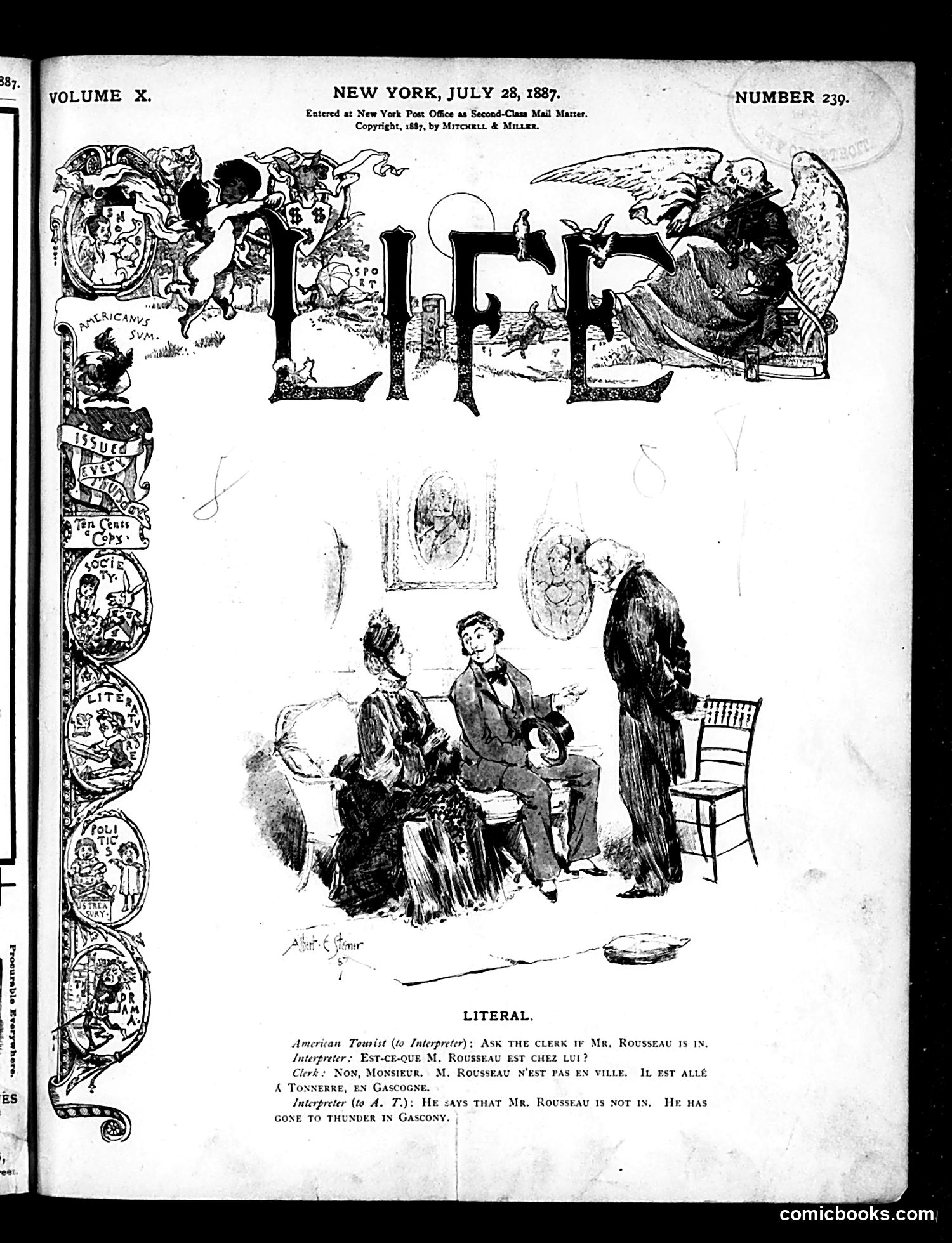
The main cartoon titled "LITERAL" depicts a comedic misunderstanding involving a French tourist (labeled "American Tourist") and a hotel clerk. The tourist asks if "Mr. Rousseau" is in. The clerk responds that Rousseau is not in the city—he has gone to "Thunder in Gascony." The interpreter mistranslates this as Rousseau going to "Thunder," when the clerk meant Tonnerre, a town in Gascony, France. The satire mocks the absurdity of literal translation and the confusion arising from language barriers. The joke plays on the humor of a foreign visitor taking a French place name too literally, creating an absurd mental image. This reflects 19th-century American attitudes toward European travel and foreign language mishaps.
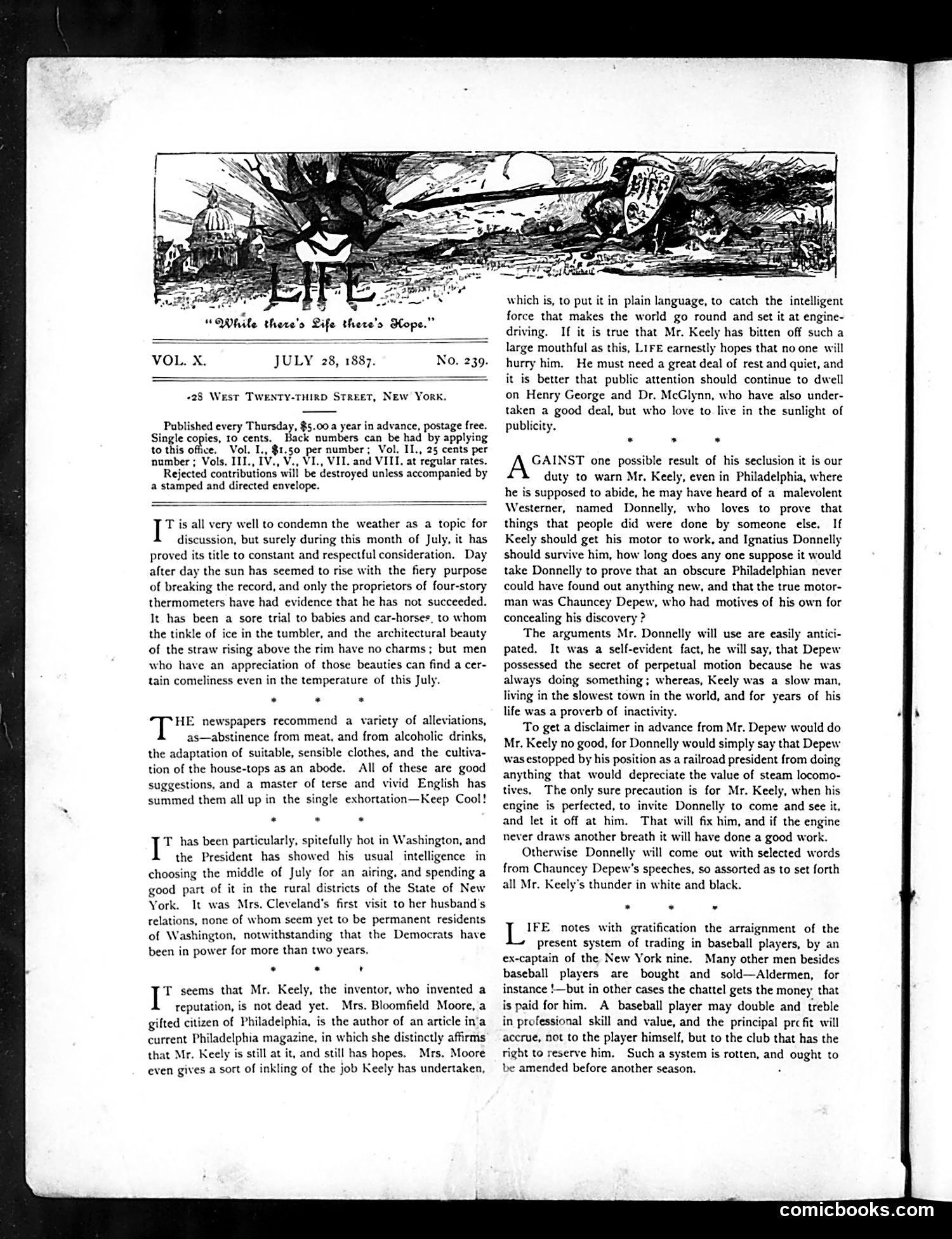
**The Cartoon:** The heading "While there's Life there's Hope" accompanies an illustration of a grim reaper or death figure looming over a landscape. This appears to be a visual pun playing on the magazine's own name ("Life") as a counterpoint to death—suggesting that as long as Life magazine exists, there remains hope, likely for social reform or progress. **The Editorial Content:** The page discusses Mr. Keely, an inventor with a claimed "perpetual motion" engine. The text suggests skepticism about his invention while noting that Mrs. Bloomfield Moore (a "gifted citizen of Philadelphia") continues to support him despite apparent lack of progress. The piece satirizes both Keely's dubious claims and the continued public interest in his project.
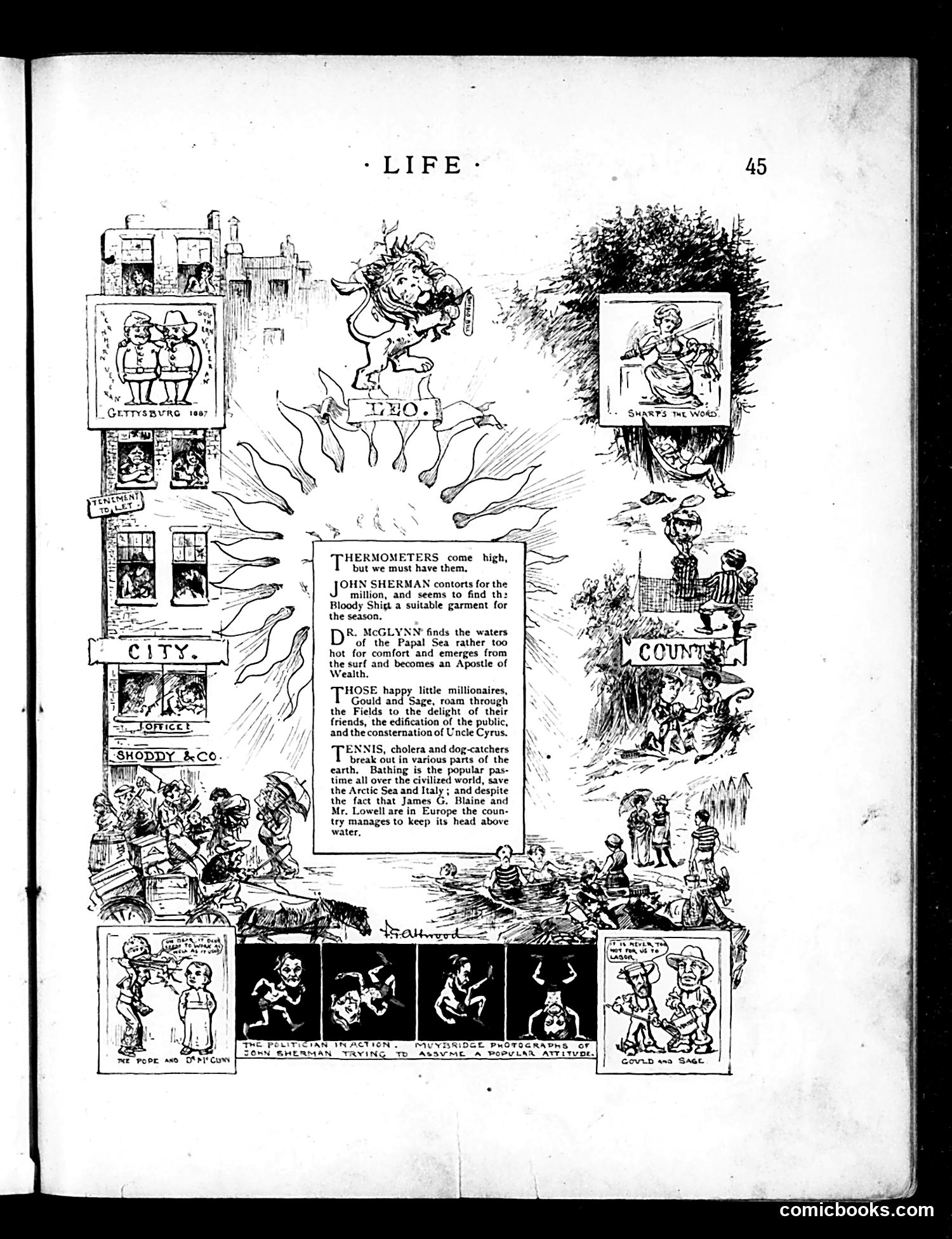
This satirical page contrasts urban and rural American life circa early 1900s. The left column depicts "CITY" life as crowded, commercial, and chaotic—featuring "SHODDY & CO." and stacked tenements with people crammed together. The right shows idealized "COUNTRY" life with spacious, pastoral scenes. The central text mocks current summer trends: wealthy New Yorkers like John Sherman seeking appropriate clothing, and Dr. McGlynn finding relief in water. The commentary suggests millionaires visiting rural areas, while common people enjoy simple country pleasures like bathing and tennis. Bottom panels appear to show recreational activities and social behavior contrasts. The overall satire critiques the artificiality of city life and the wealthy's superficial appropriation of rural leisure, while celebrating authentic country living.
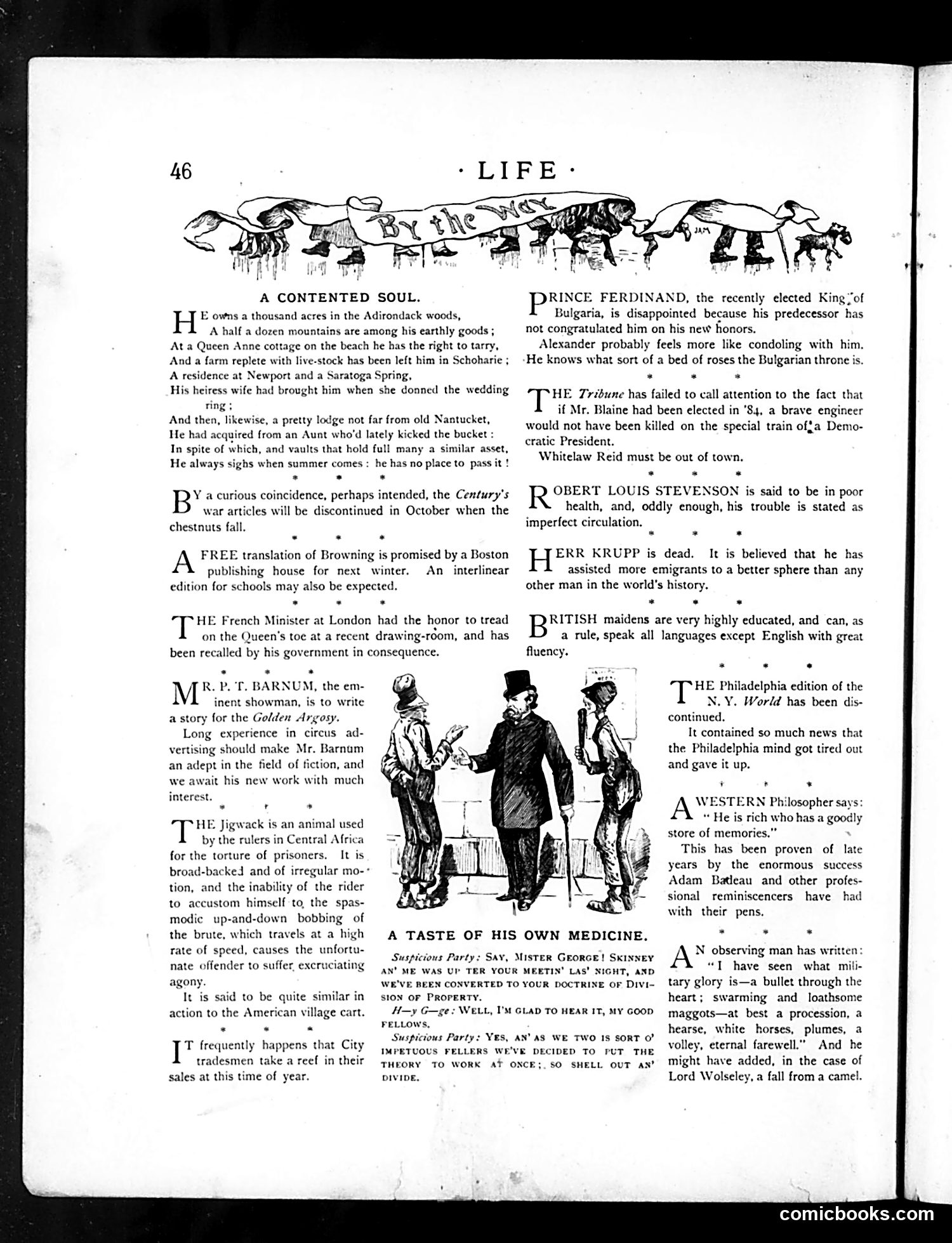
This page contains brief satirical news items rather than political cartoons. Key references include: **"A Taste of His Own Medicine"** (center illustration): Shows what appears to be a clergy member administering medicine to two women. The caption references "Suspicious Party" dialogue about converting someone to a doctrine or dividing property—likely mocking religious hypocrisy or opportunistic clergy. Other items mention: - **Prince Ferdinand of Bulgaria** being disappointed his predecessor didn't congratulate him - **Whitelaw Reid** being out of town - **Robert Louis Stevenson** having circulation problems - British women's education and language abilities - A discontinued Philadelphia newspaper edition The humor relies on contemporary political/social figures and events recognizable to 1890s readers but now obscure without additional context.
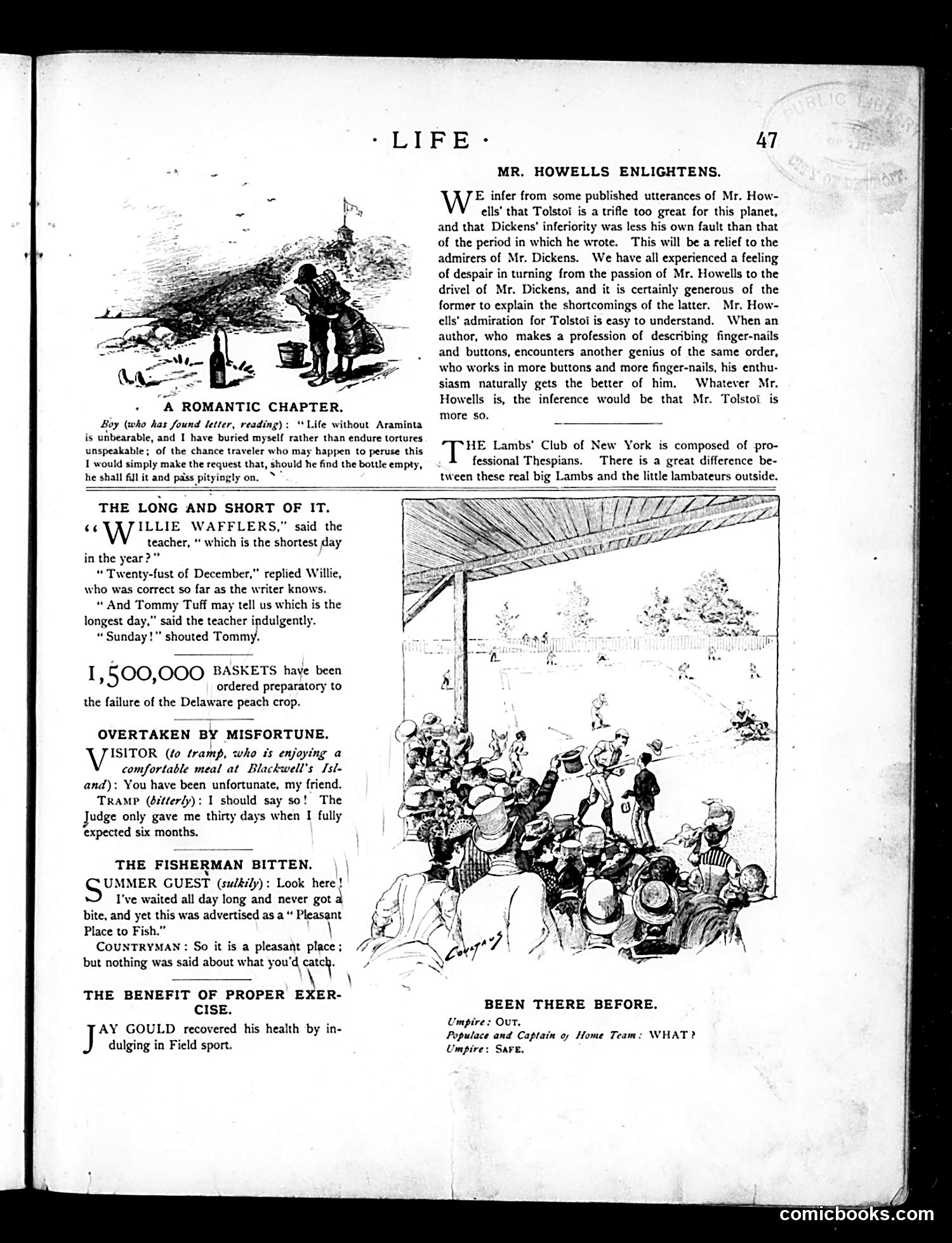
This page contains several short humorous anecdotes and one illustrated cartoon rather than political commentary. **"A Romantic Chapter"** features a sketch of a young man (labeled "Boy") declaring he'd rather die than endure torture—establishing romantic melodrama for satire. **"The Long and Short of It"** presents a teacher's joke about which is the shortest day (December 21st) versus longest day (Sunday). **The main cartoon** depicts a crowded scene under a pavilion or shelter, labeled "Been There Before." It appears to satirize overcrowding at some public venue or event, with an Empire umpire making a joke about the Palace and Captain's familiarity with the location. Other brief items mock Howells vs. Dickens, discuss a Lambs' Club, and include puns about fishing and exercise. This is primarily **light entertainment humor**, not political satire.
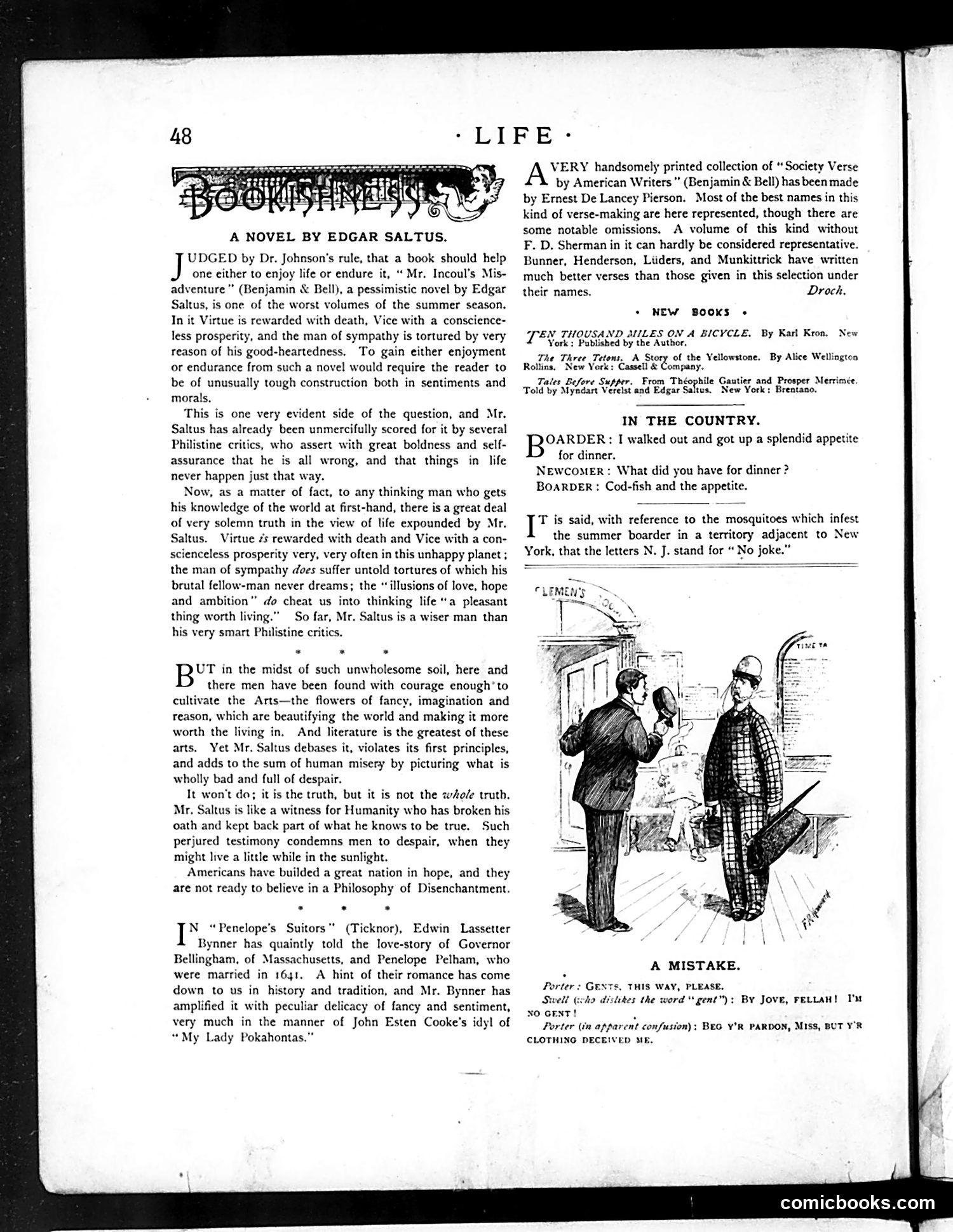
This single-panel cartoon depicts two men on a street, labeled "A Mistake." The dialogue reads: **Porter:** "Gents, this way, please. [Swells] dislike the word 'gent'): By Jove, fellow! I'm no gent!" **Porter** (in apparent confusion): "Beg y'r pardon, miss, but y'r clothing received me." The satire targets class pretension and social awkwardness. A porter misidentifies a man as a woman based on his clothing, then compounds the error by calling him "miss" while apologizing. The joke relies on the premise that the man's attire is ambiguous or oddly feminine—mocking either Victorian fashion sensibilities or the man's attempt to appear genteel. It's essentially humor about failed social codes and mistaken identity based on appearance.
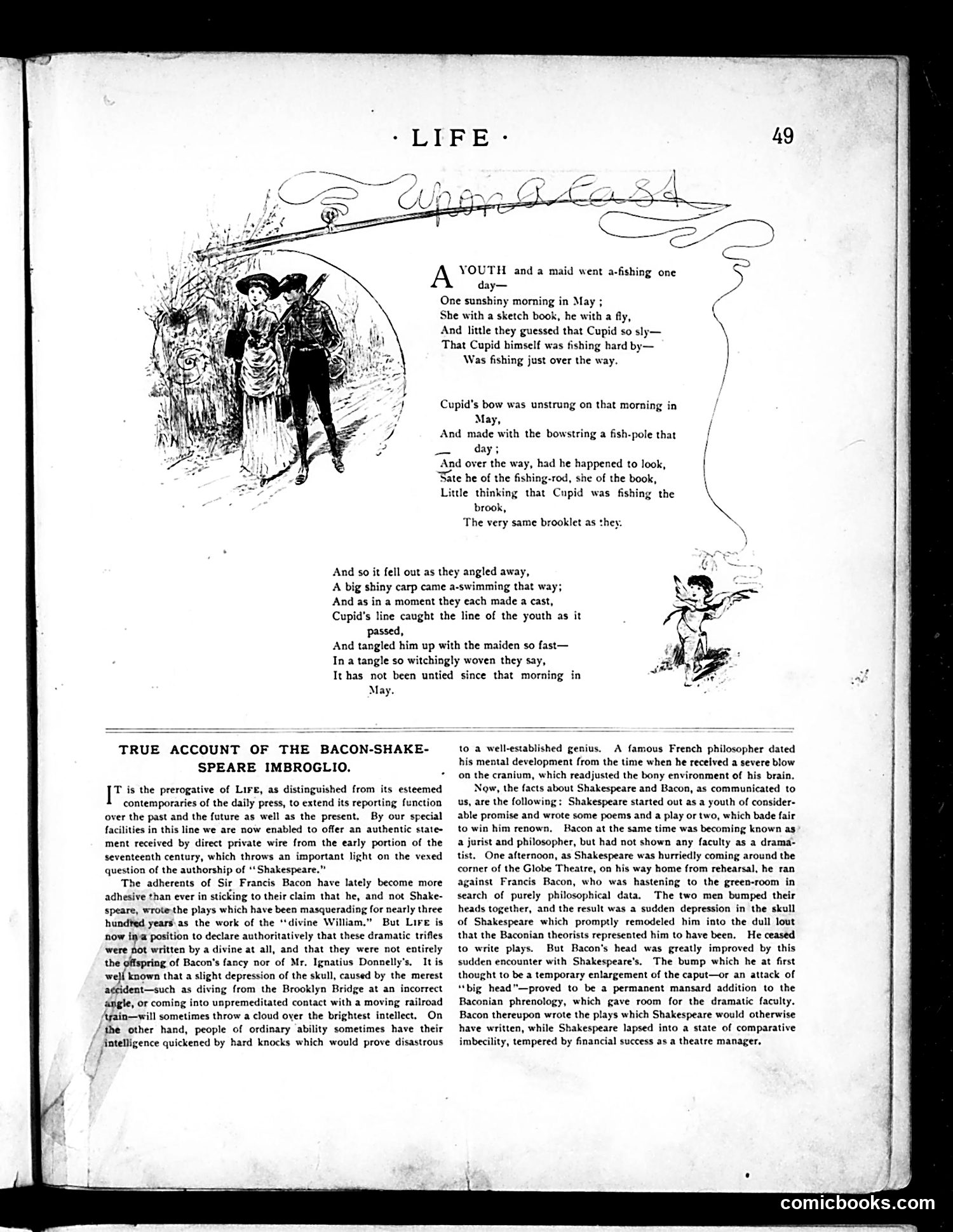
**Main Content:** The page features a whimsical poem titled "Cupid's Cast" about a youth and maid who go fishing and accidentally tangle Cupid's fishing line with theirs, resulting in romantic entanglement. This is lighthearted romantic humor with period illustrations of young people and a cherub. **Lower Section:** A serious article titled "True Account of the Bacon-Shakespeare Imbroglio" satirizes the scholarly debate over Shakespeare's authorship. It mocks the theory that Francis Bacon wrote Shakespeare's works, attributing this claim to Bacon's mental injury from a cranium blow. The satire ridicules both the Baconian theorists and Shakespeare's later theatrical mediocrity, suggesting financial success corrupted his artistic integrity. The juxtaposition creates contrasting tones: romantic levity above, intellectual mockery below.
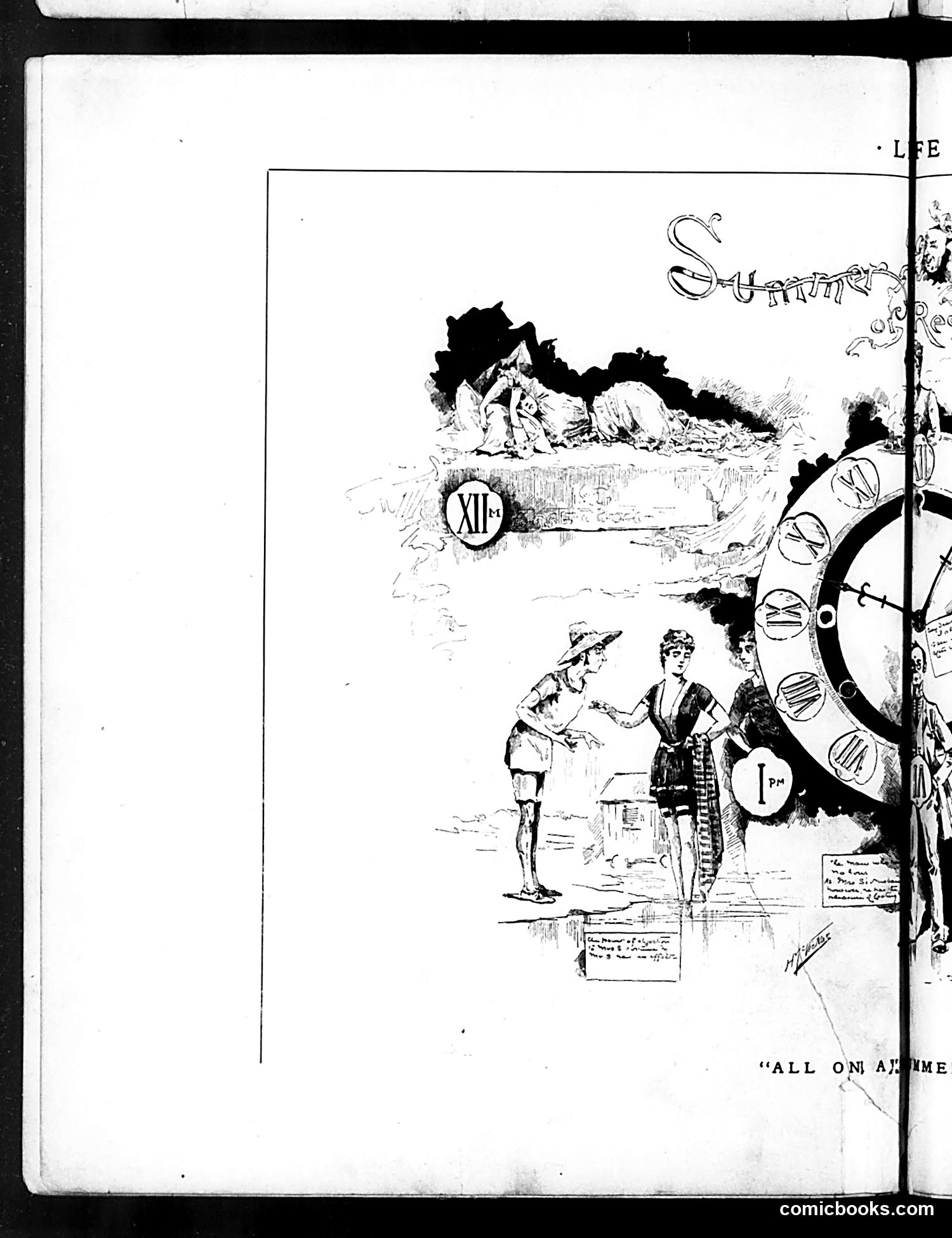
This is a "Summer" section opener from Life magazine featuring a beach scene illustration. The drawing shows two figures in summer attire on a beach with rocky outcroppings in the background. A large decorative dial or wheel appears on the right side, marked with Roman numerals and horizontal lines, suggesting a measurement device or index. The incomplete caption at bottom reads "ALL ON A SUMME[R]," but without seeing the full text, the specific satirical point is unclear. The illustration style is typical of early 20th-century Life magazine—elegant line drawing with selective black shading. The content appears to be introductory artwork for the magazine's summer-themed section rather than a political cartoon, though the exact joke or reference remains uncertain from this partial page view.
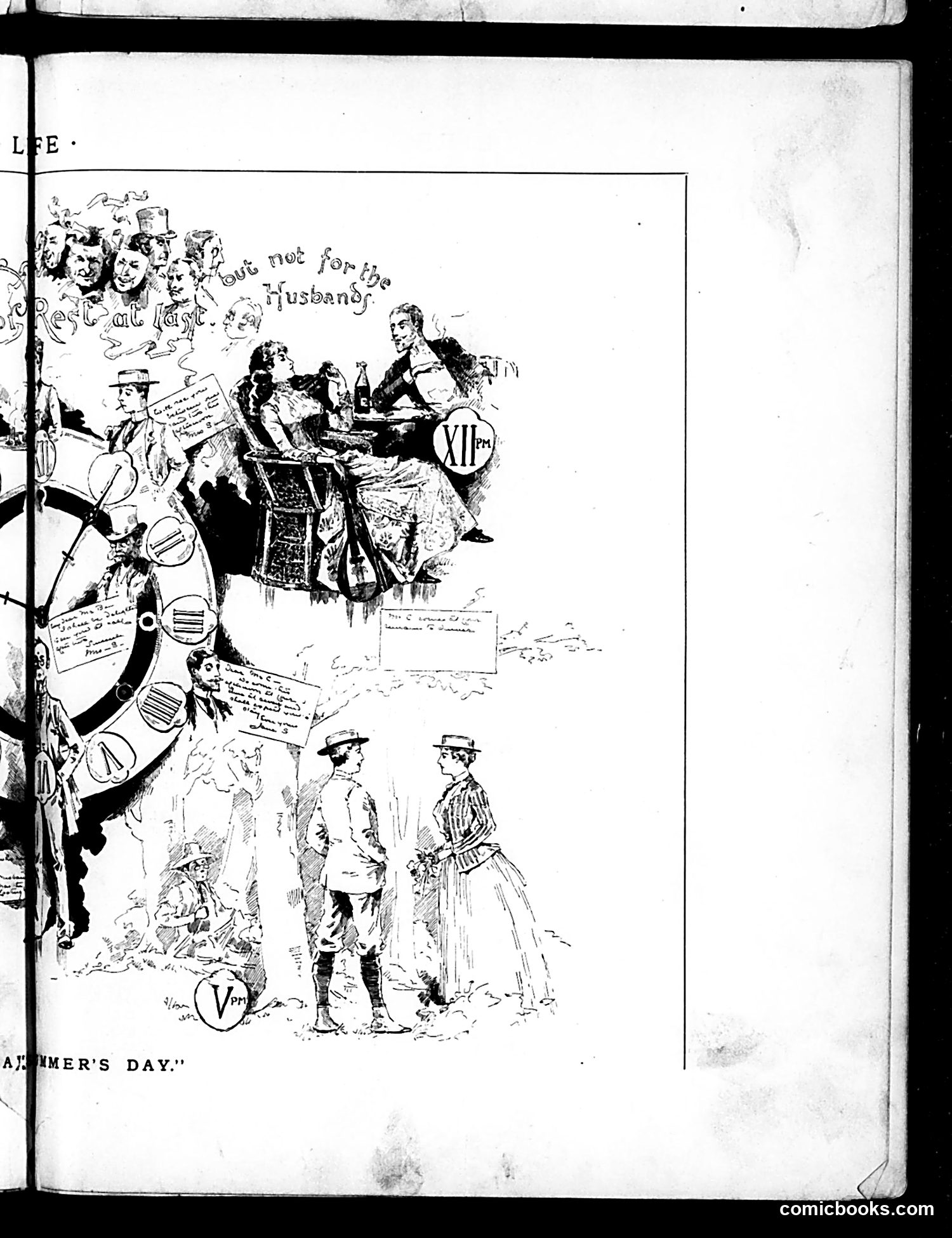
This Life magazine page presents a satirical cartoon titled "A Summer's Day" (or possibly "'A Summer's Day'"). The illustration is divided into two main scenes: The upper scene (labeled "XII") depicts an indoor domestic setting where a couple dines together, with the caption "but not for the Husband" — suggesting marital discord or the wife's complaint about her spouse. The lower scene (labeled "V") shows two men in casual outdoor attire, appearing to be soldiers or working-class men in a rural setting. The left side contains decorative circular vignettes with additional figures and text, though details are difficult to discern clearly in this reproduction. The overall tone appears to mock domestic relationships or gender relations of the era, likely from the early 20th century based on the artistic style and clothing depicted.
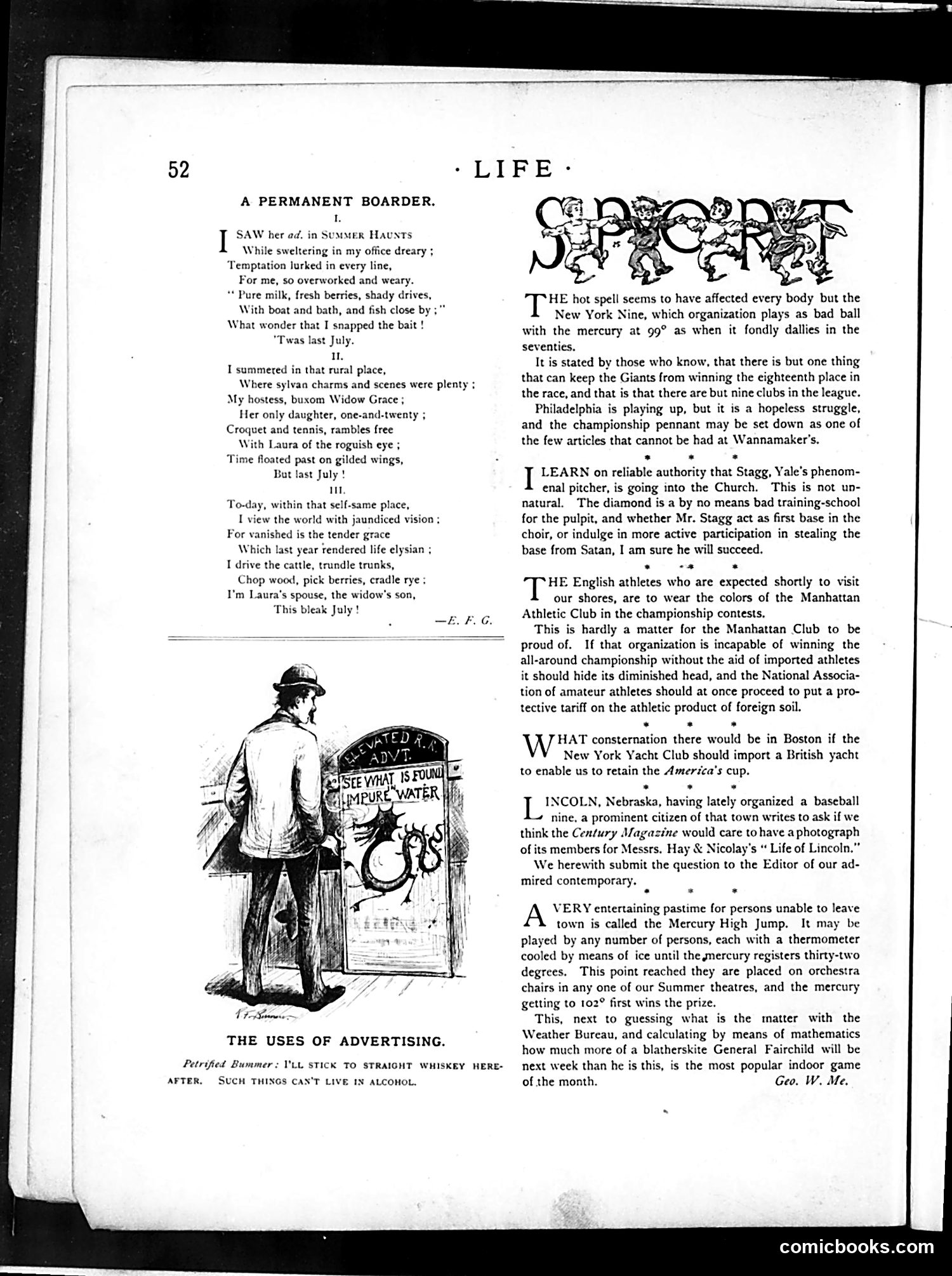
This cartoon depicts a man reading a poster advertising "Elevated R.R." (elevated railway) mineral water. The joke plays on false advertising claims: the poster promises the water will keep you elevated and healthy, but the man appears skeptical or weary—suggesting the product doesn't deliver as advertised. The caption's punchline ("I'll stick to straight whiskey hereafter. Such things can't live in alcohol") mocks how dubious patent medicines and mineral water ads made exaggerated health claims that couldn't survive scrutiny. The satire targets the proliferation of misleading advertisements in the era, suggesting alcohol-based tonics were more honest about their actual effects than seemingly medicinal products making impossible promises.
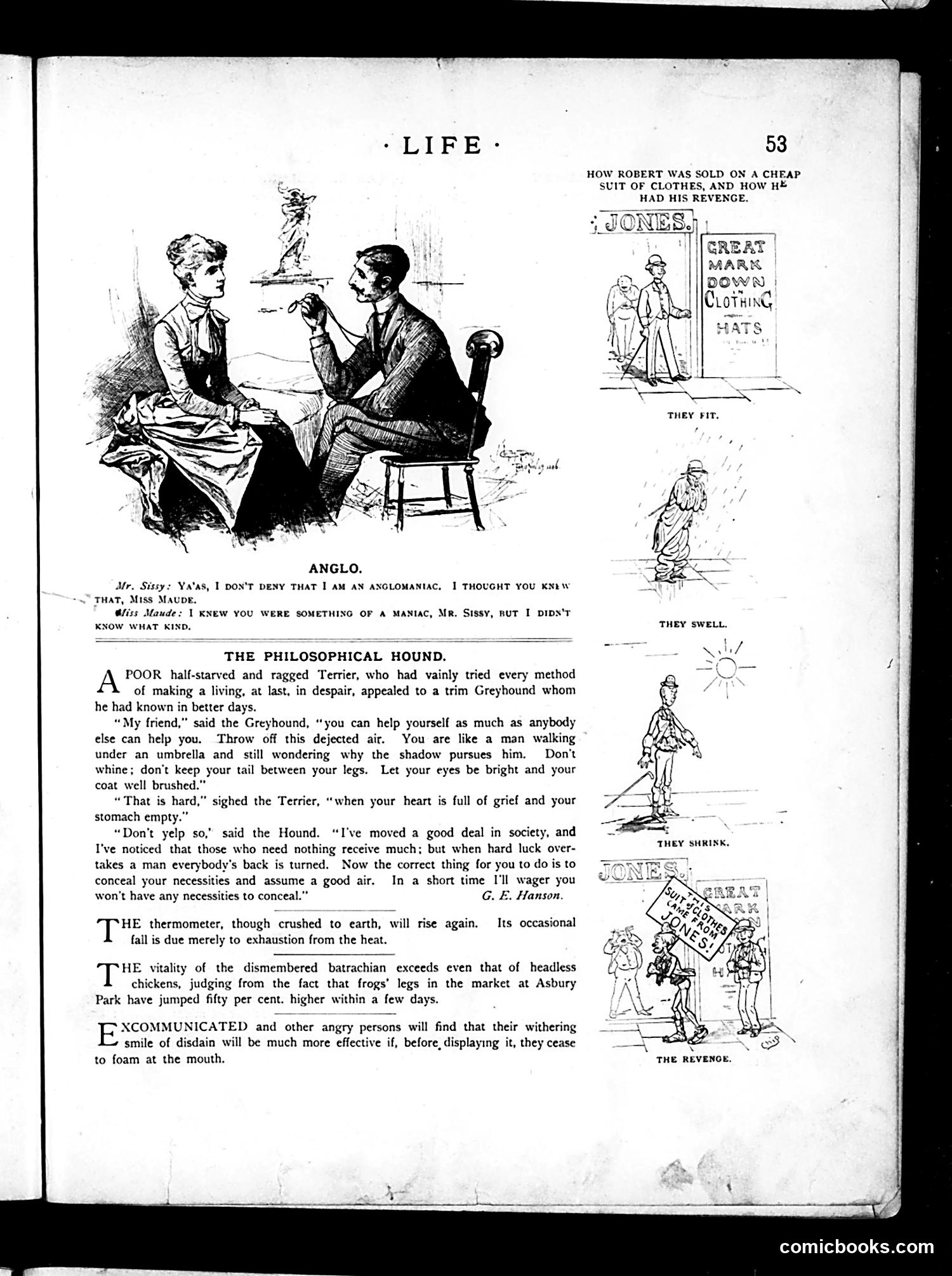
This page contains three satirical pieces typical of early 20th-century American humor magazines. **"Anglo" dialogue**: A man admits to being an "Anglomaniac" (excessively devoted to British culture), prompting Miss Maude's wordplay—she thought he was "something of a maniac" but didn't know what kind. This mocks Americans who affected British mannerisms and tastes. **"The Philosophical Hound"**: A fable where a struggling Terrier receives advice from a successful Greyhound: hide your poverty and act confident, and prosperity will follow. This satirizes self-help platitudes and the notion that mere appearance and attitude can overcome genuine hardship—advice that rings hollow to someone actually starving. **"Robert's Revenge"**: A visual sequence (right side) showing a man purchasing a cheap suit that initially fits well but then expands ("swell"). The implied punchline is his revenge—the seller is exposed when the inferior garment fails. This mocks both cheap clothing merchants and gullible buyers. The short aphorisms at bottom mock various absurdities with deadpan logic.
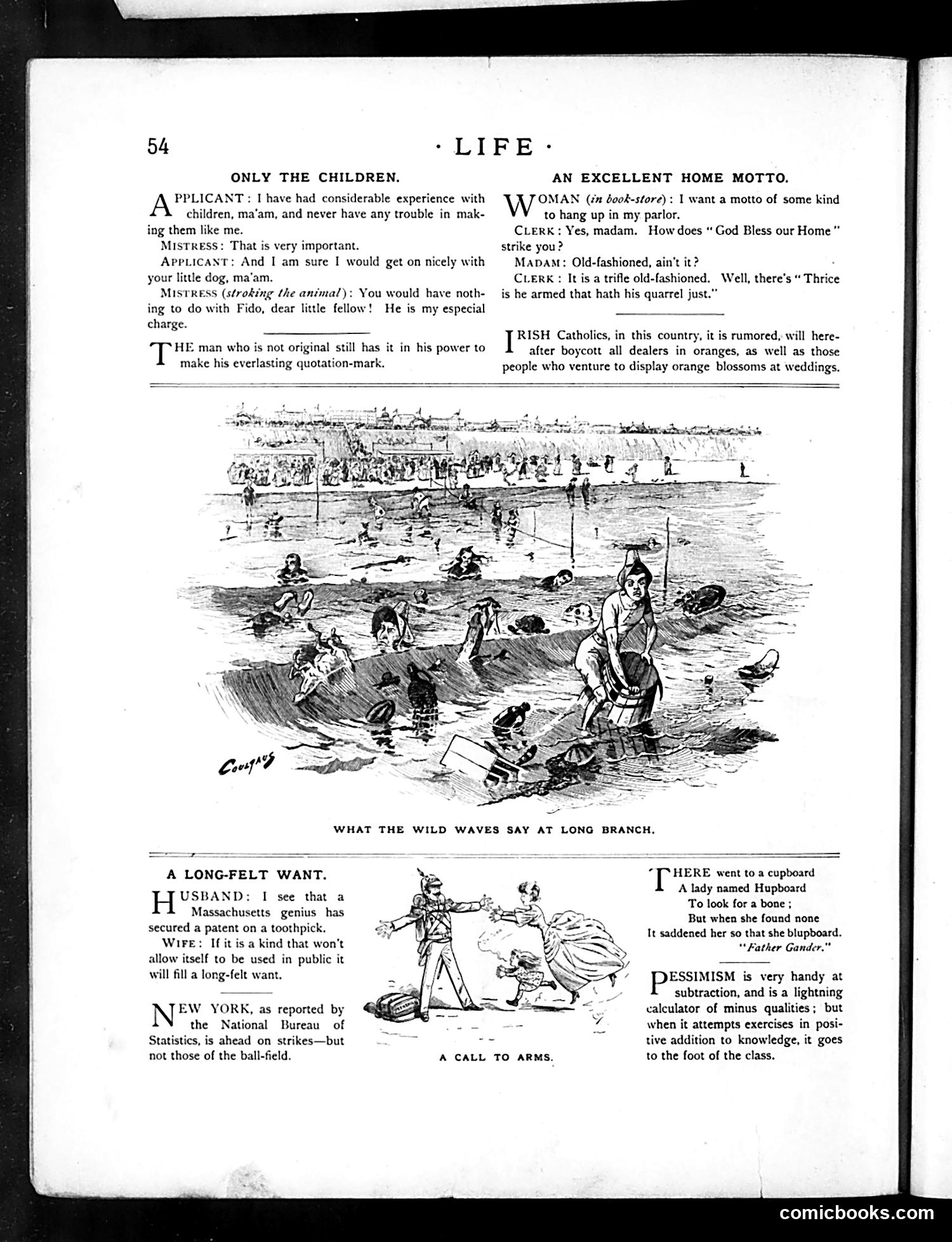
This page contains several satirical vignettes typical of Life's humor: **"Only the Children"**: A job applicant claims expertise with children but then prioritizes the employer's dog over childcare—satirizing insincere job candidates who tell employers what they want to hear. **"An Excellent Home Motto"**: A woman seeks a parlor motto; the clerk suggests "God Bless our Home," but she finds it old-fashioned. The satire mocks both outdated domestic piety and the commercialization of home sentiment. **Irish Catholics/Orange Blossoms**: A topical reference to Irish Catholic boycotts of orange imagery (associated with Protestant/British identity), extending even to wedding flowers—satirizing the intensity of sectarian tensions in America. **"A Long-Felt Want"**: A wife jokes that a patented toothpick is only useful if it *prevents* public use—mocking both the absurdity of trivial patents and poor public manners. **Other items**: Brief jokes about strikes in New York and a nursery-rhyme parody about a lady named "Hupboard." The page reflects late 19th-century American social anxieties: domestic labor, sectarian conflict, commercialism, and etiquette.
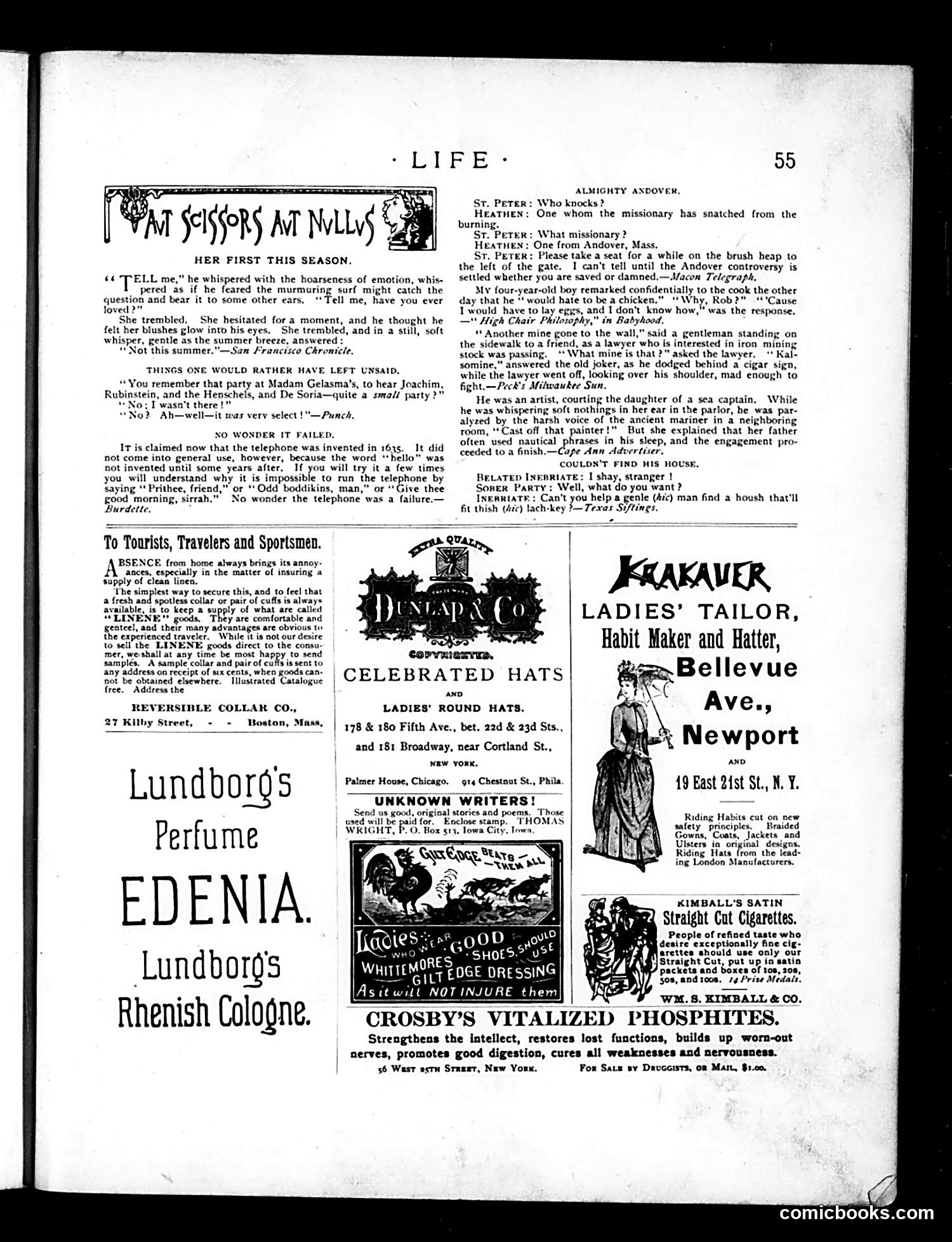
This page is primarily **advertising and humor shorts** rather than political cartoons. The content consists of: **Humor Columns:** Brief jokes from newspapers, including: - A romantic beach scene where the woman admits she's never loved "this summer" (implying prior romantic experiences) - A joke about the telephone's invention being delayed because the word "hello" hadn't been invented yet - A satirical religious piece about an Andover missionary, poking fun at evangelical competition between institutions - Anecdotes about a child's innocence, a lawyer distracted by mining stock, and a sailor's nautical language confusing his daughter's suitor **Advertisements:** The page features ads for Lundborg's Perfume, Dunlap hats, a Ladies' Tailor in Newport, Kimball's cigarettes, and Crosby's health tonic. The humor reflects typical turn-of-century American magazine satire—light, sometimes risqué observations about courtship, modern technology, and social pretension. The Andover reference suggests institutional rivalry in education/religion was a recognizable contemporary topic.
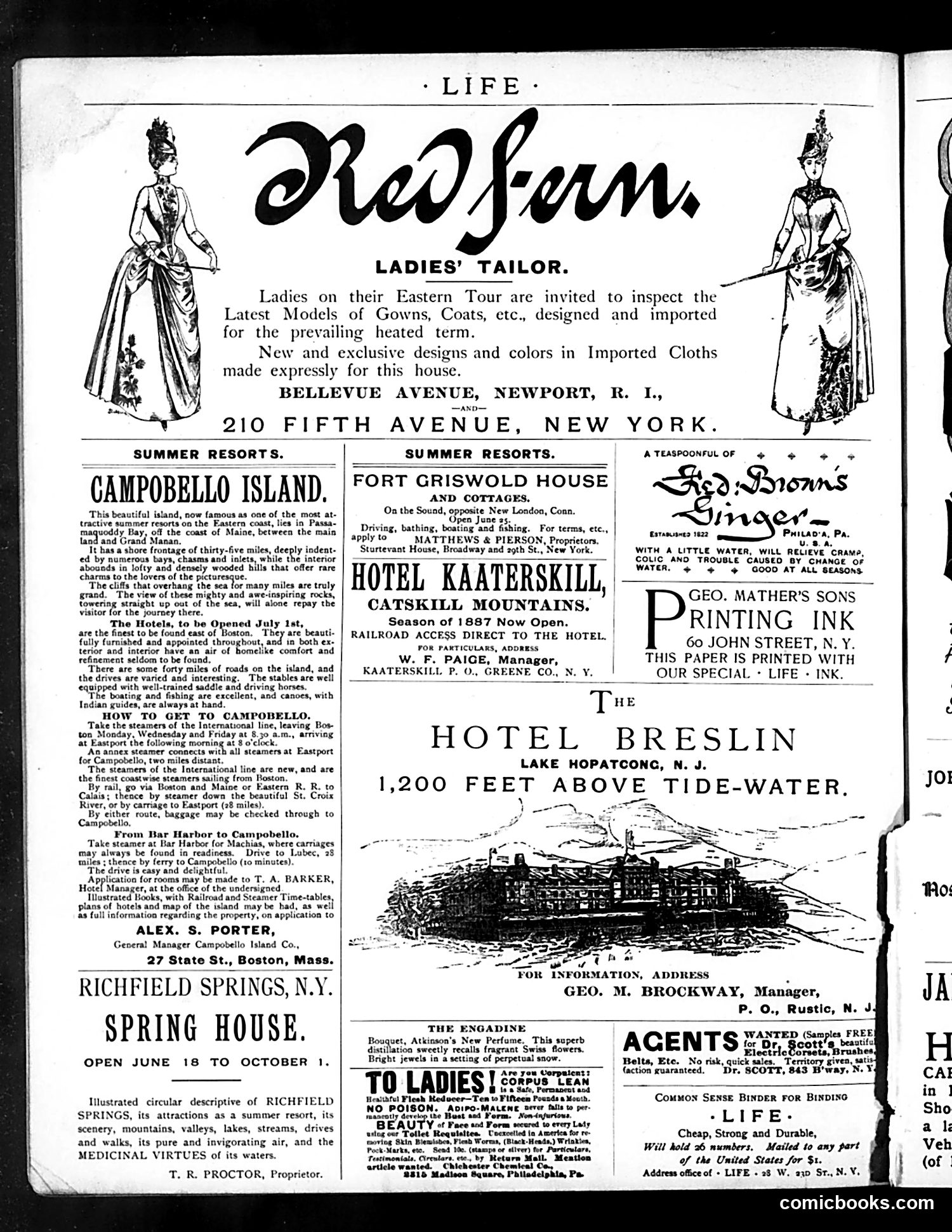
This is not a satirical or political cartoon page. It's a **Life magazine advertising section** from the 1880s (the Kaaterskill Hotel advertises "Season of 1887 Now Open"). The page contains **commercial advertisements** for: - A ladies' tailor on Fifth Avenue/Newport (high-end summer fashion) - Upscale summer resort hotels (Campobello Island, Fort Griswold House, Hotel Kaaterskill, Hotel Breslin, Richfield Springs) - Travel directions and accommodations - Printing services and a medicinal product (Red Biorns Ginger) The decorative engravings of fashionable women are typical period advertising imagery, not political commentary. There is **no satire or social critique visible**—this reflects Life magazine's advertising content during an era when such publications supported themselves heavily through resort and luxury goods advertisements targeting wealthy Eastern seaboard tourists.
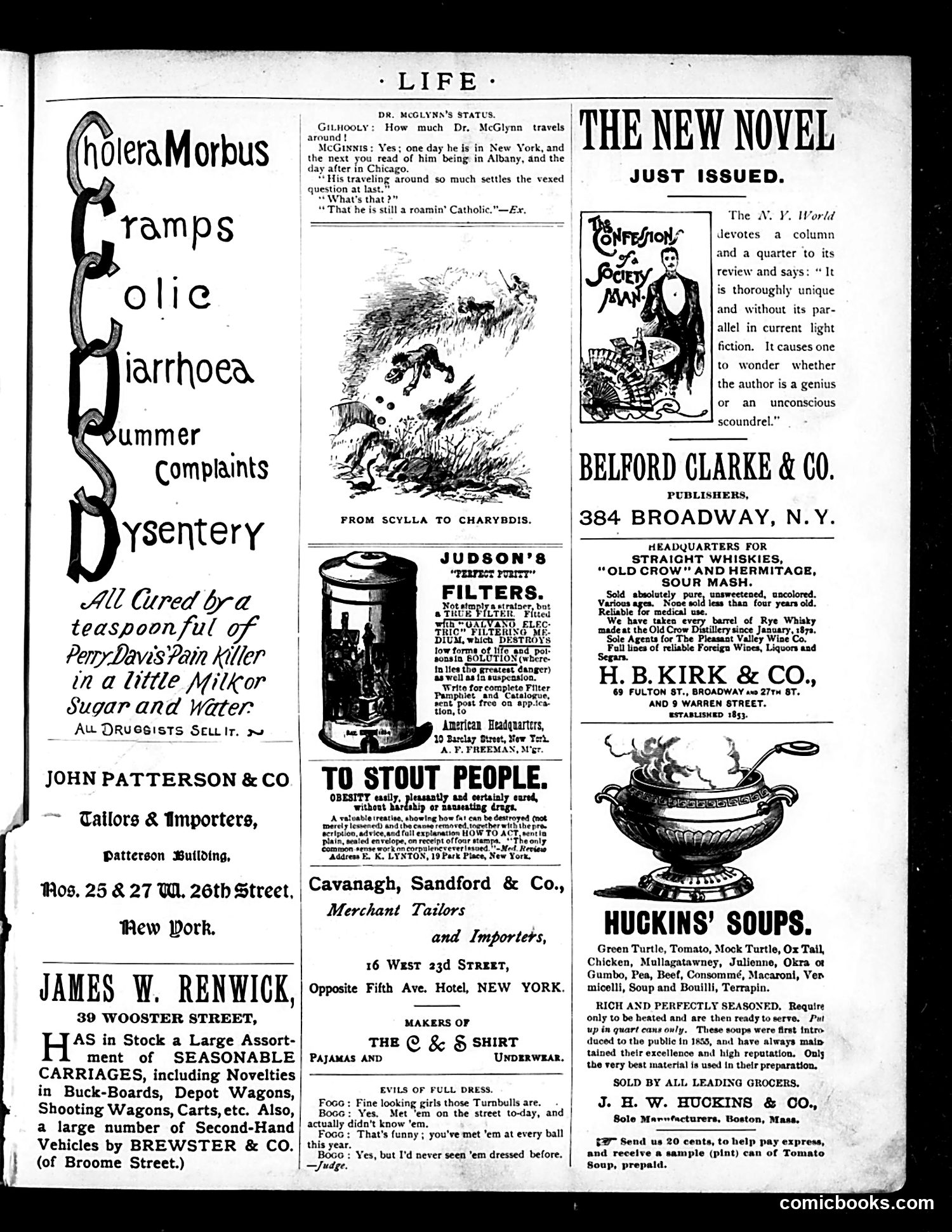
This page is primarily **advertising** with one small satirical joke. The main content consists of patent medicine ads, tailors, carriage dealers, and food/beverage products typical of late 19th-century publications. The only cartoon/joke appears in the upper-middle section: a brief dialogue about **Dr. McGlynn**, a Catholic priest who was a controversial figure. The joke plays on his frequent travels between cities, concluding with a pun: "That he is still a roamin' Catholic"—conflating his status as a "Roman Catholic" with literally "roaming" (traveling constantly). This references real ecclesiastical disputes of the era, though the specific controversy isn't detailed here. The cartoon illustration labeled "FROM SCYLLA TO CHARYBDIS" shows a figure navigating between two dangers—likely allegorical commentary, though its specific political meaning is unclear without additional context. The remainder consists of advertisements for medical treatments (Perry Davis Pain Killer for cholera and dysentery), weight-loss remedies, filters, carriages, tailoring services, and food products—reflecting period consumer culture and quack medicine proliferation.
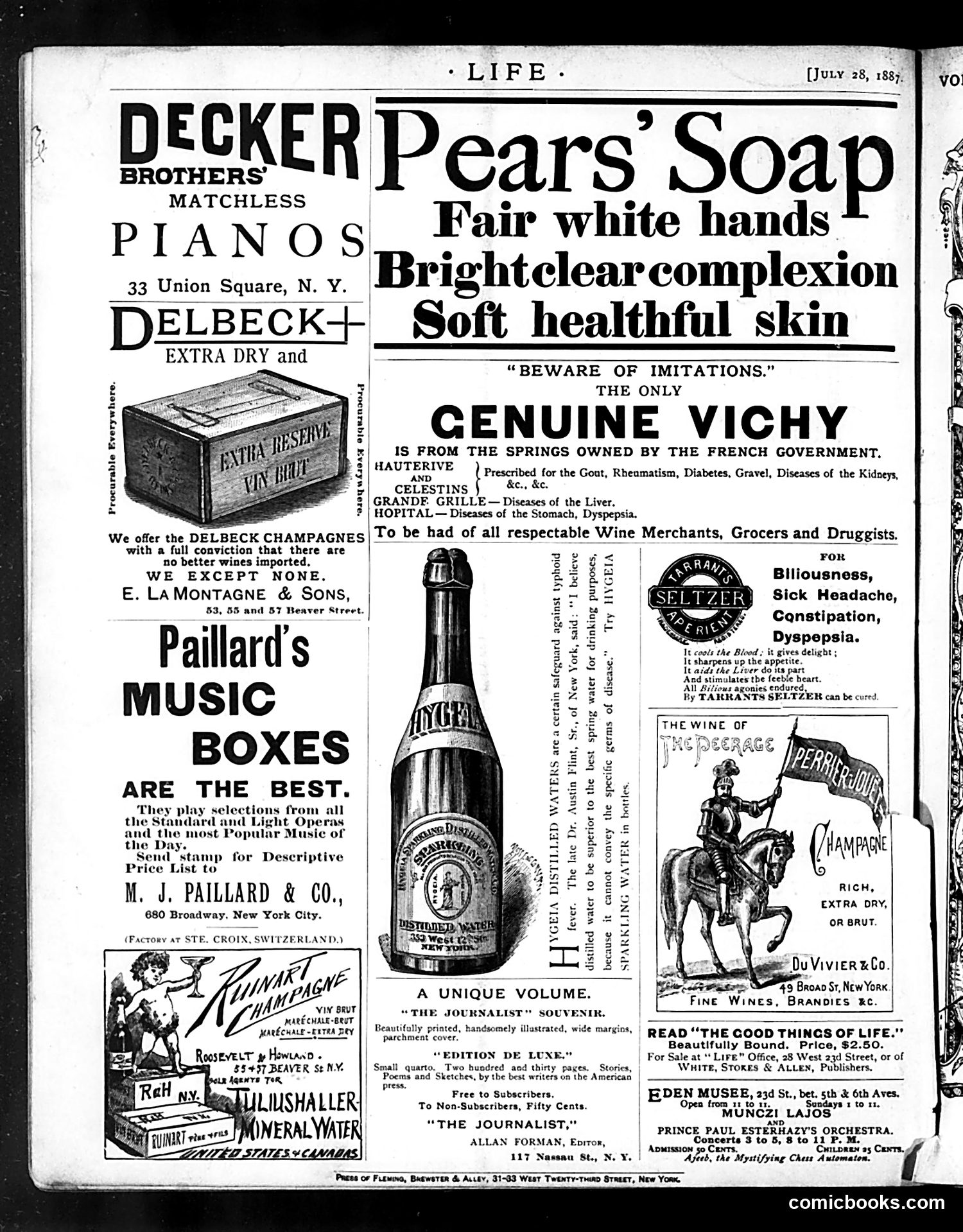
This is primarily an **advertising page** rather than editorial content or political satire. It features late-19th-century commercial advertisements typical of Life magazine during this period. Notable ads include: - **Pears' Soap**: Promotes beauty standards around "fair white hands" and "bright clear complexion"—reflecting Victorian-era beauty ideals and, problematically, racial preferences of the era - **Delbeck Champagne** and **Vichy water**: Premium imported European beverages marketed as health remedies for digestive and circulatory ailments - **Paillard Music Boxes**: Mechanical entertainment devices - **"The Journalist" souvenir book**: A collection of stories and poems The page reflects Gilded Age consumer culture: advertisements emphasize European luxury goods, health tonics (many containing questionable medicinal claims), and aesthetic refinement. There is **no political cartoon or satirical content visible**—this is straightforward commercial messaging typical of American magazines from this prosperous but unregulated advertising era.