
Life, 1887-07-28 · page 2 of 16
Life — July 28, 1887 — page 2: what you’re looking at
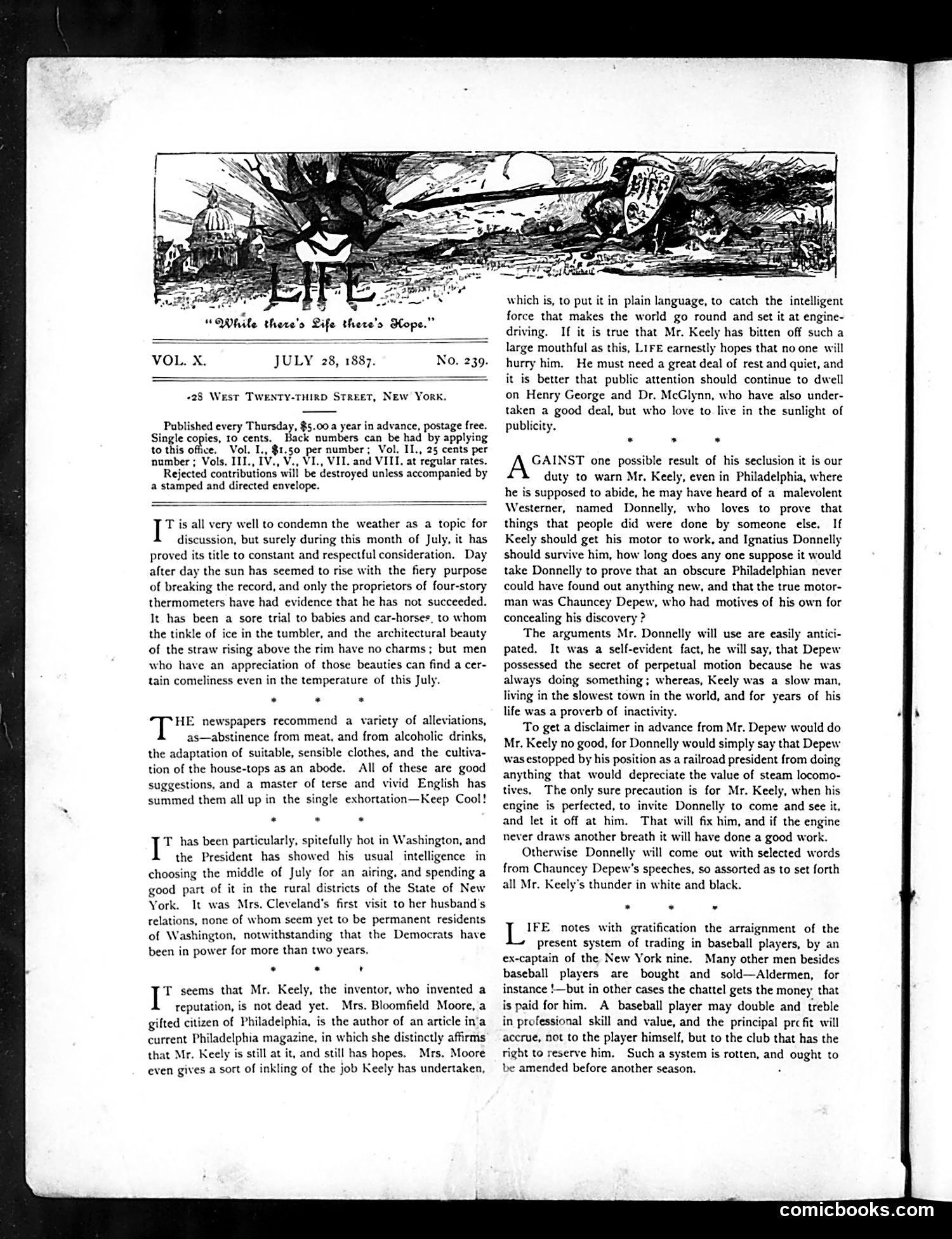
What you’re looking at
**The Cartoon:** The heading "While there's Life there's Hope" accompanies an illustration of a grim reaper or death figure looming over a landscape. This appears to be a visual pun playing on the magazine's own name ("Life") as a counterpoint to death—suggesting that as long as Life magazine exists, there remains hope, likely for social reform or progress. **The Editorial Content:** The page discusses Mr. Keely, an inventor with a claimed "perpetual motion" engine. The text suggests skepticism about his invention while noting that Mrs. Bloomfield Moore (a "gifted citizen of Philadelphia") continues to support him despite apparent lack of progress. The piece satirizes both Keely's dubious claims and the continued public interest in his project.
📄 Transcribed text from this page (OCR, searchable)
Machine-transcribed from the original scan — historical spelling and the odd misread are preserved.
Life there's Hope.” VOL. +28 West TWENTY-THIRD STREET, New York. JULY 28, 1887. Published every Thursday, $5.00 a year in advance, postage free. Single copies, 10 cents. Back numbers can be had by applying to this office. Vol. I., $1.50 per number; Vol. II., 25 cents per number ; Vols. III., IV., V., VI., VII. and VIII, at regular rates. Rejected contributions wili be destroyed unless accompanied by a stamped and directed envelope. T is all very well to condemn the weather as a topic for discussion, but surely during this month of July, it has proved its title to constant and respectful consideration. Day after day the sun has seemed to rise with the fiery purpose of breaking the record, and only the proprietors of four-story thermometers have had evidence that he has not succeeded. It has been a sore trial to babies and car-horses, to whom the tinkle of ice in the tumbler, and the architectural beauty of the straw rising above the rim have no charms; but men who have an appreciation of those beauties can find a cer- tain comeliness even in the temperature of this July. HE newspapers recommend a variety of alleviations, as—abstinence from meat, and from alcoholic drink: the adaptation of suitable, sensible clothes, and the cultiva- tion of the house-tops as an abode. All of these are good suggestions, and a master of terse and vivid English has summed them all up in the single exhortation—Keep Cool! T has been particularly, spitefully hot in Washington, and the President has showed his usual intelligence in choosing the middle of July for an airing, and spending a good part of it in the rural districts of the State of New York. It was Mrs. Cleveland's first visit to her husband's relations, none of whom seem yet to be permanent residents of Washington, notwithstanding that the Democrats have been in power for more than two years. . . ' T seems that Mr. Keely, the inventor, who invented a reputation, is not dead yet. Mrs. Bloomfield Moore, a gifted citizen of Philadelphia, is the author of an article ina current Philadelphia magazine, in which she distinctly affirms that Mr. Keely is still at it, and still has hopes. Mrs. Moore even gives a sort of inkling of the job Keely has undertaken, which is, to put it in plain language, to catch the intelligent force that makes the world go round and set it at engine- driving. If it is true that Mr. Keely has bitten off such a large mouthful as this, L1FE earnestly hopes that no one will hurry him. He must need a great deal of rest and quiet, and it is better that public attention should continue to dwell on Henry George and Dr. McGlynn, who have also under- taken a good deal, but who love to live in the sunlight of publicity. . * . GAINST one possible result of his seclusion it is our duty to warn Mr. Keely, even in Philadelphia, where he is supposed to abide, he may have heard of a malevolent Westerner, named Donnelly, who loves to prove that things that people did were done by someone else. If Keely should get his motor to work, and Ignatius Donnelly should survive him, how long does any one suppose it would take Donnelly to prove that an obscure Philadelphian never could have found out anything new, and that the true motor- man was Chauncey Depew, who had motives of his own for concealing his discovery ? The arguments Mr. Donnelly will use are easily antici- pated. It was a self-evident fact, he will say, that Depew possessed the secret of perpetual motion because he was always doing something; whereas, Keely was a slow man, living in the slowest town in the world, and for years of his life was a proverb of inactivity. To get a disclaimer in advance from Mr. Depew would do Mr. Keely no good, for Donnelly would simply say that Depew was estopped by his position as a railroad president from doing anything that would depreciate the value of steam locomo- tives. The only sure precaution is for Mr. Keely, when his engine is perfected, to invite Donnelly to come and see it, and let it off at him. That will fix him, and if the engine never draws another breath it will have done a good work. Otherwise Donnelly will come out with selected words from Chauncey Depew’s speeches, so assorted as to set forth all Mr. Keely’s thunder in white and black. IFE notes with gratification the arraignment of the present system of trading in baseball players, by an ex-captain of the New York nine. Many other men besides baseball players are bought and sold—Aldermen, for instance !—but in other cases the chattel gets the money that is paid for him. A baseball player may double and treble in professional skill and value, and the principal prc fit will accrue, not to the player himself, but to the club that has the right to reserve him. Such a system is rotten, and ought to be amended before another season. : comicbooks.com