
Life, 1887-07-28 · page 6 of 16
Life — July 28, 1887 — page 6: what you’re looking at
What you’re looking at
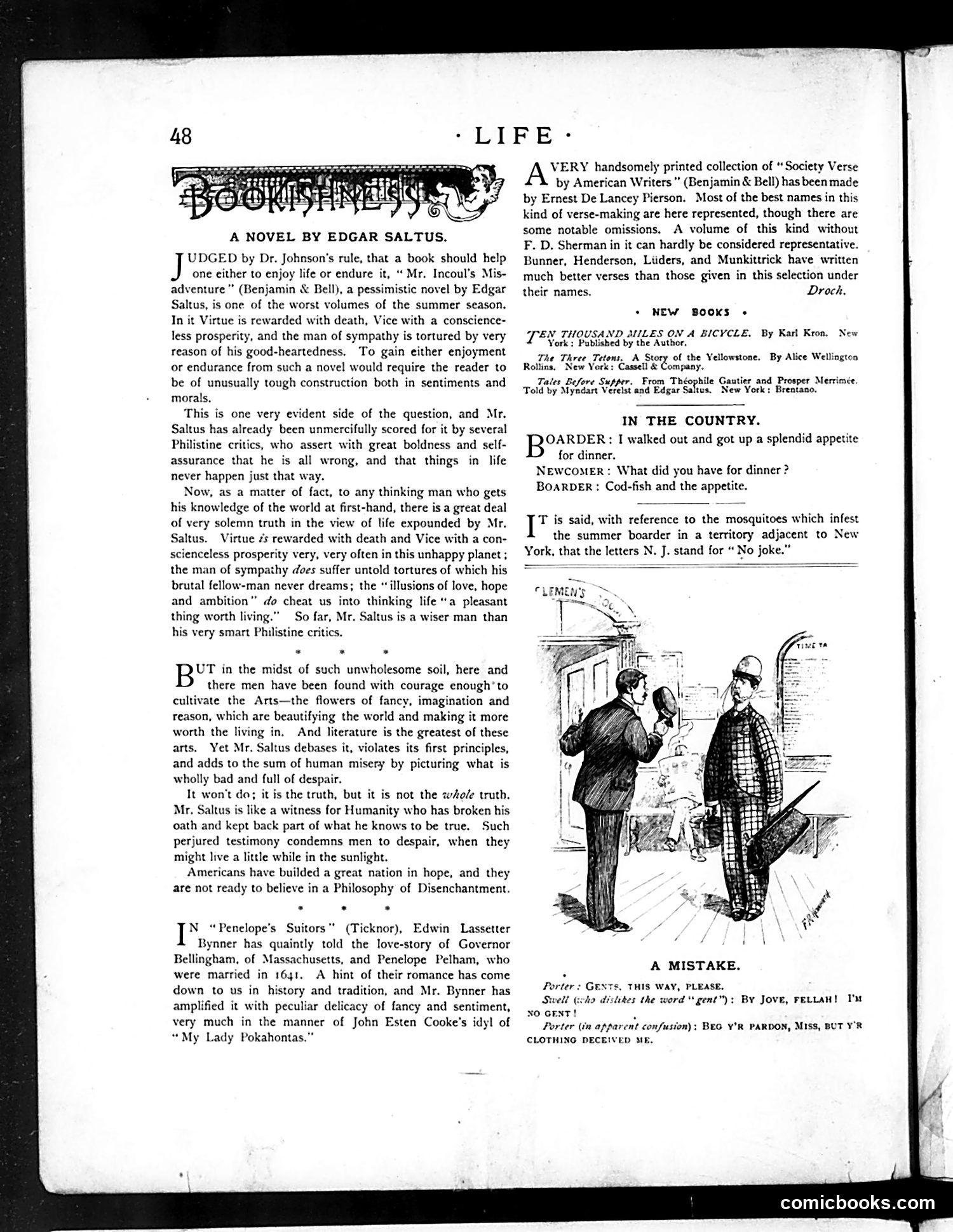
This single-panel cartoon depicts two men on a street, labeled "A Mistake." The dialogue reads: **Porter:** "Gents, this way, please. [Swells] dislike the word 'gent'): By Jove, fellow! I'm no gent!" **Porter** (in apparent confusion): "Beg y'r pardon, miss, but y'r clothing received me." The satire targets class pretension and social awkwardness. A porter misidentifies a man as a woman based on his clothing, then compounds the error by calling him "miss" while apologizing. The joke relies on the premise that the man's attire is ambiguous or oddly feminine—mocking either Victorian fashion sensibilities or the man's attempt to appear genteel. It's essentially humor about failed social codes and mistaken identity based on appearance.
📄 Transcribed text from this page (OCR, searchable)
Machine-transcribed from the original scan — historical spelling and the odd misread are preserved.
> LIFE: A NOVEL BY EDGAR SALTUS, UDGED by Dr. Johnson's rule, that a book should help J one either to enjoy life or endure it, “Mr. Incoul’s Mis- adventure" (Benjamin & Bell), a pessimistic novel by Edgar Saltus, is one of the worst volumes of the summer season. In it Virtue is rewarded with death, Vice with a conscience- less prosperity, and the man of sympathy is tortured by very reason of his good-heartedness. To gain either enjoyment or endurance from such a novel would require the reader to be of unusually tough construction both in sentiments and morals, This is one very evident side of the question, and Mr. Saltus has already been unmercifully scored for it by several Philistine critics, who assert with great boldness and self- assurance that he is all wrong, and that things in life never happen just that way. Now, as a matter of fact, to any thinking man who gets his knowledge of the world at first-hand, there is a great deal of very solemn truth in the view of life expounded by Mr. Saltus. Virtue ¢s rewarded with death and Vice with a con- scienceless prosperity very, very often in this unhappy planet ; the man of sympathy does suffer untold tortures of which his brutal fellow-man never dreams; the “illusions of love, hope and ambition” do cheat us into thinking life “a pleasant thing worth living.” So far, Mr. Saltus is a wiser man than his very smart Philistine critics. . * . UT in the midst of such unwholesome soil, here and there men have been found with courage enough’ to cultivate the Arts—the flowers of fancy, imagination and reason, which are beautifying the world and making it more worth the living in, And literature is the greatest of these arts. Yet Mr. Saltus debases it, violates its first principles, and adds to the sum of human misery by picturing what is wholly bad and full of despair. It won't do; it is the truth, but it is not the whole truth. Mr, Saltus is like a witness for Humanity who has broken his oath and kept back part of what he knows to be true. Such perjured testimony condemns men to despair, when they might live a little while in the sunlight. Americans have builded a great nation in hope, and they are not ready to believe in a Philosophy of Disenchantment. I* “Penelope's Suitors" (Ticknor), Edwin Lassetter Bynner has quaintly told the love-story of Governor Bellingham, of Massachusetts, and Penelope Pelham, who were married in 1641. A hint of their romance has come down to us in history and tradition, and Mr. Bynner has amplified it with peculiar delicacy of fancy and sentiment, very much in the manner of John Esten Cooke's idyl of “My Lady Pokahontas.” VERY handsomely printed collection of “Society Verse by American Writers" (Benjamin & Bell) has been made by Ernest De Lancey Pierson. Most of the best names in this kind of verse-making are here represented, though there are some notable omissions. A volume of this kind without F. D. Sherman in it can hardly be considered representative. Bunner, Henderson, Liiders, and Munkittrick have written much better verses than those given in this selection under their names. Droch, + NEW BOOKS + ‘NV THOUSAND MILES ON A BICYCLE, By Karl Kron. New York : Published by the Author. Three Tetons, A Story of the Yellowstone, By Alice Wellington New York: Cassell & Company. Tales Before Supper. From Théophile Gautier and Prosper Merrimée. Told by Myndart Verelst and Edgar Saltus. New York: Brentano. IN THE COUNTRY. OARDER: I walked out and got up a splendid appetite for dinner. NEWCOMER: What did you have for dinner ? BOARDER : Cod-fish and the appetite. ig is said, with reference to the mosquitoes which infest the summer boarder in a territory adjacent to New York, that the letters N. J. stand for “ No joke.” A MISTAKE. Porter ; GENTS, THIS WAY, PLEASE. Stell (who distikes the word“ gent”): BY Jove, FELLAH! It NO GENT! . Porter (in apparent confusion): BEG Y'R PARDON, MISS, BUT Y'R CLOTHING DECEIVED ME. comicbooks.com oN