
A complete issue · 16 pages · 1887
Life — May 19, 1887
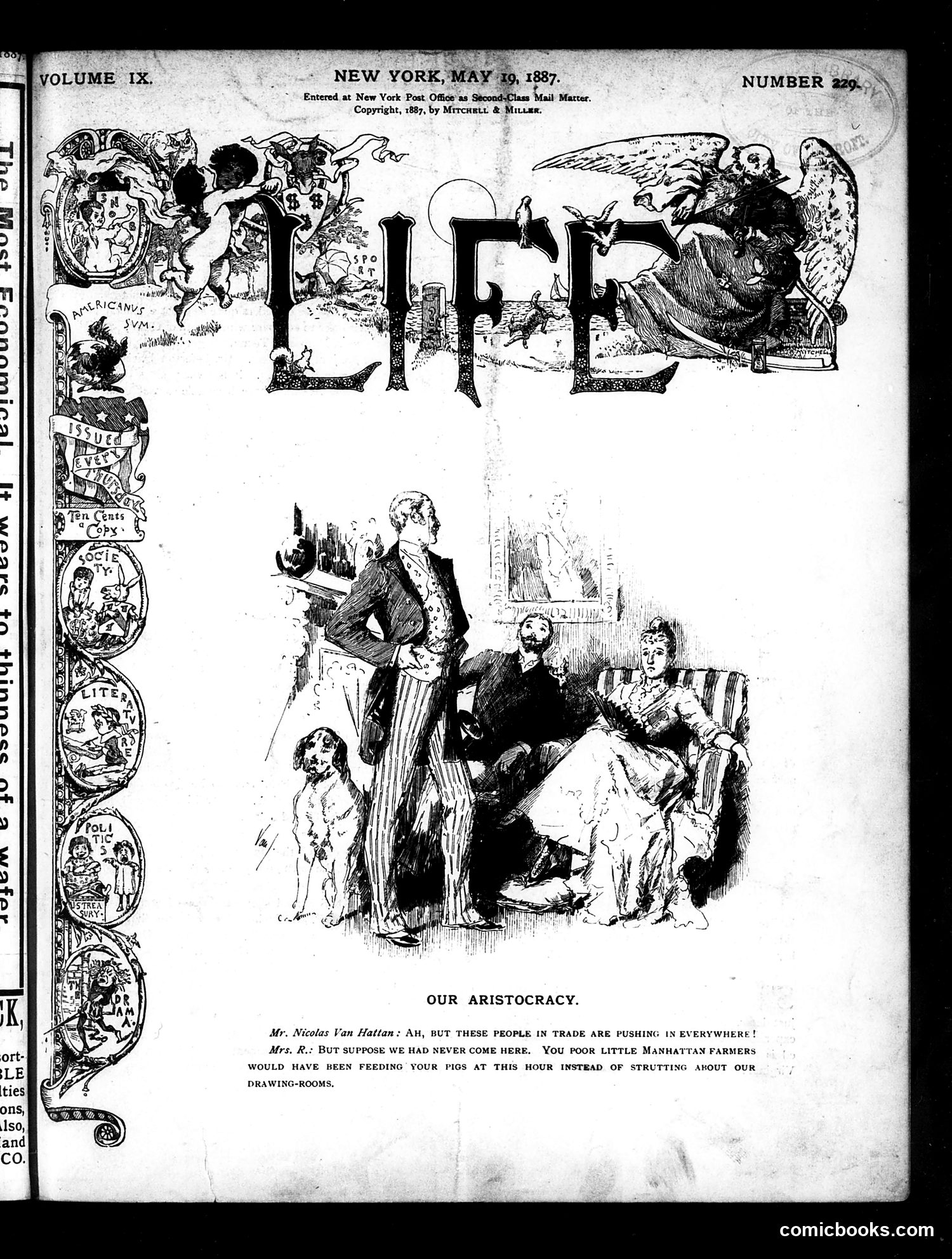
This satirical cartoon critiques the pretensions of America's newly wealthy merchant class. The scene depicts a fashionable family in their drawing room, with a man proudly displaying a cityscape model, likely representing his commercial real estate holdings or business empire. The caption's dialogue mocks their social climbing: Mrs. Van Hattan objects to tradespeople entering everywhere, claiming that without commerce, they'd never have reached Manhattan's elite status. Mrs. K. responds sarcastically, suggesting these "people in trade" are the actual foundation of their wealth—that feeding pigs (literal farm work) would be more honest than their pretentious drawing-room posturing. The satire targets Gilded Age hypocrisy: newly rich industrialists and merchants who disdained "trade" while their fortunes depended entirely upon it.
The page features a satirical drama titled "The Recurrence of Sheridan," presented as a three-act military comedy. The content consists primarily of humorous political commentary rather than visual cartoons. Key topics satirized include: 1. **General Sherman vs. Lord Wolseley**: Debate over comparing Civil War generals to British military figures 2. **Queen of Hawaii's Washington visit**: Commentary on her royal status and American officers' entertainment efforts 3. **Queen Victoria's upcoming jubilee**: Discussion of her condemnation of Tennyson's ode 4. **Sir Edward Thornton**: Reference to Virginia's financial difficulties and debt collection efforts 5. **NYC social scene**: Commentary on annual shows, Madison Square Garden, and urban life The page is primarily text-based satirical commentary on contemporary political and social figures, rather than illustrated cartoons.
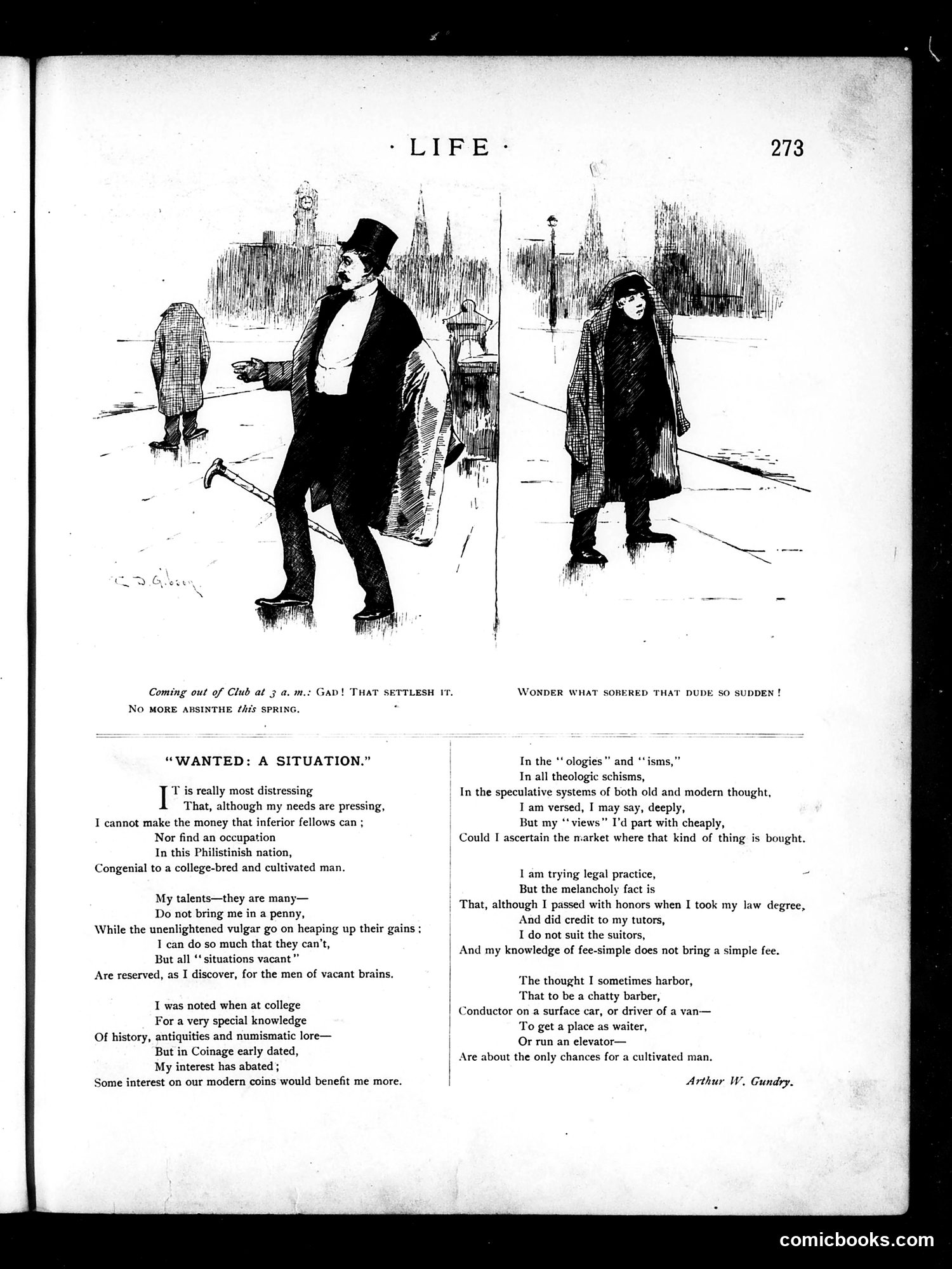
The top cartoon depicts a man in formal dress encountering a woman on an icy street, with the caption "Coming out of Club at 3 a.m.: 'Gad! That settles it. No more absinthe this spring'" and "'Wonder what sobered that dude so sudden!'" The humor appears to satirize excessive drinking and its consequences. The man's sudden sobriety (implied by his encounter with the woman) mocks the common excuse drinkers make to reform their habits. The icy setting emphasizes the shock of the unexpected encounter. Below is a poem titled "Wanted: A Situation," authored by Arthur W. Gundry, lamenting the difficulty an educated man faces finding employment suitable to his cultivated background and talents. It satirizes the paradox where education and specialized knowledge don't guarantee financial success or appropriate work.
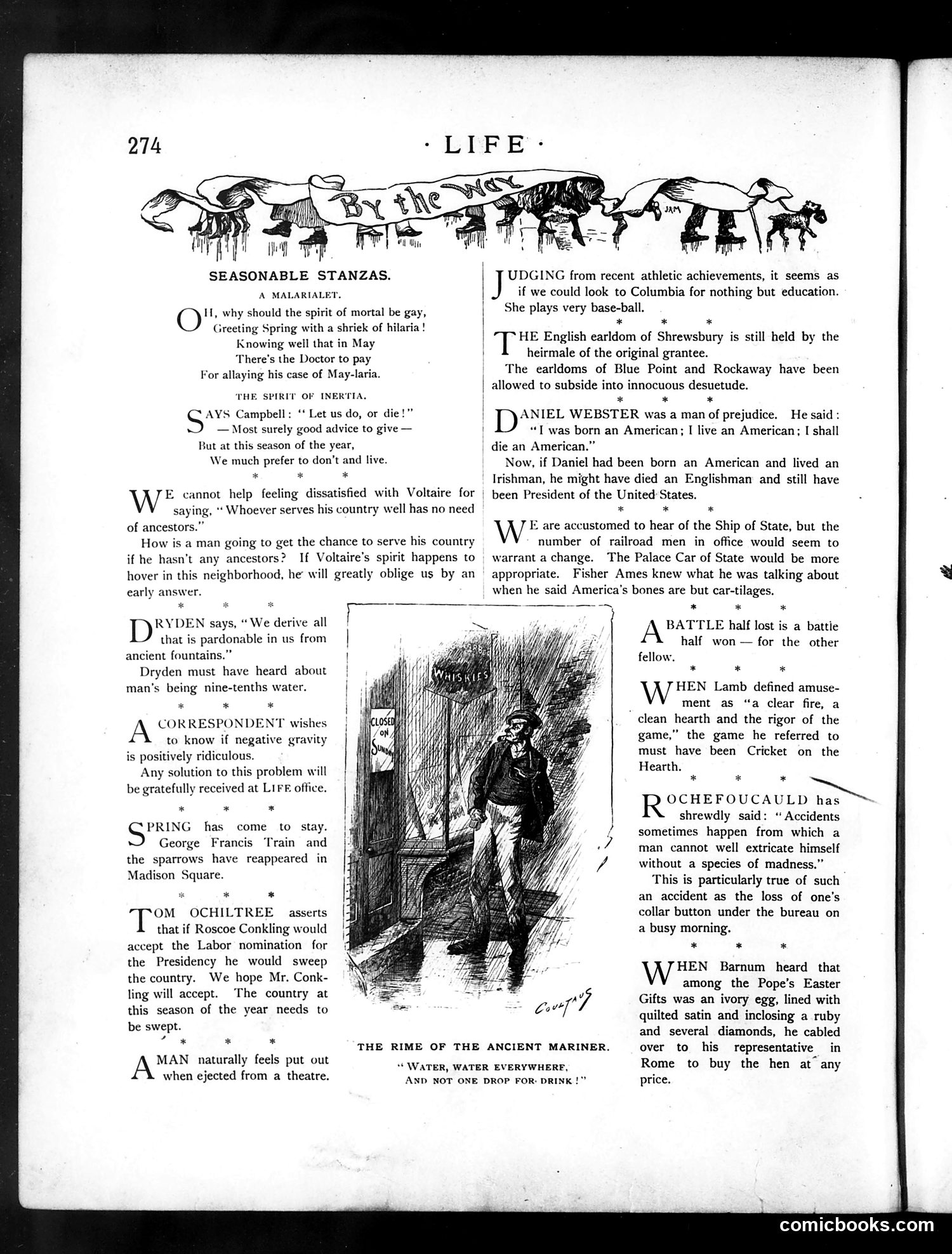
The page contains several brief satirical commentaries rather than a single cartoon. The main illustration shows "The Rime of the Ancient Mariner," depicting a figure in a dark, atmospheric scene—likely a literary reference rather than political commentary. The text items mock various subjects: ineffectual spring remedies, ancestral pretension, negative gravity as ridiculous philosophy, and theatrical etiquette. Notable references include Tom Ochiltree's comment about Roscoe Conkling accepting a Labor nomination for presidency, suggesting this reflects 1880s political satire. Another item mocks an ivory egg with jeweled contents supposedly sent to the Pope—a humorous anecdote about excess. The overall tone is lighthearted social commentary on American manners, politics, and absurdities rather than urgent political satire.
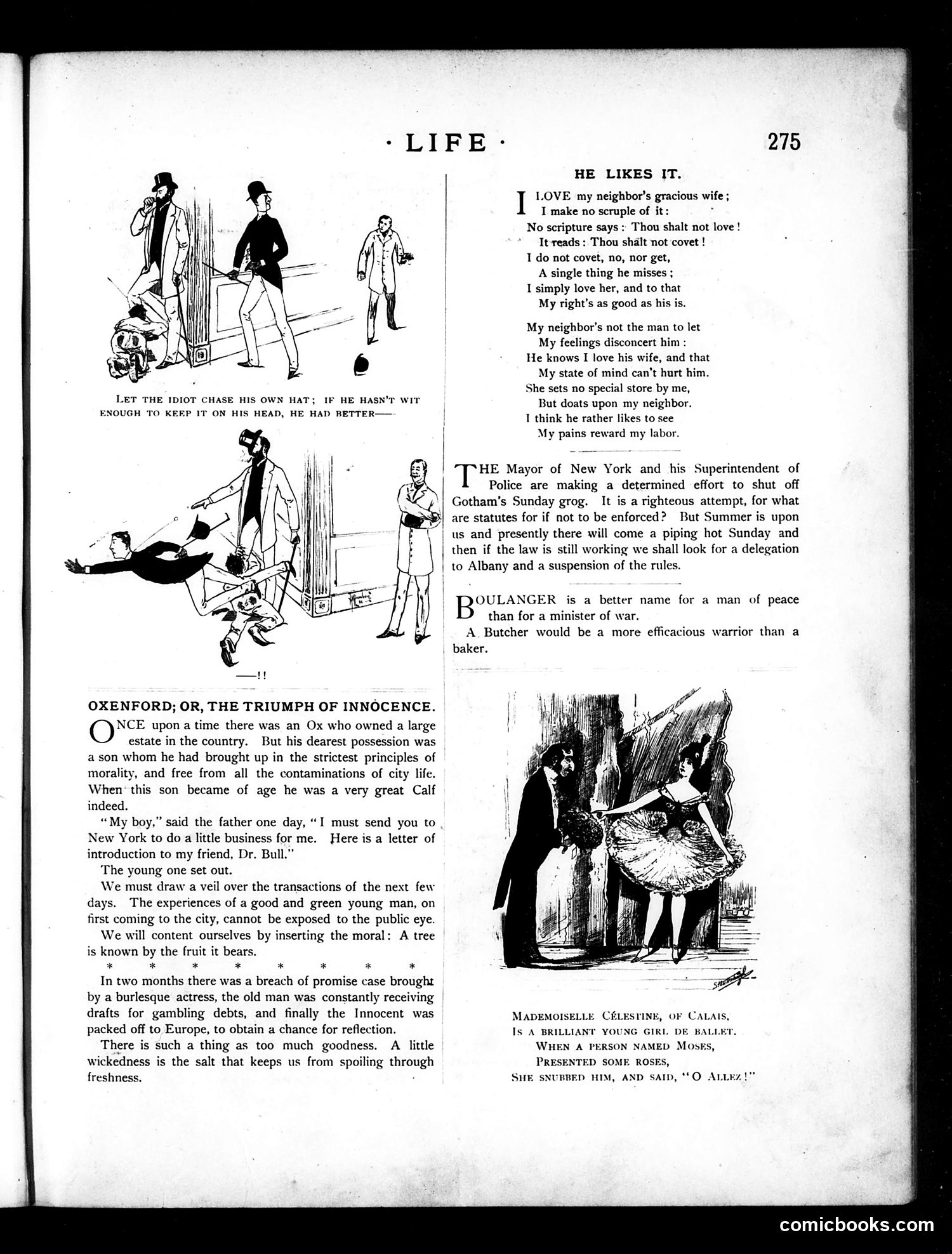
This page contains two distinct pieces of social commentary: **"He Likes It"** is a poem about coveting a neighbor's wife while maintaining that such feelings cause no harm—a satirical critique of moral rationalization and hypocrisy. **"Oxenford; or, The Triumph of Innocence"** is a satirical story about a morally sheltered young man sent from the countryside to New York City. The narrative ironically demonstrates how his "innocence" leads to corruption: he becomes involved in gambling debts and breach-of-promise scandals. The moral—"a tree is known by its fruit it bears"—suggests that removing someone from moral guidance doesn't preserve virtue; instead, city corruption exploits their naivety. The accompanying illustrations depict the young man's misadventures in urban settings, emphasizing the satirical contrast between his rural upbringing and urban moral pitfalls.
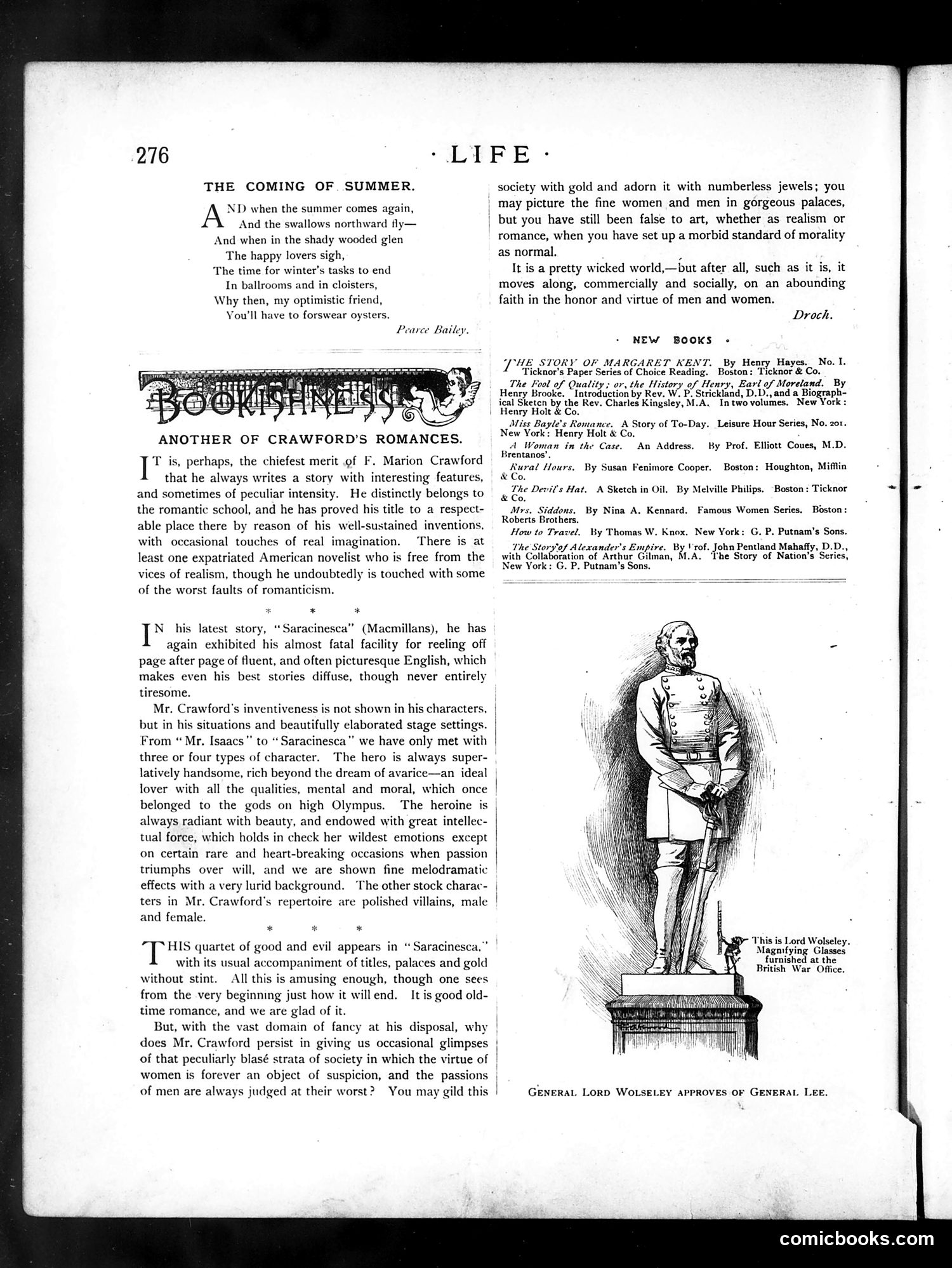
This page contains a literary review of F. Marion Crawford's romance novel "Saracinesca" alongside a statue illustration. The main image shows a standing military figure in uniform on a pedestal, captioned "General Lord Wolseley approves of General Lee." The caption appears to reference British General Wolseley endorsing American General Robert E. Lee—likely satirizing either contemporary military admiration across national lines or possibly making a pointed comment about celebrating Confederate figures. The juxtaposition is unclear without fuller historical context, but seems to critique either misplaced approval or questionable hero-worship. The text section critiques Crawford's romantic fiction for depicting virtue in women as perpetually suspect while portraying men's passions sympathetically—a social commentary on Victorian double standards regarding gender and morality.
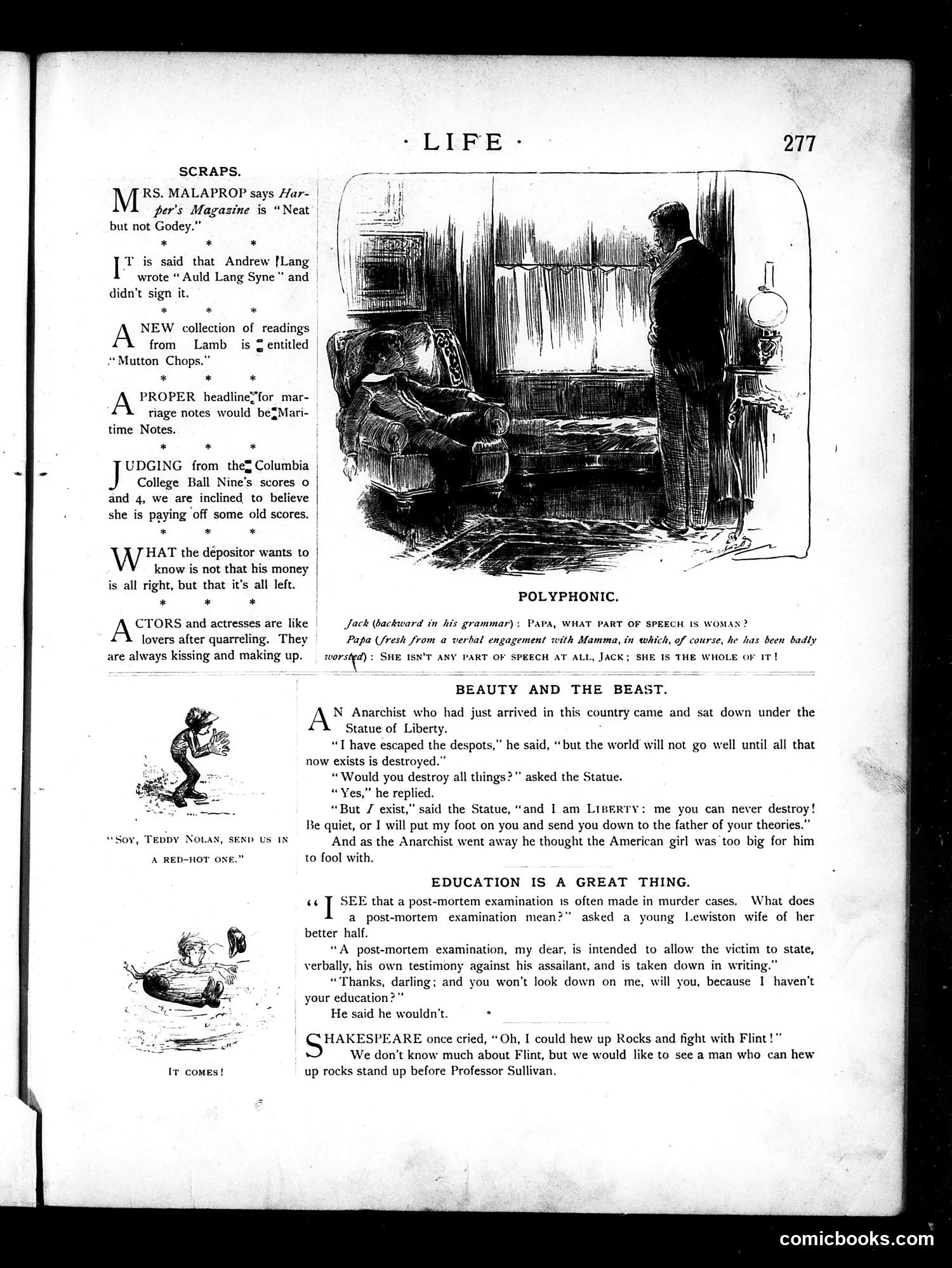
This page contains several brief satirical items and illustrations typical of Life's humor section. **"Polyphonic"** depicts a grammar lesson where a man asks if "woman" is part of speech. The joke turns on the woman character responding that she "isn't any part of speech at all, Jack; she is the whole of it!"—a sexist joke playing on stereotypes about women's talkativeness. **"Beauty and the Beast"** presents a dialogue between an Anarchist and the Statue of Liberty, mocking radical political views. The Anarchist declares everything should be destroyed; Liberty threatens to crush him, satirizing both revolutionary ideology and American exceptionalism. Other items are brief quips about grammar, education, and Shakespeare, typical of the magazine's miscellaneous humor format. The page represents early 20th-century American satirical magazine conventions mixing social commentary with crude stereotypes.
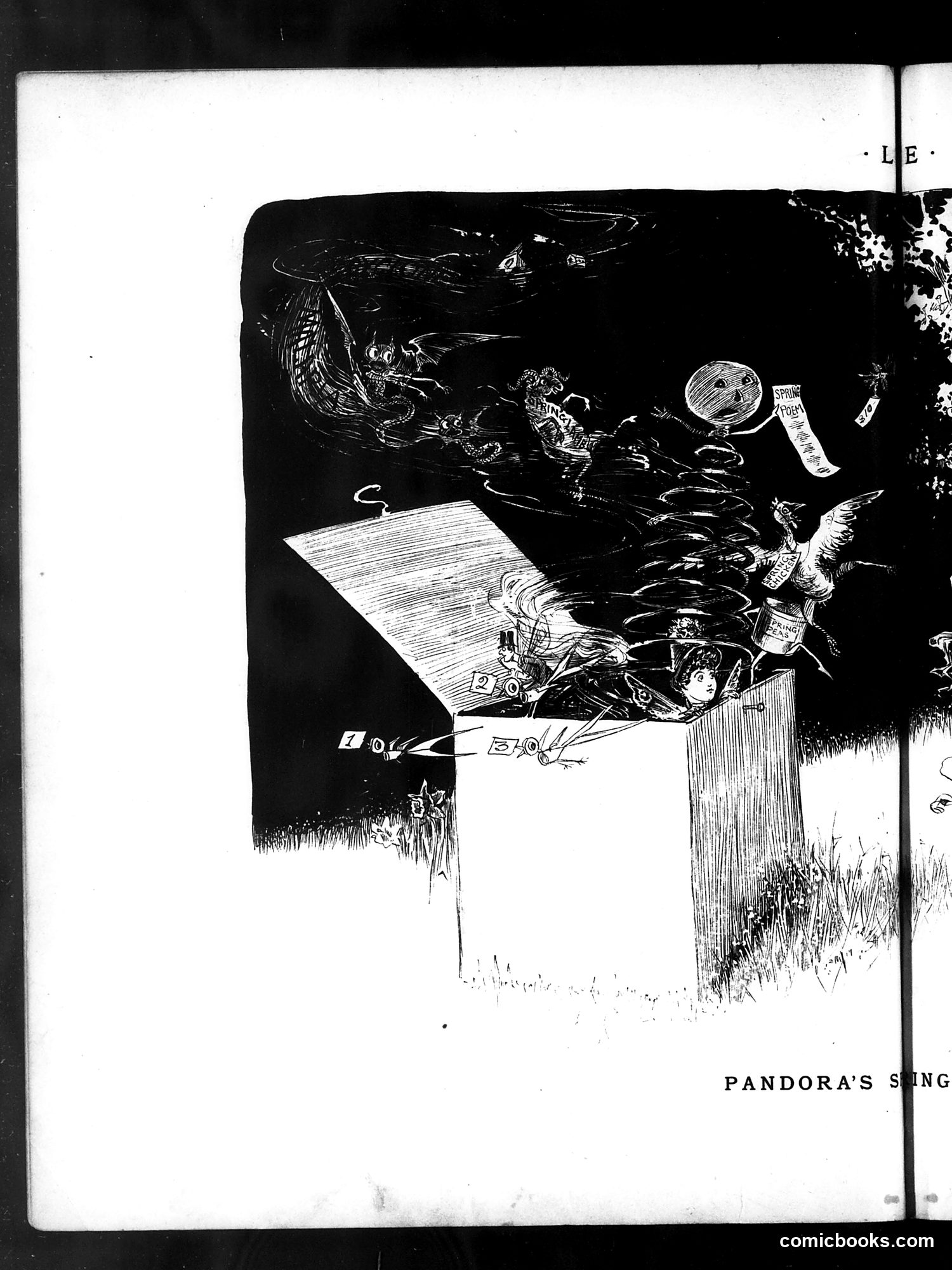
This satirical illustration depicts a large box (Pandora's Box from Greek mythology) overflowing with chaotic creatures, demons, and troublemakers. The imagery references the classical myth where opening Pandora's Box releases all evils into the world. The specific figures and labels are difficult to read clearly in this reproduction, but the cartoon appears to be social or political satire commenting on some contemporary problem or scandal—represented metaphorically as unleashing chaos. The various grotesque creatures symbolize different negative consequences or "evils" released by some action or policy. The title "Pandora's Sing" appears to be either a deliberate pun or OCR error for "Pandora's Sting," suggesting unintended negative consequences from opening something supposedly sealed away. Without clearer visibility of the labels, the specific target of satire remains unclear.
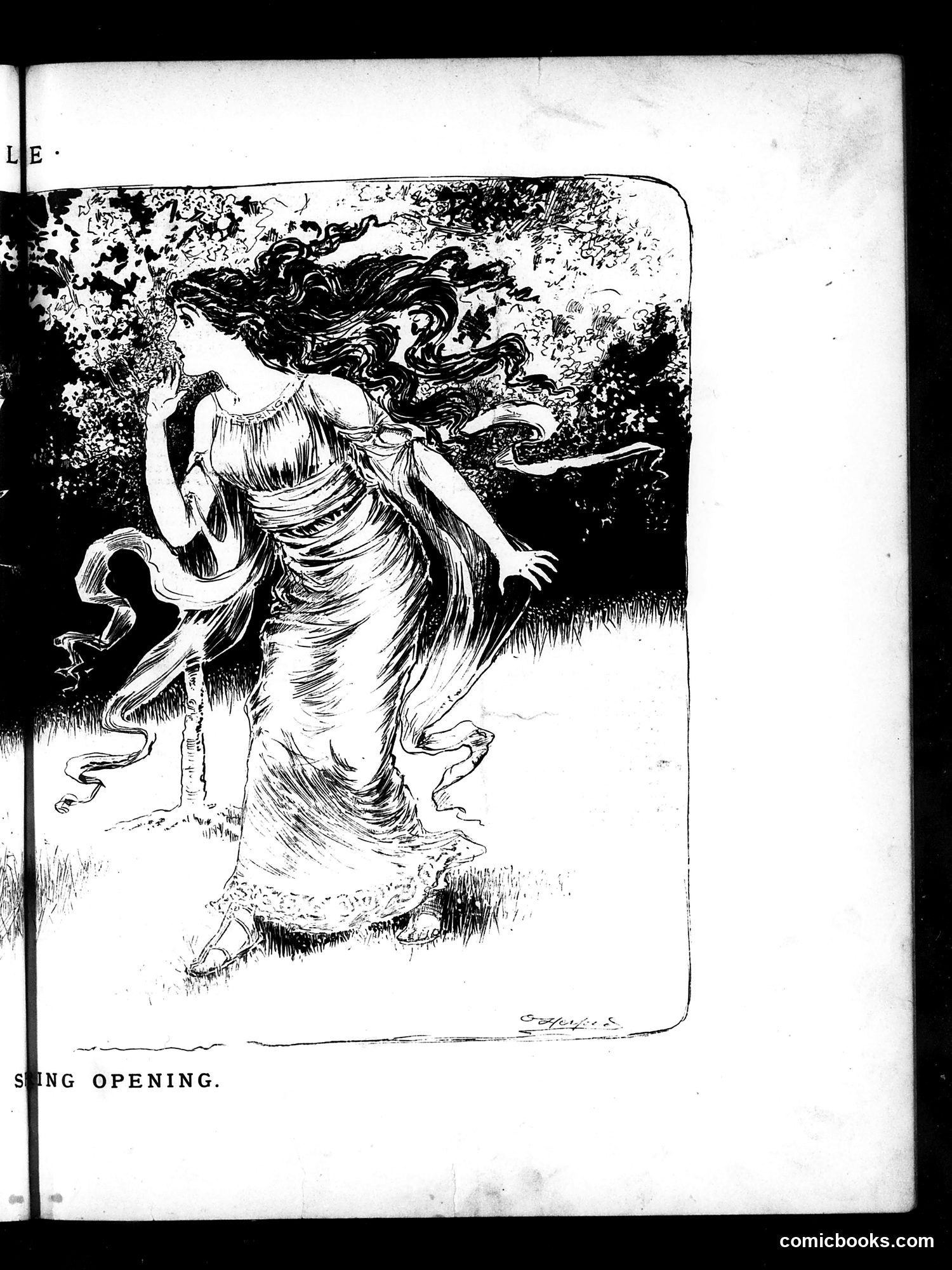
This illustration depicts a classical female figure in flowing drapery, likely representing Spring or a personification of the season. She appears to be emerging or arriving, with her hair and garments billowing dynamically. The decorative natural elements—foliage and flowering branches in the background—reinforce the seasonal theme. The title "Spring Opening" is a double entendre typical of *Life* magazine's satirical style. While ostensibly about spring's arrival, it likely carries social commentary about the fashionable "opening" of the social season—when wealthy society resumed public activities and entertainment after winter. The classical, idealized artistic treatment may be gently mocking the pretension of high society, though without additional context, the specific satirical target remains unclear.
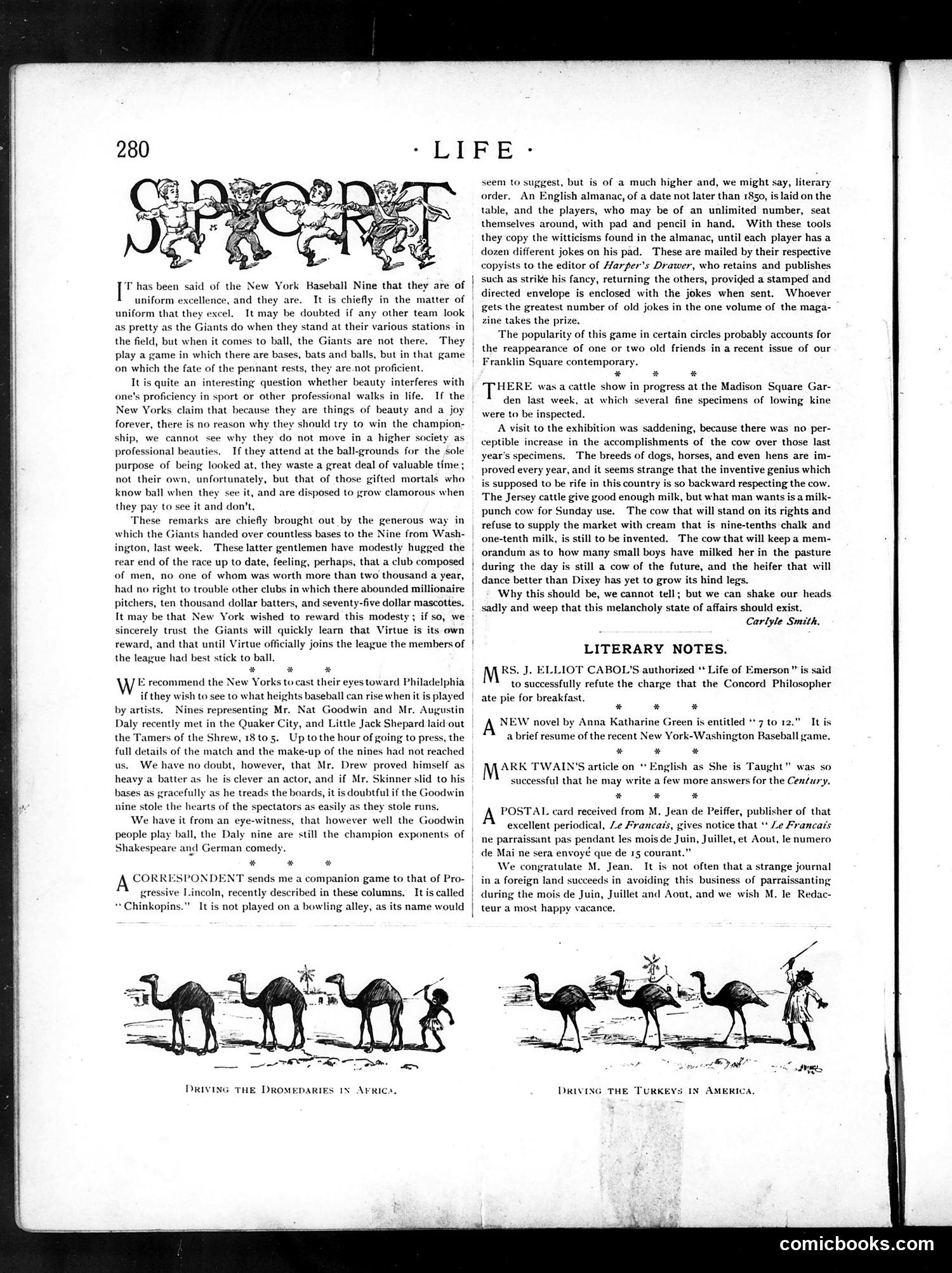
This page contains two main sections: a satirical article about the New York Giants baseball team and their uniforms, and two illustrations at the bottom labeled "Driving the Dromedaries in Africa" and "Driving the Turkeys in America." The baseball commentary critiques the Giants' lack of success despite their smart uniforms, humorously suggesting that looking good doesn't guarantee winning. The text includes literary notes about various publications and authors. The two bottom illustrations appear to be a visual joke comparing African dromedary (camel) herding to American turkey herding, likely offering a humorous contrast between exotic and domestic activities. The specific satirical point remains unclear without additional context about contemporary American attitudes toward these animals or practices.
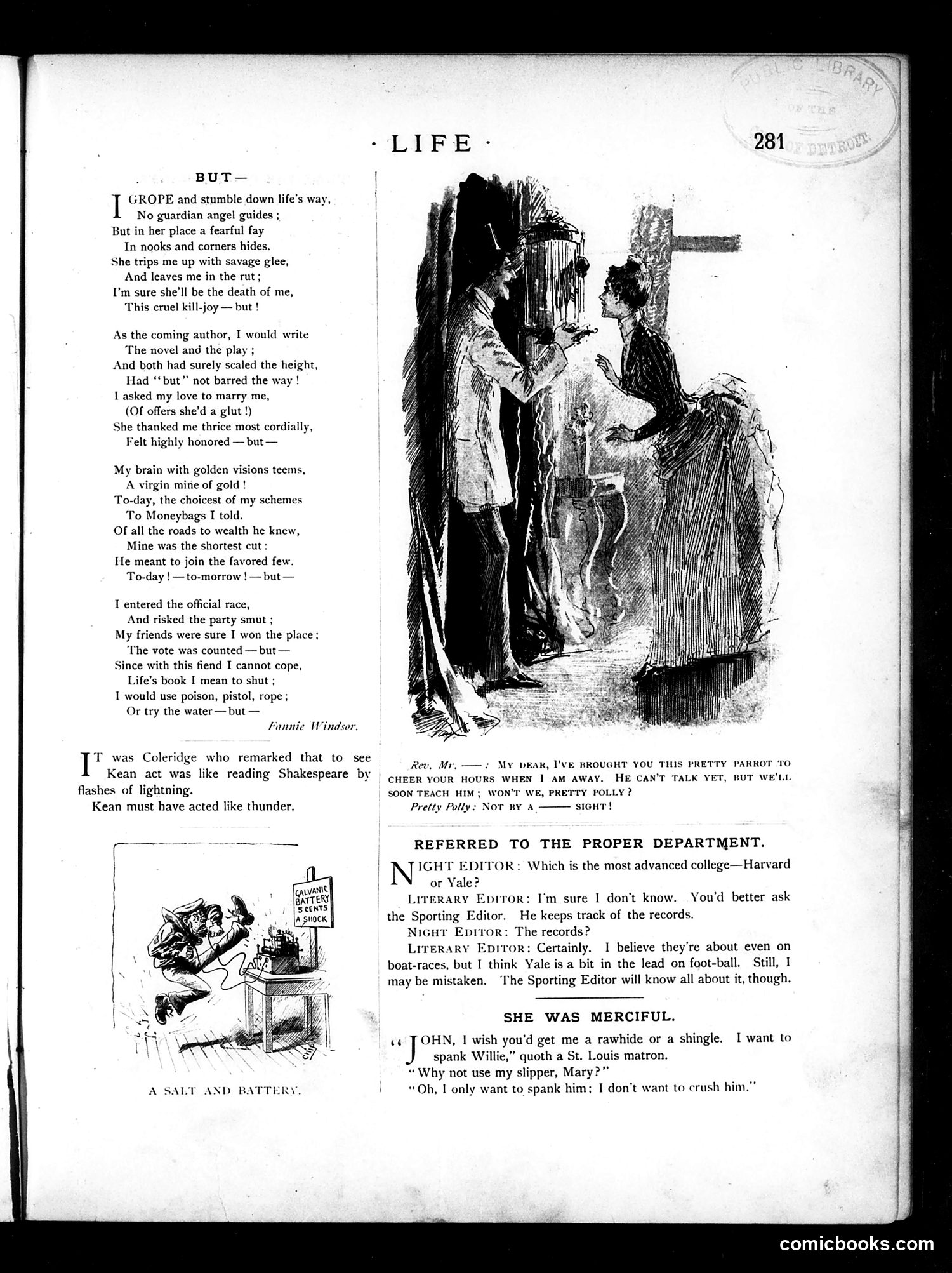
This page contains multiple humorous pieces satirizing everyday frustrations: **Main poem "But—"** by Fannie Windsor personifies the word "but" as a mischievous fairy sabotaging human ambitions. The joke is that life's plans constantly fail due to qualifications and exceptions—aspiring authors, lovers, and businessmen all encounter disappointing "buts" that prevent success. It's a clever play on how a single conjunction derails hopeful narratives. **Lower cartoons** include: - A joke about actor Edmund Kean's theatrical intensity - A conversation between editors debating whether Harvard or Yale is more advanced, with the literary editor deferring to the "Sporting Editor" on college records—satirizing how sports have become more important than academics - A domestic humor piece where a St. Louis mother wants to spank her son Willie using a rawhide rather than a slipper, joking she doesn't want to "crush him"—dark period humor about corporal punishment The page targets institutional priorities and human foibles with characteristic turn-of-the-century wit.
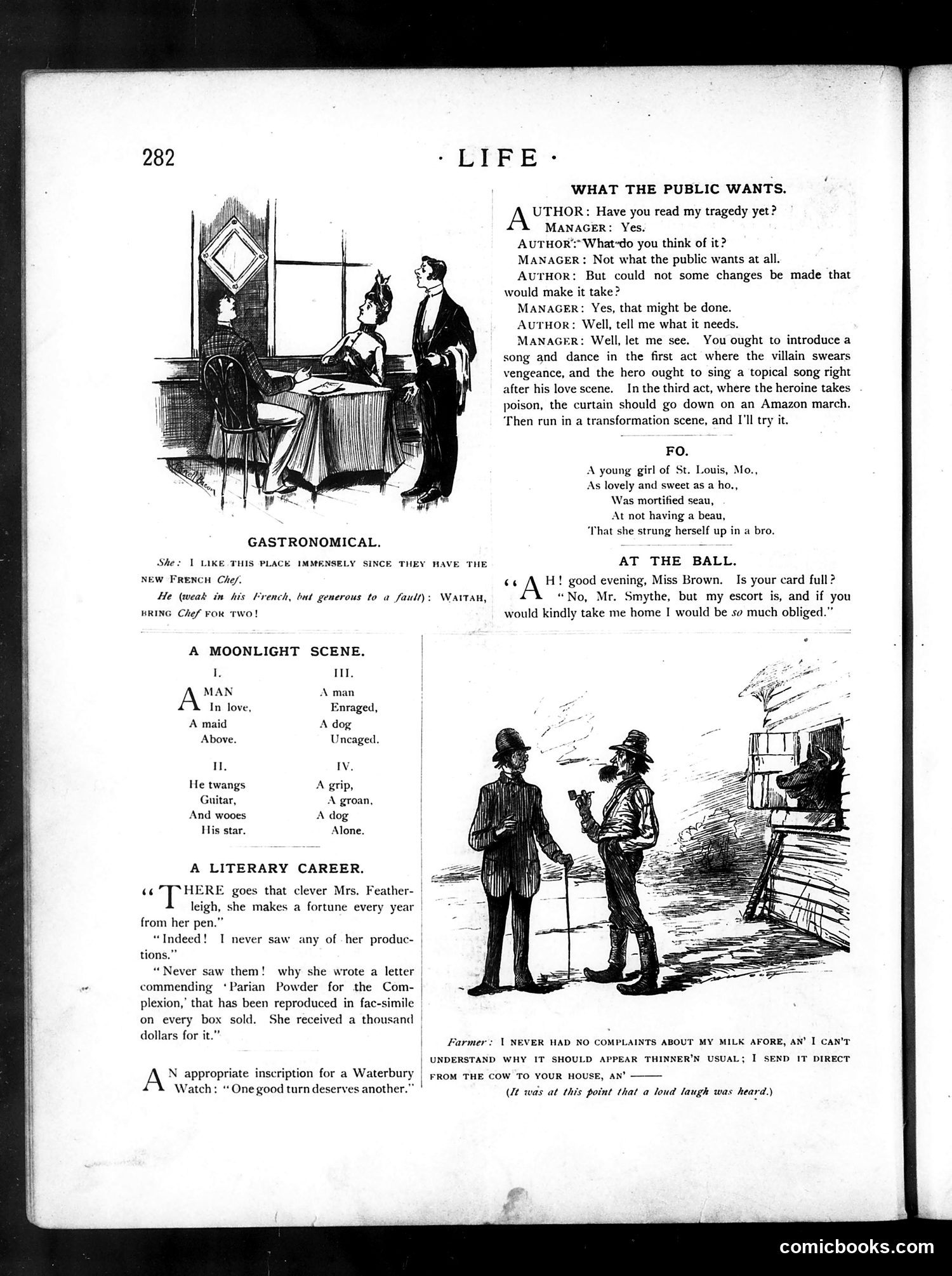
This page collects several brief satirical pieces mocking contemporary society: **"What the Public Wants"** satirizes theatrical commercialism—a playwright meets a theater manager who insists on adding songs, dances, and spectacle (an "Amazon march," "transformation scene") to make the tragedy commercially viable, regardless of artistic merit. **"Gastronomical"** jokes about pretentious dining: a woman praises a restaurant for its "new French Chef"; her companion, misunderstanding French, tells the waiter to bring the chef for two people. **"A Moonlight Scene"** parodies romantic poetry with a rhyming scheme reducing love to clichés. **"A Literary Career"** mocks commercialized writing: Mrs. Featherleigh makes a fortune not from novels but from writing a single endorsement letter for cosmetics, reproduced on product boxes. **"At the Ball"** presents a flirtation joke about a woman's dance card being full (because her escort took all slots). The overall theme: American culture prioritizes commercial appeal and advertising over genuine art and substance.
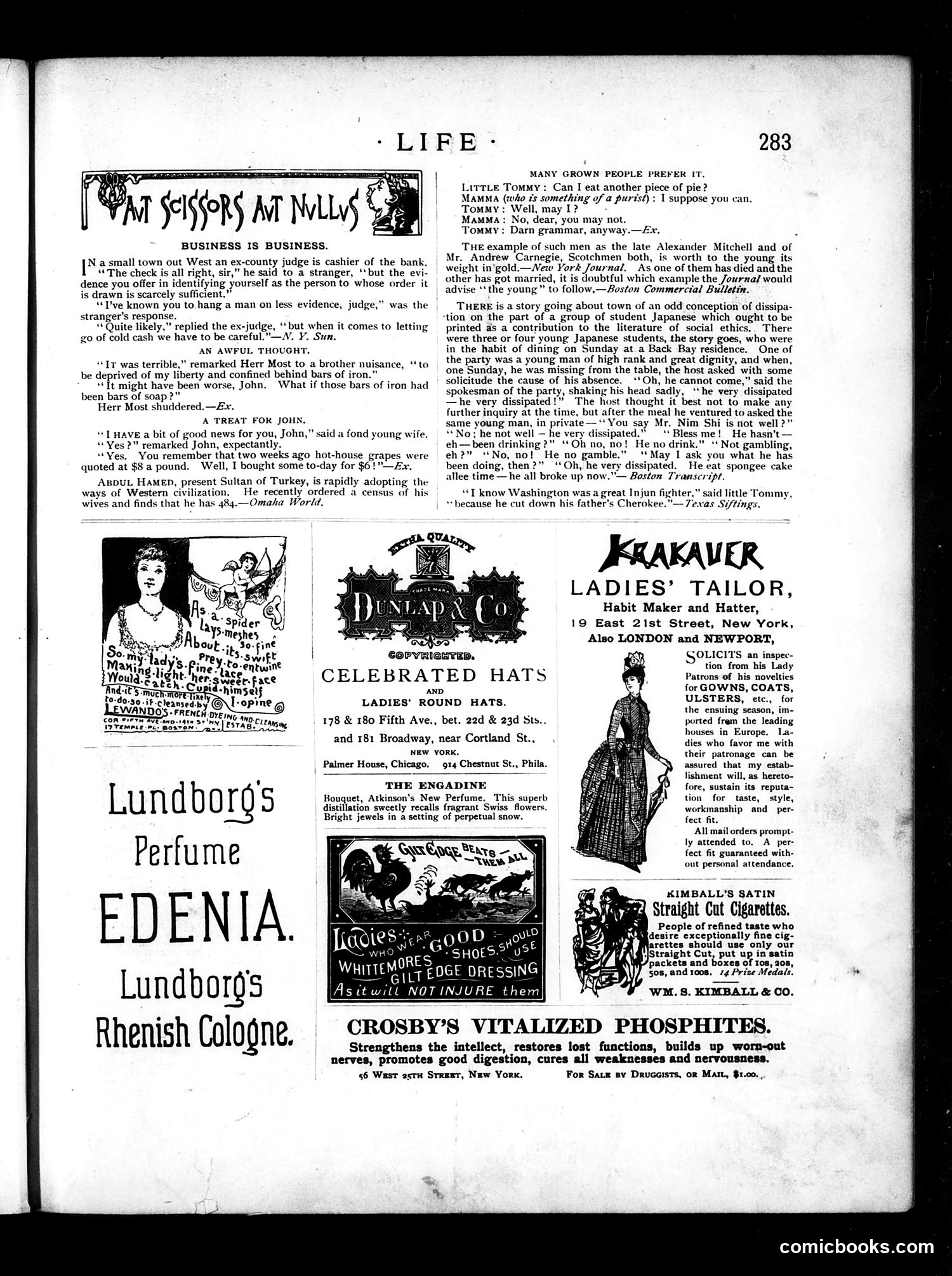
This page primarily contains **advertisements and brief satirical anecdotes** rather than political cartoons. The humor targets social absurdities of the era: **"Business is Business"**: An ex-judge who hanged men casually now demands careful evidence before releasing bank funds—satirizing hypocrisy about due process. **"An Awful Thought"**: References "Herr Most," likely Johann Most, a German-American anarchist/socialist agitator, imprisoned for radical views. The joke: even he'd find soap bars worse than iron bars—a dark jab at anarchists. **"A Treat for John"**: Mild domestic humor about a wife's frugal grape purchase. **"Abdul Hamen"**: Notes Sultan Abdul Hamid II adopted Western ways, recently ordered a census of his 484 wives—satirizing his modernization efforts while highlighting his polygamy. **The Japanese students anecdote**: Mocks a cultural misunderstanding where "dissipation" (meaning debauchery) gets confused; the student actually meant overeating sponge cake—gentle ethnic humor playing on language barriers. The page is largely advertising space with small comedic fillers typical of Life's format.
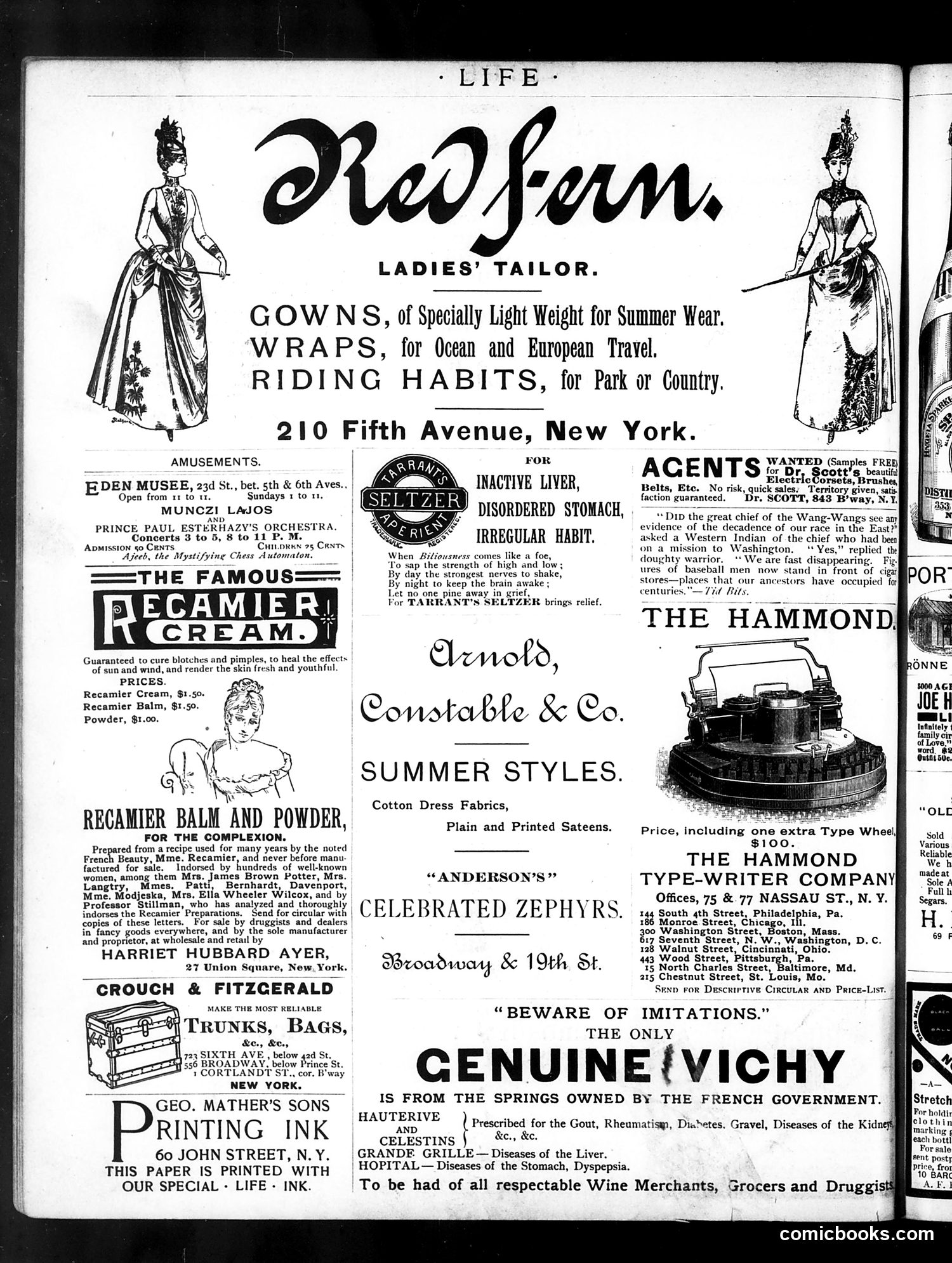
This is primarily an **advertising page**, not a satirical cartoon page. It contains various late 19th-century commercial advertisements. Notable content includes: **Fashion & Services**: Red Fern (ladies' tailor), Crouch & Fitzgerald (trunks/bags), Hammond typewriters **Health Products**: Recamier cosmetics (endorsed by famous actresses like Lillie Langtry and Sarah Bernhardt), Tarrant's Seltzer for liver complaints, Vichy water **Entertainment**: Eden Musée (wax museum with chess-playing automaton "Ajeeb"), Prince Paul Esterházy's orchestra concerts **The "Wang-Wangs" Reference**: A brief text snippet discusses a Western Indian chief lamenting racial decline, citing baseball players replacing ancestral traditions—likely a period commentary on Native American cultural displacement. The page reflects **Gilded Age consumer culture**: emphasis on European products, celebrity endorsements, and medicinal remedies marketed as cure-alls. No coherent cartoon narrative exists; this is commercial content disguised as editorial space.
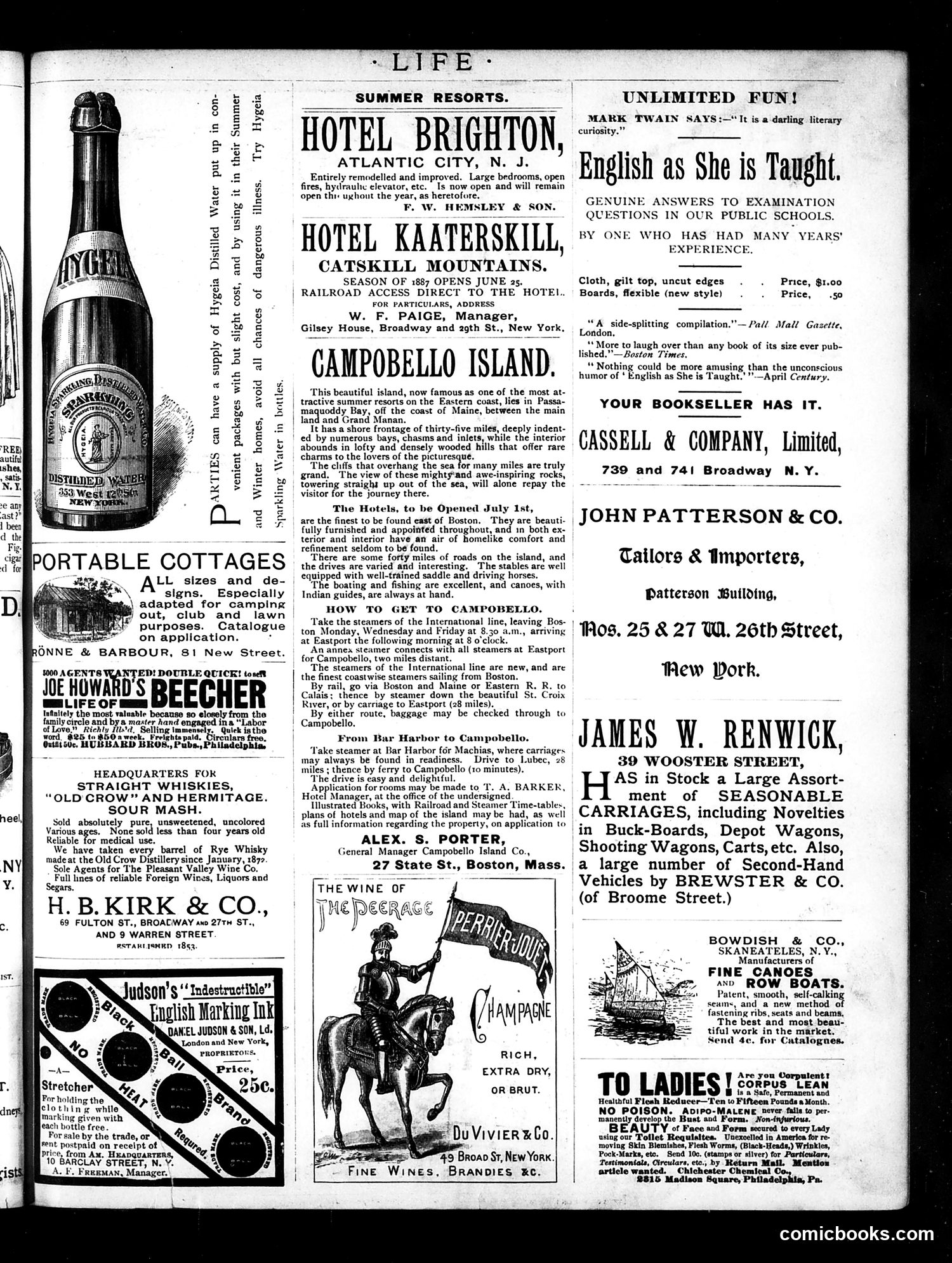
This is primarily an **advertising page** from Life magazine's summer resort section (circa 1887, based on hotel opening dates). The main content promotes vacation destinations—Hotel Brighton in Atlantic City, Hotel Kaaterskill in the Catskills, and Campobello Island in Maine—along with various commercial products (whiskey, portable cottages, carriages, wines). The advertisements reflect Gilded Age leisure culture: wealthy readers could afford steam travel, resort hotels, and recreational carriages. Notable is the marketing emphasis on "refined comfort" and detailed travel logistics—steamers, rail connections, and carriage services—indicating how vacation was a complex, expensive undertaking for the upper classes. There is **no political cartoon** on this page. The only illustration (aside from product bottles and logos) shows a figure on horseback advertising champagne, a simple commercial image with no satirical intent.
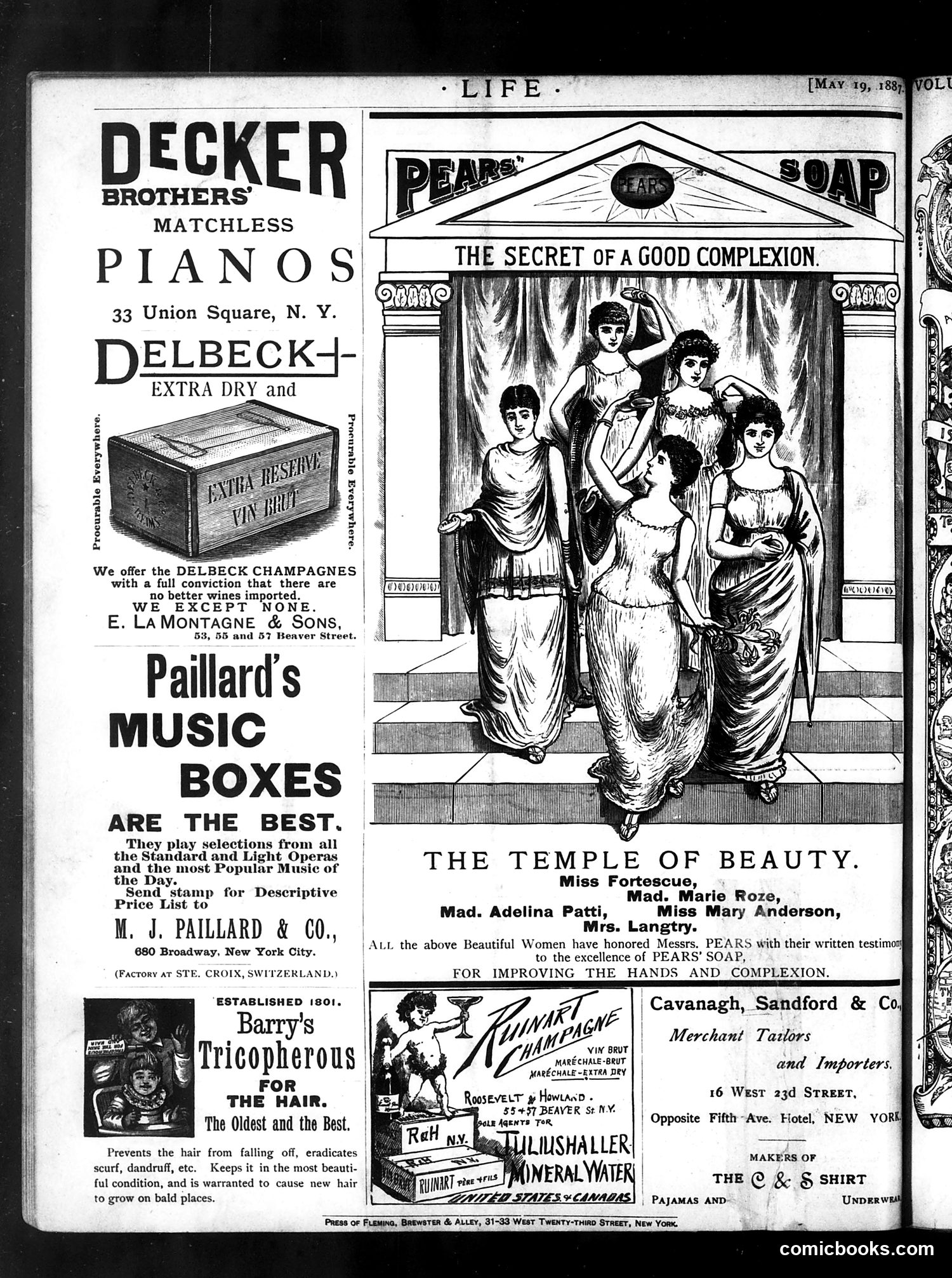
This page is primarily **advertising**, not editorial satire. It features Victorian-era commercial endorsements arranged around a central illustrated advertisement. The main image, "The Temple of Beauty," depicts five fashionable women in classical Greek dress promoting Pears' Soap. The advertisement leverages celebrity endorsement—a novel marketing technique—by listing famous actresses of the era (Adelina Patti, Marie Roze, Mary Anderson, and Lillie Langtry) who allegedly testified to the soap's efficacy for improving complexions and hands. Surrounding this are ads for luxury goods: Decker Brothers pianos, Delbeck champagne, Paillard music boxes, Barry's Tricotherou hair treatment, and tailoring services. The satire, if any exists, is subtle: the page implicitly mocks the absurdity of celebrity endorsements and beauty claims by presenting them alongside equally dubious product promises. The notion that famous actresses' testimonies could guarantee soap quality—when most likely paid—suggests the era's nascent understanding of advertising manipulation.