
Life, 1887-05-19 · page 6 of 16
Life — May 19, 1887 — page 6: what you’re looking at
What you’re looking at
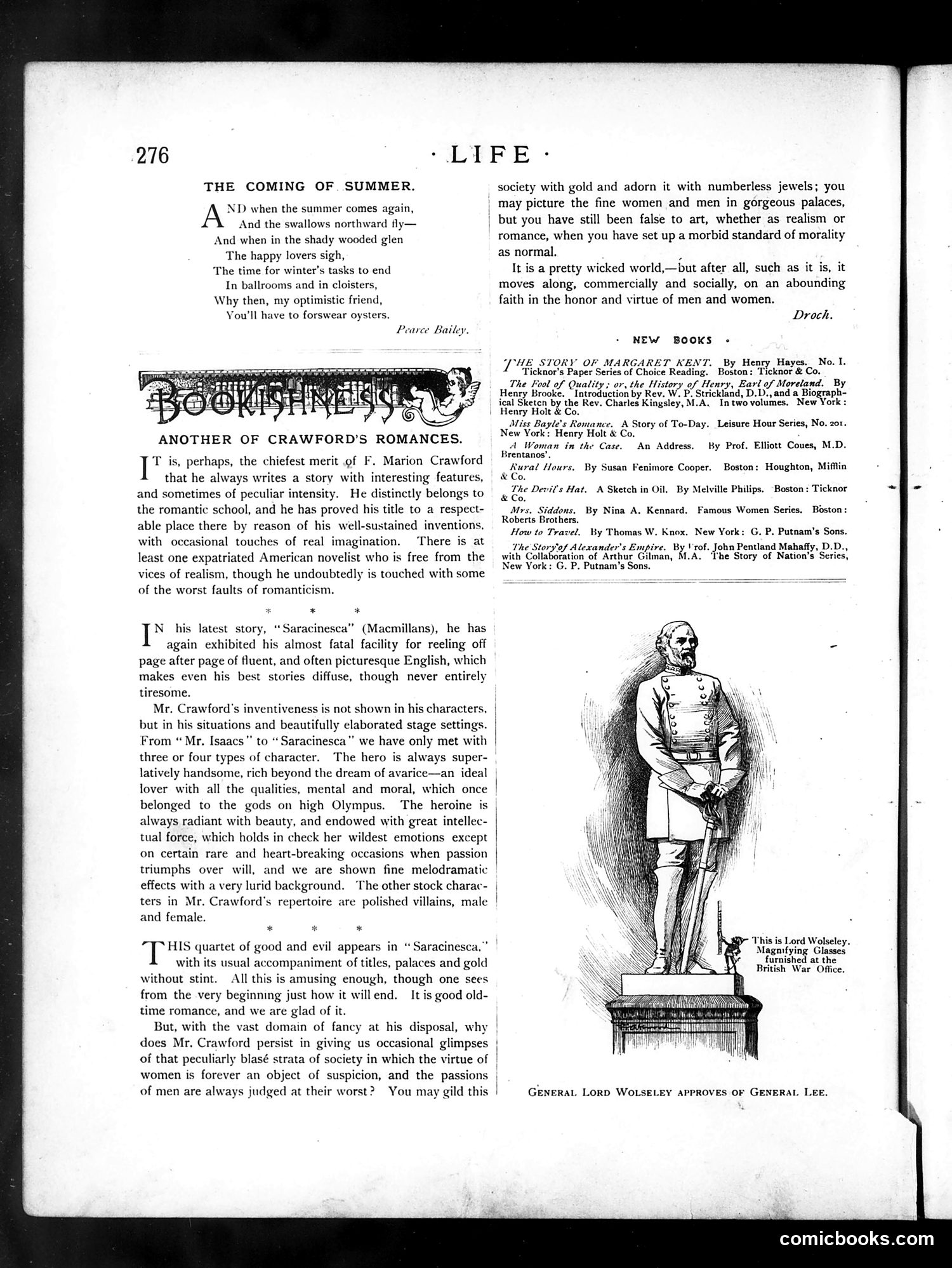
This page contains a literary review of F. Marion Crawford's romance novel "Saracinesca" alongside a statue illustration. The main image shows a standing military figure in uniform on a pedestal, captioned "General Lord Wolseley approves of General Lee." The caption appears to reference British General Wolseley endorsing American General Robert E. Lee—likely satirizing either contemporary military admiration across national lines or possibly making a pointed comment about celebrating Confederate figures. The juxtaposition is unclear without fuller historical context, but seems to critique either misplaced approval or questionable hero-worship. The text section critiques Crawford's romantic fiction for depicting virtue in women as perpetually suspect while portraying men's passions sympathetically—a social commentary on Victorian double standards regarding gender and morality.
📄 Transcribed text from this page (OCR, searchable)
Machine-transcribed from the original scan — historical spelling and the odd misread are preserved.
- LIFE - THE COMING OF. SUMMER. ND when the summer comes again, And the swallows northward fly— And when in the shady wooded glen The happy lovers sigh, The time for winter's tasks to end In ballrooms and in cloisters, Why then, my optimistic friend, You'll have to forswear oysters. Pearce Bailey. ANOTHER OF CRAWFORD’S ROMANCES. T is, perhaps, the chiefest merit of F. Marion Crawford that he always writes a story with interesting features, and sometimes of peculiar intensity. He distinctly belongs to the romantic school, and he has proved his title to a respect- able place there by reason of his well-sustained inventions, with occasional touches of real imagination. There is at least one expatriated American novelist who is free from the vices of realism, though he undoubtedly is touched with some of the worst faults of romanti I" his latest story, “Saracinesca” (Macmillans), he has again exhibited his almost fatal facility for reeling off page after page of fluent, and often picturesque English, which makes even his best stories diffuse, though never entirely tiresome. Mr. Crawford's inventiveness is not shown in his characters but in his situations and beautifully elaborated stage settings. From “ Mr. Isaacs” to “ Saracinesca three or four types of character. The hero is always super- latively handsome, rich beyond the dream of avarice—an ideal lover with all the qualities, mental and moral, which once belonged to the gods on high Olympus. The heroine is always radiant with beauty, and endowed with great intellec- tual force, which holds in check her wildest emotions except on certain rare and heart-breaking occasions when passion triumphs over will, and we are shown fine melodramatic effects with a very lurid background. ‘The other stock charac- ters in Mr. Crawford's repertoire are polished villains, male and female. * ‘ * HIS quartet of good and evil appears in “ Saracinesca,” with its usual accompaniment of titles, palaces and gold without stint. All this is amusing enough, though one sees from the very beginning just how it willend. It is good old- time romance, and we are glad of it. But, with the vast domain of fancy at his disposal, why does Mr. Crawford persist in giving us occasional glimpses | of that peculiarly blasé strata of society in which the virtue of women is forever an object of suspicion, and the passions of men are always judged at their worst? You may gild this "we have only met with | society with gold and adorn it with numberless jewels; you may picture the fine women and men in gorgeous palaces, but you have still been false to art, whether as realism or romance, when you have set up a morbid standard of morality as normal. ; It is a pretty wicked world,—but after all, such as it is, it moves along, commercially and socially, on an abounding faith in the honor and virtue of men and women. Droch. NEW BOOKS - HE STORY OF MARGARET KENT. By Henry Hayes. No. I. ‘Ticknor's Paper Series of Choice Reading. Boston: Ticknor & Co. The Fool of Quatity ; or, the History of Henry, Earl of Moreland. By Henry Brooke. "Introduction by Rev. W. P. Strickland, D.D., and a Biograph- ical Sketen by the Rev. Charles Kingsley, M.A. Intwo volumes. New York: Henry Holt & Co. Miss Bayle's Romance. A Story of To-Day. Leisure Hour Series, No. 20r. New York: Henry Holt & Co, A Woman in the Case. Brentanos’. An Address. By Prof. Elliott Coues, M.D. Rural Hours. By Susan Fenimore Cooper. & ag {he Devil's Hat. A Sketch in Oil. By Melville Philips. Boston : Ticknor °°. Boston: Houghton, Mifflin Mrs, Siddons, Roberts Brothers. How to Travel, By Nina A. Kennard. Famous Women Series, Boston: By Thomas W. Knox. New York: G. P. Putnam’s Sons. The Story'of Alexander's Empire. By Vrof. John Pentland Mahaffy, D.D. with Collaboration of Arthur Gilman, M.A, ‘The Story of Nat s New York: G. P. Putnam's Sons. This is Lord Wolseley. Magnifying Glasses furnished at the British War Office. GENERAL LORD WOLSELEY APPROVES OF GENERAL LEE. comicbooks.com