
A complete issue · 16 pages · 1887
Life — May 12, 1887
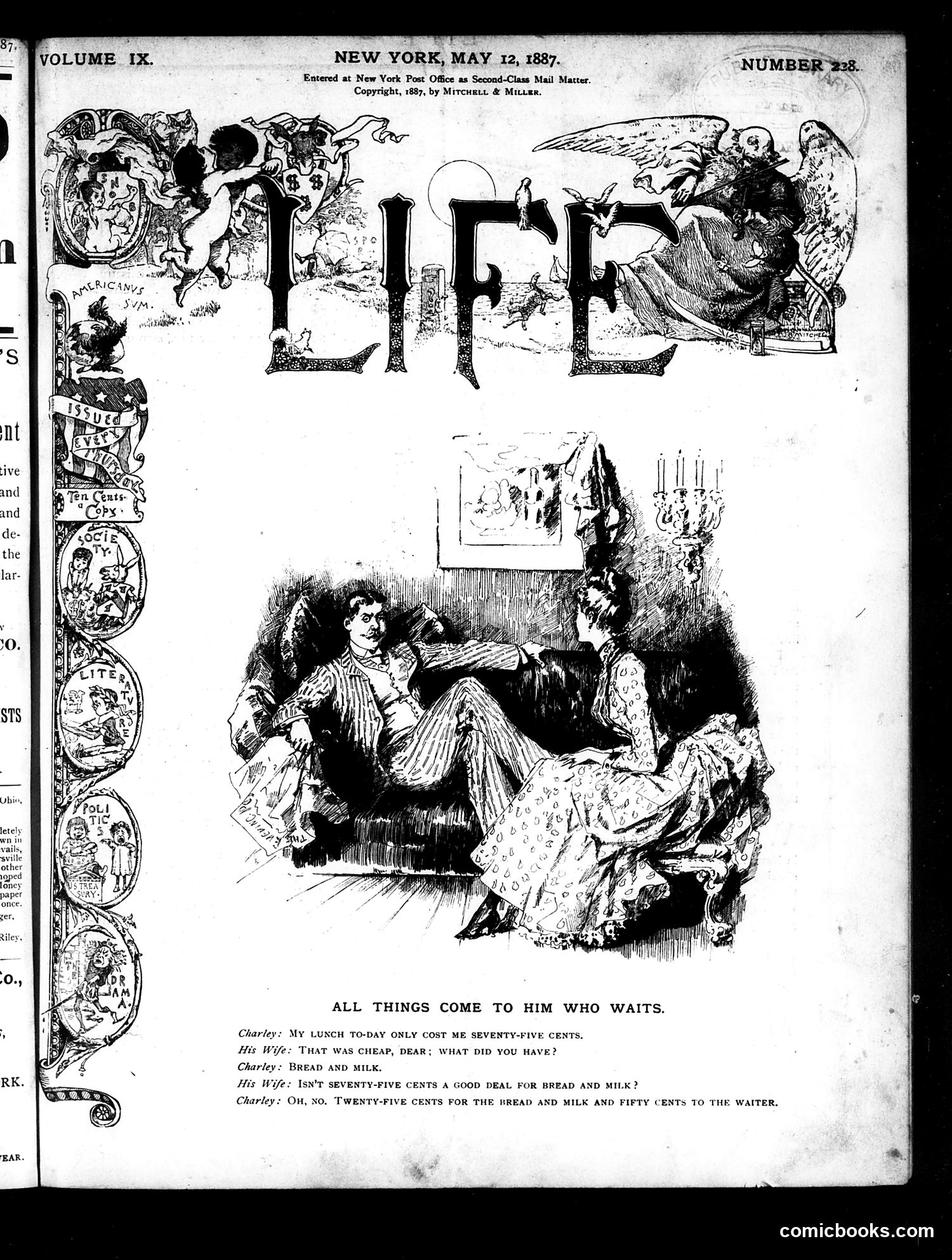
This page contains a satirical cartoon titled "All Things Come to Him Who Waits," depicting a domestic scene where a husband complains about lunch costs. **The Joke:** Charles spent only 75 cents on lunch (bread and milk), but his wife questions the expense. He defends himself, revealing he actually paid 25 cents for bread and milk, with 50 cents going to the waiter as a tip—an absurdly generous gratuity that defeats the purpose of economizing. **The Satire:** The cartoon mocks middle-class anxieties about household expenses and servant/worker wages during the Gilded Age. It satirizes both husbands' attempts at frugality and the tipping culture that undermined such efforts, presenting the economic tensions between employers and service workers in American society.
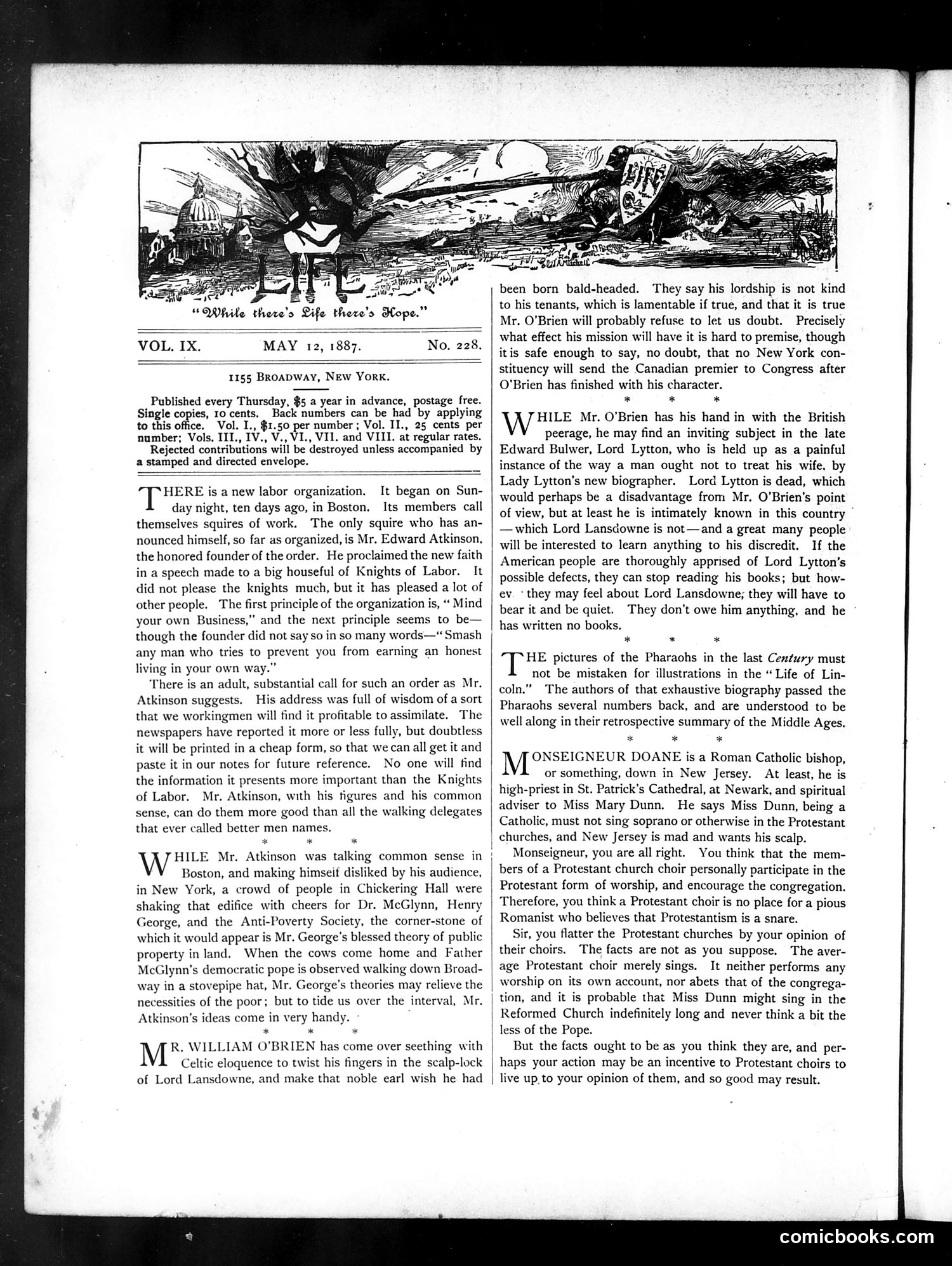
The ornate header cartoon titled "While there's Life there's Hope" depicts a nightmarish or chaotic scene with a large dark figure looming over a cityscape that includes a domed building (likely the U.S. Capitol). The imagery appears allegorical rather than depicting specific identifiable figures. The accompanying text discusses Edward Atkinson's new "Knights of Labor" organization, critiquing its founder's motto "Mind your own Business" as contradictory. The page also addresses William O'Brien's political mission and discusses Monseigneur Doane's views on Catholic clergy participation in Protestant church choirs. The header's meaning remains unclear without additional historical context, though its ominous tone suggests satirizing contemporary social or political anxieties of the 1880s.
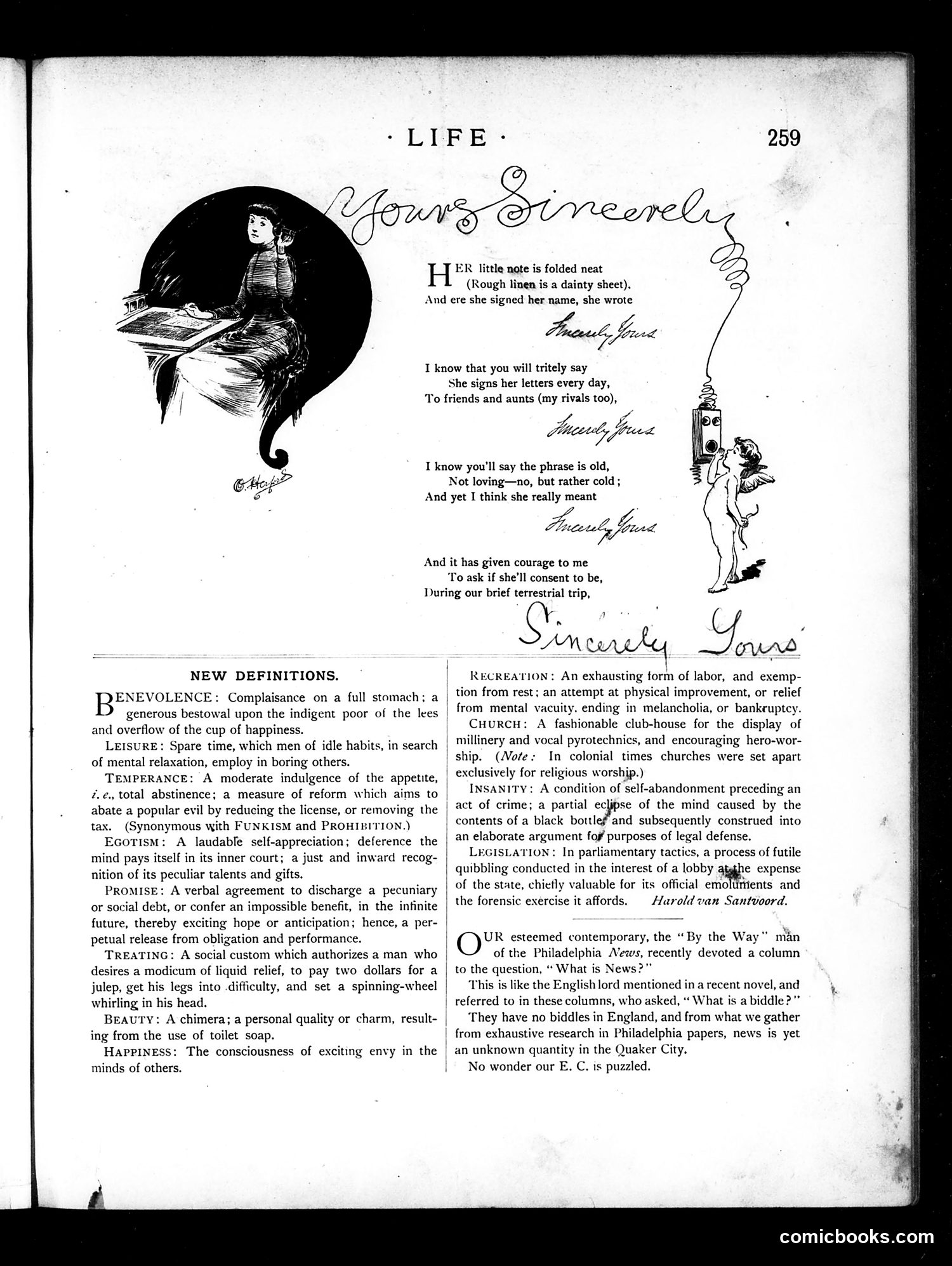
This page presents a humorous poem about a young woman's letter-writing habits, illustrated with two sketches. The left image shows a woman writing at a desk, while the right depicts Cupid with a mail-drop, suggesting romantic correspondence. The poem gently mocks the addressee for signing all her letters "Yours Sincerely" to friends, aunts, and rivals alike—a formal, emotionally reserved closing. The narrator finds this amusing yet touching, as it reveals her shyness about expressing genuine affection directly. The satire targets Victorian-era social conventions around emotional restraint and the formality of correspondence. The juxtaposition of Cupid (representing love) with stiff letter-writing protocol creates the humorous tension—she hides real feeling behind proper epistolary etiquette.
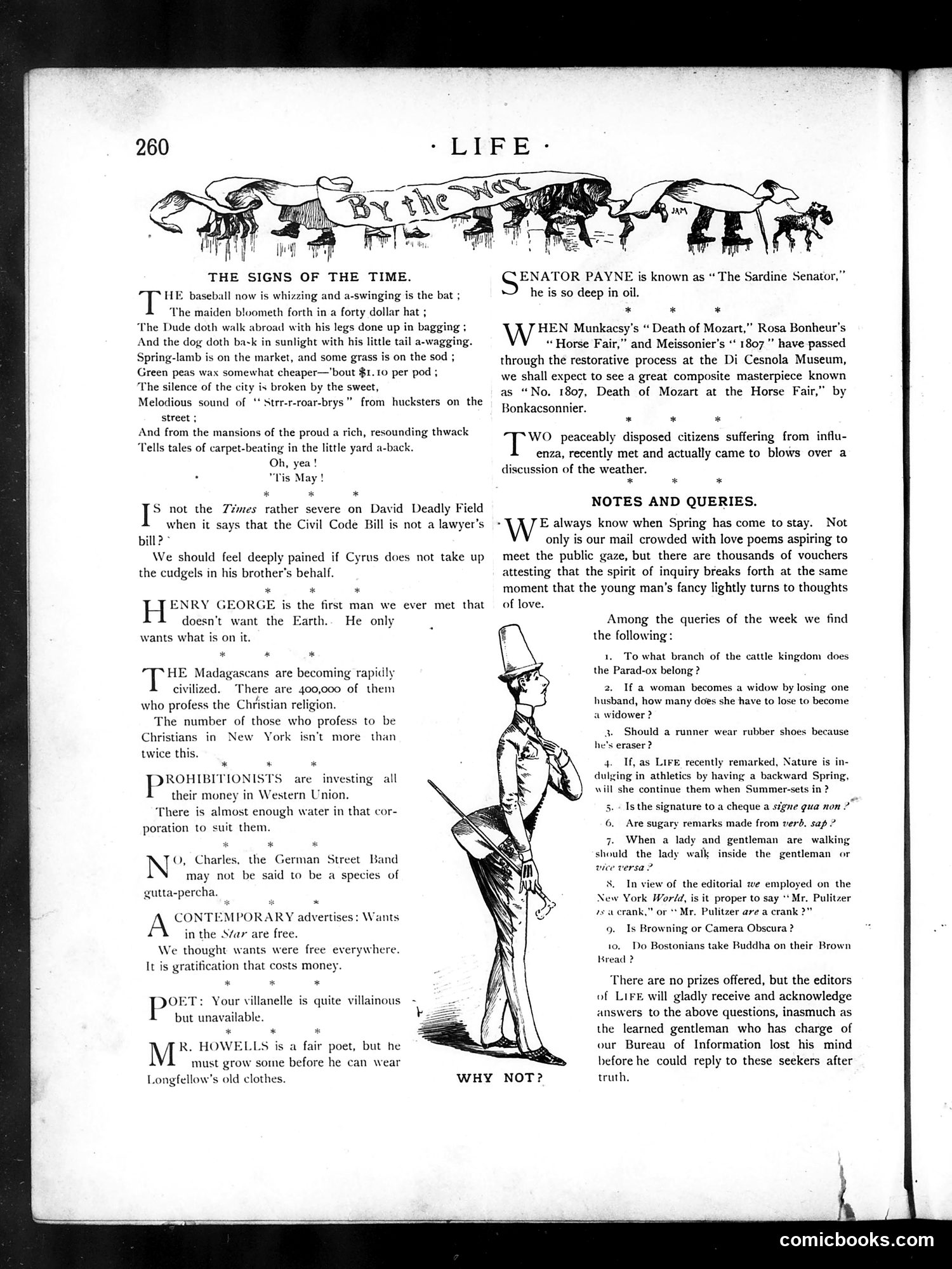
This page contains satirical commentary on contemporary issues rather than political cartoons. The main illustration shows a tall, thin gentleman in formal dress labeled "WHY NOT?" - appearing to mock someone's appearance or social pretensions. The text sections critique various topics: David Deadly Field and the Civil Code Bill, Henry George's economic views, Madagascan Christian conversion, prohibitionists investing in Western Union, and a German street band. There's also a "Notes and Queries" section answering reader questions on miscellaneous topics. The satire targets social pretension, political incompetence, and hypocrisy typical of 1880s-90s Life magazine. Without clearer context on specific figures referenced, the precise targets remain somewhat unclear, though the tone is consistently mocking of contemporary society and politics.
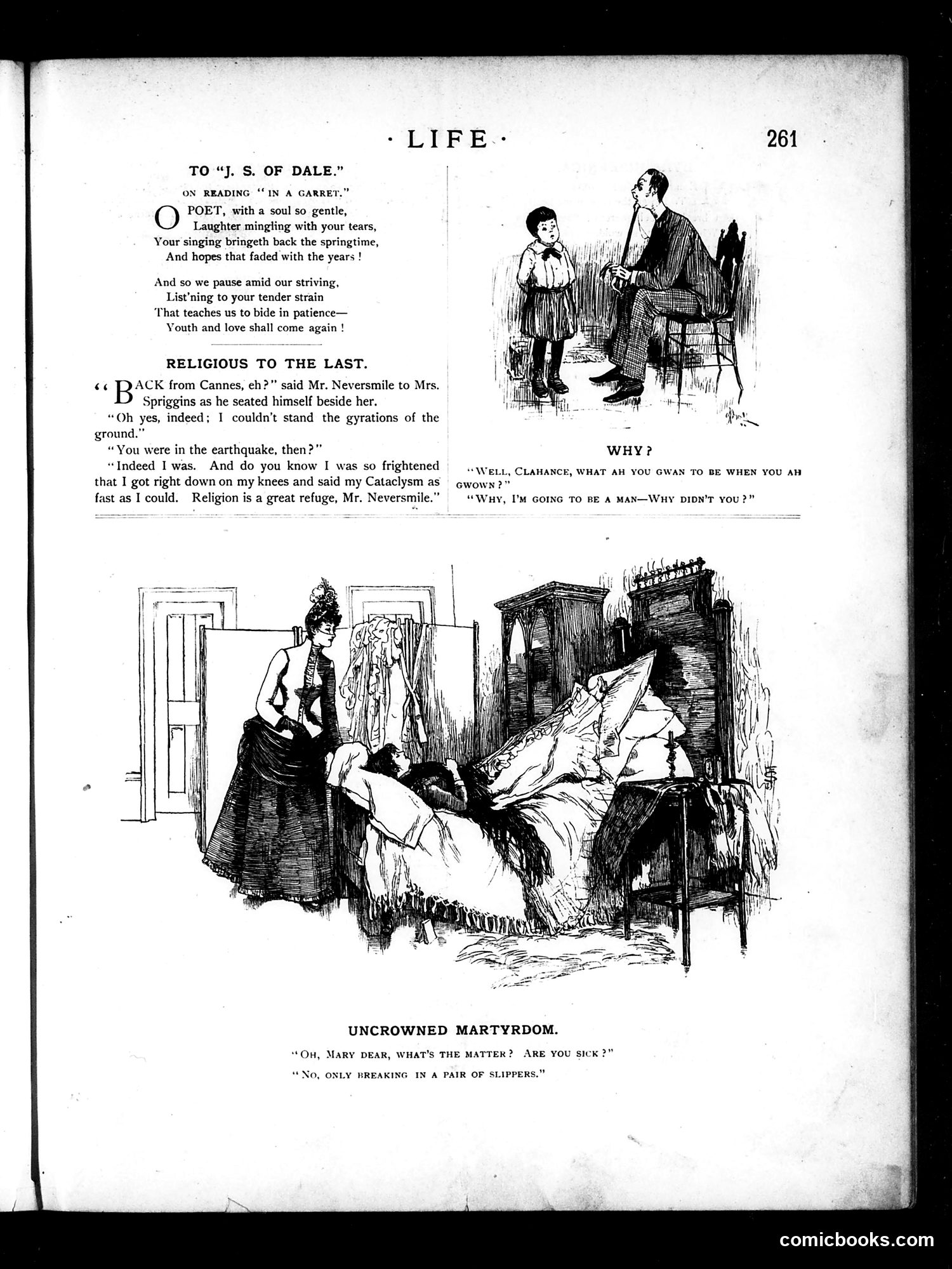
This page contains two separate pieces: **Top section:** A poem "To J.S. of Dale" praising a gentle poet, followed by "Religious to the Last"—a brief anecdote about Mr. Nevermile comforting Mrs. Spriggins during an earthquake by citing religion as refuge. **Bottom cartoon:** "Uncrowned Martyrdom" depicts a woman in bed with a minor injury (broken slippers), while another woman attends her. The humor relies on the contrast between "martyrdom" and a trivial domestic mishap—satirizing how women (or people generally) dramatize minor ailments or inconveniences as major suffering. The cartoon critiques performative victimhood or exaggeration of personal troubles as entertainment. The page's overall tone is gently mocking of human nature's tendency toward melodrama.
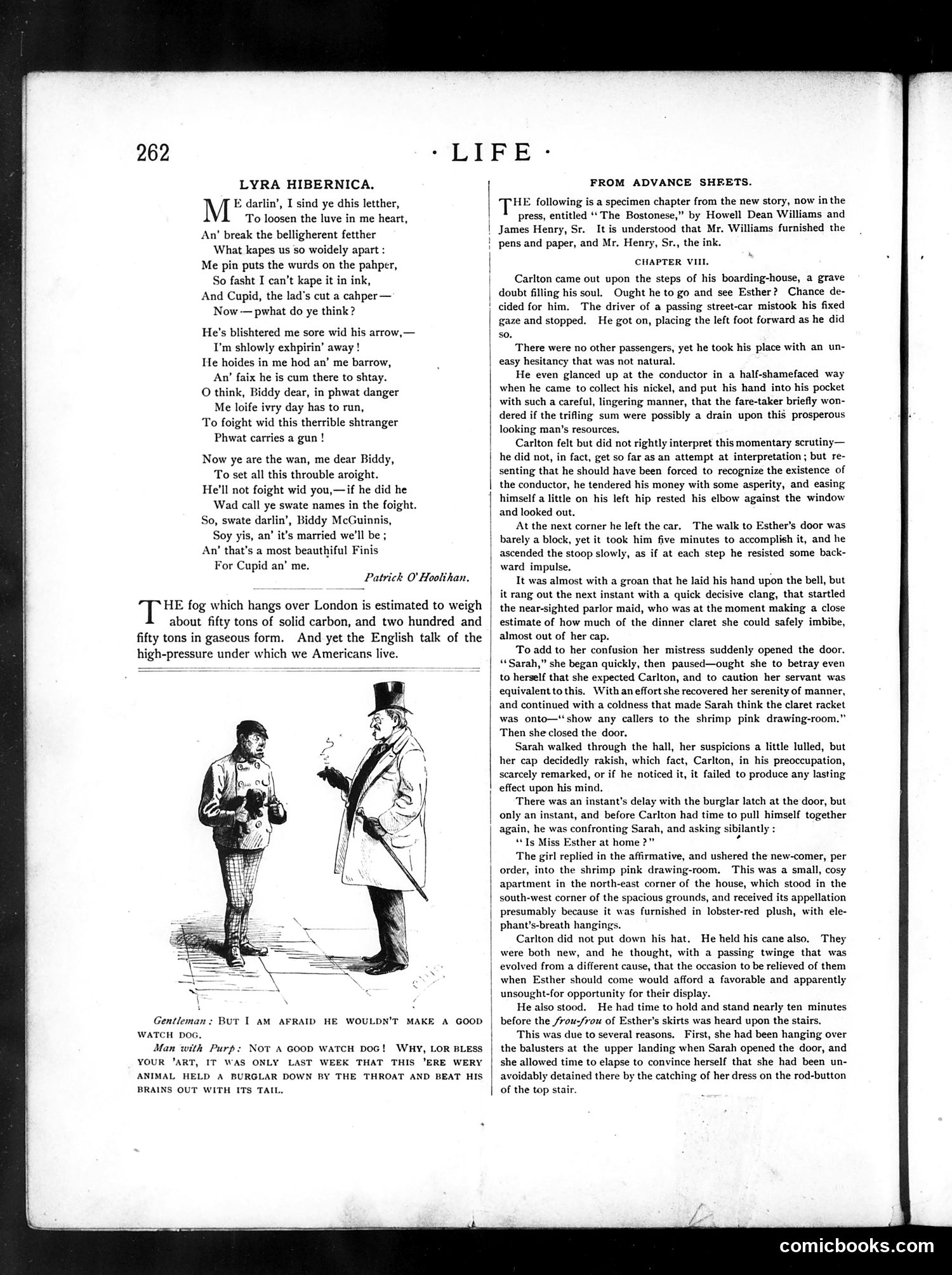
The page contains two distinct sections: poetry ("Lyra Hibernica" by Patrick O'Hoolihan) on the left, and a prose excerpt from "The Bostonese" by Henry Dean Williams and James Henry, Sr. on the right. The cartoon depicts two gentlemen in Victorian dress. The caption reads: "Gentleman: But I am afraid he wouldn't make a good watch dog. Man with Pup: Not a good watch dog! Why, lor bless you, sir, it was only last week that this 'ere very animal held a burglar down by the throat and beat his brains out with his tail." This is a humorous visual joke playing on the absurdity of the claim—the small dog's purported ferocity is presented as fact by its proud owner, while the gentleman expresses obvious skepticism. The satire mocks pet owners' tendency to exaggerate their animals' abilities and courage.
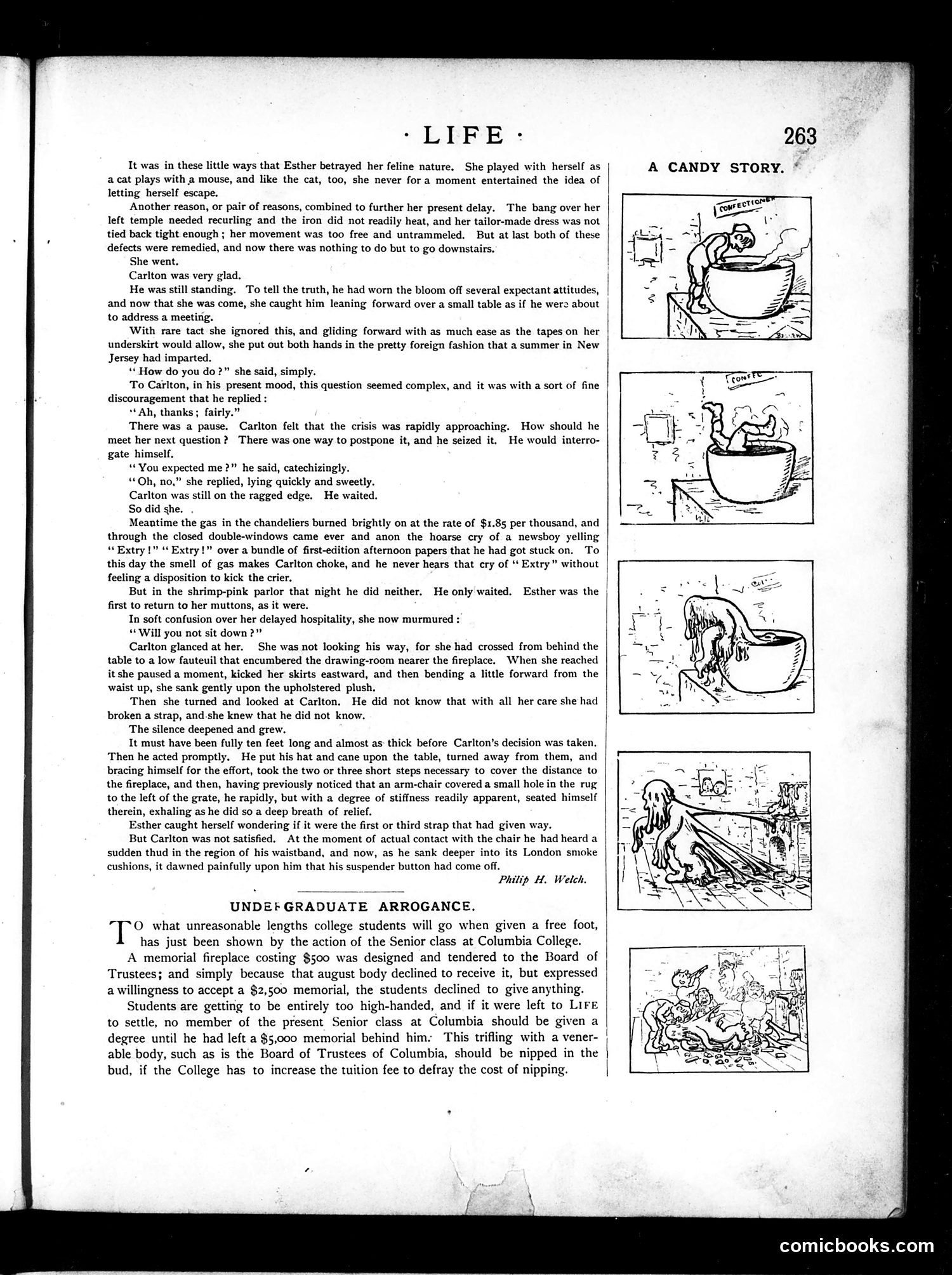
The page contains two distinct items: **"A Candy Story"** (illustrated, top): A humorous comic strip showing someone making candy in a large pot. The sequential panels appear to depict slapstick mishaps during the candy-making process, typical of early-20th-century comic humor focused on domestic accidents and physical comedy. **"Undergraduate Arrogance"** (bottom text): This satirical piece criticizes Columbia College students for refusing a $2,500 memorial gift from the Board of Trustees. The author mocks student entitlement, arguing they expect expensive memorials without contributing themselves. The satire suggests students have become "high-handed" and suggests raising tuition to fund their demands—a pointed jab at perceived undergraduate arrogance and unreasonable expectations.
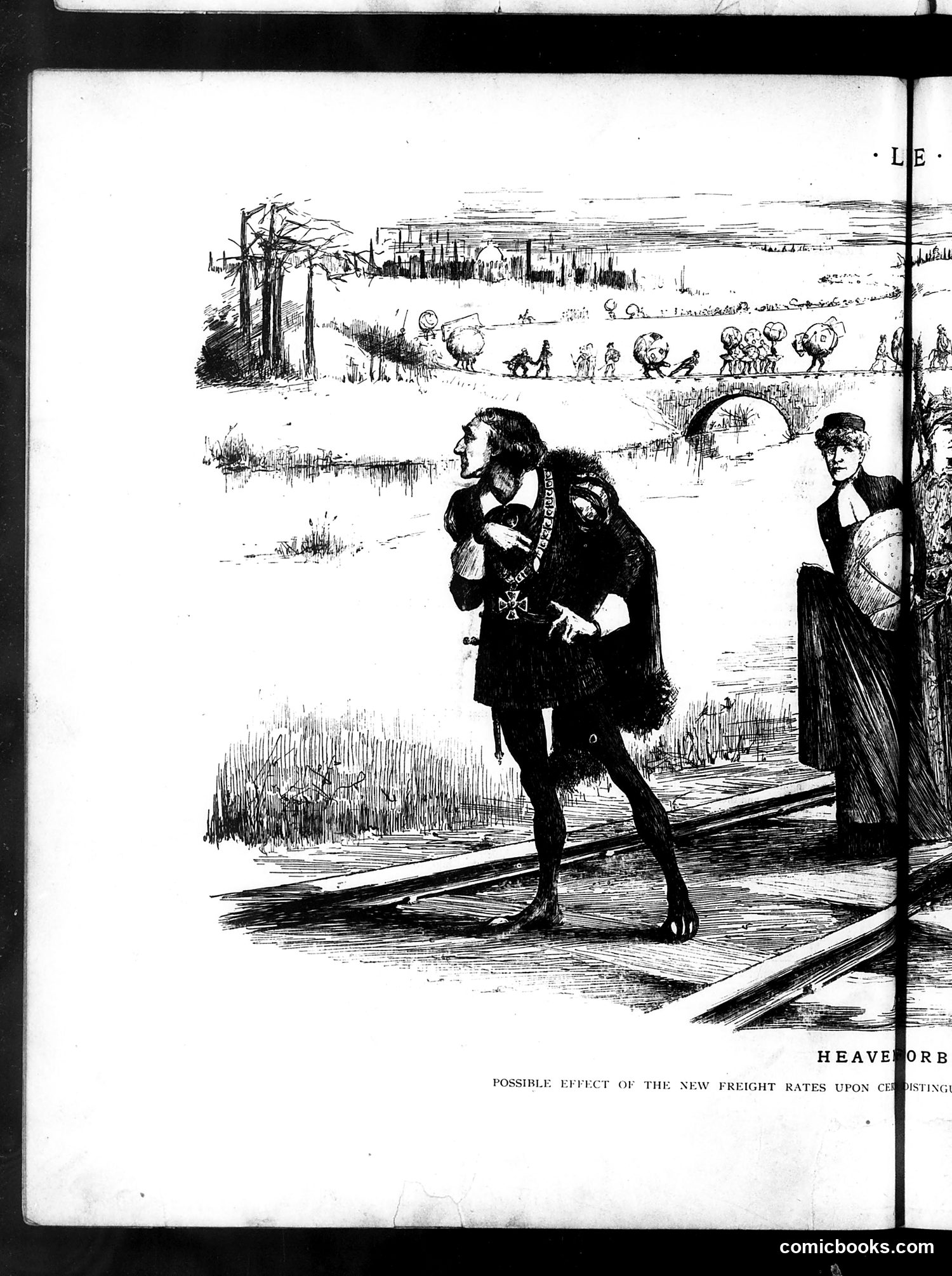
This is a satirical political cartoon from *Life* magazine titled "Possible Effect of the New Freight Rates Upon Existing" (text appears cut off). The illustration depicts a grotesquely caricatured figure—appearing emaciated and distressed—standing on railroad tracks near a bridge. A woman observes from the right. The background shows a pastoral landscape with a distant town. The cartoon satirizes the impact of newly increased railroad freight rates on commerce or industry. The skeletal, deteriorating figure likely represents a business, industry sector, or the economy generally, shown being literally starved or destroyed by these new transportation costs. The railroad setting reinforces the direct connection between freight rates and economic hardship. This appears to reference early 20th-century American debates over railroad regulation and pricing practices.
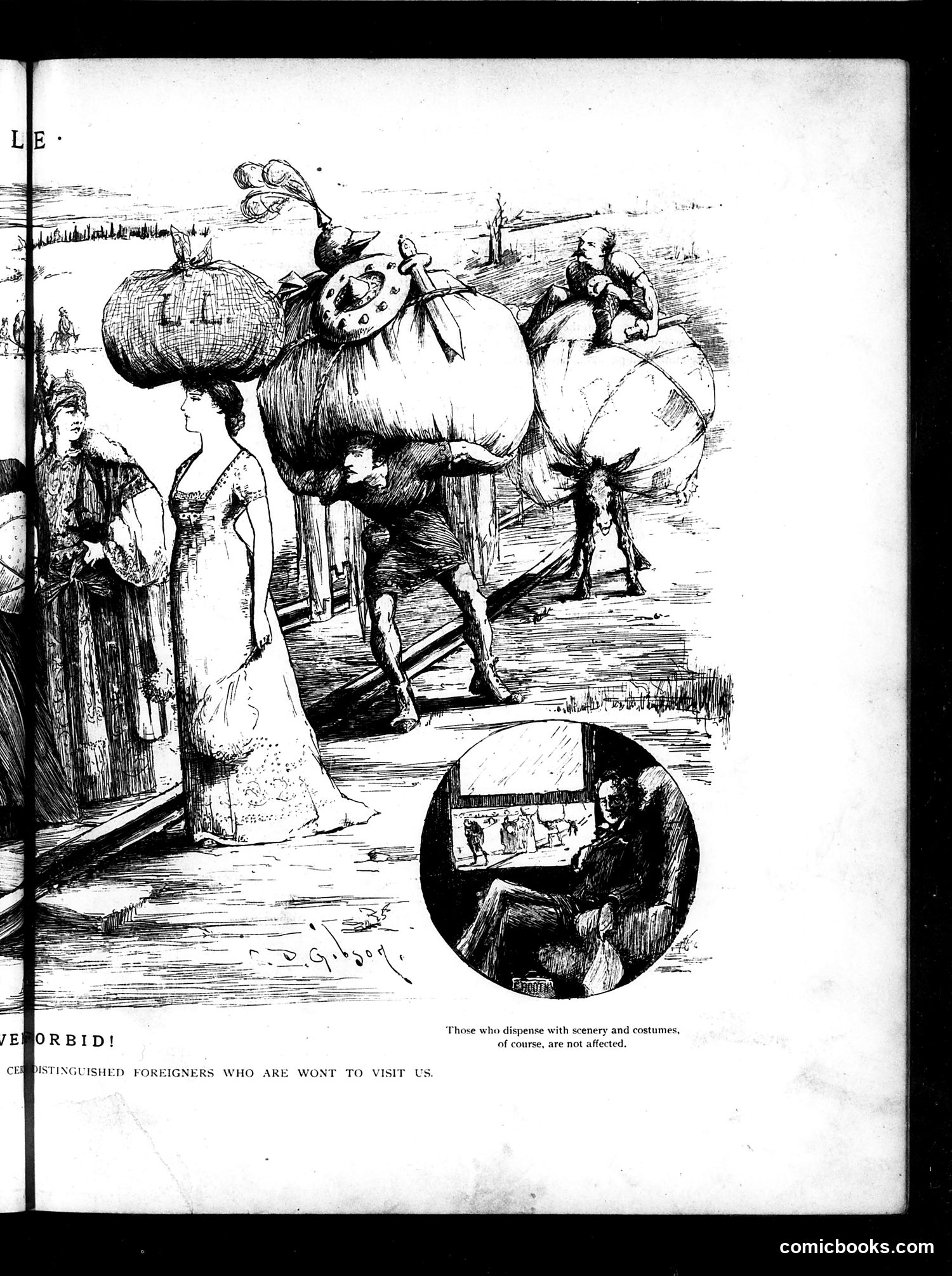
This satirical illustration mocks "distinguished foreigners" visiting America, likely from the late 19th or early 20th century. The central figure is an exaggerated caricature of a European tourist—marked by an absurdly oversized hat laden with luggage and ornate accessories. The figure's theatrical costume and affected posture embody the stereotype of pretentious, overly-formal European travelers. The caption's wit—"Those who dispense with scenery and costumes, of course, are not affected"—suggests the cartoon ridicules foreigners who prioritize superficial appearances and theatrical display over authentic experience. The inset vignette shows a practical observer unburdened by such pretense, contrasting with the main figure's comical excess. The satire targets European snobbery and American attitudes toward foreign visitors during the era.
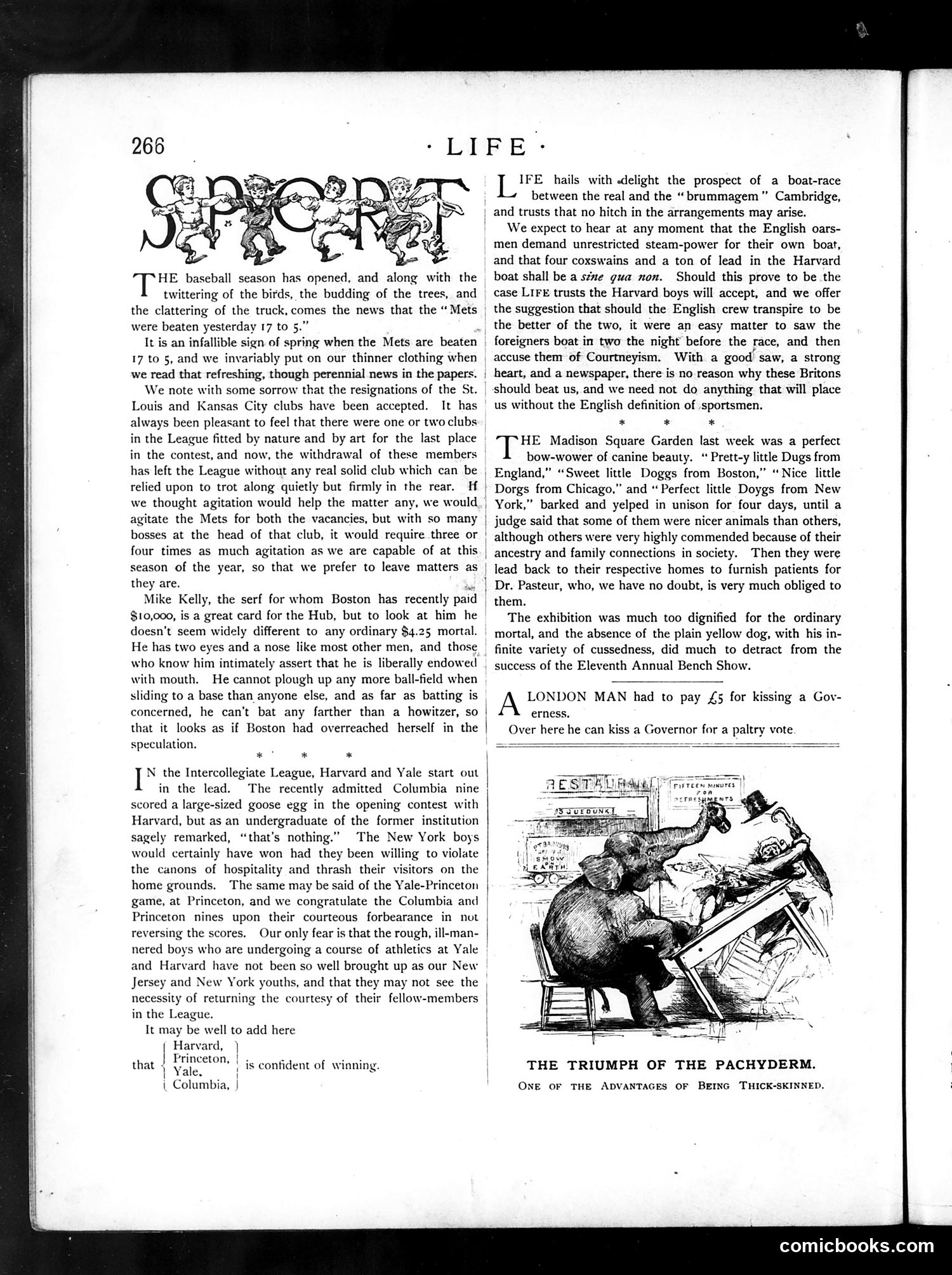
This cartoon satirizes thick-skinned resilience, likely in a political context. The image shows a large elephant (the Republican Party symbol) appearing robust and impervious, positioned at what looks like a restaurant or public establishment. The caption reads: "One of the Advantages of Being Thick-Skinned." The joke plays on the double meaning of "pachyderm" (literally thick-skinned animals) and the political metaphor of Republicans being "thick-skinned"—resistant to criticism or scandal. The elephant's imperviousness suggests the party can weather attacks or controversies without damage. The surrounding text discusses baseball, collegiate sports, and dog shows, suggesting this appears to be from a general satirical magazine covering multiple topics rather than focusing solely on this cartoon.
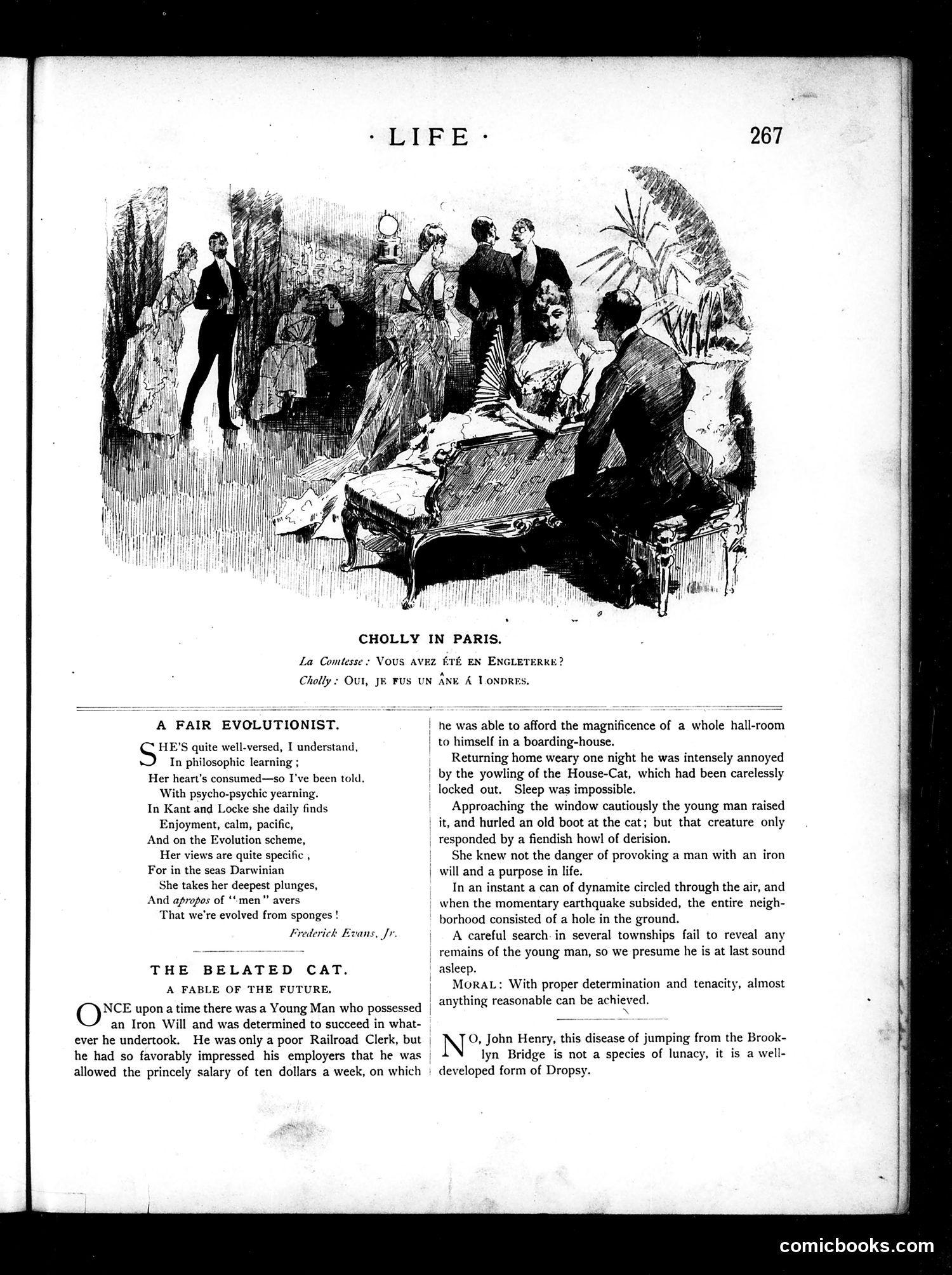
This *Life* magazine page (267) contains two satirical pieces: **"Cholly in Paris"** (top cartoon): A sketch showing a social scene where someone named Cholly is asked by a Countess if he's been in England. The caption indicates this is satirizing wealthy American socialites abroad—likely mocking their pretensions and superficial European tourism. **"A Fair Evolutionist"** (poem): Mocks an educated woman obsessed with Darwin's evolution theory, specifically ridiculing her claim that humans evolved from sponges. This satirizes late-19th-century intellectual women who embraced Darwinism—portraying their learning as pretentious rather than genuine. **"The Belated Cat"** (short story): A dark comedy fable about a railroad clerk with rigid determination who throws dynamite at a yowling cat, destroying his entire neighborhood. It's absurdist satire mocking the American cult of willpower and ambition—suggesting such blind determination leads to destruction, not success.
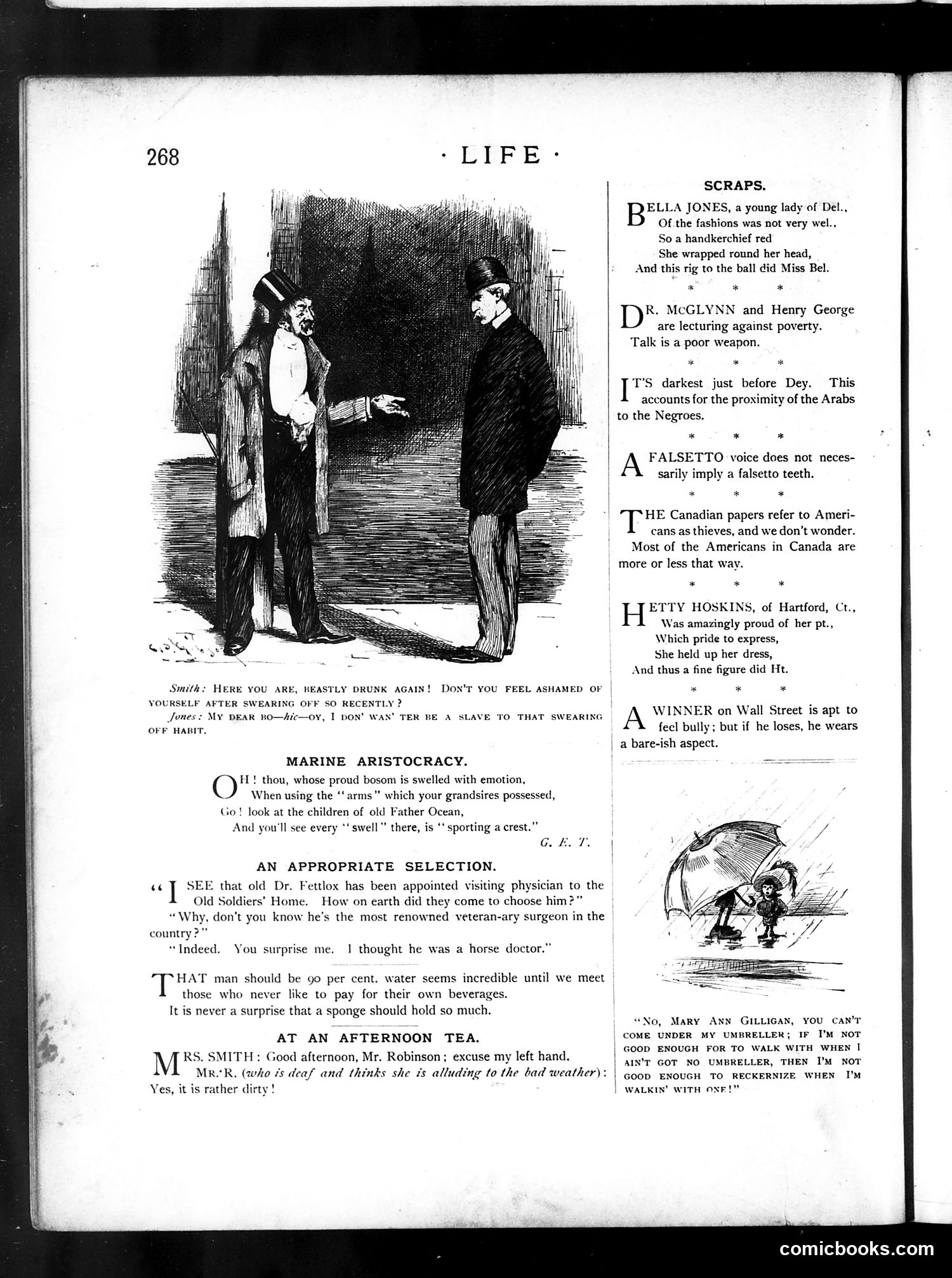
This page contains brief satirical "scraps"—short jokes and commentary on contemporary social issues. Key targets include: **Social commentary:** McGlynn and Henry George lecturing against poverty ("Talk is a poor weapon"); Canadians' reputation for theft; Americans in Canada similarly dishonest. **Personal mockery:** Bella Jones's crude fashion choice (red handkerchief to a ball); Hetty Hoskins's vanity about her figure; a drunk man unable to quit swearing despite promises. **Wordplay jokes:** A pun on "veteran-ary surgeon" (veterinarian) hired for an Old Soldiers' Home; "falsetto voice" doesn't mean false teeth; people who never buy drinks are "sponges." **Class humor:** The main cartoon shows a drunken Smith confronted by Jones about his broken sobriety oath. The bottom cartoon depicts working-class Mary Ann Gilligan refused an umbrella by a snobbish woman, highlighting class prejudice. The satire targets drunkenness, social pretension, hypocrisy, and class divisions—typical Life magazine fare of the period.
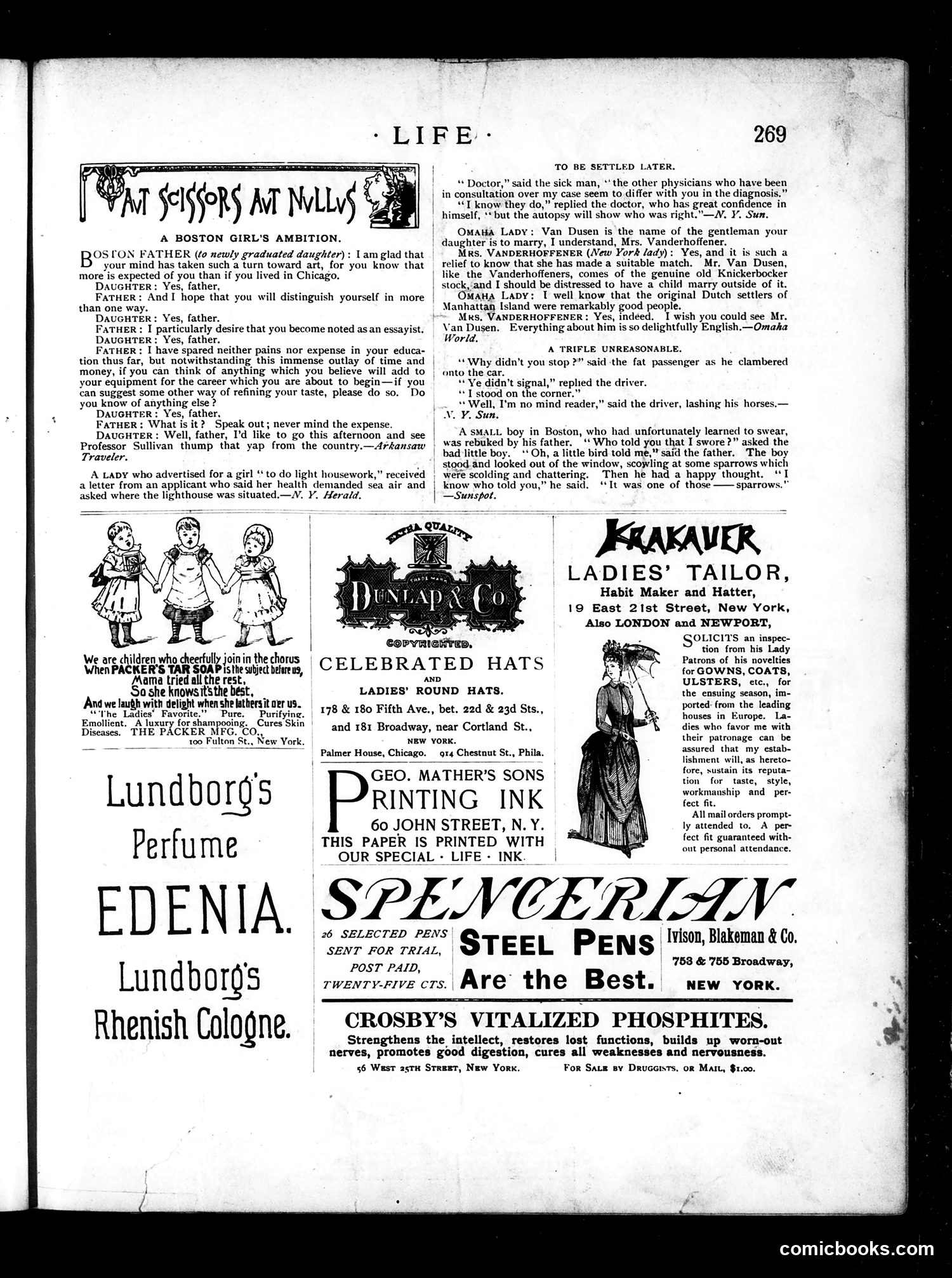
This page contains several satirical short items typical of Life's humor: **"To Be Settled Later"** mocks a confident doctor who dismisses patients' second medical opinions, arrogantly predicting an autopsy will vindicate him—dark humor about physician overconfidence. **"A Boston Girl's Ambition"** satirizes both pretentious Boston society (positioning itself as culturally superior to Chicago) and the limitations of women's education, as the daughter's true ambition is merely to attend a prizefight rather than pursue the refined pursuits her educated father expects. **"A Trifle Unreasonable"** jokes about a streetcar passenger expecting the driver to stop without signaling—humor about reasonable social expectations. **"A Small Boy"** plays on a child's literal interpretation of his father's idiom about "a little bird told me," with the boy identifying an actual sparrow as the culprit. The page is predominantly **advertisements** for perfume, printing ink, tailors, and steel pens, with minimal visual content beyond a small illustration of children.
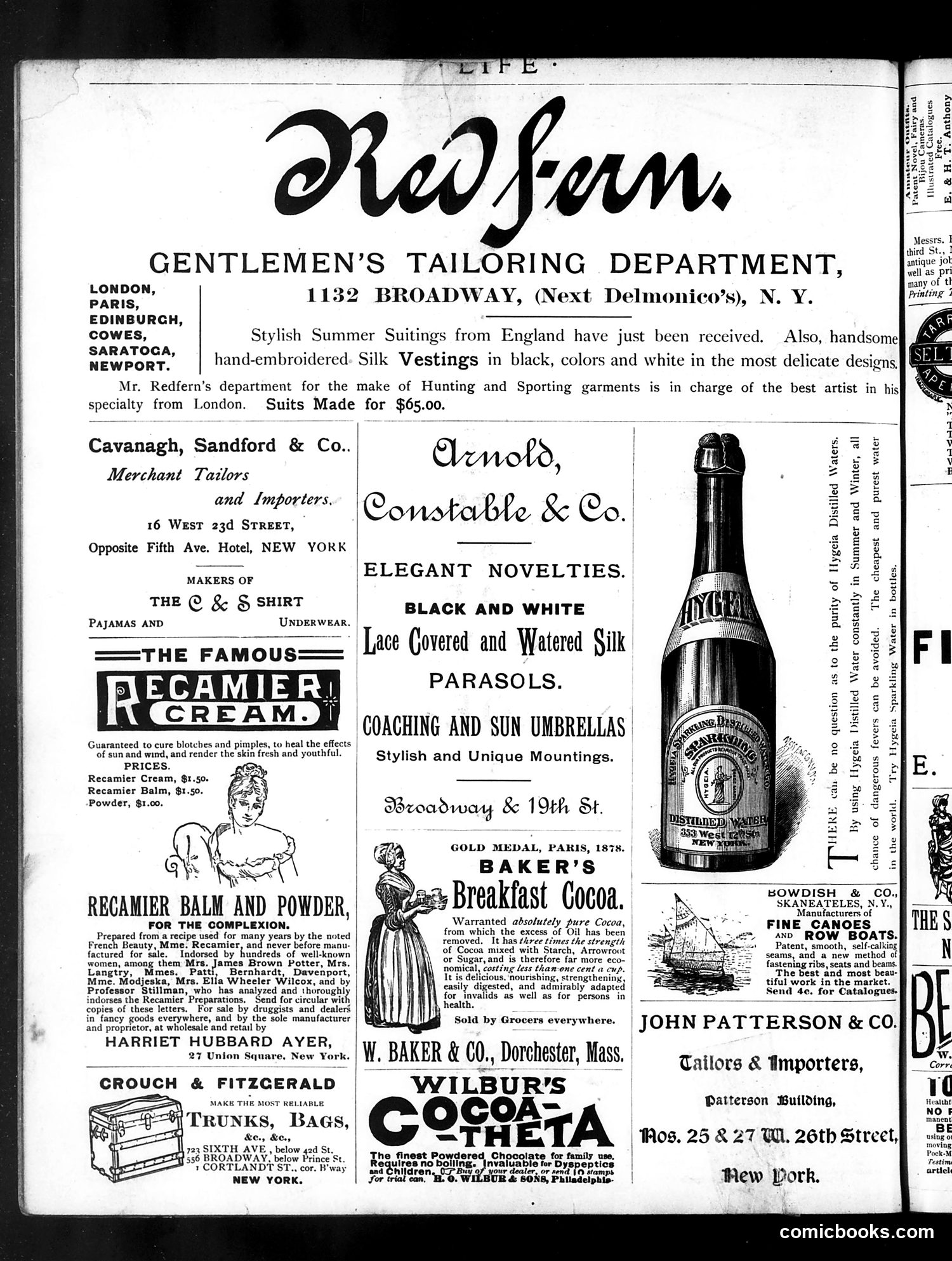
This is primarily a **commercial advertising page**, not a satirical cartoon. It contains no political commentary or social satire—instead, it showcases luxury goods and services aimed at wealthy, fashionable Americans of the Gilded Age. The advertisements feature: - **High-end tailoring** (Red Fern, Cavanagh Sandford & Co., John Patterson & Co.) offering expensive suits and imported fabrics - **Beauty products** (Recamier Balm and Powder) endorsed by famous actresses like Lillie Langtry and Sarah Bernhardt - **Luxury goods** including parasols, trunks, canoes, and fine chocolates - **Prestigious locations** referencing Fifth Avenue, Broadway, and fashionable resorts (Saratoga, Newport) The page reflects **Gilded Age consumer culture**—targeting the wealthy elite with expensive imports from London and Paris. The celebrity endorsements and emphasis on European sophistication suggest aspirational marketing to America's upper class during the late 19th century.
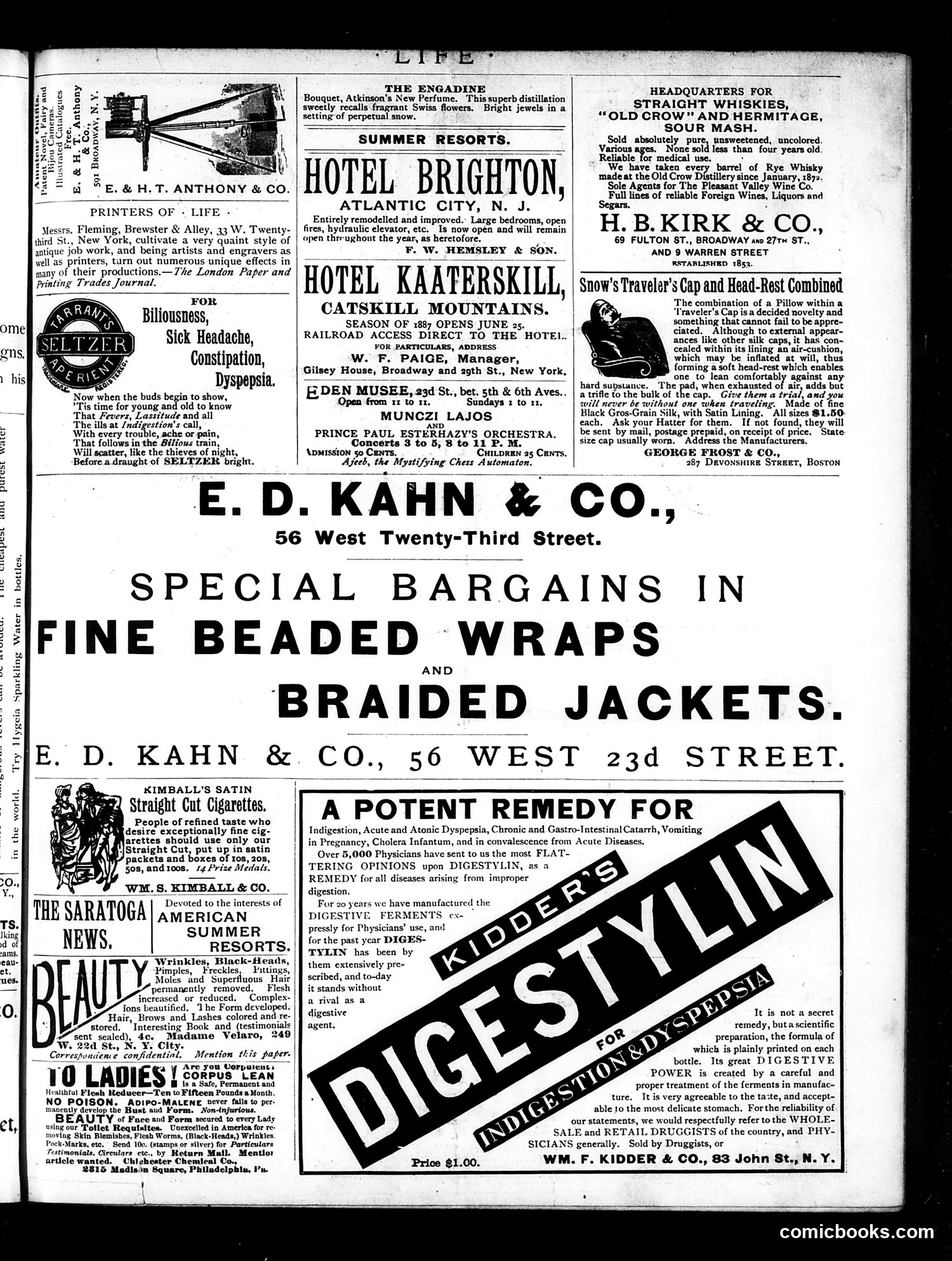
This page is primarily **advertising**, not political satire or editorial cartooning. It's from Life magazine's advertisements section and contains no meaningful political or social commentary to analyze. The page features period advertisements for summer resorts (Hotel Brighton, Hotel Kaaterskill), liquor/whiskey companies (H.B. Kirk & Co., E.D. Kahn & Co.), patent medicines (Seltzer, "Kidder's Digestive Ferments"), and consumer goods (cigarettes, perfume, beauty treatments, clothing). The only image with any figurative element is a border design for Kimball's Satin Cigarettes showing what appears to be a refined gentleman, but this is straightforward product branding rather than satire. The page documents period advertising practices and the products available to wealthy Americans in the 1880s, but contains no identifiable political cartoons or satirical commentary worth explaining to modern readers.
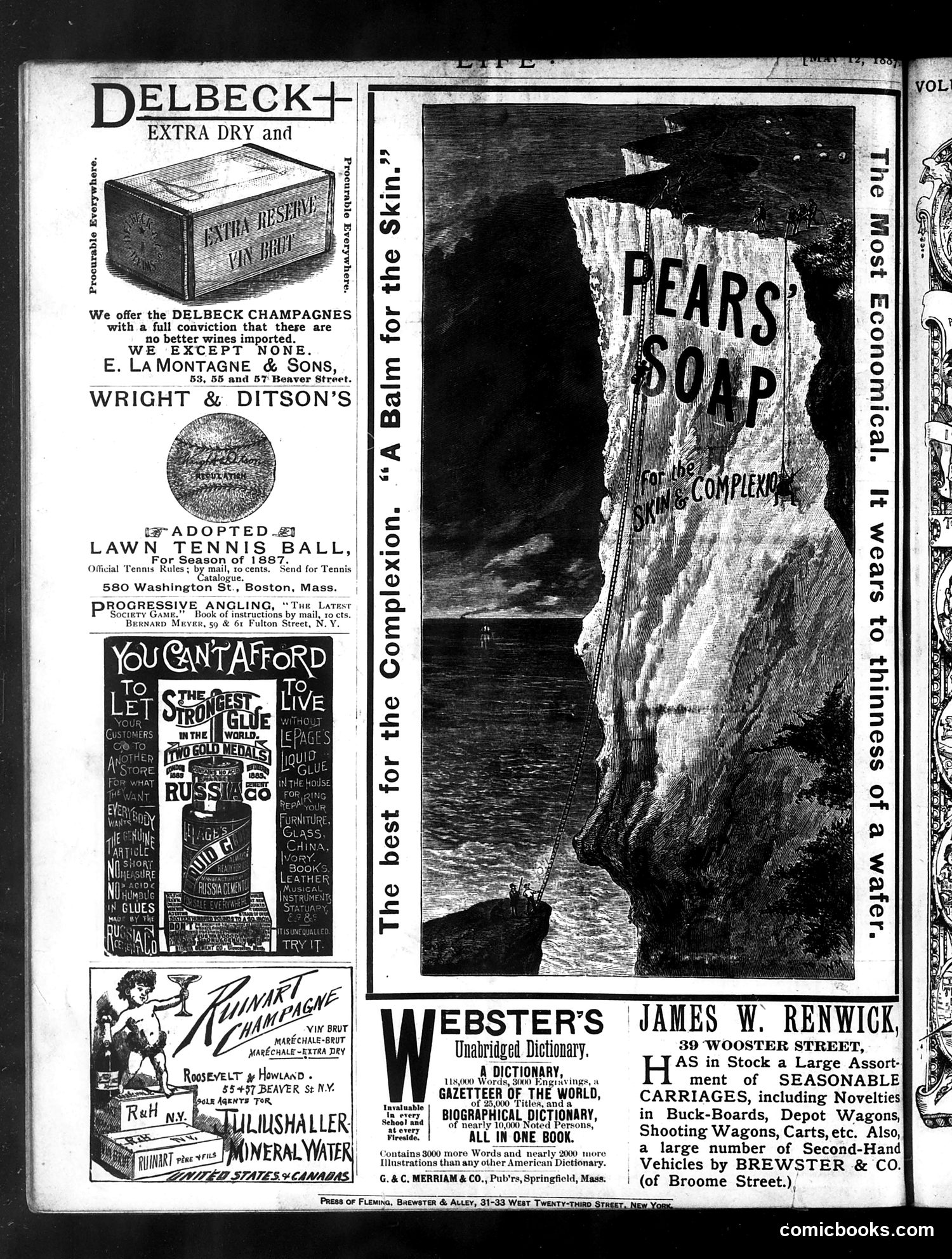
This page is primarily **advertising**, not political satire. The dominant image shows **Pears' Soap's famous "Advertizing" campaign featuring a large rock formation (likely the White Cliffs of Dover or similar geological feature) with the product name prominently displayed. The accompanying text describes Pears' Soap as "the best for the Complexion" and "A Balm for the Skin" — standard Victorian beauty product marketing. This appears to be one of Pears' well-known late-19th-century ads that used dramatic natural landscapes to suggest purity and quality. The surrounding advertisements for champagne, tennis balls, dictionaries, mineral water, and carriages fill out a typical Life magazine page from the 1880s, reflecting consumer products marketed to wealthy Americans of that era. There is **no political cartoon or satire visible** on this page.