
Life, 1887-05-12 · page 3 of 16
Life — May 12, 1887 — page 3: what you’re looking at
What you’re looking at
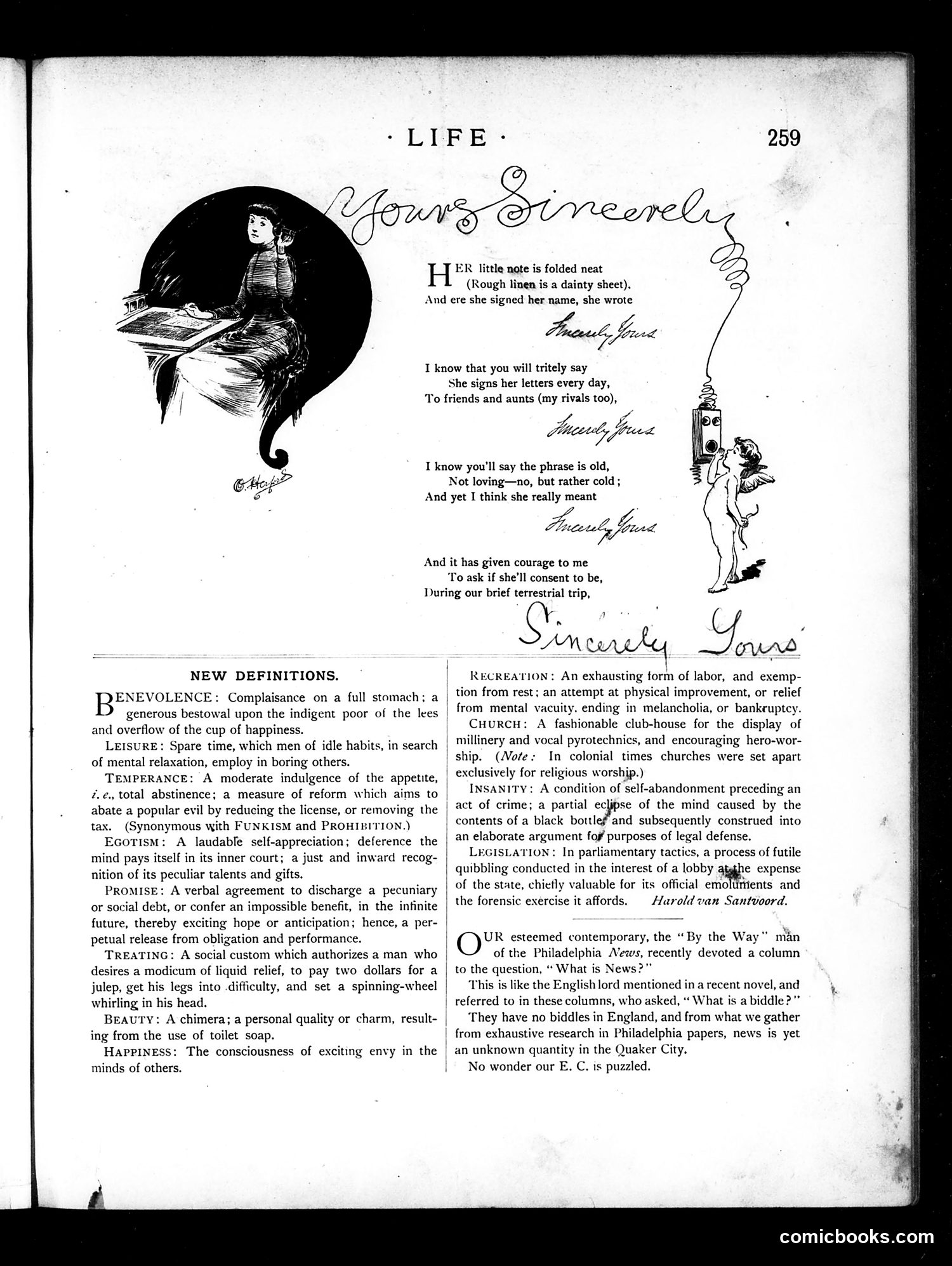
This page presents a humorous poem about a young woman's letter-writing habits, illustrated with two sketches. The left image shows a woman writing at a desk, while the right depicts Cupid with a mail-drop, suggesting romantic correspondence. The poem gently mocks the addressee for signing all her letters "Yours Sincerely" to friends, aunts, and rivals alike—a formal, emotionally reserved closing. The narrator finds this amusing yet touching, as it reveals her shyness about expressing genuine affection directly. The satire targets Victorian-era social conventions around emotional restraint and the formality of correspondence. The juxtaposition of Cupid (representing love) with stiff letter-writing protocol creates the humorous tension—she hides real feeling behind proper epistolary etiquette.
📄 Transcribed text from this page (OCR, searchable)
Machine-transcribed from the original scan — historical spelling and the odd misread are preserved.
ER little note is folded neat (Rough linen is a dainty sheet). And ere she signed her name, she wrote Foal, 3 I know that you will tritely say She signs her letters every day, To friends and aunts (my rivals too), I know you'll say the phrase is old, Not loving—no, but rather cold ; And yet I think she really meant Facsuby out And it has given courage to me To ask if she'll consent to be, During our brief terrestrial trip, NEW DEFINITIONS. | ENEVOLENCE: Complaisance on a full stomach; a | generous bestowal upon the indigent poor of the lees and overflow of the cup of happiness. LEISURE: Spare time, which men of idle habits, in search of mental relaxation, employ in boring others. TEMPERANCE: A moderate indulgence of the appetite, z.e, total abstinence; a measure of reform which aims to abate a popular evil by reducing the license, or removing the tax. (Synonymous with FUNKISM and PROHIBITION.) Ecotism: A laudable self-appreciation; deference the | mind pays itself in its inner court; a just and inward recog- nition of its peculiar talents and gifts. PROMISE: A verbal agreement to discharge a pecuniary or social debt, or confer an impossible benefit, in the infinite | future, thereby exciting hope or anticipation; hence, a per- petual release from obligation and performance. | TREATING: A social custom which authorizes a man who desires a modicum of liquid relief, to pay two dollars for a julep, get his legs into difficulty, and set a spinning-wheel whirling in his head. BEAUTY: A chimera; a personal quality or charm, result- ing from the use of toilet soap. HAPPINESS: The consciousness of exciting envy in the minds of others. | ship. contents of a black bottl | of the state, chiefly valuable for its official emo! | the forensic exercise it affords. £ | " AM wruky RECREATION: An exhausting form of labor, and exemp- tion from rest; an attempt at physical improvement, or relief from mental vacuity. ending in melancholia, or bankruptcy. CHURCH: A fashionable club-house for the display of millinery and vocal pyrotechnics, and encouraging hero-wor- (Note: In colonial times churches were set apart exclusively for religious worship.) INSANITY: A condition of self-abandonment preceding an act of crime; a partial eclipse of the mind caused by the and subsequently construed into an elaborate argument fo# purposes of legal defense. LEGISLATION: In parliamentary tactics, a process of futile quibbling conducted in the interest of a lobby atsghe expense tients and Harold van Santvoord. UR esteemed contemporary, the “By the Way" man of the Philadelphia ews, recently devoted a column to the question, “ What is News?” This is like the English lord mentioned in a recent novel, and referred to in these columns, who asked, “ What is a biddle?"” They have no biddles in England, and from what we gather from exhaustive research in Philadelphia papers, news is yet an unknown quantity in the Quaker City. No wonder our E. C. is puzzled. comicbooks.com