
A complete issue · 18 pages · 1887
Life — April 28, 1887
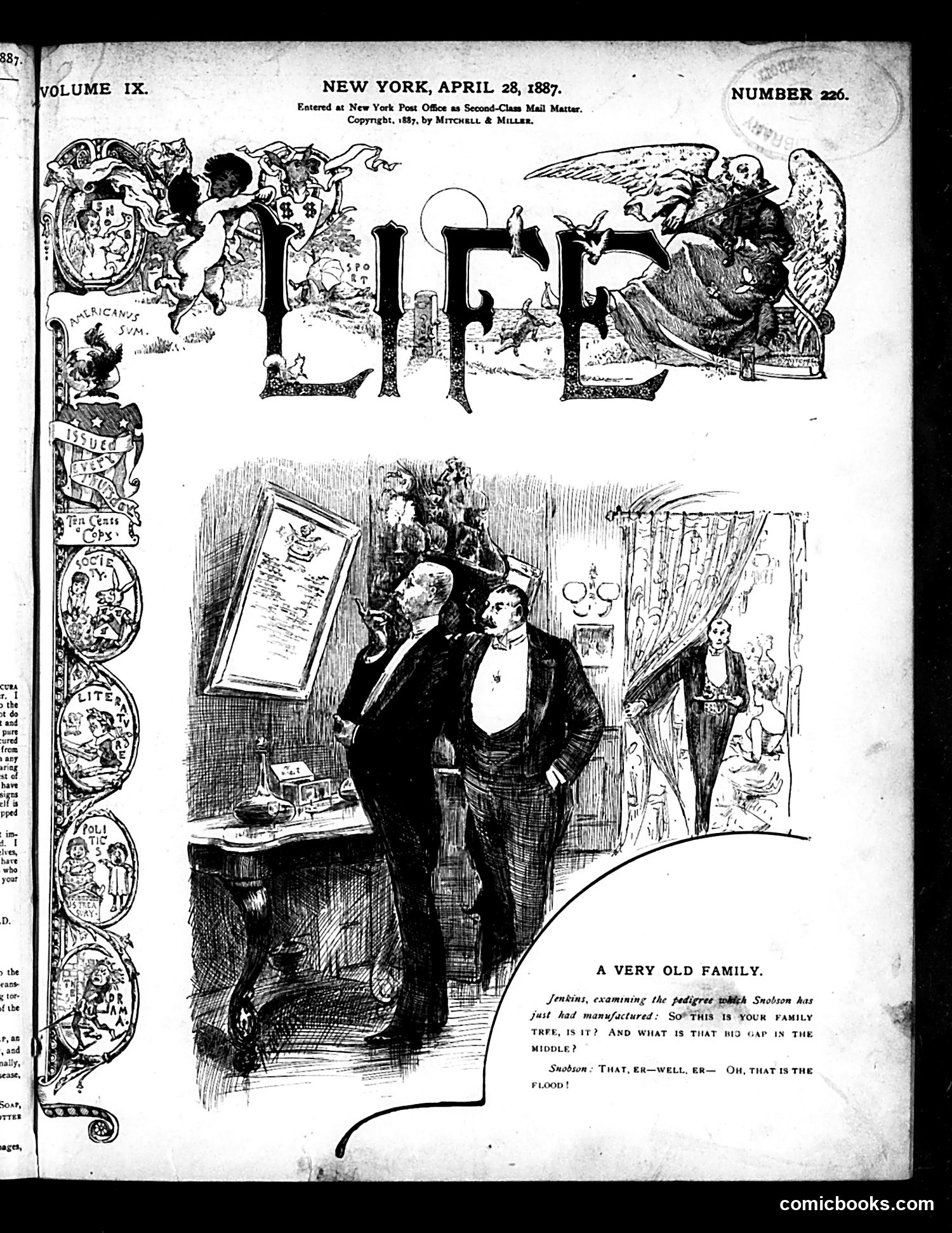
This cartoon satirizes genealogical pretension. Two well-dressed gentlemen examine a family pedigree on the wall. One (identified as "Snodson") is asked about his family's antiquity and what "that big gap in the middle" represents. His nervous reply—"That, er—well, er—Oh, that is the flood!"—is the joke's punchline. Snodson attempts to excuse a suspicious gap in his family records by claiming his ancestors survived Noah's biblical flood, implying impossibly ancient lineage. The satire mocks wealthy Americans of the Gilded Age who fabricated or exaggerated aristocratic ancestry to gain social legitimacy, a common pretension among the newly rich seeking to establish old-money credentials.
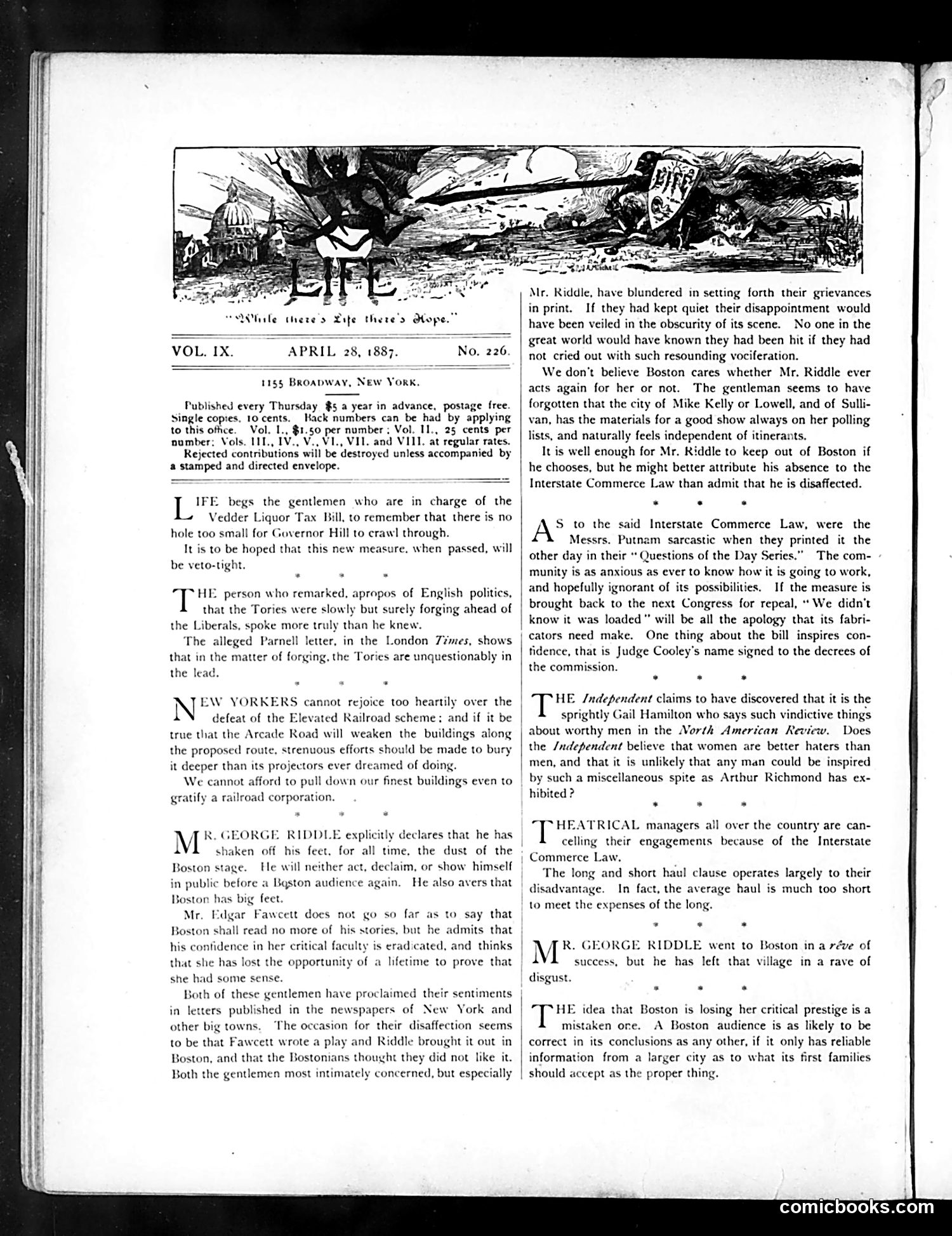
The page's masthead cartoon depicts a figure labeled "LIFE" beneath a gnarled tree, with the motto "While there's Life there's Hope." The text discusses a dispute between theatrical figures Mr. Riddle and Mr. Fawcett regarding Boston audiences and the Interstate Commerce Law. The magazine criticizes Riddle for publicly airing grievances in print, arguing such disputes should remain private to avoid embarrassment. The satire targets theatrical managers blaming the Interstate Commerce Law for canceling engagements due to shipping costs. Life suggests these complaints are exaggerated and that Boston audiences aren't actually losing theatrical prestige. The overall tone mocks both theatrical personalities and their use of legislation as an excuse for business failures, suggesting they're prioritizing public blame-shifting over professional discretion.
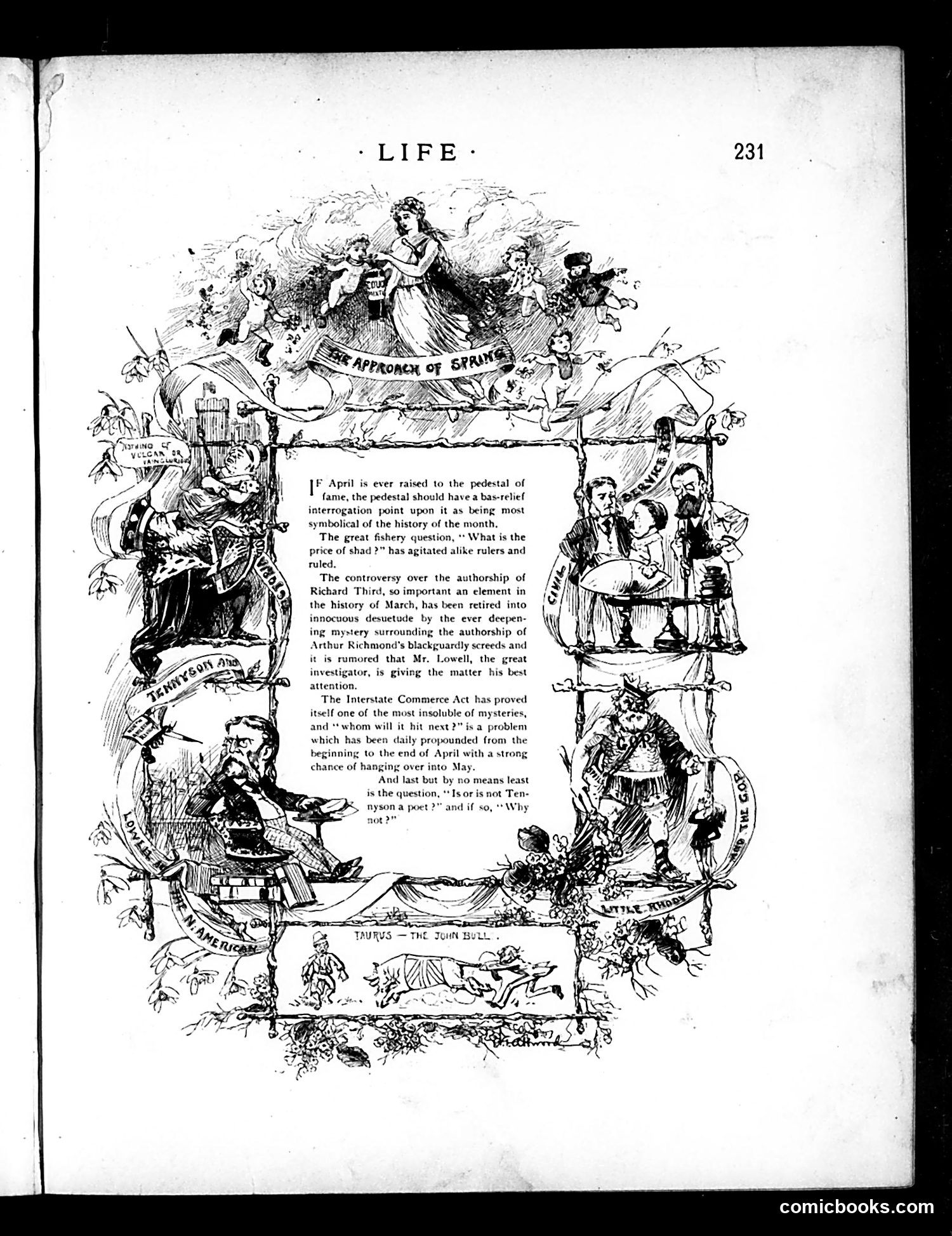
This page satirizes several contemporary controversies. The ornate decorative border frames discussions of April events, including disputes over the authorship of works attributed to Richard Third and Arthur Richmond. The text references the "fishery question" (likely maritime trade disputes), the "Interstate Commerce Act" (regulatory legislation), and debates about whether "Tennyson is a poet." The bottom illustration labeled "Taurus—The 25th Bull" appears to be an astrological or zodiac-themed cartoon, though its specific political meaning is unclear from the visible elements. The overall tone mocks the month's various intellectual and political controversies as simultaneously trivial and hotly debated—typical of *Life* magazine's satirical approach to contemporary obsessions and mysteries occupying public attention.
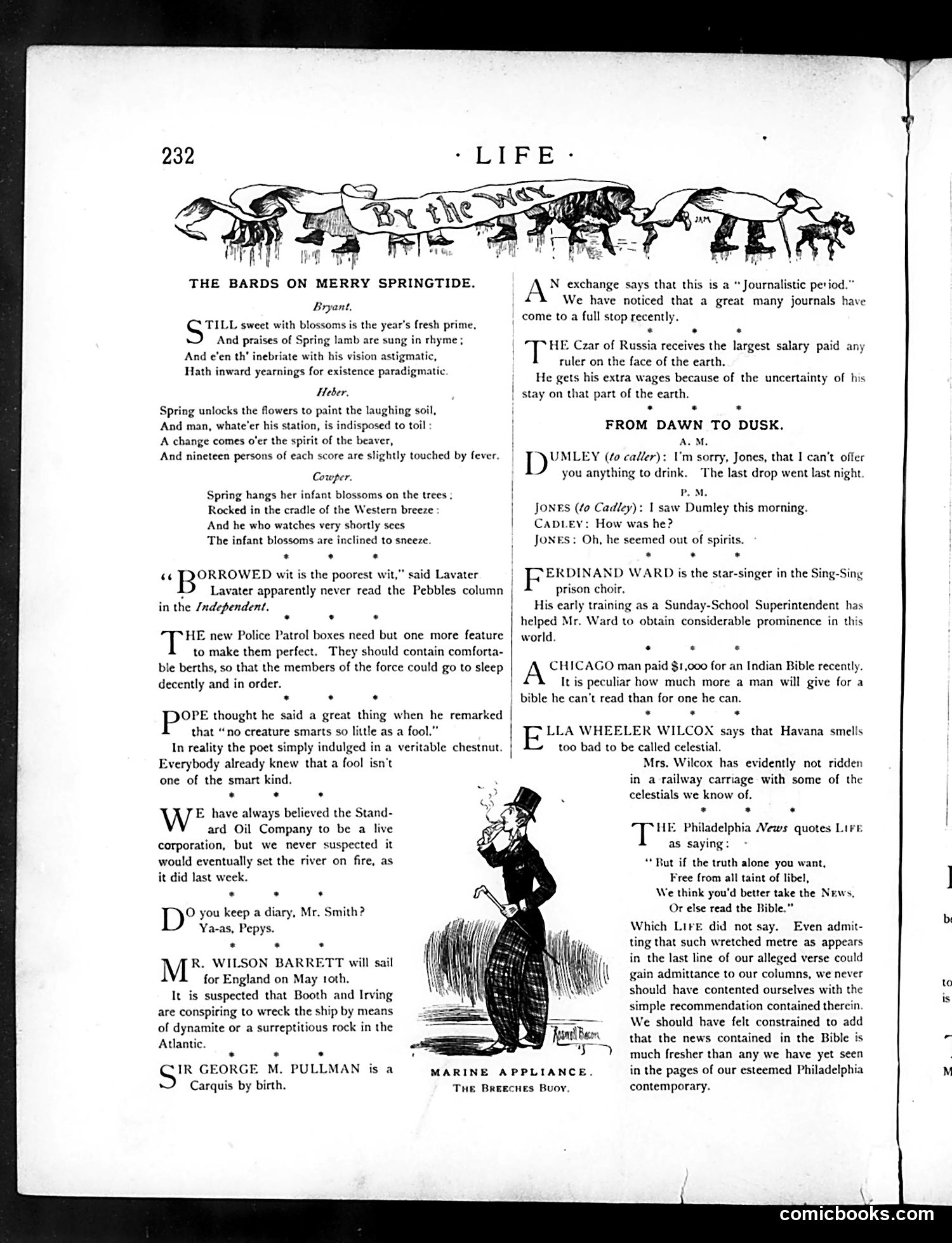
This page contains miscellaneous social commentary and anecdotes rather than political cartoons. The main illustrated item is "Marine Appliance: The Breeches Buoy"—a technical drawing showing a rescue device used at sea. The text includes brief satirical observations: a joke about keeping a diary, commentary on the Czar of Russia's wages, anecdotes about Dumley and Ferdinand Ward (a star-singer), and a humorous criticism of the Philadelphia *News* newspaper for recommending the Bible as superior reading to their own reporting. The "Bards on Merry Springtide" section presents spring-themed poetry. Overall, this appears to be a miscellaneous humor and gossip page typical of *Life's* satirical format, mixing social observation with practical illustrations, rather than focused political satire.
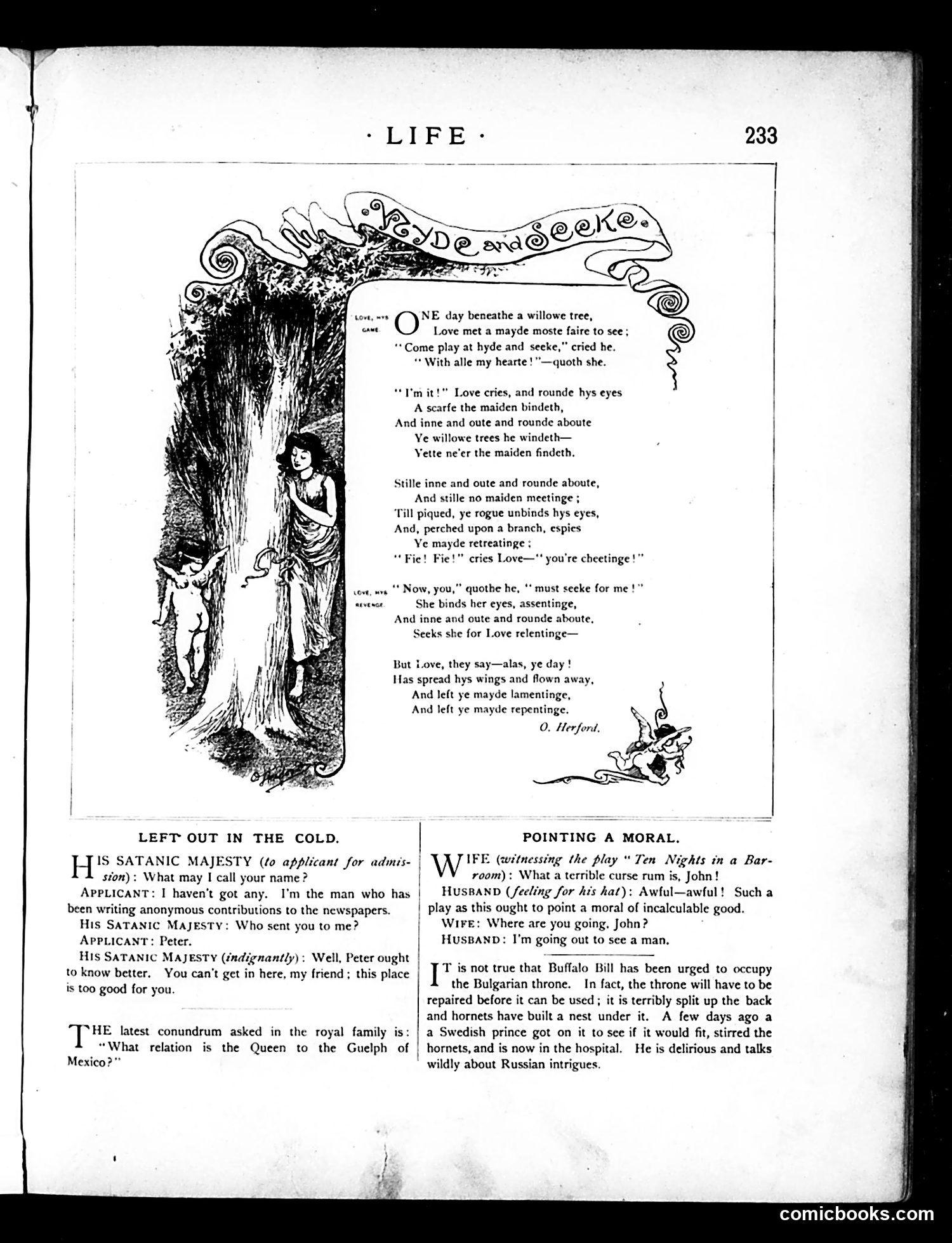
**The main content is a poem** by O. Herford titled "Hide and Seek," illustrating a romantic game between lovers beneath a willow tree. The accompanying sketch shows a woman and cherub in the tree's hollow. **Below are two satirical brief dialogues:** 1. **"Left Out in the Cold"** mocks applicants seeking anonymous newspaper jobs, with His Satanic Majesty (the Devil) appearing as the employer—suggesting newspaper work is hellish or morally compromising. 2. **"Pointing a Moral"** ridicules a domestic dispute over theater attendance, with the husband dismissing moral instruction from his wife—satire on marital tension and hypocrisy about propriety. **The final item** jokes about "Buffalo Bill" being urged to occupy the Bulgarian throne, referencing contemporary political turmoil in Bulgaria and American frontier celebrity culture.
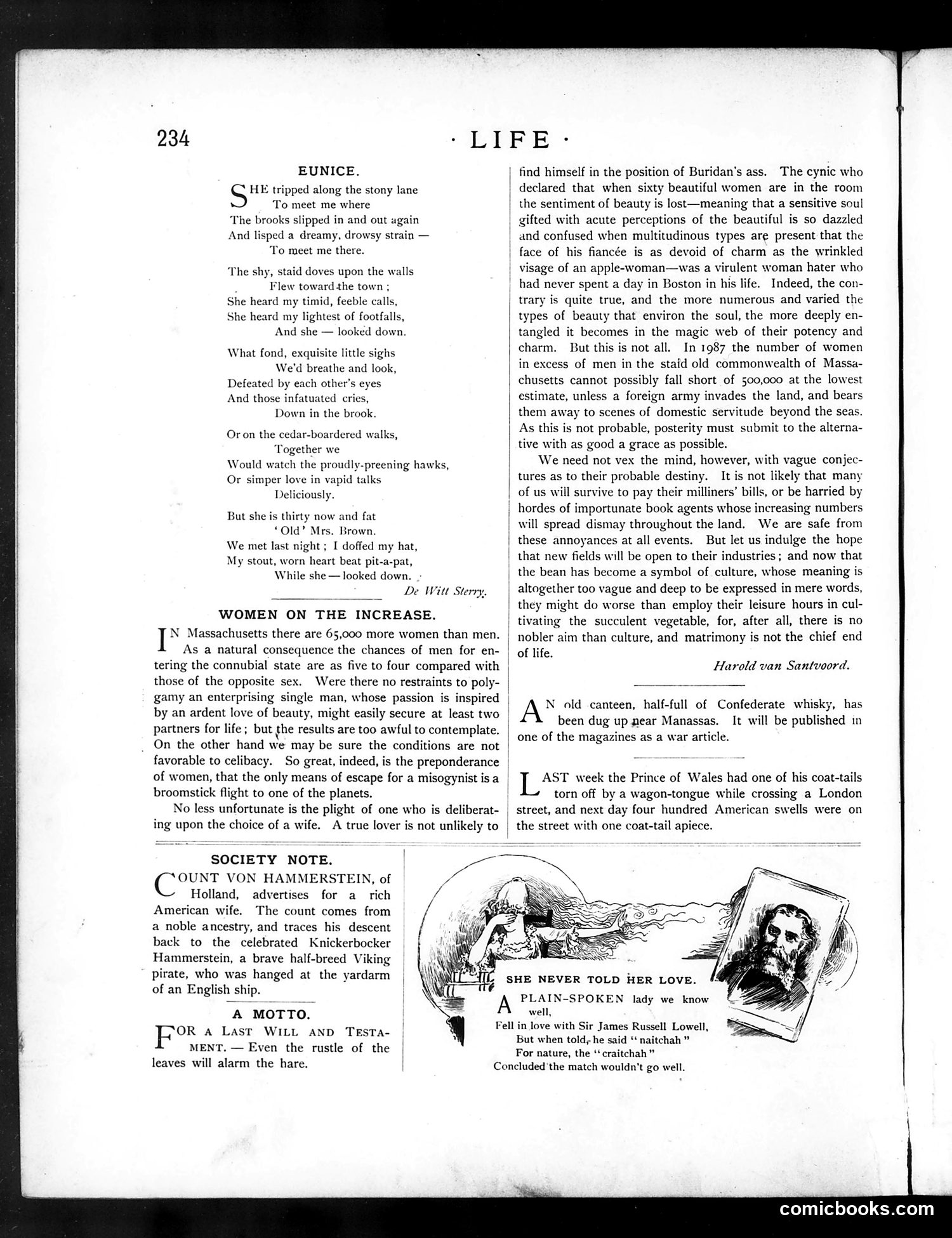
This page contains literary and social commentary rather than political cartoons. The main pieces include: **"Eunice"** — a romantic poem by De Witt Sterry about meeting a woman. **"Women on the Increase"** — an essay noting that Massachusetts has 65,000 more women than men, satirizing the implications: women outnumber potential husbands, making polygamy seem logical to some, though the author calls this escape "broomstick flight to one of the planets." The satire mocks both the demographic reality and absurd male responses to it. **Social notes** include brief gossip items about Count von Hammerstein and the Prince of Wales. **"She Never Told Her Love"** — a humorous verse about a woman who rejected Sir James Russell Lowell when he proposed, using period slang ("naitchah," "craitchah"). The page reflects turn-of-century concerns about gender ratios and marriage prospects in American society.
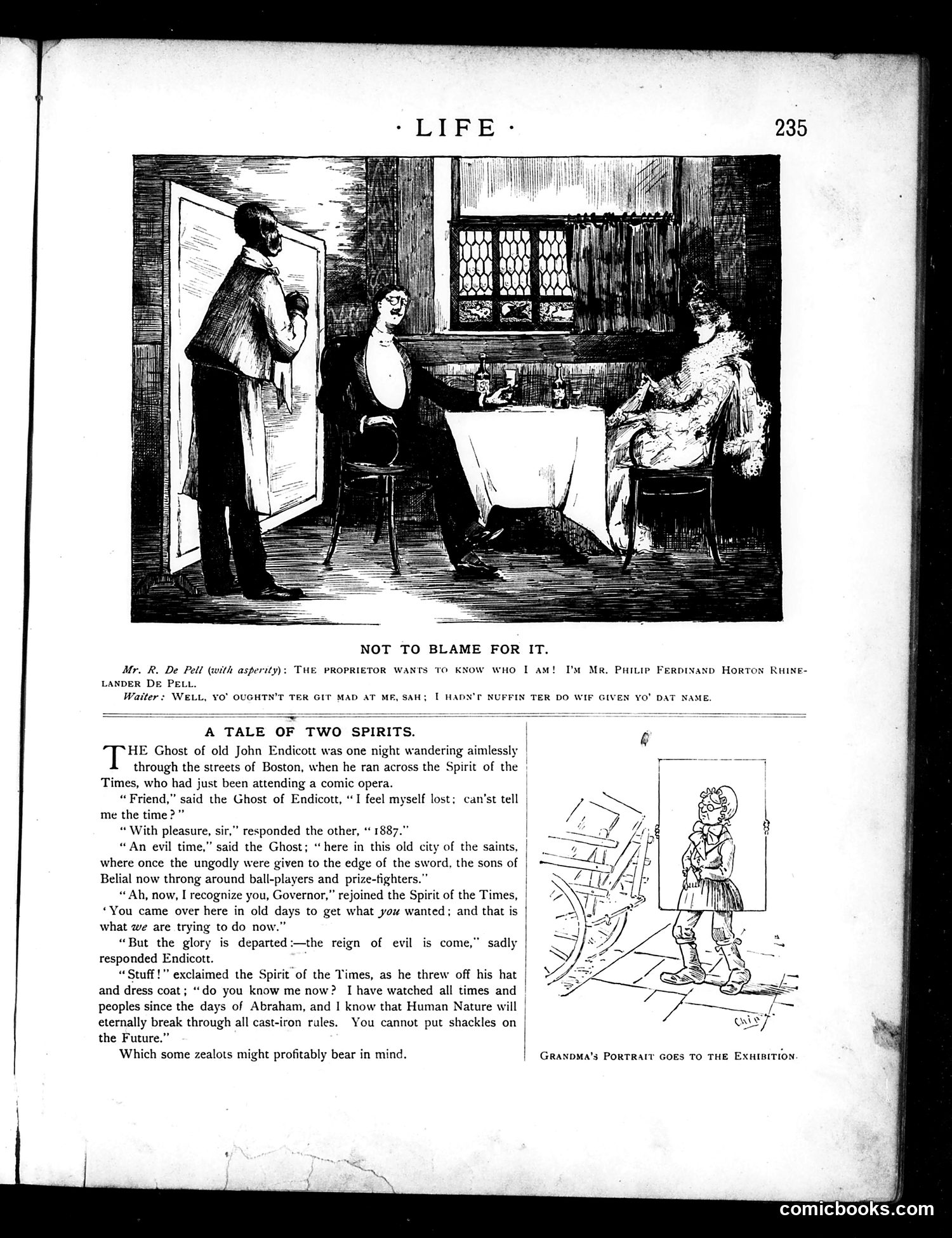
**Top Cartoon: "Not to Blame for It"** This sketch depicts a social scene where a man (identified as Mr. Philip Ferdinand Horton Rhine-Lander De Pell) arrives at what appears to be a dinner party. The proprietor questions his identity, and a waiter responds that the guest "hadn't suffer ter do wie gives yo' dat name"—suggesting the man inherited his elaborate, aristocratic name rather than earning it. The satire targets the pretensions of the wealthy upper class who derive status solely from inherited names and lineage rather than personal accomplishment or merit. **Lower Section: "A Tale of Two Spirits"** This story features two ghosts debating Boston's moral decline—one from 1887, another from an earlier era. The satire critiques contemporary society's perceived corruption, contrasting past virtue with present degeneracy. The narrative voice suggests social anxieties about modernization and moral standards.
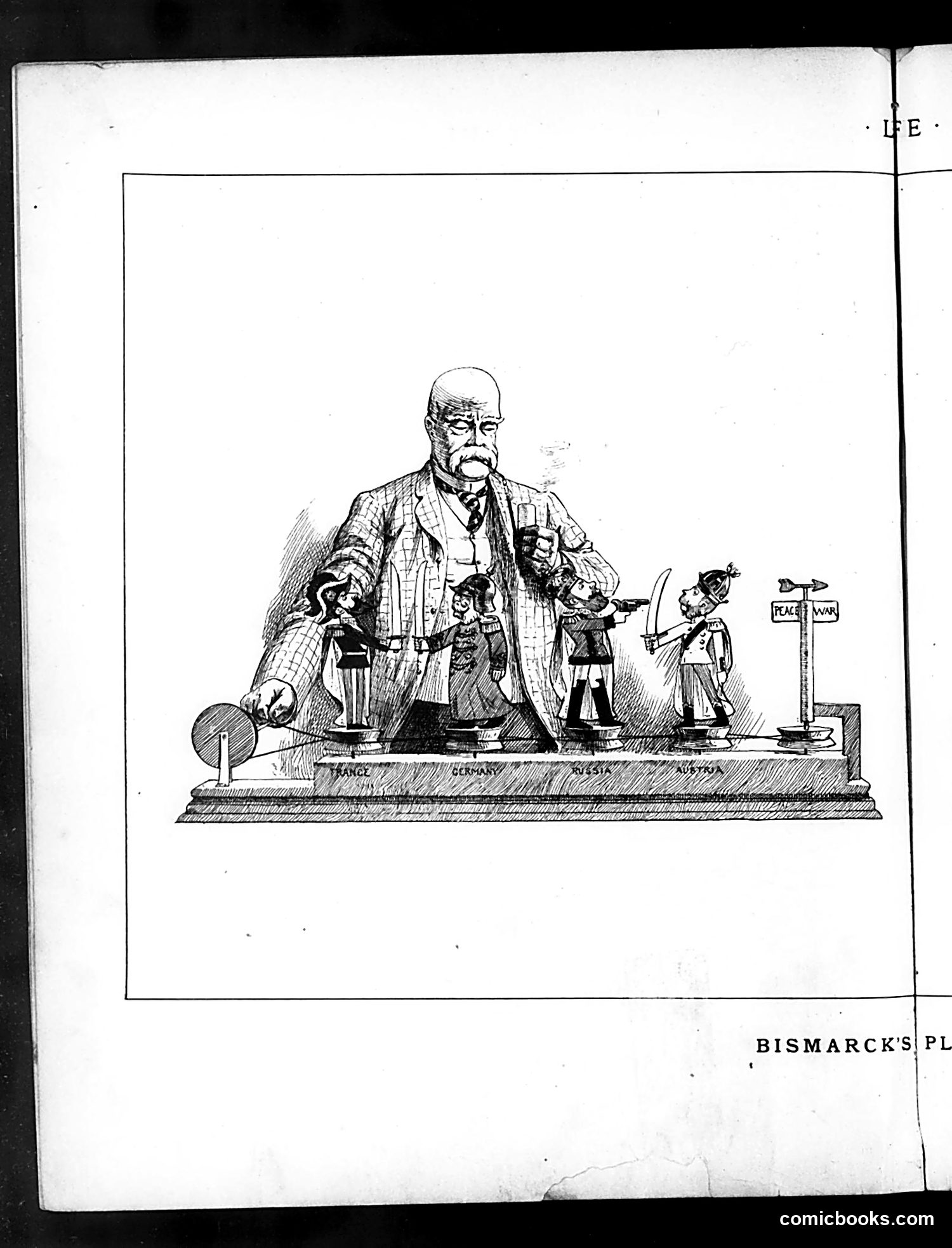
This political cartoon depicts **Otto von Bismarck**, the German Chancellor, as a large manipulative figure controlling smaller figures representing European nations. The base is labeled with **France, Germany, Russia, and Austria**, indicating these are the powers Bismarck orchestrated. The satire illustrates Bismarck's role as a political puppet-master during the late 19th century, when he dominated European diplomacy through strategic alliances and manipulation. A "Peace or War" sign suggests his control over whether conflict or peace prevailed in Europe. The cartoon criticizes Bismarck's outsized influence over continental politics and his tendency to treat major powers as mere toys to be moved at will—a commentary on imperialism and power politics of the era.
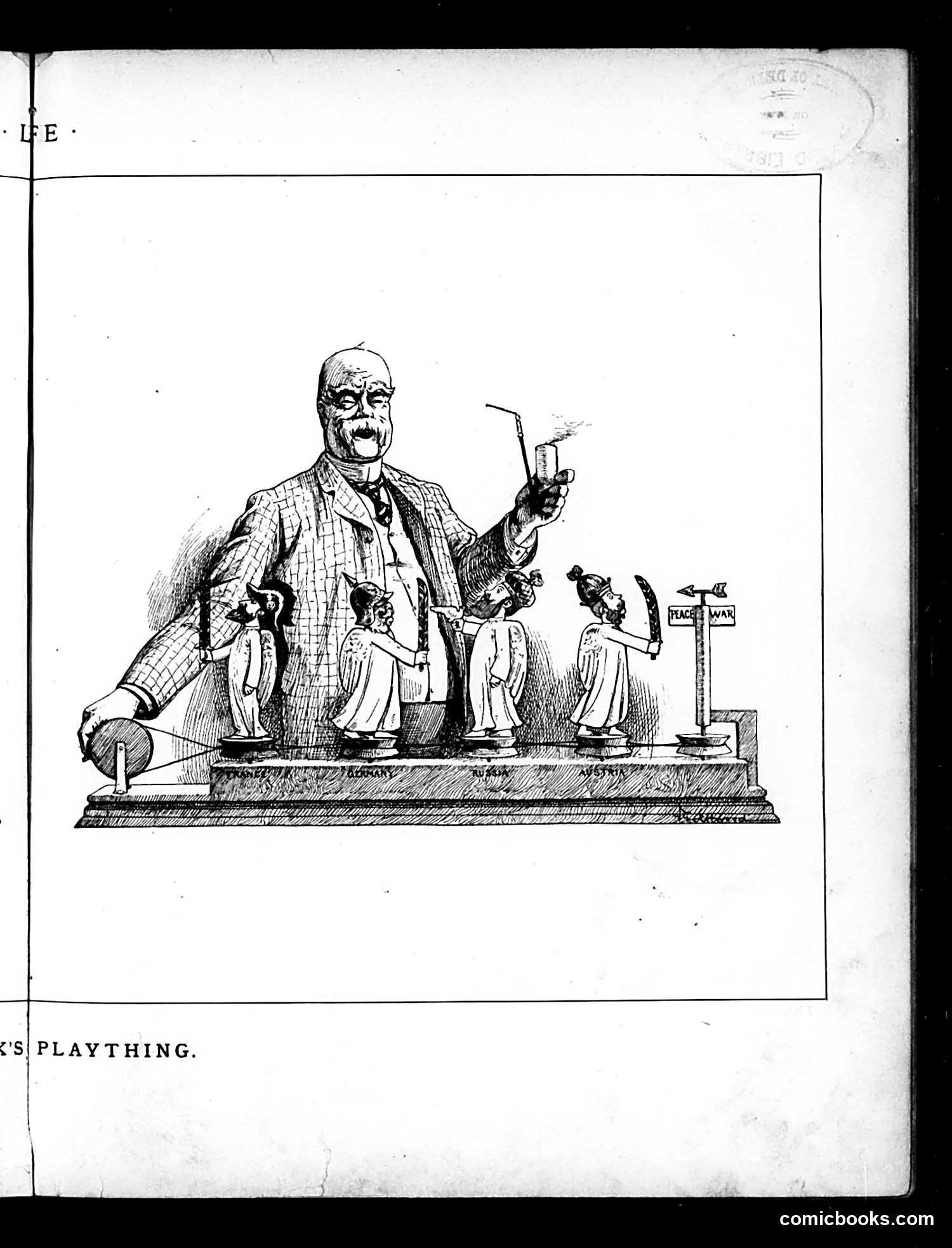
This political cartoon depicts a large, mustachioed man in a checkered suit manipulating several smaller figures like puppets on a platform labeled with place names including "GERMANY," "AUSTRIA," and what appears to be "FRANCE" and "WAR." The man holds a drink and controls the figures with strings, while a sign reading "PLACE WAR" stands nearby. The satire appears to criticize imperial power and militarism, suggesting a powerful figure orchestrates conflicts in European nations for his own amusement or profit—treating nations and wars as his "plaything." The puppet imagery emphasizes how political leaders may be mere tools of larger forces manipulating international affairs. The exact historical context and specific figure remain unclear without additional dating information.
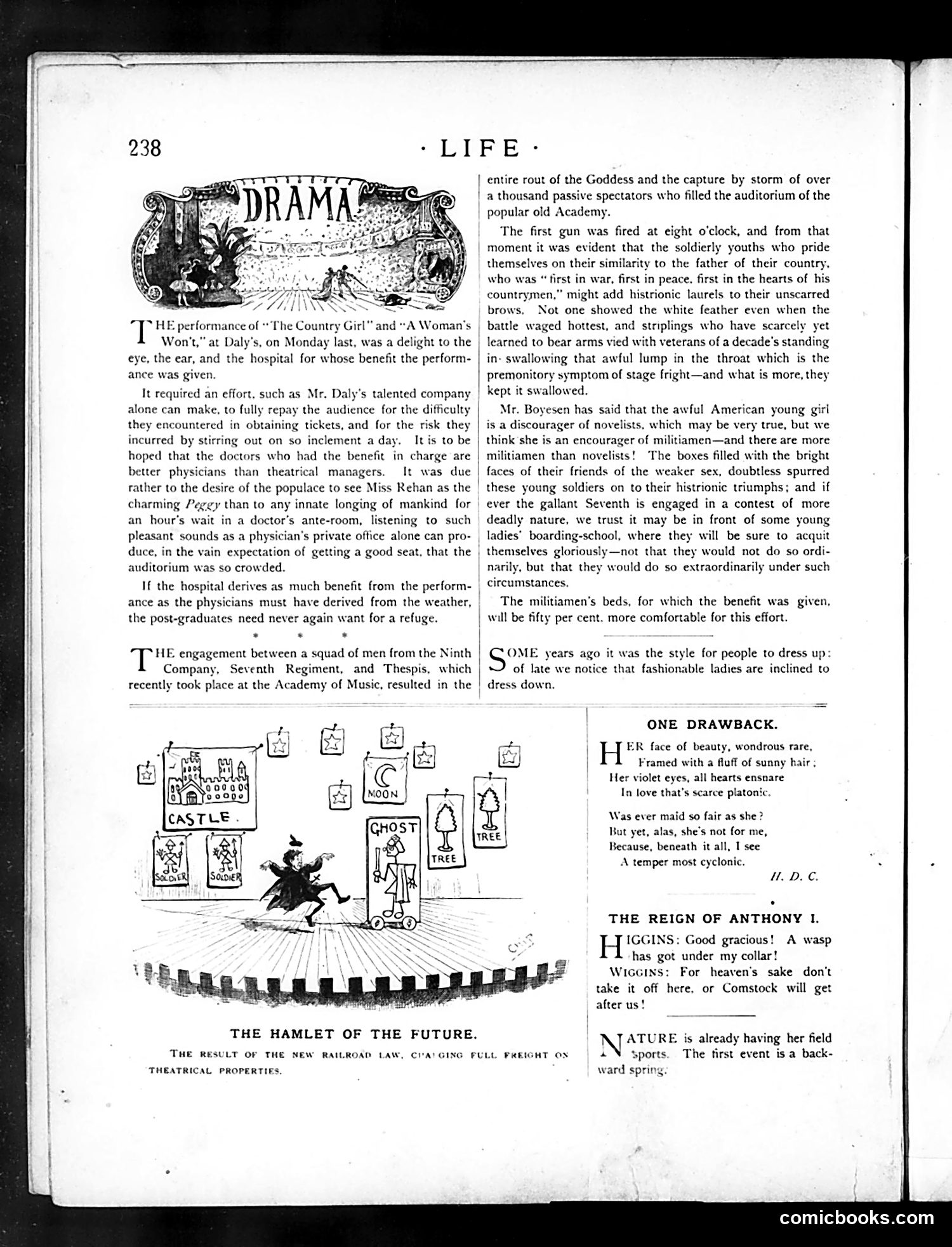
This political cartoon satirizes the impact of the **new railroad law on theatrical properties**. The illustration shows a man (likely a theater owner or producer) frantically juggling various theatrical props and sets—including a castle, ghost, tree, and moon backdrop—while apparently fleeing or being chased. The caption indicates this reflects "the result of the new railroad law, caging full freight on theatrical properties," suggesting that new railroad freight charges made transporting theatrical equipment prohibitively expensive. The cartoon mocks how this legislation inadvertently threatened the theater industry by making it economically unfeasible to move sets and props between venues. The satire critiques unintended consequences of business regulation.
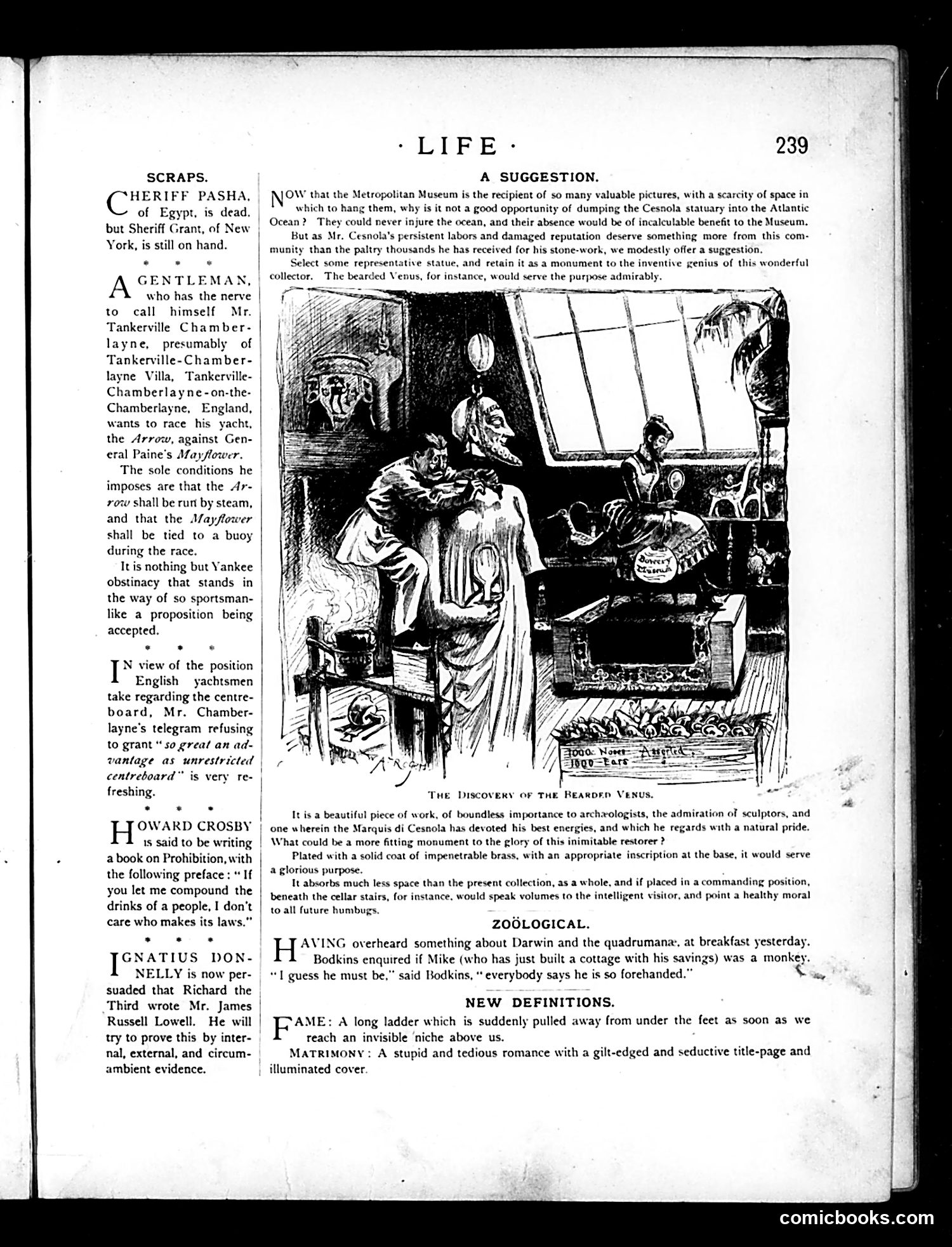
This page contains several brief satirical "scraps" mocking contemporary figures and social pretensions: **Yacht Racing Satire**: An English gentleman named Tankerville Chamberlayne proposes racing his yacht *Arrow* against General Paine's *Mayflower*, but only under absurd conditions—his boat runs by steam while his opponent's is tied to a buoy. Life mocks this as "unsporting" while sarcastically praising "Yankee obstinacy" for rejecting such obviously rigged terms. **Cesnola Statue Mockery**: The page ridicules the Marquis di Cesnola's famous "Bearded Venus" sculpture (shown in the illustration). Life suggests dumping his entire collection into the Atlantic, sarcastically proposing to retain only this statue as a "monument to the inventive genius" of this "wonderful collector"—implying the artifacts are fraudulent or of dubious authenticity. The brass-plating joke emphasizes the restoration work obscured the original. **Minor Jibes**: Quick jabs at various public figures' absurd claims or pretensions fill the margins. The overall tone satirizes wealthy pretension, fraudulent archaeology, and Anglo-American sporting disputes.
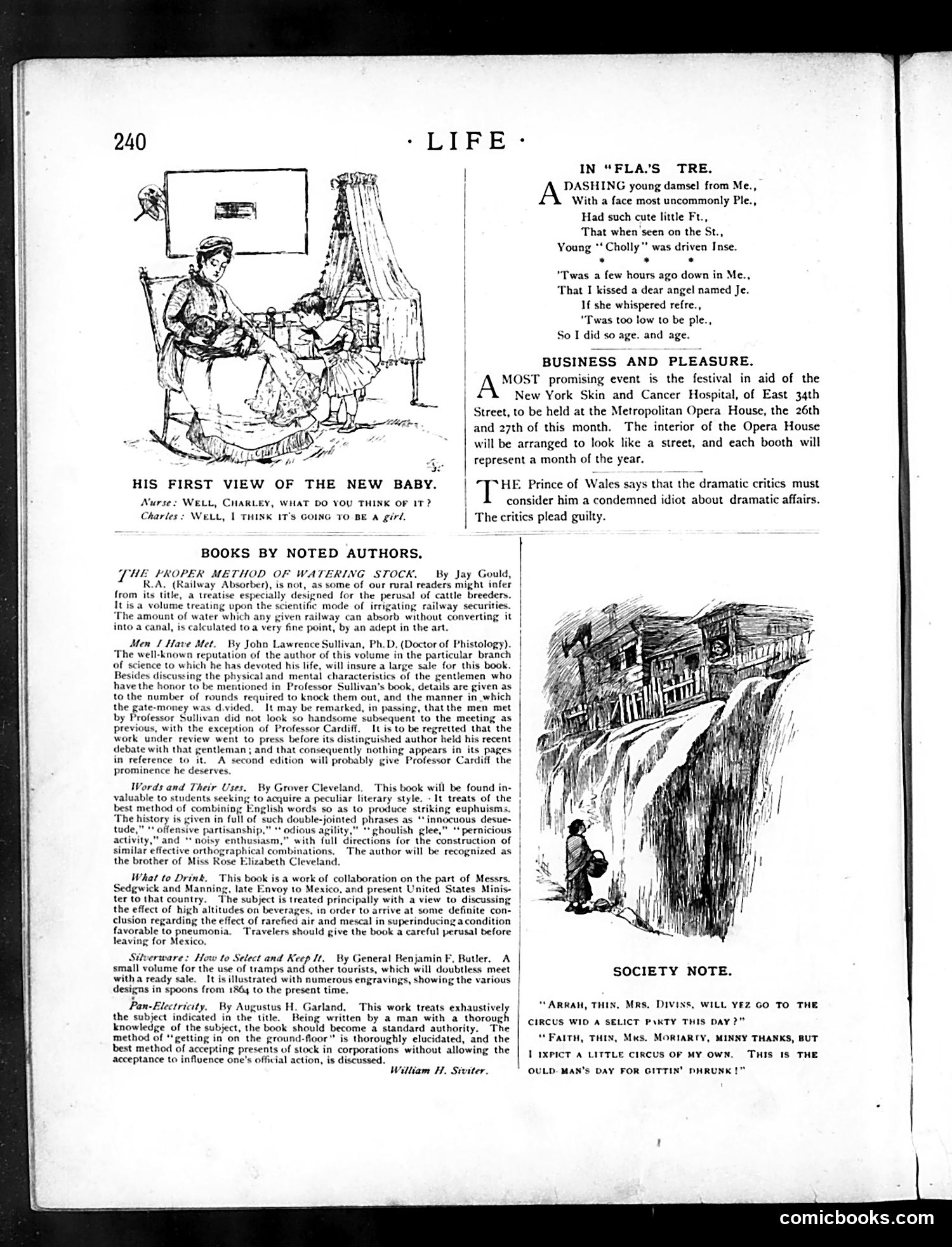
This page contains three distinct satirical elements: **"His First View of the New Baby"** (top cartoon): A gentle domestic joke where a man examines a newborn and declares it will be "a girl"—the humor lying in his confident prediction based on minimal evidence, poking fun at male presumption. **"Business and Pleasure"** (center text): Announces a Metropolitan Opera House charity festival for a hospital, with booths representing each month—straightforward society notice without satire. **"Books by Noted Authors"** (bottom section): Fake book reviews mocking contemporary public figures through invented titles. The satire targets: - **Jay Gould** (railroad magnate): "The Proper Method of Watering Stock"—a pun on "watering" securities (inflating value fraudulently) - **John L. Sullivan** (boxer): credited as "Ph.D. (Doctor of Phistology)" with a book about men he's fought and prize money divided - **Grover Cleveland** (former president): criticized for his unnecessarily verbose writing style The humor relies on readers recognizing these figures and understanding contemporary scandals about railroad fraud and political pretension.
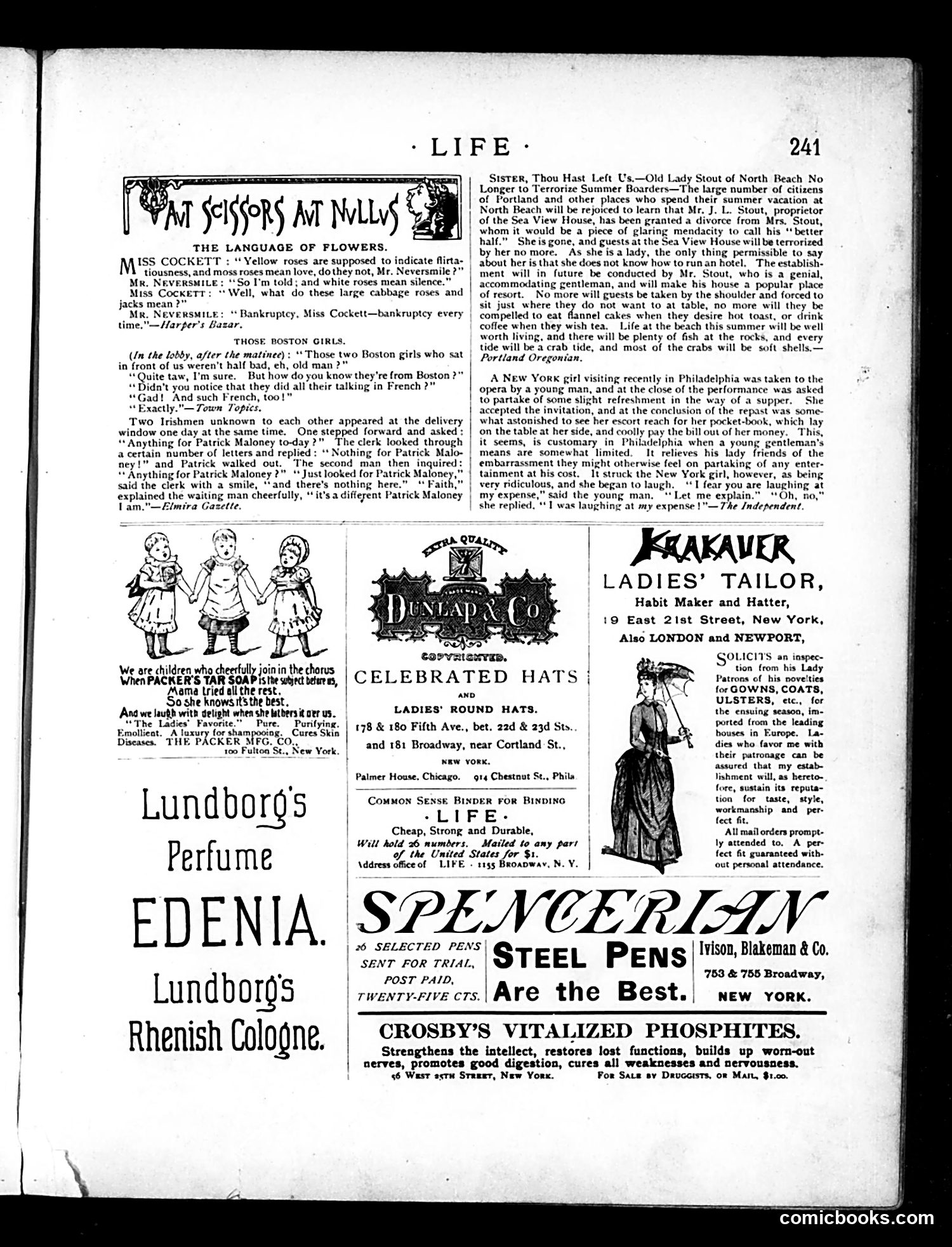
This page contains primarily **humorous anecdotes and advertisements** rather than political cartoons. The notable content includes: **"The Language of Flowers"** satirizes a flirtation attempt: a woman asks a taciturn man what large cabbage roses mean in flower symbolism; he dryly replies "bankruptcy"—mocking both her romantic pretensions and perhaps suggesting her pursuits are financially ruinous. **"Those Boston Girls"** jokes that two women speaking French in a theater must be Bostonians, with the punchline that their terrible French gives them away—a dig at American pretension and regional stereotyping. **"Patrick Maloney"** is a simple joke about two Irish immigrants with identical names appearing at a mail window. The remainder consists of period advertisements for perfume, soap, hats, pens, and tailoring services—typical of Life's revenue model. There are no political cartoons visible on this page.
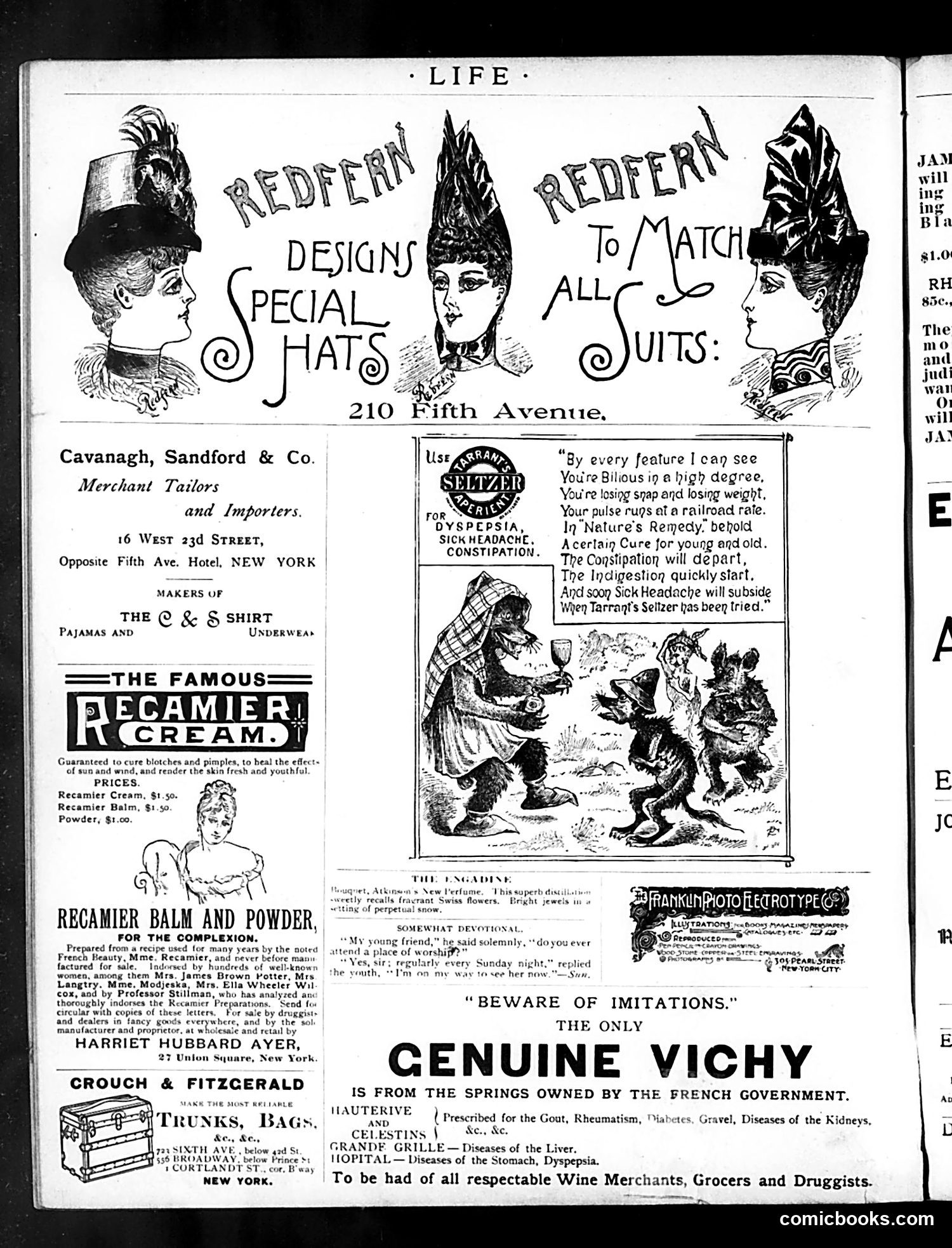
This page is primarily **advertising**, typical of late 19th-century American magazines. The dominant cartoon depicts a scene with animals (appears to be anthropomorphized creatures) and a woman in period dress, illustrating the benefits of **Tarrant's Seltzer**—a patent medicine claiming to cure bilious conditions, constipation, and sick headaches. The verse accompanying it promises relief through this product. The page is dominated by advertisements for luxury goods and patent medicines targeting wealthy consumers: Recamier beauty cream (endorsed by famous actresses), tailoring services, luggage, and bottled mineral waters from French springs. These ads reflect the era's obsession with European sophistication and the widespread promotion of unregulated "cure-all" remedies. The humor is mild—the cartoon illustrates digestive complaints metaphorically rather than offering sharp social commentary. This represents Life's role as both satirical publication and advertising vehicle for affluent readers.
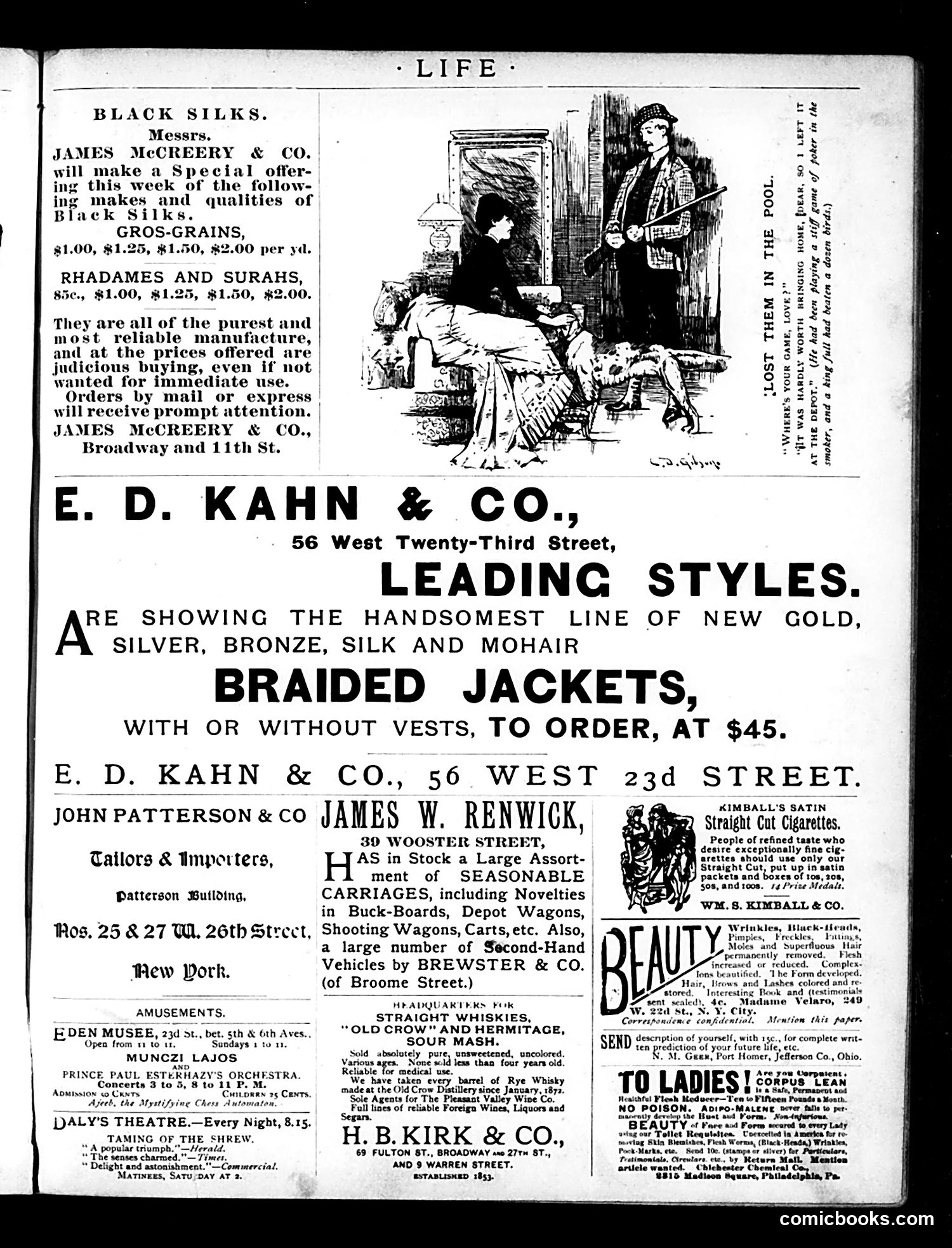
This page is primarily **advertising**, not political satire. It contains commercial notices for late-19th-century New York businesses: silk merchants (James McCreery & Co.), tailors (E.D. Kahn & Co., John Patterson & Co.), carriage dealers, whiskey distributors, and theaters. The only illustrated content is a small **cartoon** (credited "C.A. Shultze") depicting a domestic scene: a woman confronts a man about lost money. The caption reveals he lost their savings at poker ("playing a stiff game of poker") and later at "the pool" (billiards), claiming the losses "were hardly worth bringing home." This is a **humorous domestic sketch** about gambling and marital tension—a common satirical subject of the era—not political commentary. The remainder consists of patent-medicine advertisements (for weight loss, hair removal, complexion treatments) and theatrical announcements, typical of Life magazine's mixed advertising-and-content format from this period.
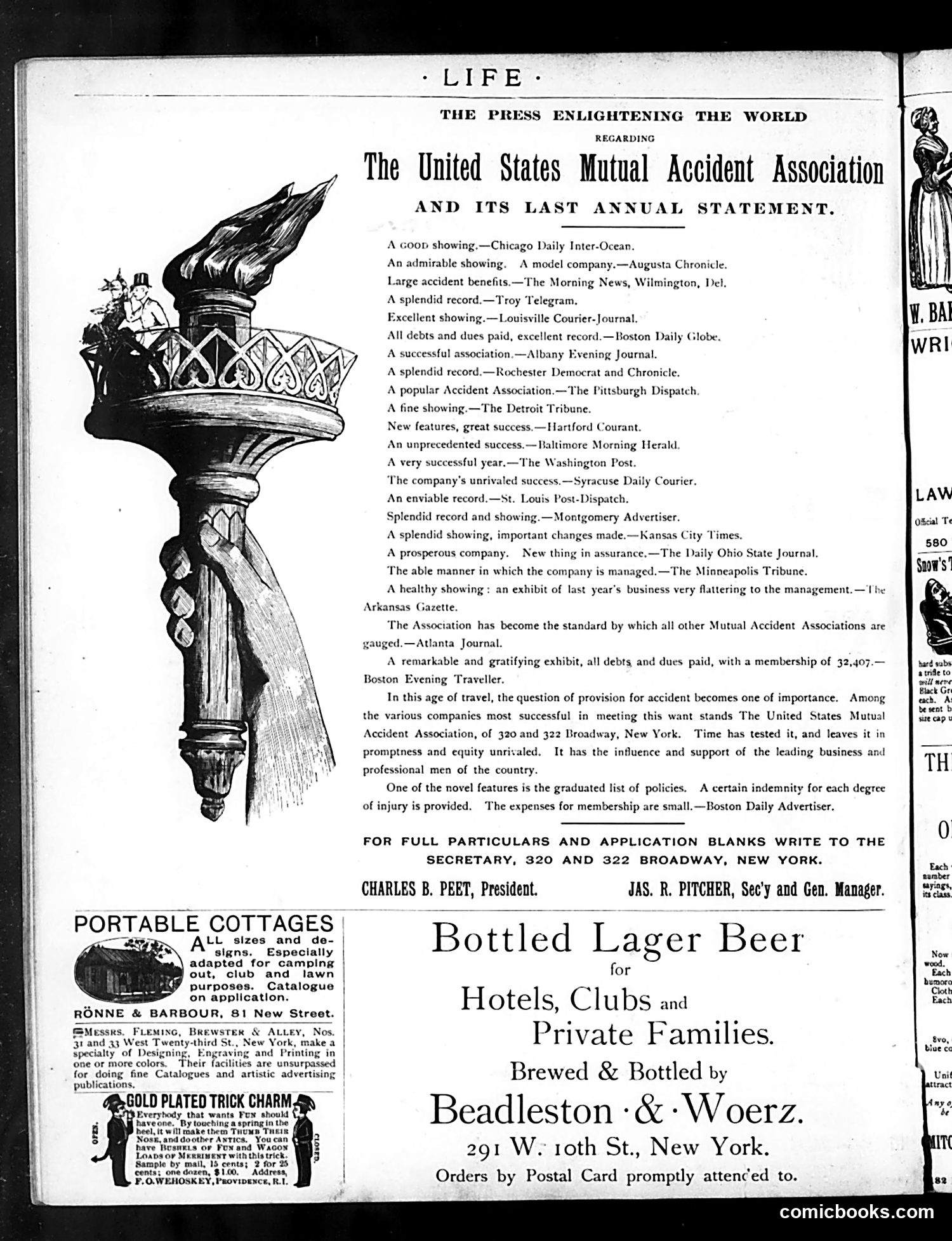
This page is primarily **advertising and corporate promotion**, not political satire. The dominant content features a torch-bearing figure (symbolizing enlightenment/truth) accompanying advertorial praise for the United States Mutual Accident Association. The "cartoon" is the torch itself—a visual metaphor suggesting "the press enlightening the world." However, the satire is subtle: Life prints dozens of glowing newspaper testimonials about this insurance company, creating the *appearance* of widespread approval. The irony likely lies in Life's knowing presentation of what amounts to corporate puffery disguised as genuine press coverage—a comment on how companies manipulate public opinion through selective quotation of favorable reviews. The page also includes unrelated advertisements for portable cottages, trick charms, and beer, which was typical magazine filler of the era. **No identifiable political figures or specific historical events appear.**
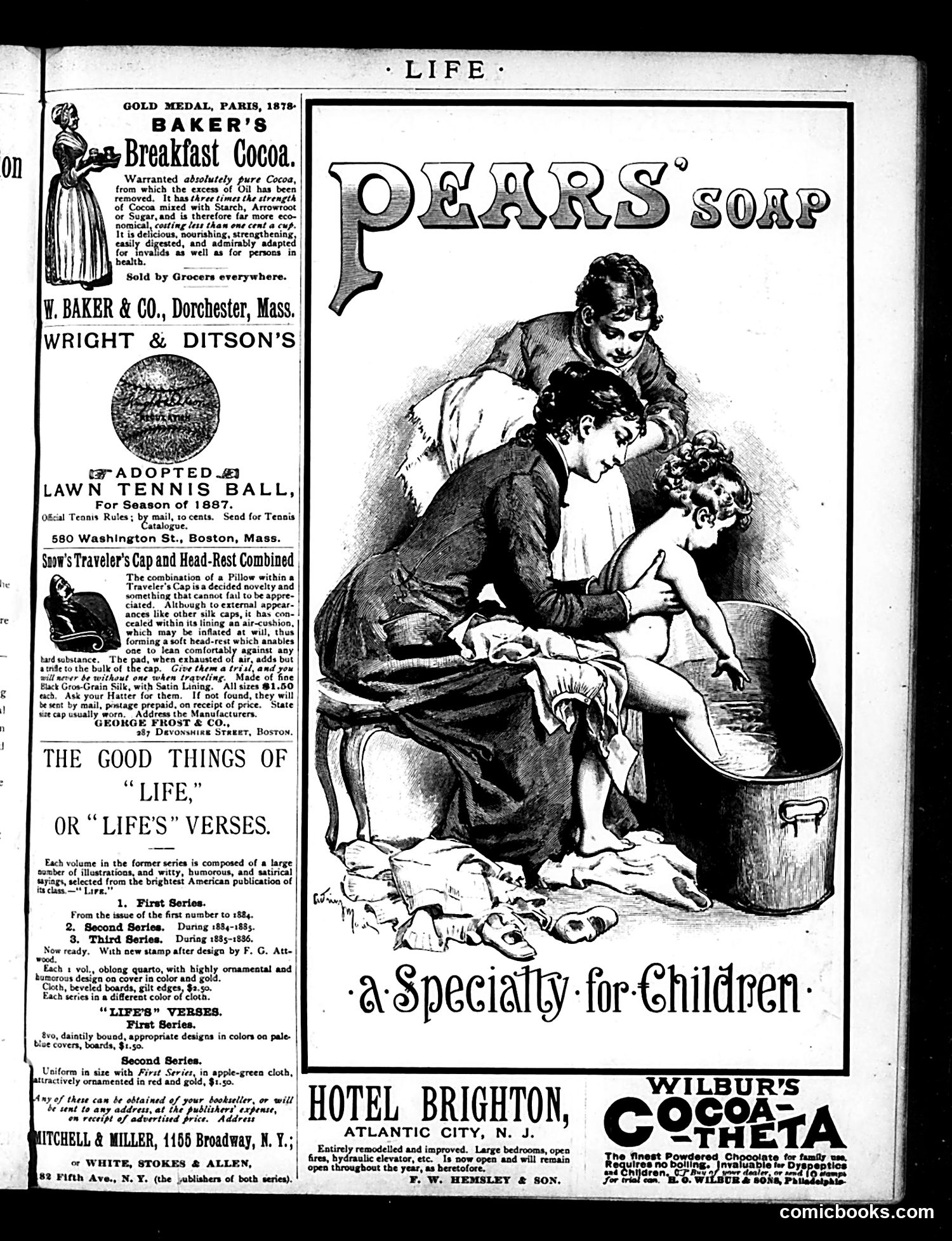
This page is primarily **advertising**, not political satire. The dominant image is a large advertisement for Pear's Soap, labeled "a Specialty for Children." The illustration shows an adult (likely a nanny or caregiver) bathing a young child in a wooden tub. The image uses sentimental, domestic imagery typical of late-19th-century product advertising—portraying soap as essential to child hygiene and care. The soft, sketched style emphasizes gentleness and wholesomeness. The surrounding advertisements promote Baker's Breakfast Cocoa, tennis balls, travel accessories, and hotel services—typical commercial content from an 1887 American magazine. The "Good Things of Life" and "Life's Verses" promotions advertise the magazine's own publications. There is no evident political commentary or satire on this particular page; it represents standard commercial and promotional content from the era.
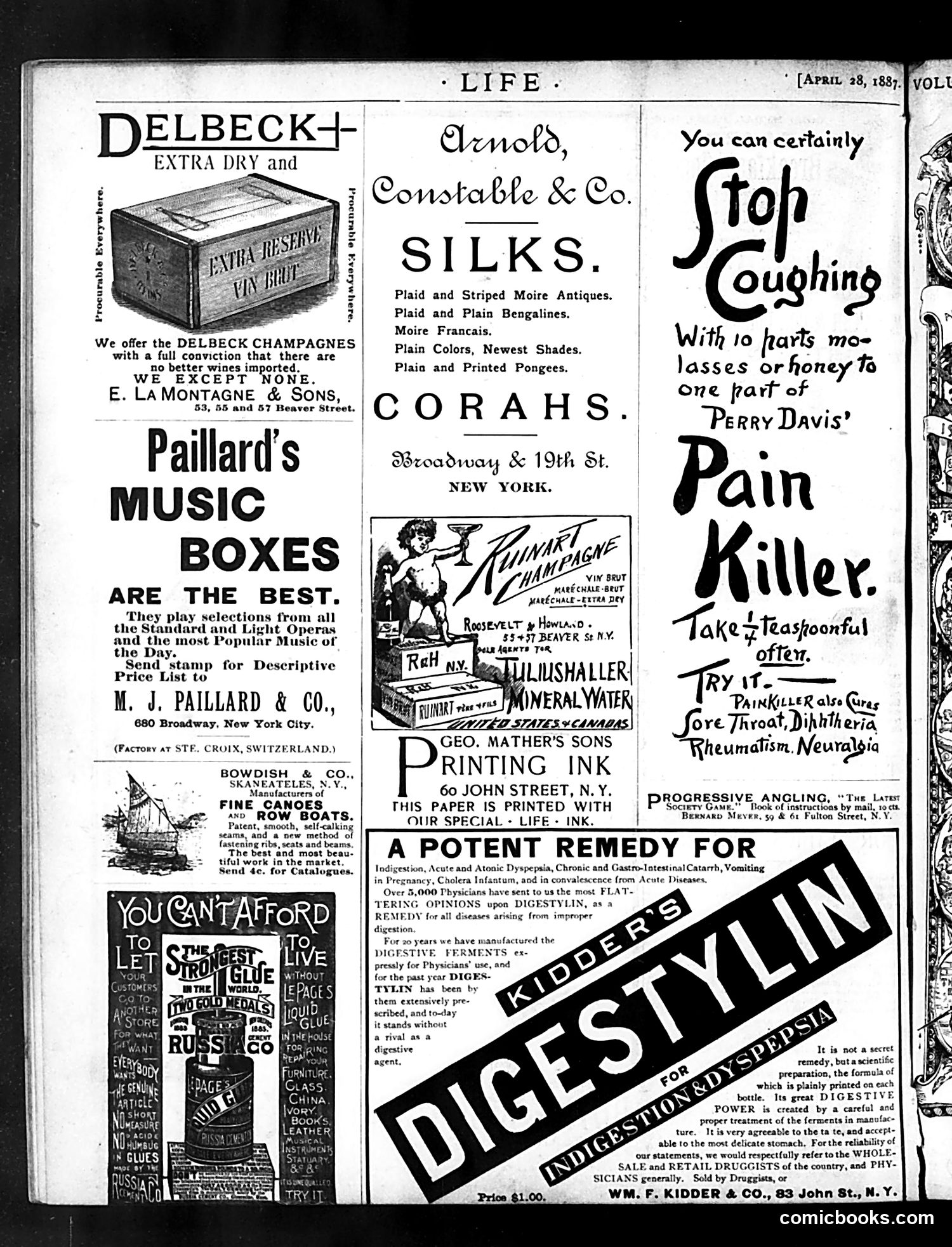
This page is **primarily advertising**, not editorial content or satire. It showcases various commercial products typical of the 1880s: champagne, music boxes, canoes, silk fabrics, printing ink, and patent medicines. The most notable advertisement is for **"Digestylin,"** a patent digestive remedy claiming endorsement from 100 physicians. This exemplifies the era's ubiquitous medical quackery—unregulated "scientific" tonics marketed with vague health claims. The ad emphasizes it's not "secret" (implying legitimacy) while making broad promises for dyspepsia and digestive ailments. **Perry Davis' Pain Killer** similarly represents era-typical patent medicines sold for coughs and pain relief. For modern readers, these ads reveal: the lack of FDA regulation, the prevalence of dubious medical claims, and how advertising filled magazine pages. The language ("potent remedy," "100 physicians") mirrors modern supplement marketing, showing such sales tactics have deep historical roots. No political cartoons or satirical commentary appears on this page.