
Life, 1887-04-28 · page 2 of 18
Life — April 28, 1887 — page 2: what you’re looking at
What you’re looking at
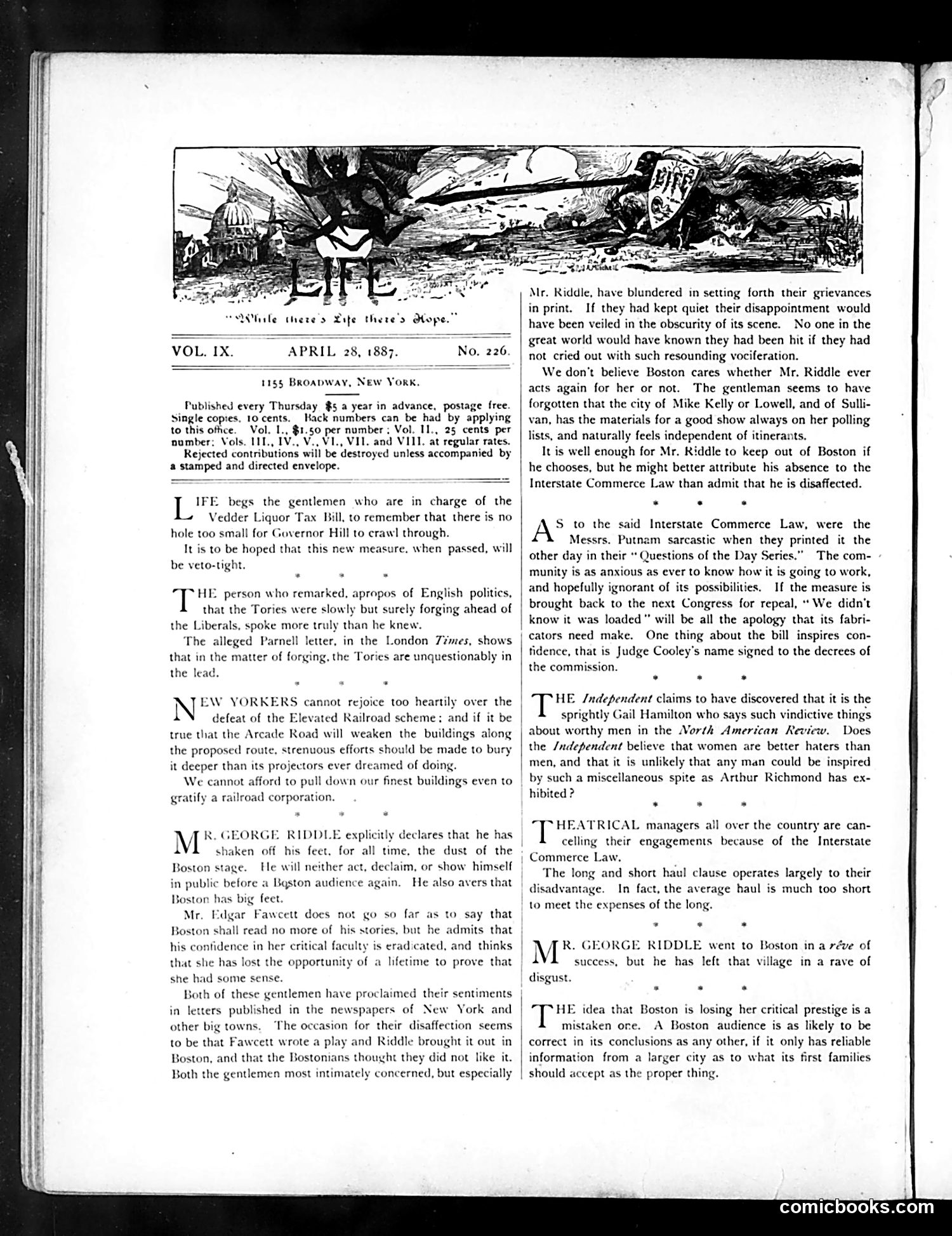
The page's masthead cartoon depicts a figure labeled "LIFE" beneath a gnarled tree, with the motto "While there's Life there's Hope." The text discusses a dispute between theatrical figures Mr. Riddle and Mr. Fawcett regarding Boston audiences and the Interstate Commerce Law. The magazine criticizes Riddle for publicly airing grievances in print, arguing such disputes should remain private to avoid embarrassment. The satire targets theatrical managers blaming the Interstate Commerce Law for canceling engagements due to shipping costs. Life suggests these complaints are exaggerated and that Boston audiences aren't actually losing theatrical prestige. The overall tone mocks both theatrical personalities and their use of legislation as an excuse for business failures, suggesting they're prioritizing public blame-shifting over professional discretion.
📄 Transcribed text from this page (OCR, searchable)
Machine-transcribed from the original scan — historical spelling and the odd misread are preserved.
“Wile theres Lite there's Mope. VOL. IX. 1887. APRIL 28, 1155 Broapway, New York. Published every Thursday $5 a year in advance, postage free. Single copies. 10 cents. Back numbers can be had by applying to this ofhce. Vol. 1., $1.50 per number ; Vol. Il., 25 cents per number: Vols. 11L., 1V., V.. VL, VIL. and VIII. at regular rates. Rejected contributions will be destroyed unless accompanied by a stamped and directed envelope. I IFE begs the gentlemen who are in charge of the — Vedder Liquor Tax Bill, to remember that there is no hole too small for Governor Hill to crawl through. It is to be hoped that this new measure. when passed, will be veto-tight. T HE person who remarked, apropos of English politics, that the Tories were slow the Liberals, spoke more truly than he knew. The alleged Parnell letter, in the London 7%mes, shows that in the matter of forging, the Tories are unquestionably in the lead. EW YORKERS cannot rejoice too heartily over the I defeat of the Elevated Railroad scheme; and if it be true that the Arcade Road will weaken the buildings along the proposed route, strenuous efforts should be made to bury it deeper than its projectors ever dreamed of doing. We cannot afford to pull down our finest buildings even to gratify a railroad corporation. ORGE RIDDLE explicitly declares that he has shaken off his feet, for all time, the dust of the Boston stage. He will neither act, declaim, or show himself in public before a Bgston audience again. He also avers that Boston has big feet. Mr. Edgar Fawcett does not go so far a say that Boston shall read no more of his stories, but he admits that his contidence in her critical faculty is eradicated, and thinks that she has lost the opportunity of a lifetime to prove that she had some sense. Both of these gentlemen have proclaimed their sentiments in letters published in the newspapers of New York and other big towns. The occasion for their disaffection seems to be that Fawcett wrote a play and Riddle brought it out in s thought they did not lik Both the gentlemen most intimately concerned, but especii Boston, and that the Bostonia y but surely forging ahead of | Mr. Riddle, have blundered in setting forth their grievances in print. If they had kept quiet their disappointment would have been veiled in the obscurity of its scene. No one in the great world would have known they had been hit if they had not cried out with such resounding vociferation. We don’t believe Boston cares whether Mr. Riddle ever acts again for her or not. The gentleman seems to have forgotten that the city of Mike Kelly or Lowell, and of Sulli- van, has the materials for a good show always on her polling lists, and naturally feels independent of itinerants. It is well enough for Mr. Riddle to keep out of Boston if he chooses, but he might better attribute his absence to the Interstate Commerce Law than admit that he is disaffected. to the said Interstate Commerce Law, were the Messrs. Putnam sarcastic when they printed it the other day in their * Questions of the Day Series.” The com- munity is as anxious as ever to know how it is going to work, and hopefully ignorant of its possibilities. If the measure is brought back to the next Congress for repeal, “* We didn't know it was loaded" will be all the apology that its fabri- cators need make. One thing about the bill inspires con- fidence, that is Judge Cooley's name signed to the decrees of the commission. . . . HE /ndependent claims to have discovered that it is the sprightly Gail Hamilton who says such vindictive things about worthy men in the orth American Review. Does the /ndependent believe that women are better haters than men, and that it is unlikely that any man could be inspired by such a miscellaneous spite as Arthur Richmond has ex- hibited ? * . * “THEATRICAL managers all over the country are can- celling their engagements because of the Interstate Commerce Law, The long and short haul clause operates largely to their disadvantage. In fact, the average haul is much too short to meet the expenses of the long. . . . N R. GEORGE RIDDLE went to Boston in a réve of i success, but he has left that village in a rave of disgust. . . . HE idea that Boston is losing her critical prestige is a mistaken ore. A Boston audience is as likely to be correct in its conclusions as any other, if it only has reliable information from a larger city as to what its first families should accept as the proper thing. comicbooks.com