
Life, 1887-04-28 · page 6 of 18
Life — April 28, 1887 — page 6: what you’re looking at
What you’re looking at
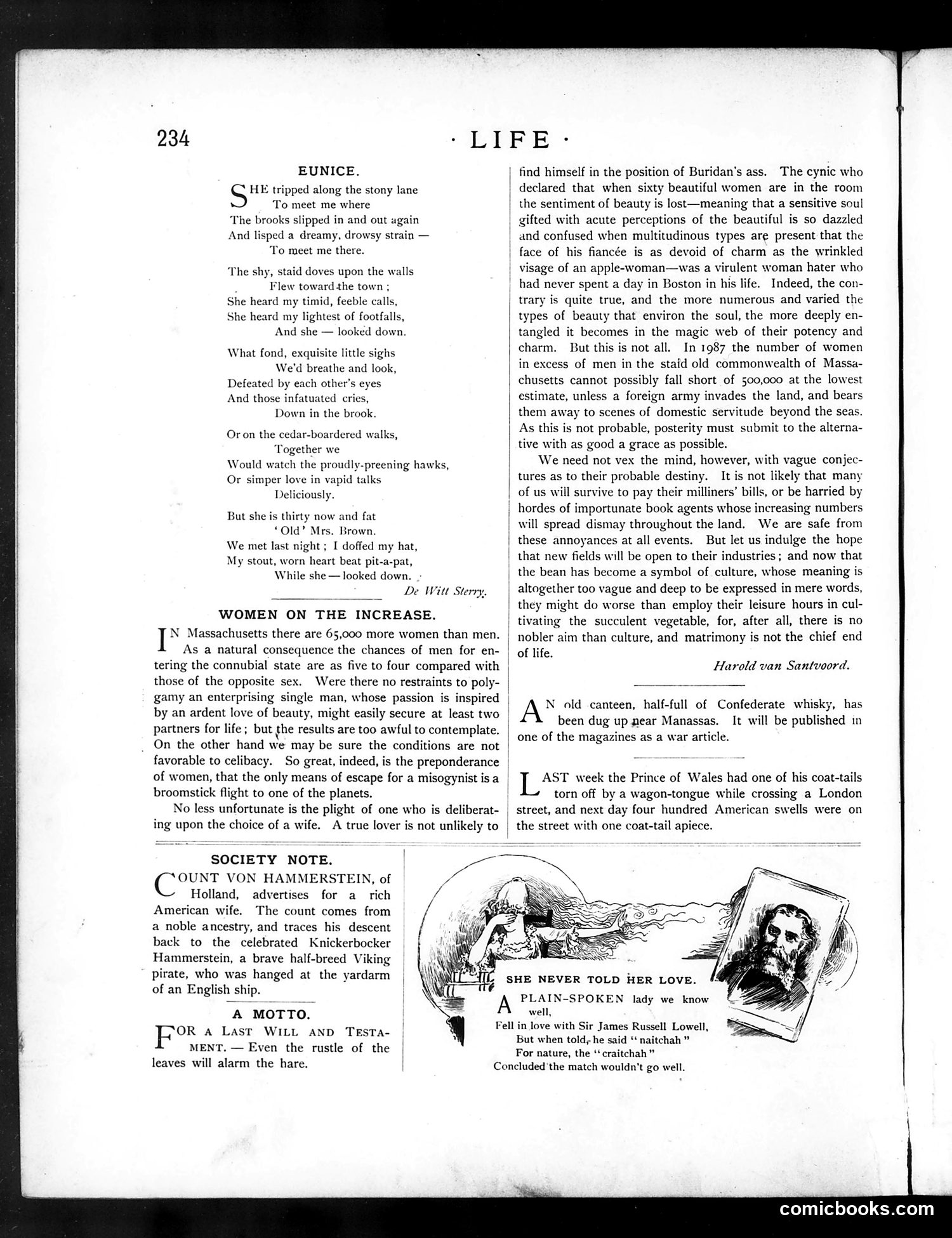
This page contains literary and social commentary rather than political cartoons. The main pieces include: **"Eunice"** — a romantic poem by De Witt Sterry about meeting a woman. **"Women on the Increase"** — an essay noting that Massachusetts has 65,000 more women than men, satirizing the implications: women outnumber potential husbands, making polygamy seem logical to some, though the author calls this escape "broomstick flight to one of the planets." The satire mocks both the demographic reality and absurd male responses to it. **Social notes** include brief gossip items about Count von Hammerstein and the Prince of Wales. **"She Never Told Her Love"** — a humorous verse about a woman who rejected Sir James Russell Lowell when he proposed, using period slang ("naitchah," "craitchah"). The page reflects turn-of-century concerns about gender ratios and marriage prospects in American society.
📄 Transcribed text from this page (OCR, searchable)
Machine-transcribed from the original scan — historical spelling and the odd misread are preserved.
- LIFE - EUNICE. S HE tripped along the stony lane To meet me where The brooks slipped in and out again And lisped a dreamy, drowsy strain — To meet me there. ‘The shy, staid doves upon the walls . Flew toward the town ; She heard my timid, feeble calls, She heard my lightest of footfalls, And she — looked down. What fond, exquisite little sighs We'd breathe and look, Defeated by each other's eyes And those infatuated cries, Down in the brook. Or on the cedar-boardered walks, ‘Together we Would watch the proudly-preening hawks, Or simper love in vapid talks Deliciously. But she is thirty now and fat ‘Old’ Mrs. Brown. We met last night ; I doffed my hat, My stout, worn heart beat pit-a-pat, While she — looked down. - De Witt Sterry., WOMEN ON THE INCREASE. ] Massachusetts there are 65,000 more women than men. As a natural consequence the chances of men for en- tering the connubial state are as five to four compared with those of the opposite sex. Were there no restraints to poly- find himself in the position of Buridan’s ass. The cynic who declared that when sixty beautiful women are in the room the sentiment of beauty is lost—meaning that a sensitive soul gifted with acute perceptions of the beautiful is so dazzled and confused when multitudinous types are present that the face of his fiancée is as devoid of charm as the wrinkled | visage of an apple-woman—was a virulent woman hater who had never spent a day in Boston in his life. Indeed, the con- trary is quite true, and the more numerous and varied the types of beauty that environ the soul, the more deeply en- tangled it becomes in the magic web of their potency and charm. But this is not all. In 1987 the number of women in excess of men in the staid old commonwealth of Massa- chusetts cannot possibly fall short of 500,000 at the lowest estimate, unless a foreign army invades the land, and bears them away to scenes of domestic servitude beyond the seas. As this is not probable, posterity must submit to the alterna- | tive with as good a grace as possible. We need not vex the mind, however, with vague conjec- tures as to their probable destiny. It is not likely that many of us will survive to pay their milliners’ bills, or be harried by hordes of importunate book agents whose increasing numbers will spread dismay throughout the land. We are safe from these annoyances at all events. But let us indulge the hope that new fields will be open to their industries; and now that the bean has become a symbol of culture, whose meaning is altogether too vague and deep to be expressed in mere words, they might do worse than employ their leisure hours in cul- tivating the succulent vegetable, for, after all, there is no | nobler aim than culture, and matrimony is not the chief end | of life. gamy an enterprising single man, whose passion is inspired | by an ardent love of beauty, might easily secure at least two partners for life; but the results are too awful to contemplate. On the other hand we may be sure the conditions are not | favorable to celibacy. So great, indeed, is the preponderance of women, that the only means of escape for a misogynist is a broomstick flight to one of the planets. No less unfortunate is the plight of one who is deliberat- ing upon the choice of a wife. A true lover is not unlikely to SOCIETY NOTE. | OUNT VON HAMMERSTEIN, of Holland, advertises for a_ rich American wife. The count comes from a noble ancestry, and traces his descent back to the celebrated Knickerbocker Hammerstein, a brave half-breed Viking pirate, who was hanged at the yardarm of an English ship. A MOTTO. OR a Last WILL AND TEsTA- MENT. — Even the rustle of the leaves will alarm the hare. Harold van Santvoord. N old canteen, half-full of Confederate whisky, has been dug up near Manassas. It will be published in one of the magazines as a war article. AST week the Prince of Wales had one of his coat-tails torn off by a wagon-tongue while crossing a London street, and next day four hundred American swells were on the street with one coat-tail apiece. SHE NEVER TOLD HER LOVE. PLAIN-SPOKEN lady we know well, Fell in love with Sir James Russell Lowell, But when told, he said “ naitchah” For nature, the “‘craitchah” Concluded ‘the match wouldn't go well. comicbooks.com