
A complete issue · 18 pages · 1887
Life — February 3, 1887
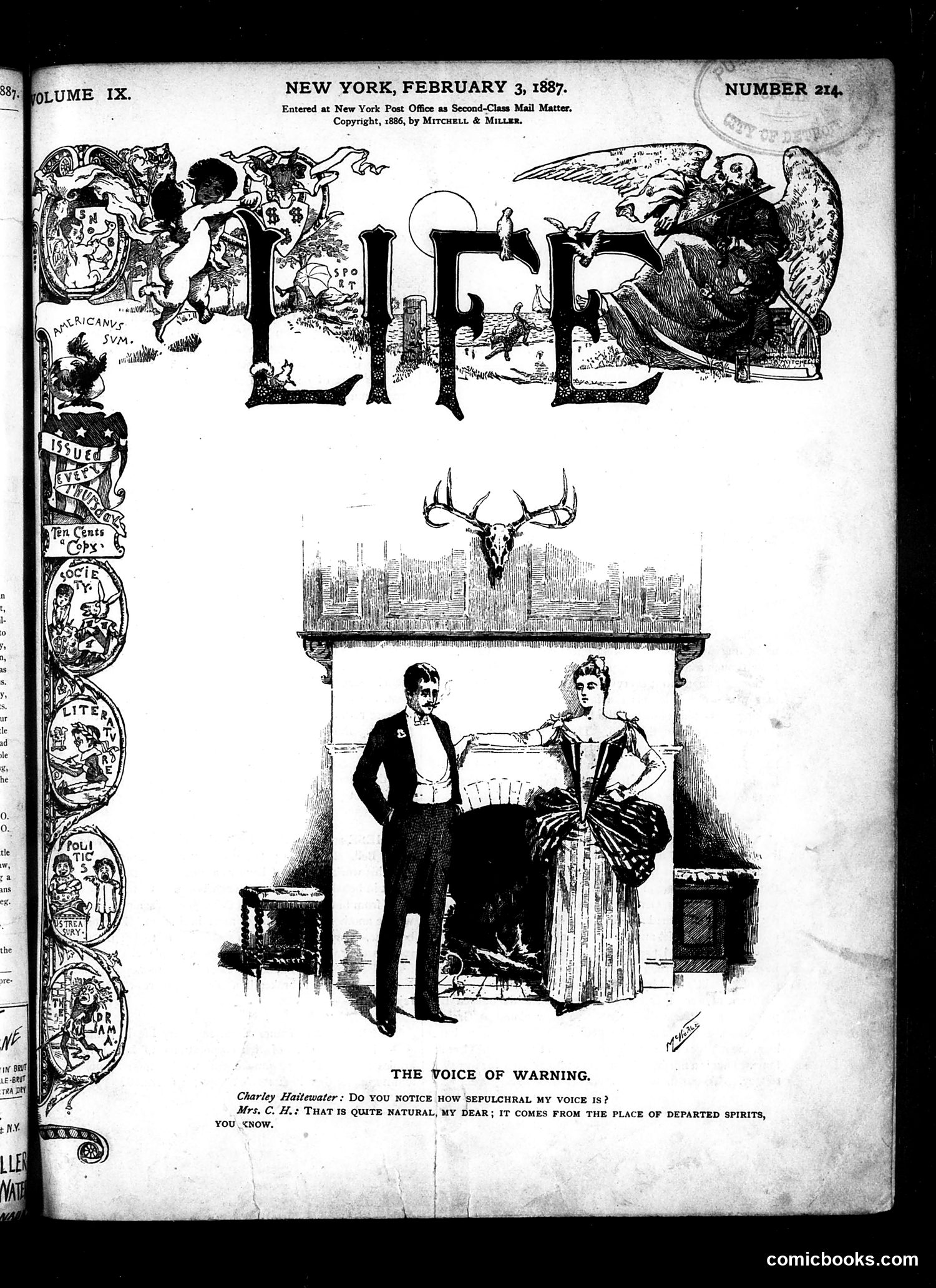
This satirical cartoon depicts a séance scene where a man in formal dress and a woman in an elegant gown sit with a fireplace mantle displaying a deer skull and cityscape. The caption indicates "Charley Hailwater" is addressing "Mrs. C.," noting that a "sepulchral" voice claims to come "from the place of departed spirits." The satire appears to target the Victorian-era spiritualism craze—the popular belief in communicating with ghosts through mediums and séances. The cartoon mocks this pseudoscientific practice by suggesting the "warning voice" is merely theatrical trickery. The formal setting and the couple's expressions suggest the absurdity of educated people participating in such supernatural claims, which were often fraudulent.
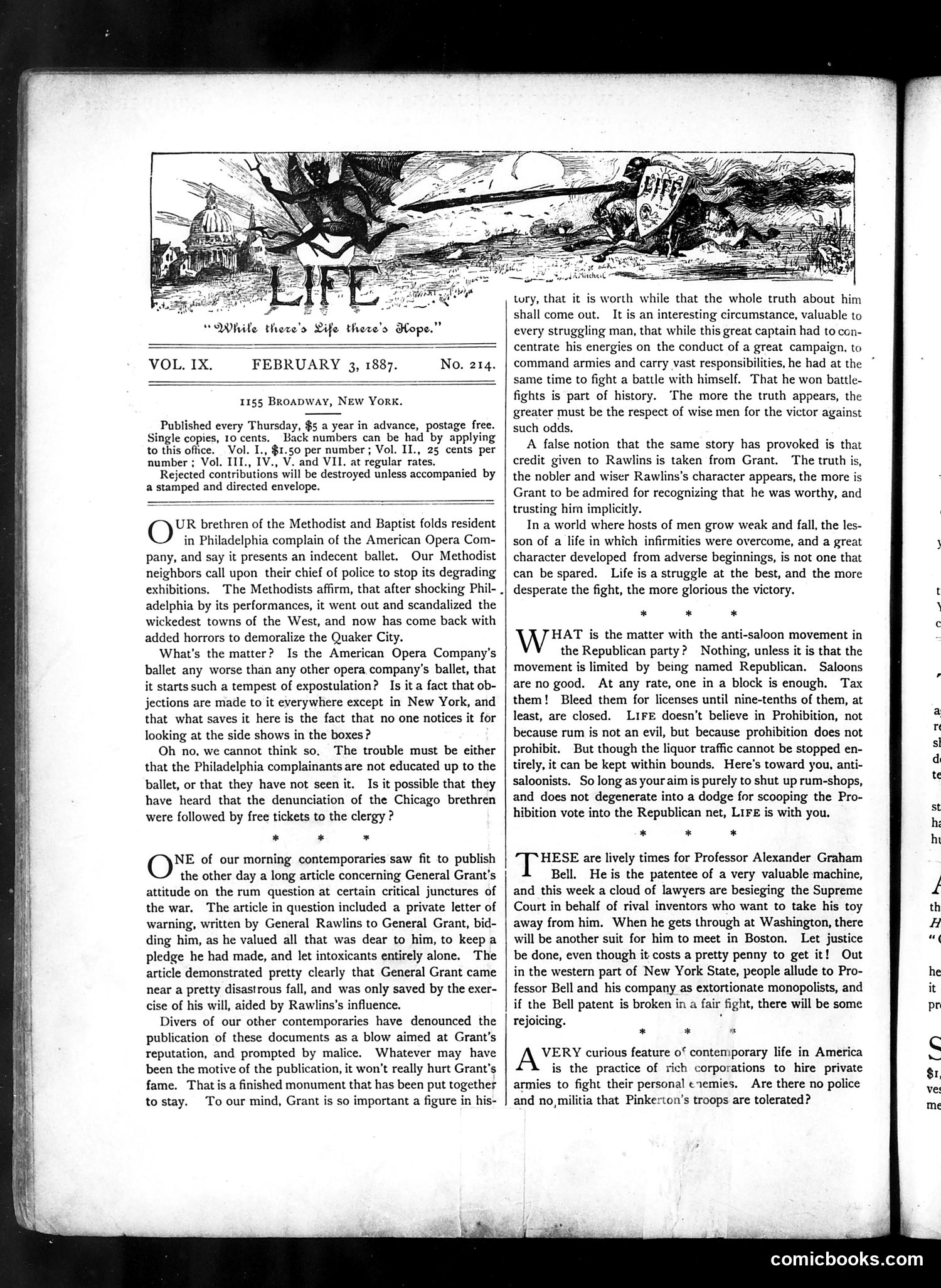
The masthead cartoon depicts a figure labeled "LIFE" beneath a bare tree, with the motto "While there's Life there's Hope." The page contains several editorial pieces discussing contemporary issues. The most specific political content addresses General Grant's reputation, debating whether unfavorable stories about him originated from General Rawlins or were taken from Grant's own writings. The editors argue that Grant's character should be evaluated fairly based on truth. Another section criticizes the "anti-saloon movement in the Republican party," suggesting that prohibitionist efforts are futile and that controlling liquor through regulation is preferable to outright bans. A final item discusses Professor Alexander Graham Bell's patent disputes, noting rival inventors' legal challenges to his monopoly on telephone technology. The commentary reflects late-19th-century debates over temperance, political reputation, and industrial patents.
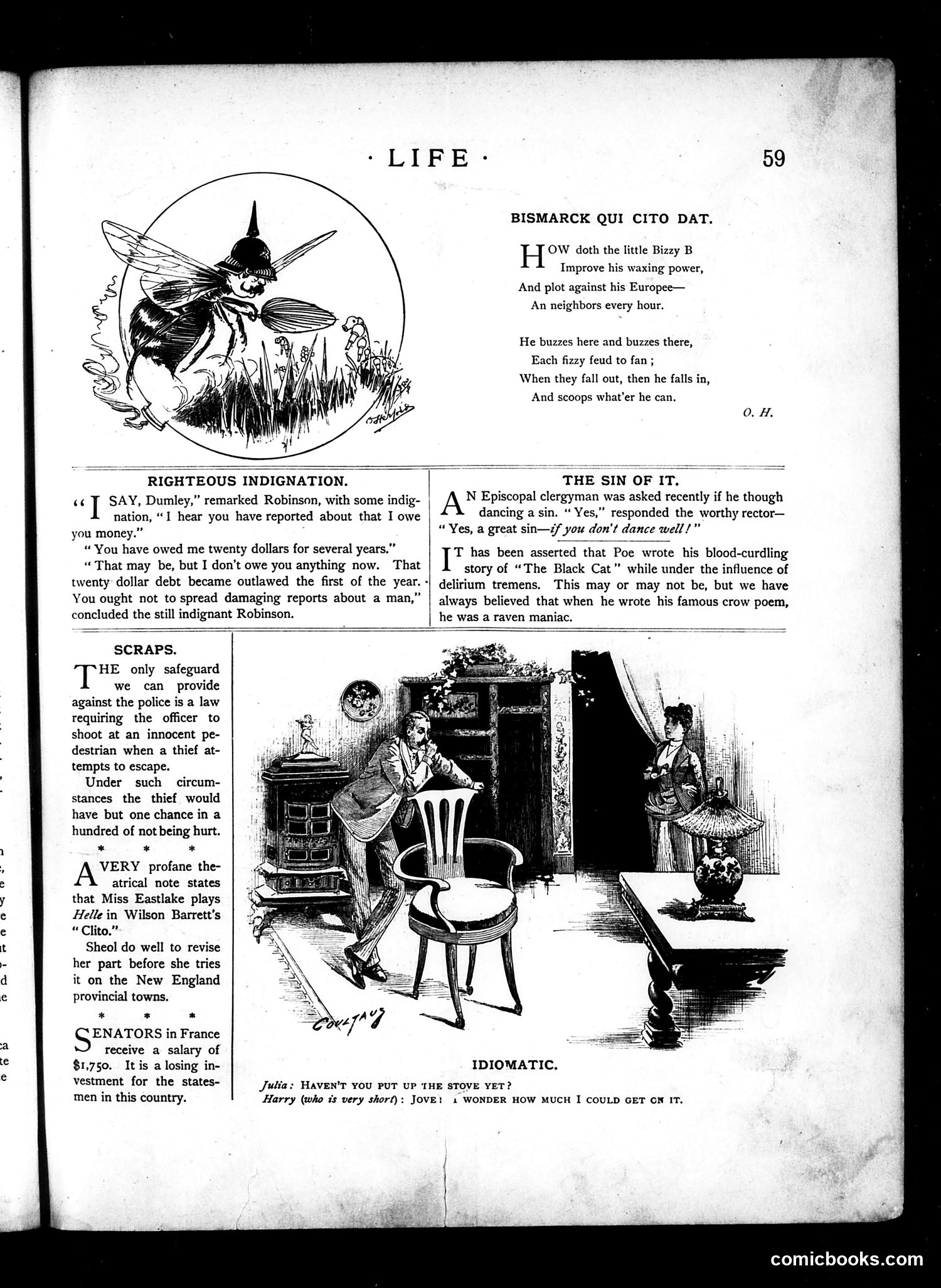
**Top Illustration ("Bismarck qui Cito Dat"):** A bee wearing a Prussian military helmet (spiked Pickelhaube) is depicted scheming against Europe. The poem satirizes Otto von Bismarck, the German chancellor, comparing his aggressive diplomacy to a buzzing bee that "plots against his Europese" neighbors. This appears to reference Bismarck's aggressive foreign policy and militarism during the late 19th century. **"Righteous Indignation" & "The Sin of It":** Brief satirical anecdotes mocking social hypocrisy—one about an unpaid debt, another about a clergyman defending dancing as acceptable behavior. **"Idiomatic" cartoon:** A domestic scene where a woman (Julia) asks about heating a stove; her short husband (Harry) quips he wonders how much he could "get on it"—a crude innuendo joke about his diminutive stature.
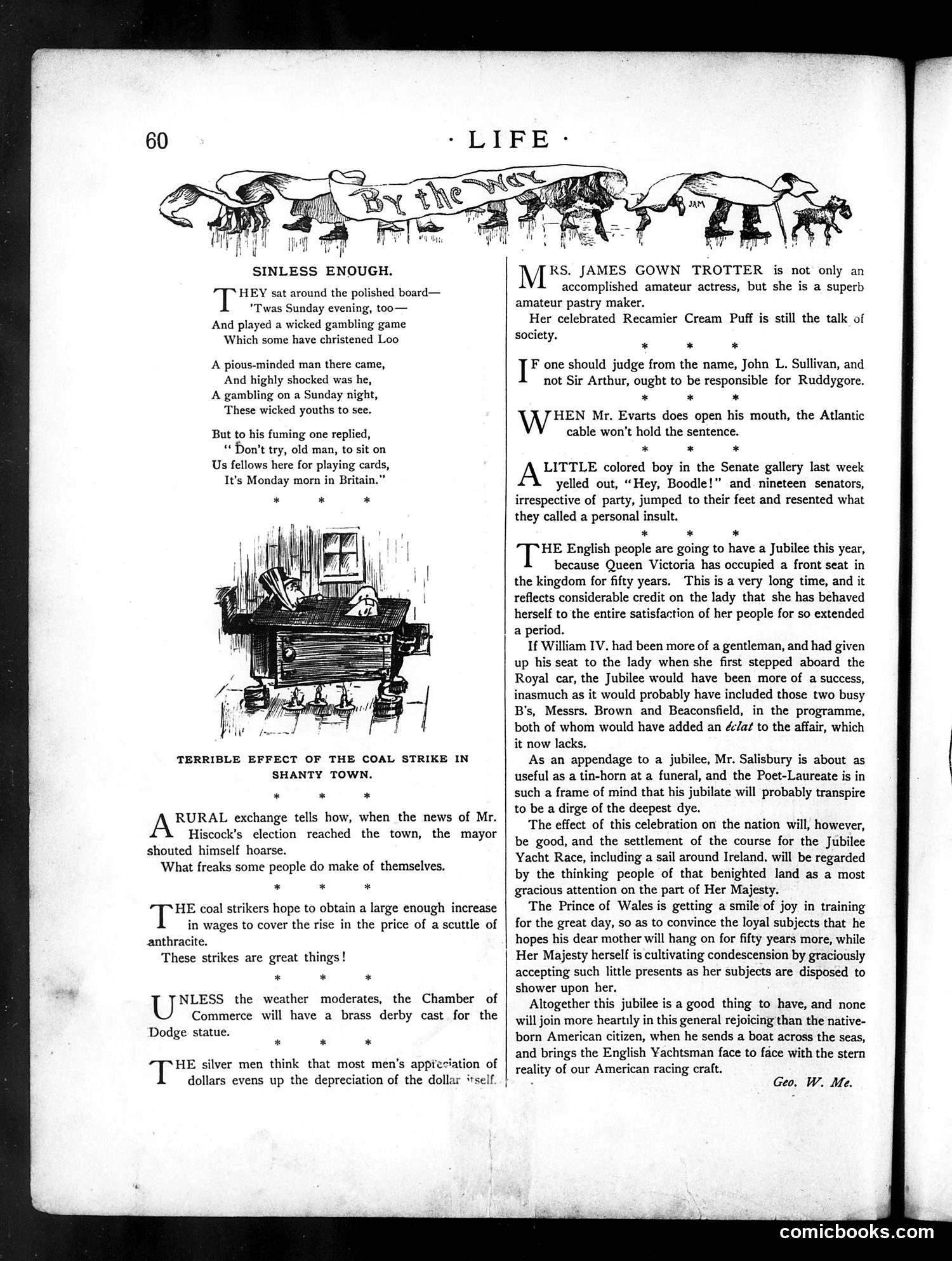
This page contains several brief satirical items typical of Life's humor section. **"Sinless Enough"** mocks religious hypocrisy: a pious man objects to Sunday gambling, but his friend points out that in Britain, even gambling is acceptable Monday morning—implying the man's selective morality is unconvincing. **The illustration** shows the "Terrible Effect of the Coal Strike in Shanty Town"—depicting domestic disruption from labor unrest. The right column contains brief social commentary on contemporary topics including Queen Victoria's Jubilee celebration, the Prince of Wales, and American yachting. These items praise British institutional stability while gently poking fun at ceremonial excess and pretension. The overall tone is light satirical commentary on social conventions, class attitudes, and current events rather than sharp political critique.
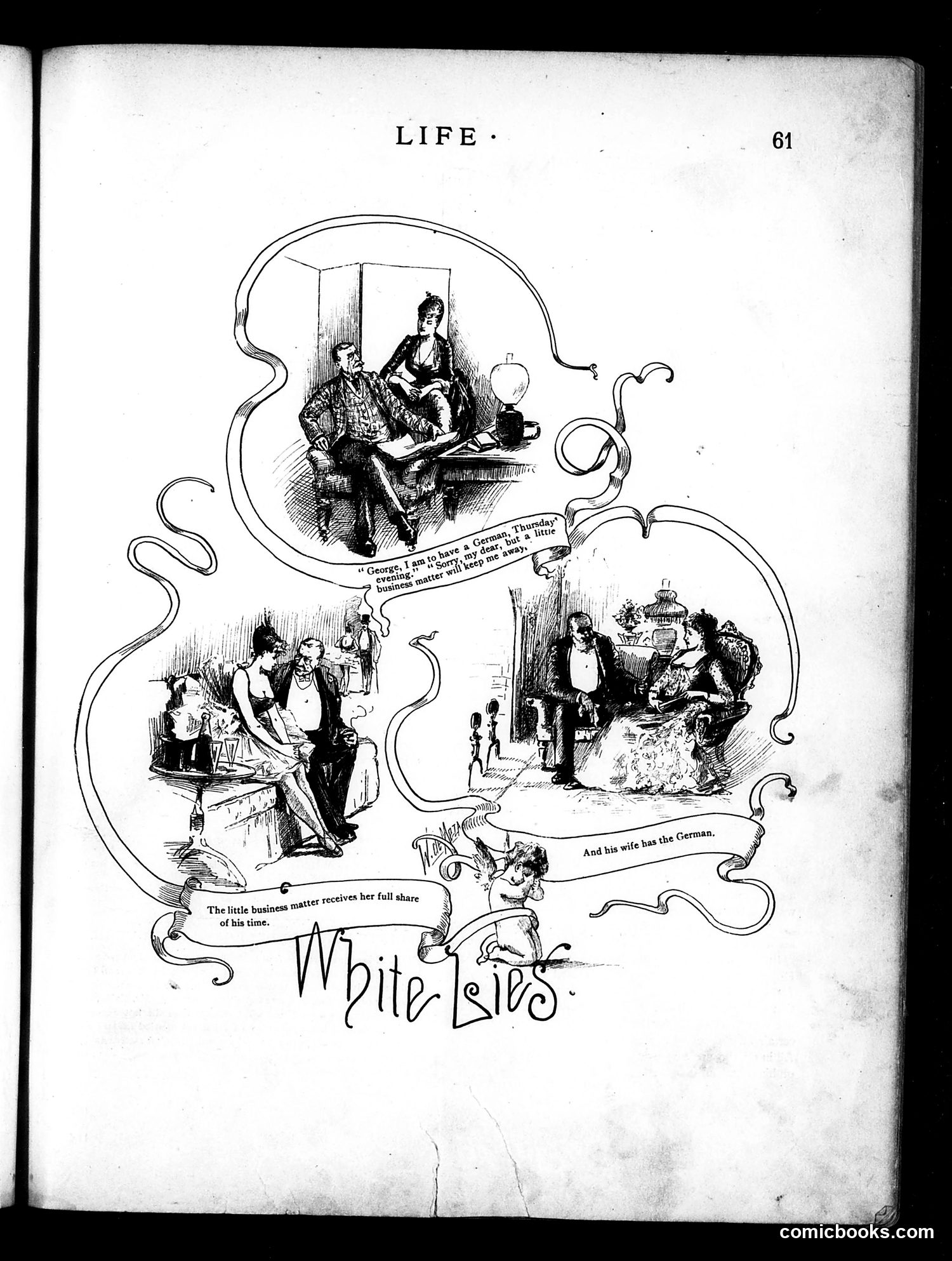
This satirical cartoon depicts a domestic comedy in four vignettes framed by ornate borders. The title "White Lies" suggests the theme concerns socially acceptable deceptions in marriage. The top panel shows a man telling his wife he has a "German" Thursday commitment requiring him to stay out late—implying the "business matter" is actually social pleasure. The left panel shows the couple at what appears to be a formal dinner, suggesting the gentleman's evening activities. The right panel shows the gentleman with a woman identified as "his wife has the German"—revealing the deception's ironic twist. The bottom caption notes "The little business matter receives her full share of his time," sarcastically commenting on how the wife participates in or accepts these domestic falsehoods. The satire targets Victorian-era marriage dynamics and male infidelity rationalization.
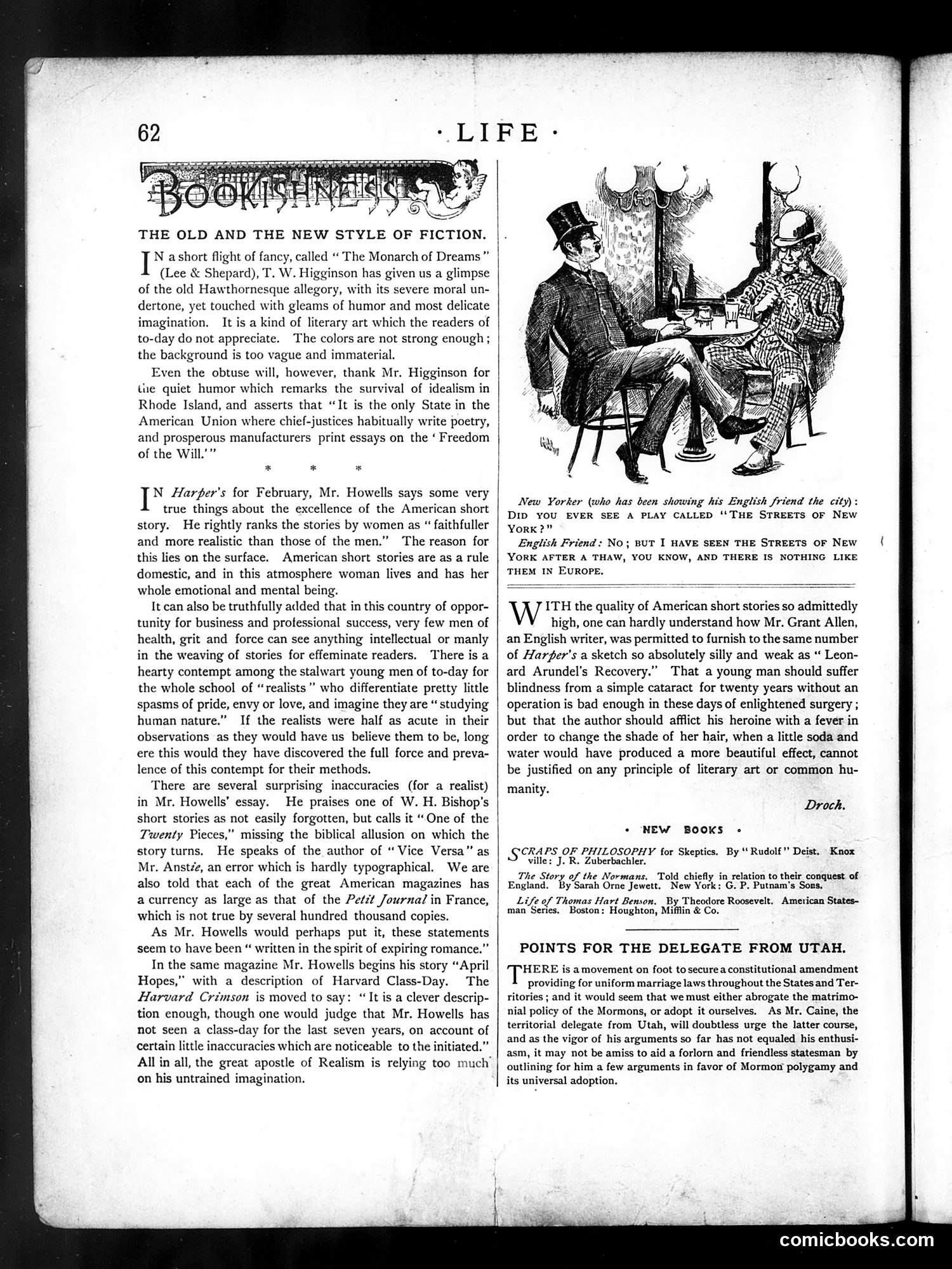
The illustration depicts a social scene with three men in period dress (appears to be late 19th century), seated around what looks like a dining table. One figure wears a top hat and formal attire; another appears to be an English gentleman based on the caption's reference to "English friend." The cartoon illustrates the caption's dialogue about New York's streets. An English visitor comments on the contrasts between American and European urban life. The satire targets American society's rough materiality—the "streets of New York" lack the refinement found in European cities, suggesting American culture prioritizes commerce and pragmatism over aesthetic cultivation. The humor relies on the transatlantic comparison, a common satirical device in this era, contrasting refined European sensibilities with brash American character.
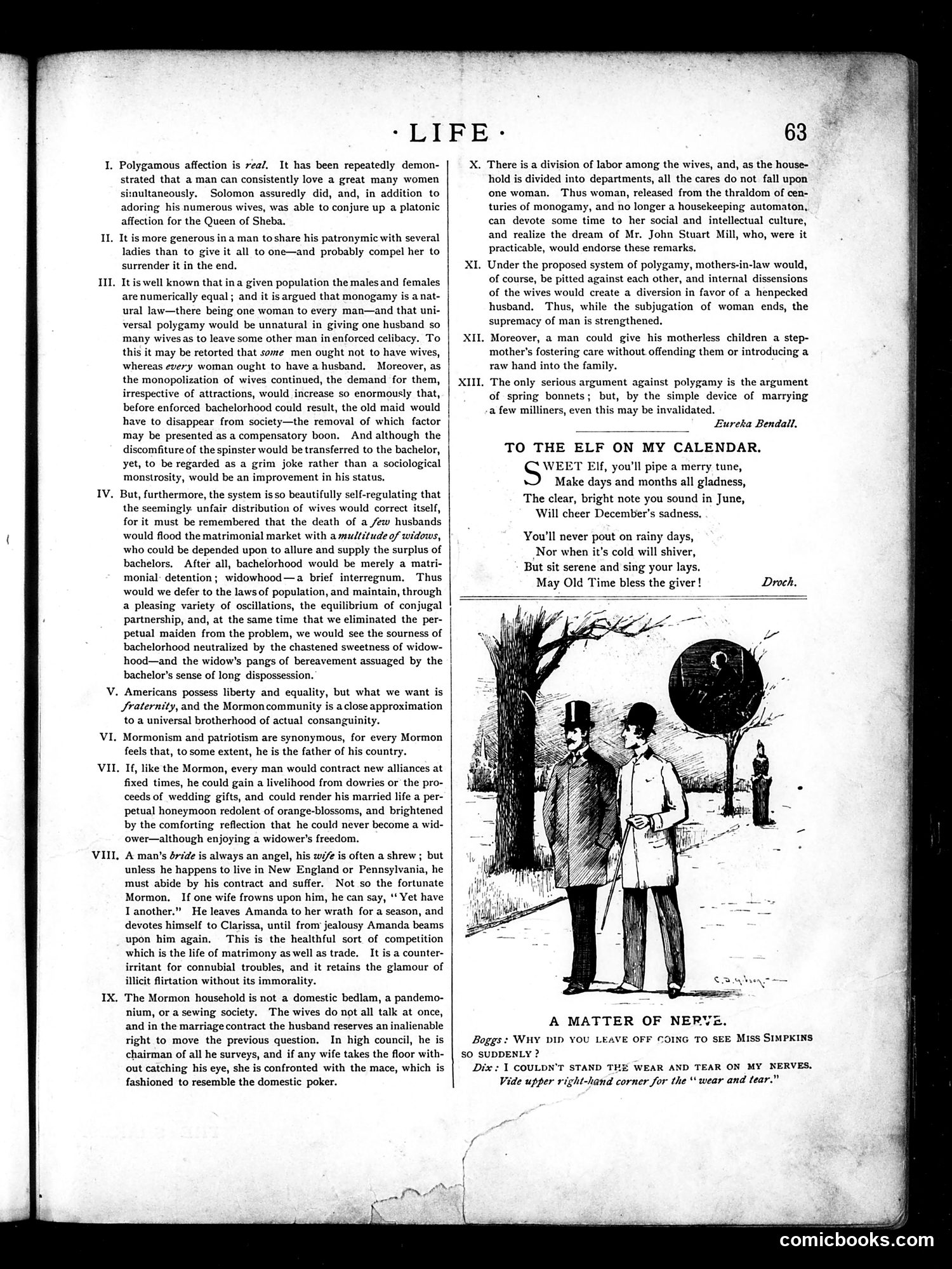
This page contains two distinct pieces: **Left side:** A numbered essay defending Mormon polygamy, arguing it would regulate population, prevent bachelorhood, and benefit society through "fraternity." **Right side cartoon ("A Matter of Nerve"):** Shows two men in Victorian dress near a tree. One asks why the other left off visiting "Miss Simpkins" so suddenly. The response claims he "couldn't stand the wear and tear on my nerves"—with a note referencing "wear and tear" in the upper right corner. The cartoon appears to satirize male nervousness or hypochondria regarding courtship obligations, a common Victorian anxiety. The humor lies in a man abandoning romantic pursuit due to emotional exhaustion rather than genuine disinterest, mocking exaggerated claims of delicate male sensibilities. The juxtaposition with the polygamy essay below creates ironic commentary on competing Victorian attitudes about marriage and male responsibility.
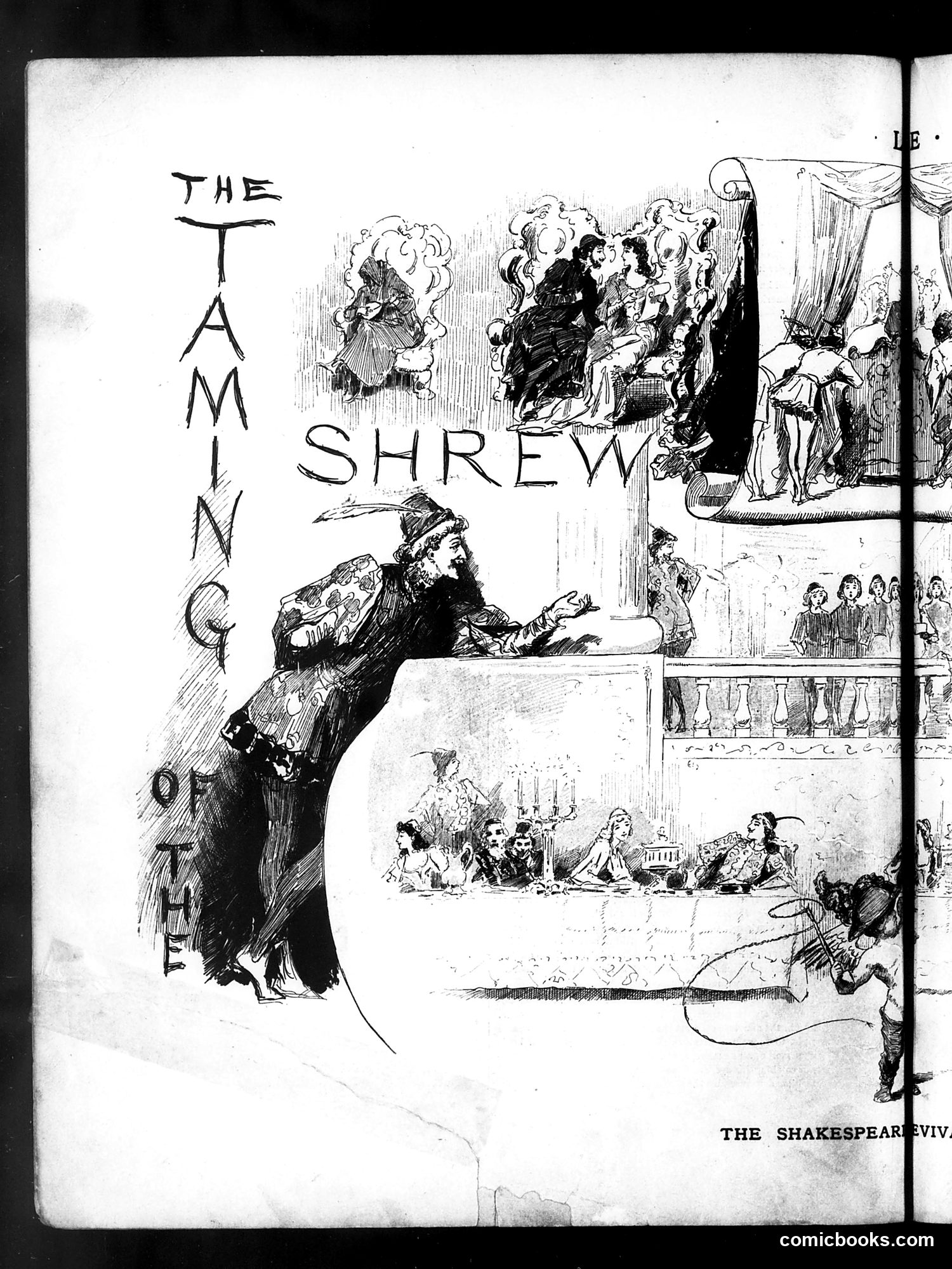
This is a title page illustration for Shakespeare's *The Taming of the Shrew*. The left panel shows a figure (likely representing a theatrical director or performer) energetically gesturing or conducting. The right panels depict theatrical scenes with audiences in tiered seating, suggesting a stage production. The satire appears to reference the play's controversial themes—specifically the "taming" of an independent woman into submission. The exaggerated pose and theatrical setting suggest commentary on how this Shakespearean plot was being performed or interpreted. The illustration likely critiques either the play itself or contemporary production choices, though the specific satirical target remains unclear without additional context about *Life* magazine's publication date.
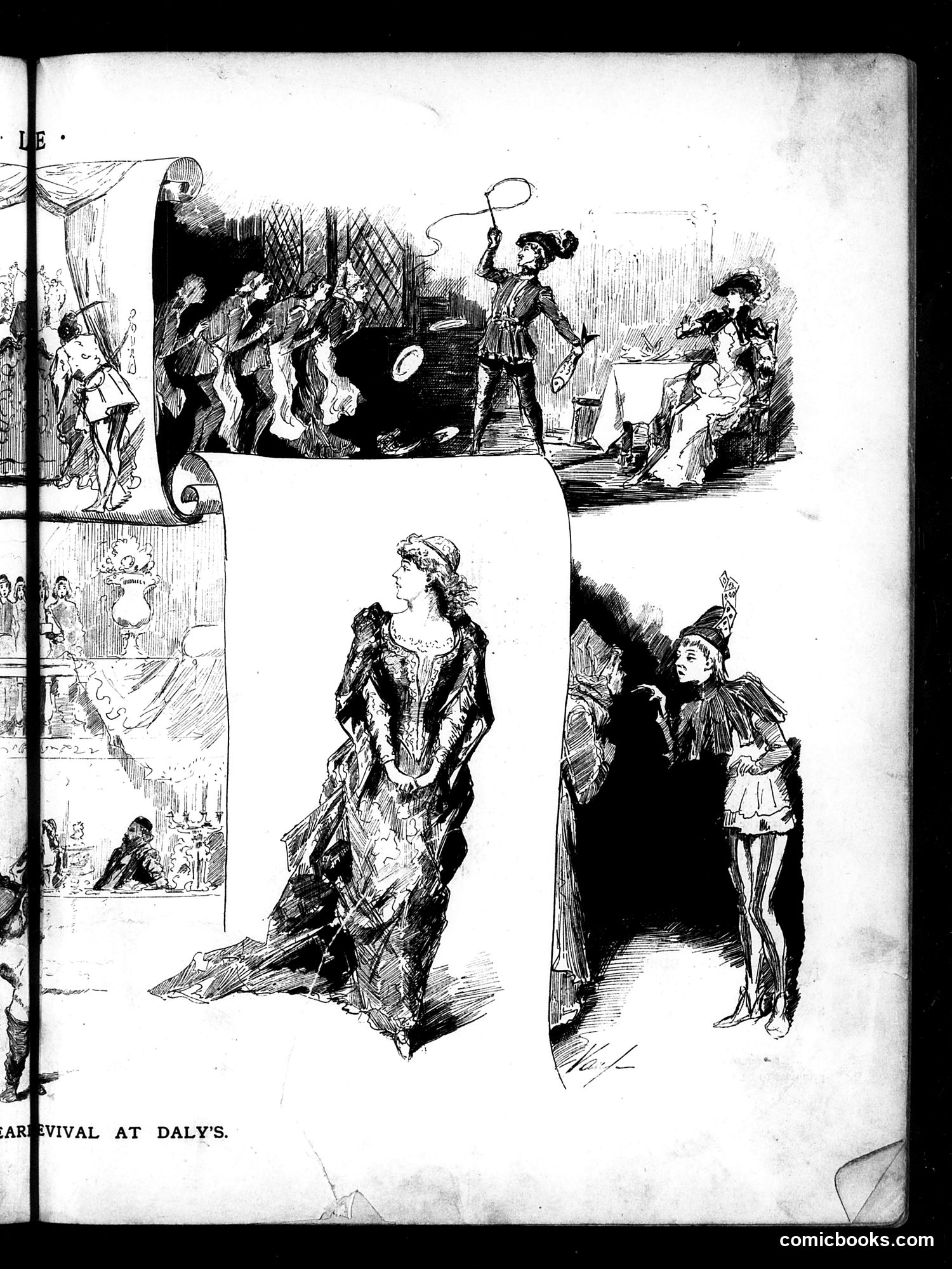
This page satirizes a theatrical production at Daly's Theatre, likely referencing a scandalous revival featuring minimal or revealing costumes. The multiple sketches show different scenes from the production, with emphasis on underdressed performers. The satire appears to target both the theatrical spectacle itself and Victorian sensibilities around decency. The elaborate staging shown in the upper panel contrasts with the isolated figures below—a woman in fur stole and a young performer—suggesting mockery of how "respectability" (the fur, the theatrical framing) barely masks what audiences actually came to see. The joke for contemporary readers was likely about the tension between theatrical "art" and burlesque entertainment, and the hypocrisy of audiences attending such productions.
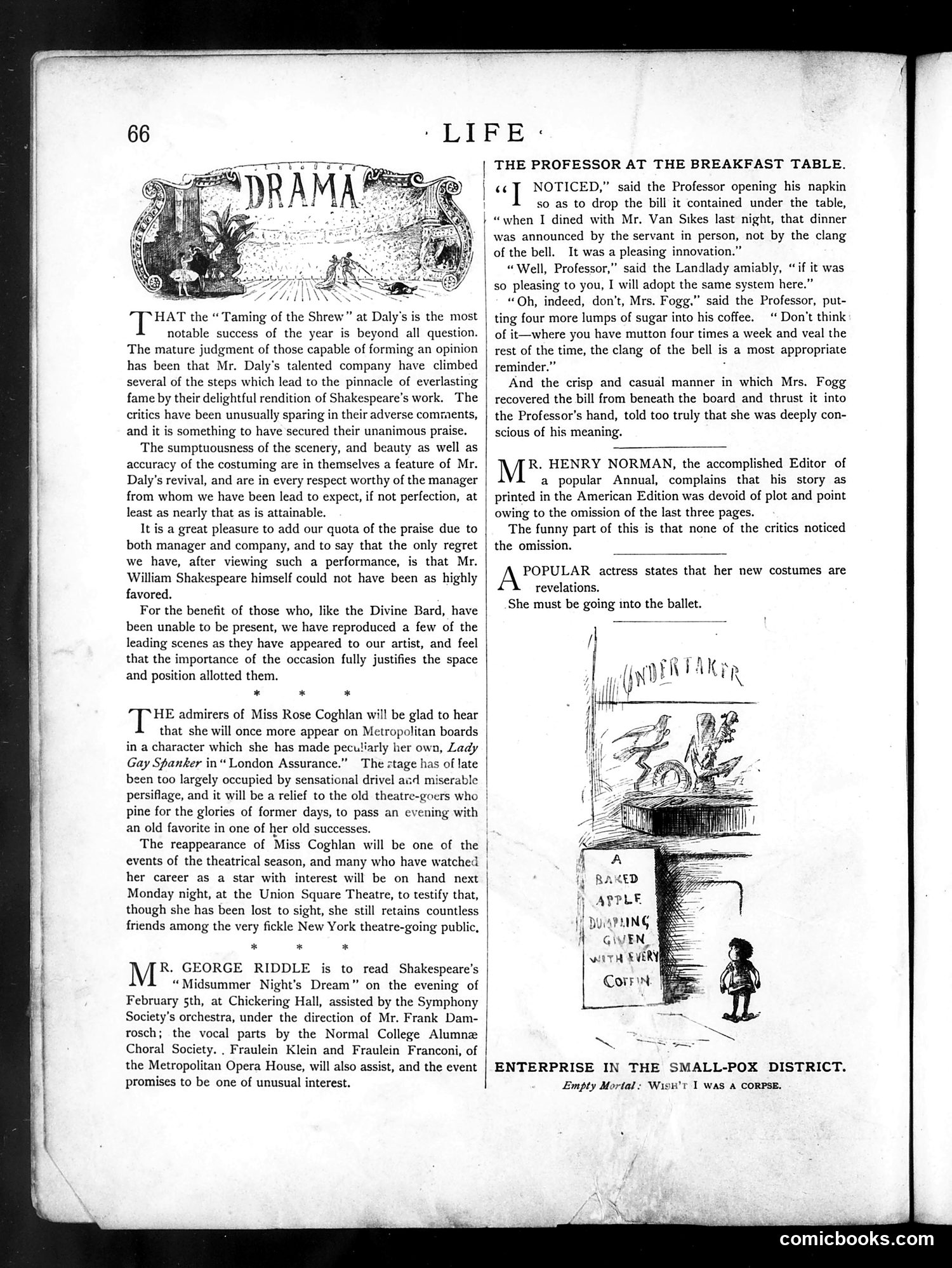
This page contains theatrical gossip and reviews rather than political cartoons. The main content discusses Shakespeare performances: praise for Daly's production of "The Taming of the Shrew," and announcements about upcoming performances by actor George Riddle and actress Rose Coghlan. The only illustration is titled "Enterprise in the Small-Pox District," showing a child looking at a sign advertising "A Baked Apple Dumpling Given With Every Coin" — likely satirizing opportunistic street vendors who exploited poor neighborhoods during disease outbreaks by advertising cheap food as an inducement to customers. The humor targets commercial exploitation of vulnerable urban areas. The page primarily serves as entertainment news rather than political satire.
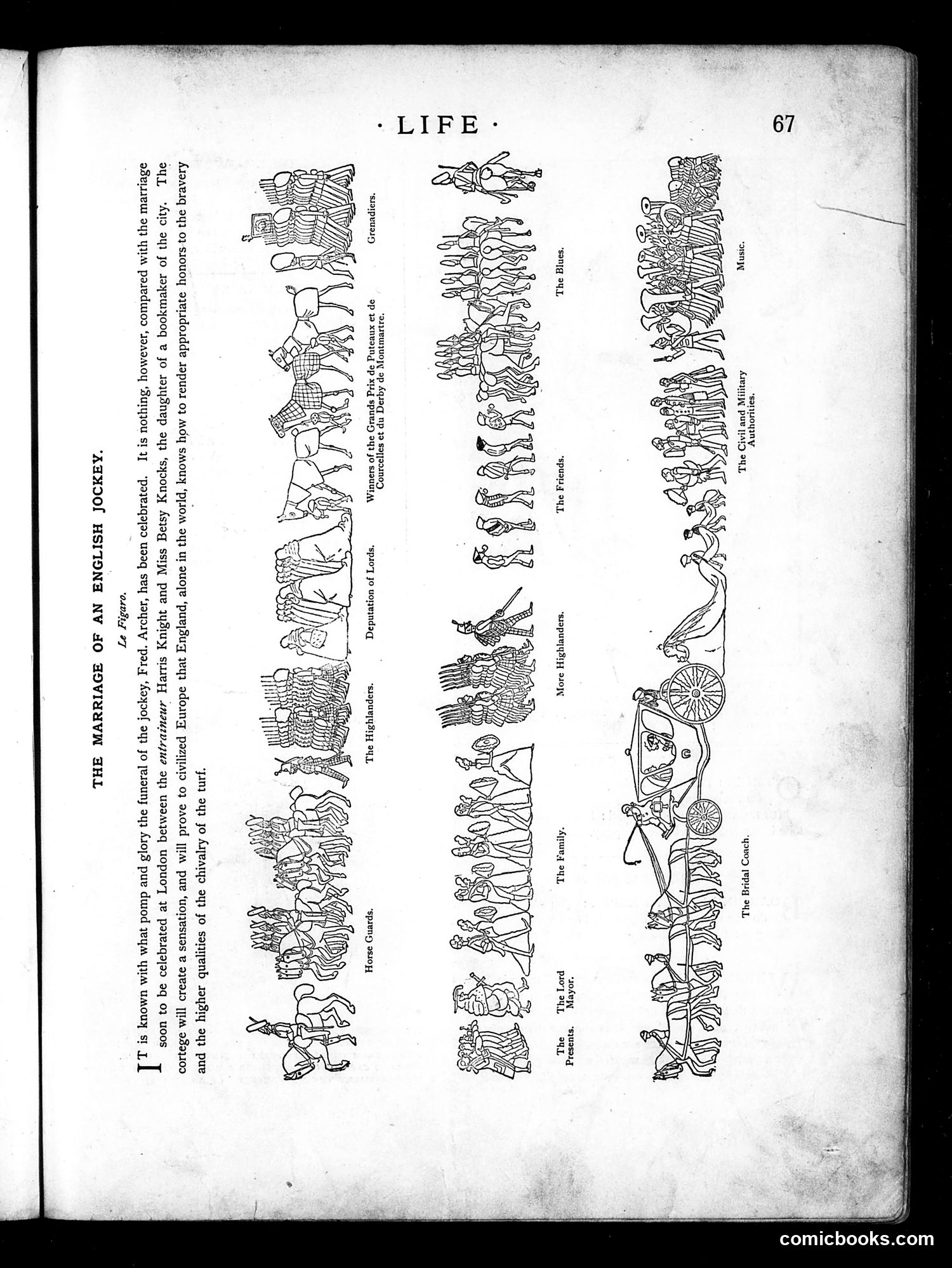
This page depicts the social scandal of an English jockey marrying above his station. The text (heavily corrupted in OCR) explains that a jockey has married a woman from the aristocracy—described as a shocking mismatch because it violates rigid class boundaries. The illustrations show processions of figures arranged hierarchically, likely contrasting the jockey's humble social position with his bride's elevated family status. The satire mocks the absurdity of such a cross-class union in rigid Victorian/Edwardian society, where marriage was strictly governed by social rank. The humor targets both the presumption of the jockey and the scandal it causes among the respectable classes. This reflects Life magazine's typical role: satirizing social pretension and class anxiety in American/English society, particularly when lower classes attempted to marry upward.
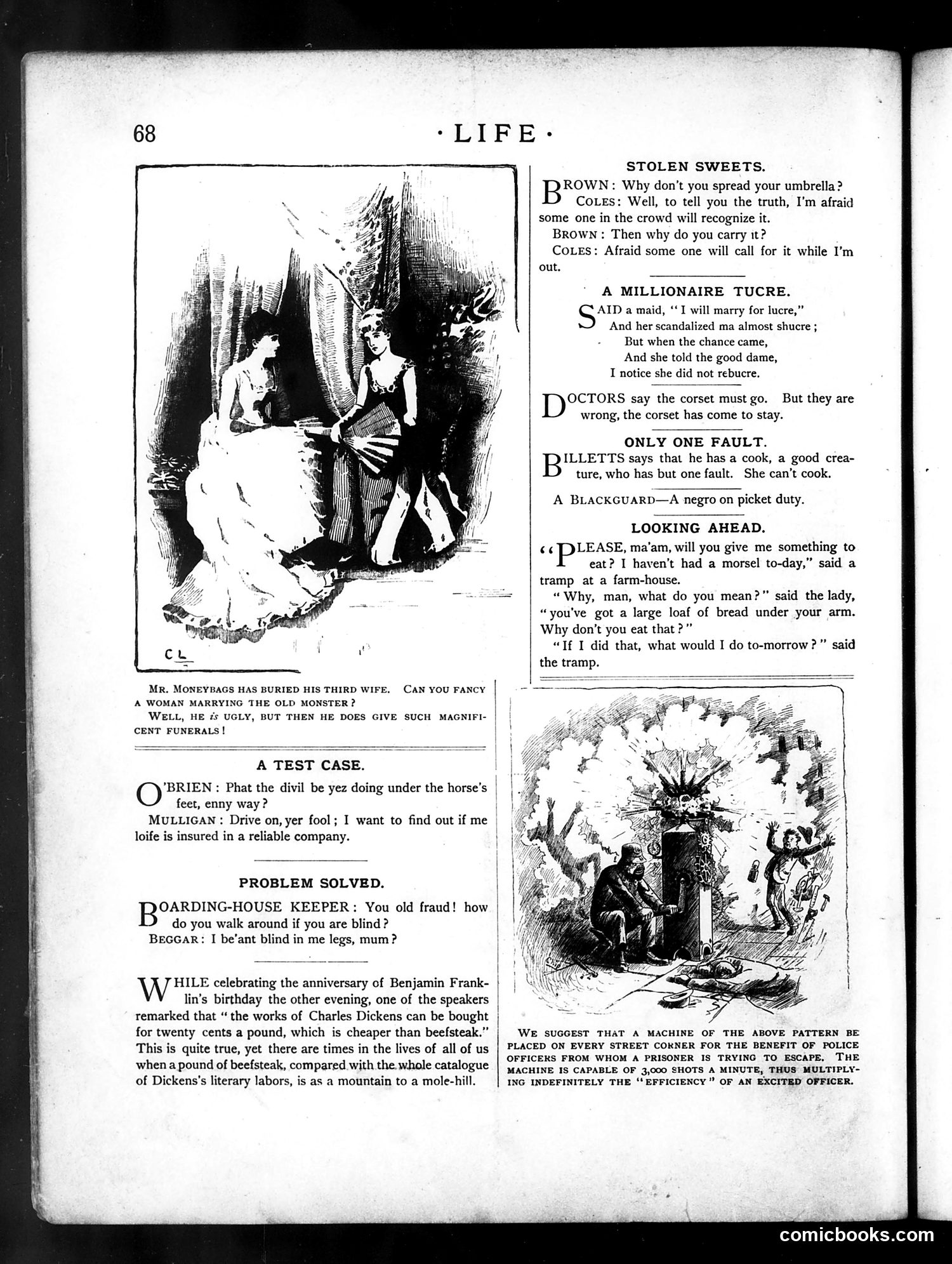
This page contains several brief satirical jokes typical of 19th-century American humor: **"Stolen Sweets"** mocks a man carrying a stolen umbrella—he won't open it because someone in a crowd might recognize it and demand it back. The joke relies on the absurdity of possessing stolen property openly. **"A Millionaire Tucre"** (a forced rhyme poem) satirizes a young woman who claims she'll marry for love, yet when a wealthy suitor appears, she abandons her principles. The satire targets mercenary attitudes among the marriage-minded. **"Only One Fault"** presents a simple ironic joke: a cook's single flaw is that she cannot cook—undercutting the premise entirely. **"Looking Ahead"** shows a tramp refusing offered bread, arguing he needs to save it for tomorrow's begging. The satire critiques either the tramp's poor planning or society's failure to address poverty adequately. The page also includes period-appropriate commentary on fashion, insurance fraud, and other contemporary social observations delivered through brief comic dialogues.
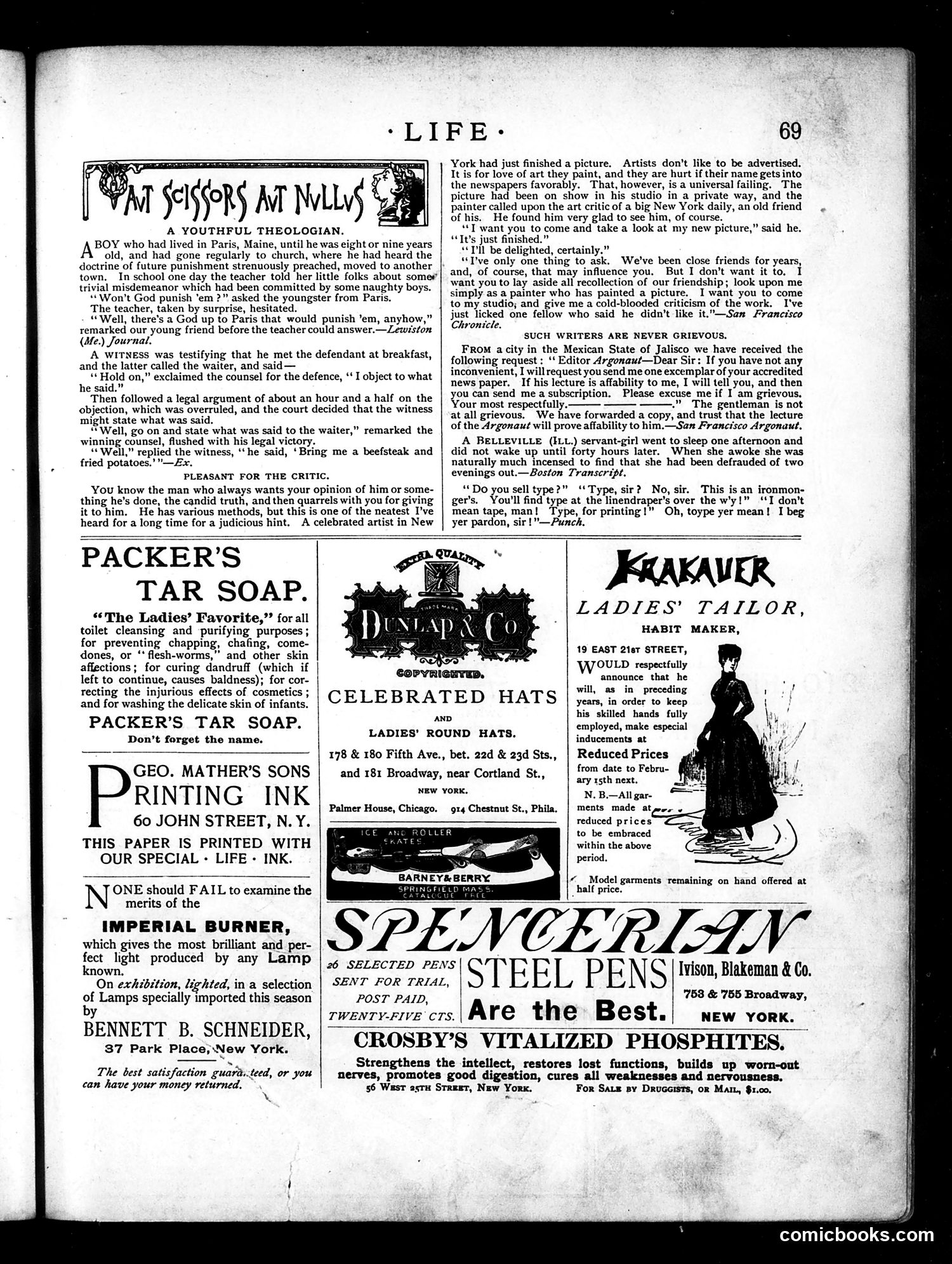
This page contains three humorous anecdotes typical of Life's satirical humor: **"A Youthful Theologian"** mocks a child's rigid religious literalism—a boy from Paris, Maine assumes God's punishment exists only in his hometown, revealing absurdity in how children internalize doctrine. **"Pleasant for the Critic"** satirizes artists' vanity. An artist invites a critic friend to view his painting while demanding "cold-blooded criticism" despite their friendship—then admits he's already beaten someone who disliked it, exposing the hypocrisy of artists who claim to want honest feedback but actually desire praise. **"Such Writers Are Never Grievous"** humorously reprints a poorly written subscription request letter from a Mexican newspaper reader, whose awkward English ("lecture" for "reading," "affability" for "approval," "excemplar" for "exemplar") creates unintentional comedy while the editor indulges the writer's earnestness. The remaining content is period advertising (soap, hats, printing supplies, pens). These anecdotes exemplify Life's focus on exposing human hypocrisy and pretension through everyday situations.
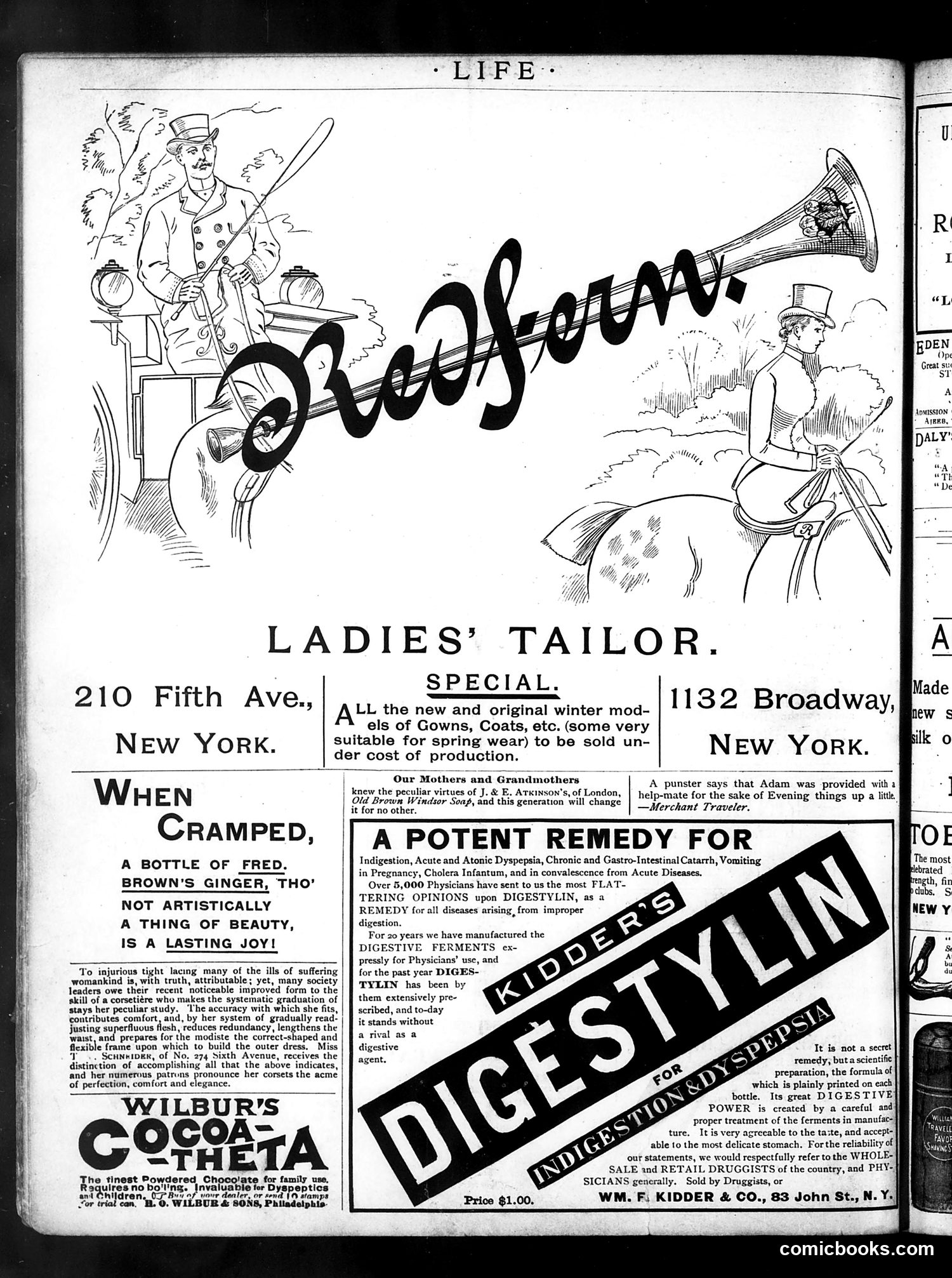
This page is primarily **advertising**, not satirical content. The dominant elements are commercial advertisements for various products and services targeting women of the era. The main cartoon at the top depicts a **hunting or sporting scene** with well-dressed figures on horseback and foot, with a hunting horn—likely advertising or illustrating themes of leisure and social status for the magazine's upper-class readership. The page promotes: - **Ladies' Tailor services** (two locations in New York) - **Corsetry and figure-shaping** by a corset-maker named Schneider, reflecting the era's obsession with tight lacing and artificially shaped waists - **Fred Brown's Ginger** (a digestive remedy) - **Digestylin** (a patent medicine claiming to cure various digestive ailments) - **Wilbur's Cocoa** The corset advertisement is particularly notable for modern readers—it depicts the period's extreme standards for women's bodies and the medical-adjacent "solutions" marketed to achieve them. The patent medicine ads showcase the unregulated pharmaceutical industry of the time.
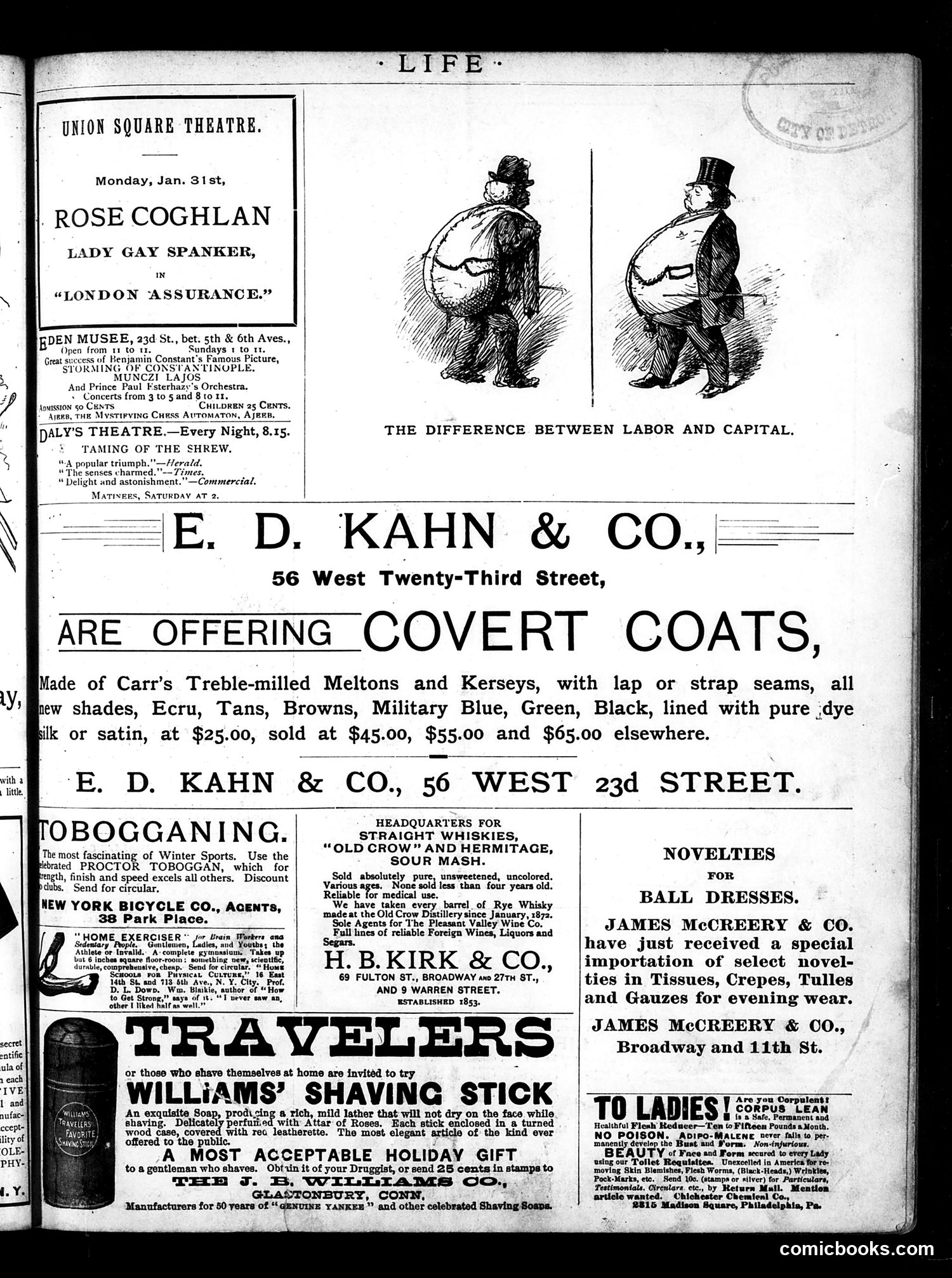
This political cartoon depicts the stark economic inequality of the Gilded Age. Two figures are shown from behind: on the left, a laborer with an enormously bloated belly representing accumulated wealth; on the right, a capitalist in formal dress (top hat) with an equally distended stomach. The satirical point is bitterly ironic: despite the title's apparent suggestion of difference, both figures are equally corpulent and self-satisfied, suggesting that in practice, there is *no* meaningful difference—both labor and capital are enriching themselves at the expense of the working poor. The cartoon critiques how even workers, through exploitation or complicity, become bloated with unearned gains while genuine poverty persists. This reflects 1880s-90s American anxieties about monopolies, wage theft, and wealth concentration during rapid industrialization.
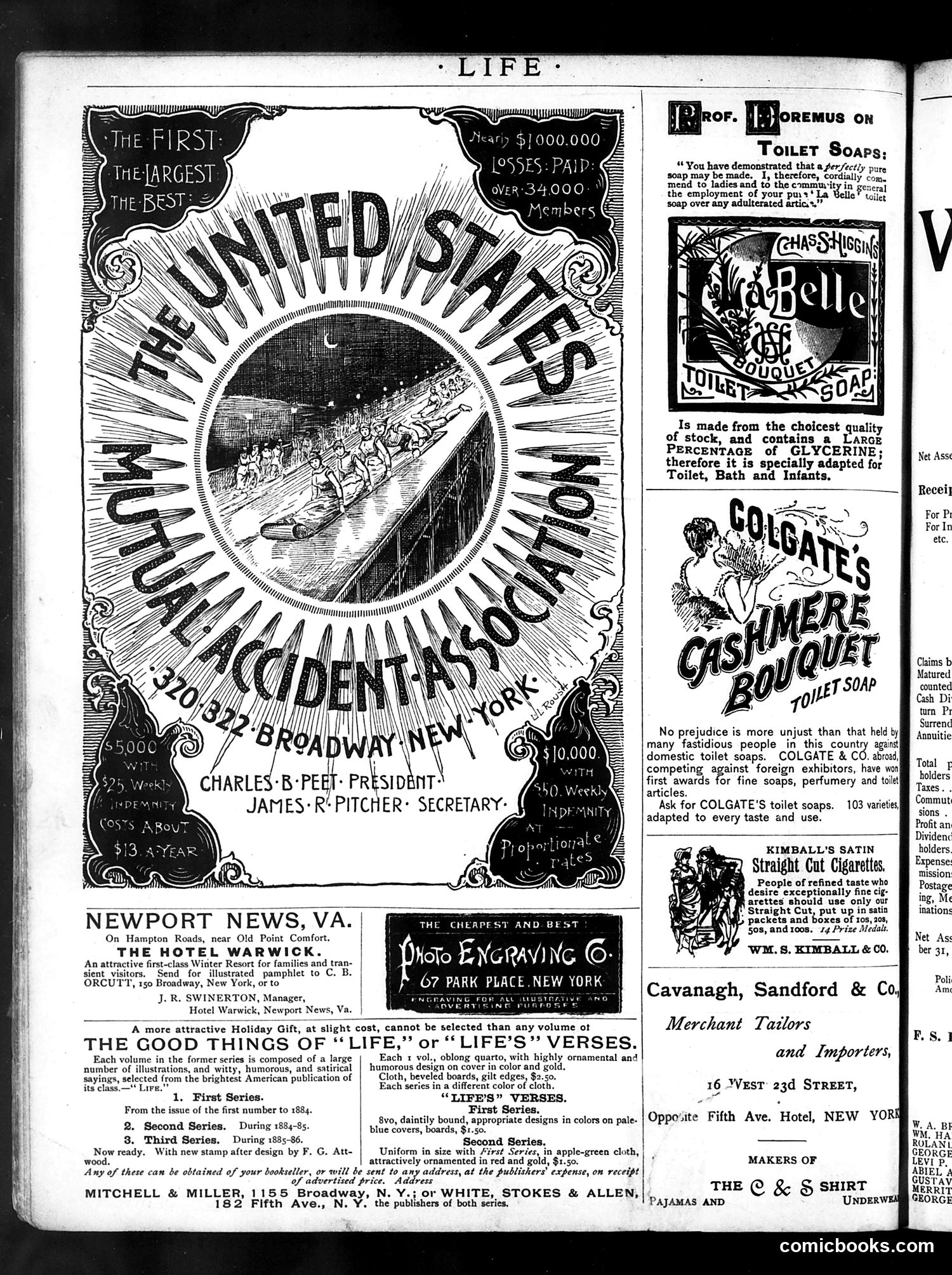
This is primarily an **advertising page** from Life magazine, not a political cartoon. The dominant feature is a large ornamental advertisement for **The United States Mutual Accident Assurance Society** (located at 3404 Broadway, New York), depicting a ship at sea within elaborate decorative borders. The ad emphasizes the company's size ("Nearly $1,000,000 losses paid," "Over 34,000 members") and costs ("About $13 a year"). The remainder of the page consists of **commercial advertisements** for various products and services: toilet soaps (Colgate's, Chase Higgins' Belle Bouquet), cigars (Kimball's Satin), the Hotel Warwick in Newport News, Virginia, photo engraving services, and merchant tailoring. There is also promotional material for bound collections of "Life's Verses"—decorative gift books of humorous poetry and illustrations. **No political satire or social commentary is present** on this page. It is a straightforward commercial publication showcasing late 19th-century consumer products and services.
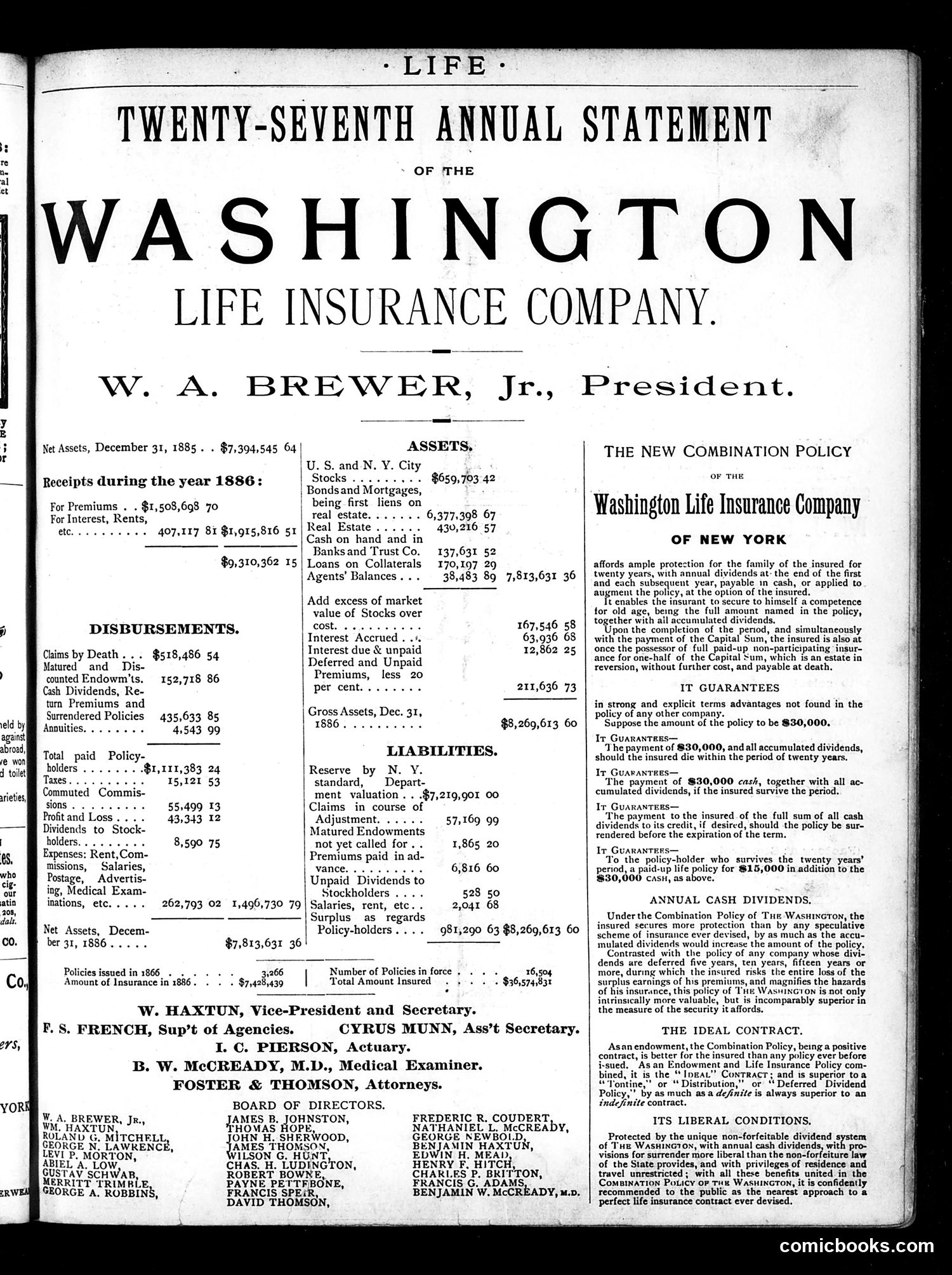
This page is primarily a financial statement and advertisement—not a political cartoon. It presents the twenty-seventh annual report of the Washington Life Insurance Company (dated 1886), listing assets, liabilities, receipts, and disbursements in detailed columns. The page includes the company's leadership roster and describes their "New Combination Policy," which offered a twenty-year endowment with annual dividends and guaranteed payouts. This was marketed as providing family protection while building personal wealth for old age. There is no satirical cartoon visible. The page functions as corporate documentation and promotional material typical of 19th-century Life magazine, which mixed satirical content with legitimate business advertising. The financial figures and policy details reflect the insurance industry's growing complexity during this period.
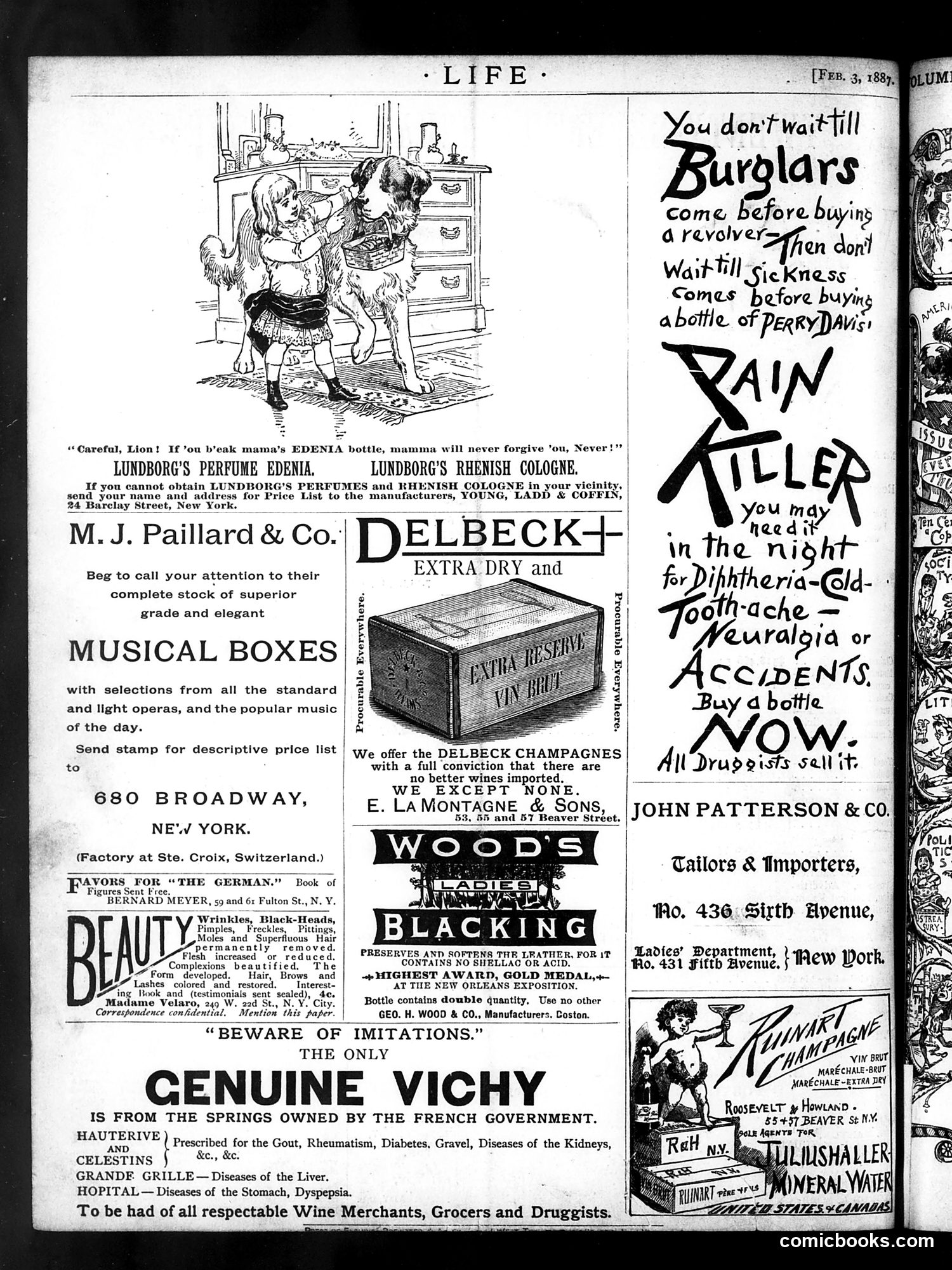
This page is primarily **advertising**, not editorial content. The single cartoon at top-left shows a child with a large dog near a dresser, captioned with a mother warning the child not to break her "Edenia" perfume bottle. It's a domestic humor scene designed to sell Lundborg's Perfume and Rhenish Cologne—the joke being that breaking mama's precious perfume would be catastrophic. The remainder of the page consists entirely of period advertisements: musical boxes, champagne, shoe blacking, beauty treatments, mineral water, and notably, a prominent **Perry Davis Pain Killer ad** using scare tactics (burglars, sickness, diphtheria) to urge immediate purchase. The ads reflect 1880s consumer culture and patent medicine marketing, particularly Perry Davis's aggressive fear-based approach. There is no political satire or social commentary visible on this page—it's a straightforward advertising section from Life magazine's commercial operations.