
Life, 1887-02-03 · page 2 of 18
Life — February 3, 1887 — page 2: what you’re looking at
What you’re looking at
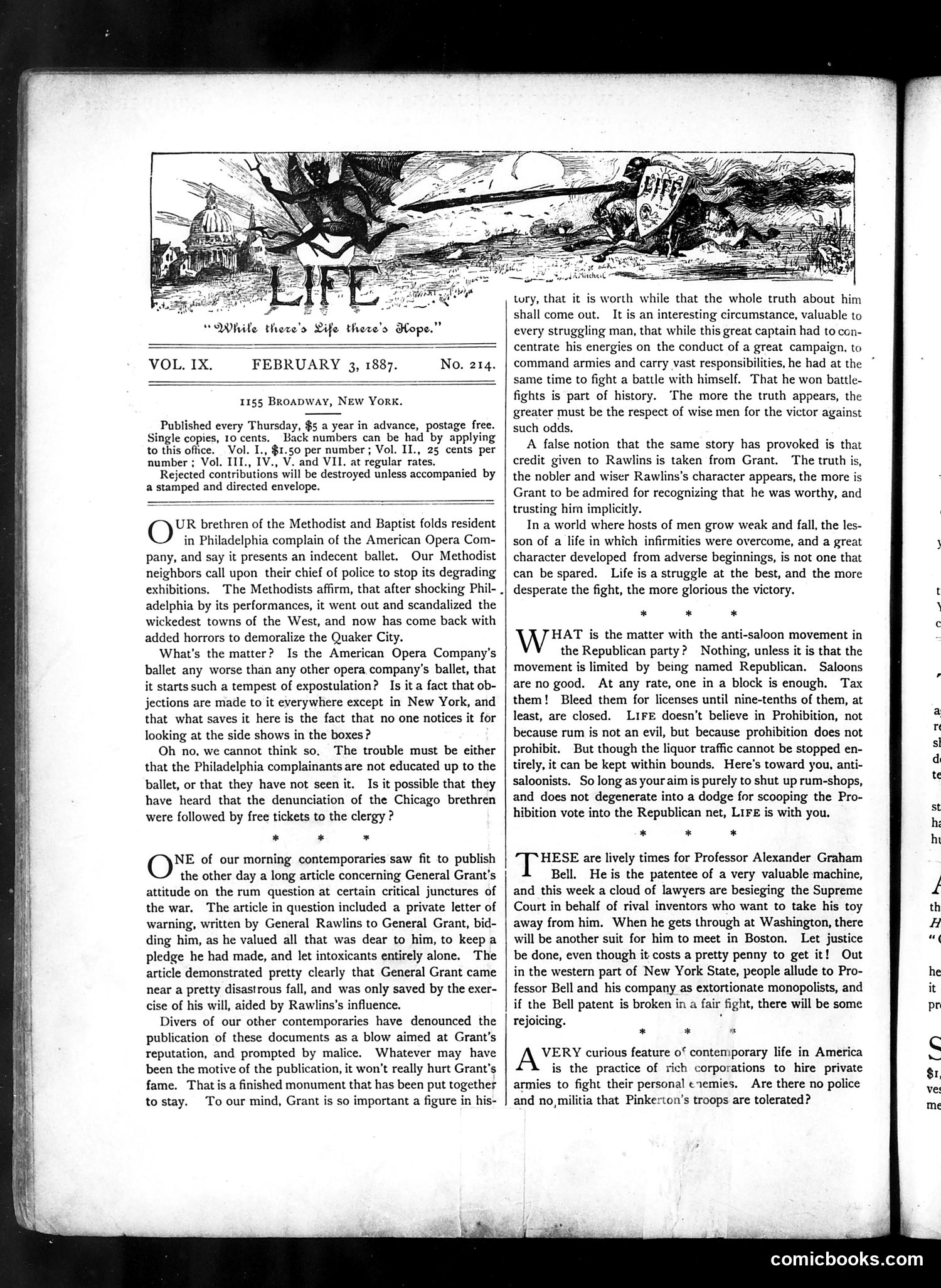
The masthead cartoon depicts a figure labeled "LIFE" beneath a bare tree, with the motto "While there's Life there's Hope." The page contains several editorial pieces discussing contemporary issues. The most specific political content addresses General Grant's reputation, debating whether unfavorable stories about him originated from General Rawlins or were taken from Grant's own writings. The editors argue that Grant's character should be evaluated fairly based on truth. Another section criticizes the "anti-saloon movement in the Republican party," suggesting that prohibitionist efforts are futile and that controlling liquor through regulation is preferable to outright bans. A final item discusses Professor Alexander Graham Bell's patent disputes, noting rival inventors' legal challenges to his monopoly on telephone technology. The commentary reflects late-19th-century debates over temperance, political reputation, and industrial patents.
📄 Transcribed text from this page (OCR, searchable)
Machine-transcribed from the original scan — historical spelling and the odd misread are preserved.
“White there's Life there's Hope.” VOL. IX. FEBRUARY 3, 1887. No. 214. 1155 Broapway, NEw York. Published every Thursday, $5 a year in advance, postage free. Single copies, 10 cents. Back numbers can be had by applying to this office. Vol. I., $1.50 per number ; Vol. II., 25 cents per number ; Vol. III., IV., V. and VII. at regular rates. Rejected contributions will be destroyed unless accompanied by a stamped and directed envelope. UR brethren of the Methodist and Baptist folds resident in Philadelphia complain of the American Opera Com- pany, and say it presents an indecent ballet. Our Methodist neighbors call upon their chief of police to stop its degrading exhibitions. The Methodists affirm, that after shocking Phil- . adelphia by its performances, it went out and scandalized the wickedest towns of the West, and now has come back with added horrors to demoralize the Quaker City. What's the matter? Is the American Opera Company's ballet any worse than any other opera company’s ballet, that it starts such a tempest of expostulation? Is it a fact that ob- jections are made to it everywhere except in New York, and that what saves it here is the fact that no one notices it for looking at the side shows in the boxes? Oh no, we cannot think so, The trouble must be either that the Philadelphia complainants are not educated up to the ballet, or that they have not seen it. Is it possible that they have heard that the denunciation of the Chicago brethren were followed by free tickets to the clergy ? * * * ONE of our morning contemporaries saw fit to publish the other day a long article concerning General Grant's attitude on the rum question at certain critical junctures of the war. The article in question included a private letter of warning, written by General Rawlins to General Grant, bid- ding him, as he valued all that was dear to him, to keep a pledge he had made, and let intoxicants entirely alone. The article demonstrated pretty clearly that General Grant came near a pretty disastrous fall, and was only saved by the exer- cise of his will, aided by Rawlins’s influence. Divers of our other contemporaries have denounced the publication of these documents as a blow aimed at Grant’s reputation, and prompted by malice. Whatever may have been the motive of the publication, it won’t really hurt Grant's fame. Thatis a finished monument that has been put together to stay. To our mind, Grant is so important a figure in his- tory, that it is worth while that the whole truth about him shall come out. It is an interesting circumstance, valuable to every struggling man, that while this great captain had to con- centrate his energies on the conduct of a great campaign. to command armies and carry vast responsibilities, he had at the same time to fight a battle with himself. That he won battle- fights is part of history. The more the truth appears, the greater must be the respect of wise men for the victor against such odds. A false notion that the same story has provoked is that credit given to Rawlins is taken from Grant. The truth is, the nobler and wiser Rawlins’s character appears, the more is Grant to be admired for recognizing that he was worthy, and trusting him implicitly. In a world where hosts of men grow weak and fall, the les- son of a life in which infirmities were overcome, and a great character developed from adverse beginnings, is not one that can be spared. Life is a struggle at the best, and the more desperate the fight, the more glorious the victory. * * * HAT is the matter with the anti-saloon movement in the Republican party? Nothing, unless it is that the movement is limited by being named Republican. Saloons are no good. At any rate, one in a block is enough. Tax them! Bleed them for licenses until nine-tenths of them, at least, are closed. LIFE doesn’t believe in Prohibition, not because rum is not an evil, but because prohibition does not prohibit. But though the liquor traffic cannot be stopped en- tirely, it can be kept within bounds. Here's toward you, anti- saloonists. So long as your aim is purely to shut up rum-shops, and does not degenerate into a dodge for scooping the Pro- hibition vote into the Republican net, Lire is with you. * * * HESE are lively times for Professor Alexander Graham Bell. He is the patentee of a very valuable machine, and this week a cloud of lawyers are besieging the Supreme Court in behalf of rival inventors who want to take his toy away from him. When he gets through at Washington, there will be another suit for him to meet in Boston. Let justice be done, even though it costs a pretty penny to get it! Out in the western part of New York State, people allude to Pro- fessor Bell and his company as extortionate monopolists, and if the Bell patent is broken in a fair fight, there will be some rejoicing. * . i VERY curious feature of contemporary life in America is the practice of rich corporations to hire private armies to fight their personal enemies. Are there no police and no, militia that Pinkerton’s troops are tolerated? comicbooks.com