
Life, 1887-02-03 · page 7 of 18
Life — February 3, 1887 — page 7: what you’re looking at
What you’re looking at
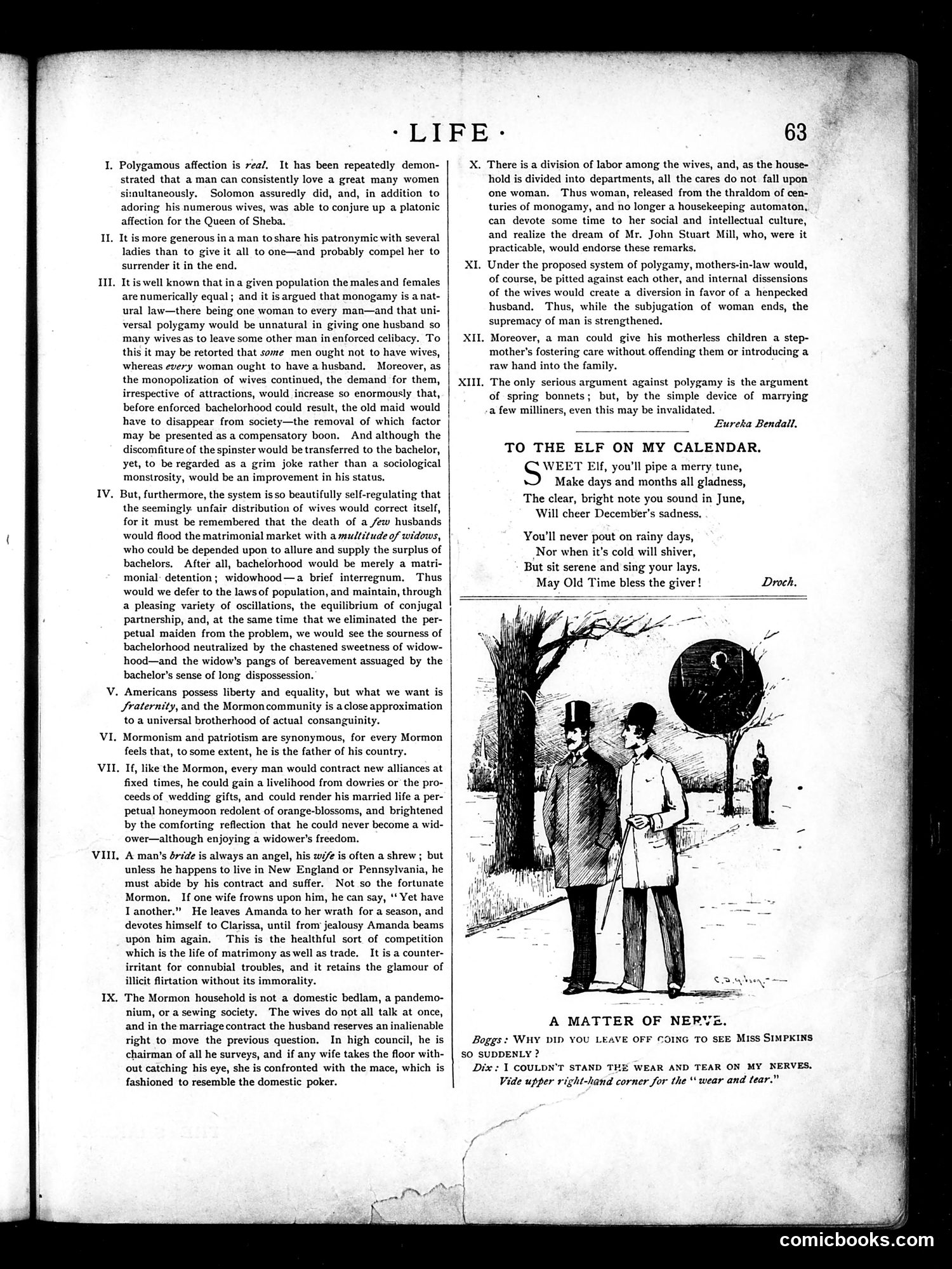
This page contains two distinct pieces: **Left side:** A numbered essay defending Mormon polygamy, arguing it would regulate population, prevent bachelorhood, and benefit society through "fraternity." **Right side cartoon ("A Matter of Nerve"):** Shows two men in Victorian dress near a tree. One asks why the other left off visiting "Miss Simpkins" so suddenly. The response claims he "couldn't stand the wear and tear on my nerves"—with a note referencing "wear and tear" in the upper right corner. The cartoon appears to satirize male nervousness or hypochondria regarding courtship obligations, a common Victorian anxiety. The humor lies in a man abandoning romantic pursuit due to emotional exhaustion rather than genuine disinterest, mocking exaggerated claims of delicate male sensibilities. The juxtaposition with the polygamy essay below creates ironic commentary on competing Victorian attitudes about marriage and male responsibility.
📄 Transcribed text from this page (OCR, searchable)
Machine-transcribed from the original scan — historical spelling and the odd misread are preserved.
-LIFE- 63 . Polygamous affection is rea’. It has been repeatedly demon- strated that a man can consistently love a great many women sinultaneously. Solomon assuredly did, and, in addition to adoring his numerous wives, was able to conjure up a platonic affection for the Queen of Sheba. . It is more generous ina man toshare his patronymic with several ladies than to give it all to one—and probably compel her to surrender it in the end. . It is well known that ina given population the males and females are numerically equal ; and it is argued that monogamy is a nat- ural law—there being one woman to every man—and that uni- versal polygamy would be unnatural in giving one husband so many wivesas to leave some other man in enforced celibacy. To this it may be retorted that some men ought not to have wives, whereas every woman ought to have a husband. Moreover, as the monopolization of wives continued, the demand for them, irrespective of attractions, would increase so enormously that, before enforced bachelorhood could result, the old maid would have to disappear from society—the removal of which factor | may be presented as a compensatory boon. And although the discomfiture of the spinster would be transferred to the bachelor, yet, to be regarded as a grim joke rather than a sociological monstrosity, would be an improvement in his status, . But, furthermore, the system isso beautifully self-regulating that the seemingly. unfair distribution of wives would correct itself, for it must be remembered that the death of a_/ew husbands would flood the matrimonial market with a multitude of widows, who could be depended upon to allure and supply the surplus of bachelors. After all, bachelorhood would be merely a matri- monial: detention; widowhood—a brief interregnum. Thus would we defer to the lawsof population, and maintain, through a pleasing variety of oscillations, the equilibrium of conjugal partnership, and, at the same time that we eliminated the per- petual maiden from the problem, we would see the sourness of bachelorhood neutralized by the chastened sweetness of widow- hood—and the widow’s pangs of bereavement assuaged by the bachelor’s sense of long dispossession. . Americans possess liberty and equality, but what we want is Jraternity, and the Mormoncommunity is aclose approximation to a universal brotherhood of actual consanguinity. . Mormonism and patriotism are synonymous, for every Mormon feels that, to some extent, he is the father of his country. . If, like the Mormon, every man would contract new alliances at fixed times, he could gain a livelihood from dowries or the pro- ceeds of wedding gifts, and could render his married life a per- petual honeymoon redolent of orange-blossoms, and brightened by the comforting reflection that he could never become a wid- ower—although enjoying a widower's freedom. A man’s bride is always an angel, his wife is often a shrew; but unless he happens to live in New England or Pennsylvania, he must abide by his contract and suffer. Not so the fortunate Mormon. If one wife frowns upon him, he can say, ‘Yet have Tanother.” He leaves Amanda to her wrath for a season, and devotes himself to Clarissa, until frony jealousy Amanda beams upon him again. This is the healthful sort of competition which is the life of matrimony as well as trade. It is a counter- irritant for connubial troubles, and it retains the glamour of illicit flirtation without its immorality. . The Mormon household is not a domestic bedlam, a pandemo- nium, or a sewing society. The wives do not all talk at once, and in the marriage contract the husband reserves an inalienable right to move the previous question. In high council, he is chairman of all he surveys, and if any wife takes the floor with- out catching his eye, she is confronted with the mace, which is fashioned to resemble the domestic poker. May Old Time bless the giver! X. There is a division of labor among the wives, and, as the house- hold is divided into departments, all the cares do not fall upon one woman. Thus woman, released from the thraldom of cen- turies of monogamy, and no longer a housekeeping automaton, can devote some time to her social and intellectual culture, and realize the dream of Mr. John Stuart Mill, who, were it practicable, would endorse these remarks. XI. Under the proposed system of polygamy, mothers-in-law would, of course, be pitted against each other, and internal dissensions of the wives would create a diversion in favor of a henpecked husband. Thus, while the subjugation of woman ends, the supremacy of man is strengthened. Moreover, a man could give his motherless children a step- mother's fostering care without offending them or introducing a raw hand into the family. The only serious argument against polygamy is the argument of spring bonnets; but, by the simple device of marrying a few milliners, even this may be invalidated. Eureka Bendall, TO THE ELF ON MY CALENDAR, ss Elf, you'll pipe a merry tune, Make days and months all gladness, The clear, bright note you sound in June, Will cheer December's sadness, You'll never pout on rainy days, Nor when it’s cold will shiver, But sit serene and sing your lays. A MATTER OF NERVE. Boggs: WHY DID YOU LEAVE OFF COING TO SEE Miss SIMPKINS SO SUDDENLY ? Dix; 1 COULDN'T STAND THE WEAR AND TEAR ON MY NERVES. Vide upper right-hand corner for the“ wear and tear.” comicbooks.com