
Life, 1887-02-03 · page 6 of 18
Life — February 3, 1887 — page 6: what you’re looking at
What you’re looking at
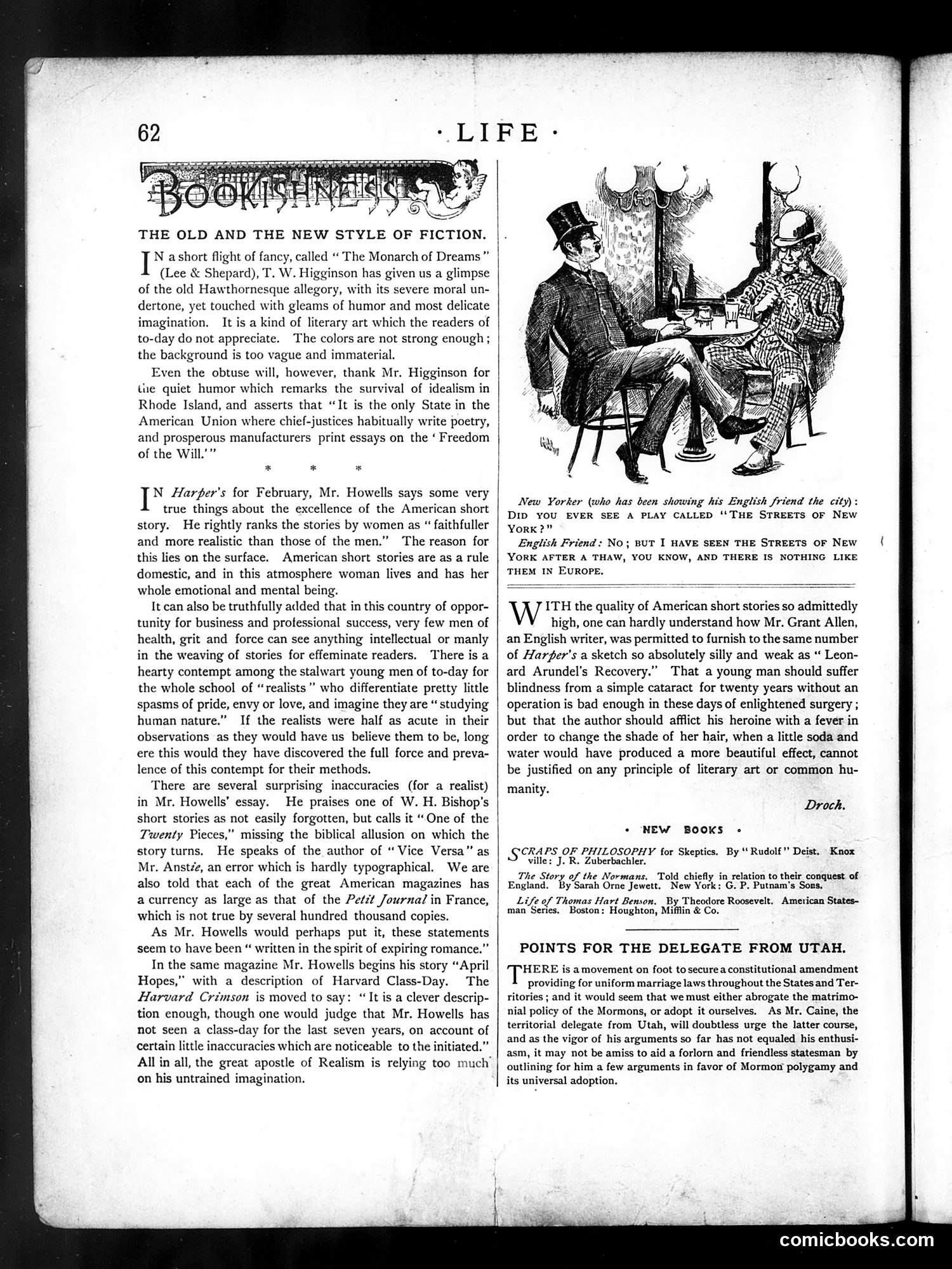
The illustration depicts a social scene with three men in period dress (appears to be late 19th century), seated around what looks like a dining table. One figure wears a top hat and formal attire; another appears to be an English gentleman based on the caption's reference to "English friend." The cartoon illustrates the caption's dialogue about New York's streets. An English visitor comments on the contrasts between American and European urban life. The satire targets American society's rough materiality—the "streets of New York" lack the refinement found in European cities, suggesting American culture prioritizes commerce and pragmatism over aesthetic cultivation. The humor relies on the transatlantic comparison, a common satirical device in this era, contrasting refined European sensibilities with brash American character.
📄 Transcribed text from this page (OCR, searchable)
Machine-transcribed from the original scan — historical spelling and the odd misread are preserved.
THE OLD AND THE NEW STYLE OF FICTION. N ashort flight of fancy, called “‘ The Monarch of Dreams (Lee & Shepard), T. W. Higginson has given us a glimpse of the old Hawthornesque allegory, with its severe moral un- dertone, yet touched with gleams of humor and most delicate imagination. It is a kind of literary art which the readers of to-day do not appreciate. The colors are not strong enough ; the background is too vague and immaterial. Even the obtuse will, however, thank Mr. Higginson for | tue quiet humor which remarks the survival of idealism in Rhode Island, and asserts that “It is the only State in the American Union where chief-justices habitually write poetry, and prosperous manufacturers print essays on the ‘ Freedom of the Will.’” * * * N Harper's for February, Mr. Howells says some very true things about the excellence of the American short story. He rightly ranks the stories by women as “ faithfuller and more realistic than those of the men.” The reason for this lies on the surface. American short stories are as a rule domestic, and in this atmosphere woman lives and has her whole emotional and mental being. It can also be truthfully added that in this country of oppor- tunity for business and professional success, very few men of health, grit and force can see anything intellectual or manly in the weaving of stories for effeminate readers. There is a hearty contempt among the stalwart young men of to-day for the whole school of “realists” who differentiate pretty little spasms of pride, envy or love, and imagine they are “ studying human nature.” If the realists were half as acute in their observations as they would have us believe them to be, long ere this would they have discovered the full force and preva- lence of this contempt for their methods. There are several surprising inaccuracies (for a realist) in Mr. Howells’ essay. He praises one of W. H. Bishop's short stories as not easily forgotten, but calls it “One of the Twenty Pieces,” missing the biblical allusion on which the story turns. He speaks of the author of “ Vice Versa” as Mr. Anstze, an error which is hardly typographical. We are also told that each of the great American magazines has a currency as large as that of the Petit Journal in France, which is not true by several hundred thousand copies. As Mr. Howells would perhaps put it, these statements seem to have been “ written in the spirit of expiring romance.” In the same magazine Mr. Howells begins his story “April Hopes,” with a description of Harvard Class-Day. The Harvard Crimson is moved to say: “It is a clever descrip- tion enough, though one would judge that Mr. Howells has not seen a class-day for the last seven years, on account of certain little inaccuracies which are noticeable to the initiated.” All in all, the great apostle of Realism is relying too much’ on his untrained imagination. New Yorker (who has been showing his English friend the city): Dip YOU EVER SEE A PLAY CALLED ‘‘ THE STREETS OF NEW York?” English Friend: No; puT I HAVE SEEN THE STREETS OF NEW YORK AFTER A THAW, YOU KNOW, AND THERE IS NOTHING LIKE THEM IN EUROPE. ITH the quality of American short stories so admittedly high, one can hardly understand how Mr, Grant Allen, an English writer, was permitted to furnish to the same number of Harper's a sketch so absolutely silly and weak as “‘ Leon- ard Arundel's Recovery.” That a young man should suffer blindness from a simple cataract for twenty years without an operation is bad enough in these days of enlightened surgery ; but that the author should afflict his heroine with a fever in order to change the shade of her hair, when a little soda and water would have produced a more beautiful effect, cannot be justified on any principle of literary art or common hu- manity. Droch. + NEW BOOKS - ‘SCRAPS OF PHILOSOPHY for Skeptics. By “Rudolf” Deist. Knox ville: J. R. Zuberbachler. The Story of the Normans. Told chiefly in relation to their conquest of England. By Sarah Orne Jewett. New York: G. P. Putnam's Sons, Life of Thomas Hart Benson. By Theodore Roosevelt. American States- man Series. Boston: Houghton, Mifflin & Co. POINTS FOR THE DELEGATE FROM UTAH. HERE is amovement on foot to secure a constitutional amendment providing for uniform marriage laws throughout the States and Ter- ritories ; and it would seem that we must either abrogate the matrimo- nial policy of the Mormons, or adopt it ourselves. As Mr. Caine, the territorial delegate from Utah, will doubtless urge the latter course, and as the vigor of his arguments so far has not equaled his enthusi- asm, it may not be amiss to aid a forlorn and friendless statesman by outlining for him a few arguments in favor of Mormon polygamy and its universal adoption. comicbooks.com