
A complete issue · 16 pages · 1887
Life — January 20, 1887
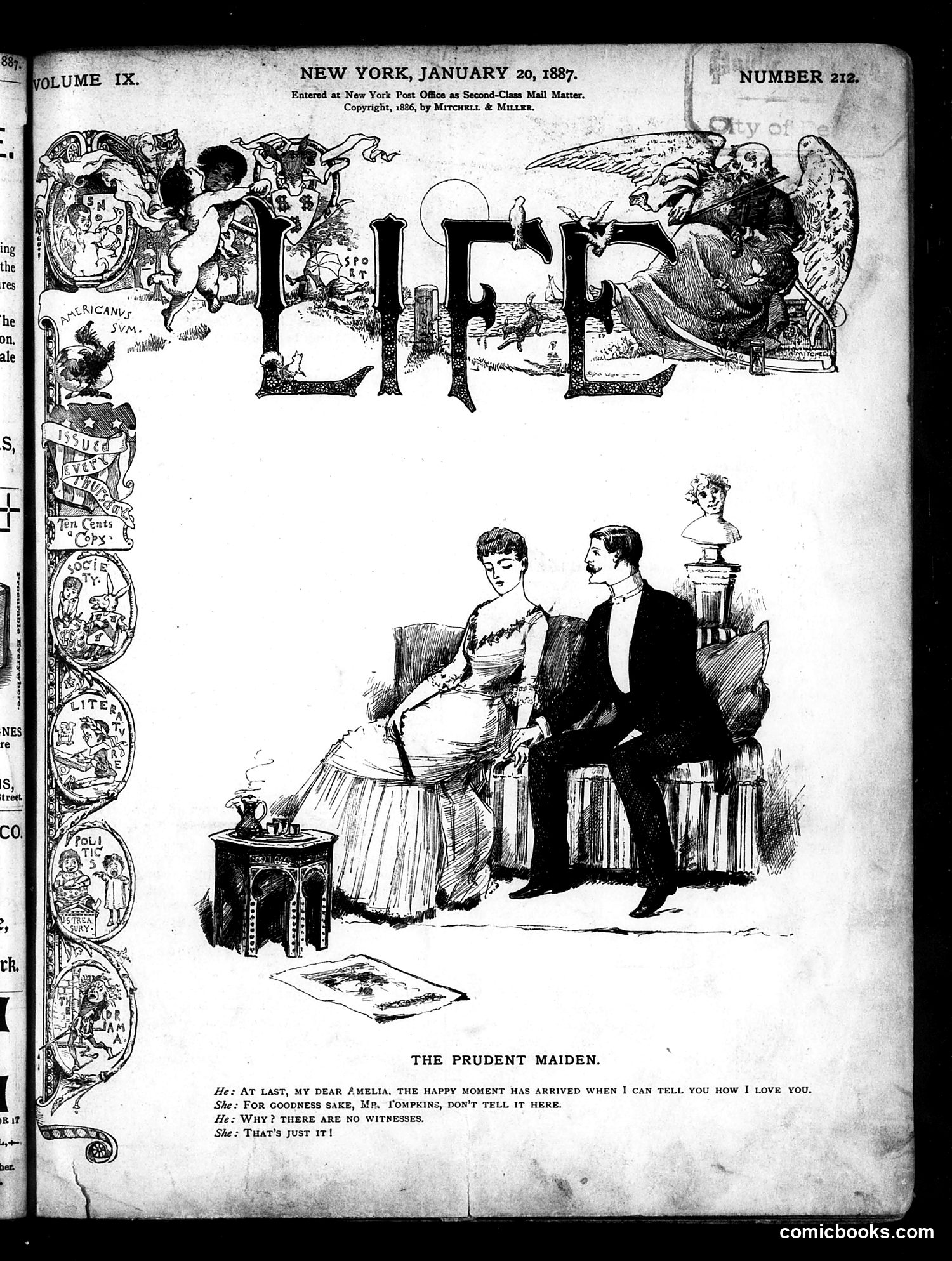
This cartoon depicts a Victorian-era domestic scene satirizing courtship conventions. A pregnant woman sits with a man who declares his love, requesting privacy to confess his feelings. The woman's response—"That's just it!"—suggests she's pointing out the obvious: witnesses are unnecessary since her condition already publicly announces what has occurred. The satire targets the hypocrisy of "prudent" courtship rituals. While propriety demanded discretion and witnesses for respectable declarations, the woman's pregnancy exposes the gap between social pretense and reality. The joke mocks both the man's belated romantic gesture and the absurdity of Victorian decorum that failed to prevent the situation it purported to protect against.
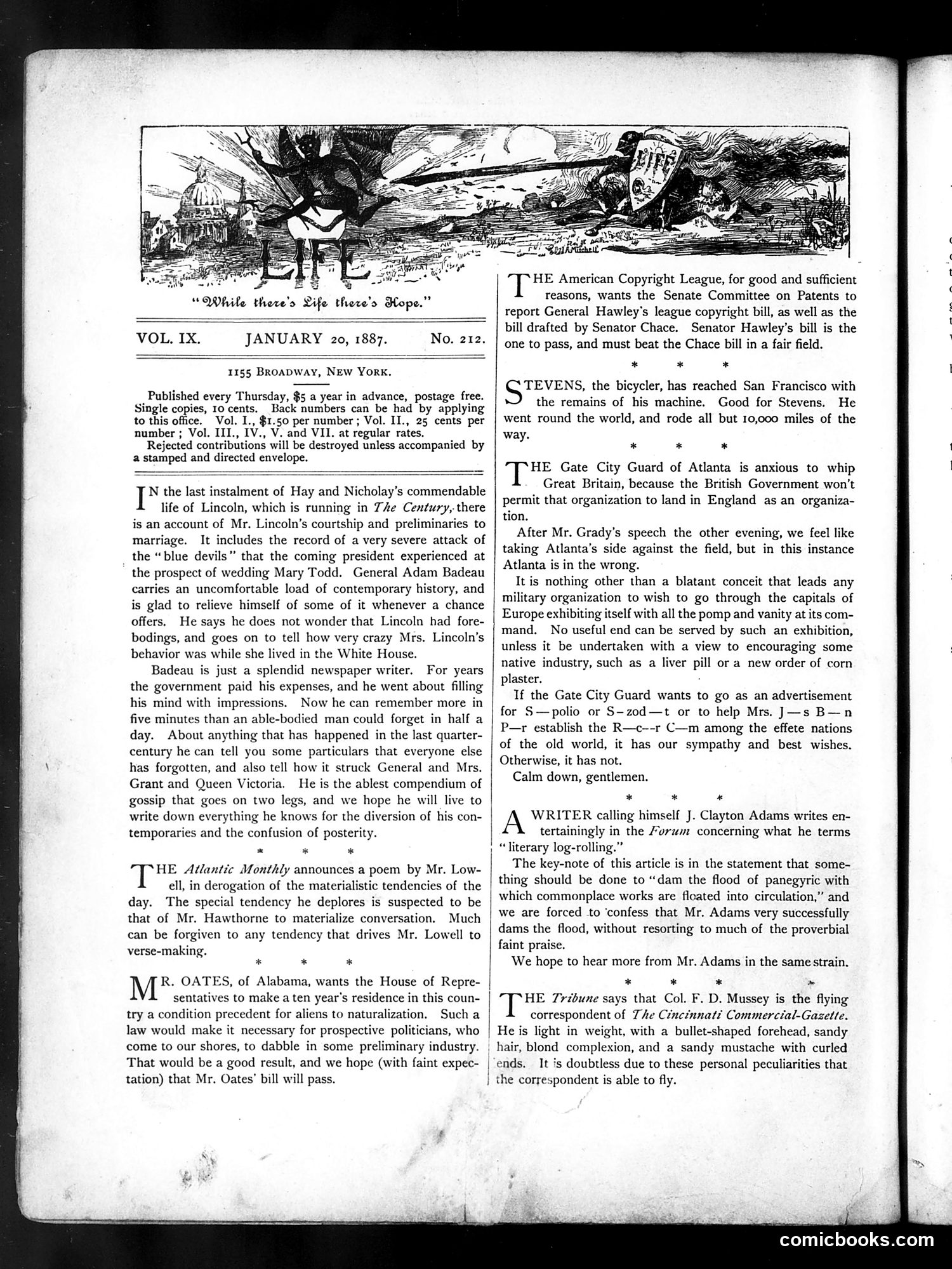
The header cartoon depicts a figure playing guitar with the caption "While there's Life there's Hope." The page contains several brief satirical items: 1. **Lincoln biography**: Commentary on a serialized account of Lincoln's life in *The Century* magazine, noting General Adam Badeau's role as writer and his tendency to include gossipy contemporary history. 2. **Stevens the bicyclist**: A brief note celebrating someone named Stevens who completed a round-the-world bicycle journey of 10,000 miles. 3. **Gate City Guard controversy**: Satirical criticism of Atlanta's military organization seeking permission to exhibit in Europe, mocking their ambitions as vain posturing that would only succeed if promoting American industry. 4. **J. Clayton Adams letter**: Comment on his "literary log-rolling" and criticism of how commonplace works flood circulation. The items are typical of *Life*'s gossipy, satirical commentary on contemporary figures and events.
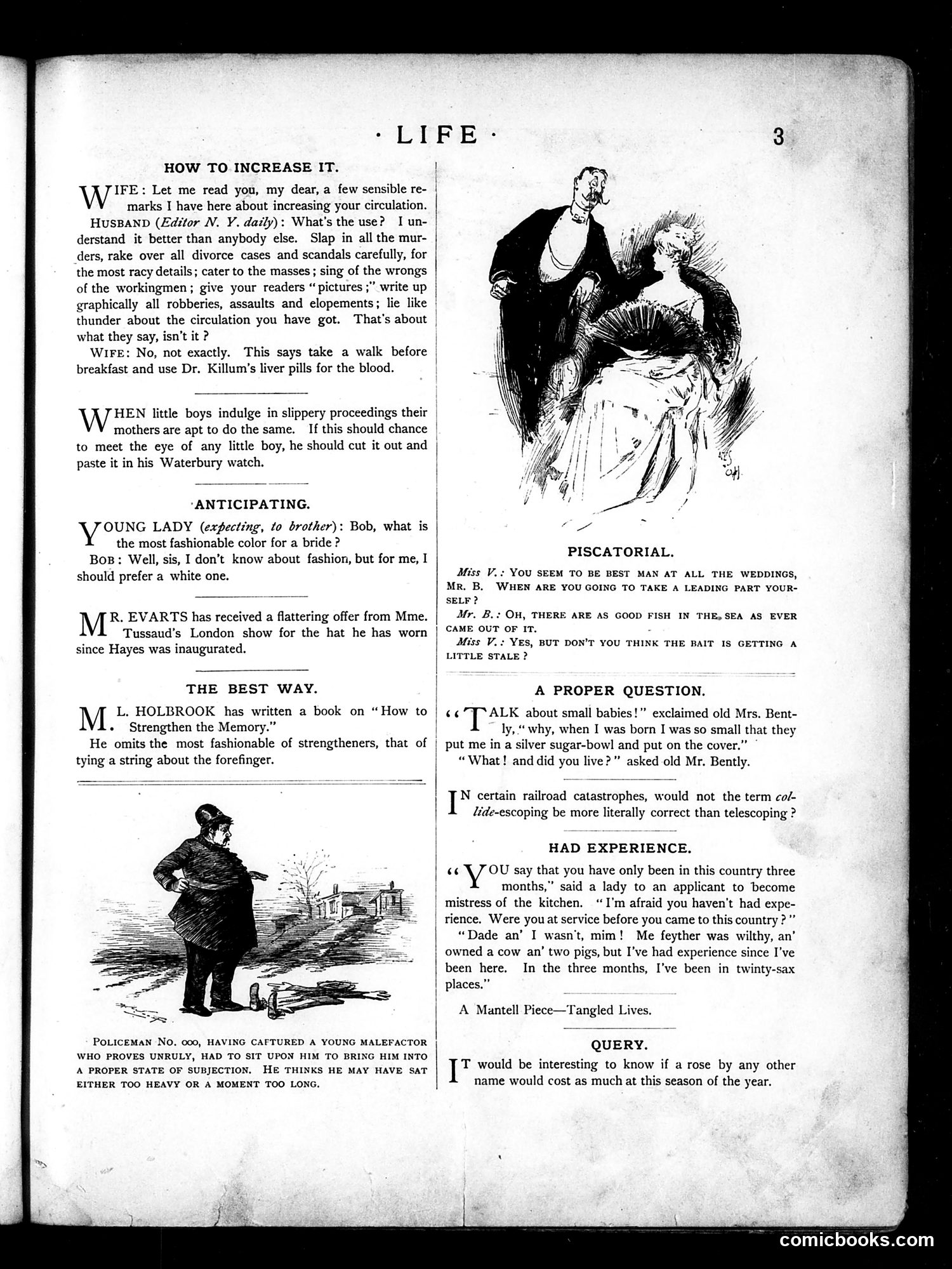
This page contains humorous advice columns and jokes typical of Life's satirical format. The main cartoon shows a policeman who has arrested a "young malefactor" and must decide whether to sit on him to maintain proper submission—a visual joke about corporal punishment and police authority. The text sections include mock advice about increasing newspaper circulation (with cynical suggestions like sensationalizing crimes), commentary on fashion, and brief humorous anecdotes. One joke mocks small babies; another questions railroad terminology. The illustration on the right shows a social scene at what appears to be a wedding, captioned "PISCATORIAL," playing on fishing metaphors applied to courtship and marriage prospects—a common satirical theme in this era mocking social ambition and matrimonial scheming among the wealthy.
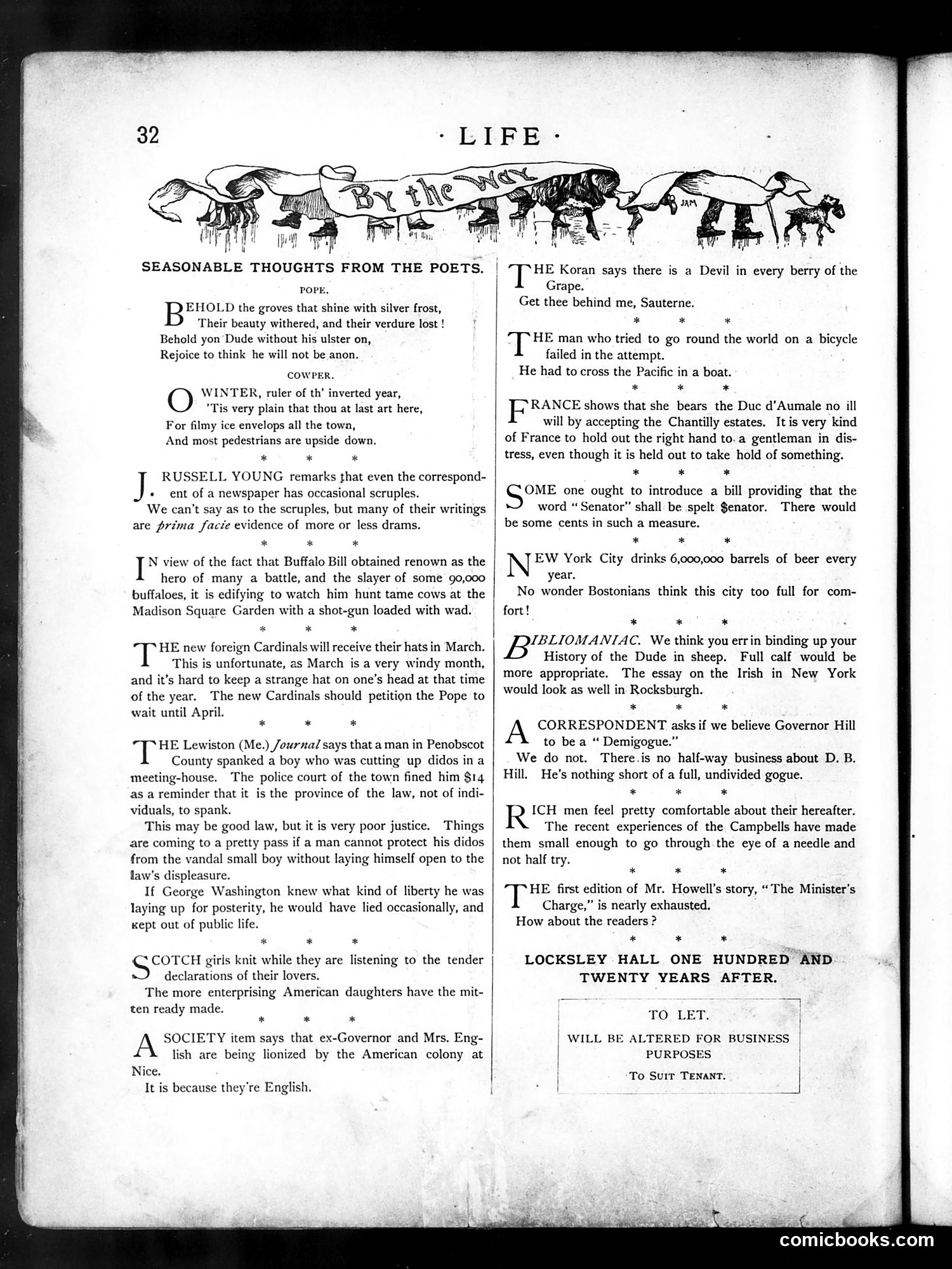
This page contains **"Seasonable Thoughts from the Poets"**—a satirical column mixing literary quotations with topical commentary. The cartoonish header illustration shows various animals in winter clothing. The pieces mock contemporary topics through witty juxtaposition: - **Buffalo Bill** reference mocks his theatrical Wild West shows, contrasting his fame with actual historical violence - **New Cardinals receiving hats in March** satirizes ecclesiastical pomp during windy weather - **Governor Hill "demigogue"** criticizes a political figure (likely David B. Hill of New York) - **Wealthy ("Rich") men and Campbell soup cans** jokes about class pretension - **Locksley Hall real estate notice** references Tennyson while advertising property The satire targets vanity, hypocrisy, and pretension among the wealthy and famous. Most references appear obscure today without historical context of late-19th-century American politics and culture.
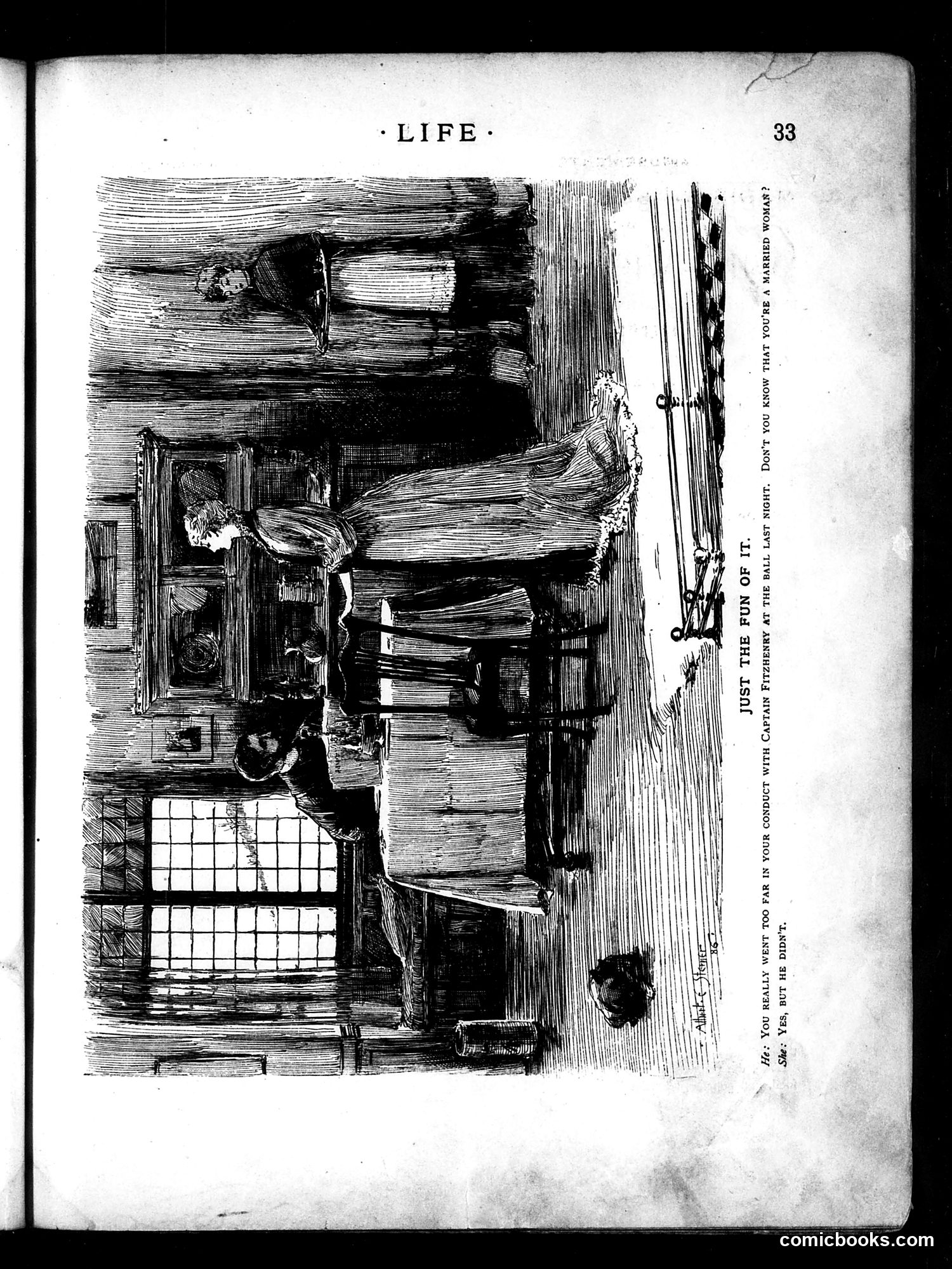
This appears to be a sketch-style illustration from *Life* magazine (page 33) showing an interior domestic scene. The image depicts what seems to be a woman in period dress standing in a modest room with a fireplace, window, and furniture. The caption references "just the fun of it" and mentions conduct "with decorum" and "firmness at the ball last night." Without clearer OCR text or additional context, the specific satirical point is difficult to determine with certainty. The cartoon likely comments on social behavior or propriety norms of its era—possibly mocking either excessive formality or social hypocrisy regarding women's conduct in public versus private settings. The domestic versus formal-occasion contrast appears central to the humor, though the exact political or social target remains unclear from this image alone.
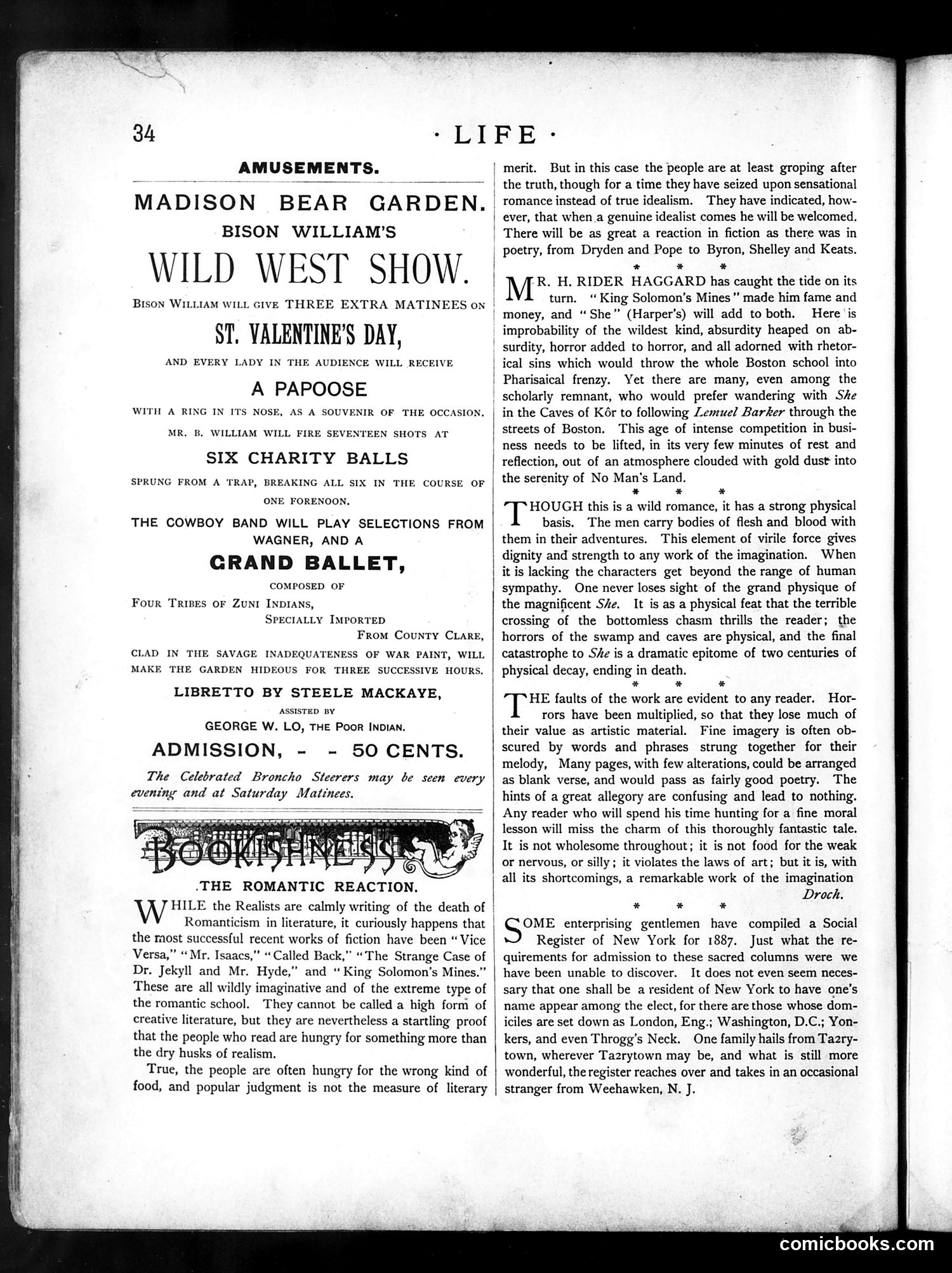
This page is primarily **advertising and literary criticism** rather than political satire. The left column advertises entertainment at Madison Bear Garden, featuring Bison William's Wild West Show with performances on St. Valentine's Day, including trick shooting, a grand ballet with imported Zuni dancers, and a libretto by Steele Mackaye. The right side contains **book reviews**, discussing romantic literature. The critic praises H. Rider Haggard's works for their physical vigor and imaginative power, while criticizing other romantic fiction as lacking moral substance—complaining that readers seek escapism rather than intellectual nourishment. The reviewer notes such works, despite their flaws, demonstrate considerable imaginative achievement. The **"Bookishness"** section at bottom announces a Social Register of New York for 1887, noting the difficulty of compiling accurate resident lists.
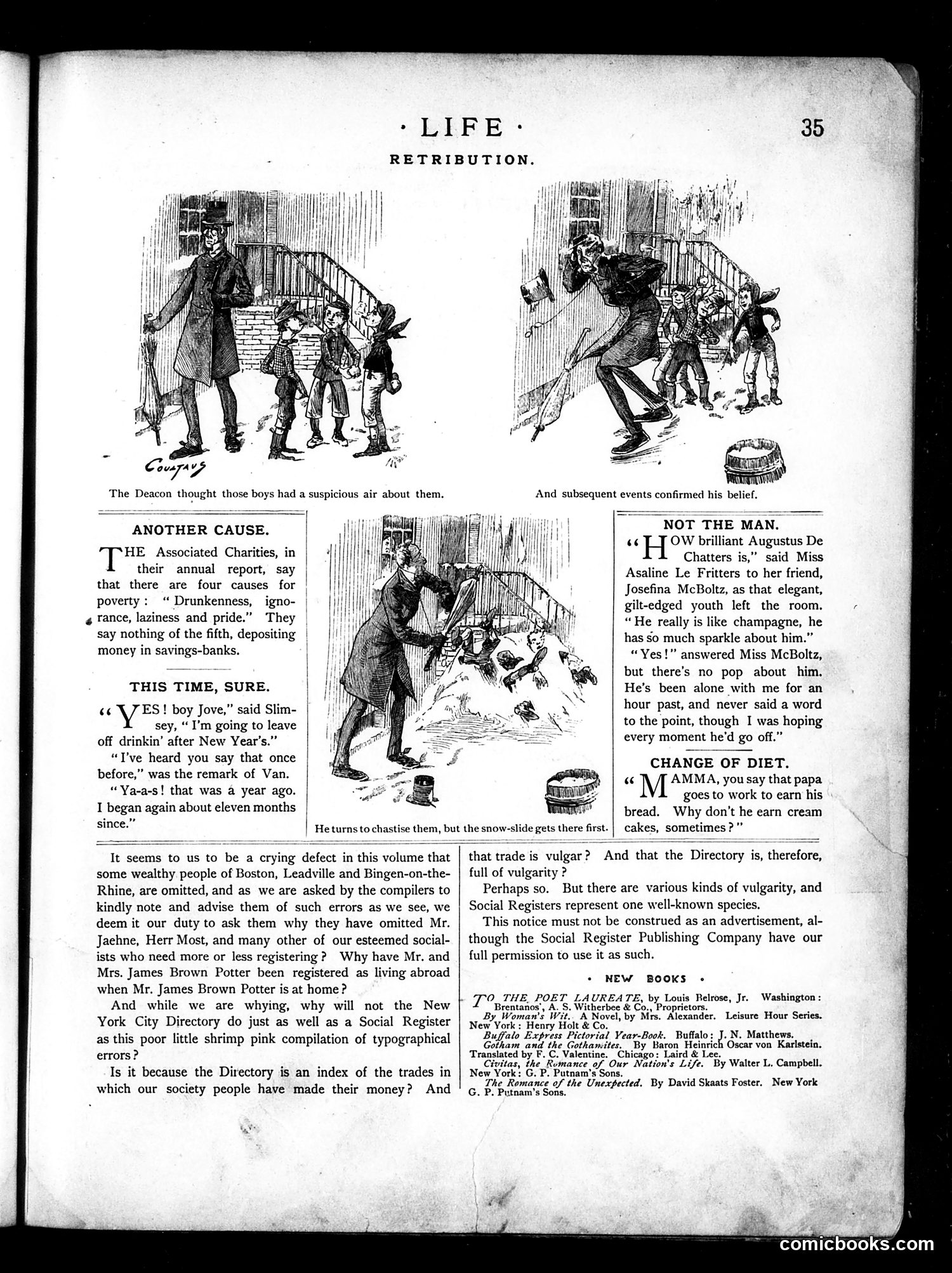
This page contains three satirical cartoons about punishment of misbehaving boys. The top panels show a "Deacon" and another adult figure catching boys in suspicious circumstances—apparently truancy or mischief. The caption notes the Deacon's suspicion proved justified by "subsequent events." The middle cartoon depicts an adult chastising boys, with one apparently knocked down in snow, illustrating consequences for wrongdoing. The right-hand text sections ("Not the Man," "Change of Diet") appear to be unrelated social commentary snippets, possibly satirizing upper-class pretension and dietary habits. The overall page theme is childhood discipline and moral instruction—typical Victorian-era Life magazine humor mocking both parental authority figures and wayward youth behavior.
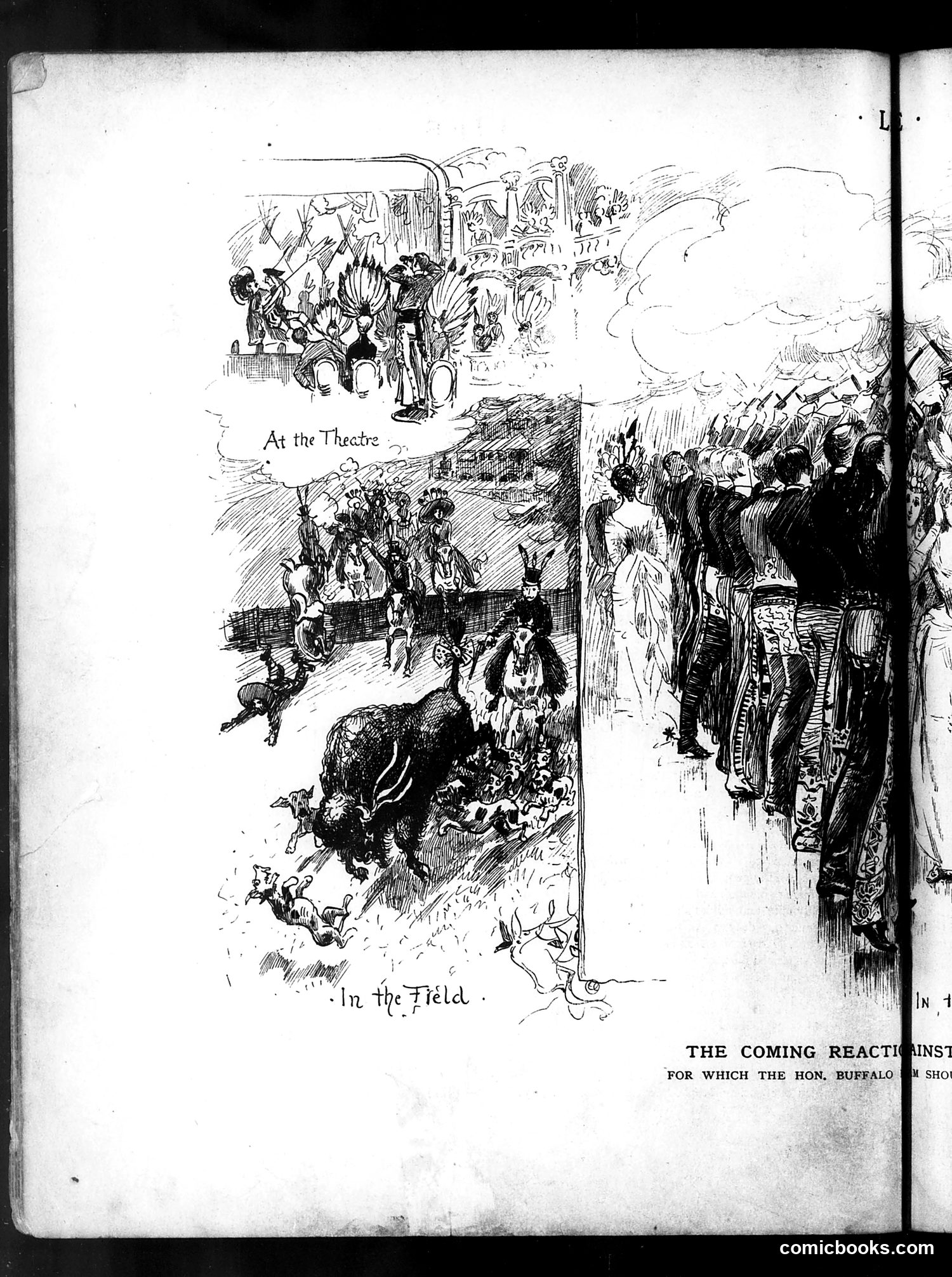
This page contrasts two scenes of American society. The upper illustration labeled "At the Theatre" depicts an ornate, crowded indoor venue with audiences in formal dress, suggesting wealth and refined entertainment. The lower illustration, "In the Field," shows a chaotic outdoor scene with what appears to be a bull or large animal amid crowds, suggesting rural or agricultural activity—possibly a bullfight or similar spectacle. The partial text at bottom references "THE COMING REACTION AGAINST" and mentions "THE HON. BUFFALO" (likely Buffalo Bill). This suggests satire comparing civilized urban entertainment with frontier/Wild West spectacles, probably critiquing American cultural pretensions or the contrast between Eastern sophistication and Western showmanship popular in the period.
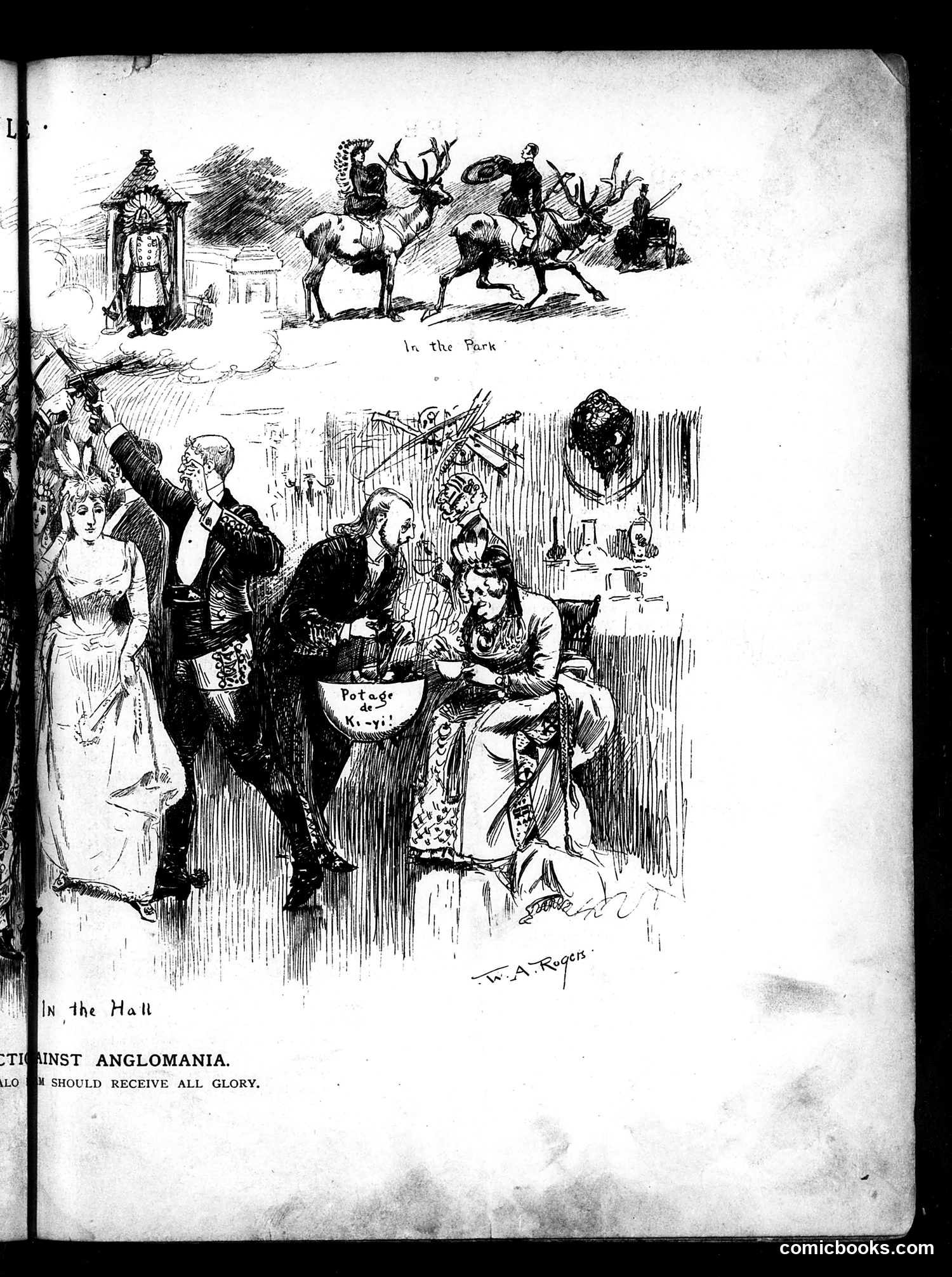
This page contains two satirical sketches by F.A. Rogers. The top panel, "In the Park," depicts British aristocrats on horseback—likely mocking the adoption of English fashions and manners among wealthy Americans. The bottom panel, "In the Hall," shows a "Potage à la Ki-yi!" (a pun on French cuisine), satirizing the pretentious imitation of European sophistication. The overall message, stated as "Against Anglomania" with the caption "Anglo should receive all glory," is ironic social criticism targeting American elites who slavishly copied British and Continental styles and customs. The cartoons mock this cultural snobbery and artificial affectation, suggesting Americans abandoned their own identity to appear more cosmopolitan or refined.
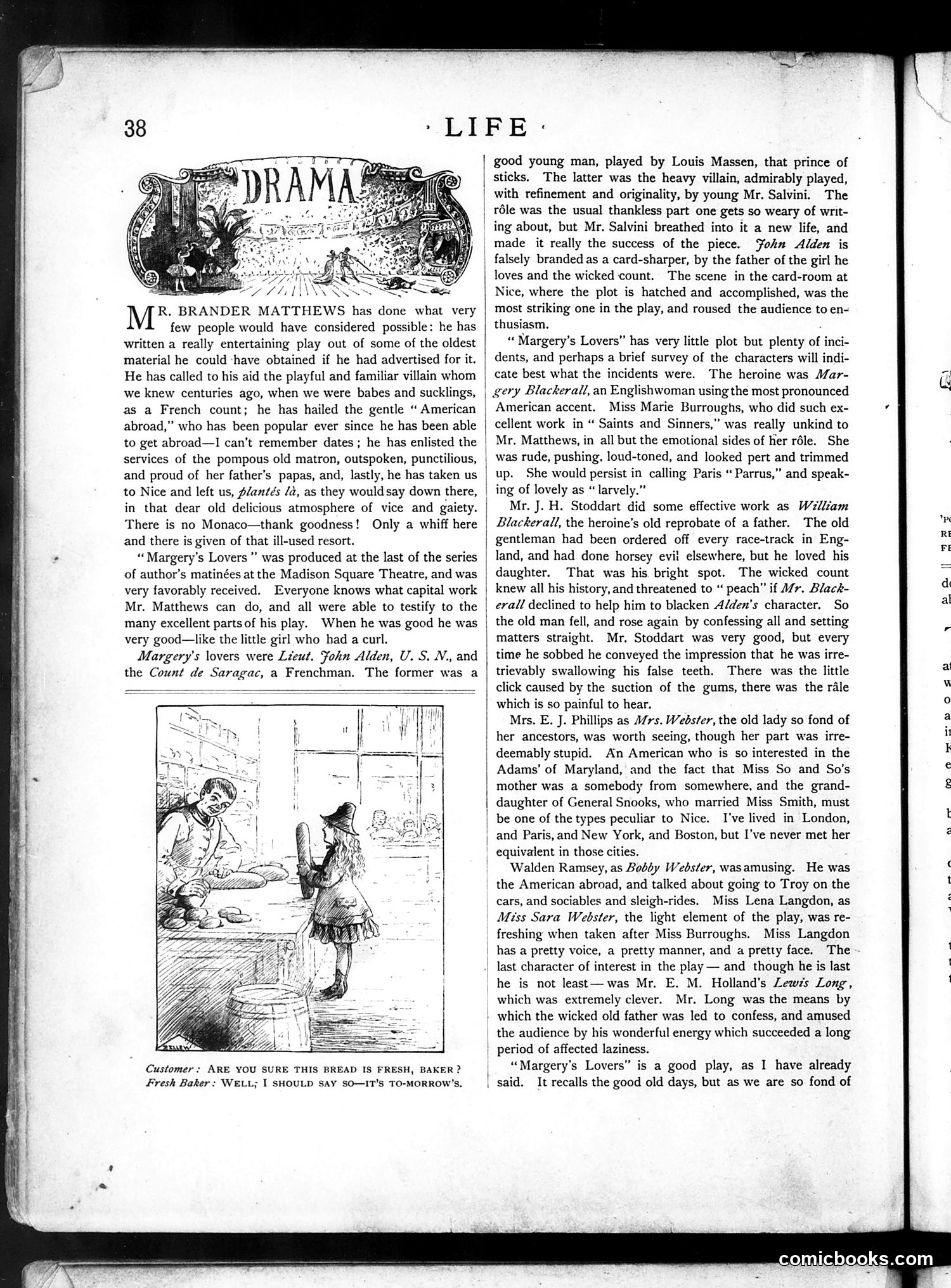
This is a drama review page discussing Brander Matthews' play "Margery's Lovers," performed at the Madison Square Theatre. The small illustration shows a domestic scene with two figures in period dress—likely depicting a scene from the play itself rather than political commentary. The review discusses the cast's performances, including actors playing roles like "John Alden" and "William Blackerall." The illustrated scene at bottom shows a conversation between a "Customer" and "Fresh Baker" about bread freshness—a brief comedic exchange typical of Life's era. This page contains theatrical criticism and light social humor rather than political satire. The content reflects late 19th-century American theater criticism and advertising conventions.
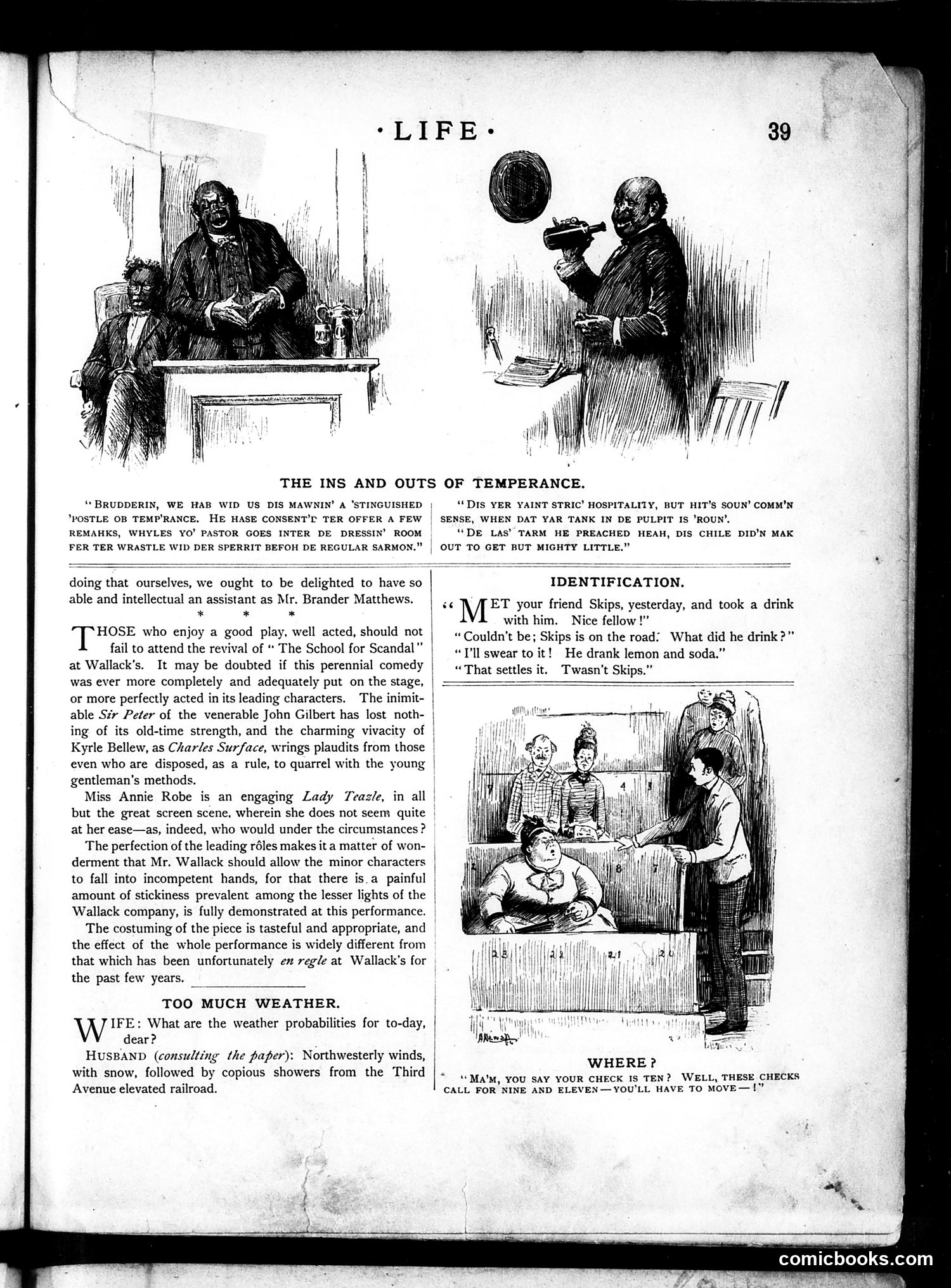
**"The Ins and Outs of Temperance"** (top cartoons): These satirize the temperance movement's hypocrisy. The left panel shows a preacher endorsing temperance while a pastor wrestles with "de sperrit" (the bottle) in the dressing room—suggesting clergy practice the opposite of their preaching. The right panel depicts a man drinking from a bottle labeled "lemon soda," mocking how temperance advocates disguised alcohol consumption. **Theater review**: Text praising Wallack's revival of "The School for Scandal," mentioning actors John Gilbert, Kyrle Bellew, and Annie Robe. **"Too Much Weather"**: A husband jokes that weather forecasts are useless, blame-shifted to the "Third Avenue elevated railroad"—likely referencing how the elevated rail's construction disrupted weather patterns or was a convenient scapegoat for urban problems. **Remaining brief jokes** ("Identification," "Where?") are unrelated vignettes about mistaken identity and restaurant confusion. The page reflects late-19th-century American urban satire focused on moral hypocrisy and modern annoyances.
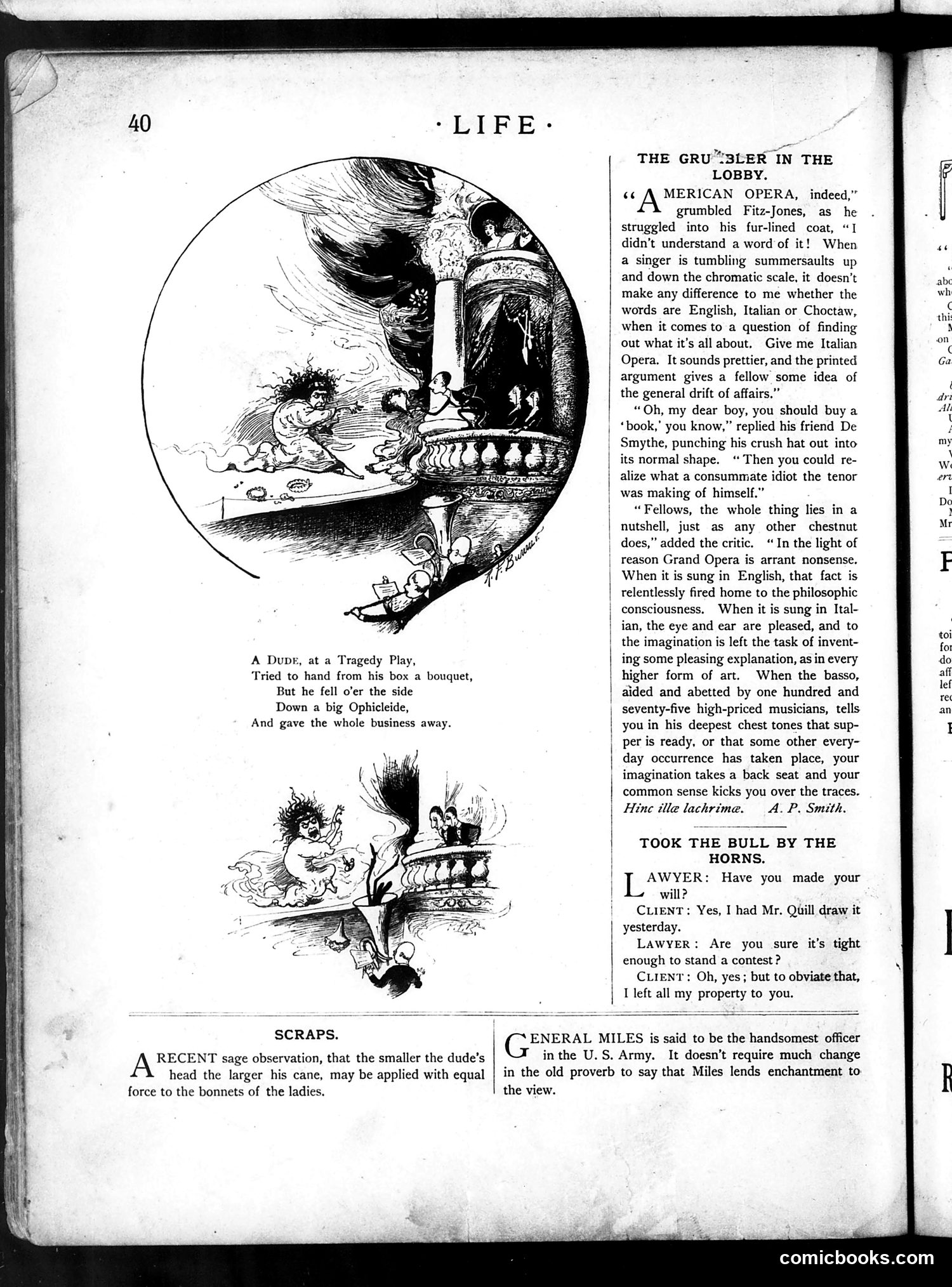
This page satirizes attitudes toward opera and high culture. The main piece presents a conversation between theater-goers debating opera's merit. "Fitz-Jones" complains he couldn't understand the performance—whether sung in English, Italian, or "Choctaw"—because the singer's vocal gymnastics obscured meaning. His friend counters that Italian opera's beauty lies partly in *not* understanding the words, allowing imagination to fill gaps rather than confronting absurd plots (like a bass announcing "supper is ready"). The satire targets both opera snobs who valorize foreign-language performances and the genre's inherent pretension: grand opera's nonsensical plots are only tolerable when language barriers prevent full comprehension. The smaller cartoons mock related vanities: a dandy dropping flowers at a tragedy (disrupting the performance), and observations about physical proportions (small-headed dandies carrying large canes; women wearing enormous bonnets).
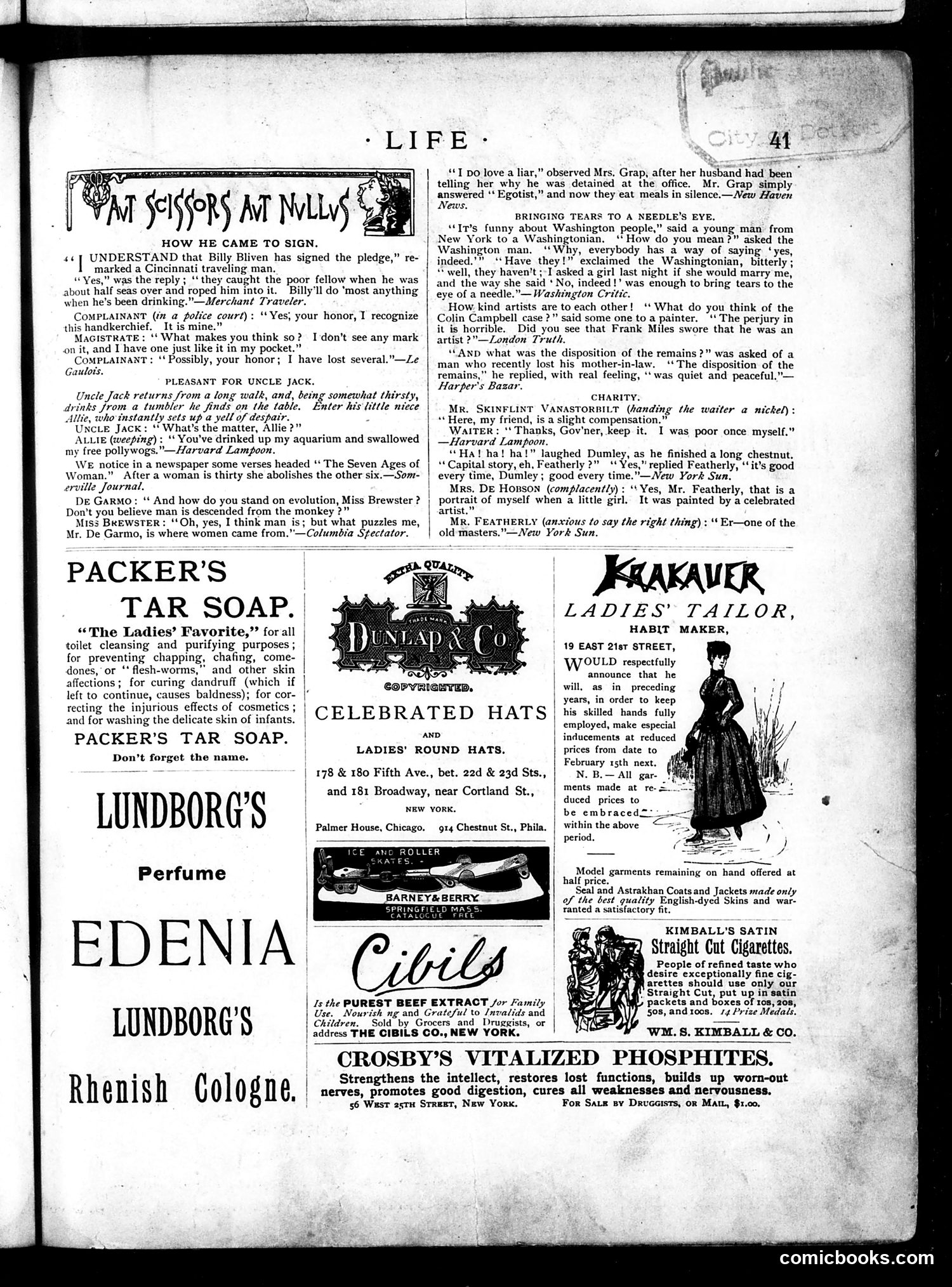
This page from *Life* magazine contains mostly **humorous short anecdotes** rather than political cartoons. The jokes satirize everyday social situations and human nature: - A man signs a temperance pledge while drunk - A woman recognizes her handkerchief by claiming she owns an identical one - A child's aquarium gets accidentally drunk by Uncle Jack - Social commentary on evolution and gender differences - Jokes about lying spouses, Washington society politeness, and artistic pretension The cartoon titled "MR SCISSORS AT NULLY'S" (top) appears to be a single-panel domestic scene, though details are unclear from the image quality. The page is otherwise dominated by **period advertisements** for tar soap, perfume, hats, and patent medicines—typical of late 19th-century magazines. No specific political figures or events are referenced. The humor relies on universal human foibles: deception, social awkwardness, and absurd situations.
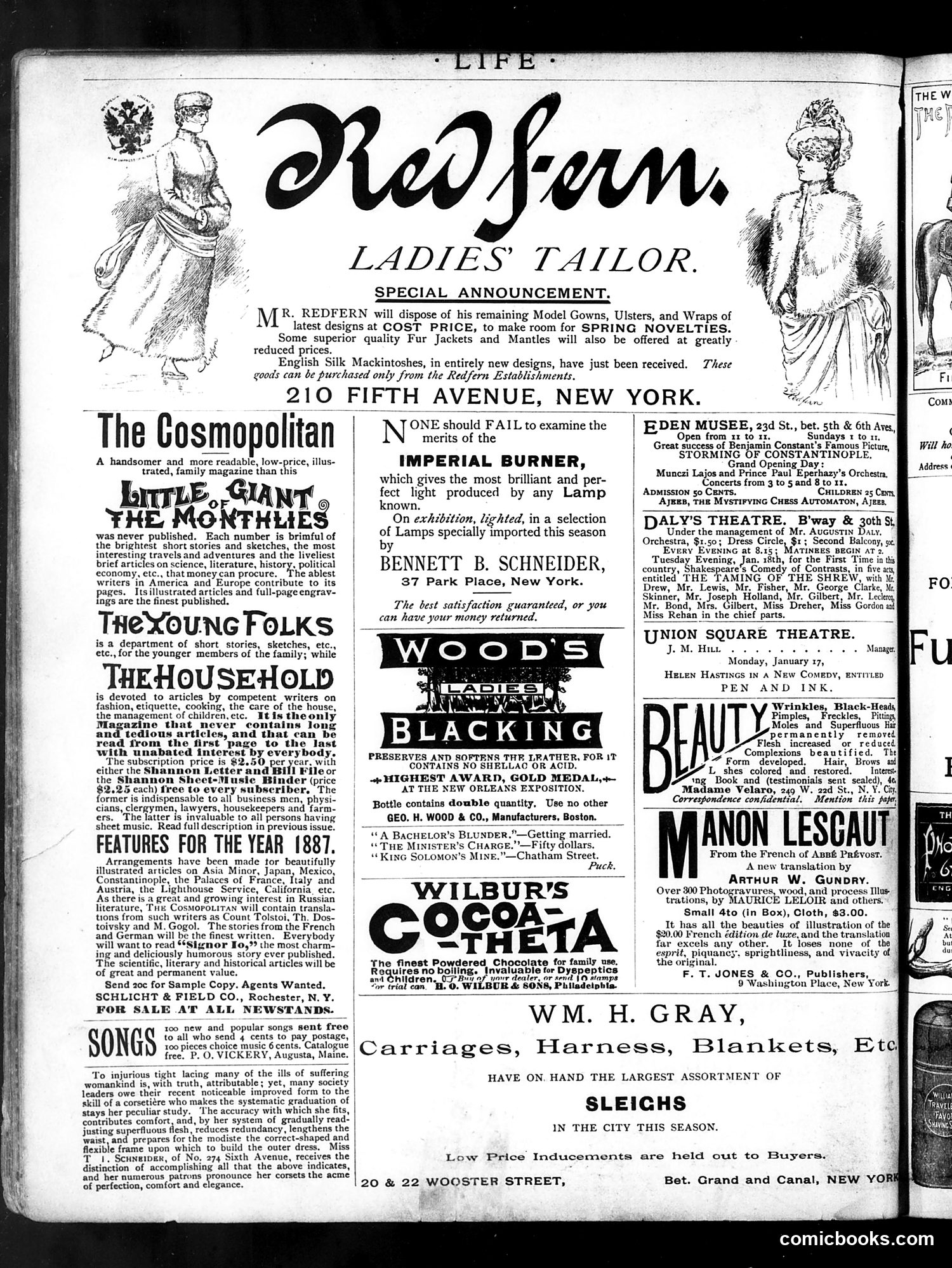
This page is primarily **advertisements and promotional content** rather than political cartoons. The layout showcases classified ads and notices typical of an 1880s magazine. The main content includes: - **Red Fern Ladies' Tailor** announcement (top): A fashion house clearing winter inventory to make room for spring designs - **Magazine advertisements**: *The Cosmopolitan*, *The Young Folks*, and *The Household* promoting their family magazine subscriptions - **Product ads**: Imperial Burner lamps, Wood's Blacking shoe polish, Wilbur's Cocoa, and WM. H. Gray's sleighs - **A corset-fitting ad**: Notably, Miss T. L. Schneider advertises her expertise in "systematic graduation of stays," addressing the era's obsession with tight-lacing and figure modification The page reflects **1880s consumer culture and women's fashion concerns**—corsetry, clothing disposal/acquisition, and emerging commercial magazines targeting family audiences. There is no political satire visible on this particular page.
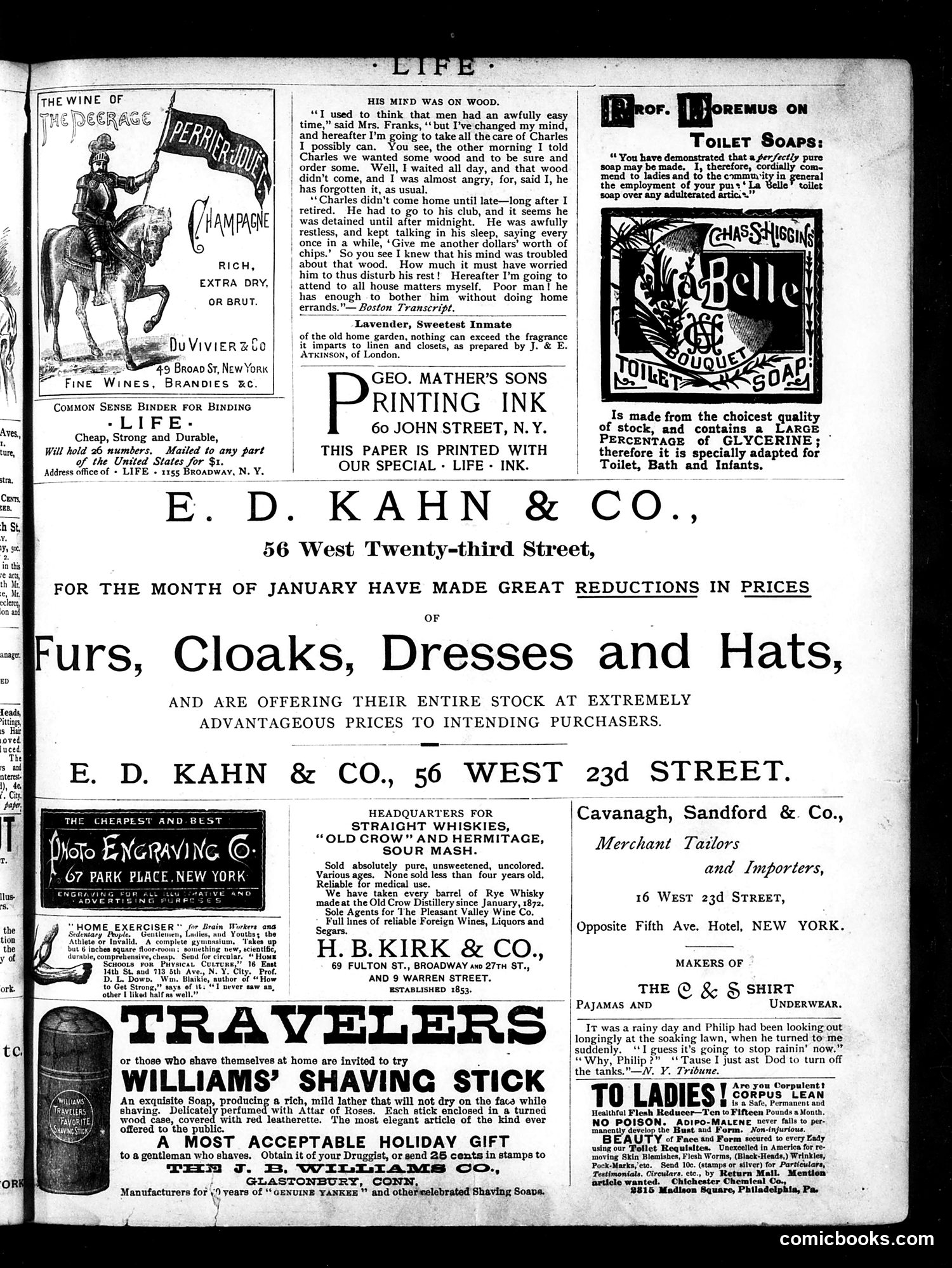
This short comic piece is **not a visual cartoon but a written satirical anecdote**. It mocks the common trope of wives sympathetically excusing their husbands' forgetfulness and absent-mindedness. Mrs. Franks recounts how her husband Charles forgot to order firewood. When he came home late and restless, talking in his sleep about "another dollar's worth of chips," she interprets his troubled sleep as anxiety over the forgotten errand—revealing her own self-deception. **The satire's target**: Wives who rationalize male incompetence as masculine burden. The joke is that Charles was likely at his club **gambling** (the "chips" reference), not mentally preoccupied with wood. Mrs. Franks' eager reinterpretation of his behavior as devoted concern excuses his actual negligence and irresponsibility. The piece criticizes how women foolishly enable men's failures through sympathetic misreading.
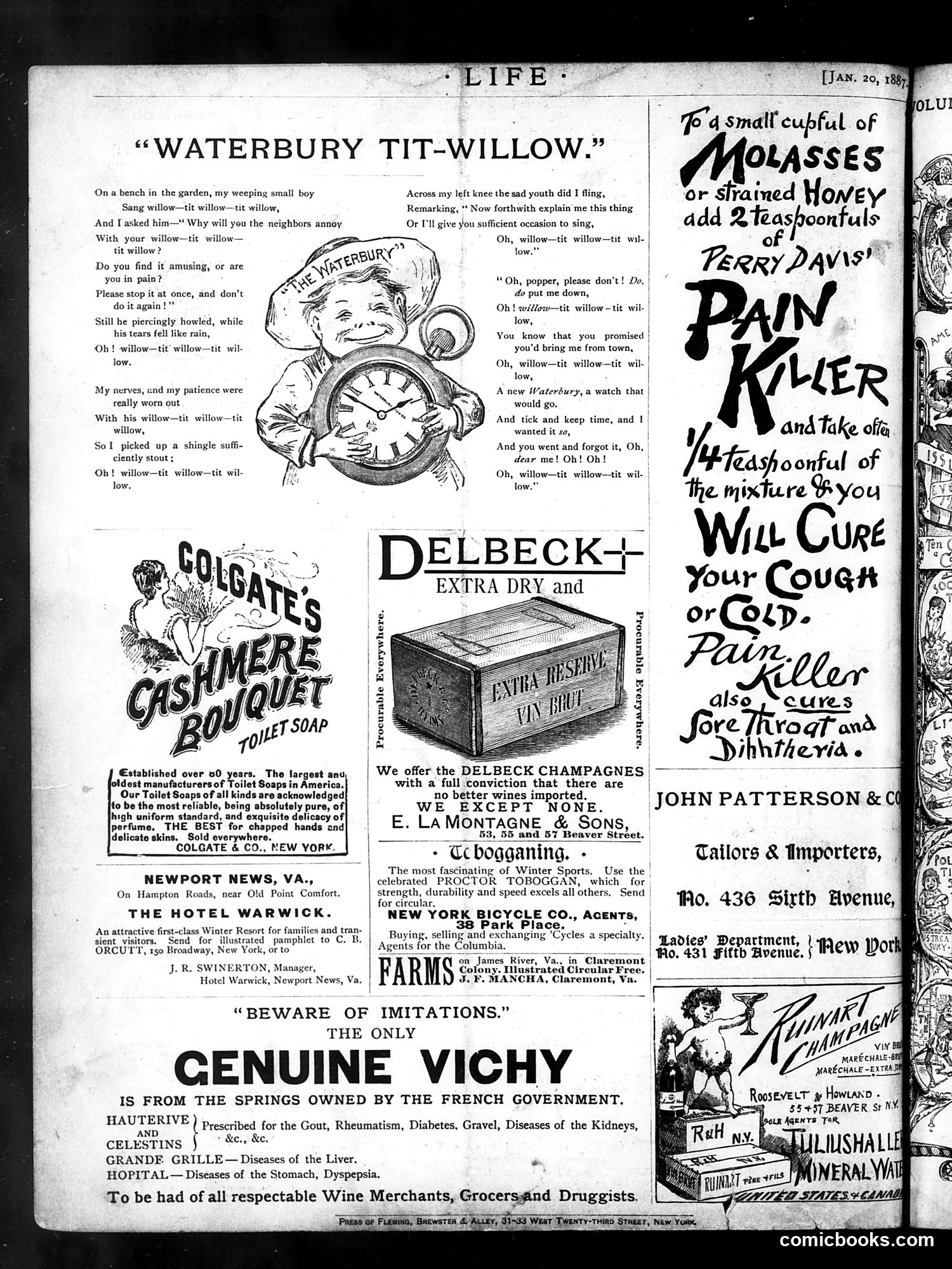
This page features a humorous poem parodying Gilbert and Sullivan's "The Mikado" (specifically its famous "Willow" song). The satire works on two levels: **The Poem's Joke:** A father grows increasingly exasperated with his son's constant singing of "willow—tit willow." When threats and reasoning fail, he threatens spanking. The child finally admits the *real* reason for his incessant singing: his father promised to bring him a **Waterbury watch** from town and forgot it. **The Advertisement:** The poem cleverly advertises Waterbury watches—a major American watch manufacturer. By making the watch the punchline, the ad uses humor to embed product placement within entertainment content, a common early advertising technique. **Social Context:** The piece satirizes both parental discipline (the father's escalating frustration) and childhood manipulation (the boy exploiting an annoying habit to remind his father of a broken promise). The repetitive "willow" refrain itself mimics the original operetta's famous repetitive structure, making it recognizable satire to contemporary readers familiar with popular theatrical music.