
Life, 1887-01-20 · page 6 of 16
Life — January 20, 1887 — page 6: what you’re looking at
What you’re looking at
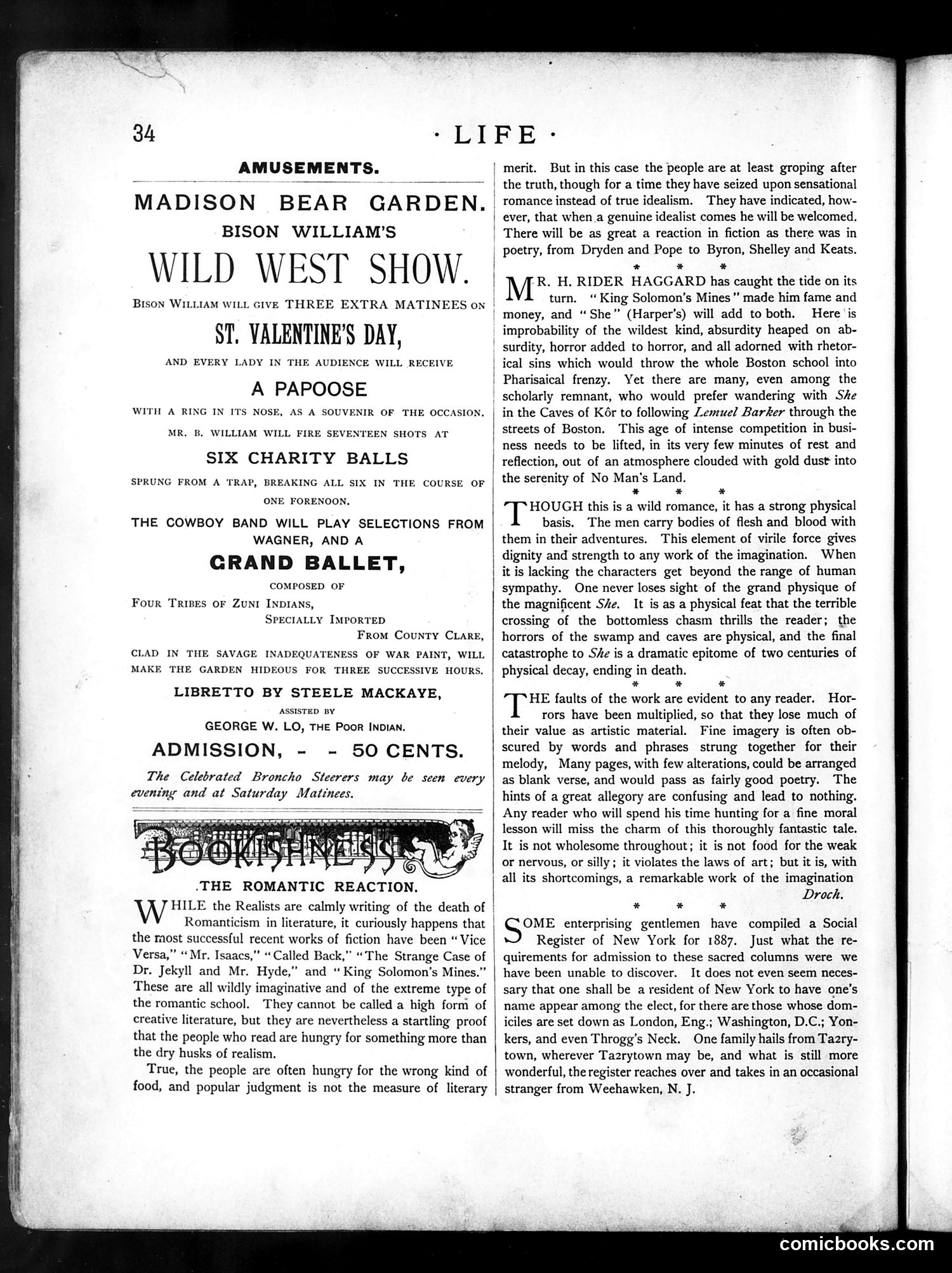
This page is primarily **advertising and literary criticism** rather than political satire. The left column advertises entertainment at Madison Bear Garden, featuring Bison William's Wild West Show with performances on St. Valentine's Day, including trick shooting, a grand ballet with imported Zuni dancers, and a libretto by Steele Mackaye. The right side contains **book reviews**, discussing romantic literature. The critic praises H. Rider Haggard's works for their physical vigor and imaginative power, while criticizing other romantic fiction as lacking moral substance—complaining that readers seek escapism rather than intellectual nourishment. The reviewer notes such works, despite their flaws, demonstrate considerable imaginative achievement. The **"Bookishness"** section at bottom announces a Social Register of New York for 1887, noting the difficulty of compiling accurate resident lists.
📄 Transcribed text from this page (OCR, searchable)
Machine-transcribed from the original scan — historical spelling and the odd misread are preserved.
“DLE E AMUSEMENTS. MADISON BEAR GARDEN. BISON WILLIAM'S WILD WEST SHOW. Bison WILLIAM WILL GIVE THREE EXTRA MATINEES on ! ST, VALENTINE’S DAY, AND EVERY LADY IN THE AUDIENCE WILL RECEIVE A PAPOOSE WITH A RING IN ITS NOSE, AS A SOUVENIR OF THE OCCASION. MR. B. WILLIAM WILL FIRE SEVENTEEN SHOTS AT. SIX CHARITY BALLS SPRUNG FROM A TRAP, BREAKING ALL SIX IN THE COURSE OF ONE FORENOON, THE COWBOY BAND WILL PLAY SELECTIONS FROM WAGNER, AND A GRAND BALLET, COMPOSED OF Four Tribes oF Zuni INDIANS, SPECIALLY IMPORTED From County Care, CLAD IN THE SAVAGE INADEQUATENESS OF WAR PAINT, WILL MAKE THE GARDEN HIDEOUS FOR THREE SUCCESSIVE HOURS. LIBRETTO BY STEELE MACKAYE, ASSISTED BY GEORGE W. LO, THE Poor INDIAN. ADMISSION, - - 50 CENTS. The Celebrated Broncho Steerers may be seen every evening and at Saturday Matinees. \ K ] HILE the Realists are calmly writing of the death of Romanticism in literature, it curiously happens that | the most successful recent works of fiction have been “Vice Versa,” “Mr. Isaacs,” “Called Back,” “The Strange Case of Dr. Jekyll and Mr. Hyde,” and “King Solomon's Mines.” These are all wildly imaginative and of the extreme type of the romantic school. They cannot be called a high form of creative literature, but they are nevertheless a startling proof that the people who read are hungry for something more than the dry husks of realism. True, the people are often hungry for the wrong kind of food, and popular judgment is not the measure of literary | merit. But in this case the people are at least groping after the truth, though for a time they have seized upon sensational romance instead of true idealism. They have indicated, how- ever, that when a genuine idealist comes he will be welcomed. There will be as great a reaction in fiction as there was in | poetry, from Dryden and Pope to Byron, Shelley and Keats. * * * R. H. RIDER HAGGARD has caught the tide on its turn. “King Solomon’s Mines” made him fame and money, and “She” (Harper’s) will add to both. Here is improbability of the wildest kind, absurdity heaped on ab- | surdity, horror added to horror, and all adorned with rhetor- | ical sins which would throw the whole Boston school into | Pharisaical frenzy. Yet there are many, even among the scholarly remnant, who would prefer wandering with Ske in the Caves of Kér to following Lemuel Barker through the streets of Boston. This age of intense competition in busi- | ness needs to be lifted, in its very few minutes of rest and reflection, out of an atmosphere clouded with gold dust into | the serenity of No Man's Land. * * * HOUGH this is a wild romance, it has a strong physical basis. The men carry bodies of flesh and blood with them in their adventures. This element of virile force gives dignity and strength to any work of the imagination. When it is lacking the characters get beyond the range of human sympathy. One never loses sight of the grand physique of the magnificent Sie. It is as a physical feat that the terrible crossing of the bottomless chasm thrills the reader; the horrors of the swamp and caves are physical, and the final catastrophe to She is a dramatic epitome of two centuries of physical decay, ending in death. * * * HE faults of the work are evident to any reader. Hor- rors have been multiplied, so that they lose much of their value as artistic material. Fine imagery is often ob- scured by words and phrases strung together for their melody, Many pages, with few alterations, could be arranged as blank verse, and would pass as fairly good poetry. The hints of a great allegory are confusing and lead to nothing. Any reader who will spend his time hunting for a fine moral lesson will miss the charm of this thoroughly fantastic tale. It is not wholesome throughout; it is not food for the weak or nervous, or silly; it violates the laws of art; but it is, with all its shortcomings, a remarkable work of the imagination Droch, * * * OME enterprising gentlemen have compiled a Social Register of New York for 1887. Just what the re- quirements for admission to these sacred columns were we have been unable to discover. It does not even seem neces- sary that one shall be a resident of New York to have one’s name appear among the elect, for there are those whose dom- iciles are set down as London, Eng.; Washington, D.C.; Yon- kers, and even Throgg’s Neck. One family hails from Ta2ry- town, wherever Tazrytown may be, and what is still more wonderful, the register reaches over and takes in an occasional stranger from Weehawken, N. J. comicbooks.com