
Life, 1887-01-20 · page 10 of 16
Life — January 20, 1887 — page 10: what you’re looking at
What you’re looking at
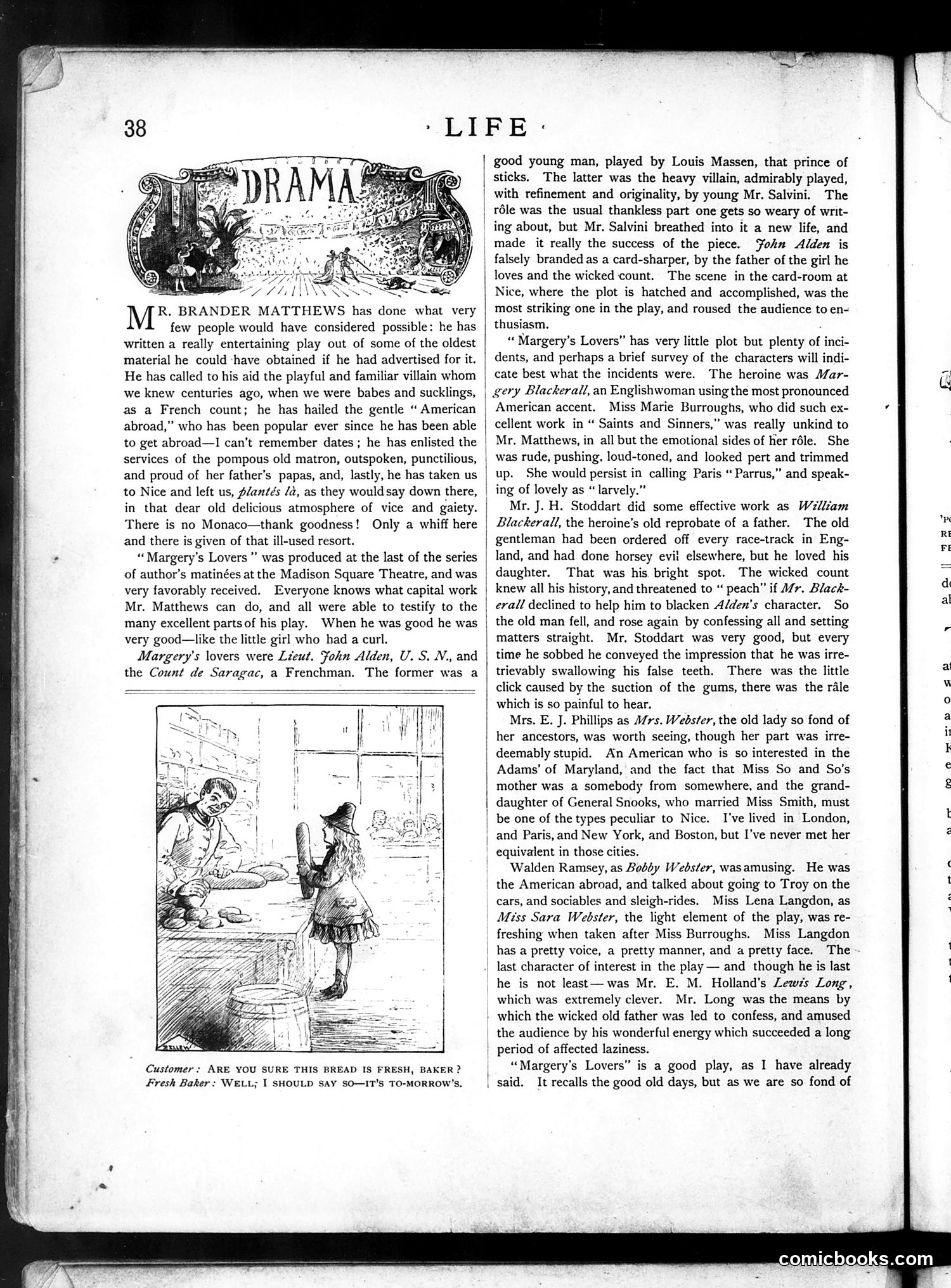
This is a drama review page discussing Brander Matthews' play "Margery's Lovers," performed at the Madison Square Theatre. The small illustration shows a domestic scene with two figures in period dress—likely depicting a scene from the play itself rather than political commentary. The review discusses the cast's performances, including actors playing roles like "John Alden" and "William Blackerall." The illustrated scene at bottom shows a conversation between a "Customer" and "Fresh Baker" about bread freshness—a brief comedic exchange typical of Life's era. This page contains theatrical criticism and light social humor rather than political satire. The content reflects late 19th-century American theater criticism and advertising conventions.
📄 Transcribed text from this page (OCR, searchable)
Machine-transcribed from the original scan — historical spelling and the odd misread are preserved.
LIFE « LP ELANNS ~ = R. BRANDER MATTHEWS has done what very few people would have considered possible: he has written a really entertaining play out of some of the oldest material he could ‘have obtained if he had advertised for it. He has called to his aid the playful and familiar villain whom | we knew centuries ago, when we were babes and sucklings, as a French count; he has hailed the gentle “ American abroad,” who has been popular ever since he has been able to get abroad—I can’t remember dates ; he has enlisted the services of the pompous old matron, outspoken, punctilious, and proud of her father’s papas, and, lastly, he has taken us | to Nice and left us, A/antés /a, as they wouldsay down there, in that dear old delicious atmosphere of vice and gaiety. There is no Monaco—thank goodness! Only a whiff here and there is given of that ill-used resort. “Margery’s Lovers” was produced at the last of the series | of author’s matinées at the Madison Square Theatre, and was | very favorably received. Everyone knows what capital work Mr. Matthews can do, and all were able to testify to the | many excellent parts of his play. When he was good he was | very good—like the little girl who had a curl. Margery’s lovers were Lieut. Fohn Alden, U. S. N., and | the Count de Saragac, a Frenchman. The former was a Customer: ARE YOU SURE THIS BREAD IS FRESH, BAKER ? Fresh Baker: Wet; | SHOULD SAY SO—IT’S TO-MORROW'S. good young man, played by Louis Massen, that prince of sticks. The latter was the heavy villain, admirably played, with refinement and originality, by young Mr. Salvini. The | réle was the usual thankless part one gets so weary of writ- ing about, but Mr. Salvini breathed into it a new life, and made it really the success of the piece. ohn Alden is falsely branded as a card-sharper, by the father of the girl he | loves and the wicked count. The scene in the card-room at Nice, where the plot is hatched and accomplished, was the most striking one in the play, and roused the audience to en- thusiasm. “ Margery’s Lovers” has very little plot but plenty of inci- dents, and perhaps a brief survey of the characters will indi- cate best what the incidents were. The heroine was Mar- gery Blackeraill, an Englishwoman using the most pronounced American accent. Miss Marie Burroughs, who did such ex- cellent work in “ Saints and Sinners,” was really unkind to Mr. Matthews, in all but the emotional sides of her réle. She was rude, pushing, loud-toned, and looked pert and trimmed up. She would persist in calling Paris “ Parrus,” and speak- ing of lovely as “larvely.” Mr. J. H. Stoddart did some effective work as W2licam Blackerall, the heroine's old reprobate of a father. The old gentleman had been ordered off every race-track in Eng- land, and had done horsey evil elsewhere, but he loved his daughter. That was his. bright spot. The wicked count knew all his history, and threatened to “ peach” if M/r. Black- erall declined to help him to blacken A/den's character. So the old man fell, and rose again by confessing all and setting matters straight. Mr. Stoddart was very good, but every time he sobbed he conveyed the impression that he was irre- trievably swallowing his false teeth. There was the little | click caused by the suction of the gums, there was the rale which is so painful to hear. Mrs. E. J. Phillips as Mrs. Webster, the old lady so fond of her ancestors, was worth seeing, though her part was irre- | deemably stupid. An American who is so interested in the Adams’ of Maryland, and the fact that Miss So and So’s | mother was a somebody from somewhere, and the grand- daughter of General Snooks, who married Miss Smith, must | be one of the types peculiar to Nice. I've lived in London, and Paris, and New York, and Boston, but I’ve never met her equivalent in those cities. Walden Ramsey, as Bobsy Webster, wasamusing. He was the American abroad, and talked about going to Troy on the cars, and sociables and sleigh-rides. Miss Lena Langdon, as Miss Sara Webster, the light element of the play, was re- freshing when taken after Miss Burroughs. Miss Langdon has a pretty voice, a pretty manner, and a pretty face. The last character of interest in the play — and though he is last he is not leastt—was Mr. E. M. Holland's Lewzs Long, which was extremely clever. Mr. Long was the means by which the wicked old father was led to confess, and amused the audience by his wonderful energy which succeeded a long | period of affected laziness. “Margery's Lovers” is a good play, as I have already | said. It recalls the good old days, but as we are so fond of q pK