
Life, 1887-01-20 · page 2 of 16
Life — January 20, 1887 — page 2: what you’re looking at
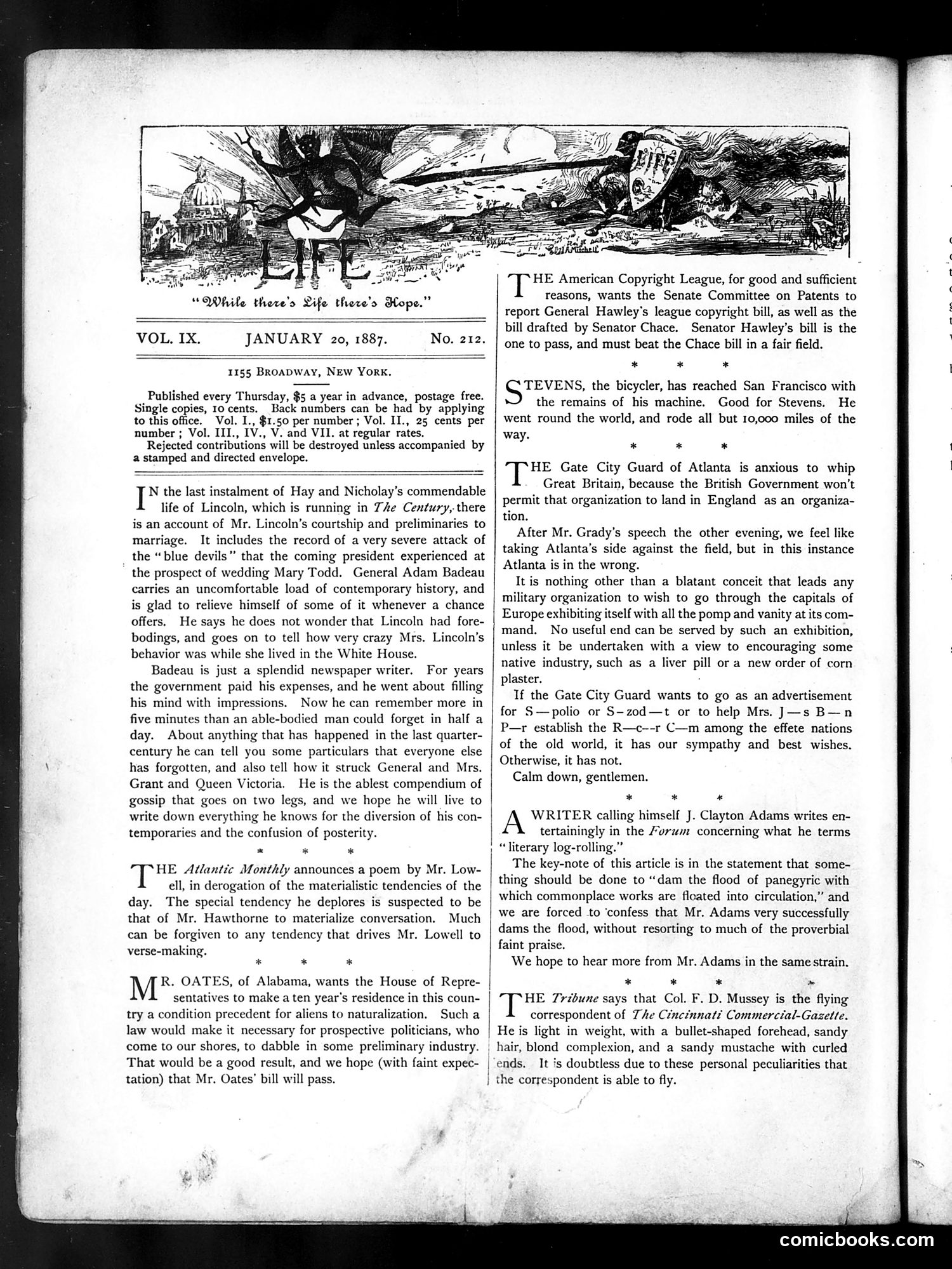
What you’re looking at
The header cartoon depicts a figure playing guitar with the caption "While there's Life there's Hope." The page contains several brief satirical items: 1. **Lincoln biography**: Commentary on a serialized account of Lincoln's life in *The Century* magazine, noting General Adam Badeau's role as writer and his tendency to include gossipy contemporary history. 2. **Stevens the bicyclist**: A brief note celebrating someone named Stevens who completed a round-the-world bicycle journey of 10,000 miles. 3. **Gate City Guard controversy**: Satirical criticism of Atlanta's military organization seeking permission to exhibit in Europe, mocking their ambitions as vain posturing that would only succeed if promoting American industry. 4. **J. Clayton Adams letter**: Comment on his "literary log-rolling" and criticism of how commonplace works flood circulation. The items are typical of *Life*'s gossipy, satirical commentary on contemporary figures and events.
📄 Transcribed text from this page (OCR, searchable)
Machine-transcribed from the original scan — historical spelling and the odd misread are preserved.
7 a5 2 “OWMhile there's Life there’s Hope.” VOL. IX. No. 212. JANUARY 20, 1887. 1155 Broapway, NEw York. Published every Thursday, $5 a year in advance, postage free. Single copies, ro cents. Back numbers can be had by applying to this office. Vol. I., $1.50 per number ; Vol. II., 25 cents per number ; Vol. III., IV., V. and VII. at regular rates. Rejected contributions will be destroyed unless accompanied by a stamped and directed envelope. N the last instalment of Hay and Nicholay’s commendable life of Lincoln, which is running in The Century, there is an account of Mr. Lincoln’s courtship and preliminaries to marriage. It includes the record of a very severe attack of the “blue devils” that the coming president experienced at the prospect of wedding Mary Todd. General Adam Badeau carries an uncomfortable load of contemporary history, and is glad to relieve himself of some of it whenever a chance offers. He says he does not wonder that Lincoln had fore- bodings, and goes on to tell how very crazy Mrs. Lincoln's behavior was while she lived in the White House. Badeau is just a splendid newspaper writer. For years the government paid his expenses, and he went about filling his mind with impressions. Now he can remember more in five minutes than an able-bodied man could forget in half a day. About anything that has happened in the last quarter- century he can tell you some particulars that everyone else has forgotten, and also tell how it struck General and Mrs. Grant and Queen Victoria. He is the ablest compendium of gossip that goes on two legs, and we hope he will live to write down everything he knows for the diversion of his con- temporaries and the confusion of posterity. * * * HE Adlantic Monthly announces a poem by Mr. Low- ell, in derogation of the materialistic tendencies of the day. The special tendency he deplores is suspected to be that of Mr. Hawthorne to materialize conversation. Much can be forgiven to any tendency that drives Mr. Lowell to verse-making. * * R. OATES, of Alabama, wants the House of Repre- | sentatives to make a ten year's residence in this coun- try a condition precedent for aliens to naturalization. Such a law would make it necessary for prospective politicians, who come to our shores, to dabble in some preliminary industry. That would be a good result, and we hope (with faint expec- tation) that Mr. Oates’ bill will pass. HE American Copyright League, for good and sufficient reasons, wants the Senate Committee on Patents to report General Hawley’s league copyright bill, as well as the bill drafted by Senator Chace. Senator Hawley’s bill is the one to pass, and must beat the Chace bill in a fair field. * * * TEVENS, the bicycler, has reached San Francisco with the remains of his machine. Good for Stevens. He went round the world, and rode all but 10,000 miles of the way. * * * HE Gate City Guard of Atlanta is anxious to whip Great Britain, because the British Government won't permit that organization to land in England as an organiza- tion. After Mr. Grady’s speech the other evening, we feel like taking Atlanta’s side against the field, but in this instance Atlanta is in the wrong. It is nothing other than a blatant conceit that leads any military organization to wish to go through the capitals of Europe exhibiting itself with all the pomp and vanity at its com- mand. No useful end can be served by such an exhibition, unless it be undertaken with a view to encouraging some native industry, such as a liver pill or a new order of corn plaster. é If the Gate City Guard wants to go as an advertisement | for S—polio or S~zod—t or to help Mrs. J—s B—n P—r establish the R—c--r C—m among the effete nations of the old world, it has our sympathy and best wishes. Otherwise, it has not. Calm down, gentlemen. * * « WRITER calling himself J. Clayton Adams writes en- tertainingly in the “rw concerning what he terms “literary log-rolling.” The key-note of this article is in the statement that some- thing should be done to “dam the flood of panegyric with which commonplace works are floated into circulation,” and we are forced to ‘confess that Mr. Adams very successfully dams the flood, without resorting to much of the proverbial faint praise. We hope to hear more from Mr. Adams in the same strain. * * * » iS Dae Tribune says that Col. F. D. Mussey is the flying correspondent of The Cincinnati Commercial-Gazette. He is light in weight, with a bullet-shaped forehead, sandy hair, blond complexion, and a sandy mustache with curled ends. It is doubtless due to these personal peculiarities that | the correspondent is able to fly. comicbooks.com