
A complete issue · 19 pages · 1886
Life — December 30, 1886
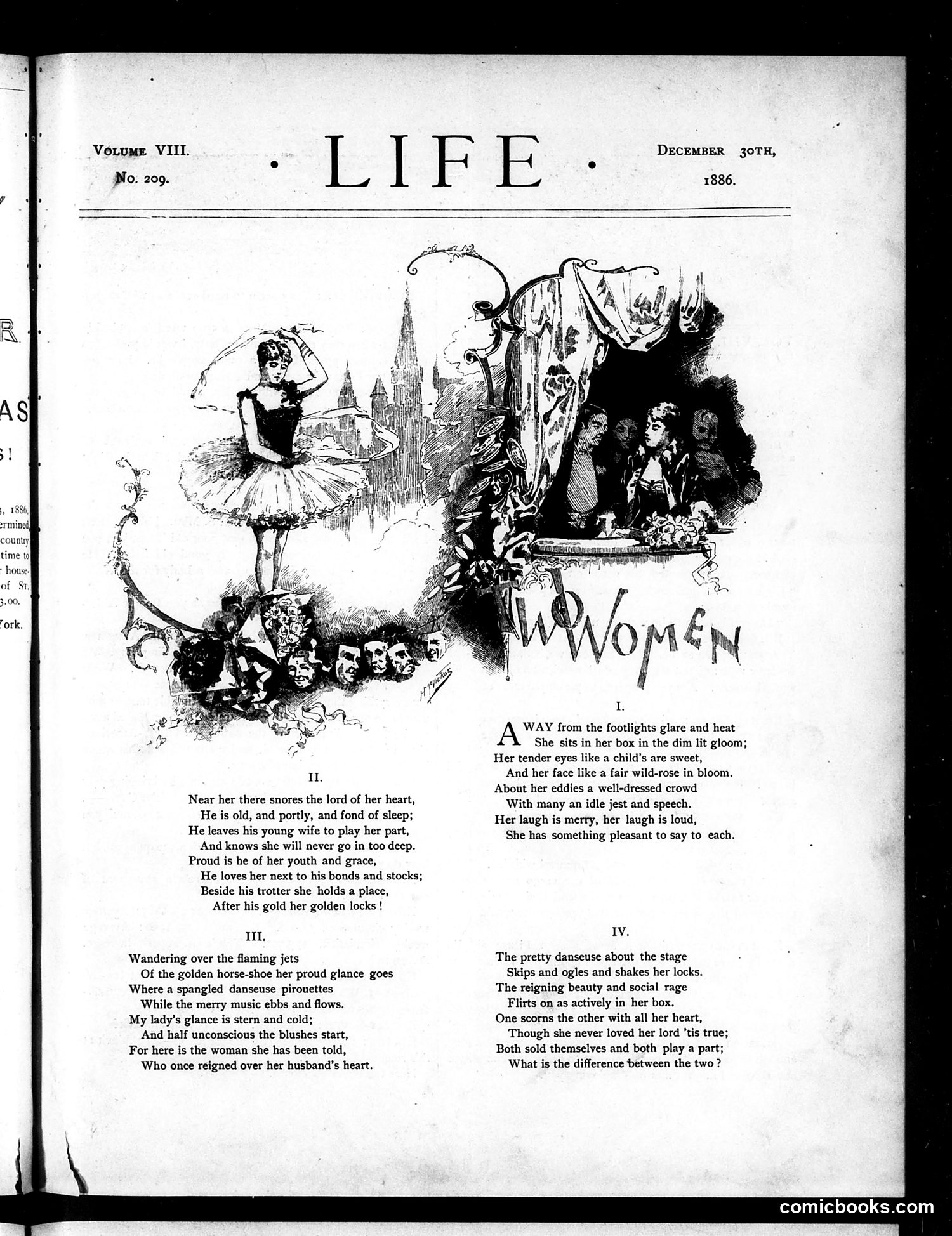
This satirical poem contrasts two types of women through four stanzas. The illustration shows a ballerina in an elegant tutu alongside theatrical/social scenes, depicting women in public performance and society. The satire juxtaposes: - **Stanza I**: A woman who escapes "footlights glare" to sit in theater boxes, surrounded by admirers and "idle jest"—suggesting artificiality and performance in social settings - **Stanzas II-IV**: Comparison between a woman who "reigned over her husband's heart" (traditional domestic role) versus one performing publicly on stage The piece critiques the theatrical nature of women's social roles in the 1880s—whether as society performers or stage actresses—suggesting both are ultimately performances rather than authentic self-expression. The poem questions what distinguishes between a woman who "sold themselves" versus one maintaining traditional domestic status.
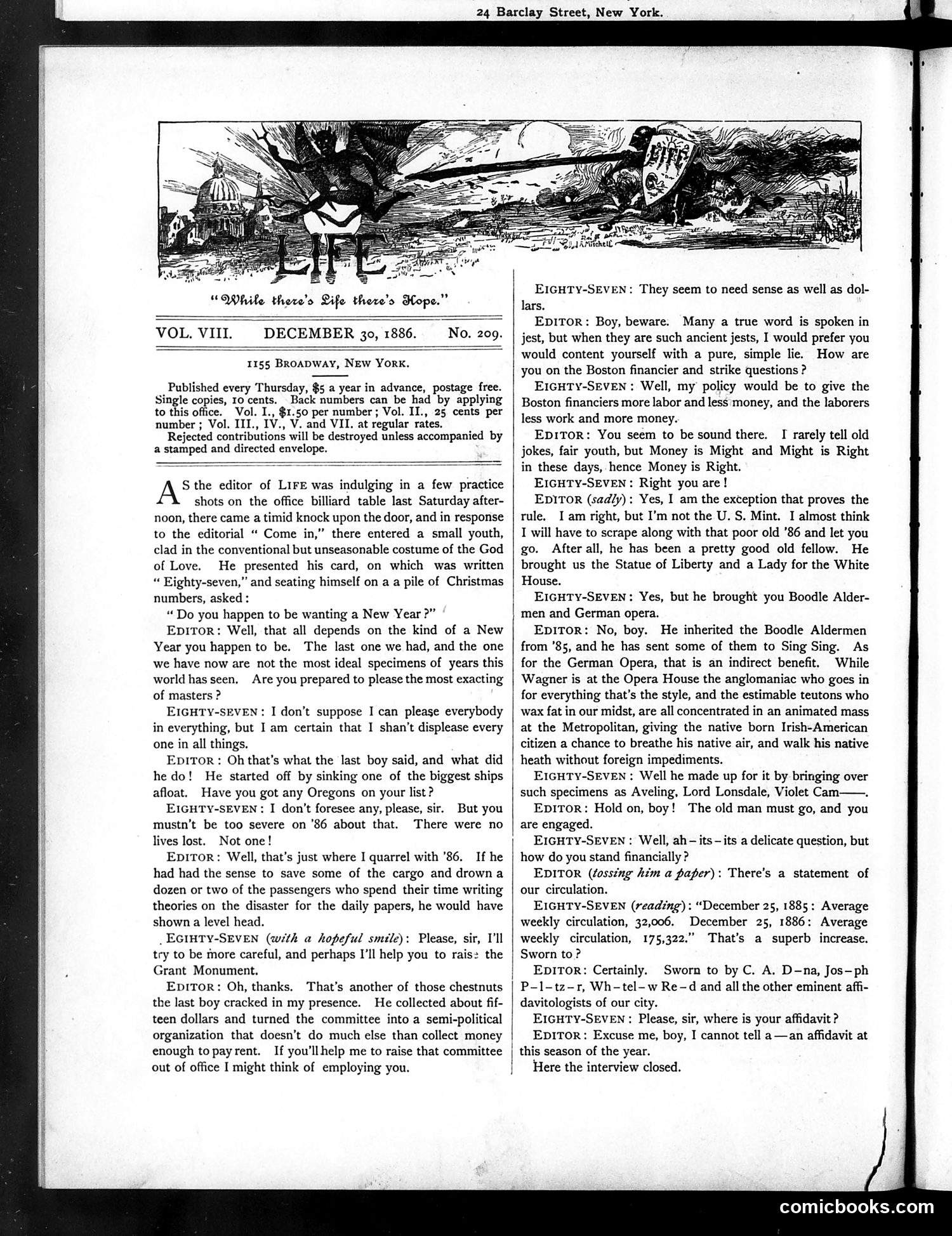
The header cartoon depicts a classical allegorical scene with winged figures and architectural elements, illustrating the motto "While there's Life there's Hope." The main content is an **editorial interview** between the Editor and a young visitor (labeled "Eighty-Seven," likely representing 1887). The satire addresses **late-19th-century political and social controversies**: the Editor defends Life's focus on money as a governing force in American society, dismisses recent immigrant-friendly cultural imports (Boodle Aldermen, German opera, the Statue of Liberty), and criticizes wealthy patrons like Violet Cameron and Lord Lonsdale. The piece ridicules American pretensions while grudgingly acknowledging that immigrants and foreign culture are reshaping the nation—a distinctly xenophobic but resigned tone typical of 1880s elite commentary.
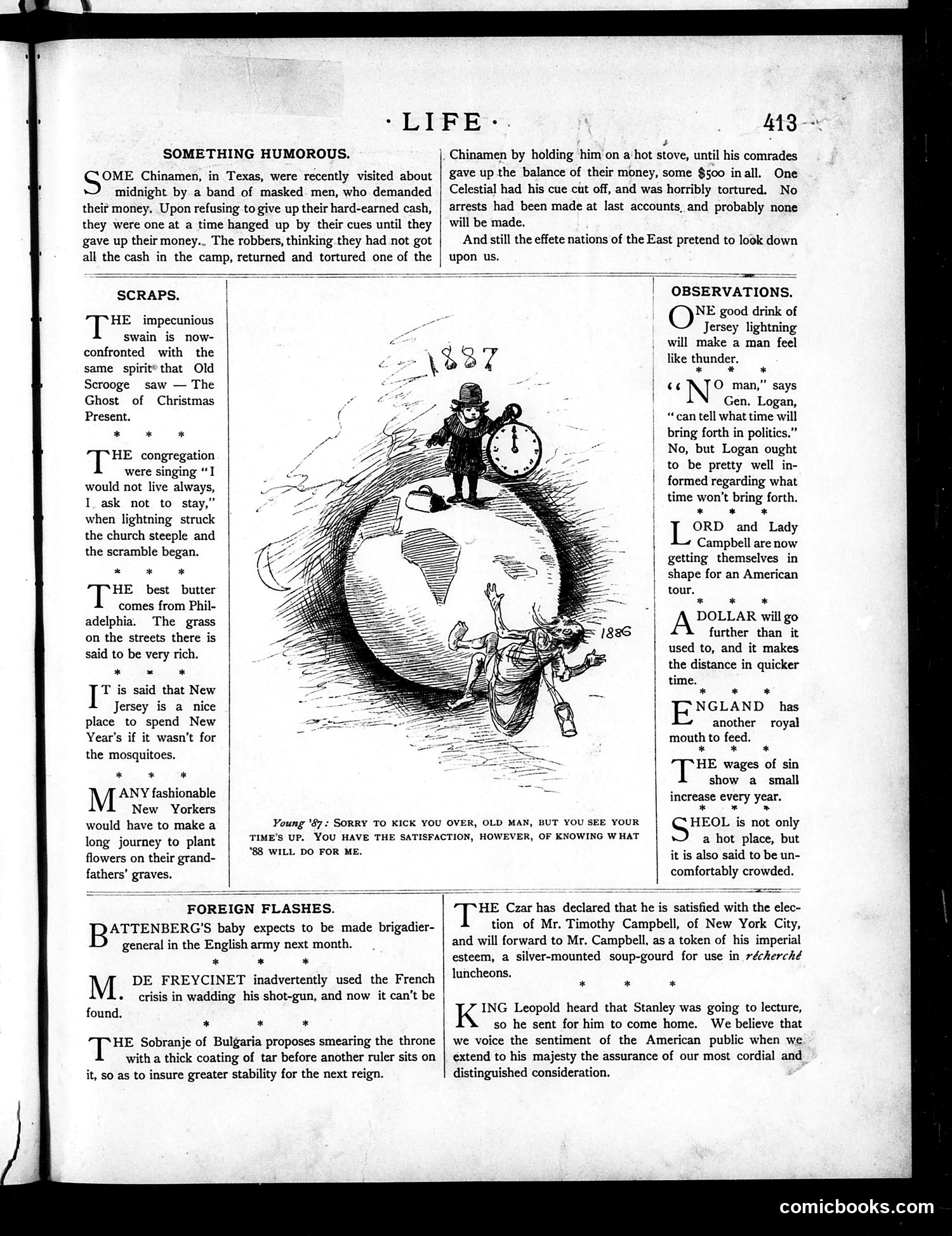
The central cartoon depicts Father Time (identifiable by his hourglass and scythe) standing atop a large globe, with a figure below apparently being kicked or knocked over. The caption reads: "Young '97: SORRY TO KICK YOU OVER, OLD MAN, BUT YOU SEE YOUR TIME'S UP. YOU HAVE THE SATISFACTION, HOWEVER, OF KNOWING WHAT IS WILL DO FOR ME." This is New Year's satirical commentary—the outgoing year (1896) is personified as an elderly man being replaced by the incoming year (1897). The joke mocks how each passing year claims superiority while the old year departs. The surrounding "Scraps" and "Observations" contain brief satirical notes on contemporary matters including politics, social customs, and international affairs typical of Life's style.
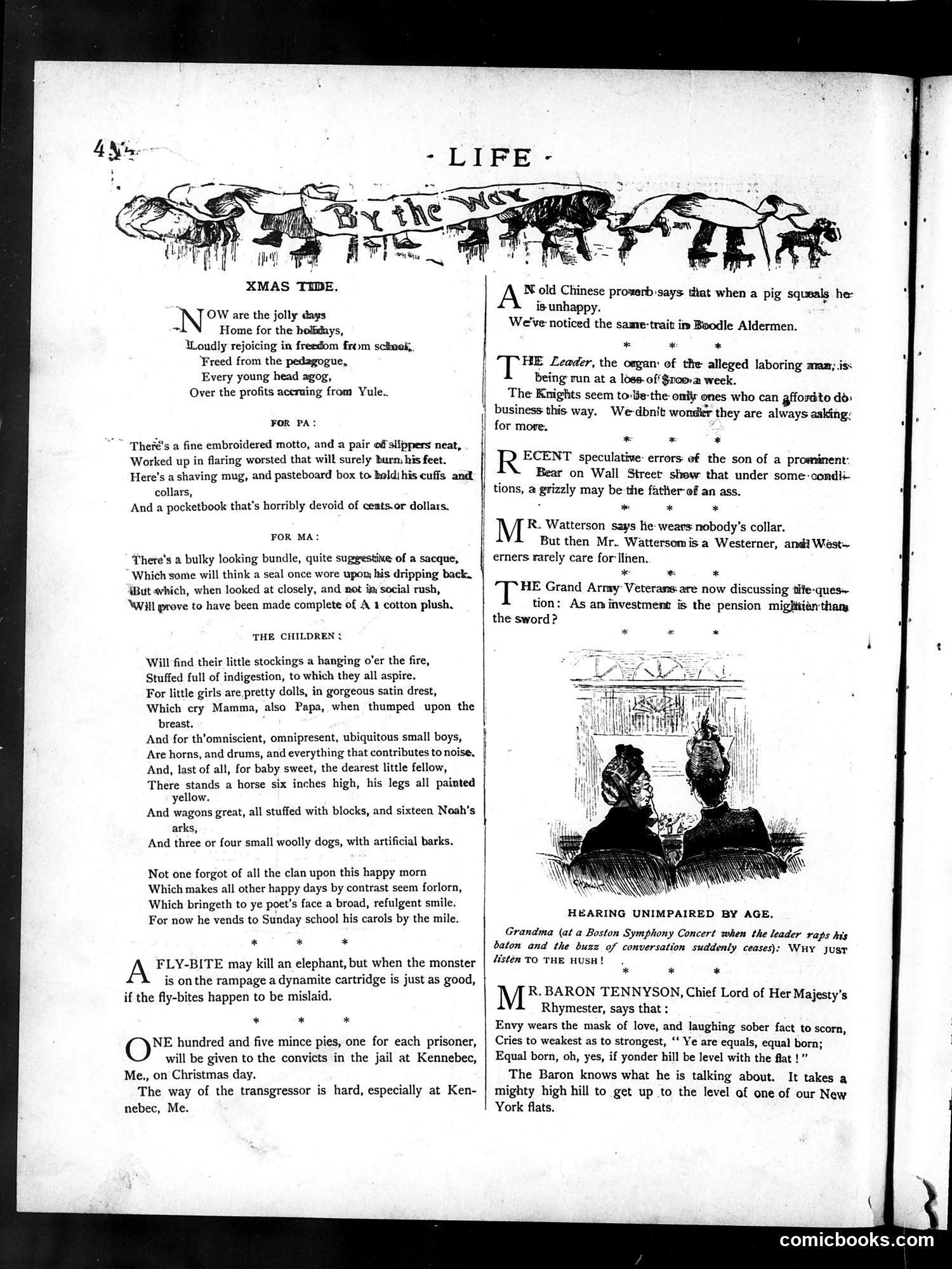
This appears to be a Christmas-themed satirical page from Life magazine. The main content includes: **"Xmas Tide"** — A humorous poem about holiday gifts for various family members (parents, children), mocking both the commercialization of Christmas and the impracticality of typical presents. **Right column vignettes** — Brief satirical observations about contemporary society, including references to: - Chinese proverbs about pigs - The *Leader* newspaper's financial struggles - Wall Street speculation and financial impropriety - A Baron Tennyson quote about equality and New York wealth disparity **Bottom illustration** — Shows two figures (appears to be elderly women) at a Boston Symphony Concert, captioned "Hearing Unimpaired by Age," satirizing how older attendees may not fully appreciate the music. The overall tone is typical Life magazine humor: mocking wealth disparities, financial corruption, and social pretension of the era.
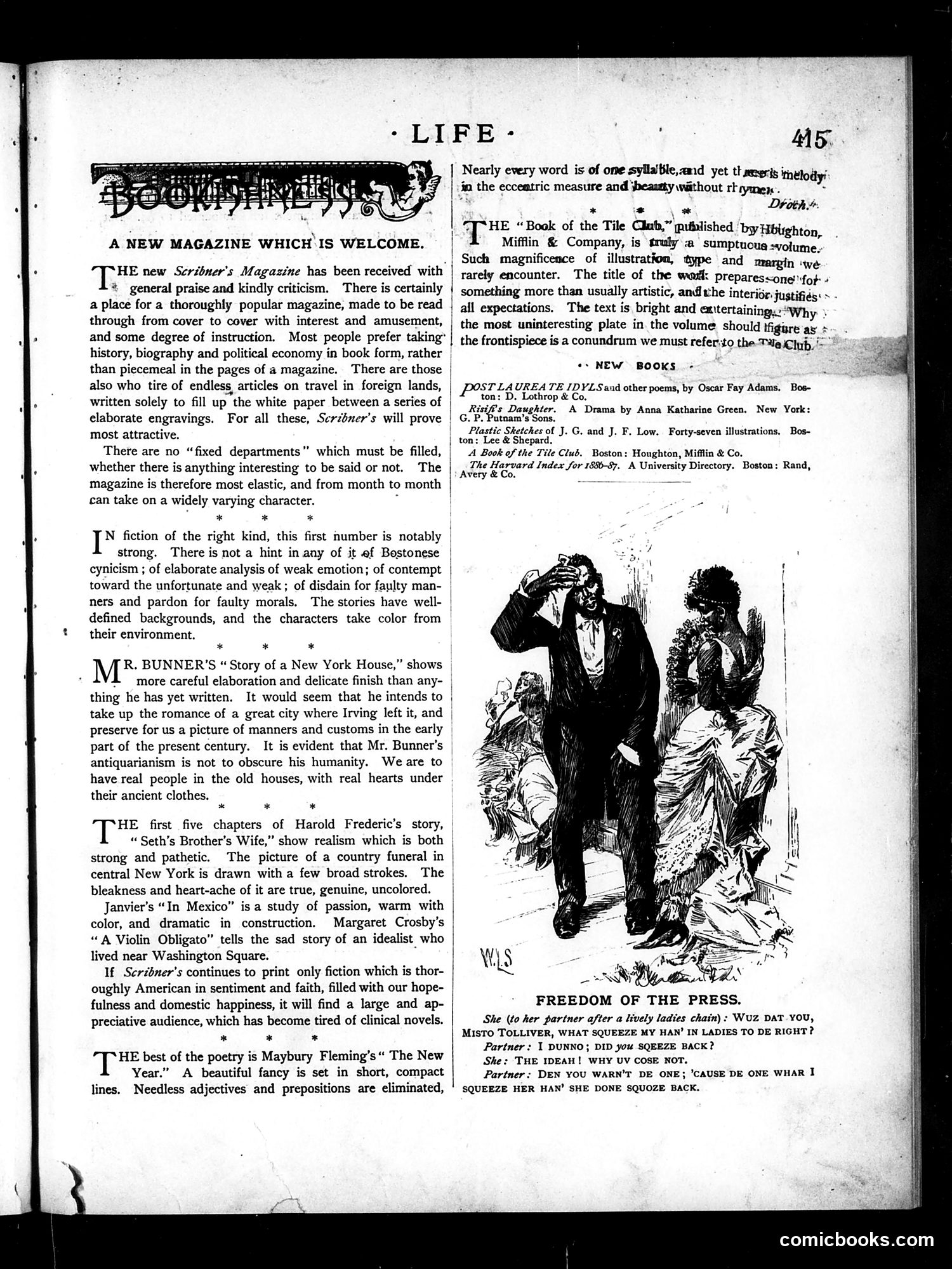
This cartoon illustrates a domestic dispute over newspaper reading rights. The caption presents a comedic dialogue between partners about access to the newspaper—a valuable commodity in this era when papers were singular household items. The humor derives from the wife's demand for newspaper access ("what squeeze me in ladies to be right?") and the partner's reluctant response ("I dunno; did you squeeze back?"). The final exchange escalates the conflict, with threats of physical retaliation ("den you warn't be one; 'cause be one whar I squeeze her han' she done squoze back"). The satire satirizes marital power dynamics and domestic disputes over newspaper monopoly—treating serious "freedom of the press" concepts ironically by reducing them to petty household quarrels over who controls reading material.
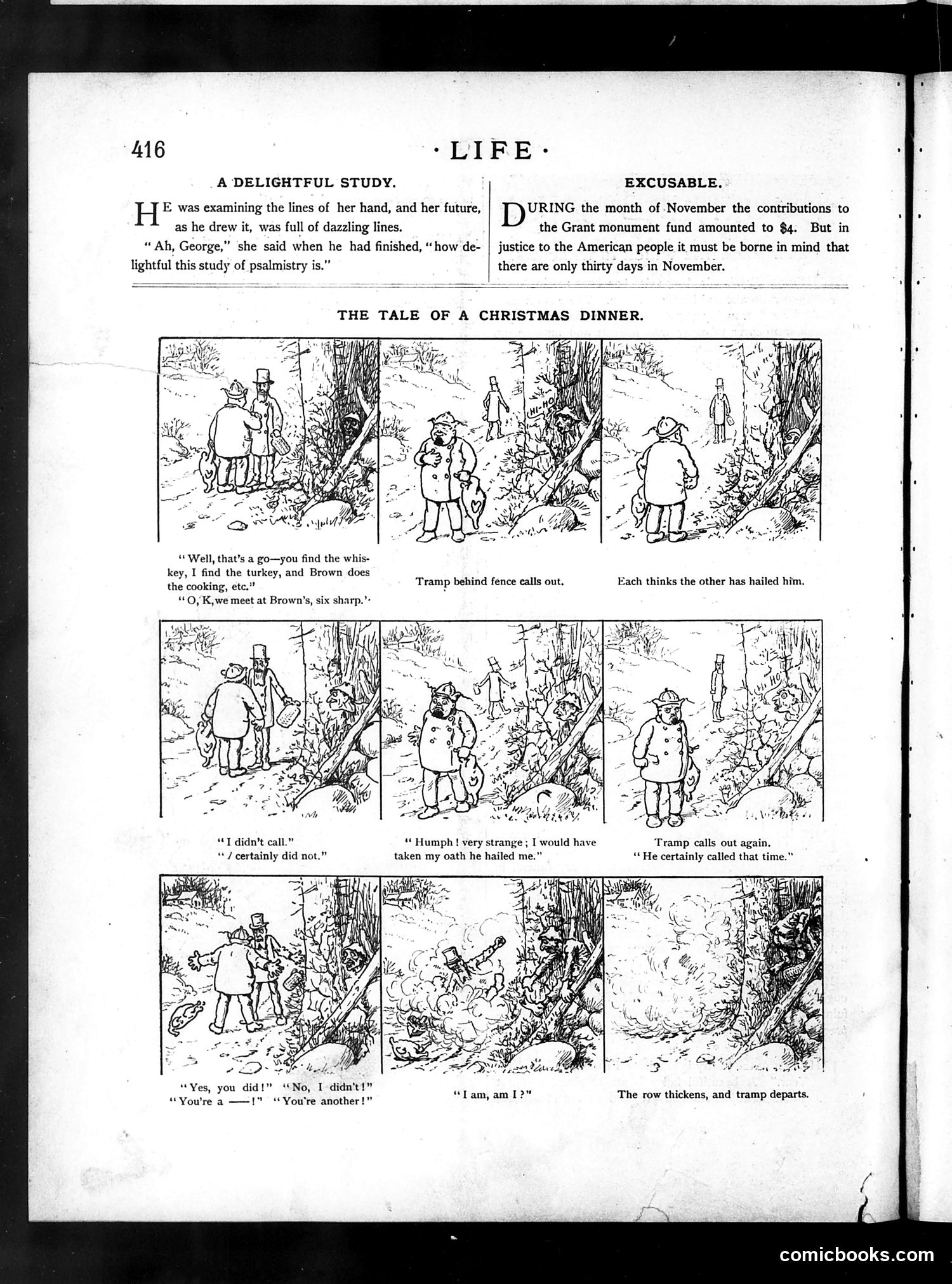
This comic strip depicts a humorous misunderstanding between two men meeting in the woods. One man calls out to arrange a Christmas dinner meeting at "Brown's," mentioning he'll bring the turkey and handle cooking. The other man, thinking he's been hailed by name, responds accordingly. Both men then search for each other, each believing the other has failed to show. When they finally encounter one another, confusion erupts—each accuses the other of not calling or showing up. The situation escalates into a physical fight beneath a tree. The joke hinges on the classic comedic trope of miscommunication: two people talking past each other due to mishearing or misinterpretation, leading to absurd consequences.
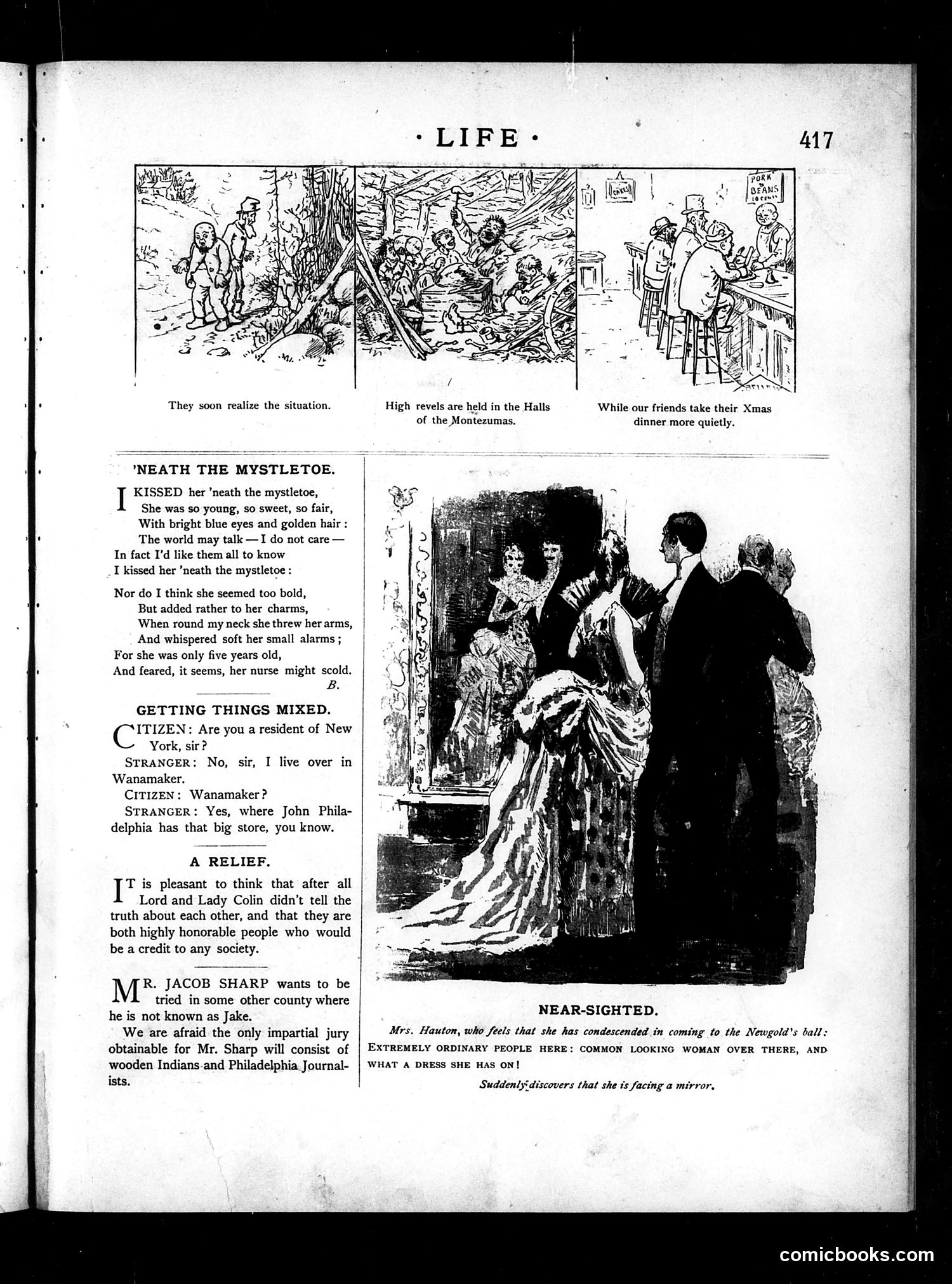
This page contains three distinct pieces: **Top Comics:** Three panels depicting what appears to be a Christmas narrative—people realizing a situation, revels in "Halls of the Montezumas" (a military reference), and friends dining quietly elsewhere. **"'Neath the Mistletoe":** A sentimental poem about kissing a young girl under mistletoe, emphasizing her youth and innocence. **"Getting Things Mixed":** A brief dialogue joke where a stranger claims to live in "Wanamaker" (likely referencing Wanamaker's department store in Philadelphia), confusing the citizen who thought he meant a place. **"A Relief" and "Near-Sighted":** Text pieces satirizing social pretensions—one about Lord and Lady Colin's honesty, another mocking "Mrs. Haxton" for her presumed vanity at a ball, discovering she's actually looking in a mirror. The page exemplifies early 20th-century American humor: sentimental, class-conscious, and gently mocking social pretension.
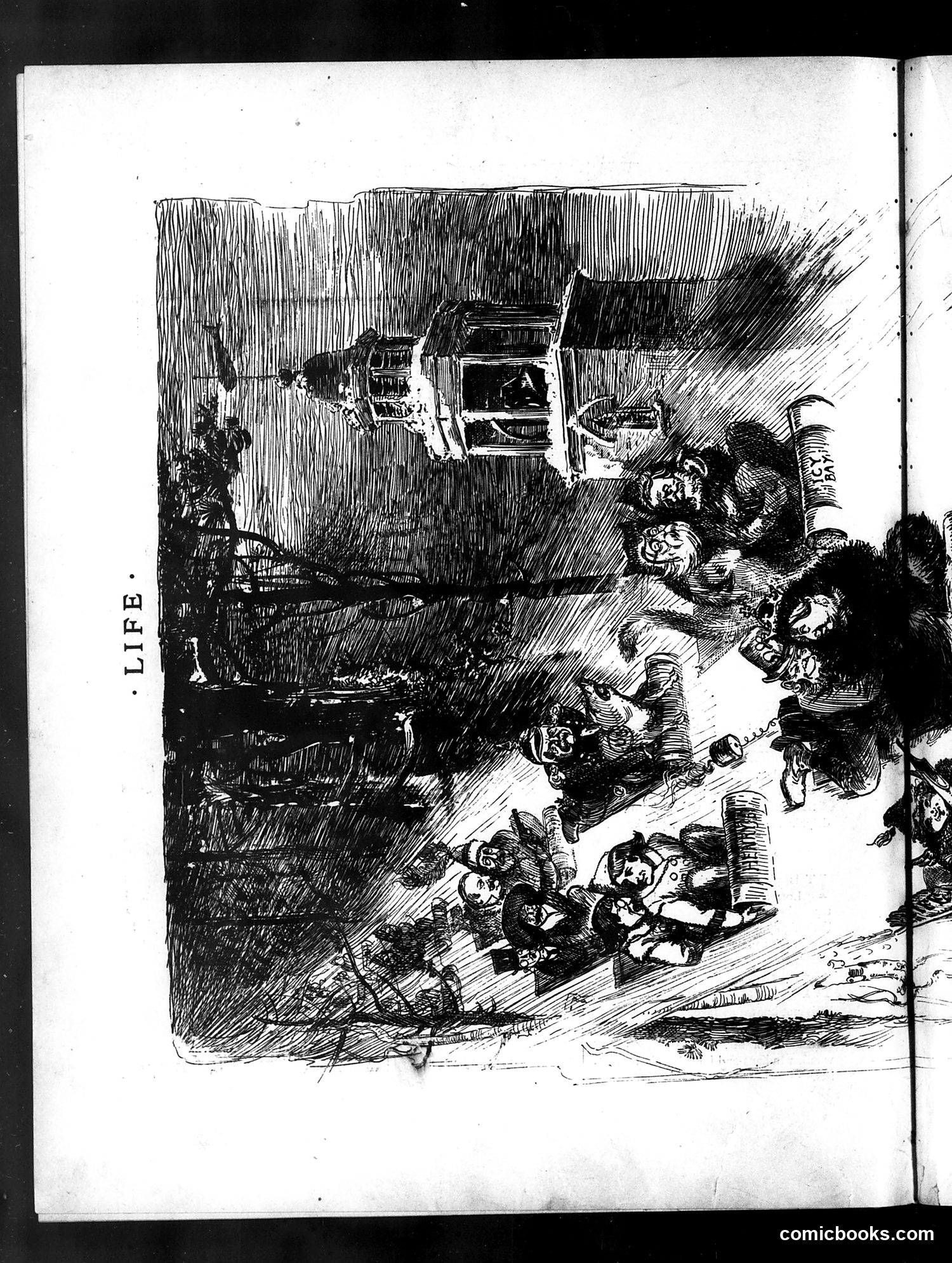
This page shows "Life" magazine's masthead/section header. The illustration depicts a chaotic street scene with figures in period dress (appearing to be 18th or 19th century based on clothing) engaged in what seems to be a brawl or tumultuous gathering. Multiple characters are shown fighting, falling, or fleeing. The word "LIFE" appears on the left margin, indicating this is the magazine's title section or opening illustration. The satirical nature is evident in the exaggerated, crowded composition typical of Life magazine's visual style—the chaos and mayhem appear designed humorously to represent the chaotic nature of life itself, or possibly contemporary social disorder. Without additional context or visible text identifying specific figures, the precise historical or political reference remains unclear, though the vintage style suggests 19th-century commentary.
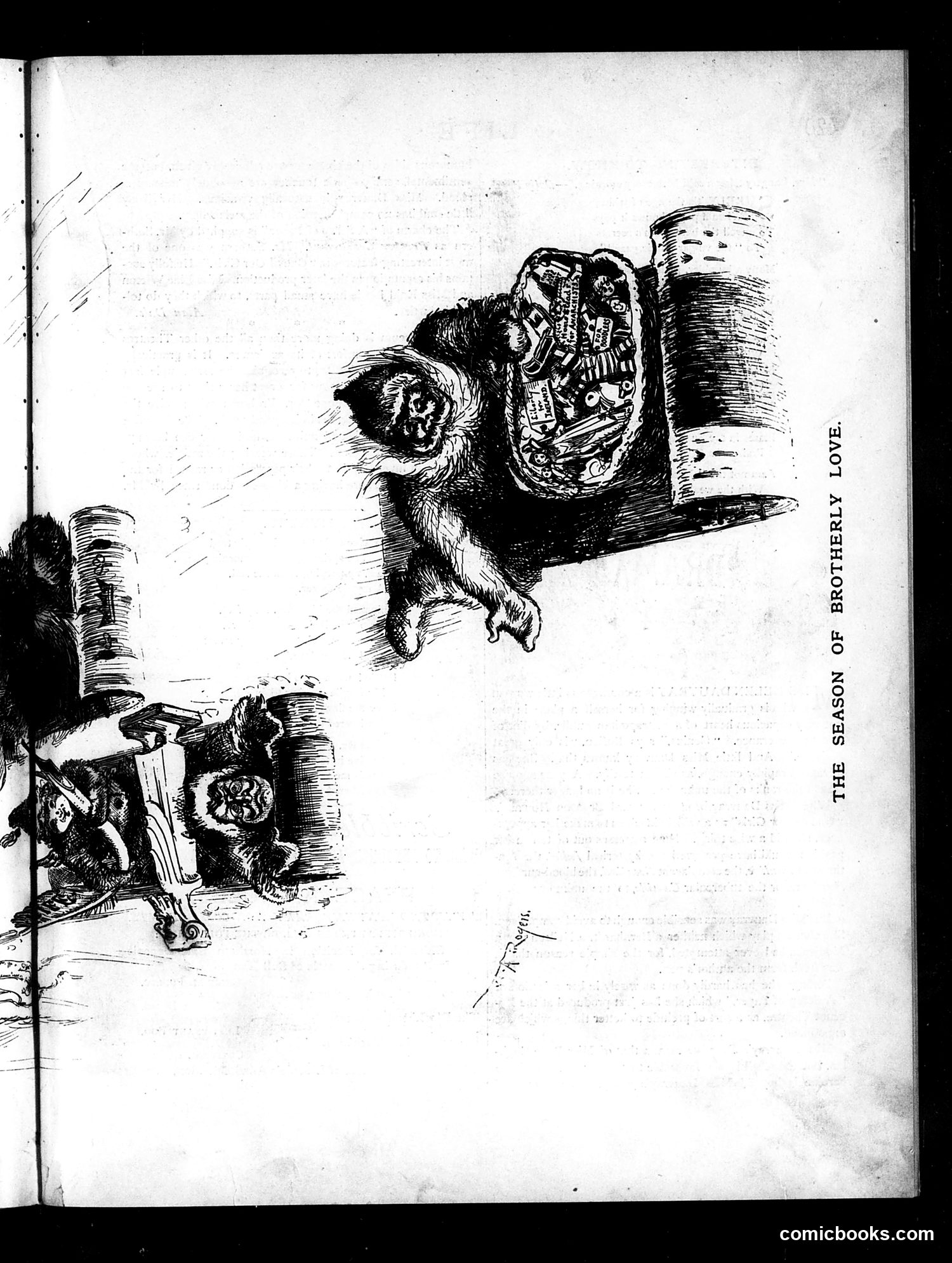
This satirical illustration depicts a primate (likely representing humanity or a specific national/political group) holding what appears to be a decorated container or vessel, surrounded by scattered items including what looks like books or documents on the left side. The title "The Season of Brotherly Love" is ironic—a reference to the Christmas/holiday period traditionally associated with peace and goodwill. The cartoon likely critiques the hypocrisy of nations or groups claiming peaceful intentions while engaging in conflict or selfish behavior during this supposedly harmonious season. The monkey figure suggests commentary on primitive or uncivilized conduct during a time supposedly dedicated to civility and moral behavior. Without additional context about Life magazine's publication date, I cannot identify the specific historical event being satirized.
This page is primarily **theatrical criticism and drama reviews**, not political satire. The main content discusses Miss Helen Dauvray, an actress who recently appeared in "One of Our Girls" and "A Scrap of Paper" at the Lyceum Theatre. The critic praises Dauvray's sensible career choices, noting she wisely avoided comparison with famous actresses by selecting fresh material rather than established roles. The review commends the Lyceum Theatre's audience accommodations. Below the drama section, "Scribbler's Monthly" advertises upcoming peace articles by contemporary non-combatants, including pieces titled "The Skirmish for Position in Northern Safe Deposit Vaults" and "Four Years in a Turkish Bath"—appearing to be humorous essay titles rather than serious political content. The page contains no identifiable political cartoons.
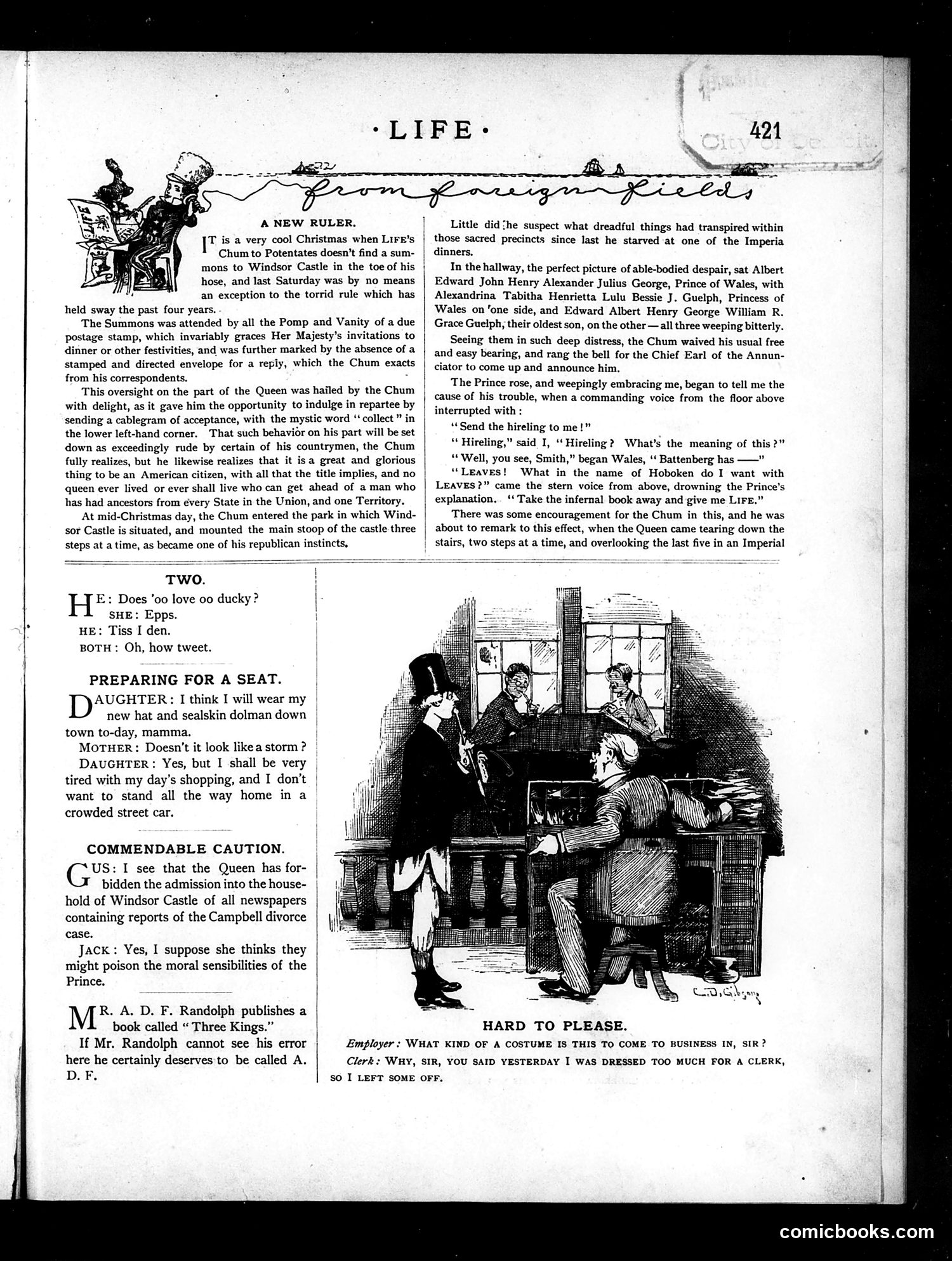
This *Life* magazine page satirizes American arrogance and the British royal family circa the 1890s. **"A New Ruler"** mocks an American visitor ("the Chum") who receives a summons to Windsor Castle. The satire centers on his republican swagger—he sends an acceptance telegram marked "collect" (refusing to pay), boasting that no queen can intimidate a man with "ancestors from every State." He climbs the castle steps three at a time, embodying crude American individualism. Upon arrival, he finds the Prince of Wales and family in distress over the "Campbell divorce case"—likely a scandal the Queen wishes suppressed from newspapers. The Prince cries out for "LIFE" (the magazine itself) rather than "Leaves" (a book), providing self-promotional wordplay. The smaller cartoons mock British customs: the couple's affected baby-talk, a woman overdressing for shopping to avoid standing in crowded transit, and the Queen censoring divorce coverage to protect the Prince's "moral sensibilities." The humor targets both American boisterousness and British prudish pretension.
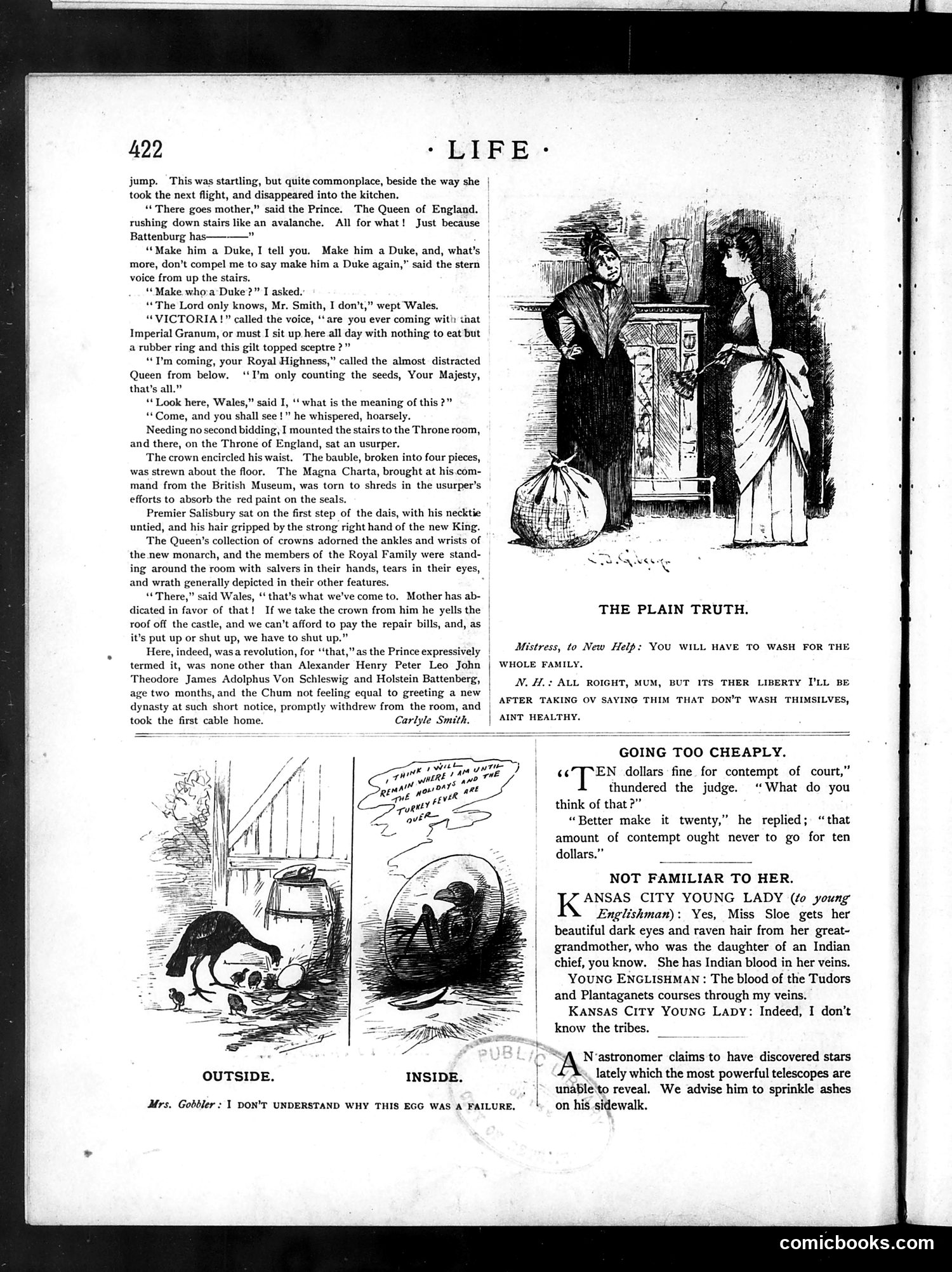
This page contains multiple short humorous pieces typical of Life magazine's satirical format: **Main Story (top):** A fictional narrative where a two-month-old royal infant, Alexander Henry Peter Leo John Theodore James Adolphus Von Schleswig and Holstein Battenberg, becomes King of England. The satire mocks both the absurdity of infant rule and the pomposity of royal naming conventions. The child destroys the crown, Magna Carta, and royal regalia while the Queen abdicates. This appears to reference real tensions in the British monarchy, likely the succession debates of the period. **Bottom Cartoons:** Two small sketches labeled "Outside" and "Inside" showing a broken egg, with Mrs. Gobbler confused about the failure—likely a visual pun about expectations versus reality. **Short Jokes:** Include satirical quips about washing servants, court fines, a Kansas City woman unfamiliar with English nobility, and an astronomer discovering invisible stars. The page exemplifies Life's approach: irreverent mockery of authority, class distinctions, and contemporary absurdities.
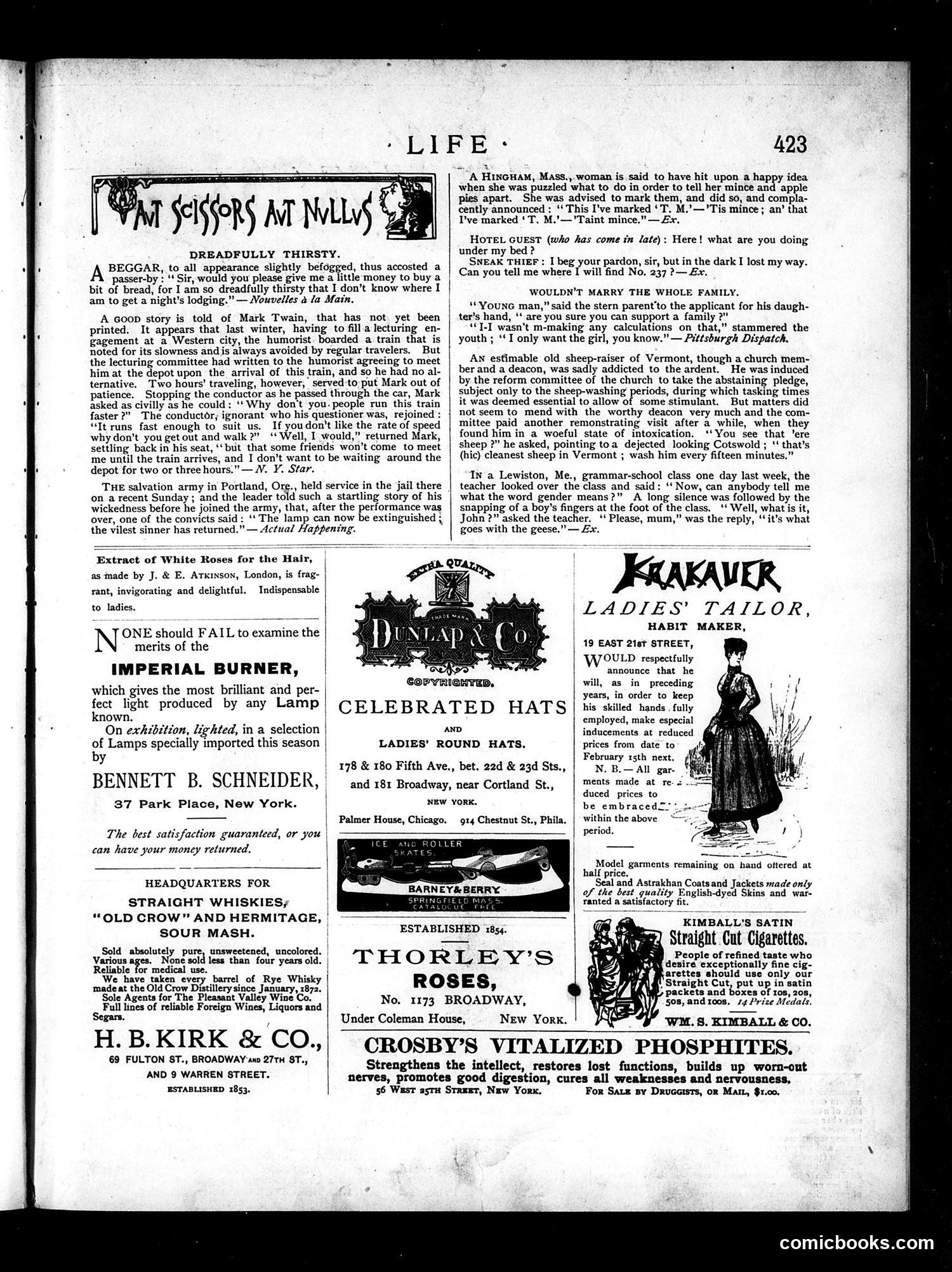
This page is primarily **humorous anecdotes and advertisements** rather than political cartoons. The title cartoon "Wit Scissors at Nully's" appears to be the magazine's humor section. The jokes include: - A beggar confusing hunger with thirst (absurdist humor) - Mark Twain boarding a slow train and being told to walk instead - A Salvation Army service in jail where a reformed sinner claims to be "the vilest" - Various domestic comedy scenarios (pie-marking, hotel theft, courtship) **Context for modern readers:** These are Victorian-era jokes relying on wordplay, misunderstandings, and gentle social observations—no sharp political satire. The "Salvation Army" reference shows that organization was already active in America by this period. The page is dominated by **period advertisements** for ladies' fashion, whiskey, lamps, and patent medicines, which was typical Life magazine content.
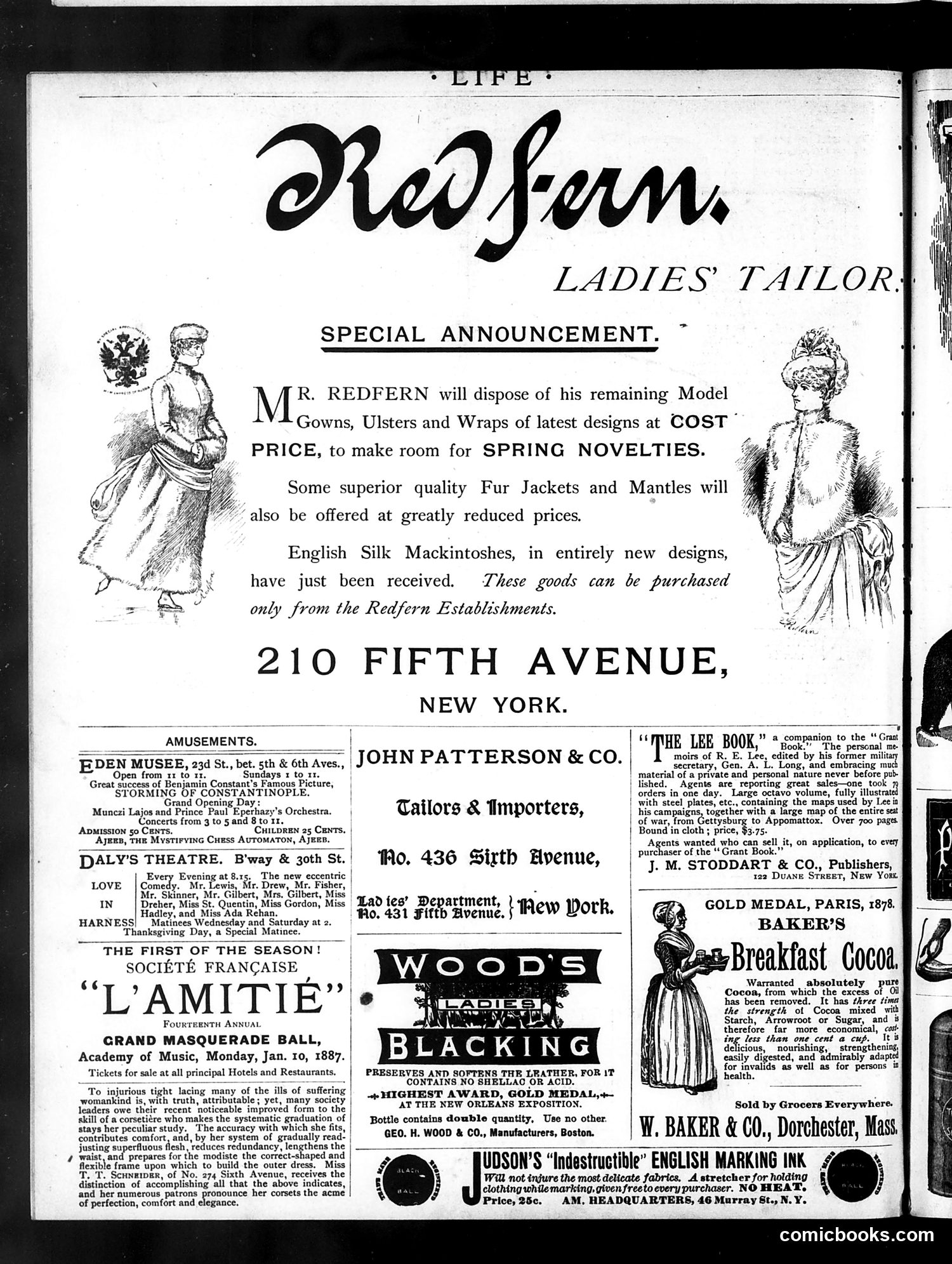
This is primarily an **advertising page** from Life magazine, circa 1887. The bulk of the content consists of commercial advertisements rather than satirical cartoons. **Key Content:** The dominant feature is a **special announcement for Redfern**, a high-end ladies' tailor at 210 Fifth Avenue in New York. Redfern is clearing inventory of model gowns, wraps, fur jackets, and new English silk mackintoshes at reduced prices to make room for spring fashions. Two elegant sketches of fashionably-dressed women flank the announcement. The surrounding advertisements include entertainment listings (Eden Musee, Daly's Theatre), the Grand Masquerade Ball at the Academy of Music, and product advertisements for Baker's Breakfast Cocoa, Wood's Blacking shoe polish, and Judson's English Marking Ink. **Notable:** A lengthy text block discusses a corsetiére's skill in fitting corsets to improve women's posture and appearance—reflecting period beauty standards and fashion concerns. This is primarily a **commercial publication page**, not satirical content.
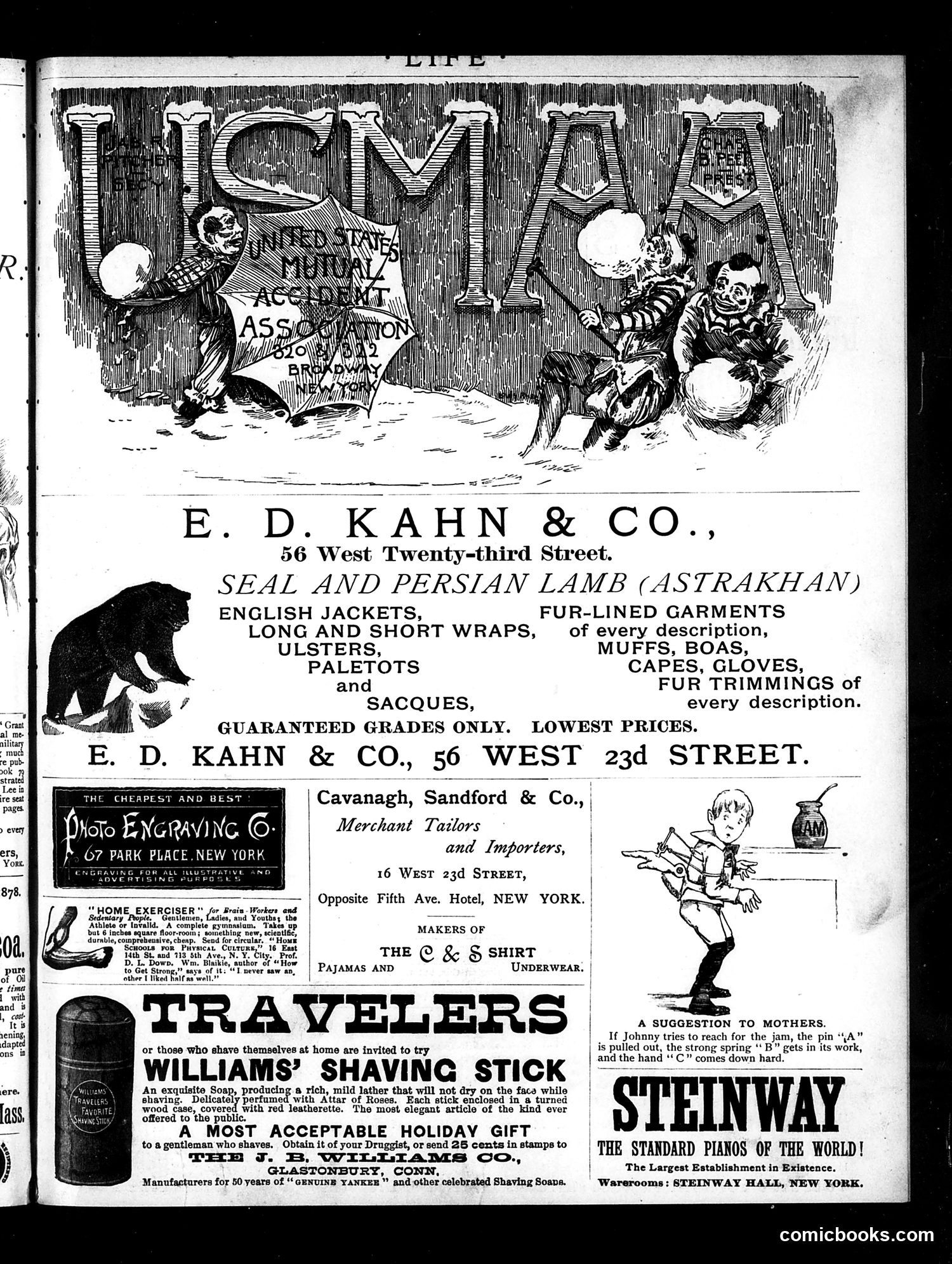
This is primarily an **advertising page** rather than a political cartoon. The dominant image at the top—labeled "LICKMAA"—appears to be a satirical illustration of the **United States Mutual Accident Association**, shown as oversized letters being juggled or manipulated by small figures. This likely mocks the insurance industry or a specific company's practices. The rest of the page contains period advertisements for luxury goods: E.D. Kahn & Co. (fur garments), merchant tailors, shaving products, and Steinway pianos. One notable ad shows a mechanical child-safety device for preventing accidents—ironic given the insurance mockery above. The "Lickmaa" cartoon suggests contemporary skepticism about insurance companies' reliability or fairness, a common satirical target in early 20th-century American humor. However, **without additional context about this specific company or date, the precise grievance remains unclear**.
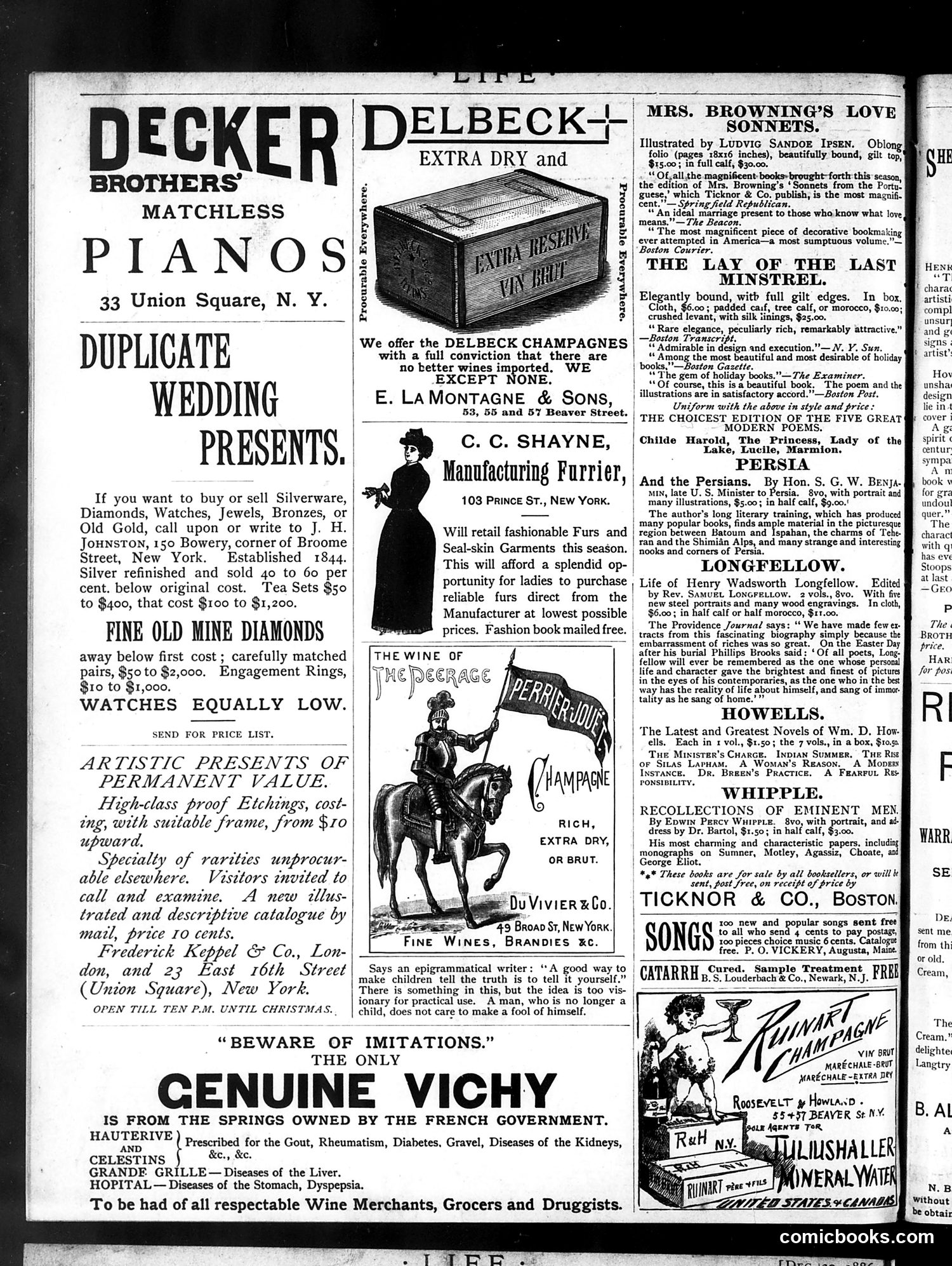
This page is primarily **advertising and book promotion**, not political satire. It features luxury goods aimed at wealthy late-19th-century consumers: pianos, champagne, furs, diamonds, and fine editions of classic literature. The small illustrated advertisements show period conventions—a fashionable woman in a corset advertising furs, and a man on horseback promoting champagne. These aren't caricatures with political meaning, but rather typical commercial imagery of the era. The book promotions (Mrs. Browning's *Sonnets*, *The Lay of the Last Minstrel*, *Longfellow's Life*) reflect Victorian cultural values—emphasizing beautiful binding, gilt edges, and literary prestige as status symbols for educated elites. The page's satire, if any, is subtle: *Life* magazine's satirical edge appears mainly in juxtaposing high-minded literary culture with crass commerce. The advertising itself mocks consumer pretension through sheer excess of luxury marketing, though this requires knowing *Life*'s editorial stance. **No identifiable political figures or events are present.**
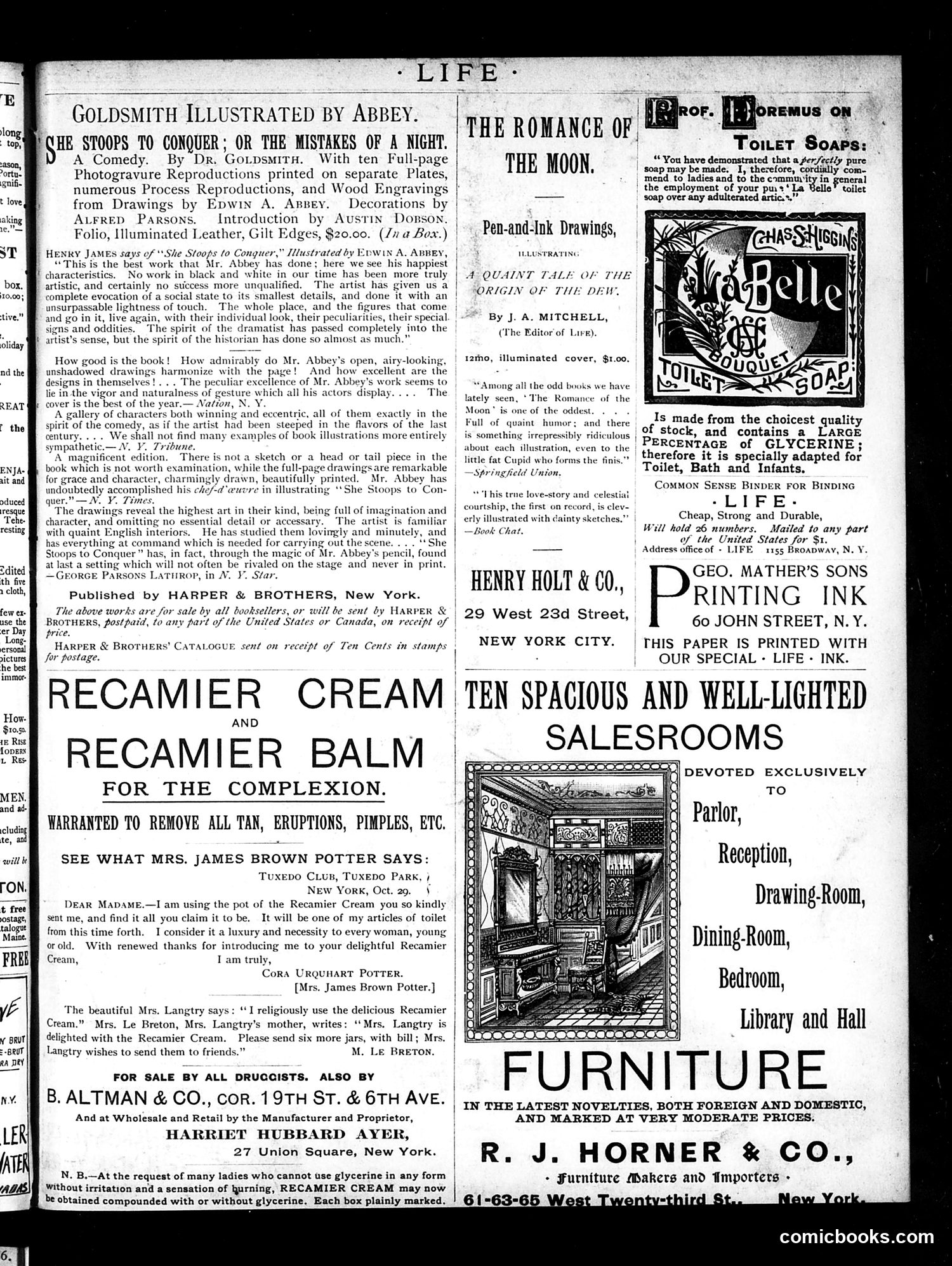
This is primarily a **book advertisement and product promotion page**, not a political cartoon. The main content advertises a lavish illustrated edition of Oliver Goldsmith's 1773 comedy *She Stoops to Conquer*, illustrated by artist Edwin A. Abbey. The page features glowing critical praise emphasizing Abbey's skill in capturing the play's 18th-century characters and social milieu through detailed pen-and-ink drawings. The page also includes advertisements for **Recamier Cream and Balm** (a complexion product), endorsing testimonials from society figures Mrs. James Brown Potter and actress Lillie Langtry—typical marketing tactics of the era using celebrity endorsements. Additional ads promote printing ink, toilet soap, and furniture showrooms. **There is no political satire here**—this is a standard late-19th-century magazine page mixing literary promotion with luxury product advertising aimed at affluent readers.
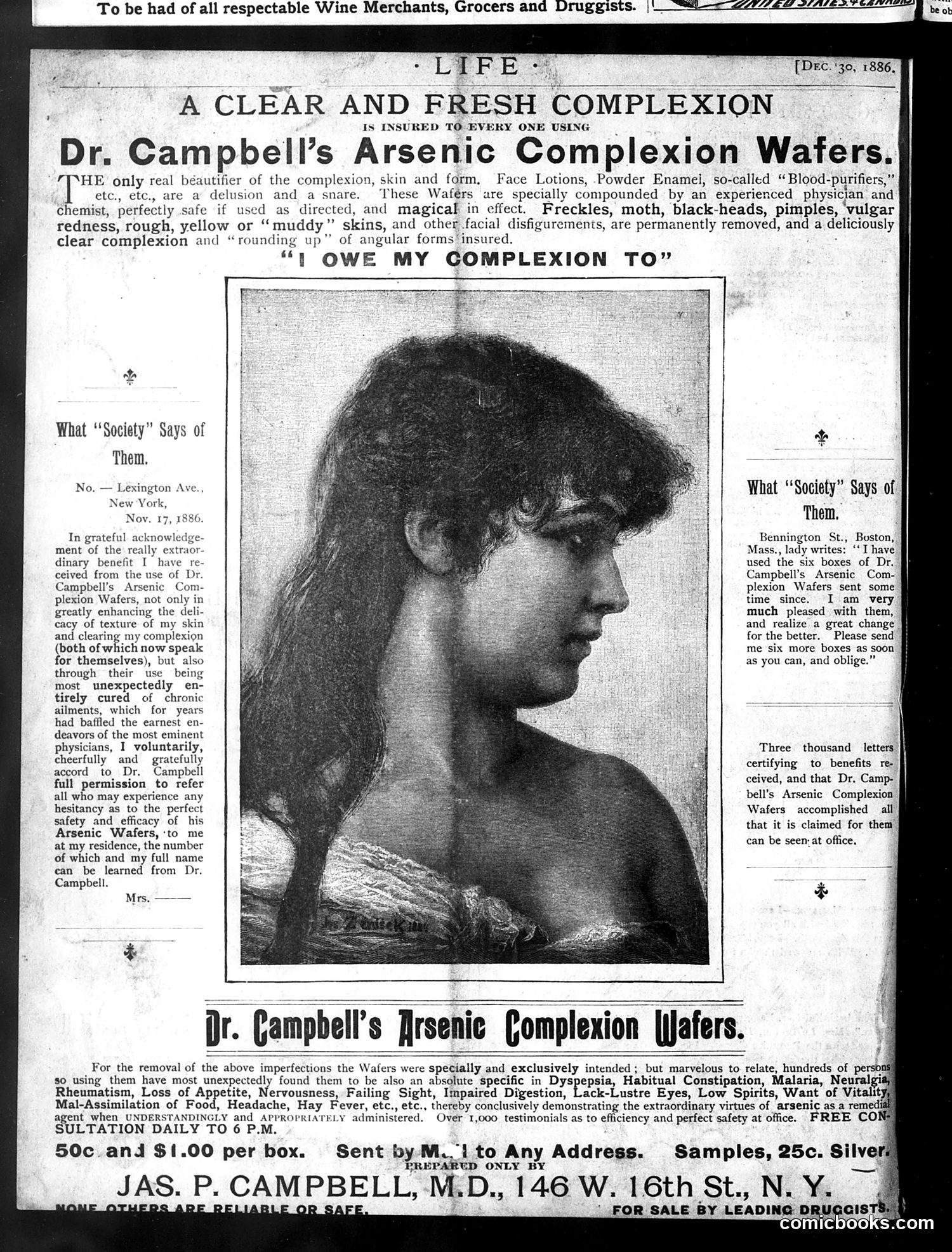
This is not satire—it's a genuine 1886 advertisement in *Life* magazine. Though presented without irony, it's darkly comic to modern readers because the product contains **arsenic**, a poison. The ad claims the wafers cure complexion problems, freckles, and pimples, while also treating dyspepsia, malaria, rheumatism, and nervous disorders. The ad includes fake testimonial letters from satisfied "society" women praising results. The centerpiece is a portrait of a woman with mysteriously darkened features—whether this represents "before" or "after" is unclear and somewhat absurd. By 1886, arsenic's toxicity was known but remained common in "patent medicines" and beauty products marketed to women. The ad's breathless tone and extravagant health claims, combined with its dangerous ingredient, exemplify the unregulated, snake-oil medicine era preceding the 1906 Pure Food and Drug Act.

I can see this is a page from Life magazine, but the image is almost entirely black or heavily degraded, making it impossible to discern any cartoon artwork, caricatures, text, or satirical content with confidence. Only fragmentary text remnants appear along the left and right margins, which are too incomplete to establish context or meaning. To properly analyze the political or social satire, I would need a clearer reproduction of the actual page content. I cannot responsibly identify figures, historical references, or explain the humor without being able to see the material clearly.