
Life, 1886-12-30 · page 5 of 19
Life — December 30, 1886 — page 5: what you’re looking at
What you’re looking at
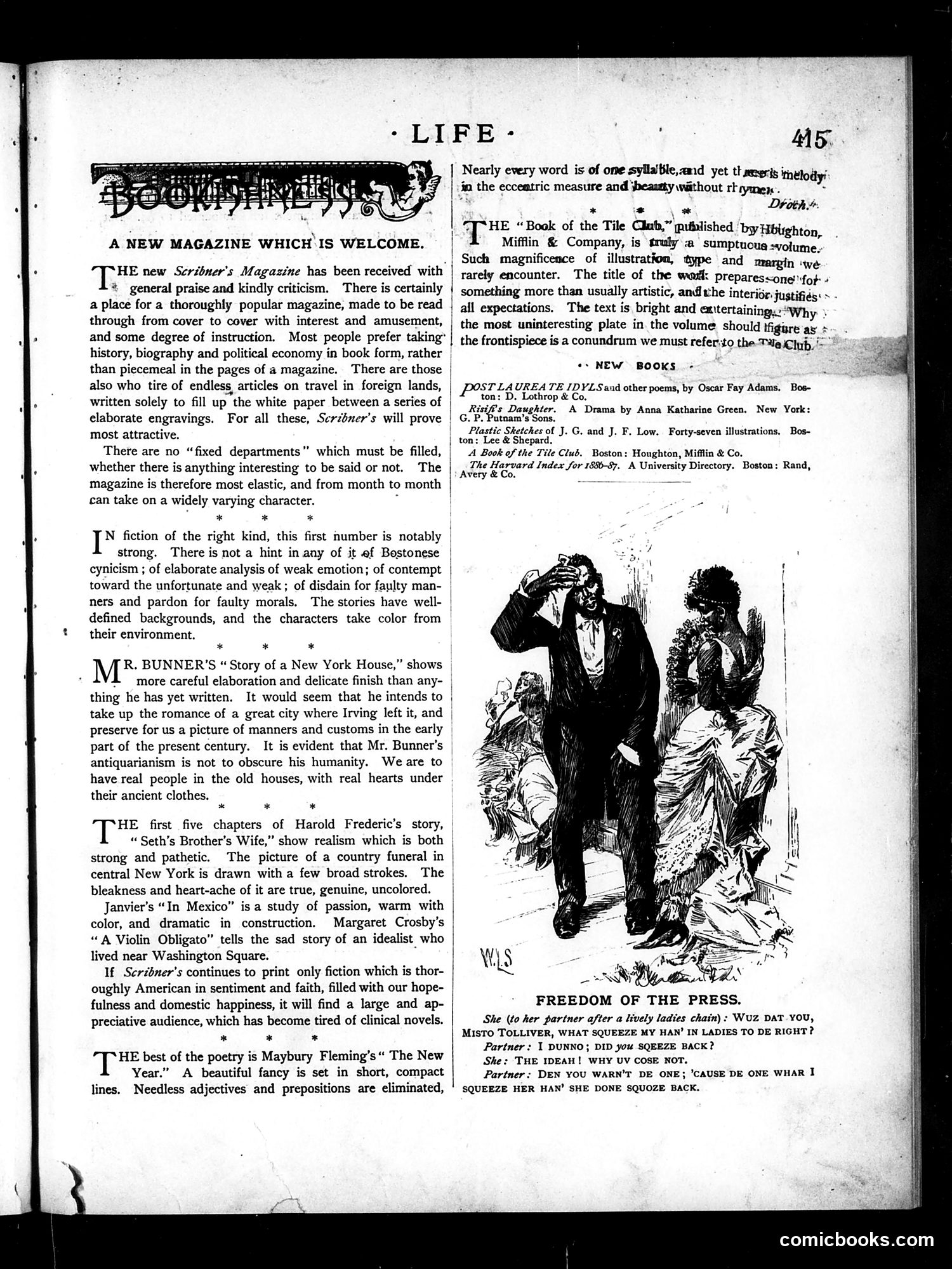
This cartoon illustrates a domestic dispute over newspaper reading rights. The caption presents a comedic dialogue between partners about access to the newspaper—a valuable commodity in this era when papers were singular household items. The humor derives from the wife's demand for newspaper access ("what squeeze me in ladies to be right?") and the partner's reluctant response ("I dunno; did you squeeze back?"). The final exchange escalates the conflict, with threats of physical retaliation ("den you warn't be one; 'cause be one whar I squeeze her han' she done squoze back"). The satire satirizes marital power dynamics and domestic disputes over newspaper monopoly—treating serious "freedom of the press" concepts ironically by reducing them to petty household quarrels over who controls reading material.
📄 Transcribed text from this page (OCR, searchable)
Machine-transcribed from the original scan — historical spelling and the odd misread are preserved.
A NEW MAGAZINE WHICH\IS WELCOME. HE new Scribner's Magazine has been received with * general praise and kindly criticism. There is certainly a place for a thoroughly popular magazine, made to be read through from cover to cover with interest and amusement, and some degree of instruction. than piecemeal in the pages of a magazine. There are those also who tire of endless, articles on travel in foreign lands, written solely to fill up the white paper between a series of | elaborate engravings. most attractive. For all these, Serzbner's will prove There are no “fixed departments” which must be filled, | whether there is anything interesting to be said or not. The magazine is therefore most elastic, and from month to month can take on a widely varying character. . * * * [* fiction of the right kind, this first number is notably | strong. There is not a hint in any of it af Bostonese | cynicism ; of elaborate analysis of weak emotion; of contempt toward the unfortunate and weak ; of disdain for faulty man- | ners and pardon for faulty morals. The stories have well- defined backgrounds, and the characters take color from their environment. * * * R. BUNNER’S “Story of a New York House,” shows more careful elaboration and delicate finish than any- | thing he has yet written. It would seem that he intends to take up the romance of a great city where Irving left it, and preserve for us a picture of manners and customs in the early part of the present century. It is evident that Mr. Bunner’s antiquarianism is not to obscure his humanity. We are to have real people in the old houses, with real hearts under their ancient clothes. * * * HE first five chapters of Harold Frederic’s story, “Seth’s Brother’s Wife,” show realism which is both | strong and pathetic. central New York is drawn with a few broad strokes. bleakness and heart-ache of it are true, genuine, uncolored. Janvier’s “In Mexico” is a study of passion, warm with color, and dramatic in construction. “A Violin Obligato” tells the sad story of an idealist who lived near Washington Square. If Scribner's continues to print only fiction which is thor- oughly American in sentiment and faith, filled with our hope- fulness and domestic happiness, it will find a large and ap- preciative audience, which has become tired of clinical novels. * * * HE best of the poetry is Maybury Fleming’s“ The New Year.” A beautiful fancy is set in short, compact lines. Needless adjectives and prepositions are eliminated, The picture of a country funeral in | Nearly every word is of one syllaible,zand yet thaeeris itn Most people prefer taking’ history, biography and political economy in book form, rather | The | Margaret Crosby's | elodyi: in the eccentric measure and jbeautty waithout ri ryiney. ey, * * \ = Drath. “[ HE “Book of the Tile Club,” published by Hbughton, Mifflin & Company, is truly a sumptuous -volume.- | Such magnificence of illustration, type and margin we rarely encounter. The title of the wu preparessonefo}: + something more than usually artistic, andl the interidr, justifiés: ~ - | all expectations. The text is bright and enitertaining, “Why » the most uninteresting plate in the volume should Higore as > the frontispiece is a conundrum we must refer:to the Ma Cin, ~ *s NEW BOOKS - (POST LAUREATE IDYLS and other poems, by Oscar Fay Adams. Bos ton: D. Lothrop & Co. Risif's Daughter. A Drama by Anna Katharine Green, New York: G. P. Putnam's Sons. Plastic Sketches of J. G. and J. F. Low. ton: Lee & Shepard, A Book of the Tile Club. Boston: Houghton, Mifflin & Co. The Harvard Index for 188-87. A University Directory. Boston: Rand, Forty-seven illustrations, Bos- Avery & Co. FREEDOM OF THE PRESS. She (to her partner after a lively ladies chain): WUZ DAT YOU, MisTo TOLLIVER, WHAT SQUEEZE MY HAN’ IN LADIES TO DE RIGHT? Partner: 1 DUNNO; DID you SQEEZE BACK? She: THE IDEAH! WHY UV COSE NOT. Partner: DEN YOU WARN’T DE ONE; ’CAUSE DE ONE WHAR I SQUEEZE HER HAN’ SHE DONE SQUOZE BACK. comicbooks.com