
A complete issue · 18 pages · 1886
Life — December 23, 1886
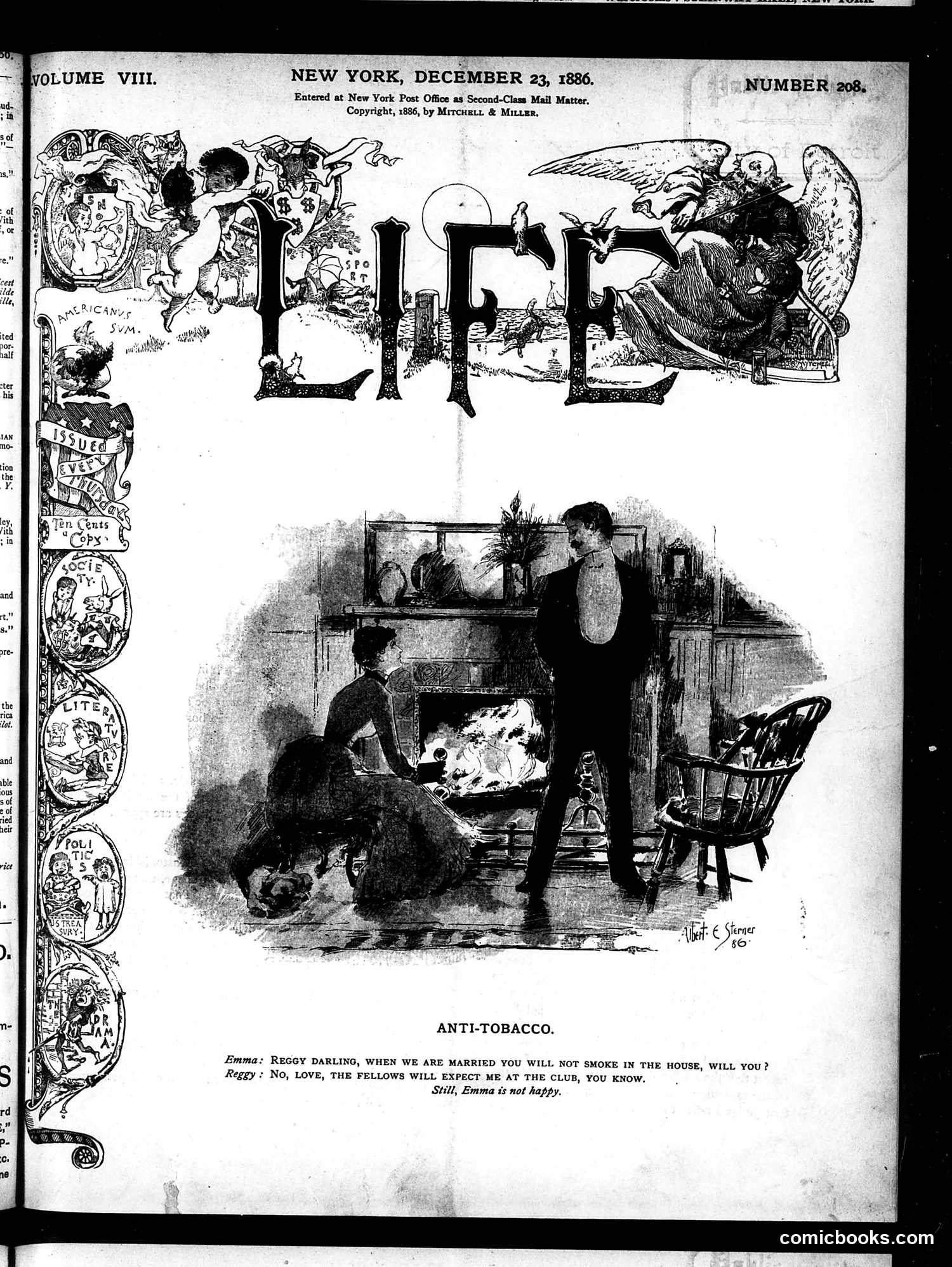
This 1886 *Life* magazine cartoon satirizes anti-smoking campaigns through domestic conflict. The titled caption "Anti-Tobacco" presents a marriage dispute: Emma demands her husband Reggy stop smoking in their home after marriage, threatening he'll be banished to his club. Reggy refuses, and the caption notes "Still, Emma is not happy." The satire mocks Victorian-era anti-tobacco movements, particularly efforts to restrict men's smoking habits. Rather than depicting tobacco's health dangers, the cartoon frames the issue as marital control—suggesting reformers are nagging spouses trying to police male behavior and leisure spaces. The joke assumes readers will sympathize with Reggy's resistance to domestic authority over his habits, ridiculing the temperance-style moral crusade as domestic meddling.
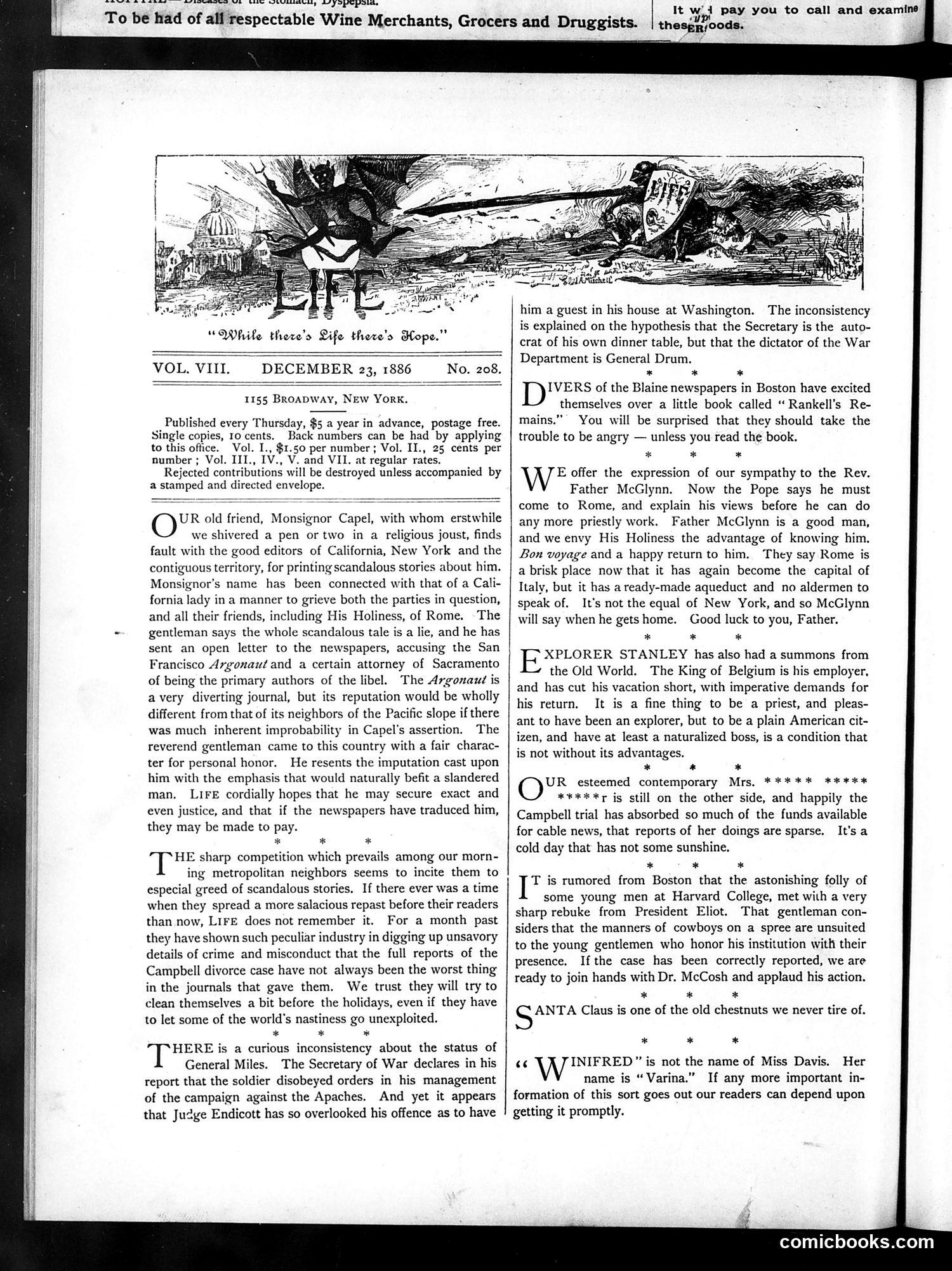
The main cartoon depicts a figure sitting beneath a large tree with the caption "While there's Life there's Hope." The tree appears gnarled and possibly diseased, suggesting decline or hardship. The image likely represents satirical commentary on American optimism during economic or political difficulties of the 1880s. The accompanying text discusses Monsignor Capel, a religious figure accused of spreading scandal about California society, and debates surrounding General Miles and Apache campaign management. There's also commentary on newspaper competition and sensationalism. The cartoon seems to critique the gap between hopeful rhetoric and difficult realities—a common satirical theme of the era. Without clearer visual details of specific figures or caricatures, the exact political targets remain somewhat unclear.
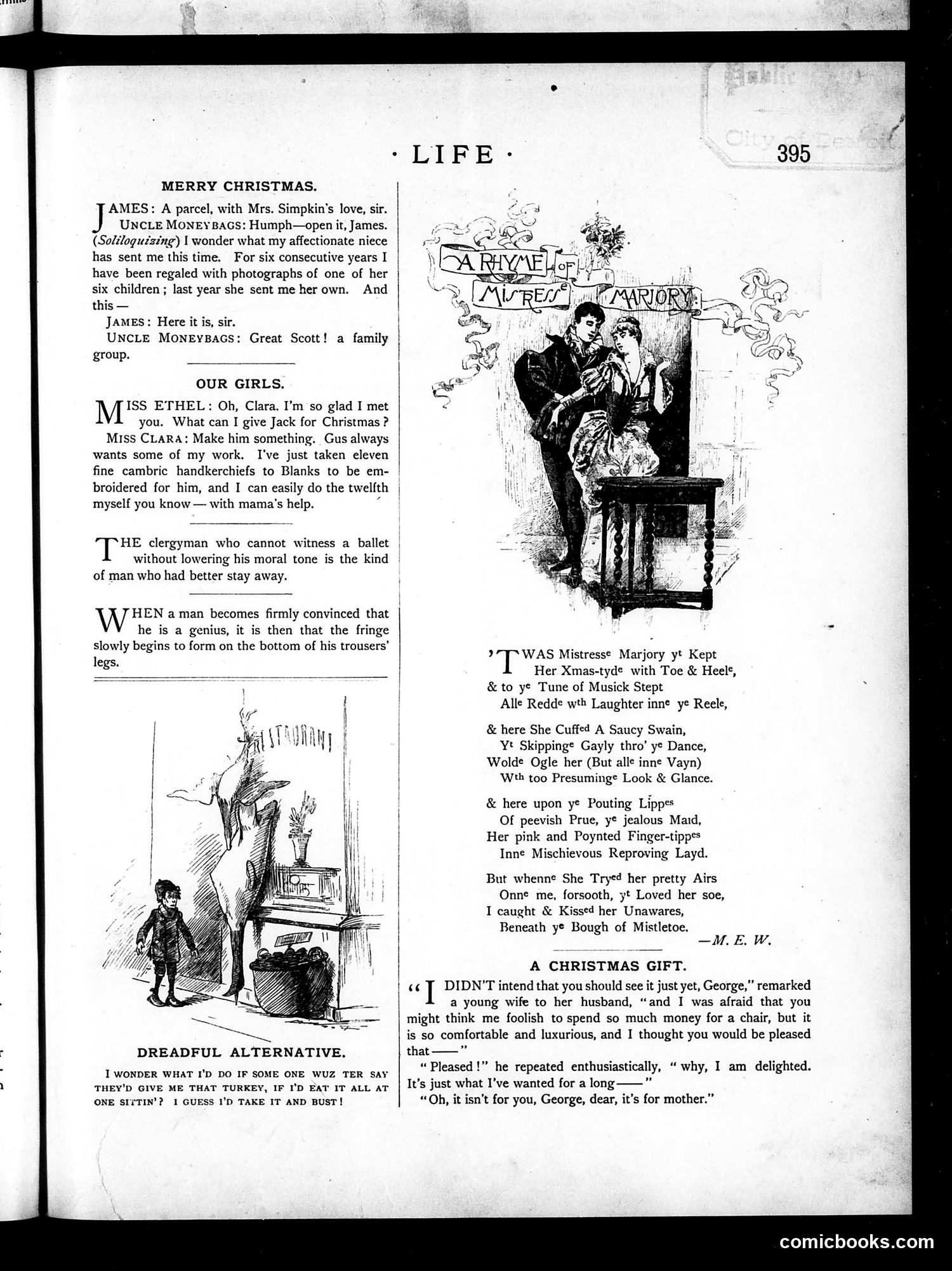
This page contains **Christmas-themed humorous sketches and verse**, not political cartoons. The content includes: **"Merry Christmas"** — A dialogue where James receives a large family portrait from his niece, prompting Uncle Moneybags's amazed reaction to the size of the family. **"Our Girls"** — Dialogue between Miss Ethel and Miss Clara about Christmas gifts, including handkerchief embroidery. **Two satirical observations** about men's vanity and moral decline. **"A Rhyme of Mistress Marjory"** — A period-style verse (with archaic spelling) about a woman's Christmas behavior and romantic encounters, ending with "—M.E.W." **"A Christmas Gift"** — A short story about a wife giving her husband an expensive chair, revealing it's actually for his mother. These are gentle domestic satires typical of Victorian-era Life magazine humor, not political commentary.
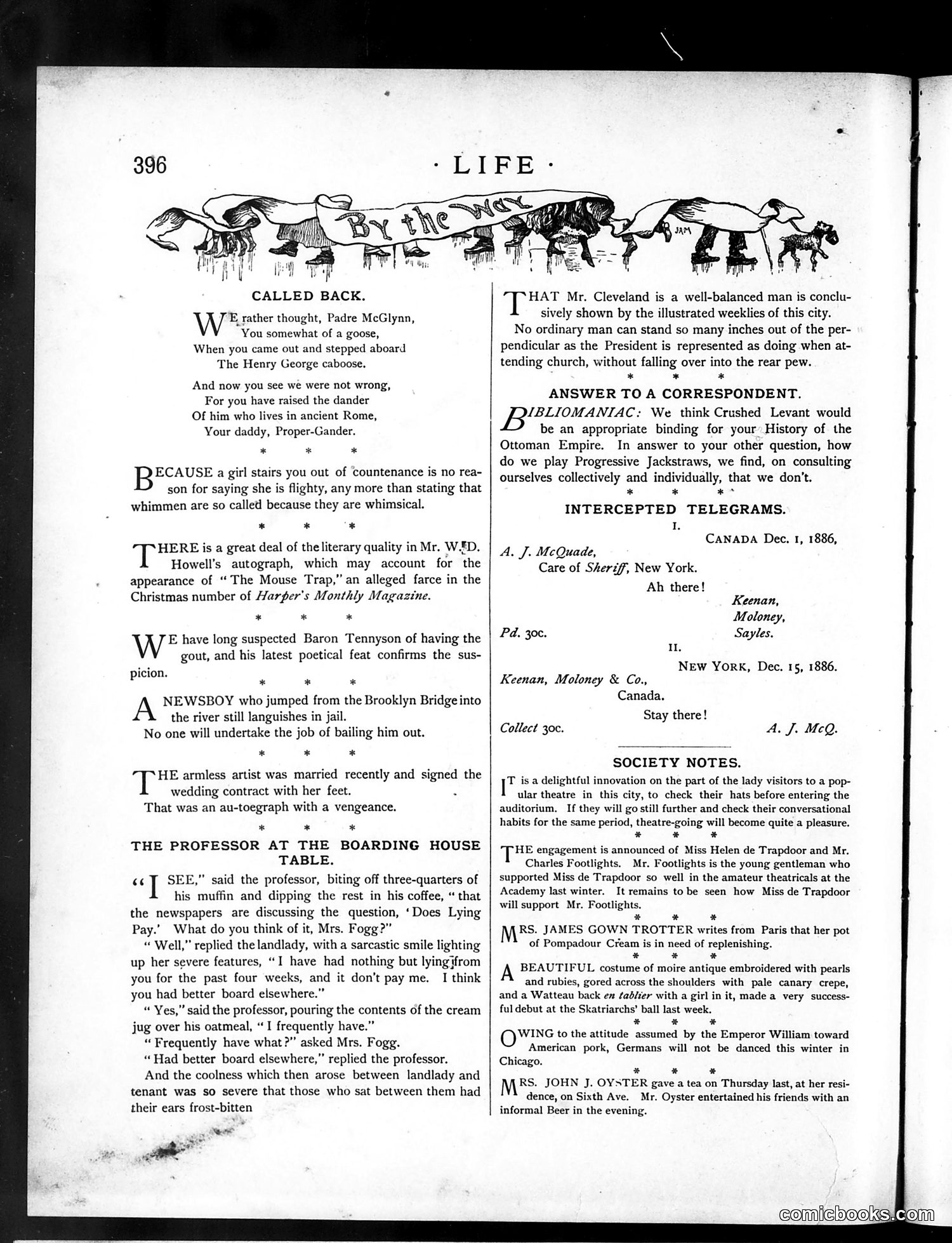
The top cartoon "By the Way" shows a series of caricatured figures in exaggerated poses, but the specific identities and satirical targets are unclear from the image alone. The main text content consists of humorous social commentary and gossip items rather than political satire. "Called Back" critiques Padre McGlynn (a Catholic priest involved in land-reform controversies). Other items mock contemporary figures like Baron Tennyson, reference a Brooklyn Bridge suicide attempt, and comment on theatrical society. "Intercepted Telegrams" presents fake messages in comedic style, typical of Life's satirical format. The "Society Notes" section reports on theater attendance habits and engagement announcements among the wealthy. This appears to be a **society/gossip page** rather than overtly political commentary—Life often mixed social satire with cultural criticism of the upper classes.
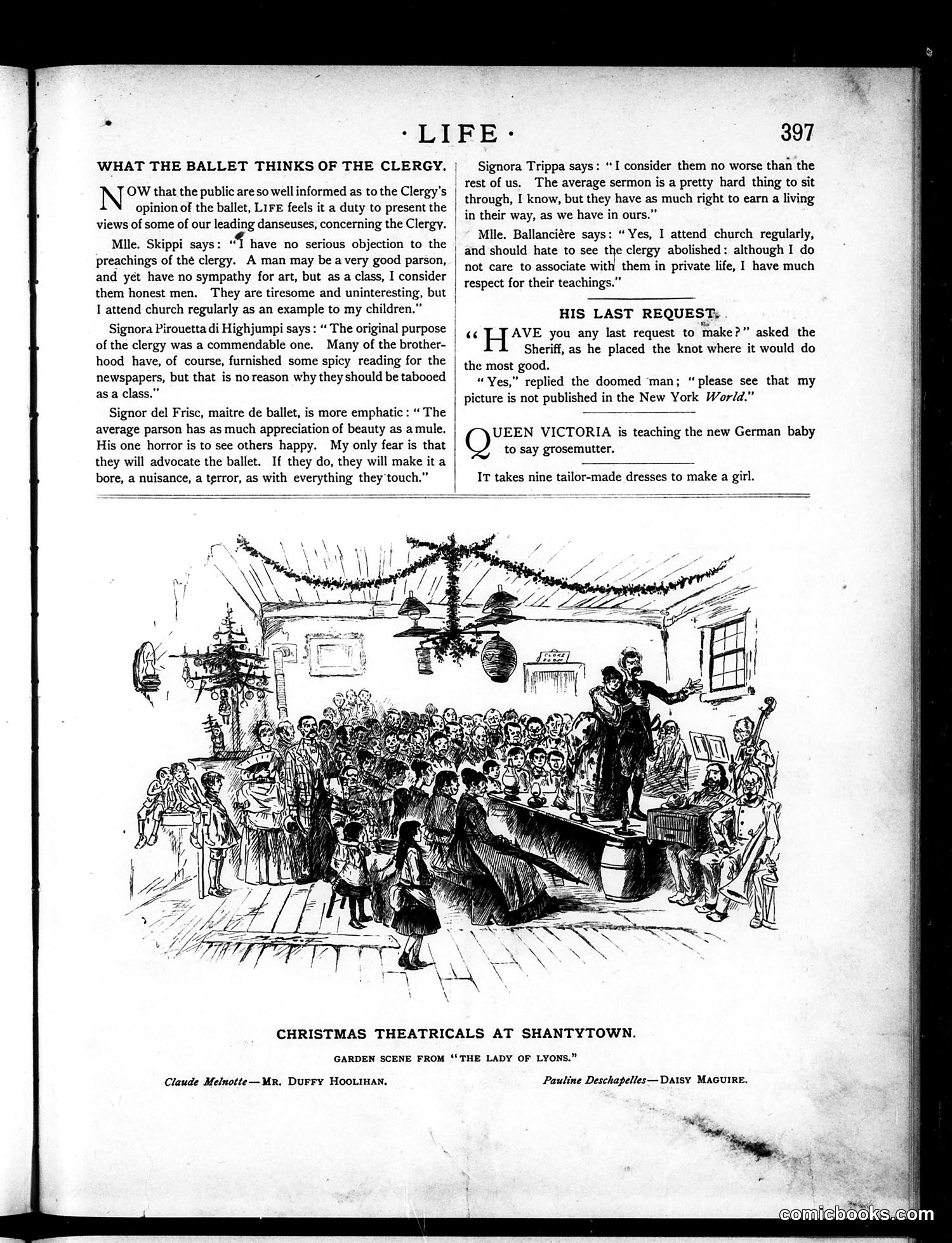
This page from *Life* magazine contains satirical commentary on the clergy and a theatrical illustration, rather than political cartoons. The text section "What the Ballet Thinks of the Clergy" presents quotes from dancers criticizing priests. Signora Trippa and others argue clergy work hard and deserve respect, while Signer de Frisc contends the "average person has as much appreciation of beauty as a mule" and fears clergy will ruin ballet if they advocate for it. The large illustration below depicts "Christmas Theatricals at Shantytown," showing a crowded indoor theatrical performance from "The Lady of Lyons," with actors on a raised platform. The scene satirizes amateur theatrical productions, likely mocking poorly-staged Christmas performances in working-class neighborhoods. The page blends social commentary on class, religion, and entertainment.
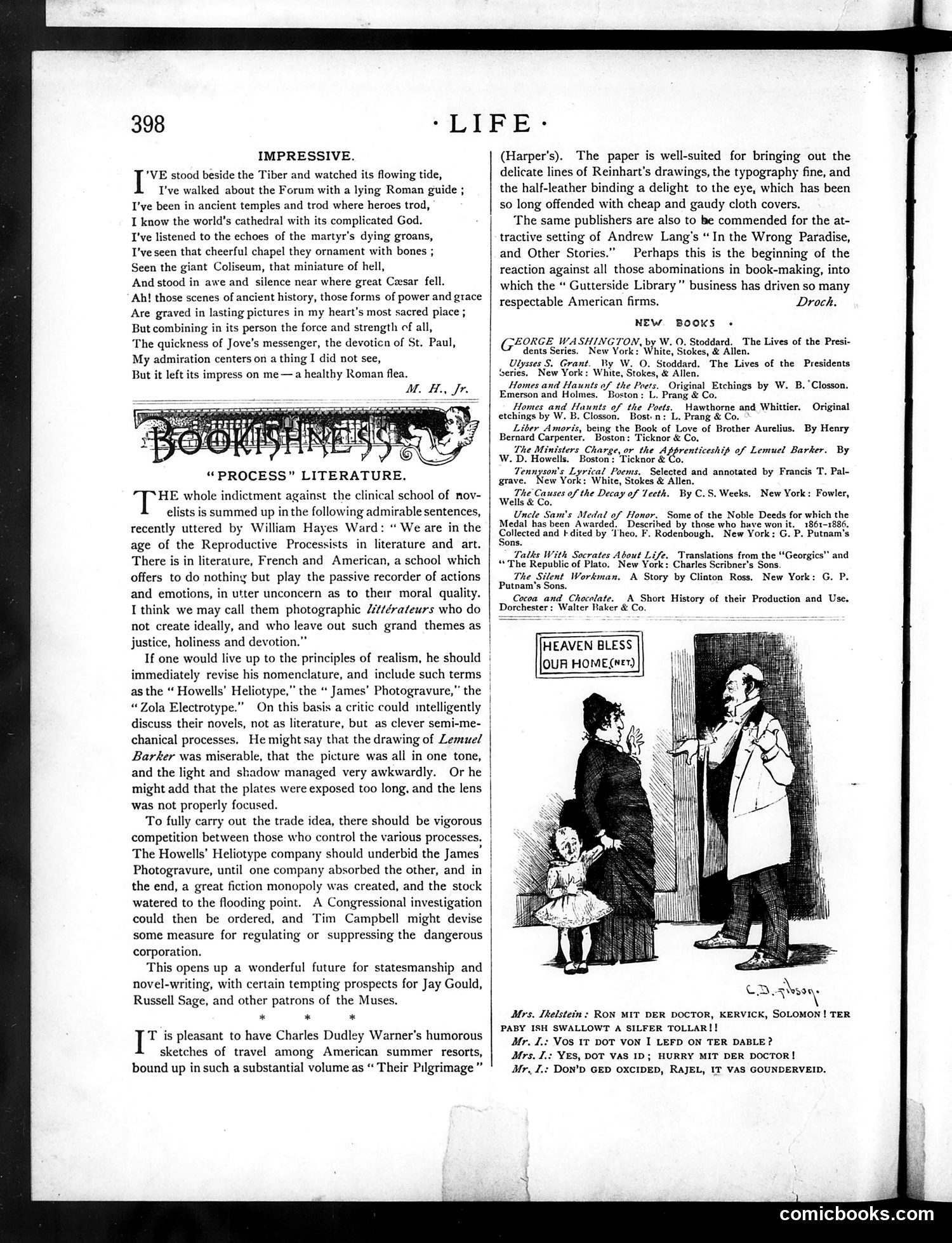
This cartoon depicts a domestic scene with satirical captions in what appears to be German or a Germanic dialect. A woman and child are greeting a man at a doorway, with the woman saying something like "Ron mit der doctor" (roughly "Ron with the doctor"). The humor appears to target domestic life and possibly immigrant or working-class family dynamics of the early 20th century. The exaggerated dialect in the caption suggests satire aimed at German-American households—a common target of American humor magazines during this period. The title "Heaven Bless Our Home(s)" ironically frames the domestic scene, suggesting the cartoon mocks either the sentimentality of home life or specific contemporary social conditions affecting American families. Without additional historical context about the specific date and Life magazine's editorial stance, the precise target remains somewhat unclear.
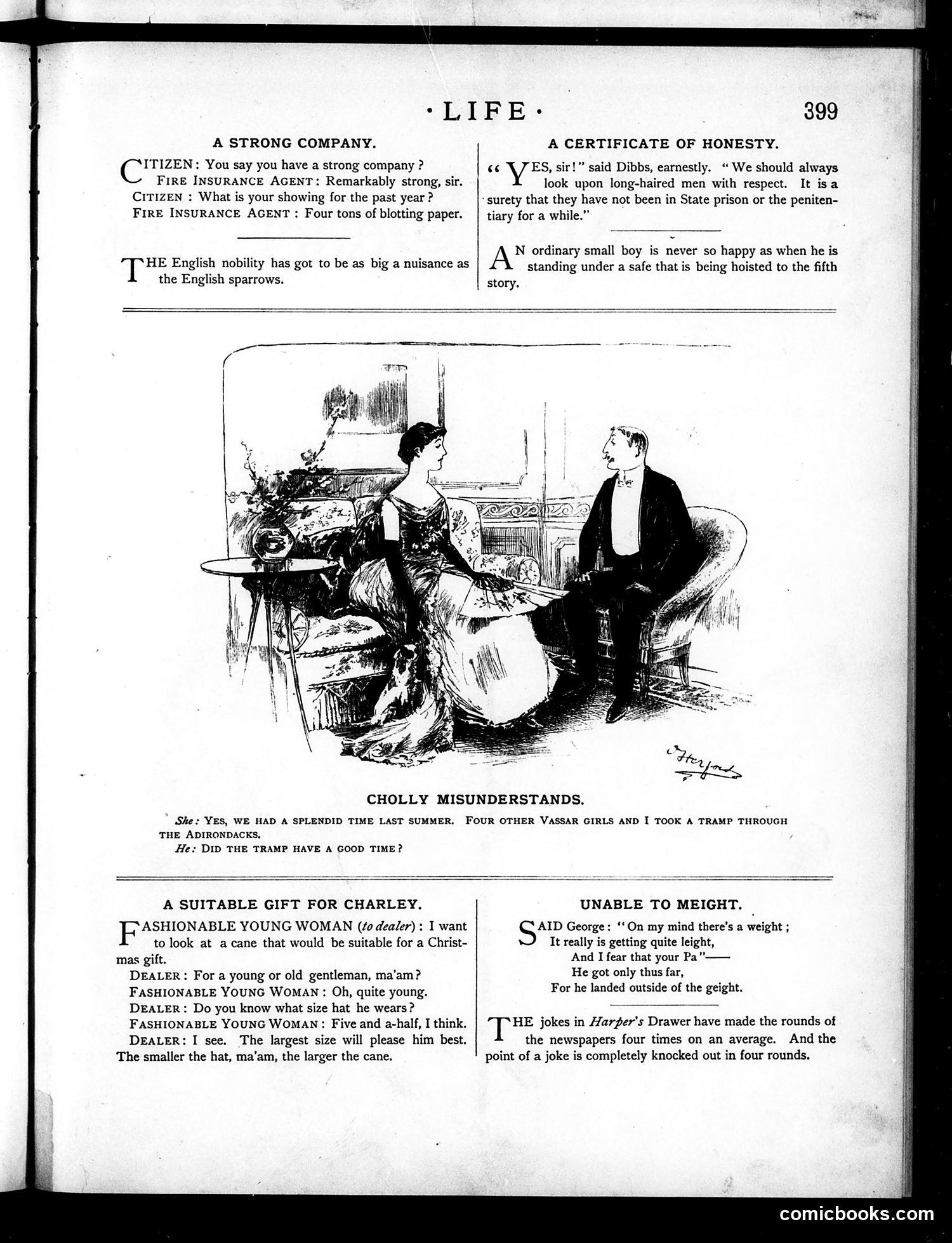
This page contains several brief satirical items typical of early Life magazine's humor: **"A Strong Company"** mocks fire insurance agents' exaggerated claims—four tons of blotting paper supposedly represents financial strength. **"The English Nobility"** compares English aristocrats unfavorably to sparrows, suggesting they're equally bothersome. **"Cholly Misunderstands"** features a woman describing a summer outing with Vassar girls and "a tramp" through the Adirondacks; a man misinterprets "tramp" as a vagrant rather than a hiking trip. **"A Suitable Gift for Charley"** jokes about buying a hat for a young man, playing on the old saying that smaller hats require larger canes—absurdist humor about male fashion accessories. The page's humor relies on wordplay, class commentary, and social observation typical of early 20th-century American satire.
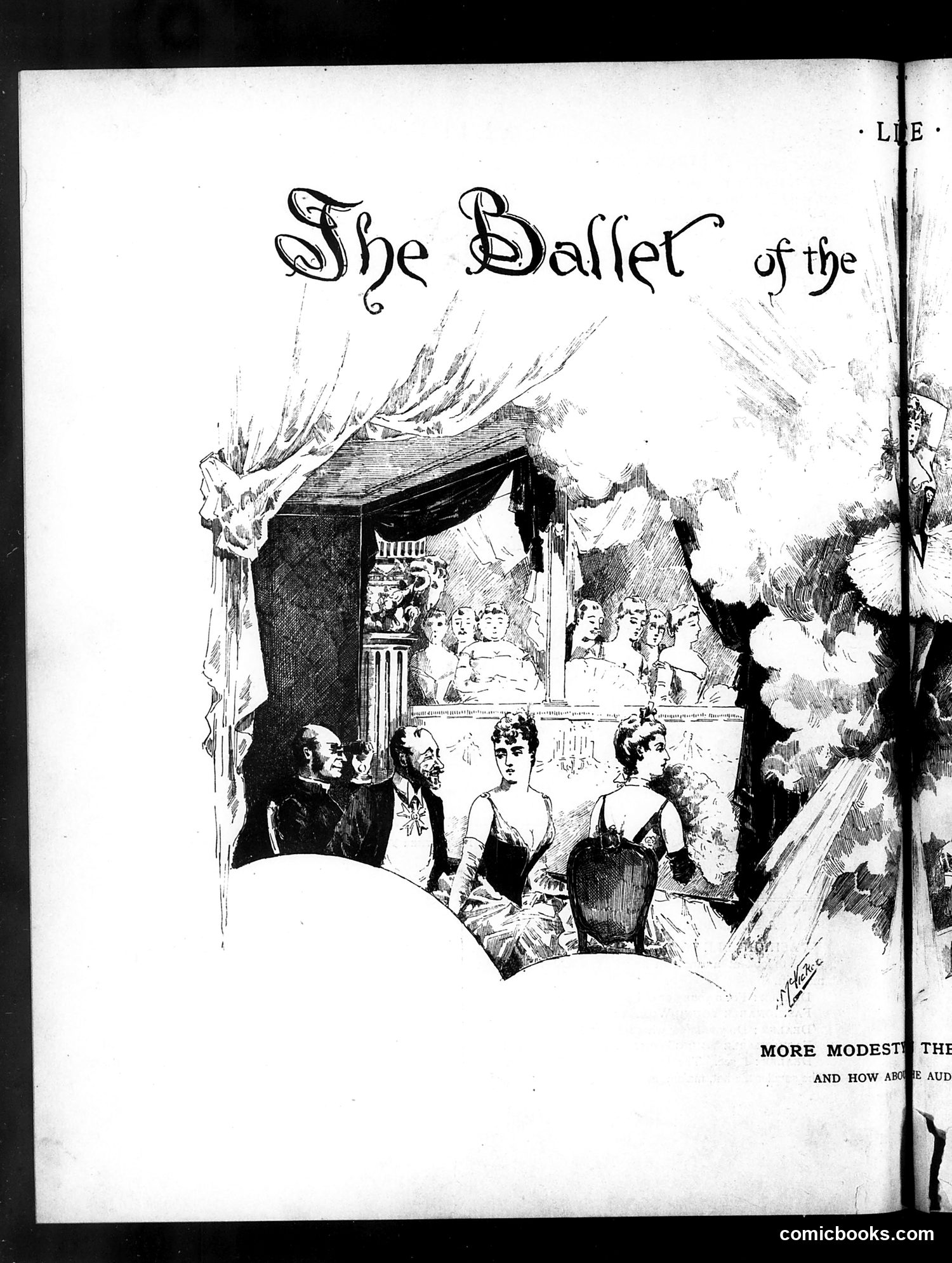
This appears to be a title page or section opener for *Life* magazine featuring a satirical illustration about theater or performance. The sketch shows several elegantly dressed figures (appears to be men in formal wear and women in evening gowns) viewing what looks like a theatrical performance or ballet from a box seat. The ornate theater setting and fashionable audience suggest satire about high society's pretensions regarding the arts. The partial text at bottom ("MORE MODESTY THE" and "AND HOW ABOUT AUDI") is incomplete, but likely continues the satirical commentary. Without the full article text or date, the specific social critique remains unclear—though the image suggests mockery of fashionable society attending cultural performances, possibly questioning their genuine appreciation or aesthetic judgment.
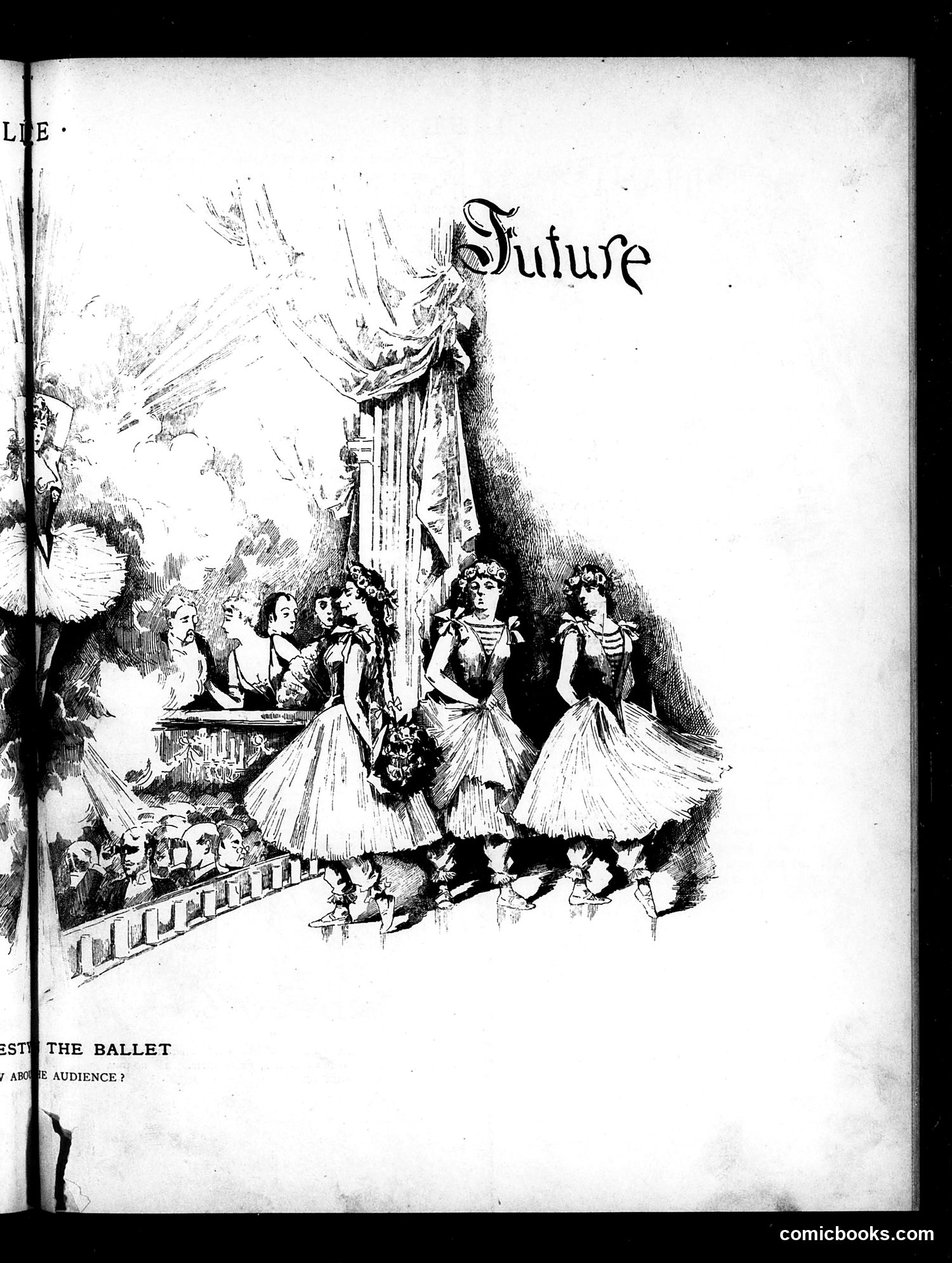
This page appears to be a title page or section break for *Life* magazine featuring an illustration labeled "Future" with a theatrical ballet scene. The image shows female dancers in tutus performing on stage, with an audience visible below and what appears to be an allegorical or symbolic female figure presiding above them. The visible text references "THE BALLET" and mentions "AUDIENCE," though the full context is unclear from this fragment. Without additional context or dates, I cannot definitively identify which specific ballet or theatrical event this satirizes, nor can I determine what political or social commentary it intends. It likely comments on contemporary theater or cultural trends of the era, but the specific reference remains uncertain.
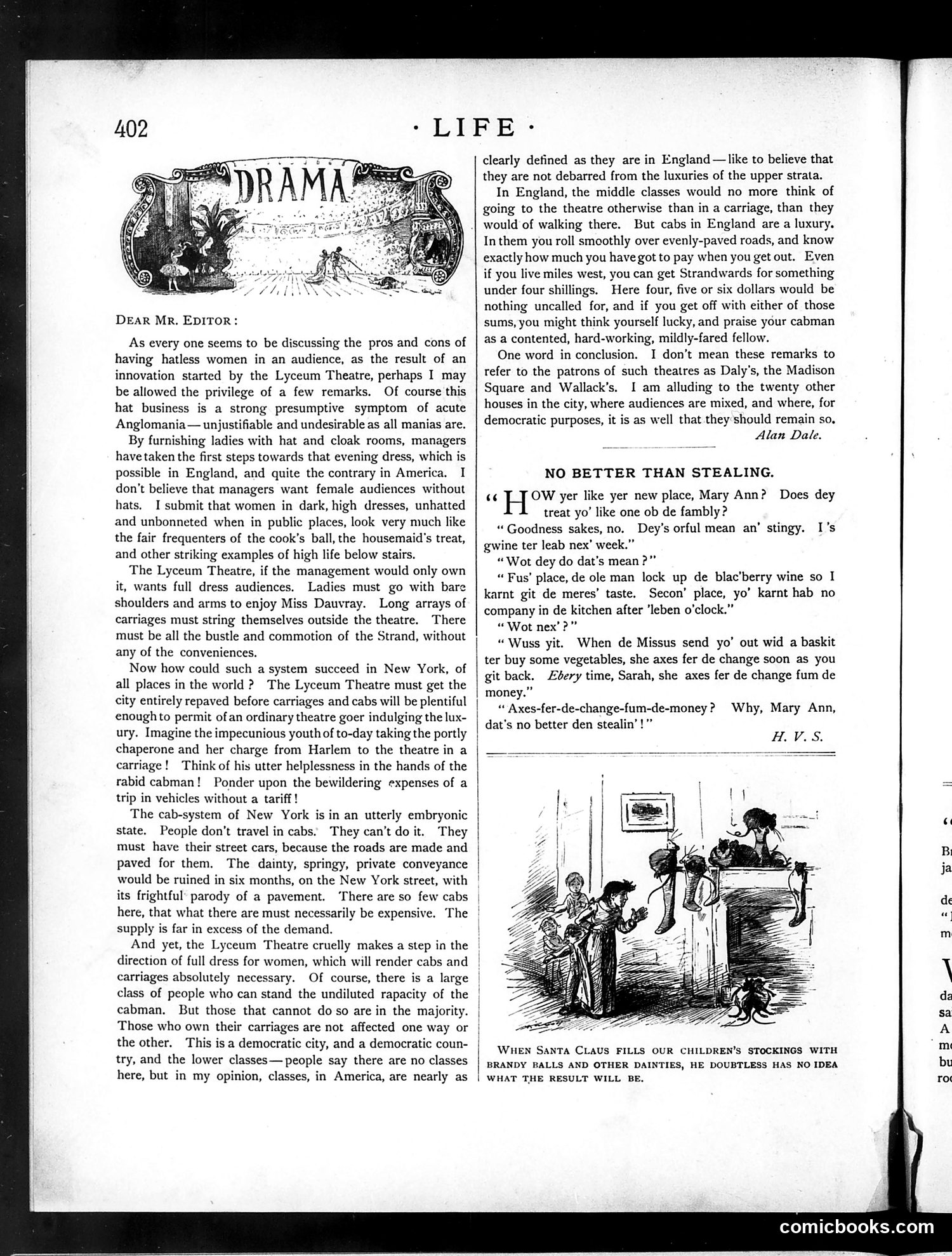
This page contains two distinct sections: **Left Column:** A letter to the editor debating the Lyceum Theatre's new dress code requiring women to attend in full formal dress. The writer argues this is impractical and unnecessary—contrasting English theater customs with American ones. He criticizes the expense and inconvenience, suggesting the policy will backfire and hurt attendance. **Right Section:** A humorous dialogue titled "No Better Than Stealing" depicting working-class domestic servants discussing their employer's expectations around household management and errand-running. The illustration shows two women in a kitchen, with their exchange satirizing the penny-pinching attitude of middle-class employers toward their hired help. Both pieces address class dynamics and social expectations in turn-of-century America through criticism of impractical or exploitative practices.
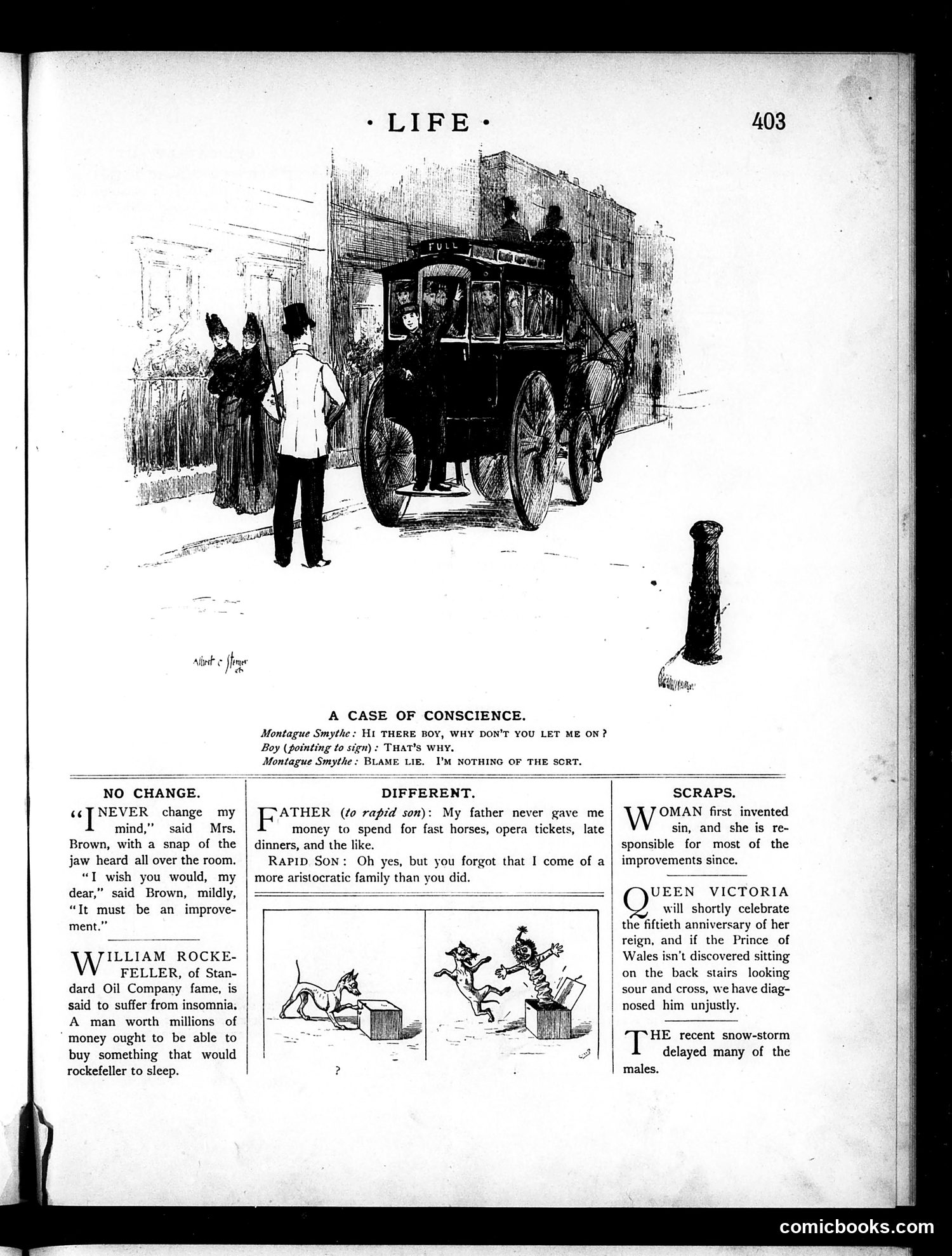
This page contains three unrelated humorous pieces typical of Life's satirical format: **"A Case of Conscience"** (top): A boy refuses entry to a well-dressed man (Montague Smythe), pointing to a sign. Smythe claims he's "nothing of the sort"—likely responding to an accusation of dishonesty or impropriety. The joke hinges on his defensive denial. **Three brief satirical items** (bottom sections): - **"No Change"**: A domestic joke about Mrs. Brown's stubbornness; her husband suggests her inflexibility is itself a flaw. - **"Different"**: A father and son debate family status. The son boasts of superior aristocratic lineage despite his father's moral superiority—mocking nouveau riche pretension. - **"Scraps"**: Misogynist humor crediting women with inventing sin and "improvements" (euphemism for moral corruption). Additional items reference William Rockefeller's insomnia (mocking the wealthy) and Queen Victoria's reign. These are light, society-page jokes with no deep political meaning—representative of Life's middle-class humor circa the 1890s.
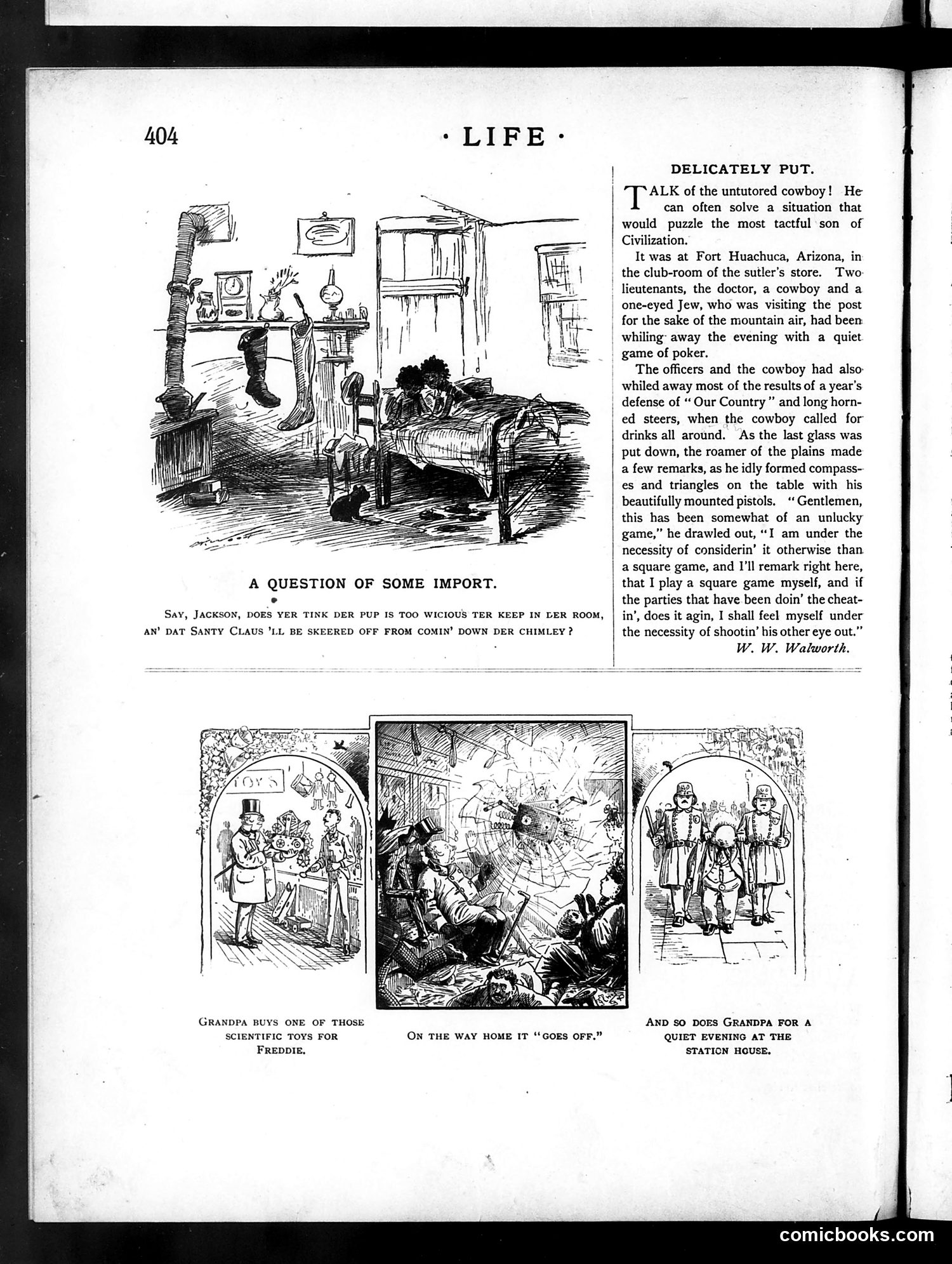
This page contains two distinct pieces of satirical humor: **Top story "Delicately Put"** (by W.W. Walworth): A narrative joke about a cowboy's blunt diplomacy. At Fort Huachuca, Arizona, during a poker game with military officers and a visiting Jewish man, the cowboy accuses someone of cheating. Rather than tactfully addressing the accusation, he threatens to shoot out the cheater's "other eye"—a crude but effective deterrent. The satire contrasts the cowboy's unsophisticated but practical directness with the ineffectual politeness of "civilization." **Bottom cartoons**: Three sequential panels showing a grandfather buying toys. The humor appears to involve toys that malfunction or explode ("goes off"), resulting in the grandfather spending a "quiet evening at the station house" (jail)—suggesting the malfunctioning toy causes legal trouble or property damage. The page satirizes both frontier masculinity and modern toy safety through comedy.
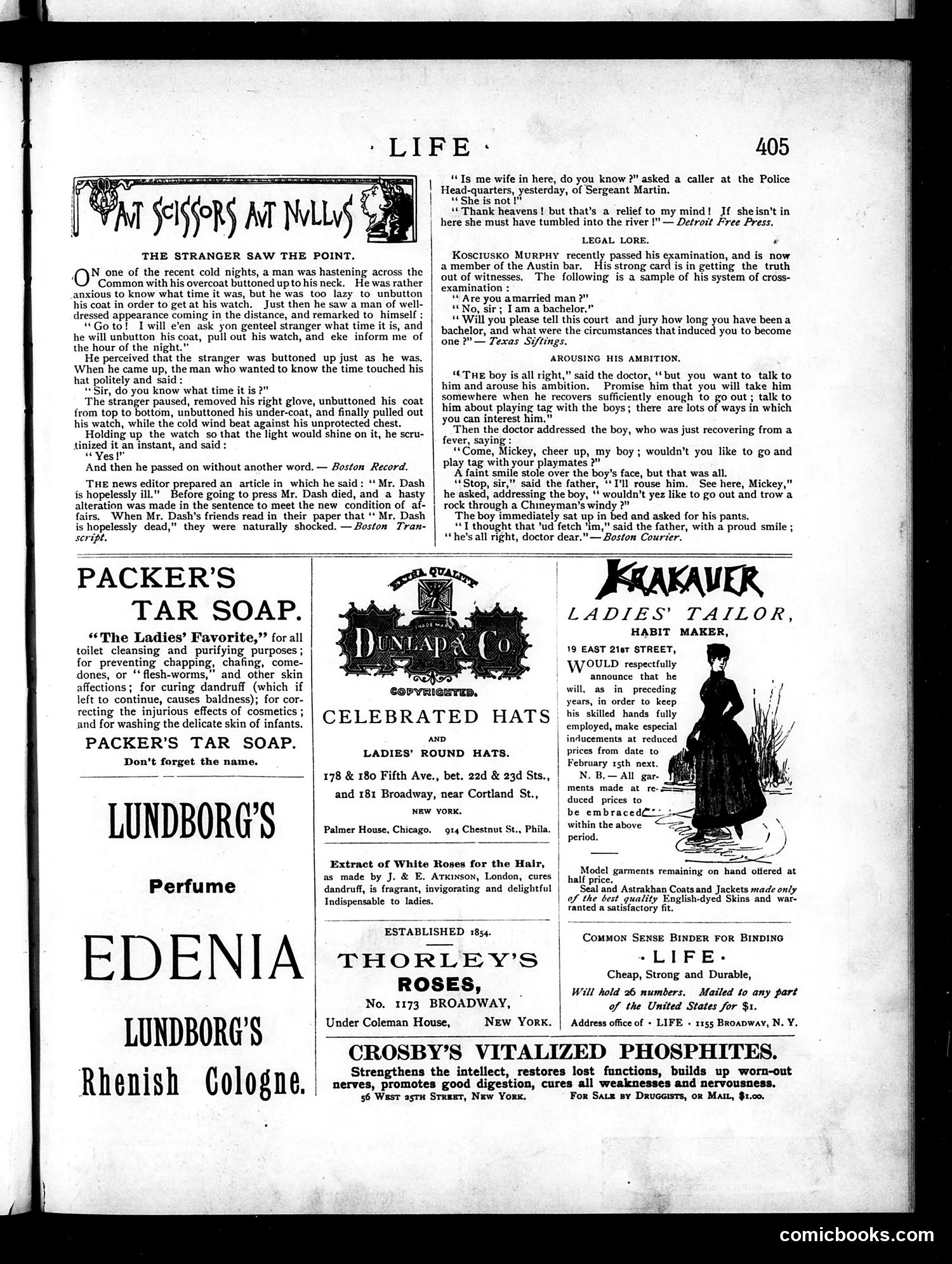
This page contains **humorous anecdotes** rather than political cartoons. The humor relies on wordplay, misunderstandings, and social observation typical of late-19th-century American magazines. **Key pieces:** 1. **"The Stranger Saw the Point"**: A joke about a man who asks for the time; the stranger goes through elaborate effort (removing gloves, unbuttoning multiple coats in cold) just to say "Yes"—the anticlimax being the obvious punchline. 2. **Newspaper editing error**: A proofreader's mistake transforms "Mr. Dash is hopelessly ill" to "Mr. Dash is hopelessly dead" after his actual death—dark humor about editorial mishaps. 3. **Police station joke**: A visitor asks if his wife is at the station; relieved she's not, he jokes she must have drowned instead—dark domestic humor. 4. **"Arousing His Ambition"**: A doctor suggests moral incentives to motivate a sick boy; the father succeeds by promising he can throw rocks through a Chinese immigrant's window—satirizing ethnic prejudice while presenting it as practical child psychology. The rest is **advertising** for period products (soaps, perfumes, hats, tonics).
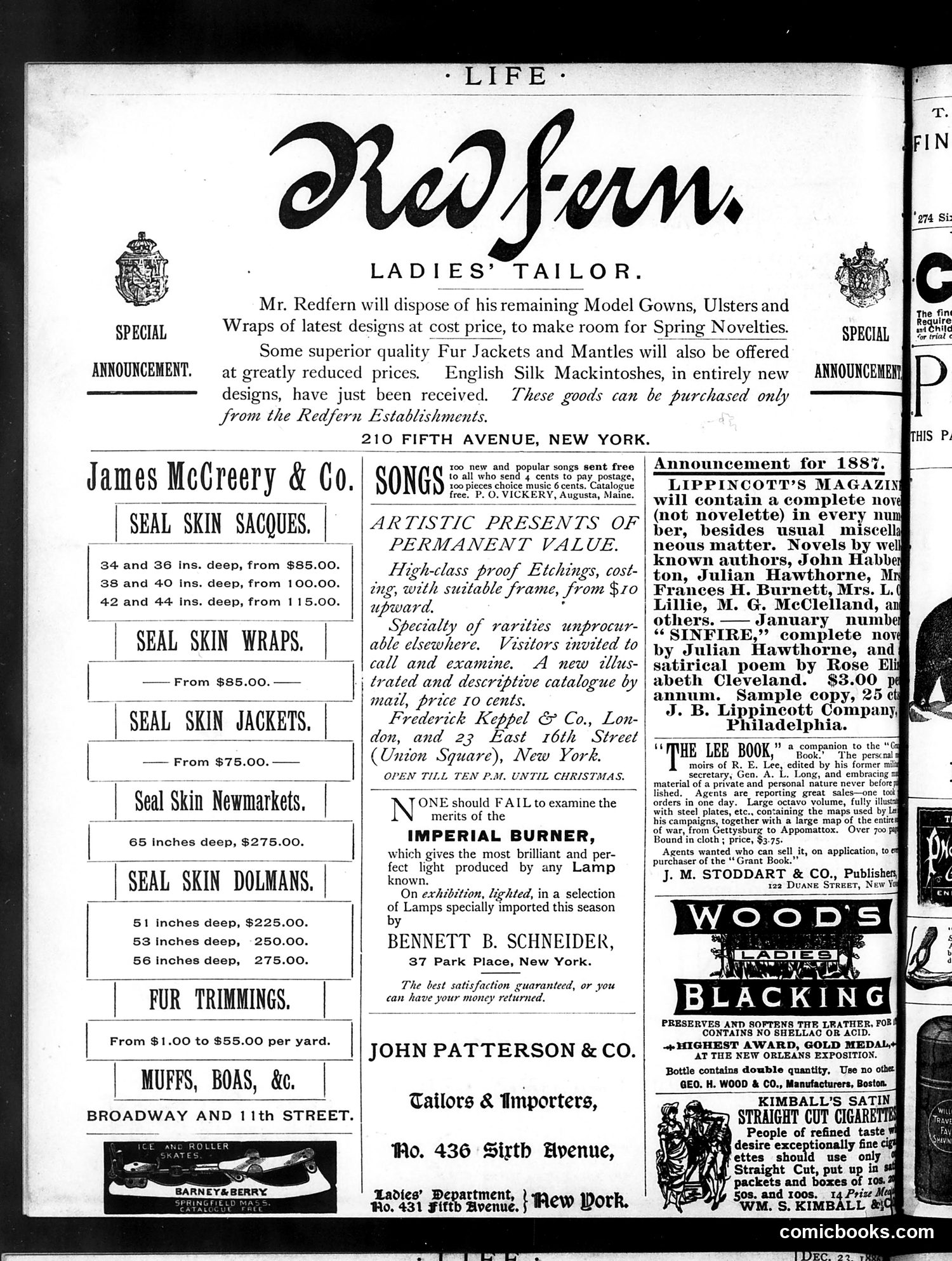
This page is **primarily advertising**, not political satire or editorial content. It's from *Life's* December 23, 1886 issue. The bulk of the page consists of luxury retail advertisements targeting wealthy women, particularly for: - **Red Fern** (ladies' tailor on Fifth Avenue) advertising designer gowns and fur coats - **James McCreery & Co.** selling seal-skin fashion items (sacques, wraps, jackets, newmarkets, dolmans) with prices ranging $75–$275 - **John Patterson & Co.** offering tailoring services - Various publishers advertising gift books for the 1887 holiday season The seal-skin fur products are particularly prominent—these represented expensive status symbols for affluent Gilded Age women. There are no visible political cartoons or satirical commentary on this page. It appears to be a typical *Life* magazine advertising section designed to appeal to the magazine's wealthy urban readership.
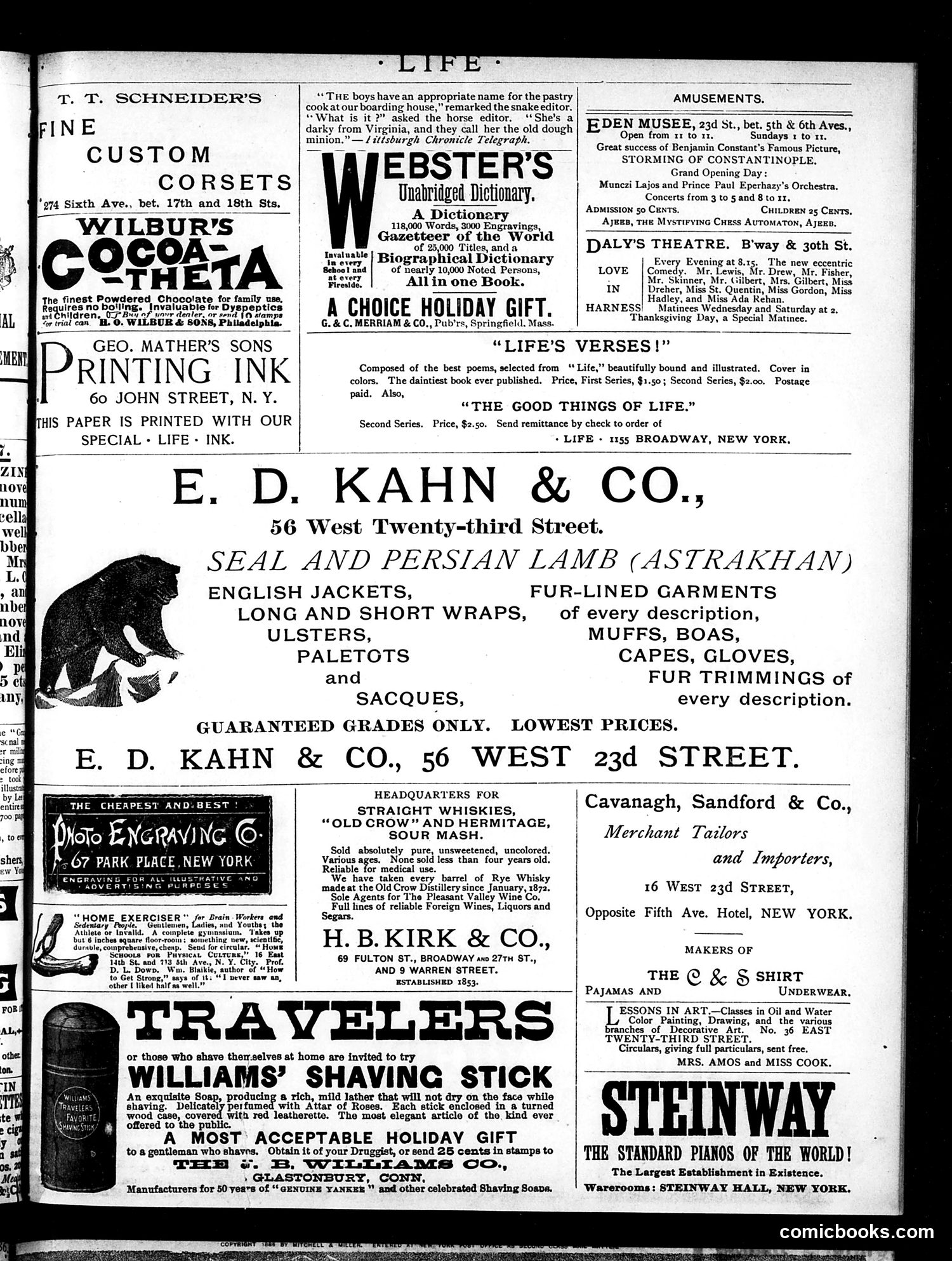
This page is primarily **advertising**, with minimal editorial content. The single notable item is a brief joke at the top: A boarding house cook is nicknamed "the old dough" because she's described as a "darky from Virginia." This reflects the racist humor typical of the 1880s-90s era—the "joke" relies on a dehumanizing racial stereotype and a crude pun on her name/role. The remainder of the page consists entirely of commercial advertisements for luxury goods (furs, corsets, printing ink, pianos, shaving products) and cultural venues (Eden Musee, Daly's Theatre), aimed at upper-class readers. **Historical context**: This appears from *Life*'s satirical heyday, when the magazine mixed social commentary with genteel advertising. The casual racism in the joke reflects period attitudes without satire or critique—it's presented as straightforward entertainment.
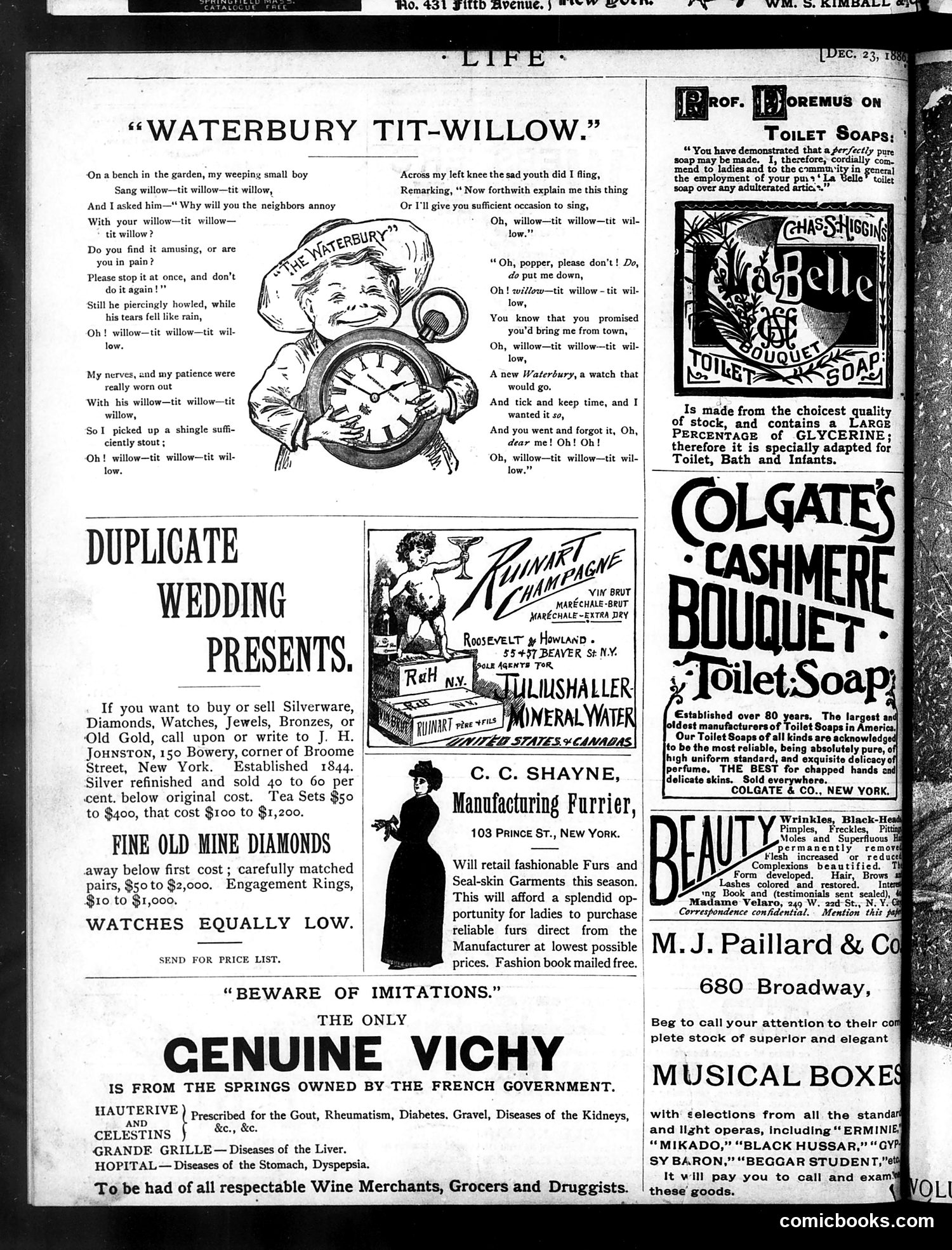
This is primarily a **parody poem with illustration**, not political satire. It mimics the Gilbert & Sullivan song "Tit-Willow" from *The Mikado* (1885), substituting a father's frustration with his crying son who won't stop whining about a forgotten Waterbury watch. The joke is domestic humor: the exasperated parent threatens corporal punishment ("I'll give you sufficient occasion to sing"), the child keeps wailing "willow—tit willow—tit willow," and the punchline involves the broken promise of a cheap watch. **The context modern readers miss**: *Waterbury* was a famous affordable American watch brand, making this a mild product placement joke. The repetitive "willow" refrain mimics the famous operetta, creating humor through recognition and incongruity—applying high-art music to low-brow parental discipline. The rest of the page is advertisements for jewelry, furs, champagne, and beauty products.
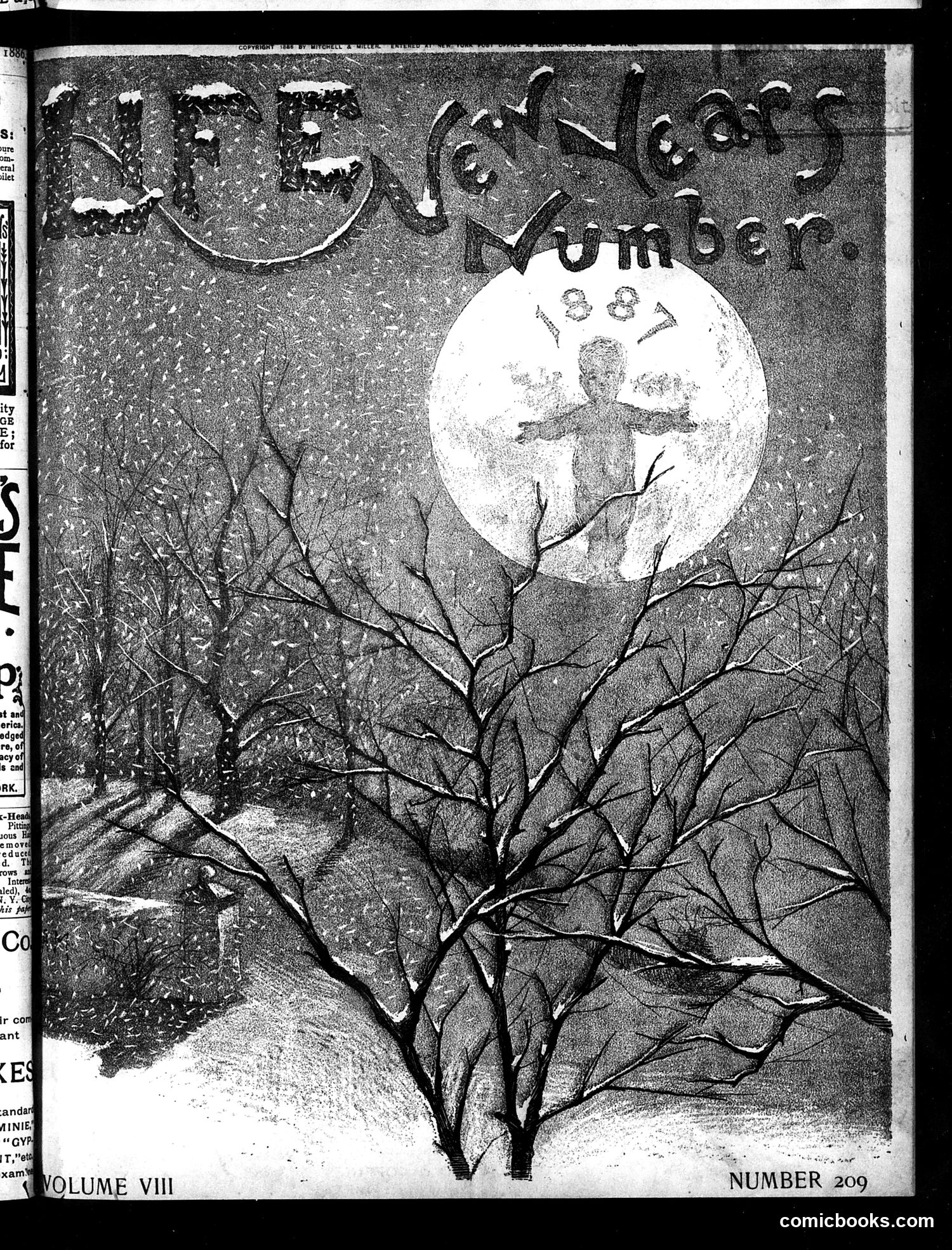
This appears to be a cover or illustration from *Life* magazine (Volume VIII, Number 209). The image depicts a bare, gnarled tree silhouetted against a large full moon in a nighttime landscape. A figure—appearing ghostly or skeletal—stands within or emerges from the moon itself, with arms outstretched. The text at the top reads "Life's Grumbler" (partially legible), suggesting this illustrates a humorous or satirical piece about someone complaining or grieving. The skeletal/death imagery combined with the bare winter tree creates a melancholic or gothic mood, likely used to humorously personify autumn/winter complaints or social grievances of the era. Without clearer OCR of the headline or additional context, the specific satirical target remains unclear, though the aesthetic suggests commentary on seasonal melancholy or human complaint.
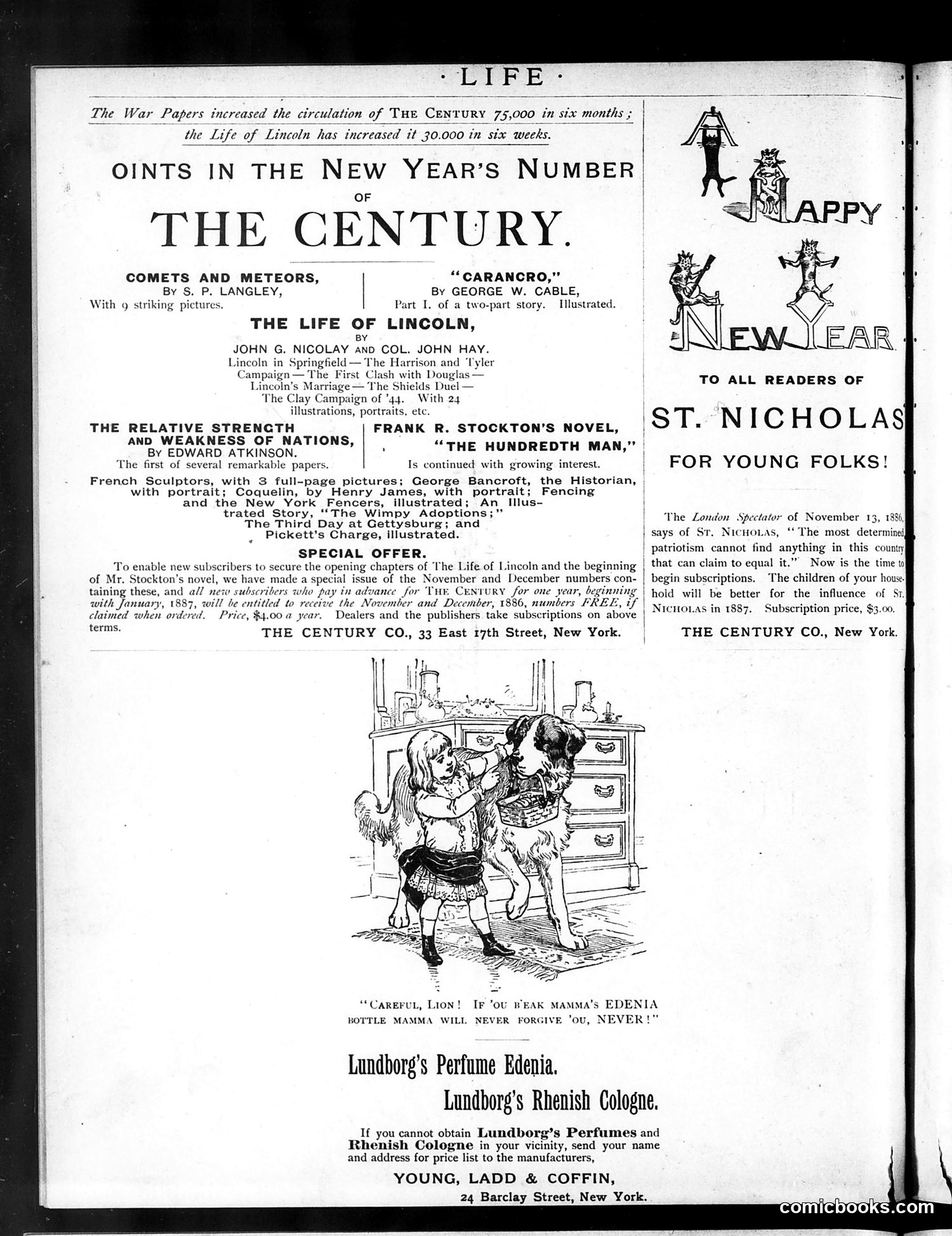
This is primarily a **table of contents and advertisement page** for *The Century* magazine's New Year's issue, with a small cartoon advertisement at bottom. The main cartoon shows a **child warning a lion** not to break a bottle of "Mamma's Edenia" perfume, threatening that "Mamma will never forgive 'ou, NEVER!" This is an advertisement for **Lundborg's Perfume Edenia** and Rhenish Cologne. The humor relies on the exaggerated threat a child makes to a dangerous wild animal—treating the perfume bottle as more precious and fearful than the lion itself. It's a humorous overstatement meant to appeal to mothers by suggesting the perfume's value and desirability. The cartoon uses a child's innocent logic as comedic contrast to the absurd scenario. The page's bulk announces upcoming *Century* content including Lincoln biography articles and serialized fiction—positioning the magazine as serious and culturally significant despite the lighthearted advertising.