
Life, 1886-12-23 · page 10 of 18
Life — December 23, 1886 — page 10: what you’re looking at
What you’re looking at
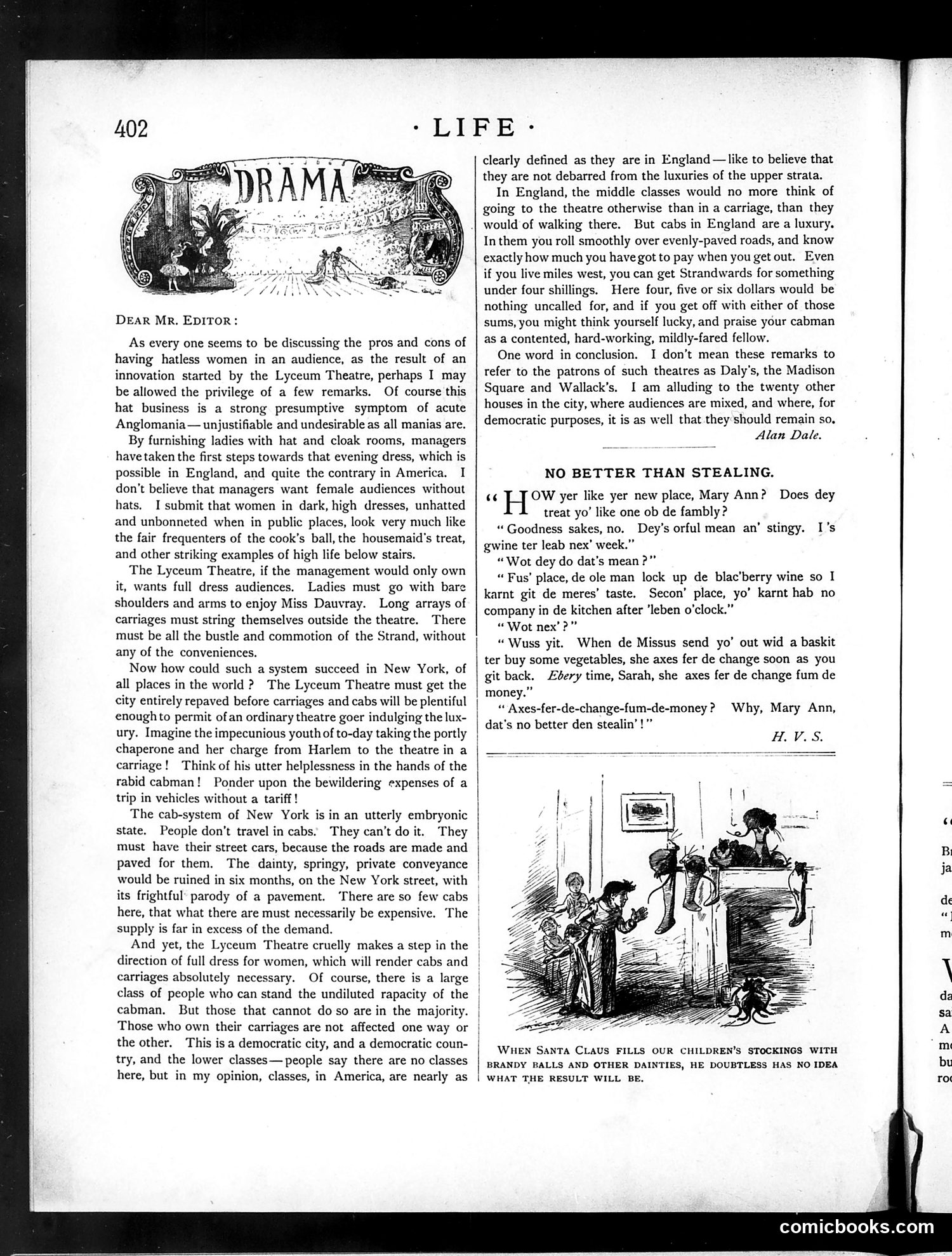
This page contains two distinct sections: **Left Column:** A letter to the editor debating the Lyceum Theatre's new dress code requiring women to attend in full formal dress. The writer argues this is impractical and unnecessary—contrasting English theater customs with American ones. He criticizes the expense and inconvenience, suggesting the policy will backfire and hurt attendance. **Right Section:** A humorous dialogue titled "No Better Than Stealing" depicting working-class domestic servants discussing their employer's expectations around household management and errand-running. The illustration shows two women in a kitchen, with their exchange satirizing the penny-pinching attitude of middle-class employers toward their hired help. Both pieces address class dynamics and social expectations in turn-of-century America through criticism of impractical or exploitative practices.
📄 Transcribed text from this page (OCR, searchable)
Machine-transcribed from the original scan — historical spelling and the odd misread are preserved.
- LIFE: DEAR MR. EDITOR: As every one seems to be discussing the pros and cons of having hatless women in an audience, as the result of an innovation started by the Lyceum Theatre, perhaps I may be allowed the privilege of a few remarks. Of course this hat business is a strong presumptive symptom of acute Anglomania— unjustifiable and undesirable as all manias are. By furnishing ladies with hat and cloak rooms, managers havetaken the first steps towards that evening dress, which is possible in England, and quite the contrary in America. I don’t believe that managers want female audiences without hats. I submit that women in dark, high dresses, unhatted and unbonneted when in public places, look very much like the fair frequenters of the cook’s ball, the housemaid's treat, and other striking examples of high life below stairs. The Lyceum Theatre, if the management would only own it, wants full dress audiences. Ladies must go with bare shoulders and arms to enjoy Miss Dauvray. Long arrays of carriages must string themselves outside the theatre. There must be all the bustle and commotion of the Strand, without any of the conveniences. Now how could such a system succeed in New York, of all places in the world ? The Lyceum Theatre must get the city entirely repaved before carriages and cabs will be plentiful | enough to permit ofan ordinary theatre goer indulging the lux- | ury. Imagine the impecunious youth of to-day taking the portly chaperone and her charge from Harlem to the theatre in a | carriage! Think of his utter helplessness in the hands of the rabid cabman! Ponder upon the bewildering expenses of a trip in vehicles without a tariff! The cab-system of New York is in an utterly embryonic state. People don’t travel in cabs. They can’t do it. They must have their street cars, because the roads are made and paved for them. The dainty, springy, private conveyance | would be ruined in six months, on the New York street, with its frightful’ parody of a pavement. There are so few cabs | here, that what there are must necessarily be expensive. The | supply is far in excess of the demand. And yet, the Lyceum Theatre cruelly makes a step in the direction of full dress for women, which will render cabs and carriages absolutely necessary. Of course, there is a large class of people who can stand the undiluted rapacity of the | cabman. But those that cannot do so are in the majority. | Those who own their carriages are not affected one way or | the other. This isa democratic city, and a democratic coun- | try, and the lower classes— people say there are no classes clearly defined as they are in England —like to believe that they are not debarred from the luxuries of the upper strata. In England, the middle classes would no more think of going to the theatre otherwise than in a carriage, than they would of walking there. But cabs in England are a luxury. Inthem you roll smoothly over evenly-paved roads, and know exactly how much you have got to pay when you get out. Even if you live miles west, you can get Strandwards for something under four shillings. Here four, five or six dollars would be nothing uncalled for, and if you get off with either of those sums, you might think yourself lucky, and praise your cabman as a contented, hard-working, mildly-fared fellow. One word in conclusion. I don’t mean these remarks to refer to the patrons of such theatres as Daly's, the Madison Square and Wallack’s. I am alluding to the twenty other houses in the city, where audiences are mixed, and where, for democratic purposes, it is as well that they should remain so, Alan Dale. NO BETTER THAN STEALING. “ H™ yer like yer new place, Mary Ann? Does dey treat yo’ like one ob de fambly? “Goodness sakes, no. Dey’s orful mean an’ stingy. I's gwine ter leab nex’ week.” “Wot dey do dat’s mean?” “ Fus’ place, de ole man lock up de blac’berry wine so I karnt git de meres’ taste. Secon’ place, yo’ karnt hab no company in de kitchen after ‘leben o'clock.” “Wot nex’?” “Wuss yit. When de Missus send yo’ out wid a baskit ter buy some vegetables, she axes fer de change soon as you git back. Zéery time, Sarah, she axes fer de change fum de money.” “ Axes-fer-de-change-fum-de-money? Why, Mary Ann, dat’s no better den stealin’!”” ALV.S. WHEN SanNTA CLAUS FILLS OUR CHILDREN’S STOCKINGS WITH . | BRANDY BALLS AND OTHER DAINTIES, HE DOUBTLESS HAS NO IDEA here, but in my opinion, classes, in America, are nearly as | wHaT THE RESULT WILL BE. comicbooks.com