
A complete issue · 16 pages · 1886
Life — September 9, 1886
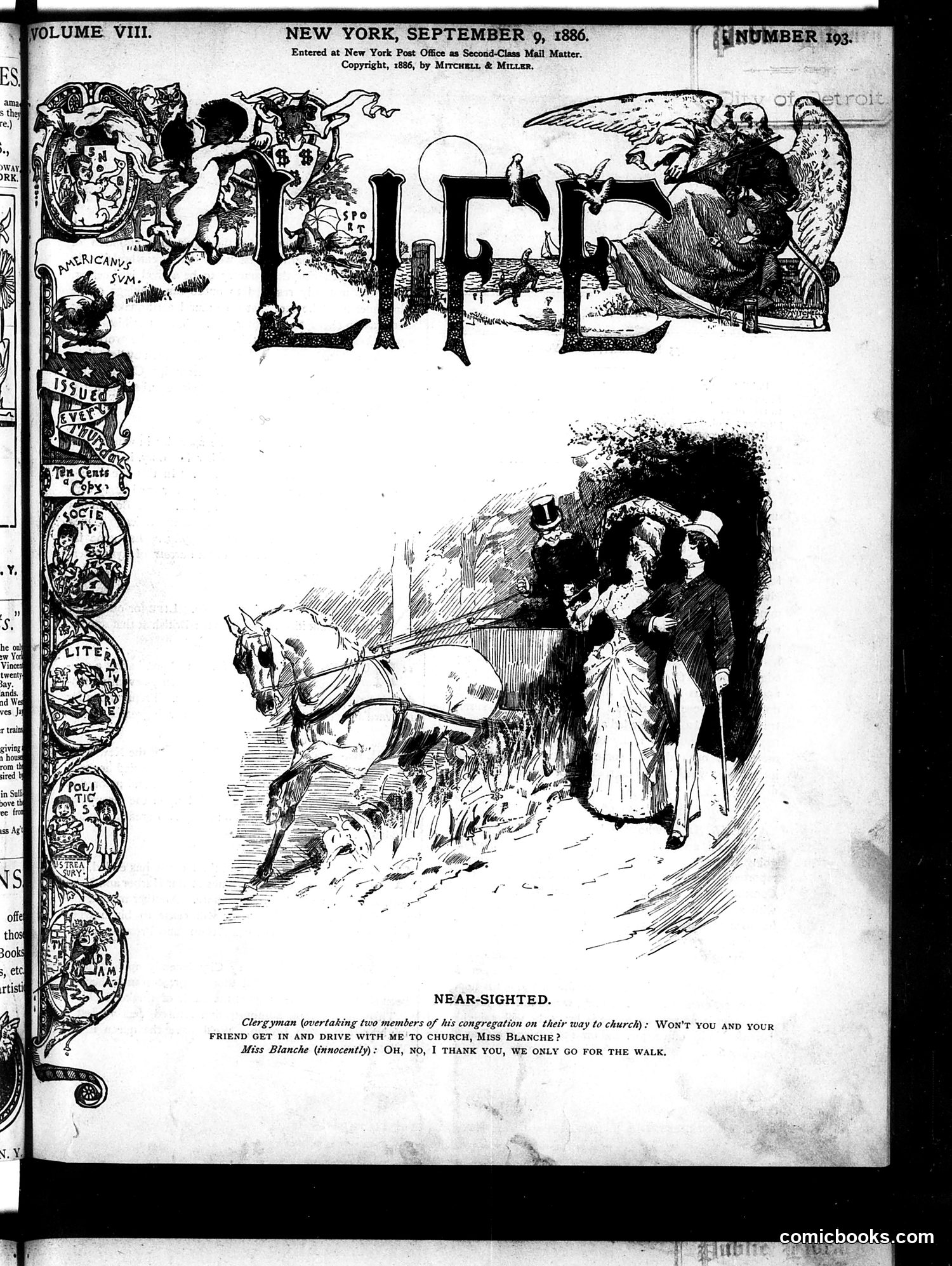
This 1886 *Life* magazine cartoon satirizes religious hypocrisy. A clergyman invites two women ("Miss Blanche" and friend) to ride in his carriage to church, claiming piety. However, the women decline, saying they "only go for the walk"—implying the clergyman's true motives are romantic rather than spiritual. The title "Near-Sighted" suggests the clergyman cannot see (or pretends not to see) his own obvious impropriety. The joke ridicules clergy who use religious authority as cover for pursuing women, while also gently mocking the women for their transparent excuse. This reflects late-Victorian skepticism about clerical morality and the gap between public piety and private behavior.
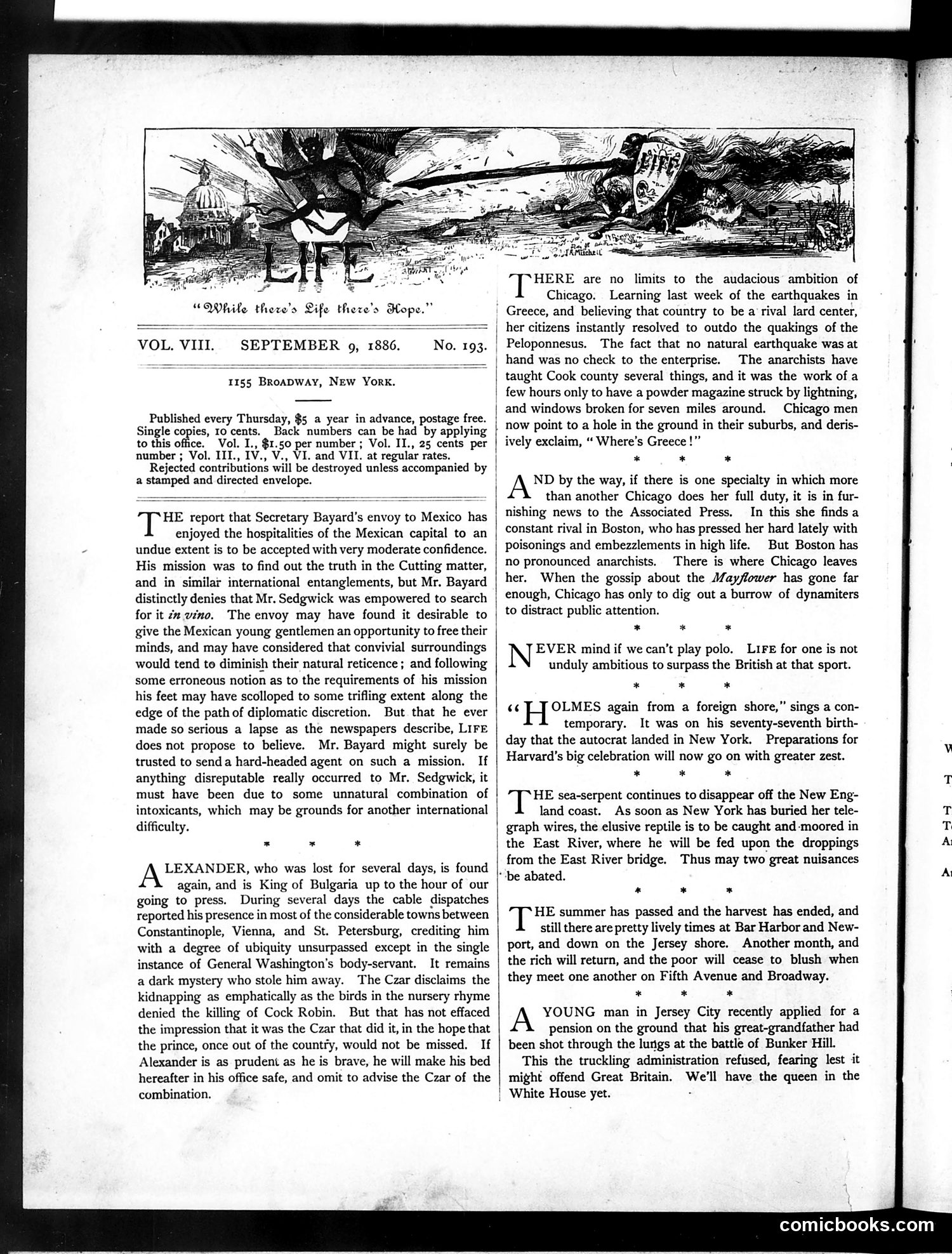
The header illustration titled "While there's Life there's Hope" depicts a skeletal Death figure looming over a landscape. This appears to be a memento mori design—a traditional allegorical image warning of mortality's inevitability. The text contains editorial commentary on contemporary events, including Secretary Bayard's diplomatic mission to Mexico and references to Alexander (likely the Bulgarian monarch mentioned in dispatches). A notable item discusses Chicago's competitive ambitions following earthquakes in Greece, satirizing the city's boastful claims to grandeur. The magazine also references "Holmes again from a foreign shore," likely referring to a notable public figure, and mentions social items about Bar Harbor society and a Jersey City pension dispute involving a Bunker Hill battle veteran. The page is primarily text-based editorial commentary rather than elaborate cartooning.
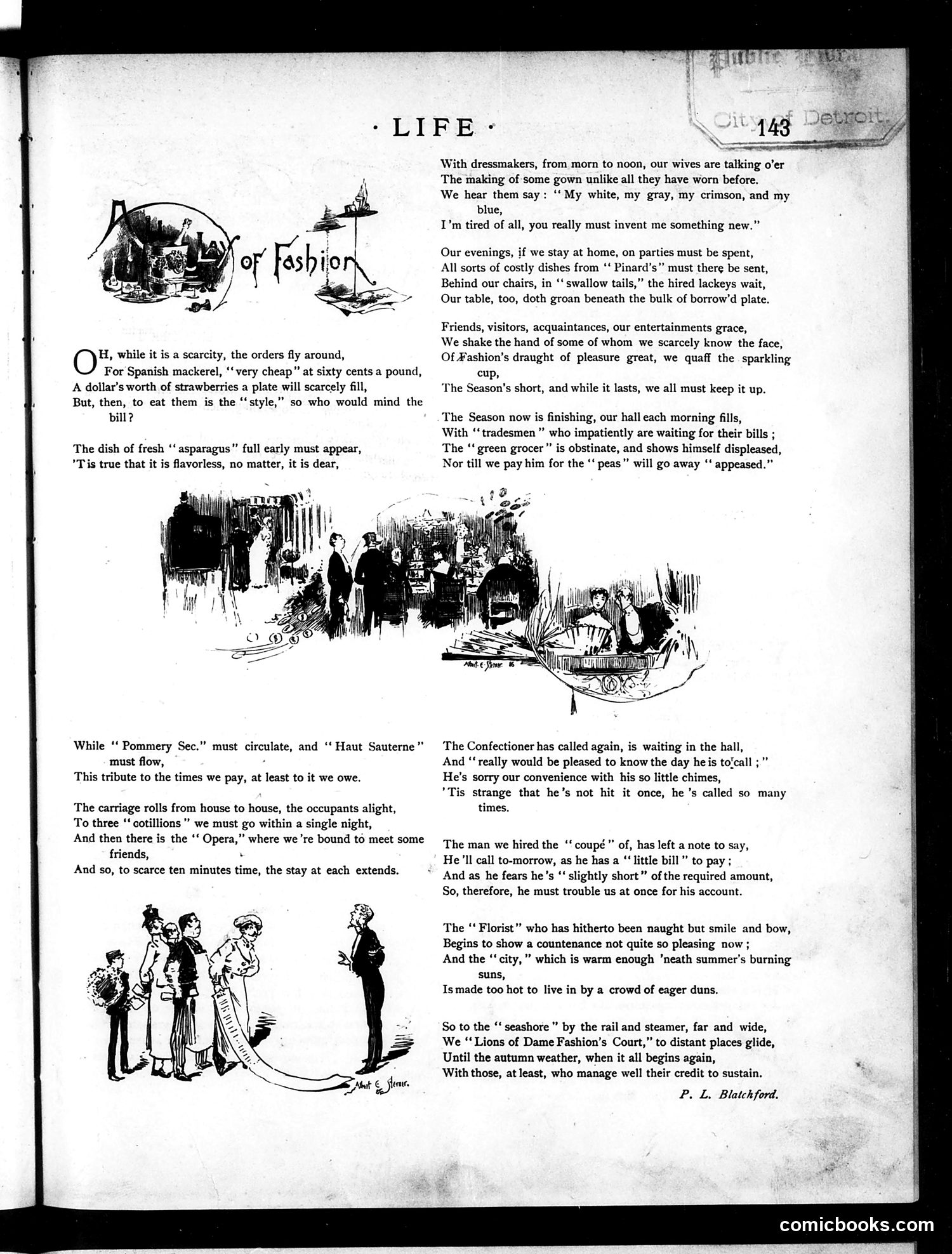
This satirical piece mocks the frivolous expenditures and constant social obligations of wealthy society women. The text complains about wives constantly demanding new fashions ("my white, my gray, my crimson, and my blue") while husbands foot expensive bills for dressmakers, fancy dinners featuring costly dishes like asparagus and Pommery champagne, and mandatory social events (opera, cotillions, parties). The accompanying sketches depict fashionable society figures attending various social functions. The satire targets the endless cycle of conspicuous consumption and social climbing—constant carriage rides between events, hiring servants, maintaining appearances—all sustained through what the author suggests is wasteful, unsustainable spending. The author (P.L. Blackford) critiques both the women's materialism and the broader wealthy class's priorities during what appears to be the Gilded Age.
This page contains satirical commentary rather than a cartoon. The "Three Little Maids" section offers witty social observations in verse form, mocking various topics: - **British pretension**: jibing at affectations of British culture - **Urban infrastructure**: criticizing New York's horse-car system as chaotic - **Anarchism**: sarcastically dismissing anarchists' political goals - **Presidential politics**: joking about a president caught in a lie - **Child labor**: commenting on children doing chores The right column features brief satirical items about contemporary figures (Dana, a Brooklyn robbery victim, a rhinoceros at Central Park) and a longer piece on John C. Eno's return from Europe, mocking his financial schemes and suggesting he represents a nouveau riche American trying to gain British aristocratic acceptance. The humor targets social hypocrisy and absurdity of the era.
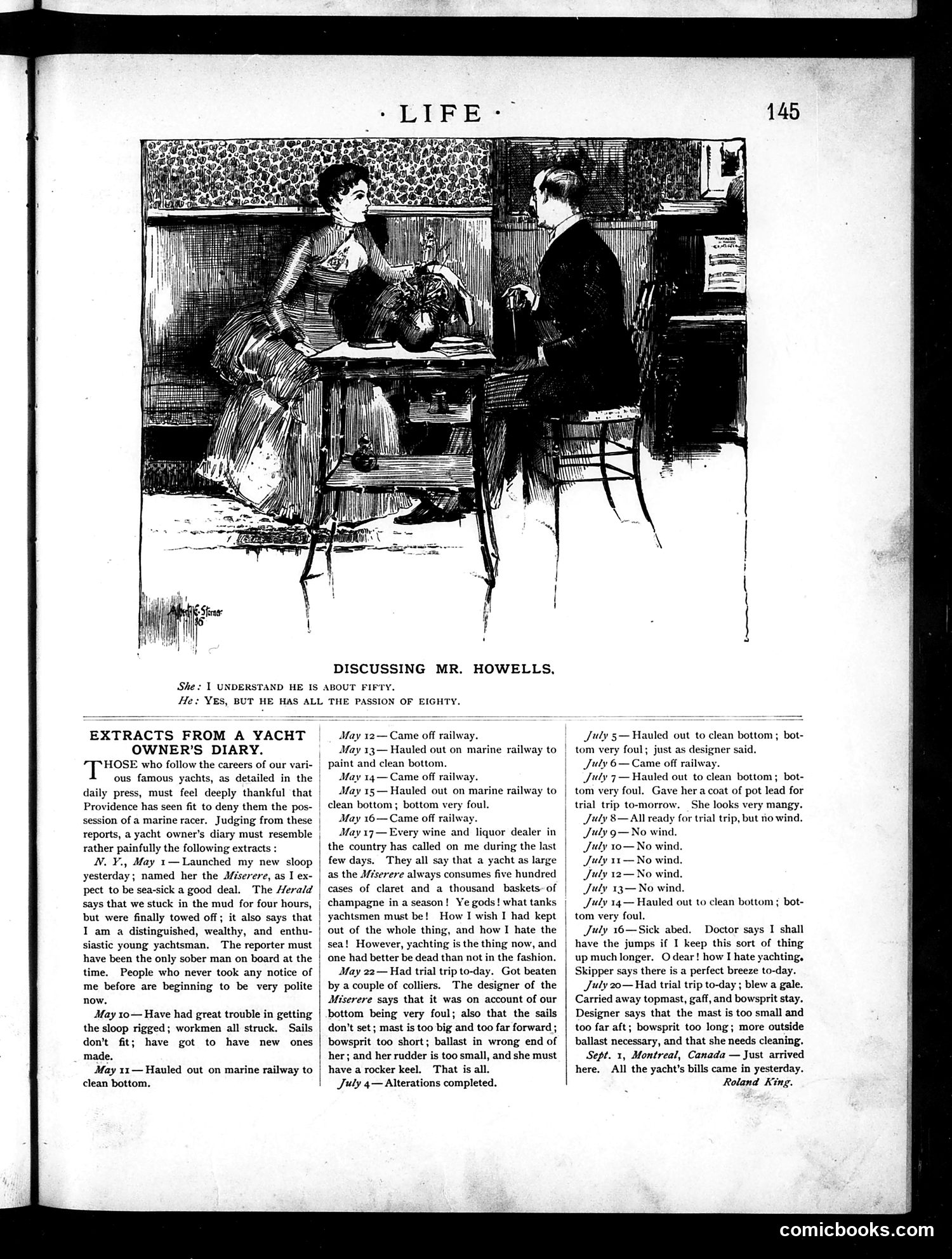
The page contains two distinct elements: **Top cartoon**: "Discussing Mr. Howells" depicts a woman and man in conversation. The caption suggests social commentary about a gentleman "about fifty" who possesses "all the passion of eighty"—likely satirizing either the subject's age-related decline or critiquing romantic pretensions. The specific reference to "Mr. Howells" remains unclear without additional context. **Bottom section**: "Extracts from a Yacht Designer's Diary" presents humorous journal entries documenting a yacht's maintenance problems (fouled bottoms, sail issues, design flaws). The satire targets incompetent yacht design and the owner's complaints, poking fun at wealthy leisure culture and the gap between aspirations and reality. The concluding note from Montreal suggests the yacht ultimately arrived—implying the journey was far more troublesome than intended. Both pieces employ gentle social satire typical of *Life* magazine's approach.
This page contains no political cartoon. Instead, it features: **"Remembered"** — a poem about a man in town missing his absent female companion who's at the shore. The poem expresses romantic longing with humorous complaints about her negligence and his boredom without her. **Book reviews and literary notes**, including: - Praise for Mrs. E.D.E.N. Southworth's novel "The Gipsy's Prophecy" - A note about Andrew Lang's edition of dead authors' letters - Commentary on Oscar Fay Adams' poetry project - Publishing announcements for new books **A brief joke** at the bottom about a plumber's pipes. The page is primarily literary content rather than visual satire or political commentary.
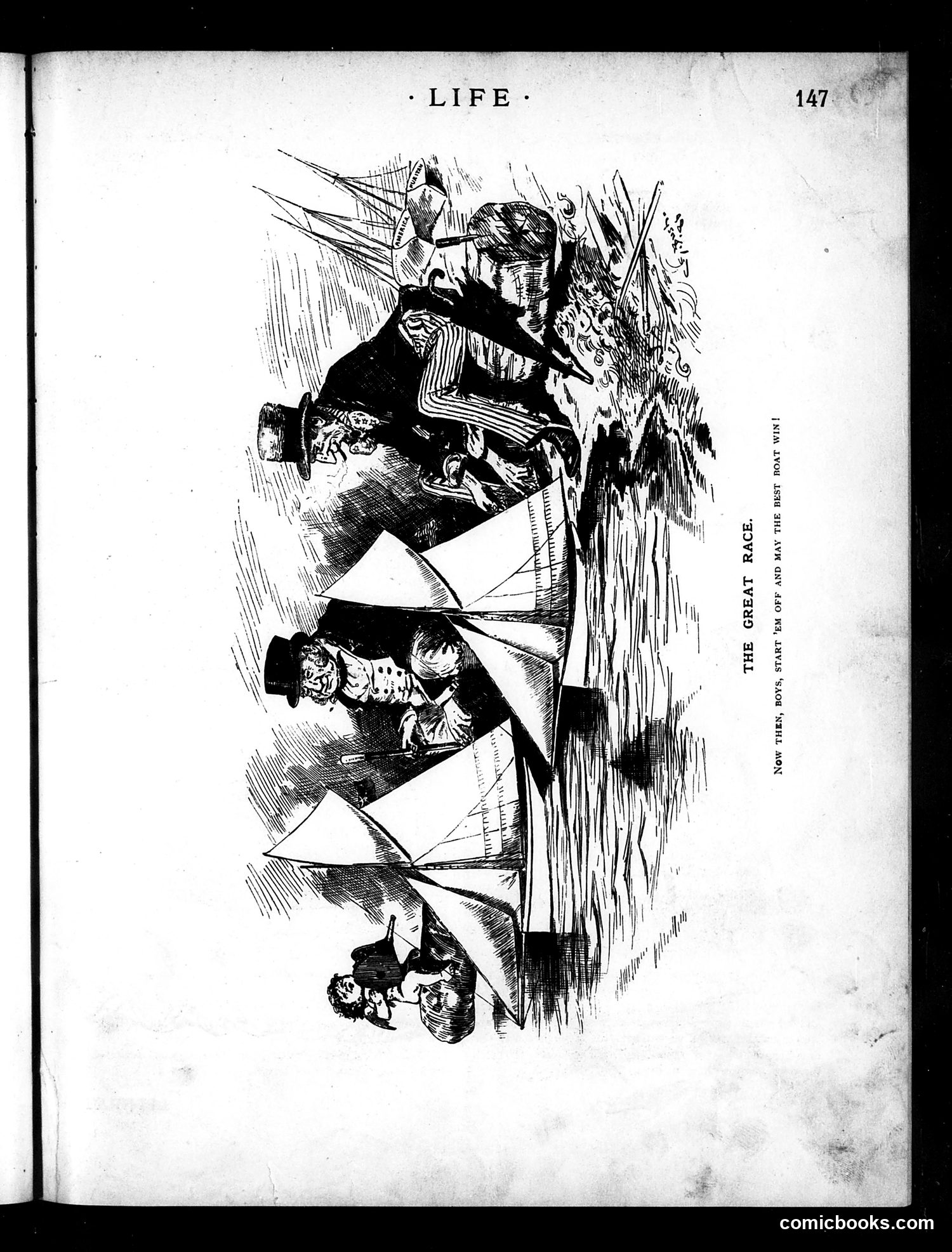
This satirical cartoon depicts a horse race where the jockeys appear to be wealthy or prominent figures engaged in competitive struggle. The image is titled "The Great Race" with the caption "Not their born, art he kept and very best lovers." The cartoon likely satirizes economic or social competition among the upper classes during the Gilded Age era of *Life* magazine. The exaggerated caricatures and dynamic racing composition suggest mockery of how the wealthy pursued status and profit with intensity comparable to actual sporting competition. Without clearer identification of specific figures, I cannot definitively name the jockeys, but the style and subject matter indicate social commentary on class competition, greed, or industrial-era rivalries that would have resonated with *Life*'s satirical audience.
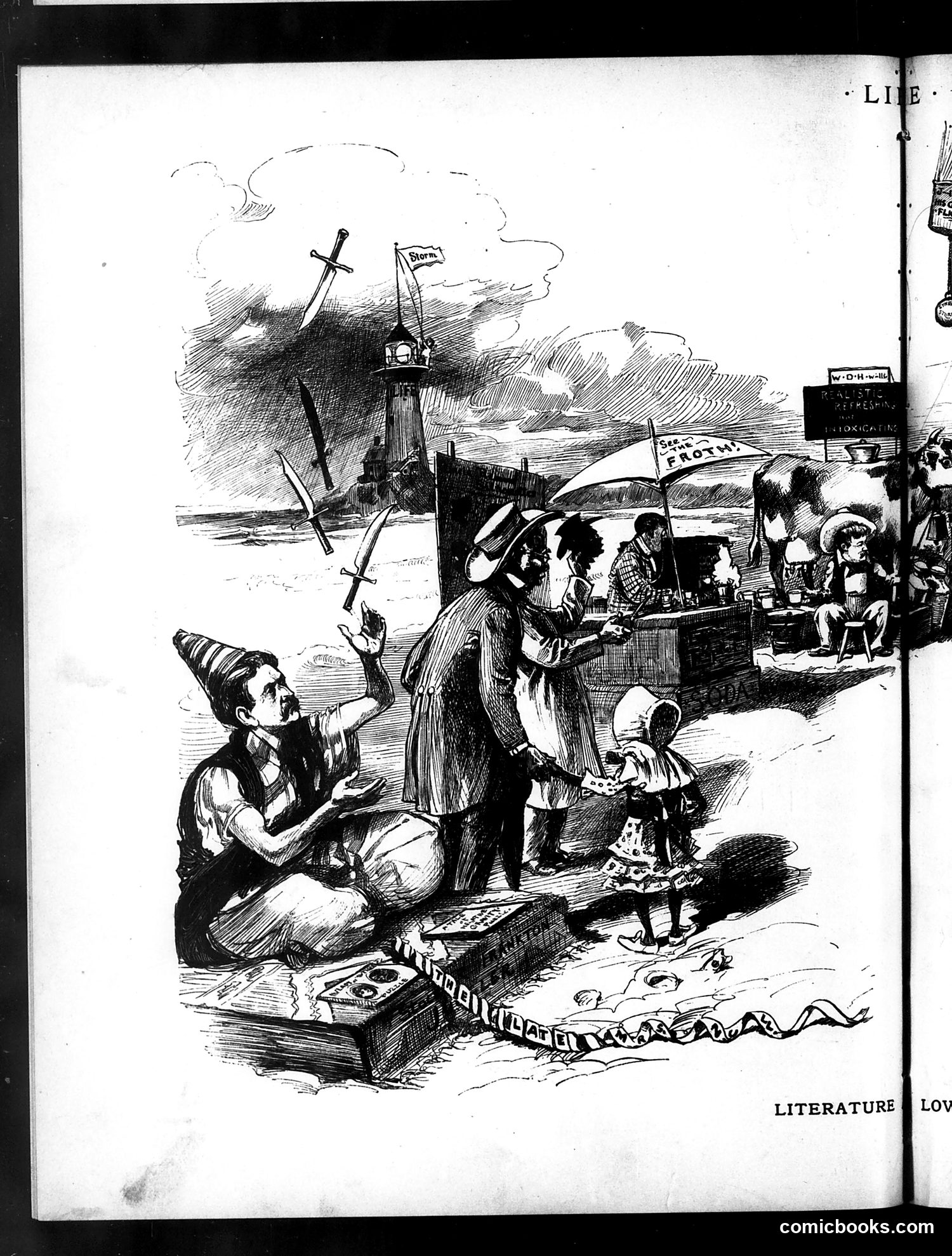
This political cartoon depicts a seaside beach scene with a shipwreck in the background. In the foreground, a man in period costume (appearing to be dressed as a Dutchman or historical figure) juggles swords while standing among various vendor stalls and entertainers. Children and other figures observe him. The visible text fragments include references to "LITERATURE" at the bottom, suggesting this is satirizing literary or cultural commerce. The juggling swords, shipwreck, and carnival-like atmosphere likely critique how serious subjects (possibly literature, art, or historical events) are trivialized and turned into popular entertainment or commercial spectacle for mass consumption. However, without the complete OCR text or additional context, the specific literary or social reference remains unclear.
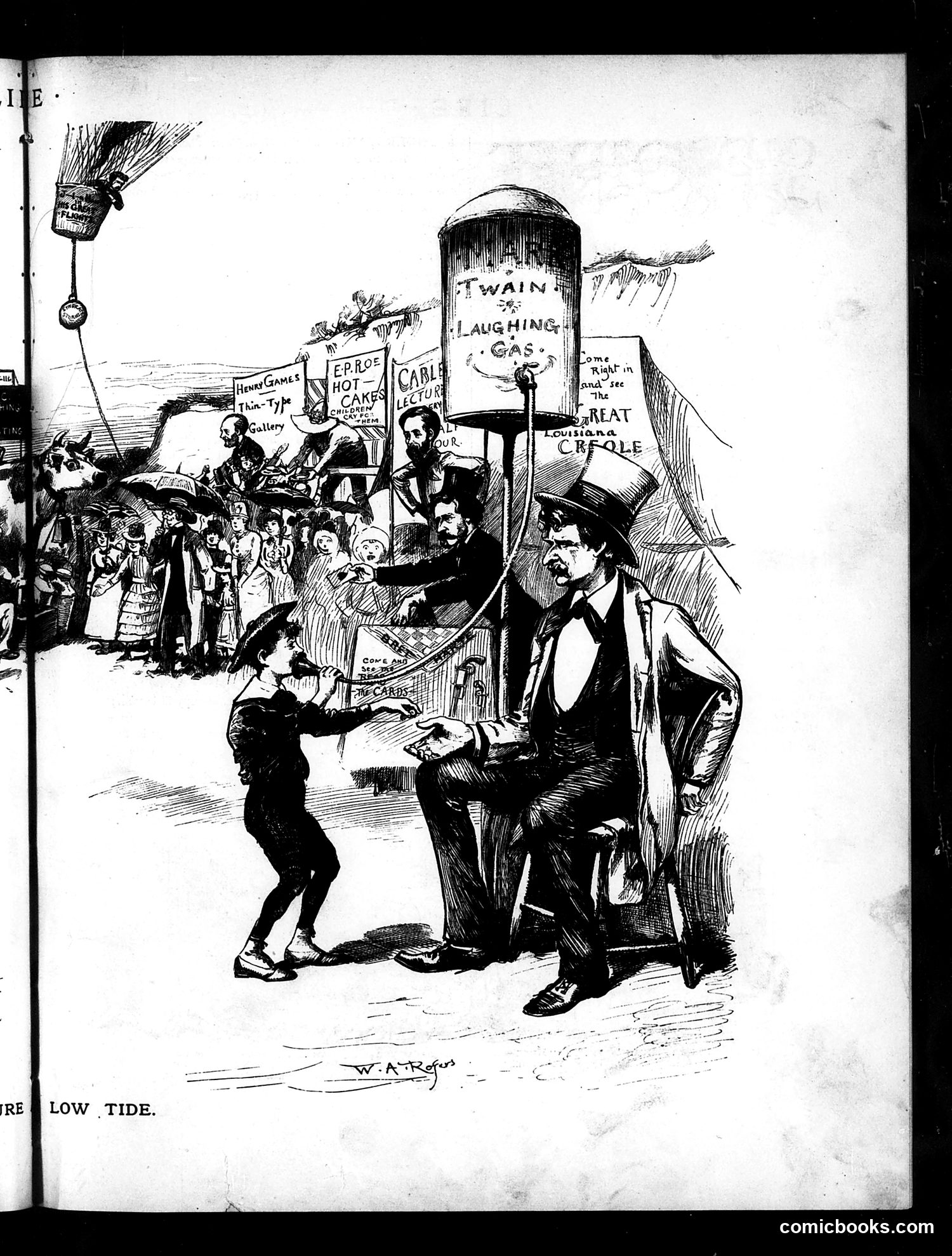
This satirical cartoon depicts a street scene where a well-dressed gentleman in formal attire stands beside a tall "Laughing Gas" dispensing machine. A young boy approaches him, seemingly to purchase or receive the gas. The background shows crowds and various signs advertising entertainment attractions including "Hard Games," "Hot Cake Gallery," and "The Great Louisiana Creole." The title "Low Tide" suggests a critique of public morality or cultural degradation. The "Laughing Gas" machine likely represents escapism or frivolous amusement that distracts the masses from serious concerns. The well-dressed figure may represent someone profiting from or promoting such diversions. The cartoon appears to satirize how entertainment and commercial amusement distract people from more substantive issues, particularly affecting youth. The artist is W.A. Rogers.
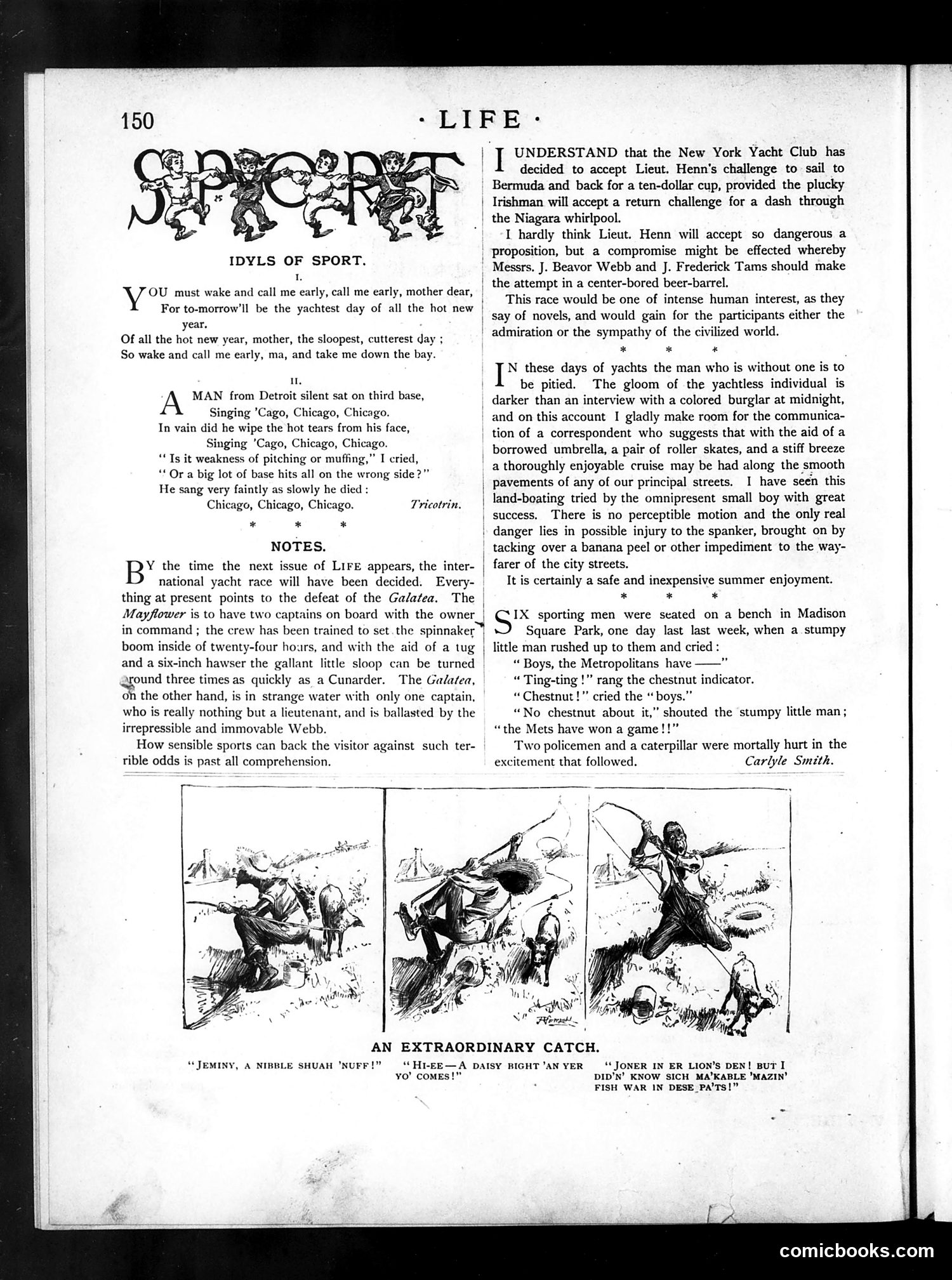
This page contains sports humor typical of early 20th-century *Life* magazine. The main cartoon, "An Extraordinary Catch," depicts a fisherman's comedic struggle landing what appears to be a large fish or sea creature. The three sequential panels show escalating chaos—the fisherman is knocked about, tangled in his line, and generally overwhelmed by his catch. The captions employ period slang ("Jeminy," "Hi-ee") and mock-heroic language. The joke hinges on the fisherman being utterly unprepared for success—a common theme in American humor about overmatched sportsmen. The surrounding text discusses yacht racing and urban recreational activities, reflecting leisure pursuits of the era's wealthy readership.
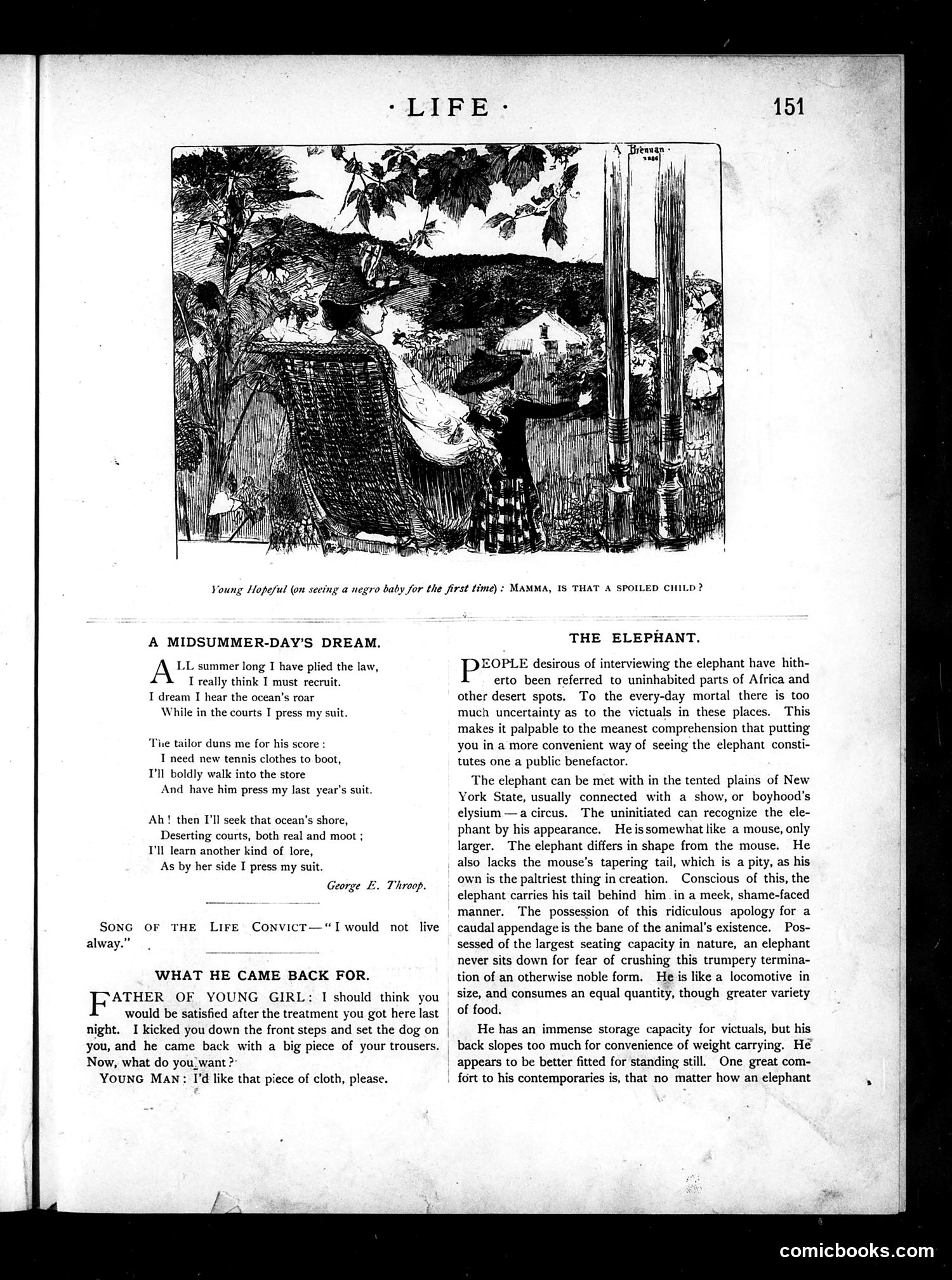
The top cartoon uses a racist stereotype: a white child asks his mother if a Black baby is "spoiled," implying Black skin is a defect or damage rather than natural variation. This reflects the deeply embedded racial prejudice of the era, presenting such ignorance as innocent childhood confusion rather than challenging it. The other content includes humorous poems and sketches about mundane social situations—a lawyer dreaming of vacation, a suitor returning despite violent rejection to retrieve torn trousers—typical Light satirical fare of the period. "The Elephant" section is straightforward descriptive humor, comparing an elephant to a mouse and poking fun at the animal's awkward tail and inability to sit down due to its size. The cartoon's casual racism is the notable historical element—it documents how normalized such stereotypes were in mainstream American humor publications of this era.
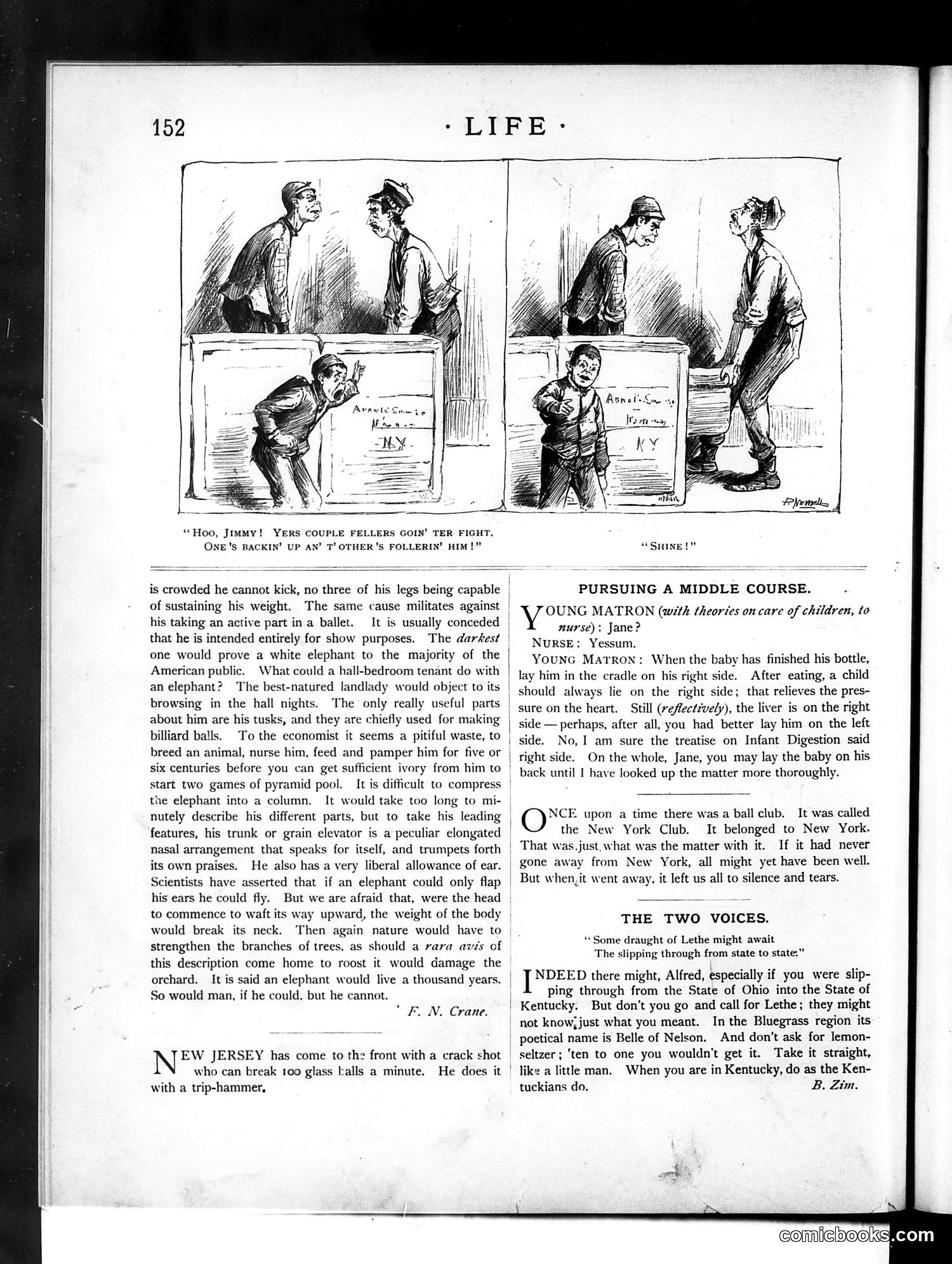
The top cartoon shows two men in a confrontation near what appears to be a ballot box or voting station. One man is backing away while the other advances—the humor comes from the caption's deadpan observation that one fellow is "backin' up" while the other is "followin' him," treating a tense political or social standoff as casual observation. This likely satirizes 19th-century political intimidation or confrontational behavior at polling places. The remaining content includes three unrelated pieces: a lengthy essay mocking elephants (likely satirizing their impracticality or current popularity in American culture), a humorous piece about a New Jersey sharpshooter, and two comedic advice columns—one mocking an indecisive young mother obsessing over conflicting infant care theories, another joking about travel between Ohio and Kentucky using classical mythology references. The page demonstrates *Life*'s characteristic blend of visual satire and witty prose commentary on contemporary American life and society.
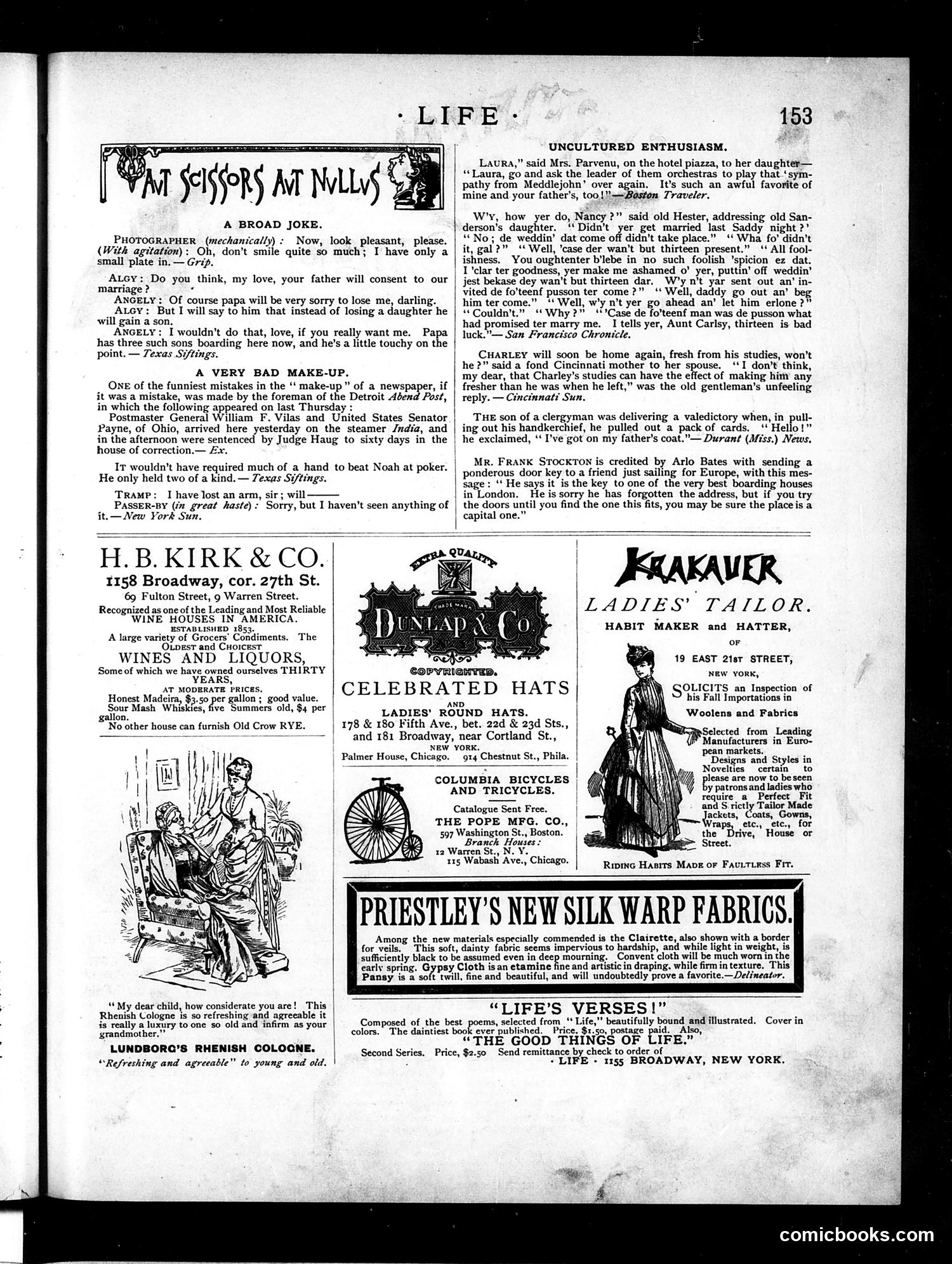
This page showcases **short humorous anecdotes** typical of Life's satirical format, with several recurring themes: ## The Cartoons/Anecdotes: **"At Scissors at Nully"** — A photographer's joke about portrait composition appears at top. **Social Satire:** - **"A Broad Joke"** mocks an engaged couple's naïveté about the fiancé's father, who already has three adult sons boarding at home—implying he's running a boarding house and is financially struggling, making the marriage joke about "gaining a son" uncomfortably literal. - **"Uncultured Enthusiasm"** ridicules Mrs. Parvenu (a new-money nouveau riche character) for mispronouncing Mendelssohn's "Consolation" and calling it "sympathy from Meddlejohn"—satirizing the social pretensions of the newly wealthy. - Additional anecdotes mock superstition, clerical hypocrisy, and poor judgment. ## Context for Modern Readers: The humor relies on **class mockery, puns, and situational irony**—common in Gilded Age magazines targeting educated, middle-class readers who enjoyed laughing at outsiders (the vulgar rich, rural folk, immigrants). Most of the page is **advertisements** for wines, bicycles, and ladies' fashions.
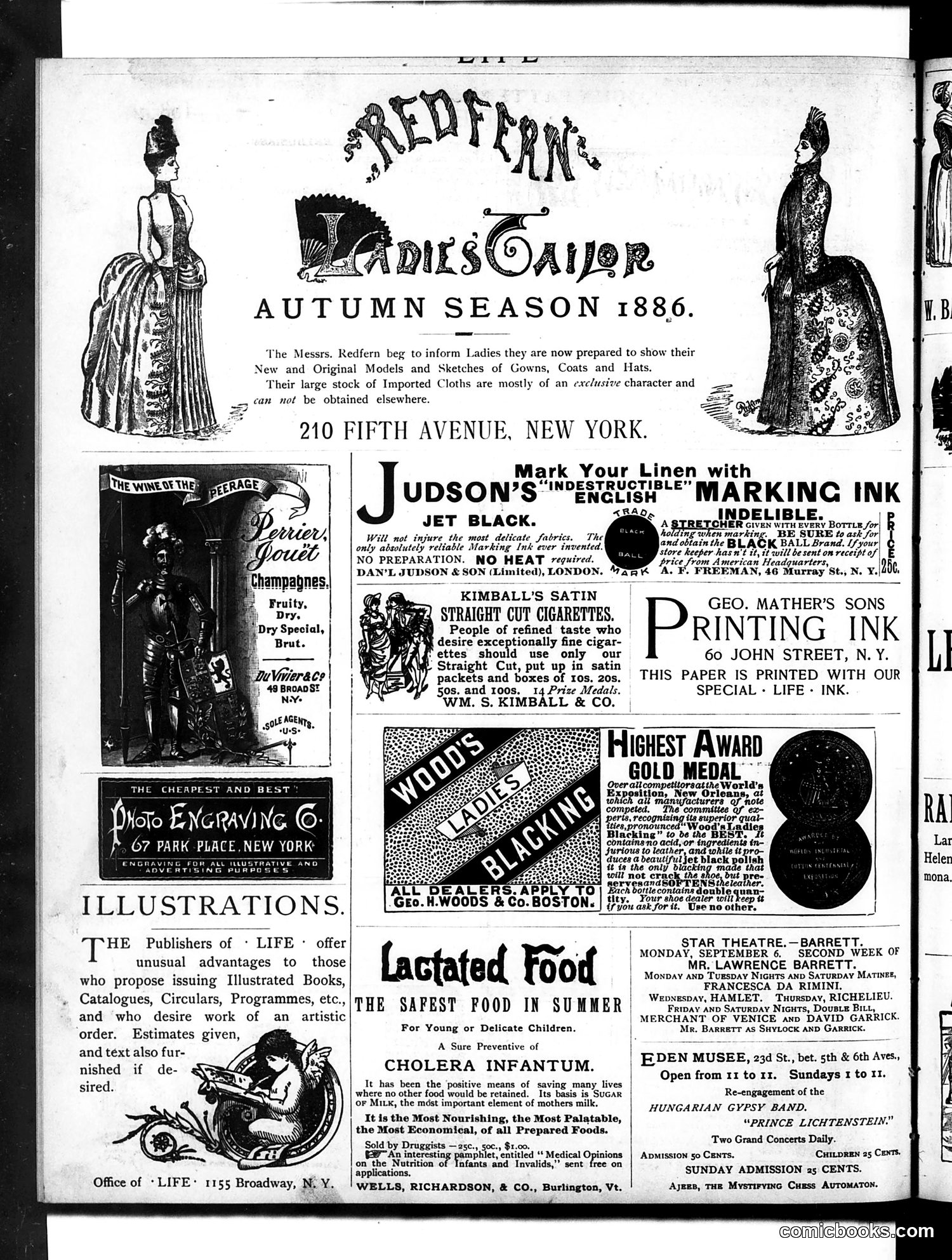
This is primarily **a title page and advertisements**, not a political cartoon. The page announces the Autumn 1886 season and is dominated by commercial promotions for luxury goods and services. The two illustrated fashion figures at top represent the Redfern dress house's exclusive new clothing designs—typical of high-end advertising for wealthy women's wear. The advertisements below promote late-Victorian consumer goods: marking inks, cigarettes, printing inks, and notably "Lactafed Food," claimed as a preventive for cholera infantum (a common childhood illness of the era). The inclusion of this ad reflects genuine public health concerns of the 1880s. Theater listings advertise Lawrence Barrett's performances in classical plays, and the Eden Musee museum advertises a Hungarian gypsy band—entertainment typical of the period's upper-class leisure activities. There is **no political satire** visible on this page. Life magazine here functions as a traditional advertising venue for affluent readers.
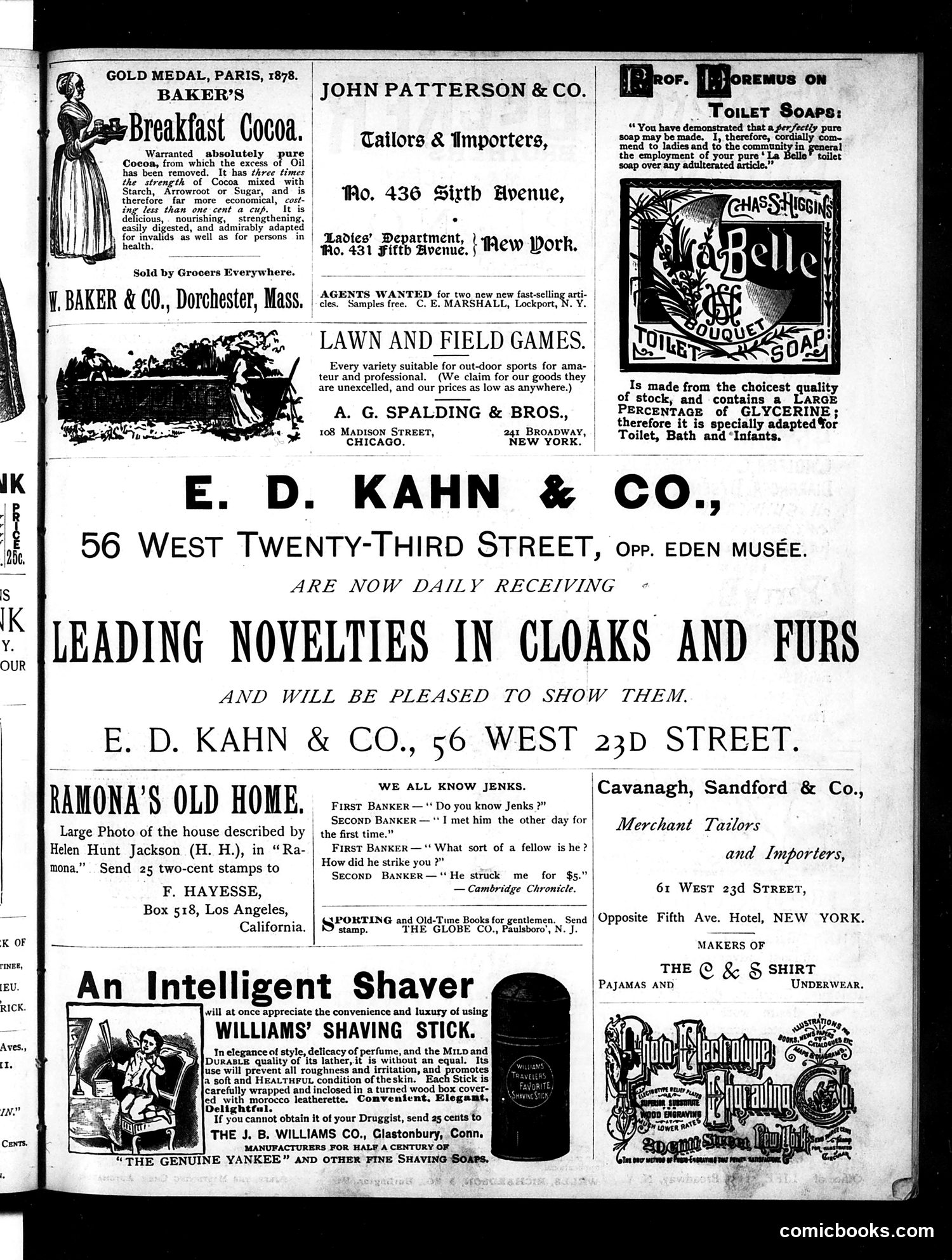
This page is primarily **advertising**, not political satire. It contains commercial advertisements for late 19th-century products: Baker's Breakfast Cocoa, tailoring services, sporting goods, La Belle toilet soap, clothing retailers, and shaving products. The **only humor element** is a brief joke titled "We All Know Jenks"—a simple pun about a banker named Jenks who "strikes" someone (assaults him) for $5 when asked how he impressed them. The joke plays on double meaning: "strike" as both "make an impression" and "hit someone up for money." The page includes one non-commercial item: an advertisement for a photograph of the house from Helen Hunt Jackson's 1884 novel *Ramona*, a popular romantic story set in California. There is **no political cartoon or satire** on this page. It represents typical Life magazine filler—mostly vendor advertisements interspersed with light, gentle humor.
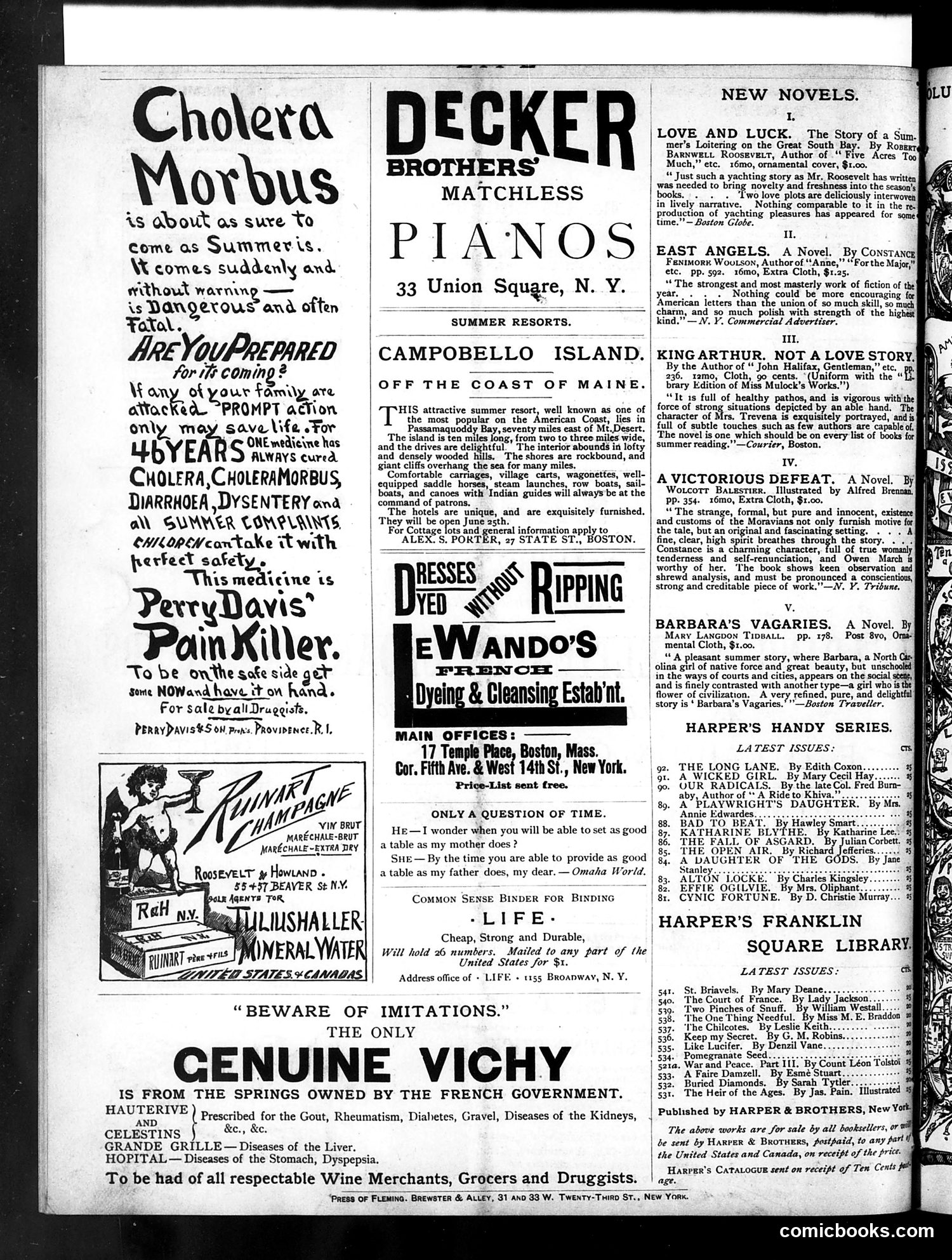
This page is primarily **advertising and book notices**, not political satire. The dominant content includes: **Left side:** Patent medicine ads for Perry Davis' Pain Killer and REH Mineral Water, making exaggerated health claims typical of 19th-century nostrum marketing. The cholera reference reflects genuine disease concerns of the era. **Center:** Decker Brothers piano advertisement and Campobello Island summer resort listing. **Right side:** "New Novels" book reviews—a standard magazine feature listing contemporary fiction titles with critical excerpts. **Bottom:** A Vichy water advertisement claiming French government ownership, contrasting with the "beware of imitations" warning—common competitive messaging. **No political cartoons appear here.** The page reflects commercial Life magazine content: medical product pitches exploiting health anxieties, tourism promotion, consumer goods, and literary culture. The advertising style reveals Victorian-era consumer concerns and marketing tactics rather than satirical commentary.