
Life, 1886-09-09 · page 11 of 16
Life — September 9, 1886 — page 11: what you’re looking at
What you’re looking at
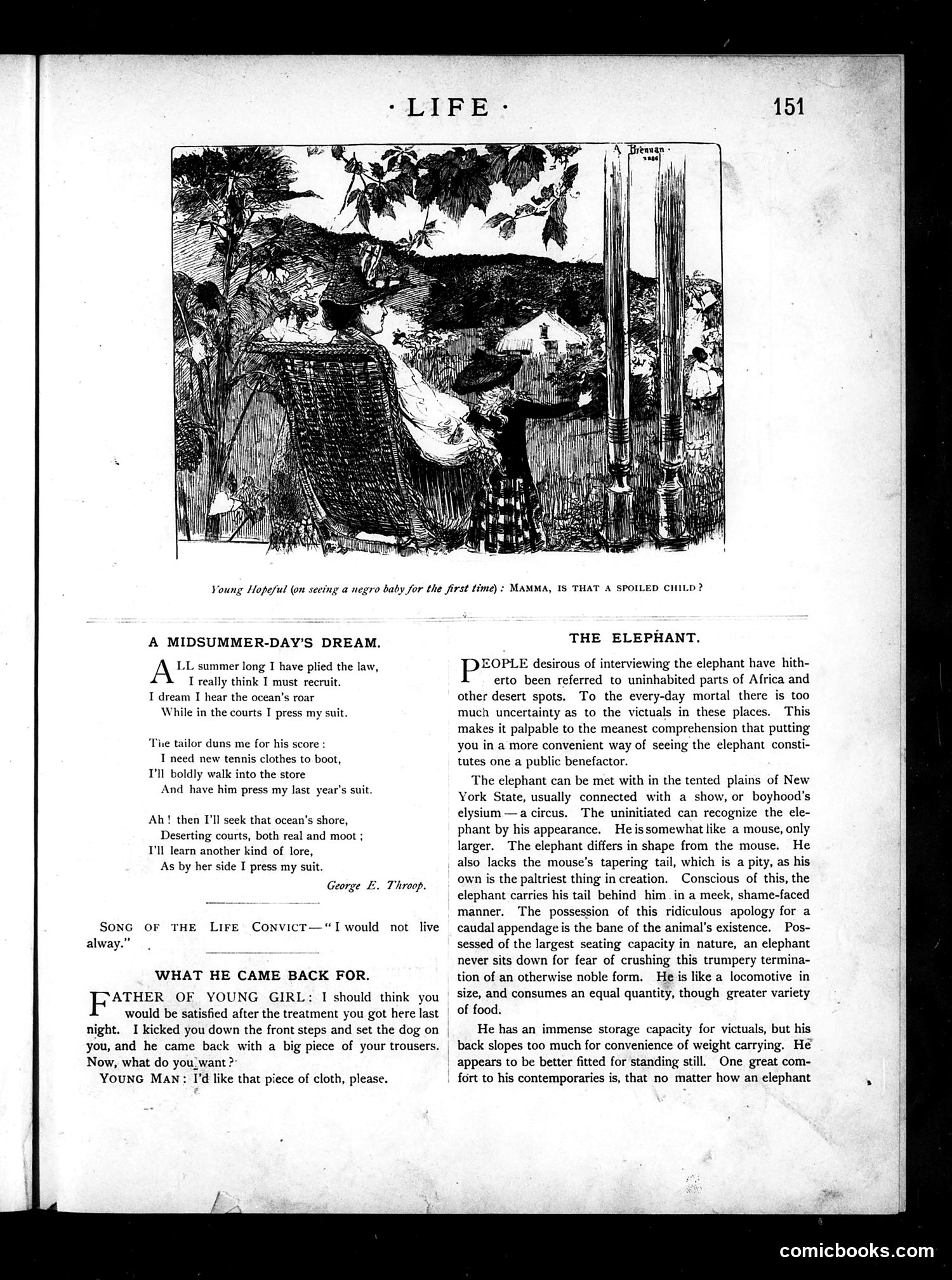
The top cartoon uses a racist stereotype: a white child asks his mother if a Black baby is "spoiled," implying Black skin is a defect or damage rather than natural variation. This reflects the deeply embedded racial prejudice of the era, presenting such ignorance as innocent childhood confusion rather than challenging it. The other content includes humorous poems and sketches about mundane social situations—a lawyer dreaming of vacation, a suitor returning despite violent rejection to retrieve torn trousers—typical Light satirical fare of the period. "The Elephant" section is straightforward descriptive humor, comparing an elephant to a mouse and poking fun at the animal's awkward tail and inability to sit down due to its size. The cartoon's casual racism is the notable historical element—it documents how normalized such stereotypes were in mainstream American humor publications of this era.
📄 Transcribed text from this page (OCR, searchable)
Machine-transcribed from the original scan — historical spelling and the odd misread are preserved.
Young Hopeful (on seeing a negro baby for the first time): MAMMA, IS THAT A SPOILED CHILD? A MIDSUMMER-DAY’S DREAM. LL summer long I have plied the law, I really think I must recruit. I dream I hear the ocean’s roar While in the courts I press my suit. ‘Tie tailor duns me for his score : I need new tennis clothes to boot, I'll boldly walk into the store And have him press my last year's suit. Ah! then I'll seek that ocean’s shore, Deserting courts, both real and moot ; T'll learn another kind of lore, As by her side I press my suit. George E. Throop. SONG OF alway.” THE Lir—E ConvicT—‘“I would not live WHAT HE CAME BACK FOR. ATHER OF YOUNG GIRL: I should think you would be satisfied after the treatment you got here last night. I kicked you down the front steps and set the dog on you, and he came back with a big piece of your trousers. Now, what do you:want? YOUNG MAN: I’d like that piece of cloth, please. THE ELEPHANT. EOPLE desirous of interviewing the elephant have hith- erto been referred to uninhabited parts of Africa and other desert spots. To the every-day mortal there is too much uncertainty as to the victuals in these places. This makes it palpable to the meanest comprehension that putting you in a more convenient way of seeing the elephant consti- tutes one a public benefactor. The elephant can be met with in the tented plains of New York State, usually connected with a show, or boyhood’s elysium —a circus. The uninitiated can recognize the ele- phant by his appearance. He issomewhat like a mouse, only larger. The elephant differs in shape from the mouse. He also lacks the mouse’s tapering tail, which is a pity, as his own is the paltriest thing in creation. Conscious of this, the elephant carries his tail behind him. in a meek, shame-faced manner. The possession of this ridiculous apology for a caudal appendage is the bane of the animal’s existence. Pos- sessed of the largest seating capacity in nature, an elephant never sits down for fear of crushing this trumpery termina- tion of an otherwise noble form. He is like a locomotive in size, and consumes an equal quantity, though greater variety of food. He has an immense storage capacity for victuals, but his back slopes too much for convenience of weight carrying. He appears to be better fitted for standing still, One great com- fort to his contemporaries is, that no matter how an elephant comicbooks.com