
A complete issue · 16 pages · 1886
Life — August 26, 1886
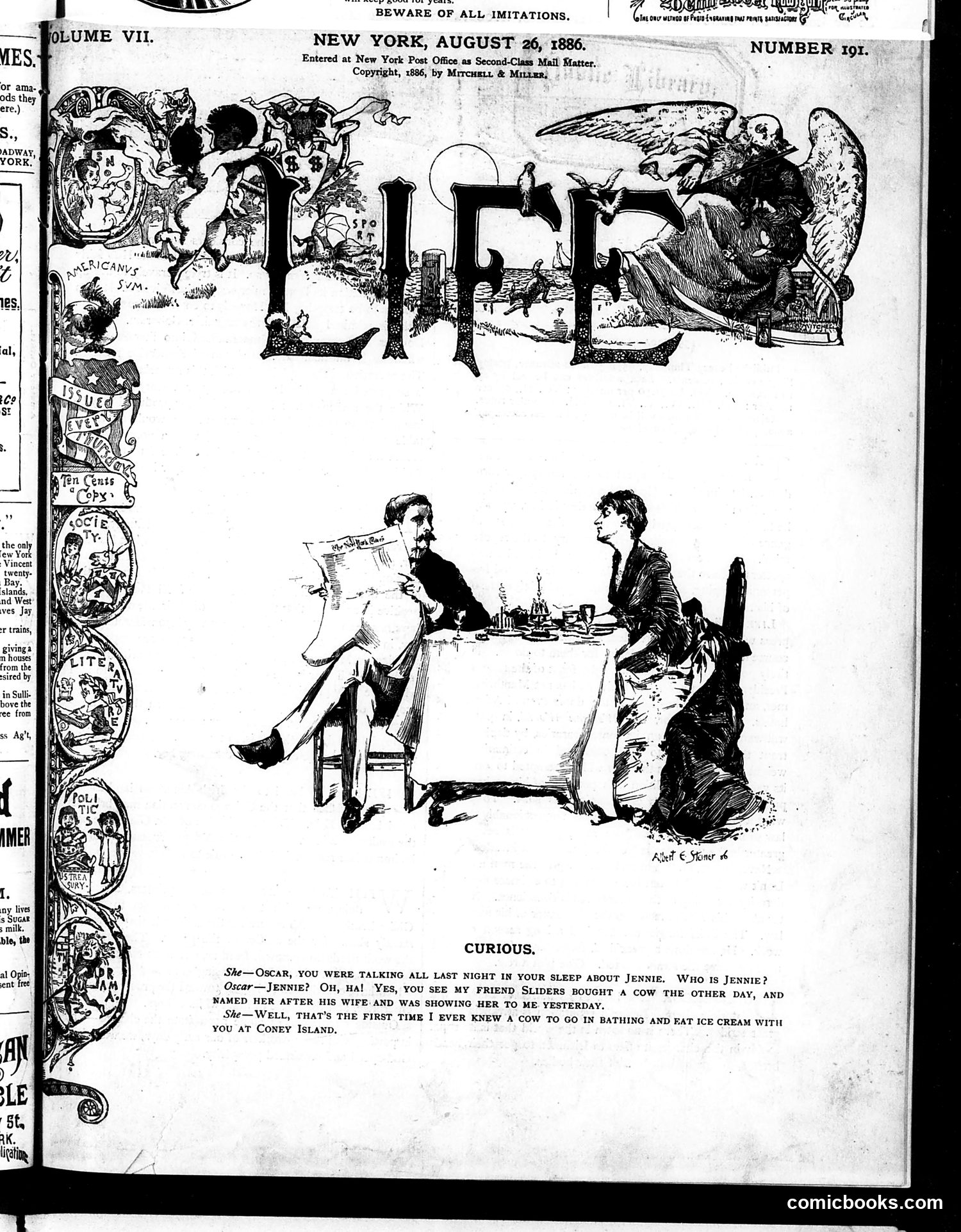
**The Main Cartoon ("Curious")** Two men sit at a chess table. One reads a newspaper while the other watches. The dialogue reveals the joke: Oscar was talking in his sleep about "Jennie," and his friend Sliders bought a cow named after the man's wife, then showed it to Oscar at Coney Island (a popular amusement park). The humor is a straightforward domestic comedy: the wife's name is so ordinary that it's been given to livestock, and the friend's prank exploits Oscar's apparent infidelity anxiety by presenting the "cow named Jennie" as comeuppance. The chess game sets an intellectual tone, contrasting with the crude punchline about bathing cows at Coney Island—typical of Victorian-era magazine humor mixing sophistication with lowbrow jokes.
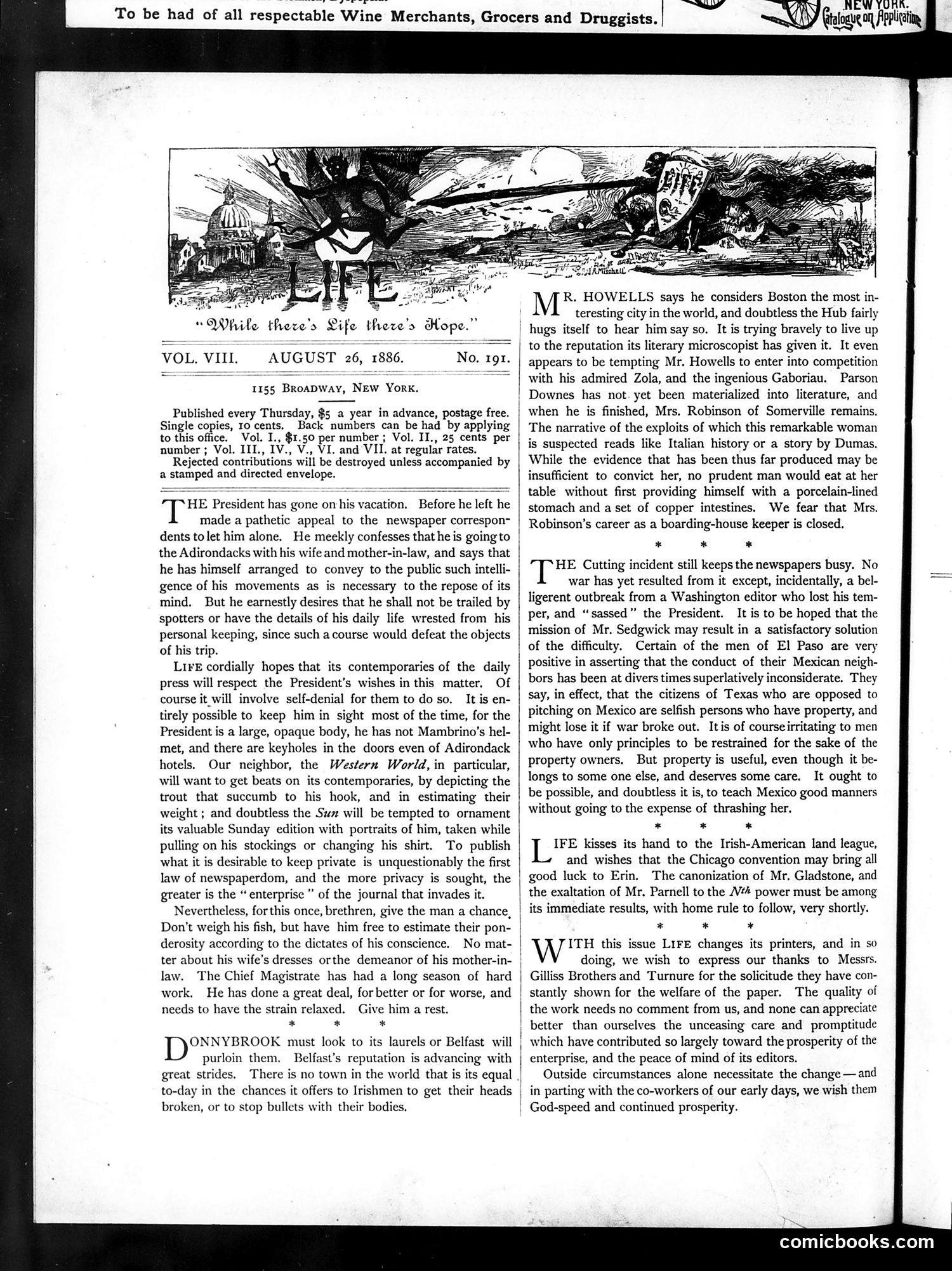
The masthead cartoon shows a tree with the motto "While there's Life there's Hope," depicting Life magazine's satirical mission. The editorial content addresses President Cleveland's vacation and the resulting media speculation about his movements—apparently the press was being asked to respect his privacy. The editors note the irony: newspapers want privacy for themselves but eagerly publish details about others' lives. The piece also discusses the "Cutting incident," an international dispute involving Mexico. American editor A.K. Cutting had been imprisoned in Mexico; the editors suggest some expansionist politicians opportunistically used the incident to advocate military intervention, despite complexity in the situation. The final section praises the magazine's new printers (Gilliss Brothers and Turnure), crediting them with improving paper quality during this transition period.
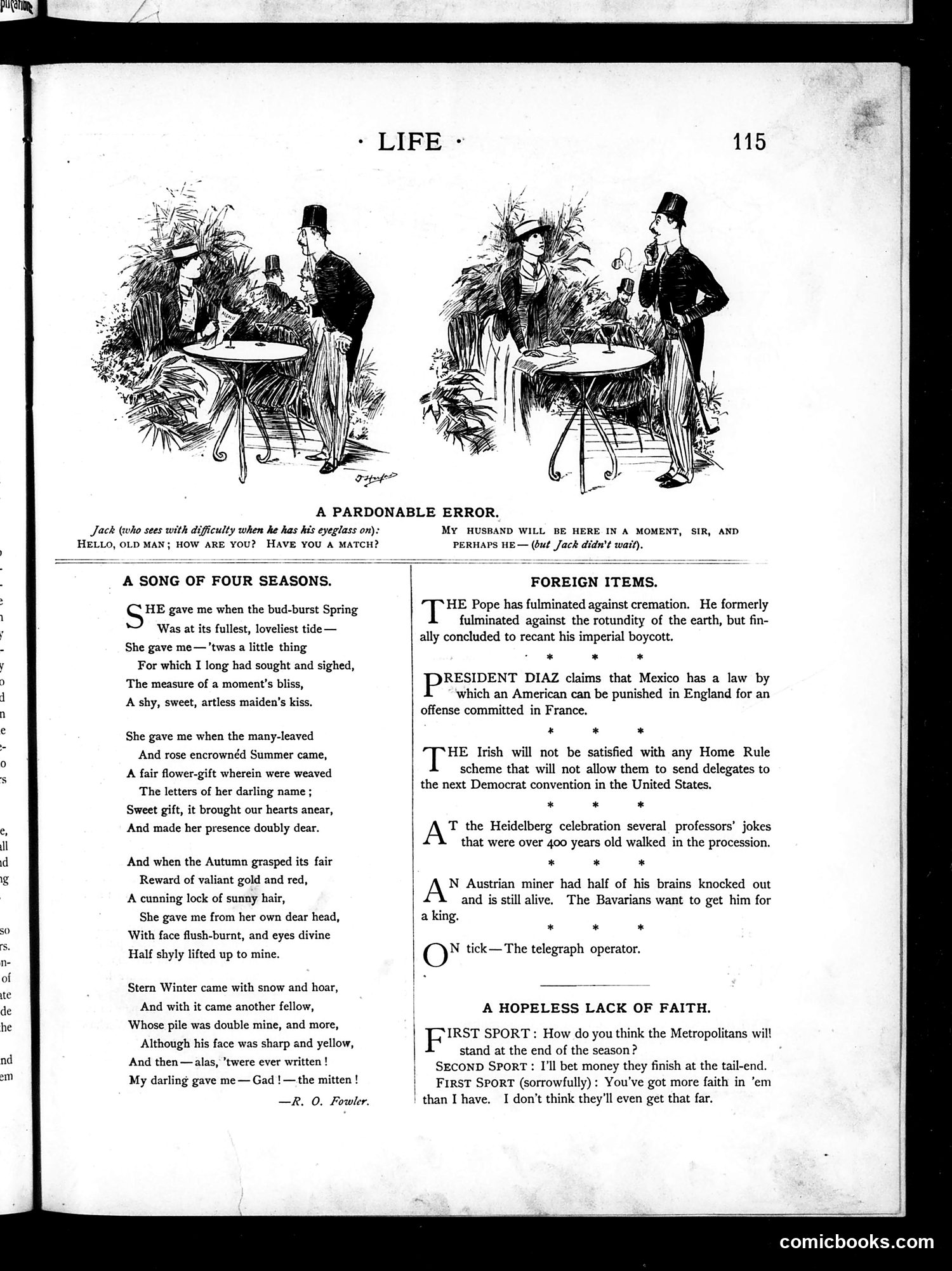
The cartoon shows two nearly identical garden scenes with a woman and two men. The caption explains the joke: a man with defective eyesight mistakes an old man for his wife, greeting him enthusiastically ("Hello, old man; how are you?"). The "pardonable error" is the visual confusion caused by poor eyesight. The accompanying content includes a sentimental poem "A Song of Four Seasons" by R.O. Fowler about romantic gifts through the year, and a "Foreign Items" section with brief satirical news snippets about international politics (the Pope, Mexico, Ireland, Austria). Below is "A Hopeless Lack of Faith"—a humorous dialogue between two sports fans pessimistic about the Metropolitans baseball team's season prospects. The page represents typical Life magazine content: light humor, verse, and sports commentary.
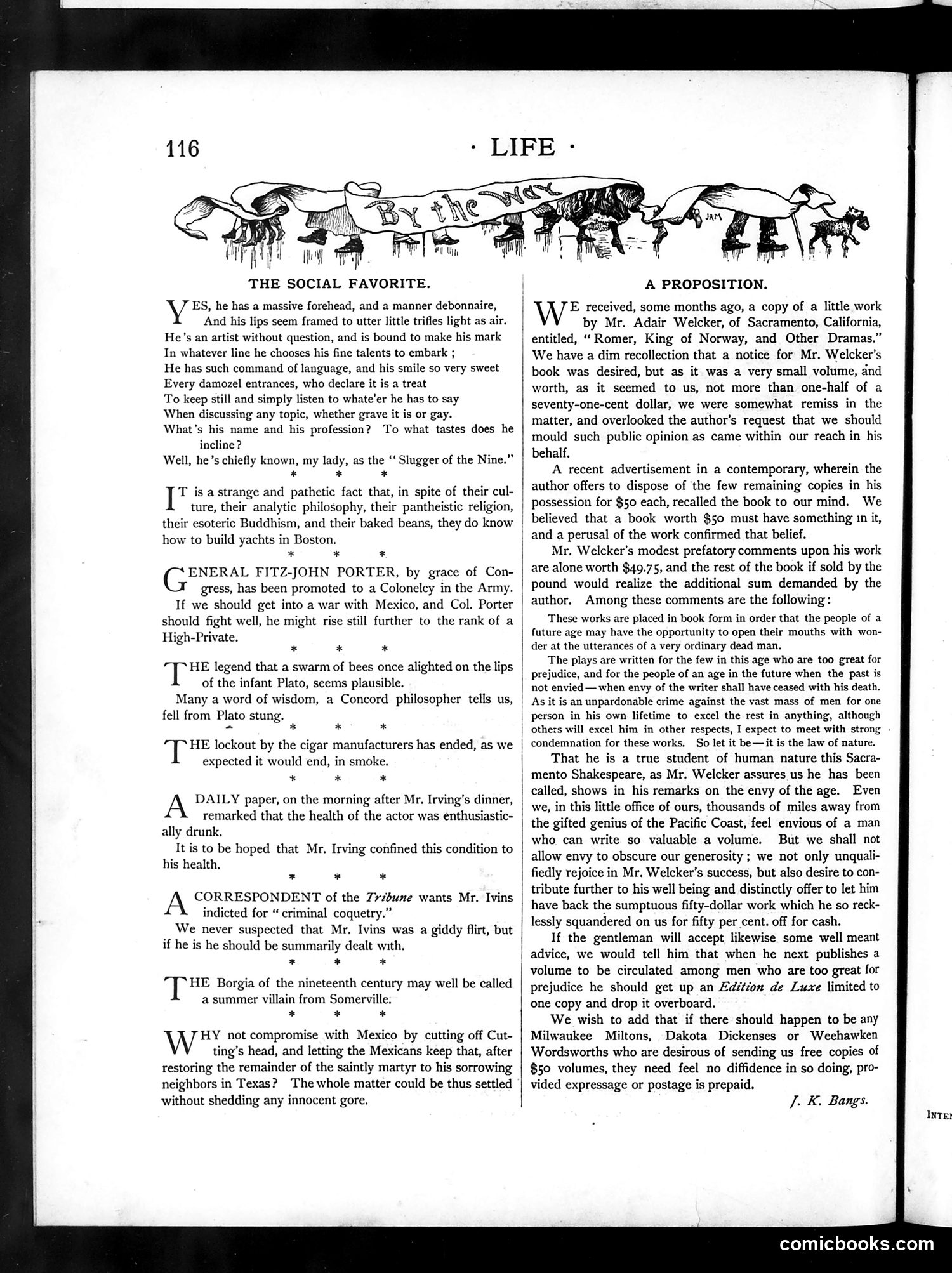
The page contains satirical commentary rather than political cartoons. The header illustration shows a procession of figures, likely representing various public personalities or social types of the era. The left column includes brief satirical items about contemporary figures: "The Social Favorite" describes someone known as "the Slugger of the Nine" (likely a baseball player); there's commentary on General Fitz-John Porter's military promotion; and jabs at various public figures including actor Mr. Irving and references to the *Tribune* newspaper. The right column, "A Proposition," discusses Mr. Adair Welcker's self-published book of dramatic works, with heavy sarcasm about its modest value and the author's pretensions. The satire targets both minor celebrities and the publishing industry's vanities—typical of *Life* magazine's humor, which mocked social pretension and minor public figures rather than major political events.
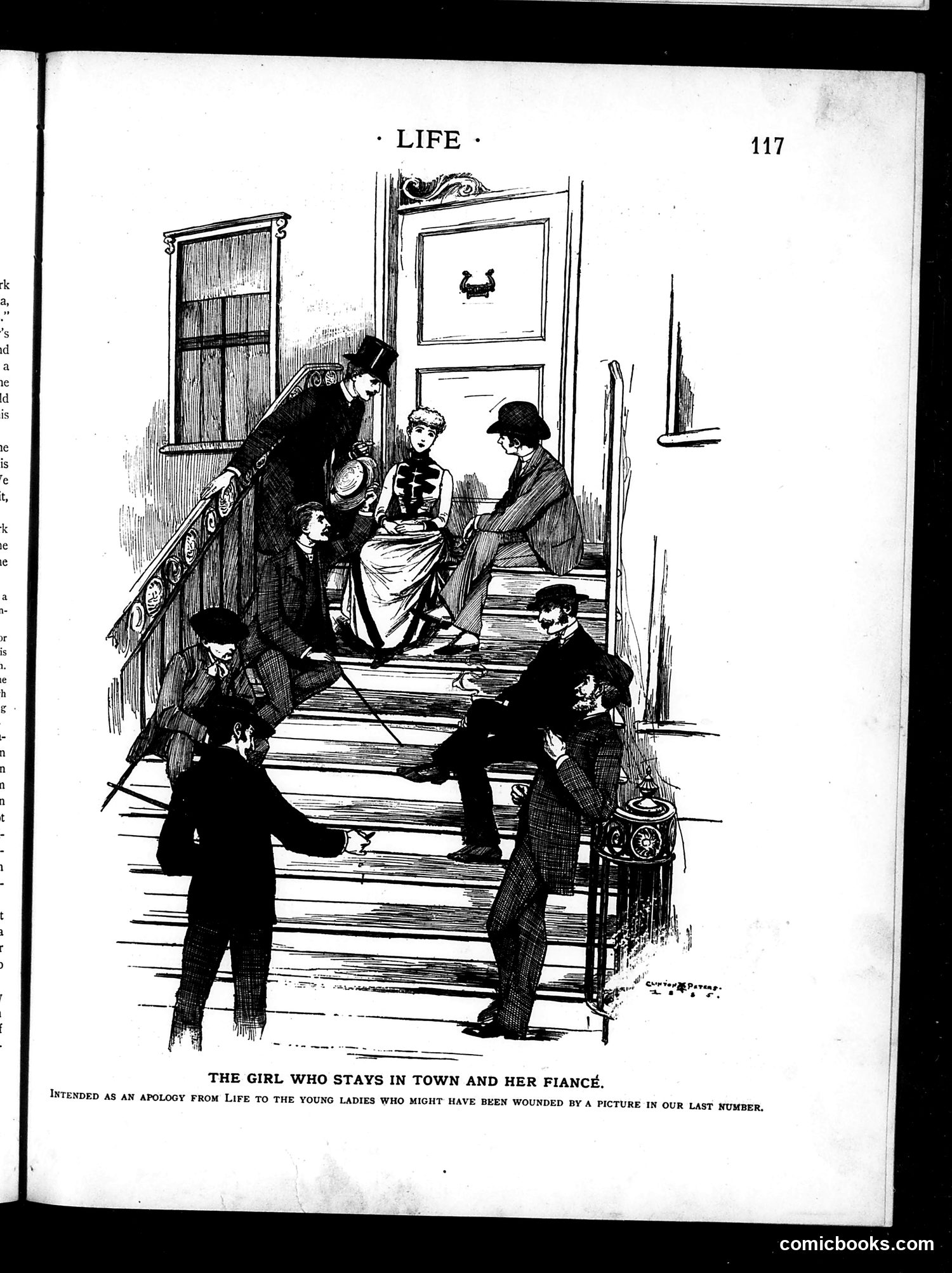
This is a satirical illustration titled "The Girl Who Stays in Town and Her Fiancé," presented as an apology from *Life* magazine to young women potentially offended by a previous issue's content. The scene depicts a stairwell gathering of well-dressed figures from the late 19th or early 20th century. The caption indicates this cartoon responds to criticism about an earlier *Life* illustration that apparently portrayed young women negatively—likely depicting those who remained in cities (rather than vacationing elsewhere during summer) in an unflattering manner. The specific social commentary concerns urban versus country living preferences among the leisure class. The illustration appears to humorously reverse or defend the "city girl" lifestyle, though the exact previous offense remains unclear without that referenced issue.
This page contains literary content rather than political cartoons. The main sections include: 1. **"To an Absent One"** - A romantic poem by C.H. about missing someone during summer. 2. **"The Milk in the Coconut"** - A humorous dialogue between an Old Gentleman and Little Boy about Sunday School attendance, where the boy admits he's excluded because one parent is Catholic and the other Protestant. 3. **Literary criticism and book reviews** discussing realism in American fiction and weakness in novel writing. 4. **"Must Have Home Comforts"** - A comedic dialogue about a traveler seeking boarding accommodations, with the landlord describing unsuitable conditions. The page reflects early-20th-century American life, religious divisions, and literary debates of the era rather than topical political satire.
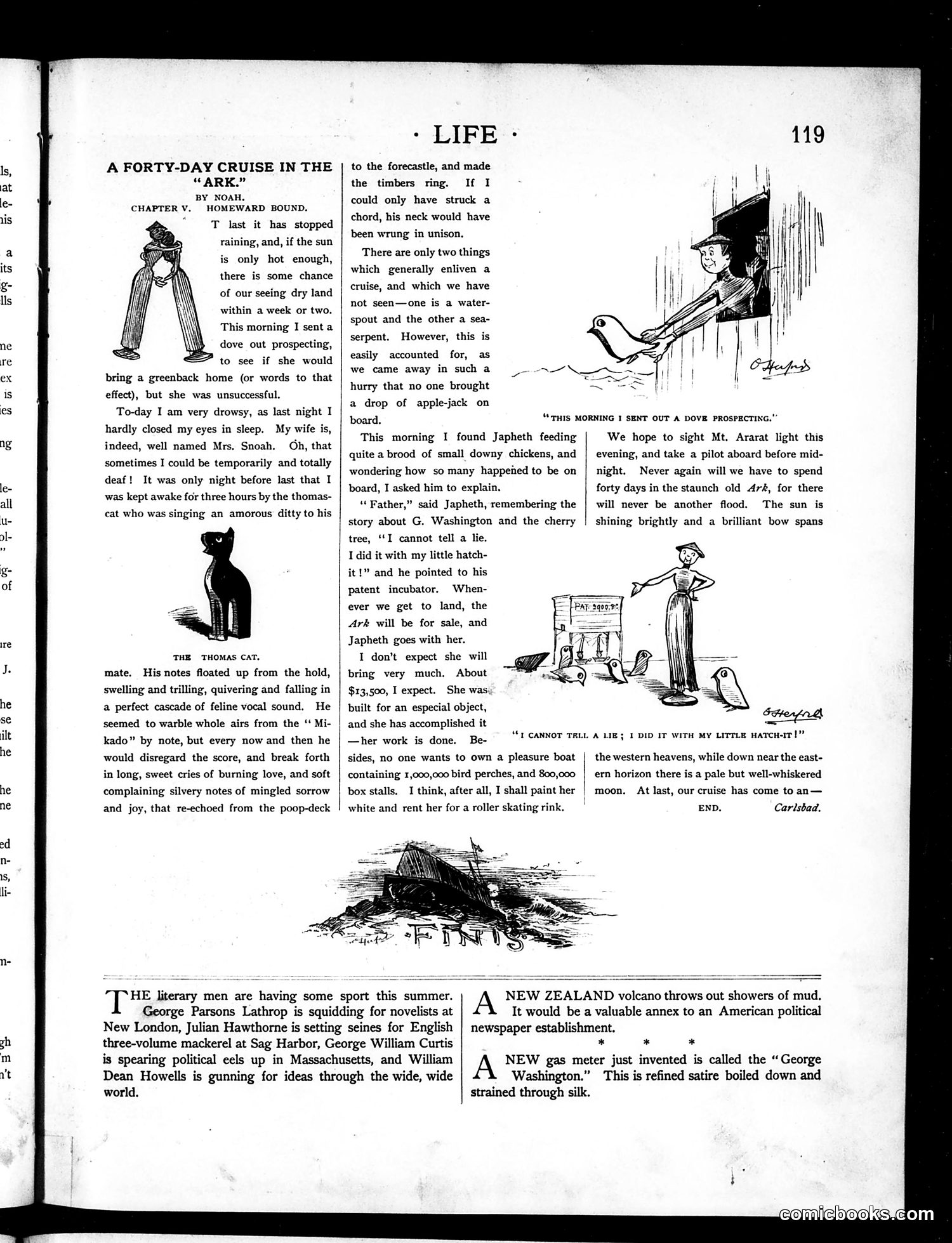
This page contains a serialized story titled "A Forty-Day Cruise in the Ark" by Noah, illustrated with period drawings. The main narrative describes a character named Japheth explaining downy chickens aboard a ship, referencing an incubator and eventual sale of the vessel. Three separate satirical brief items appear at the bottom, mocking: 1. **Literary men**: George Parsons Lathrop, Julian Hawthorne, George William Curtis, and William Dean Howells—prominent American writers engaged in various projects 2. **New Zealand volcano**: Suggesting volcanic mud could improve American newspapers (political satire about journalism quality) 3. **A "George Washington" gas meter**: Refined satire about American commercial innovation being "strained through silk" (overly genteel or diluted) The cartoons appear designed as light social commentary on contemporary American literary and commercial culture.
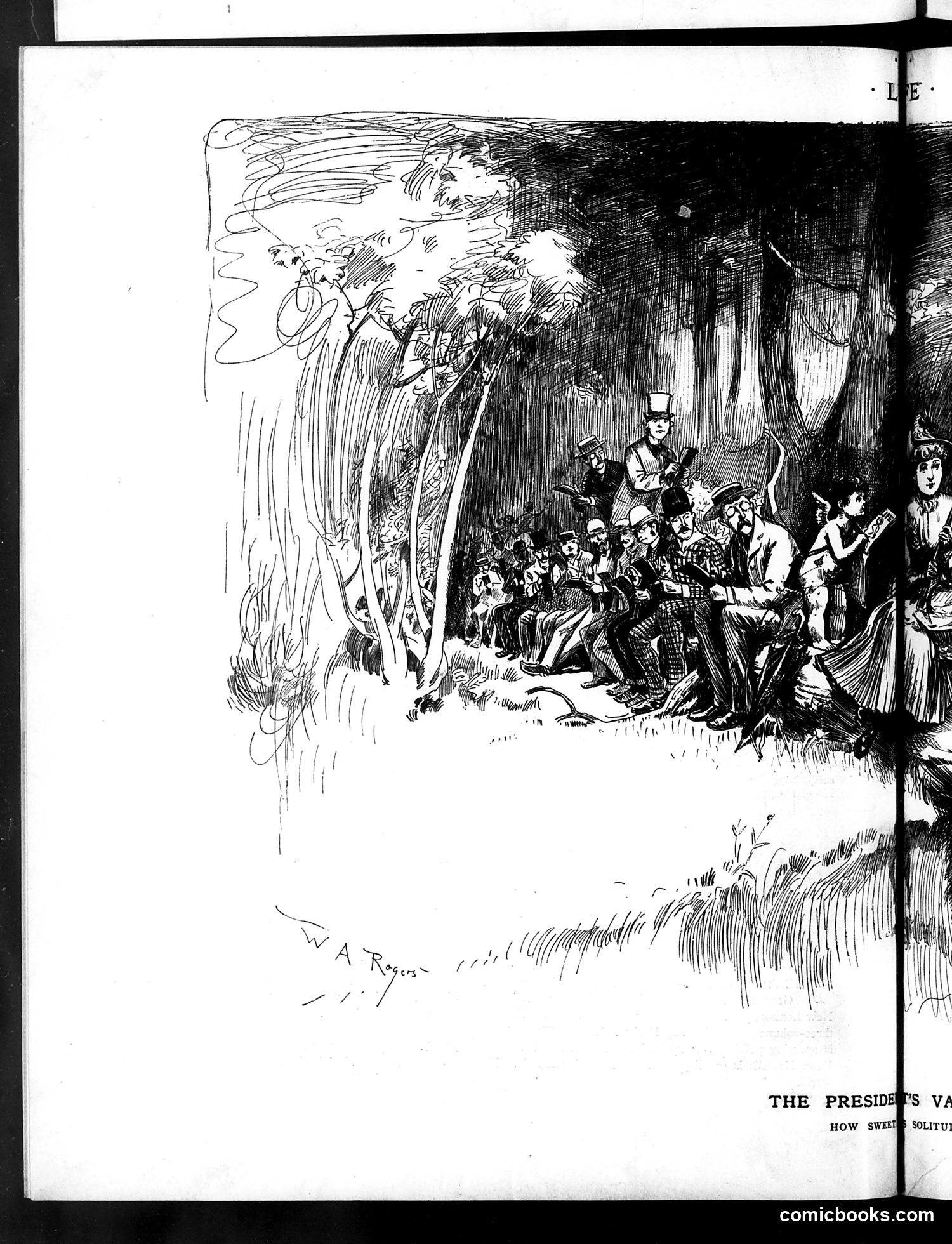
This is a satirical illustration depicting what the partial caption indicates is "THE PRESIDES VA[...]" with a subtitle "HOW SWEET SOLITU[...]" (likely "The President's Vacation" and "How Sweet Solitude"). The cartoon shows a large ethereal face or vision looming over a forest clearing where a crowd of people—appearing to be politicians, journalists, and various attendants in period dress—have gathered. The artist's signature appears to read "W.A. Rogers." The satire likely mocks presidential retreat or vacation attempts: despite seeking solitude in nature, the president is surrounded by an entourage of officials and press. The ghostly face above suggests the president's thoughts or presence dominating even this supposedly private moment. This reflects a common theme in political satire about the impossibility of true privacy for political figures.
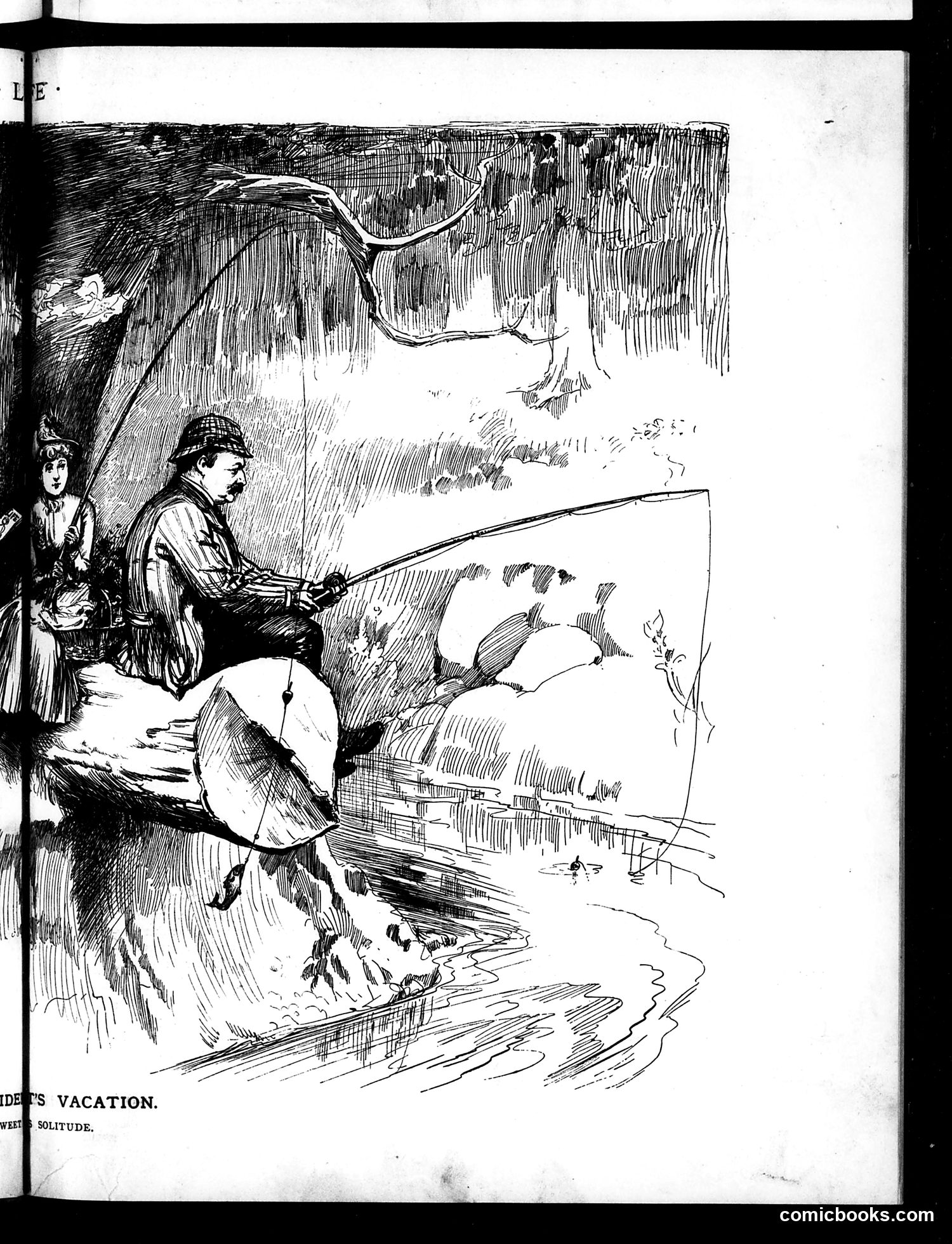
This satirical cartoon depicts a man in formal attire (bowler hat, suit) fishing from a riverbank while a woman stands nearby. The caption reads "AN IDLE'S VACATION" with subtitle "SWEET SOLITUDE." The satire appears to target leisured wealthy individuals—an "idle" person of means—who escape to nature for relaxation. The gentleman's formal dress while fishing humorously underscores the absurdity of maintaining bourgeois propriety even during vacation. The woman's presence (likely his wife or companion) undermines the "solitude" promised by the subtitle, suggesting that escape from social obligation is illusory. This reflects Life magazine's typical social commentary mocking the affectations and contradictions of the privileged classes during the late 19th/early 20th century.
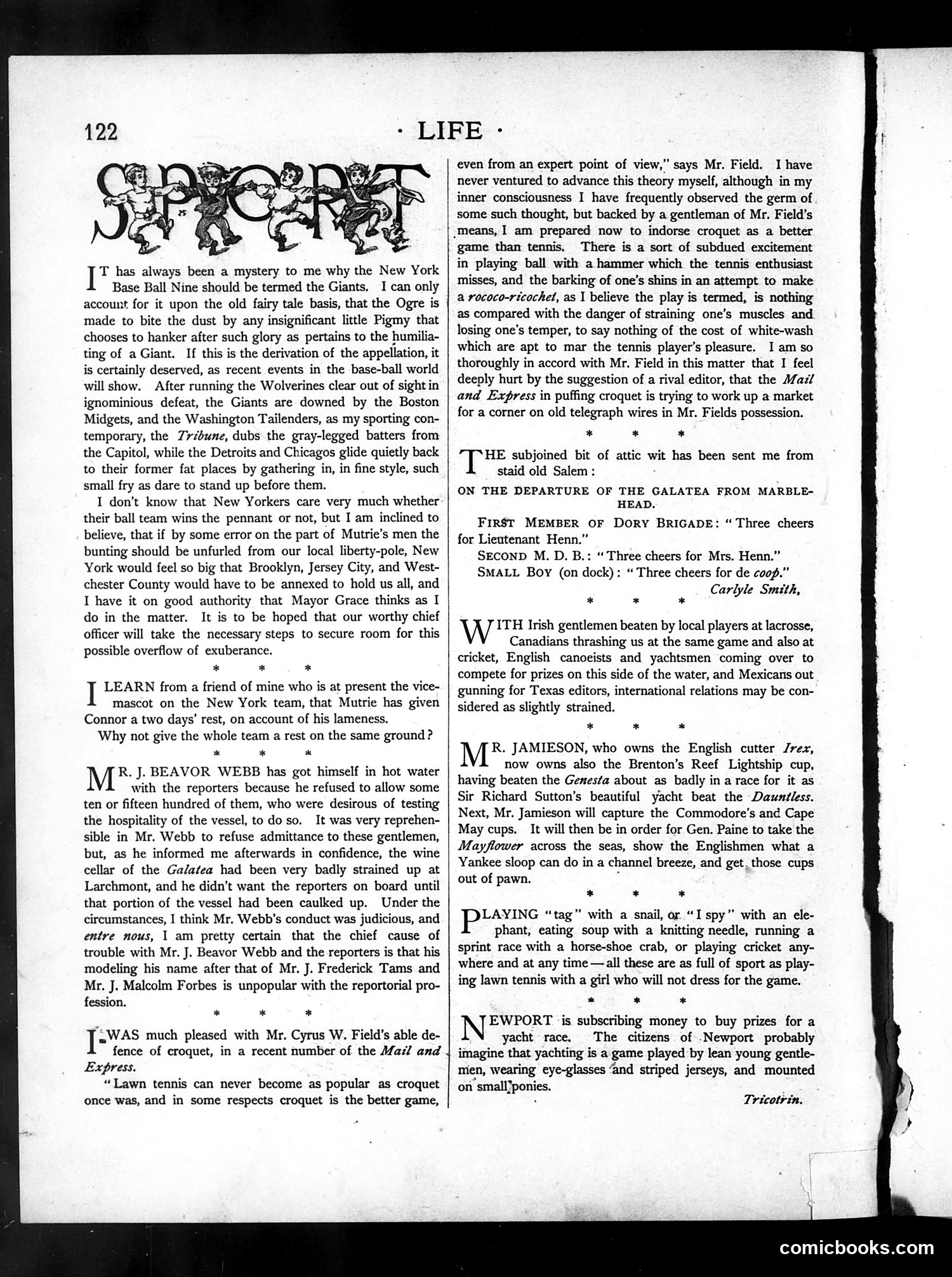
This page consists primarily of **written commentary and gossip**, not political cartoons. The content addresses sports and social topics of the era: The main piece, titled "SPORT," critiques the **New York Giants baseball team's** recent losses to Boston and Washington. The author expresses concern that if Brooklyn, Jersey City, and Westchester weren't annexed to New York, the city might lose interest in the team. Subsequent items discuss **croquet versus tennis** (favoring croquet), **J. Beavor Webb's** refusal to allow reporters aboard his vessel the *Galatea*, various **yacht racing** activities, and sporting competitions involving Irish, Canadian, and English participants. The tone is lighthearted gossip and social commentary typical of Life's satirical approach to contemporary leisure activities and local personalities.
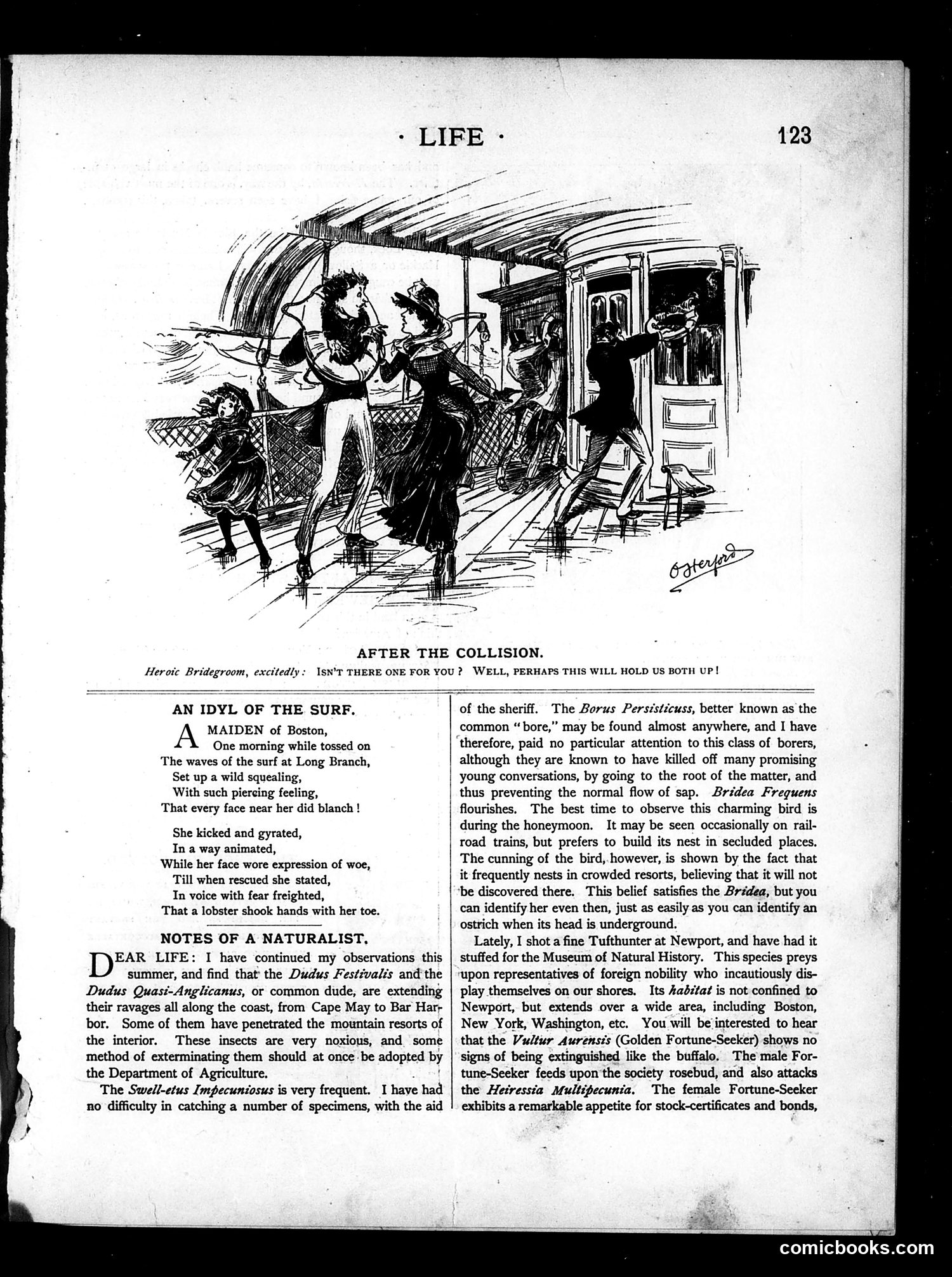
The top cartoon depicts a honeymoon couple in a carriage collision, with the groom offering his hand to catch his bride—a visual pun on marital support. The bulk of the page is naturalist satire targeting wealthy summer vacationers, particularly at fashionable resorts like Long Branch and Newport. The author humorously catalogs social "species" as if they were insects: - **"Dudus" types**: Fashionable young men ("dudes") spreading coastal blight - **"Swell-etus Impecuniosus"**: Well-dressed but penniless loafers - **"Borus Persisticuss"**: Boring people who kill conversations - **"Bridea Frequens"**: Young brides, observed during honeymoons - **"Vudtur Aurensus"**: Gold-digging fortune-seekers preying on society The joke attacks Gilded Age leisure culture, mocking the shallow pretensions and predatory behavior of the wealthy class vacationing at exclusive resorts. The naturalist framing—cataloging social types as harmful species worthy of "extermination"—is the satirical vehicle.
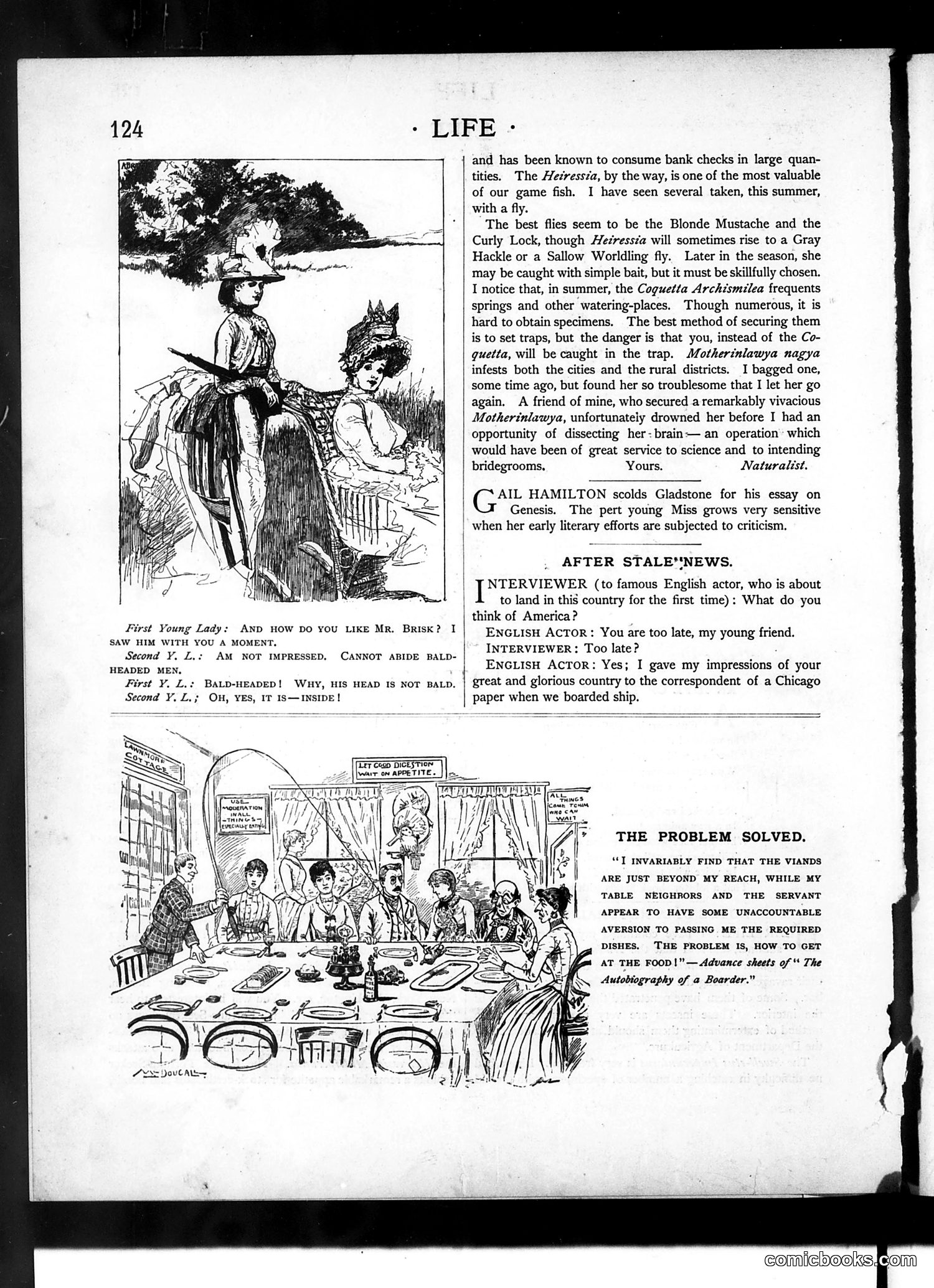
This page contains three satirical pieces typical of late-19th-century American humor: **Top Section**: A naturalist's tongue-in-cheek essay on "game fish," where species names are puns for women ("Heiressia," "Motherinlawya"). The joke satirizes both pretentious naturalist writing and the social reality of women as objects to be "caught"—comparing courtship to fishing. References to "bank checks" suggest wealthy women. **Middle Section**: "After Stale News" features an English actor arriving in America who jokes he's already given his impressions to a Chicago newspaper before even disembarking. This mocks the rapid spread of press coverage and the actor's eagerness for publicity. **Bottom Section**: A cartoon captioned "The Problem Solved" depicts a boarding house dinner where the narrator complains food is always out of reach while servants seem unwilling to serve him. It satirizes the indignities and poor service of boarding house life—a common complaint in this era. All three pieces mock social pretension, gender relations, and middle-class domestic inconveniences.
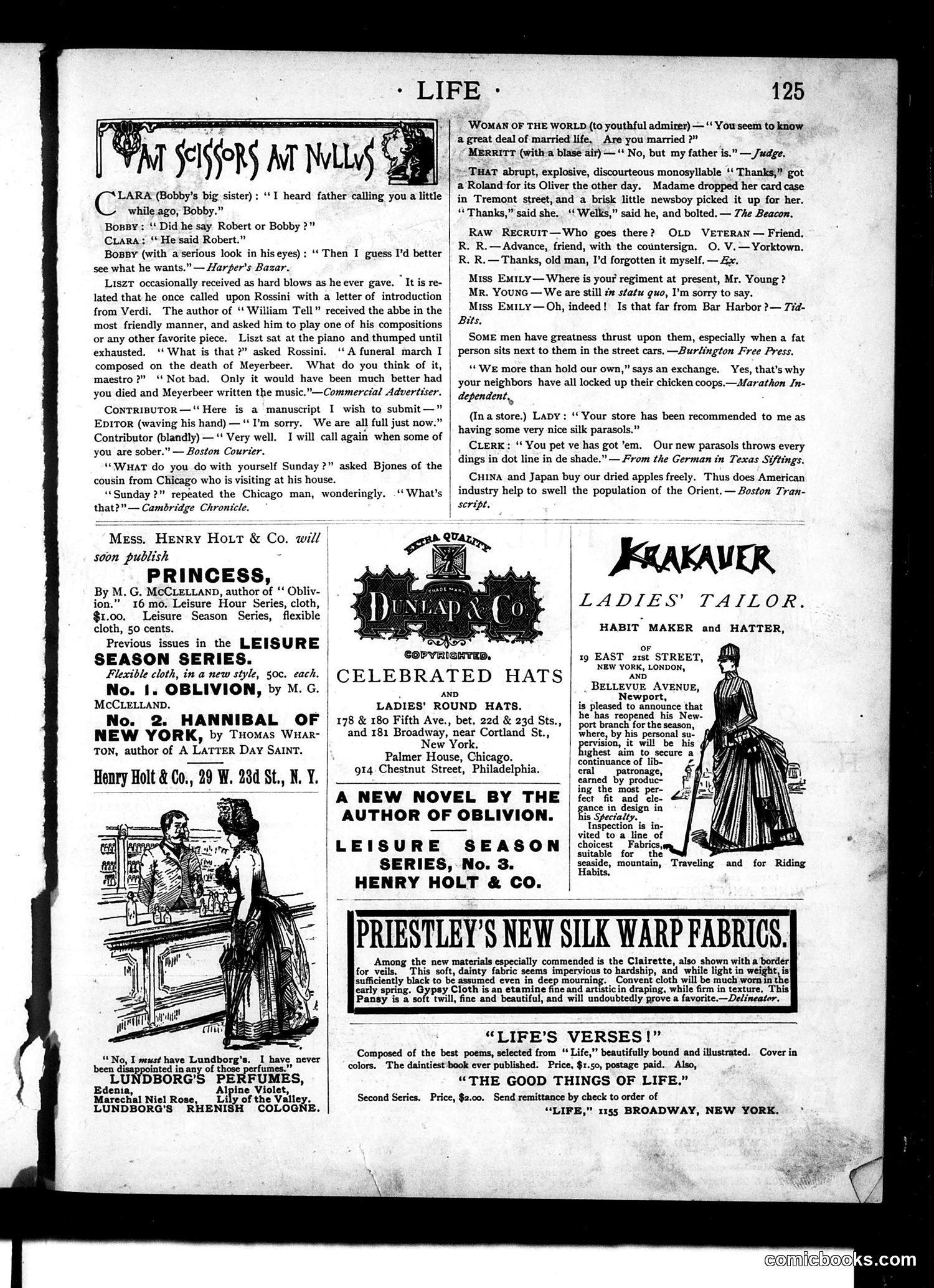
This page from *Life* magazine features multiple brief comedic sketches satirizing Victorian social conventions and human nature. The main cartoon, "Scissors at Nullity," depicts family dynamics: a boy named Bobby learns his father used his formal name "Robert," implying he's in trouble—a familiar domestic scene poking fun at parental authority. Other jokes mock various targets: a man claiming expertise about married life despite being unmarried (satirizing pretentious bluffing); a newsboy's sardonic response to a woman's curt "thanks" (mocking politeness); romantic misunderstandings about geography; and ethnic stereotypes about German and American speech patterns. The page also includes literary advertisements and anecdotes about composer Liszt, emphasizing *Life*'s role as a venue for quick-witted, often cynical observations about contemporary middle-class life. The humor relies on wordplay, irony, and social commentary typical of late 19th-century American satire.
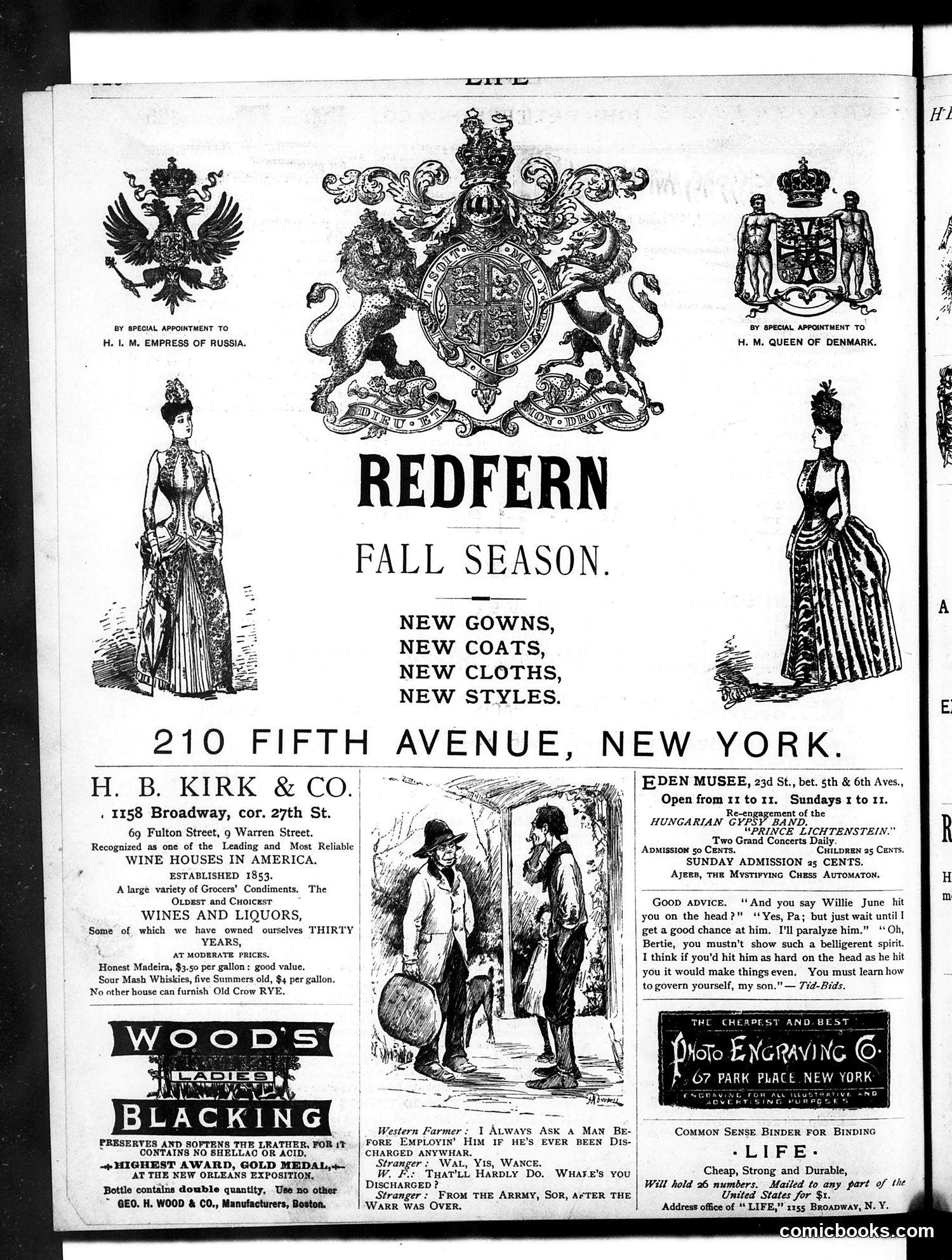
This is primarily an advertising page from *Life* magazine's fall fashion issue, not a political cartoon. The central image is Redfern's fashion advertisement for women's clothing, flanked by royal warrants claiming endorsement by the Empress of Russia and Queen of Denmark—a common marketing practice asserting the prestige of high-end retailers. The page includes various commercial ads (wines, shoe polish, museums) and two small satirical sketches typical of *Life*'s humor: one depicts a rural farmer's employment screening (dialect humor about a soldier discharged after the Civil War), and another shows parental advice about childhood aggression. These are gentle domestic humor pieces rather than political satire. The page reflects Gilded Age consumer culture and class aspirations more than social commentary.
This is primarily an **advertising page** from Life magazine (late 19th century, based on fashion and product styles). The few editorial jokes are brief anecdotes rather than political cartoons. The two short jokes present are mild social humor: 1. **"Not Strong Yet With a Load"** — A young man named Bertie asks Mr. Schuyler if he's strong. When Schuyler demurs, Bertie notes his father said Schuyler had "a heavy load on last night"—a double-entendre suggesting drunkenness. The humor relies on the girl innocently misunderstanding adult slang about intoxication. 2. **The tall man anecdote** — A spectator at a baseball game wants to stretch, but the person behind him complains the man's legs are already too long and obstructing his view. Both are lightweight, non-political social satire typical of Life's humor section. The remainder is advertising for clothing, toiletries, and cigarettes aimed at affluent New York consumers.
This is primarily an **advertising page** rather than a satirical cartoon page. The dominant content is commercial notices for patent medicines and consumer goods typical of the 1880s. The largest advertisement promotes **Perry Davis's Pain Killer**, a patent medicine claiming to cure cholera and summer complaints like diarrhea. The testimonial format—emphasizing "46 Years experience"—was typical advertising rhetoric of this era, when such elixirs were sold without regulation or scientific testing. Other notable ads include: - **Lactated Food**: marketed as a breast milk substitute for infants - **Genuine Vichy**: mineral water prescribed for gout, kidney disease, and digestive issues - **The New American Tricycle** and **Columbia Bicycles**: reflecting the cycling craze of the 1880s - **Spalding sporting goods** and printing supplies The page reflects no evident political satire—it's a straightforward commercial publication showcasing unregulated medical claims and consumer products marketed to Life's educated, affluent readership.