
Life, 1886-08-26 · page 6 of 16
Life — August 26, 1886 — page 6: what you’re looking at
What you’re looking at
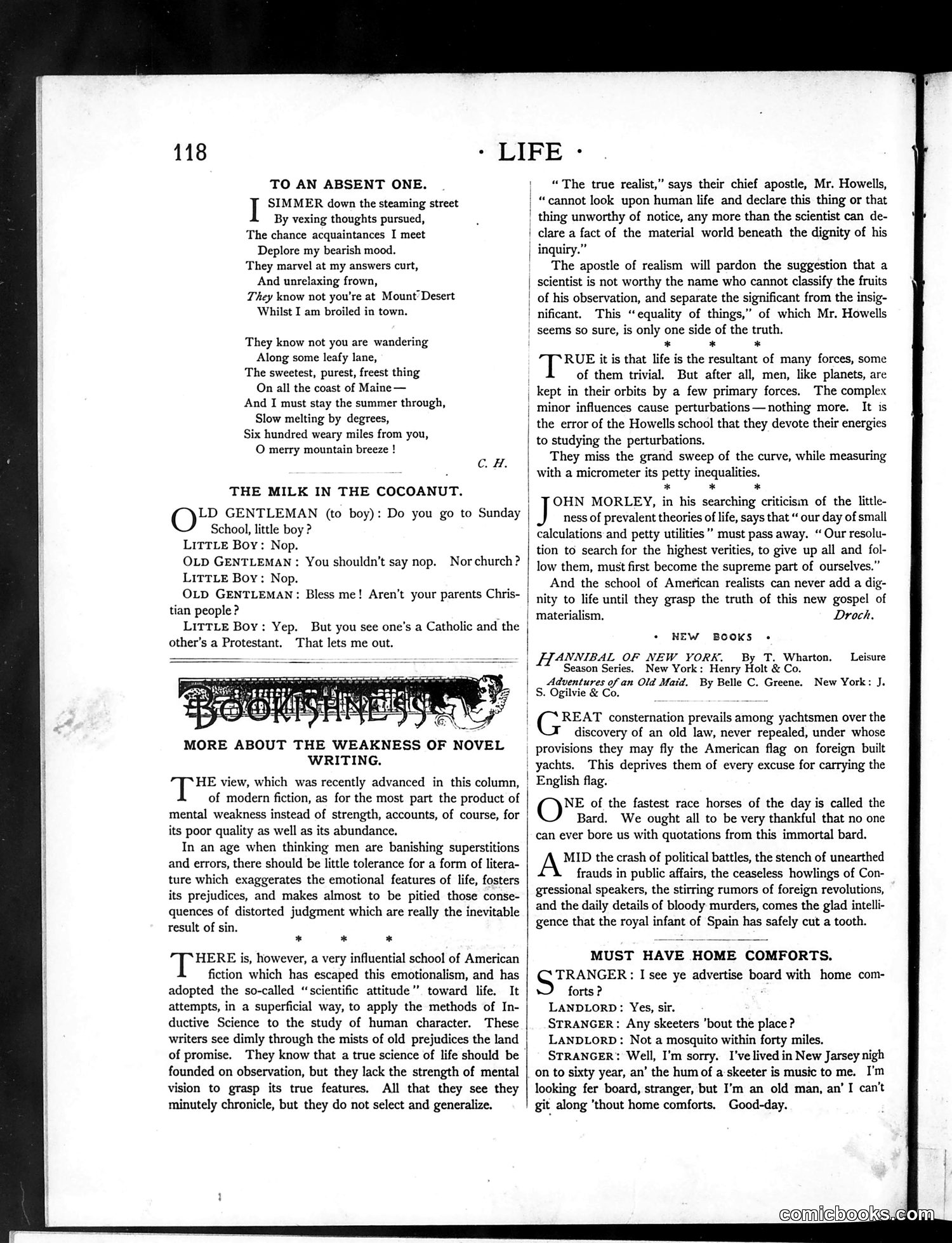
This page contains literary content rather than political cartoons. The main sections include: 1. **"To an Absent One"** - A romantic poem by C.H. about missing someone during summer. 2. **"The Milk in the Coconut"** - A humorous dialogue between an Old Gentleman and Little Boy about Sunday School attendance, where the boy admits he's excluded because one parent is Catholic and the other Protestant. 3. **Literary criticism and book reviews** discussing realism in American fiction and weakness in novel writing. 4. **"Must Have Home Comforts"** - A comedic dialogue about a traveler seeking boarding accommodations, with the landlord describing unsuitable conditions. The page reflects early-20th-century American life, religious divisions, and literary debates of the era rather than topical political satire.
📄 Transcribed text from this page (OCR, searchable)
Machine-transcribed from the original scan — historical spelling and the odd misread are preserved.
: LIFE - TO AN ABSENT ONE. SIMMER down the steaming street By vexing thoughts pursued, The chance acquaintances I meet Deplore my bearish mood. They marvel at my answers curt, And unrelaxing frown, They know not you're at Mount’ Desert Whilst I am broiled in town. They know not you are wandering Along some leafy lane, The sweetest, purest, freest thing On all the coast of Maine— And I must stay the summer through, Slow melting by degrees, Six hundred weary miles from you, O merry mountain breeze ! THE MILK IN THE COCOANUT. LD GENTLEMAN (to boy): Do you go to Sunday | School, little boy ? LitTLE Boy: Nop. OLD GENTLEMAN: You shouldn’t say nop. Nor church? LITTLE Boy: Nop. OLD GENTLEMAN: Bless me! Aren't your parents Chris- | tian people ? LITTLE Boy: Yep. But you see one’s a Catholic and the other's a Protestant. That lets me out. MORE ABOUT THE WEAKNESS OF NOVEL WRITING. “The true realist,” says their chief apostle, Mr. Howells, | “cannot look upon human life and declare this thing or that | thing unworthy of notice, any more than the scientist can de- | clare a fact of the material world beneath the dignity of his minor influences cause perturbations — nothing more. inquiry.” The apostle of realism will pardon the suggestion that a scientist is not worthy the name who cannot classify the fruits of his observation, and separate the significant from the insig- nificant. This “equality of things,” of which Mr. Howells seems so sure, is only one side of the truth. * * * RUE it is that life is the resultant of many forces, some of them trivial. But after all, men, like planets, are kept in their orbits by a few primary forces. The complex It is the error of the Howells school that they devote their energies to studying the perturbations. They miss the grand sweep of the curve, while measuring | with a micrometer its petty inequalities. | materialism. * * * OHN MORLEY, in his searching criticism of the little- ness of prevalent theories of life, says that “ our day of small calculations and petty utilities” must pass away. “ Our resolu- tion to search for the highest verities, to give up all and fol- low them, must first become the supreme part of ourselves.” And the school of American realists can never add a dig- nity to life until they grasp the truth of this new gospel of Droch. + NEW BOOKS + FL ANNIBAL OF NEW YORK. By T. Wharton. Season Series. New York: Henry Holt & Co. Adventures of an Old Maid. By Belle C. Greene. Leisure New York: J. | S. Ogilvie & Co. T= view, which was recently advanced in this column, | of modern fiction, as for the most part the product of mental weakness instead of strength, accounts, of course, for its poor quality as well as its abundance. In an age when thinking men are banishing superstitions and errors, there should be little tolerance for a form of litera- ture which exaggerates the emotional features of life, fosters its prejudices, and makes almost to be pitied those conse- quences of distorted judgment which are really the inevitable result of sin. * * * HERE is, however, a very influential school of American fiction which has escaped this emotionalism, and has adopted the so-called “scientific attitude” toward life. It attempts, in a superficial way, to apply the methods of In- ductive Science to the study of human character. These writers see dimly through the mists of old prejudices the land of promise. They know that a true science of life should be founded on observation, but they lack the strength of mental vision to grasp its true features, All that they see they minutely chronicle, but they do not select and generalize. REAT consternation prevails among yachtsmen over the discovery of an old law, never repealed, under whose provisions they may fly the American flag on foreign built yachts. This deprives them of every excuse for carrying the English flag. NE of the fastest race horses of the day is called the Bard. We ought all to be very thankful that no one can ever bore us with quotations from this immortal bard. MID the crash of political battles, the stench of unearthed frauds in public affairs, the ceaseless howlings of Con- gressional speakers, the stirring rumors of foreign revolutions, and the daily details of bloody murders, comes the glad intelli- gence that the royal infant of Spain has safely cut a tooth. MUST HAVE HOME COMFORTS. TRANGER: I see ye advertise board with home com- forts ? LANDLORD: Yes, sir. STRANGER: Any skeeters ‘bout the place ? LANDLORD: Not a mosquito within forty miles. STRANGER: Well, I'm sorry. I've lived in New Jarsey nigh on to sixty year, an’ the hum of a skeeter is music to me. I'm looking fer board, stranger, but I’m an old man, an’ I can't git along ‘thout home comforts. Good-day.