
Life, 1886-08-26 · page 11 of 16
Life — August 26, 1886 — page 11: what you’re looking at
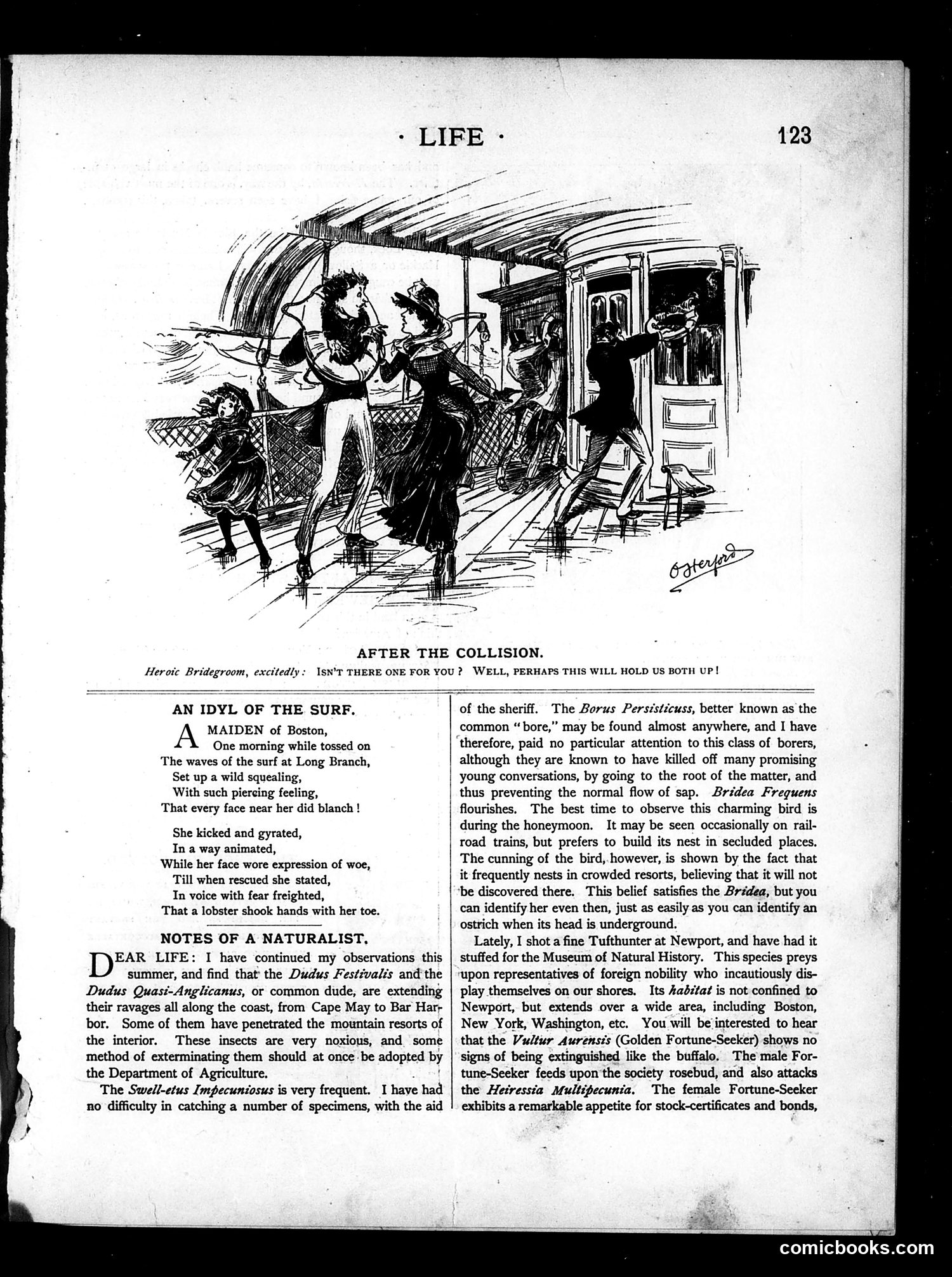
What you’re looking at
The top cartoon depicts a honeymoon couple in a carriage collision, with the groom offering his hand to catch his bride—a visual pun on marital support. The bulk of the page is naturalist satire targeting wealthy summer vacationers, particularly at fashionable resorts like Long Branch and Newport. The author humorously catalogs social "species" as if they were insects: - **"Dudus" types**: Fashionable young men ("dudes") spreading coastal blight - **"Swell-etus Impecuniosus"**: Well-dressed but penniless loafers - **"Borus Persisticuss"**: Boring people who kill conversations - **"Bridea Frequens"**: Young brides, observed during honeymoons - **"Vudtur Aurensus"**: Gold-digging fortune-seekers preying on society The joke attacks Gilded Age leisure culture, mocking the shallow pretensions and predatory behavior of the wealthy class vacationing at exclusive resorts. The naturalist framing—cataloging social types as harmful species worthy of "extermination"—is the satirical vehicle.
📄 Transcribed text from this page (OCR, searchable)
Machine-transcribed from the original scan — historical spelling and the odd misread are preserved.
AFTER THE COLLISION. Heroic Bridegroom, excitedly: ISN'T THERE ONE FOR YOU? WELL, PERHAPS THIS WILL HOLD US BOTH UP! AN IDYL OF THE SURF. MAIDEN of Boston, One morning while tossed on The waves of the surf at Long Branch, Set up a wild squealing, With such piercing feeling, That every face near her did blanch ! She kicked and gyrated, In a way animated, While her face wore expression of woe, Till when rescued she stated, In voice with fear freighted, That a lobster shook hands with her toe. NOTES OF A NATURALIST, EAR LIFE: I have continued my observations this summer, and find that: the Dudus Festévalis and the Dudus Quast-Anglicanus, or common dude, are extending their ravages all along the coast, from Cape May to Bar Har, bor. Some of them have penetrated the mountain resorts of the interior. These insects are very noxious, and some method of exterminating them should at once be adopted by the Department of Agriculture. beget The Swell-etus Impecuniosus is very frequent. 1 have had no difficulty in catching a number of specimens, with the aid of the sheriff. The Borus Persisticuss, better known as the common “bore,” may be found almost anywhere, and I have ‘therefore, paid no particular attention to this class of borers, although they are known to have killed off many promising young conversations, by going to the root of the matter, and thus preventing the normal flow of sap. Bridea Frequens flourishes. The best time to observe this charming bird is during the honeymoon. It may be seen occasionally on rail- road trains, but prefers to build its nest in secluded places. The cunning of the bird,. however, is shown by the fact that it frequently nests in crowded resorts, believing that it will not ‘be discovered there. This belief satisfies the Brédea, but you can identify her even then, just as easily as you can identify an ostrich when its head is underground. Lately, I shot a fine Tufthunter at Newport, and have had it stuffed for the Museum of Natural History. This species preys upon representatives of foreign nobility who incautiously dis- play themselves on our shores. Its Aadztat is not confined to Newport, but extends over a wide area, including Boston, New York, Washington, etc. You.will be'interested to hear that the Vudtur Aurens?s (Golden Fortune-Seeker) shows no signs of being extinguished like the buffalo, The male For- tune-Seeker feeds upon'the society rosebud, and also attacks the Hetressia Multipecunia, The female Fortune-Seeker exhibits a remarkable appetite for stock-certificates and bonds, comicbooks.com