
A complete issue · 16 pages · 1886
Life — August 19, 1886
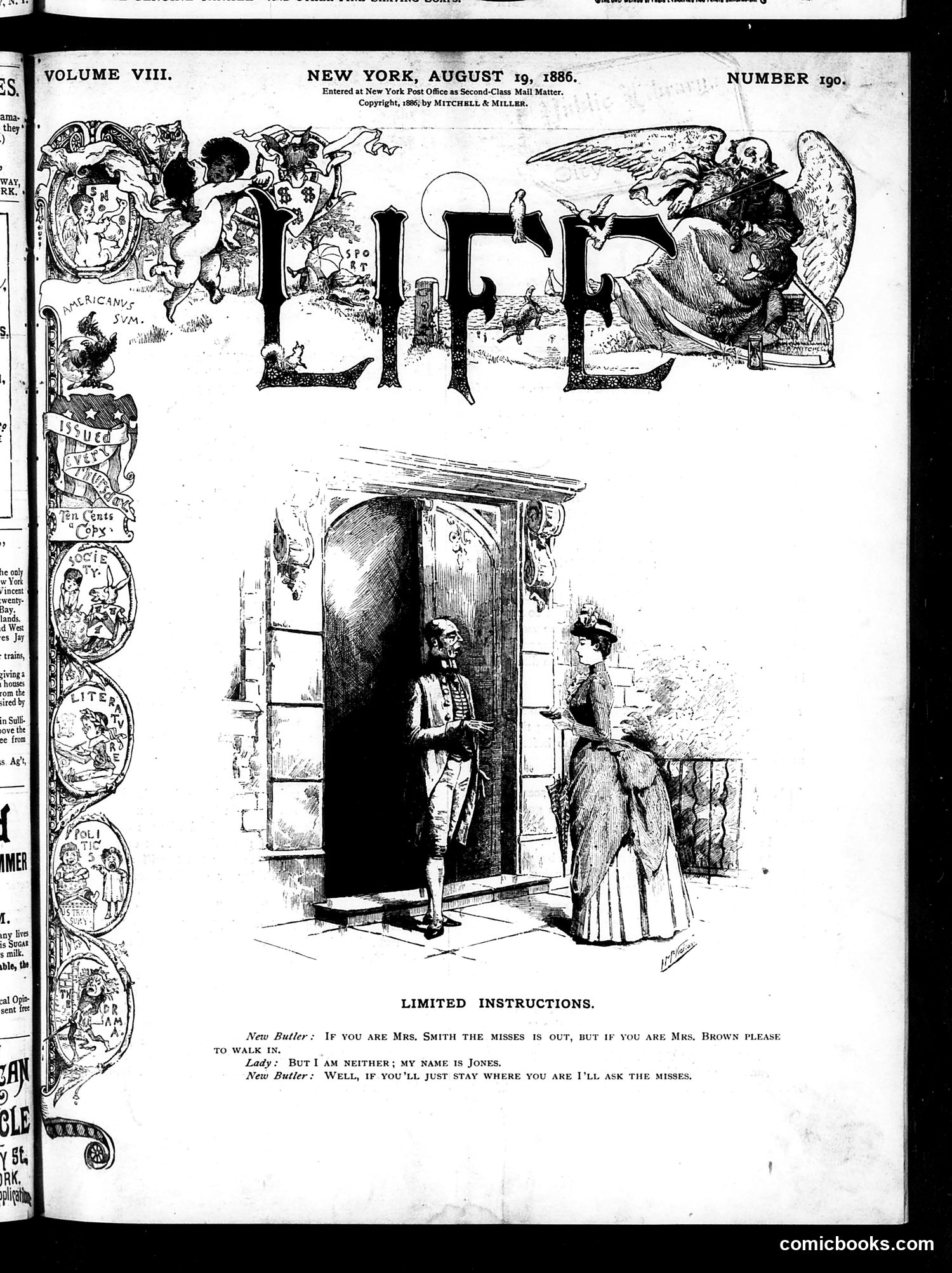
This domestic comedy sketch satirizes class distinctions and servant employment in the 1880s. A new butler, uncertain about his duties, receives confusing instructions from a lady of the house: he should admit the Misses Smith if they call, but *not* admit Mrs. Brown—unless the lady's name is actually Mrs. Jones, in which case he should defer to her judgment about which visitors to accept. The humor lies in the butler's bewilderment facing these contradictory, socially-coded rules about which callers warrant admission. The joke mocks both the arbitrary social hierarchies governing Victorian households and the difficulty servants faced navigating their employers' intricate social pretensions and petty distinctions between acceptable and unacceptable visitors.
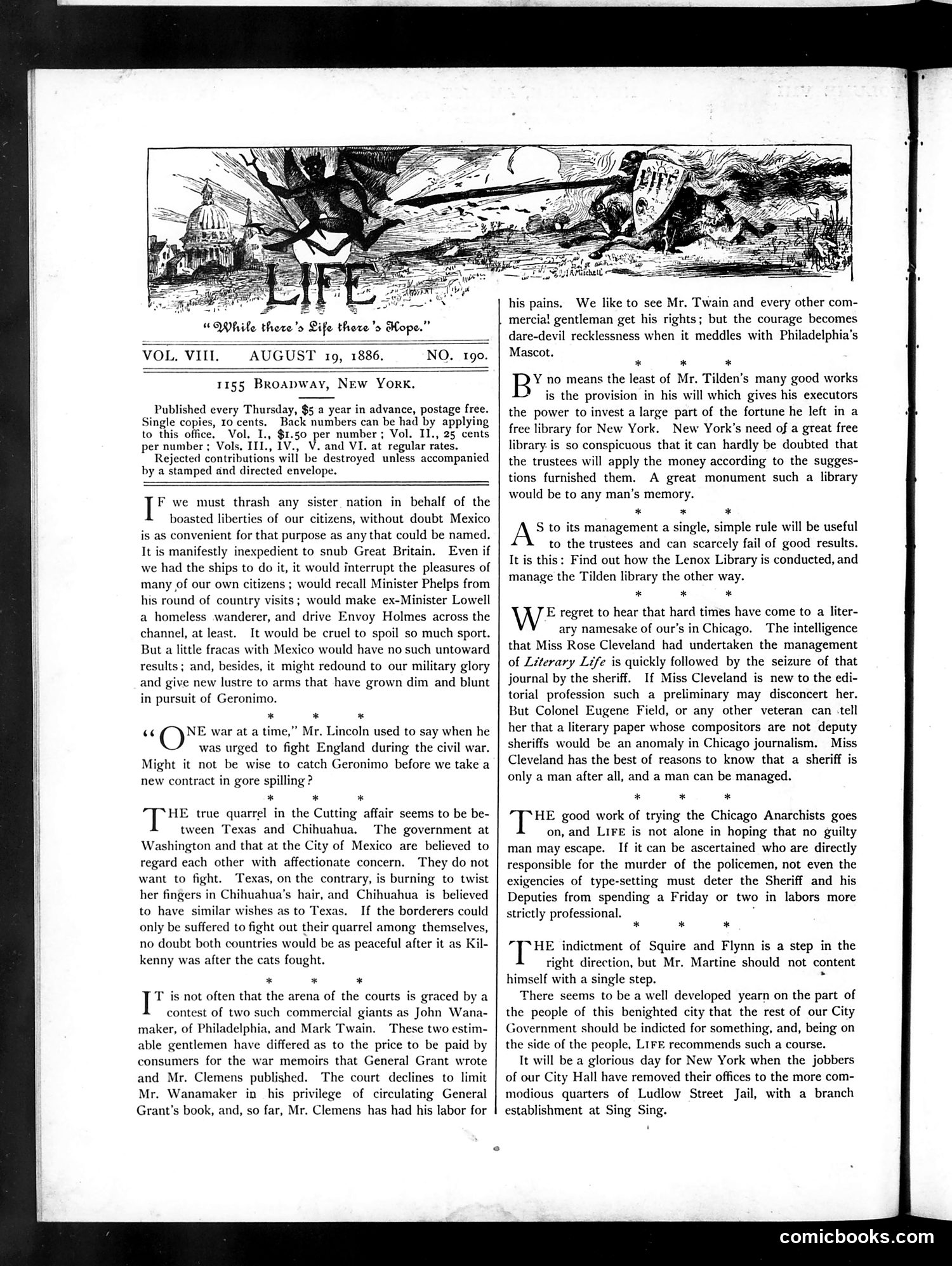
The masthead cartoon depicts a allegorical figure of "Life" herself—a winged woman—surveying a landscape. The image reinforces the magazine's satirical mission. The editorial content addresses several contemporary issues: a dispute between the U.S. government and Mexico over border tensions; a legal battle between Philadelphia businessman John Wanamaker and Mark Twain over memoir publication rights; and Chicago anarchist violence following the Haymarket affair. The magazine criticizes government overreach regarding Mexico, defends commercial rights (backing Twain and Wanamaker), and expresses concern about anarchist activities while acknowledging legitimate labor grievances. The tone is conservative but not entirely unsympathetic to workers' concerns.
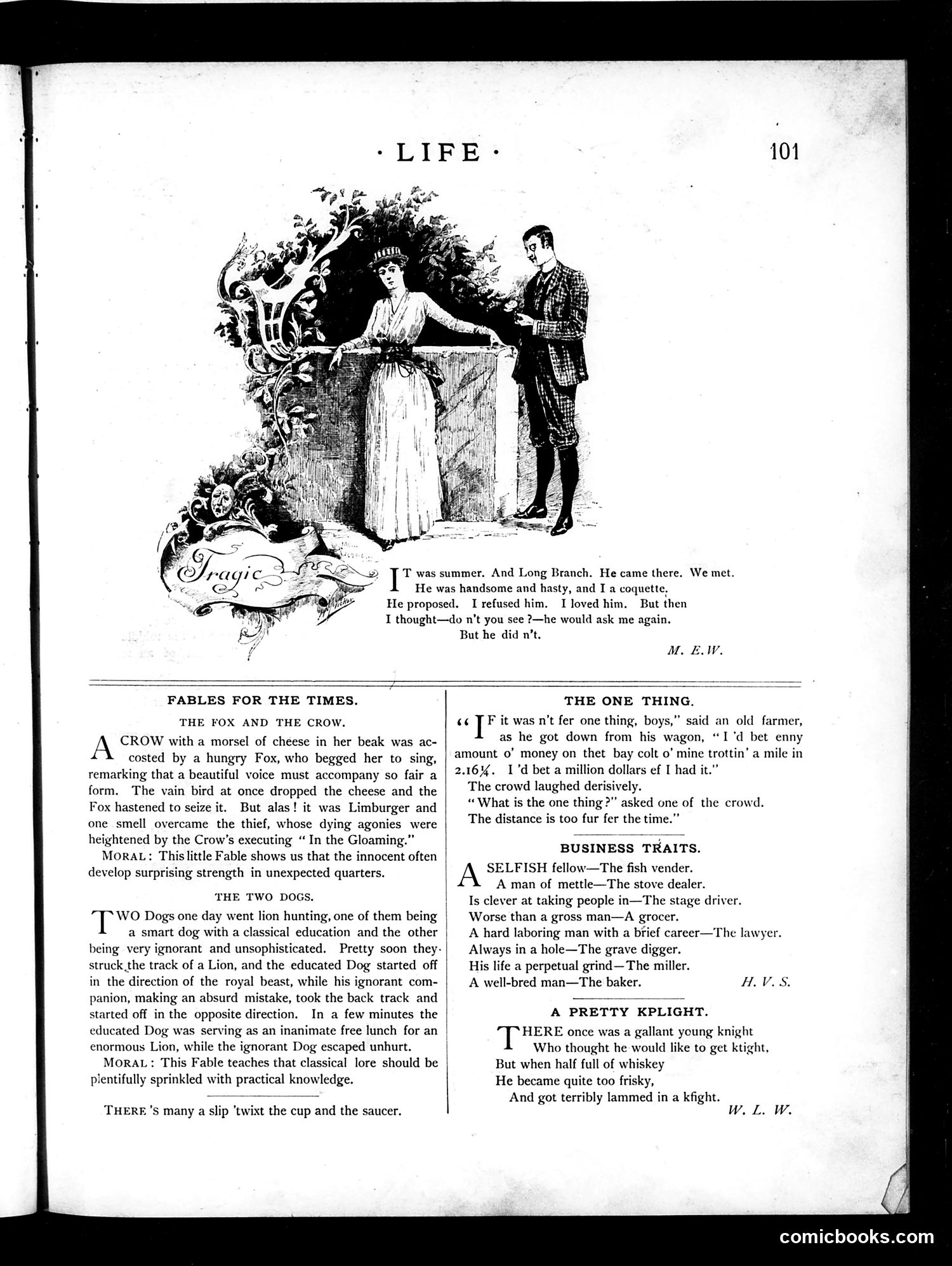
This page contains several unrelated short satirical pieces rather than a single unified cartoon. The illustrated header titled "Tragic" depicts a romantic scene—a woman at a balcony railing rejecting a man's proposal, with the accompanying verse by M.E.W. describing a summer romance where she refused a handsome suitor, expecting him to propose again but he didn't. Below are four brief fables and humorous pieces: "The Fox and the Crow" (classic Aesop retelling), "The Two Dogs" (contrasting educated versus ignorant dogs), "The One Thing" (a farmer's boast about mining profits), and "Business Traits" (sardonic character types), plus "A Pretty Kiplight" (a drinking-related mishap). These are general social satire without specific political references—typical early 20th-century Life magazine humor targeting human folly and vanity.
The page contains satirical short items rather than a single cartoon. The header illustration shows animals labeled "By the Way," establishing a humorous tone. Key satirical items include: - **Letter writing risks**: Warning that careless writing can cause harm, with a quote from editor Rollin Squire - **Banking in Honduras**: Mocking an impractical American banking venture - **Columbia College admissions**: Joking about women baseball players being admitted - **Magazine criticism**: Praising the *Texas Siftings* magazine critic - **"The Sun" spelling joke**: A pun on how the newspaper office spells "cat" as "CAD" - **Political ambitions**: Noting Mr. Flower's willingness to enter politics after a death - **Irish staffing**: Commenting on Chinamen in San Francisco versus Irishmen The satire targets American business ventures, higher education changes, journalistic pretensions, and ethnic demographics of the era—typical Life magazine social commentary circa late 1800s.
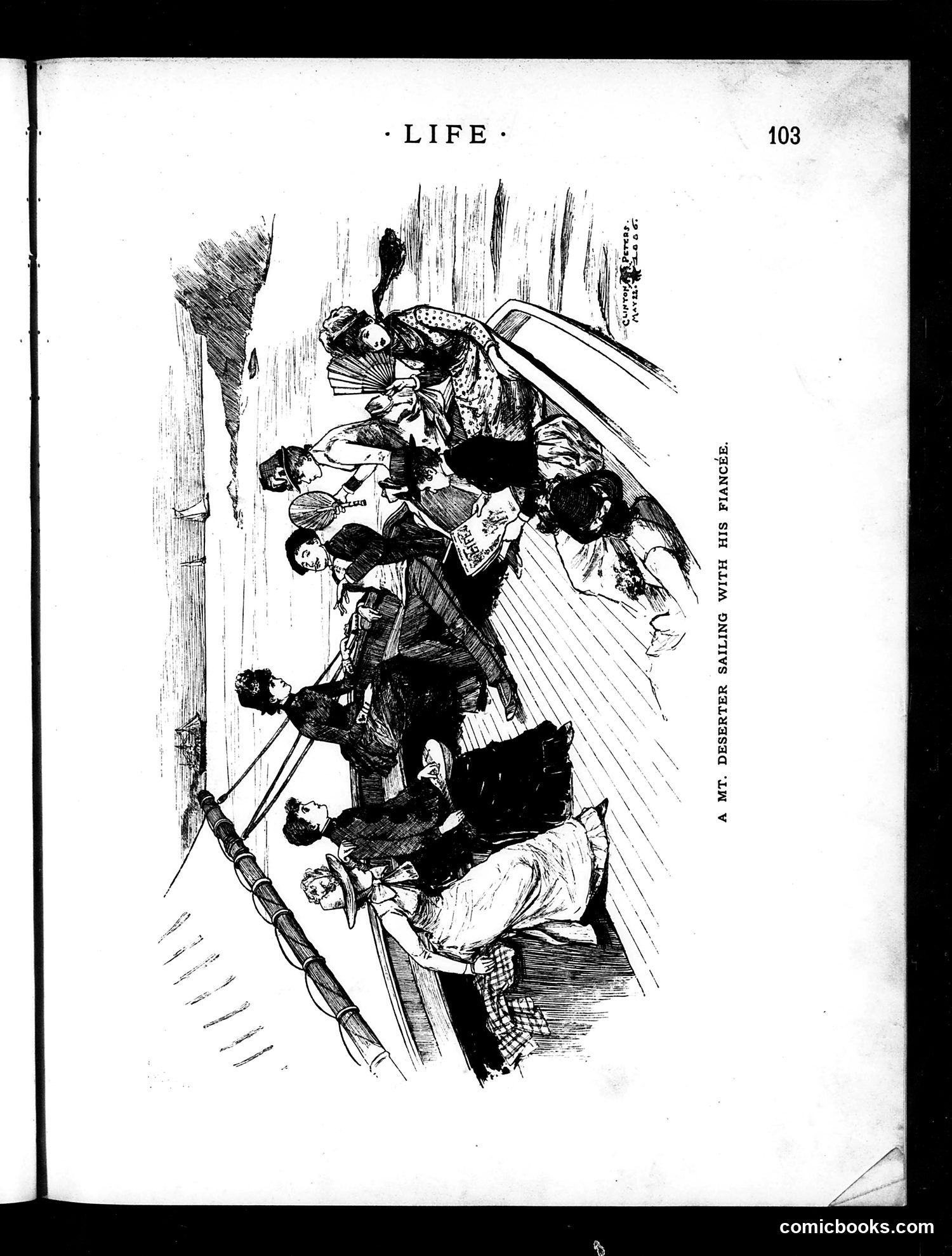
This is a satirical cartoon showing a man abandoning a sinking ship, carrying wooden planks (his "planks" - a pun). The title suggests he's a "Mt. Deserter" fleeing from Mount Desert, likely referencing a specific political or social figure who abandoned responsibilities or principles. The cartoon depicts him escaping while others remain aboard, drowning in the background. The style of dress and illustration suggests early 20th-century American satire. Without additional context about which specific "Mt. Deserter" or historical event this references, the general message is clear: satirizing someone for cowardly abandonment of duty or constituents during crisis, using the ship-sinking metaphor common in political cartoons of the era.
This page from *Life* magazine consists primarily of **literary criticism and humor pieces**, not political cartoons. The content includes: 1. **"My Pictures"** — A poem critiquing character sketches, likely of women in contemporary fiction 2. **A review of Miss M.G. McClelland's novel "Oblivion"** — praising her character work and observational skill while noting the story weakens when action moves to Washington 3. **"A Mild Howl"** and **"A Reasonable Supposition"** — brief satirical dialogues about a bartender refusing service and a merchant's joke about debt The page contains **no identifiable political cartoons or caricatures**. It's primarily literary commentary typical of *Life*'s satirical approach to contemporary novels and social behavior, employing wit rather than visual satire.
This page contains satirical commentary rather than political cartoons. The main sections include: **"The Dog Days Have Come"** — A brief poem mocking someone's "wrath" and preference for "a favorite style" of living, suggesting domestic discord. **"It Wouldn't Interfere"** — A dialogue between an Army officer and Secretary of War about a West Point graduate's requested transfer from East to West. The joke satirizes bureaucratic indifference to military assignments. **Additional quips** mock various subjects: a Pennsylvania banker's humorless nature, English political candidates "running" for office (versus Americans "standing"), drunk policemen, and a Kentucky nut with no shell. The accompanying illustrations show domestic scenes and characters, reinforcing the satirical tone. The humor targets bureaucracy, social pretension, and absurdity rather than specific historical events.
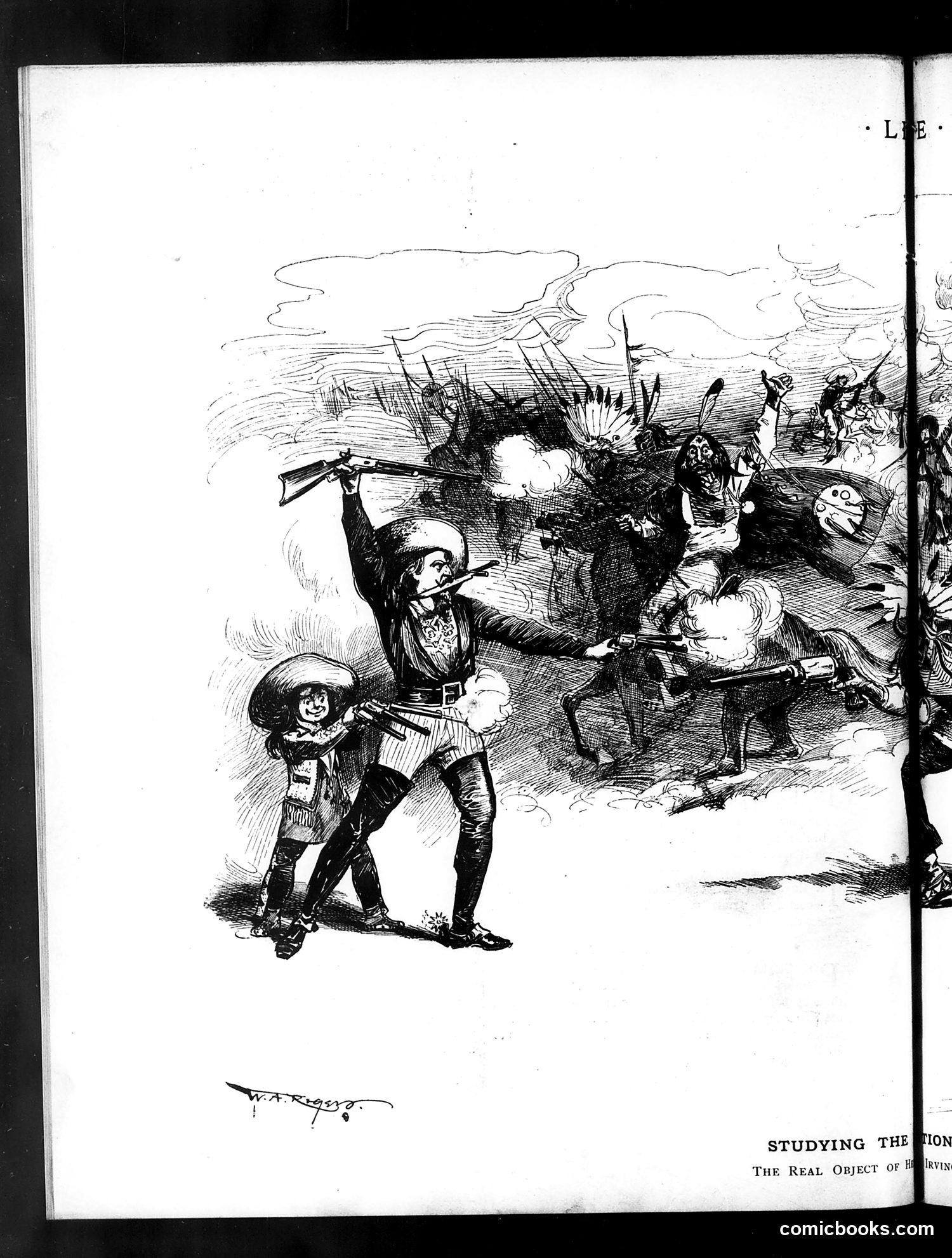
This satirical illustration depicts a military figure in the foreground firing a rifle at a chaotic group of caricatured demons or devils in the background. The title reads "STUDYING THE [REAL OBJECT OF HIS] IRVING" (text partially cut off). The cartoon appears to be 19th-century political satire, likely attacking a specific public figure named Irving (possibly Washington Irving or another contemporary). The military protagonist seems to represent virtue or order fighting against evil or corruption, depicted through exaggerated demonic caricatures. The satirical point likely critiques Irving's actual activities or positions, though without the complete title and full historical context, the precise political target remains unclear. The artistic style and imagery suggest this addresses moral or political wrongdoing worthy of combat.
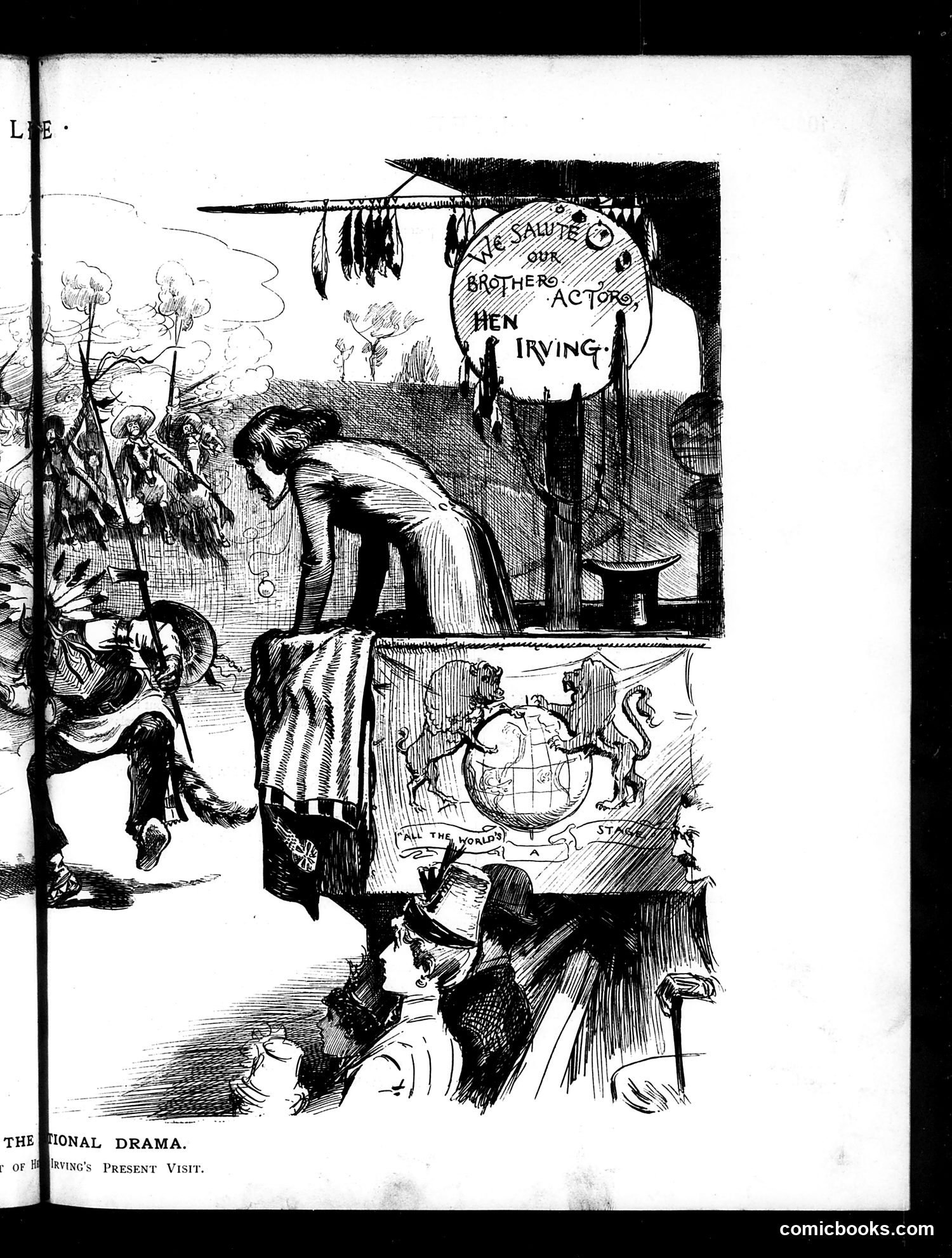
This page appears to be from Life magazine's satirical section titled "The National Drama" concerning "Irving's Present Visit." The central cartoon depicts a scene with a sign reading "We Salute Our Brother Actor Henry Irving," referencing the famous English actor Henry Irving's visit to America. The illustration shows what appears to be theatrical figures and audience members in a satirical take on Irving's reception. The cartoon likely comments on American attitudes toward visiting English theatrical celebrities—possibly mocking excessive reverence toward foreign actors or the theatrical world's pretensions. The lower portion shows additional figures, possibly audience members or other theatrical personalities reacting to Irving's presence. Without more context about Irving's specific visit date, the exact satirical point remains somewhat unclear, though it appears to lampoon American celebrity worship and theatrical culture.
This page contains primarily literary and editorial content rather than political cartoons. The left side features "Love's Larceny," a poem by Arthur W. Gundry about Cupid painting a lady's portrait. Below it is a decorative "SPORT" header with cherubs, followed by commentary on the Detroit baseball team's poor performance and "heavy batting" as explanation for their losses. The right side contains reader correspondence addressing fishing techniques, yacht racing design preferences, and a note correcting typographical errors attributed to Mr. John L. Sullivan of Boston. The final item comments on American Eagle lacrosse team's poor sportsmanship toward visiting Irish players. This appears to be a general-interest satirical magazine page mixing humor, sports commentary, and reader letters rather than focused political satire.
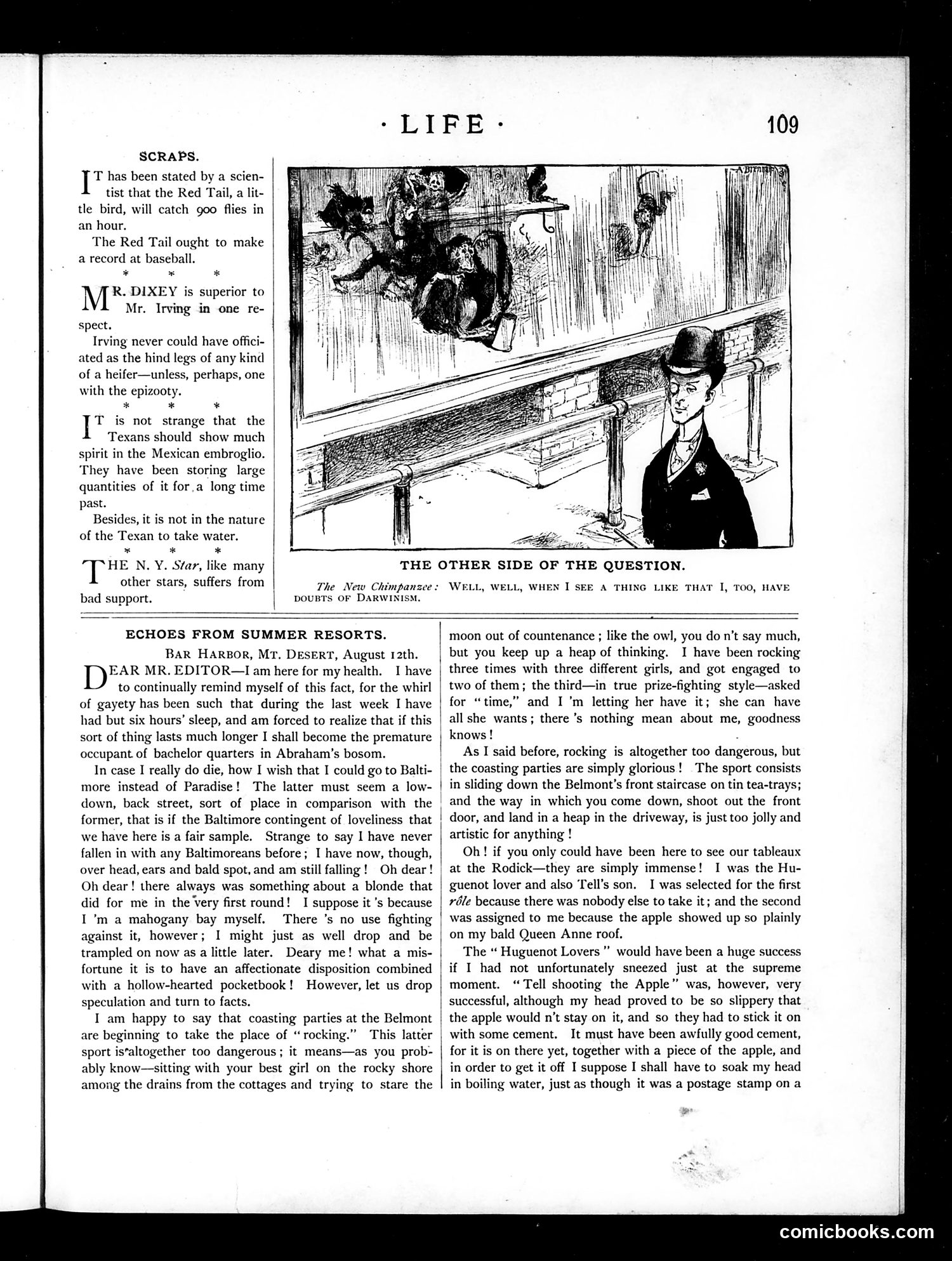
This page contains short satirical "scraps"—brief jokes mocking contemporary figures and issues from the 1880s-90s era. **The cartoon** titled "The Other Side of the Question" depicts a well-dressed gentleman at a railing observing chimpanzees, captioned as "The New Chimpanzee" with a reference to "Doubts of Darwinism." The joke plays on Darwin's theory of evolution: the cartoonist sarcastically suggests that observing this refined man and the ape raises questions about which direction evolution proceeded. **The text scraps** include quips about: - Baseball records - Comparing actors Dixey and Irving (likely 19th-century stage performers) - Texans' combativeness regarding Mexico - A summer resort letter describing coasting parties (sliding down stairs on tea-trays) and amateur theatrical tableaux—mocking wealthy leisure activities and the narrator's romantic entanglements The overall tone is lighthearted mockery of contemporary celebrities, social habits, and scientific debates of the period.
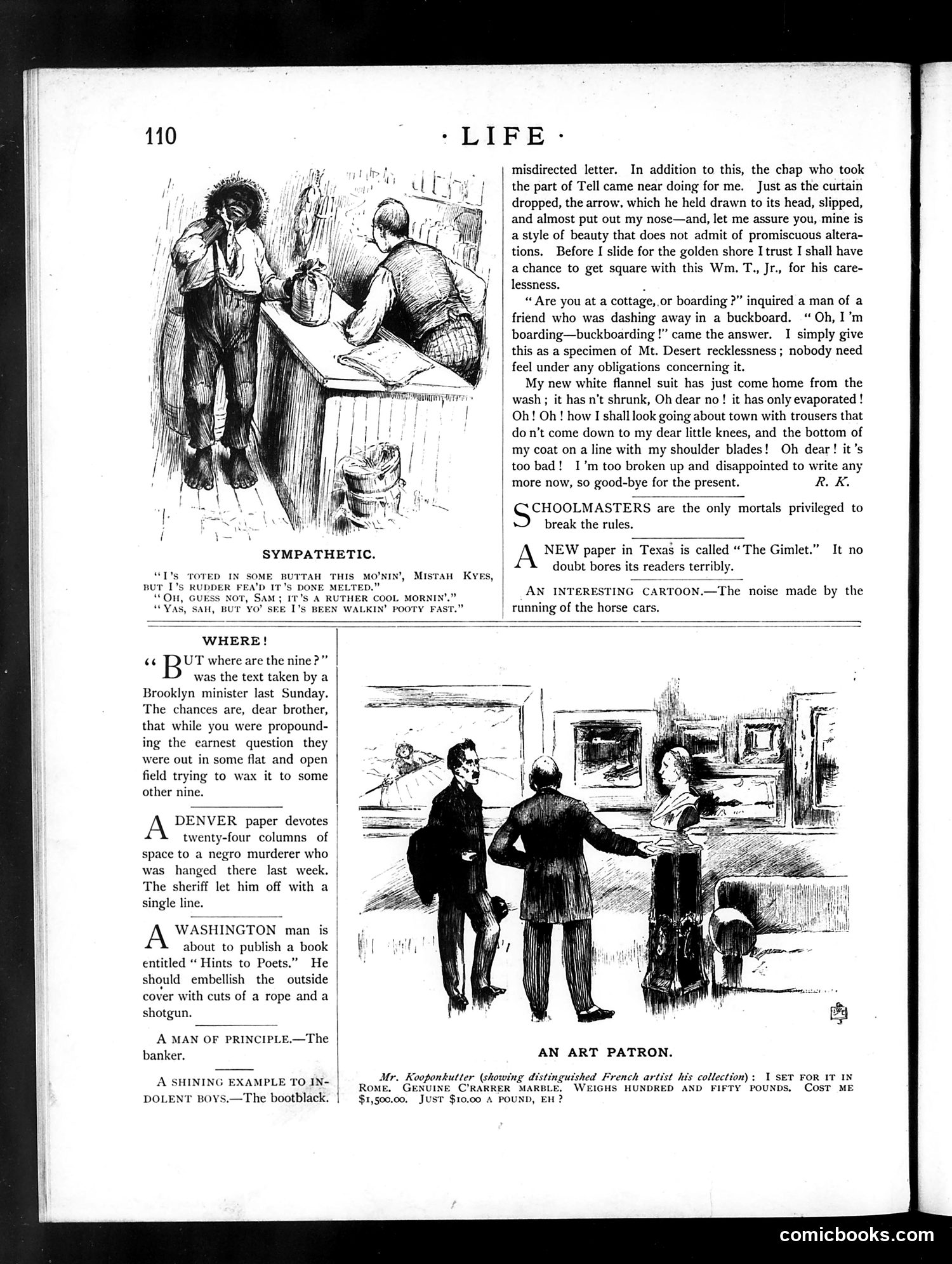
This page from Life magazine contains several brief satirical items and cartoons mocking contemporary American society: **"An Art Patron"** (bottom cartoon) depicts a wealthy collector showing off an expensive marble sculpture, boasting of its high cost ($1,500) while revealing it's merely standard marble at $10 per pound. The satire targets nouveau-riche collectors who value art primarily by price rather than aesthetic merit. **"Sympathetic"** (top-left illustration) shows what appears to be a domestic scene, accompanying humorous verse about poor behavior. **Scattered brief jokes** mock: a Texas newspaper called "The Gimlet" (implying it "bores" readers), a Denver paper's excessive coverage of a execution, a Washington poet's book needing dark humor on its cover, and schoolmasters breaking rules. The overall tone is typical of Life's late 19th-century satirical style—sharp, class-conscious commentary on American pretension, journalism excess, and social hypocrisy, delivered through brief quips and illustrations targeting recognizable social types and behaviors.
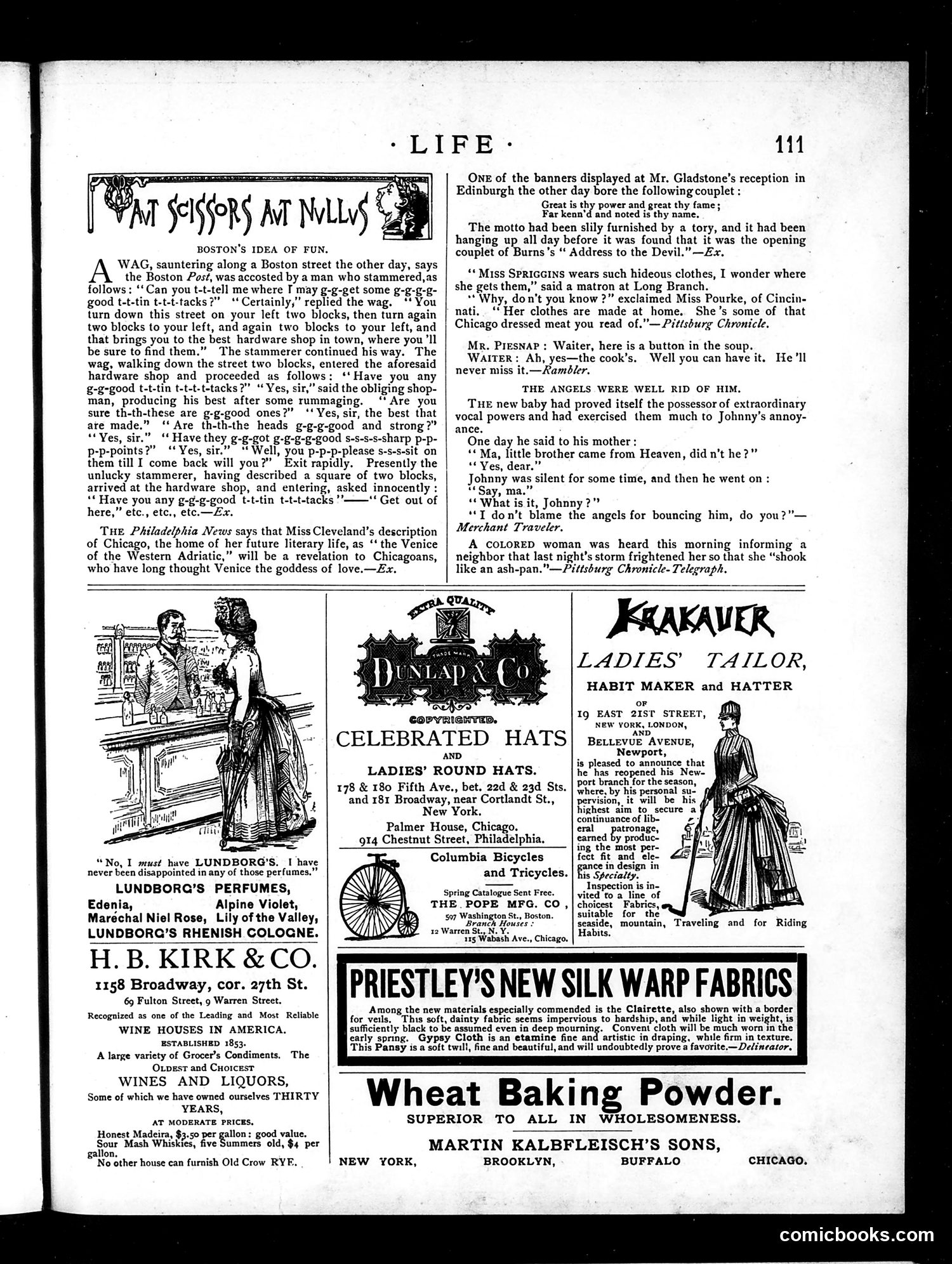
This page consists primarily of brief humorous anecdotes rather than political cartoons. The main item, "Fat Seisers at Nully," is a joke about a Boston stammerer. A helpful stranger deliberately sends him on a wild goose chase through the city, then mocks him by stammering mockingly when the man returns to ask for tin tacks. The humor relies on cruel ridicule of speech impediments—a form of comedy acceptable in this era but considered offensive today. Other items include a jab at Frances Cleveland's flowery description of Chicago, a prank played on William Gladstone using Burns poetry, and jokes about Miss Spriggins's appearance and a child's theological irreverence about his newborn brother. The page is primarily **advertisements** for perfumes, bicycles, hats, and other goods. The political/satirical content is minimal and relies on period-specific references and now-outdated attitudes toward disability.
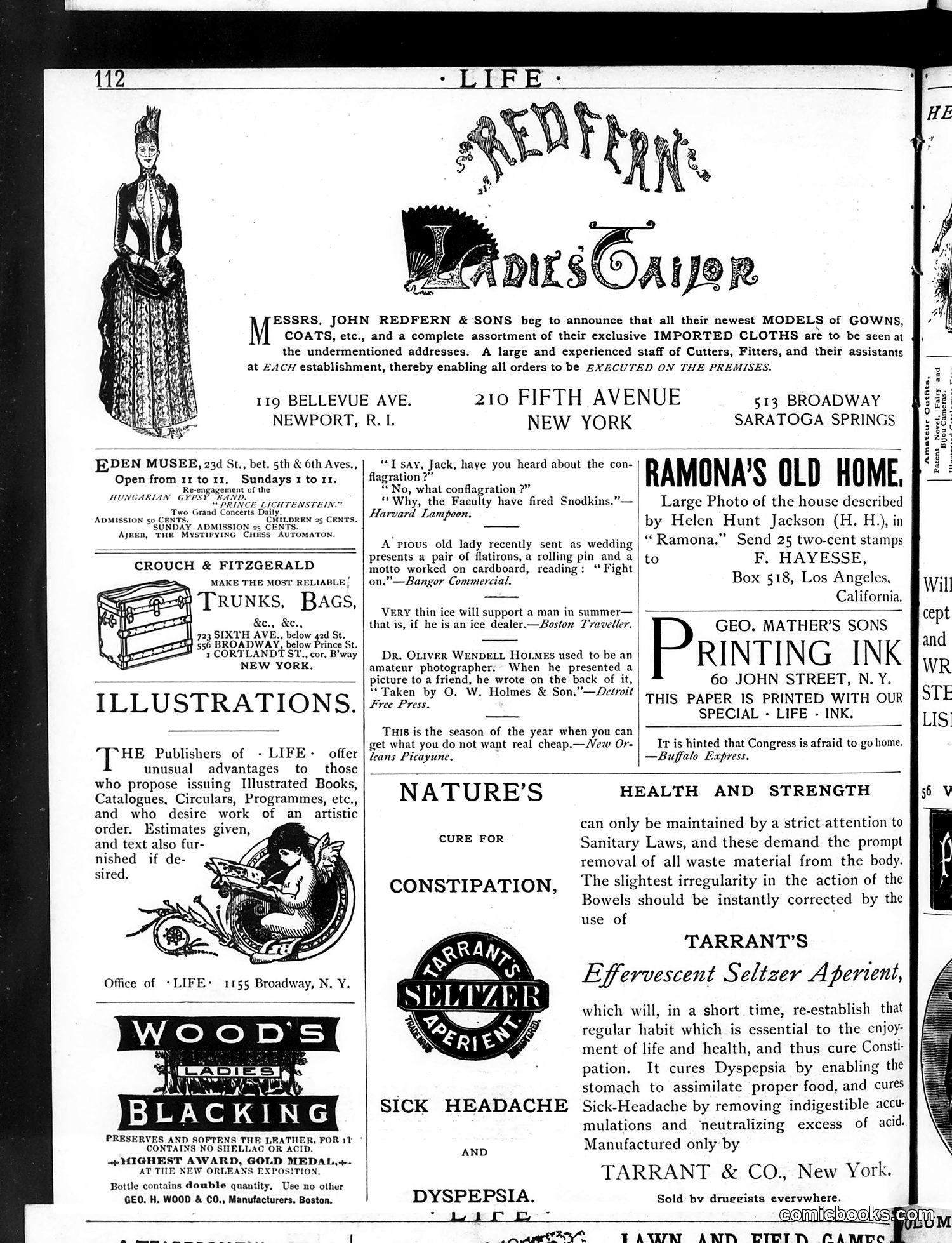
This page is primarily **advertisements** with scattered short humorous items typical of Life magazine's satirical format. The main content includes: **Fashion/Shopping ads** for Redfern (high-end women's clothing) and Wood's blacking (shoe polish). **Short humor pieces** (jokes/anecdotes): - A Harvard Lampoon joke about firing a professor named Snodkins - A pious woman giving practical gifts (flatirons, rolling pin) with fighting motto as wedding presents - Oliver Wendell Holmes crediting his son for photography he took himself - Wordplay about thin ice supporting ice dealers in summer **Patent medicine ads** dominating the lower half, promoting Tarrant's Effervescent Seltzer for constipation, dyspepsia, and headaches—typical of 19th-century advertising making grandiose health claims. There are **no political cartoons** on this page. The humor is gentle social satire—poking fun at academia, gift-giving conventions, and amateur vanity—rather than serious political commentary. The page reflects Life's mix of advertising revenue and light satirical entertainment.
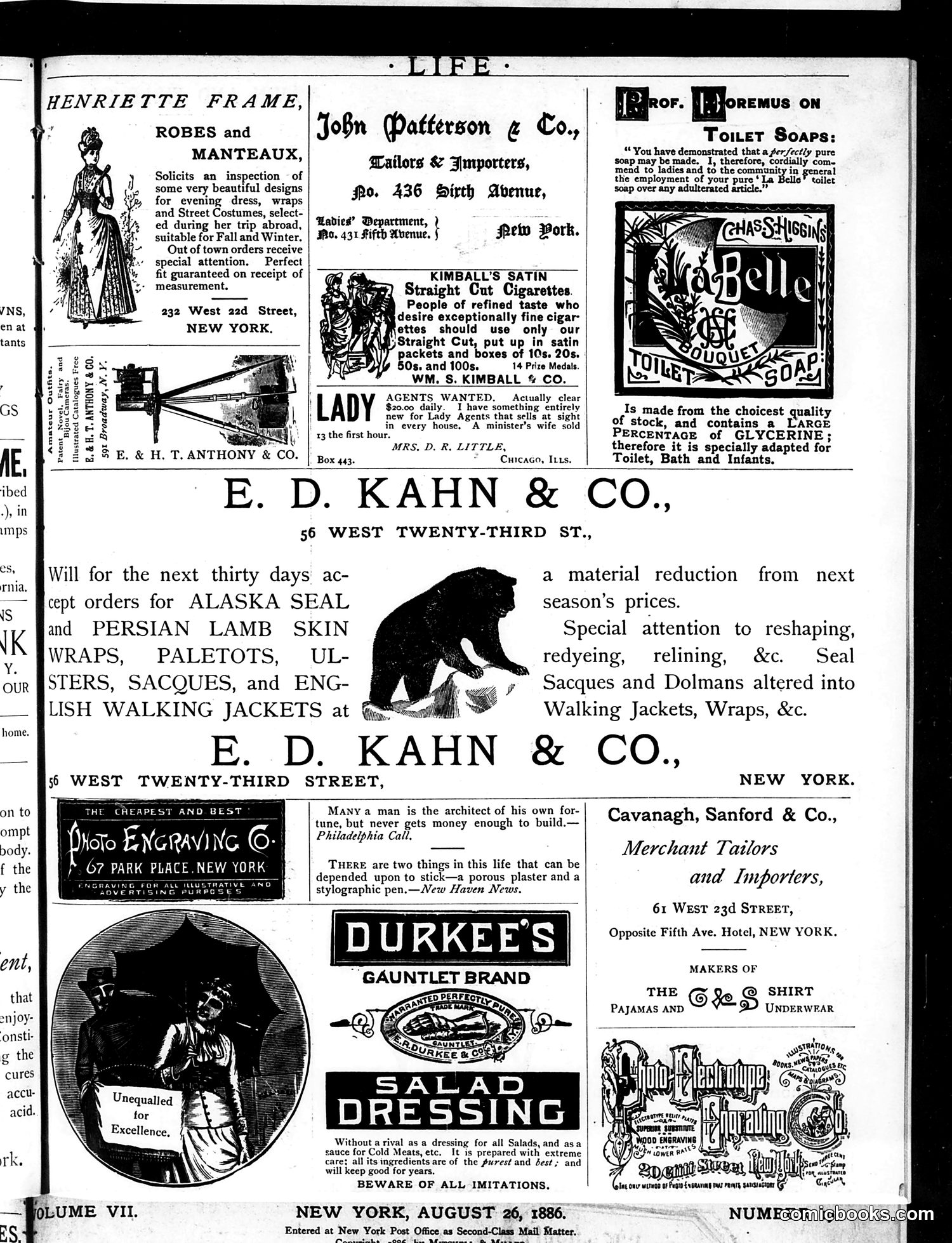
This is primarily a **advertising page**, not a political cartoon issue. The page contains commercial advertisements for clothing, toiletries, and services typical of 1880s New York. Notable content includes: **Henriette Frame** advertises fashionable robes and mantels for women, emphasizing European designs—reflecting the era's association of continental fashion with sophistication. **E.D. Kahn & Co.** promotes fur wraps and coats (Alaska seal, Persian lamb), advertising a 30-day sale. The illustration shows a seal, directly referencing the product. **Durkee's Salad Dressing** features a circular portrait of a woman, labeled "Unequalled for Excellence"—standard Victorian-era marketing imagery. Two brief **satirical quips** appear mid-page: one mocking self-made men who lack wealth, another joking about porous plasters and pens that "stick." The page reflects 1880s consumer culture and gender roles, with advertisements targeting women's fashion and household products. There are no significant political cartoons or social commentary beyond these minor humorous observations.
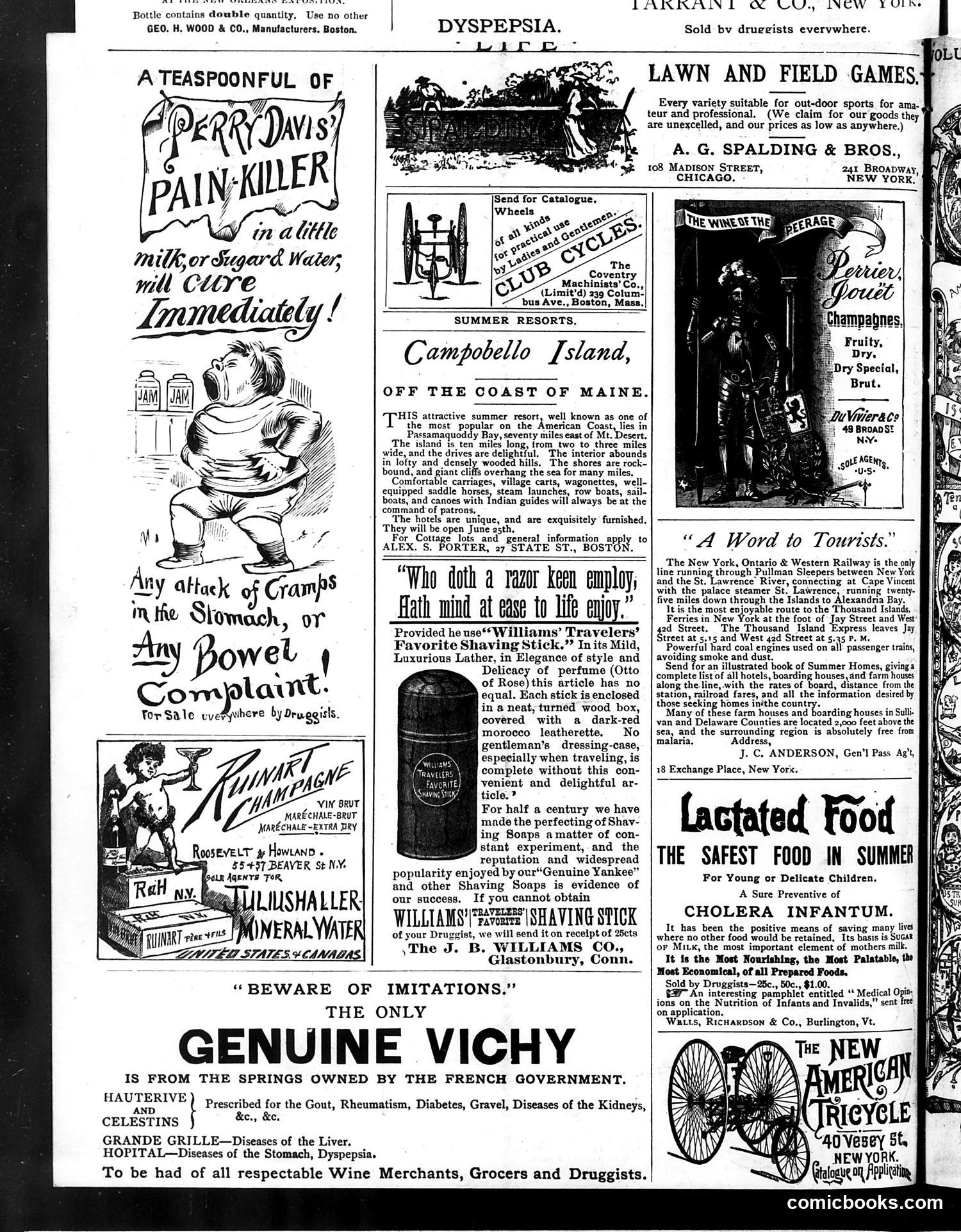
This page is primarily **advertising**, not editorial satire. It showcases patent medicines and consumer products typical of the 1890s era. The most historically significant ads reveal period anxieties: **Perry Davis' Pain-Killer**: Sold as a universal remedy for stomach complaints and bowel issues—reflects the era's obsession with digestive ailments and unregulated patent medicines. **Vichy Water**: Marketed as treatment for gout, rheumatism, and kidney disease, emphasizing its French government ownership to establish legitimacy. **Williams' Shaving Stick**: A luxury grooming product positioned as essential for travelers, reflecting Victorian gentleman culture. **Lactated Food**: Advertised as the "safest food in summer" for children, suggesting genuine public health concerns about infant mortality and food safety. The repeated emphasis on "genuine" products and warnings against imitations indicate widespread consumer skepticism about fraudulent goods—a real problem in this unregulated market era. These ads collectively illustrate how nineteenth-century Americans approached health through commercial solutions rather than medical science.