
Life, 1886-08-19 · page 6 of 16
Life — August 19, 1886 — page 6: what you’re looking at
What you’re looking at
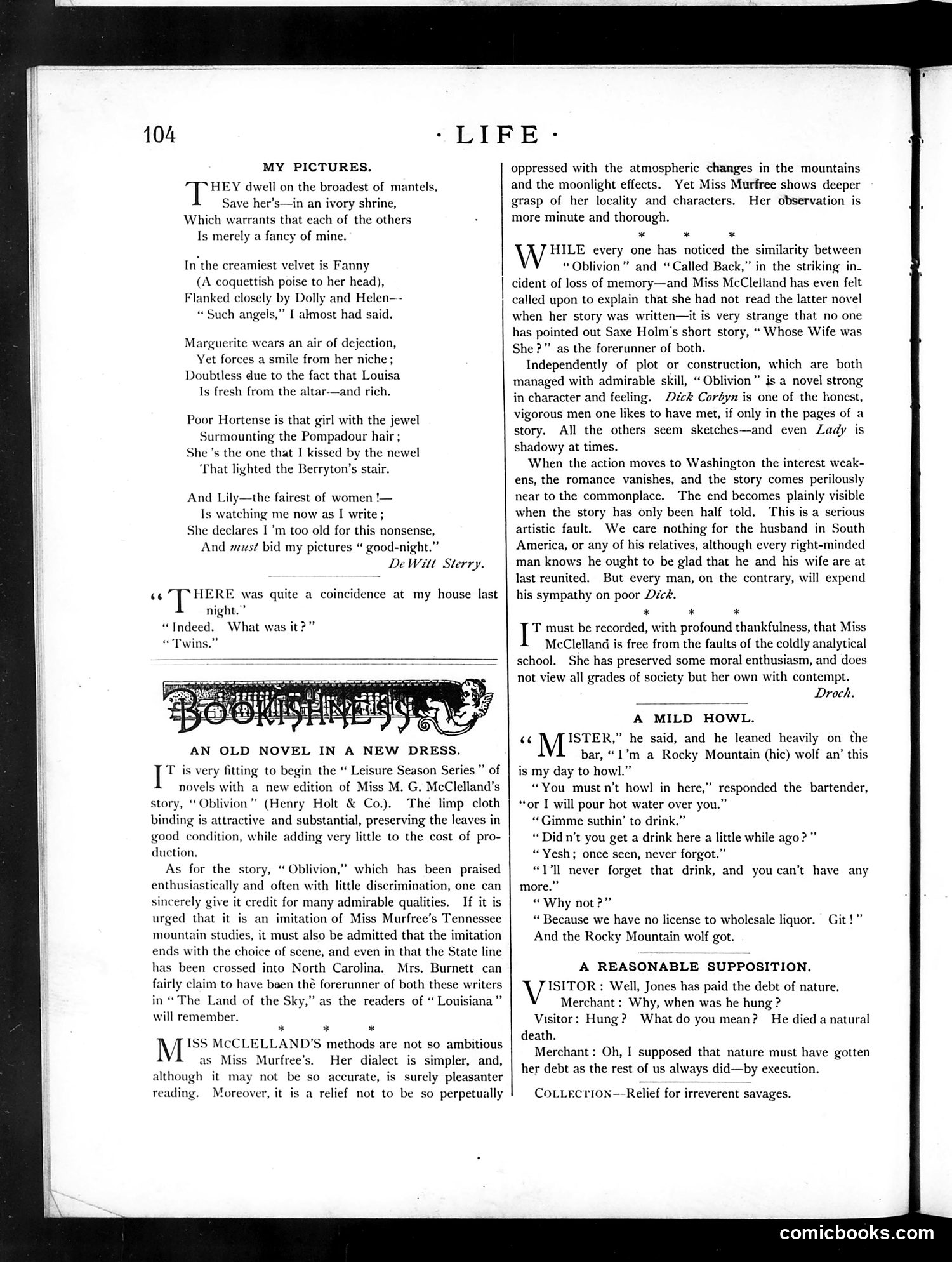
This page from *Life* magazine consists primarily of **literary criticism and humor pieces**, not political cartoons. The content includes: 1. **"My Pictures"** — A poem critiquing character sketches, likely of women in contemporary fiction 2. **A review of Miss M.G. McClelland's novel "Oblivion"** — praising her character work and observational skill while noting the story weakens when action moves to Washington 3. **"A Mild Howl"** and **"A Reasonable Supposition"** — brief satirical dialogues about a bartender refusing service and a merchant's joke about debt The page contains **no identifiable political cartoons or caricatures**. It's primarily literary commentary typical of *Life*'s satirical approach to contemporary novels and social behavior, employing wit rather than visual satire.
📄 Transcribed text from this page (OCR, searchable)
Machine-transcribed from the original scan — historical spelling and the odd misread are preserved.
- LIFE: MY PICTURES. HEY dwell on the broadest of mantels, Save her’s—in an ivory shrine, Which warrants that each of the others Is merely a fancy of mine. In the creamiest velvet is Fanny (A coquettish poise to her head), Flanked closely by Dolly and Helen—- “ Such angels,” I almost had said. Marguerite wears an air of dejection, Yet forces a smile from her niche ; Doubtless due to the fact that Louisa Is fresh from the altar-—and rich. Poor Hortense is that girl with the jewel Surmounting the Pompadour hair ; She's the one that I kissed by the newel ‘That lighted the Berryton’s stair. And Lily—the fairest of women !— Is watching me now as I write; She declares I’m too old for this nonsense, And must bid my pictures “ good-night.” DeWitt Sterry. 6“ HERE was quite a coincidence at my house last night.” “Indeed. What was it?” AN OLD NOVEL IN A NEW DRESS. T is very fitting to begin the “ Leisure Season Series ” of novels with a new edition of Miss M. G. McClelland’s story, “Oblivion” (Henry Holt & Co.). The limp cloth binding is attractive and substantial, preserving the leaves in good condition, while adding very little to the cost of pro- duction. As for the story, “ Oblivion,” which has been praised enthusiastically and often with little discrimination, one can sincerely give it credit for many admirable qualities. If it is urged that it is an imitation of Miss Murfree’s Tennessee mountain studies, it must also be admitted that the imitation ends with the choice of scene, and even in that the State line has been crossed into North Carolina. Mrs. Burnett can fairly claim to have been thé forerunner of both these writers in “The Land of the Sky,” as the readers of “ Louisiana” will remember. * * * LLAND’S methods are not so ambitious Murfree’s. Her dialect is simpler, and, although it may not be so accurate, is surely pleasanter reading. Moreover, it is a relief not to be so perpetually oppressed with the atmospheric changes in the mountains and the moonlight effects. Yet Miss Murfree shows deeper grasp of her locality and characters. Her observation is more minute and thorough. * * * HILE every one has noticed the similarity between “Oblivion” and “Called Back,” in the striking in- cident of loss of memory—and Miss McClelland has even felt called upon to explain that she had not read the latter novel when her story was written—it is very strange that no one has pointed out Saxe Holm’s short story, “ Whose Wife was She?” as the forerunner of both. Independently of plot or construction, which are both managed with admirable skill, “Oblivion” is a novel strong in character and feeling. Dzck Cordyn is one of the honest, vigorous men one likes to have met, if only in the pages of a story. All the others seem sketches—and even Lady is shadowy at times. When the action moves to Washington the interest weak- ens, the romance vanishes, and the story comes perilously near to the commonplace. The end becomes plainly visible when the story has only been half told. This is a serious artistic fault. We care nothing for the husband in South America, or any of his relatives, although every right-minded man knows he ought to be glad that he and his wife are at last reunited. But every man, on the contrary, will expend his sympathy on poor Deck. * * * T must be recorded, with profound thankfulness, that Miss McClelland is free from the faults of the coldly analytical school. She has preserved some moral enthusiasm, and does not view all grades of society but her own with contempt. Droch. A MILD HOWL. “ ISTER,” he said, and he leaned heavily on the bar, “1’m a Rocky Mountain (hic) wolf an’ this is my day to howl.” “You must n’t howl in here,” responded the bartender, “or I will pour hot water over you.” “Gimme suthin’ to drink.” “Did n't you get a drink here a little while ago?” “Yesh; once seen, never forgot.” “1’ll never forget that drink, and you can’t have any more.” “Why not?” “ Because we have no license to wholesale liquor. And the Rocky Mountain wolf got. Git!” A REASONABLE SUPPOSITION. ISITOR: Well, Jones has paid the debt of nature. Merchant : Why, when was he hung ? Visitor: Hung? What do you mean? He died a natural death. Merchant: Oh, I supposed that nature must have gotten her debt as the rest of us always did—by execution. COLLECTION—Relief for irreverent savages. comicbooks.com