
A complete issue · 16 pages · 1886
Life — July 29, 1886
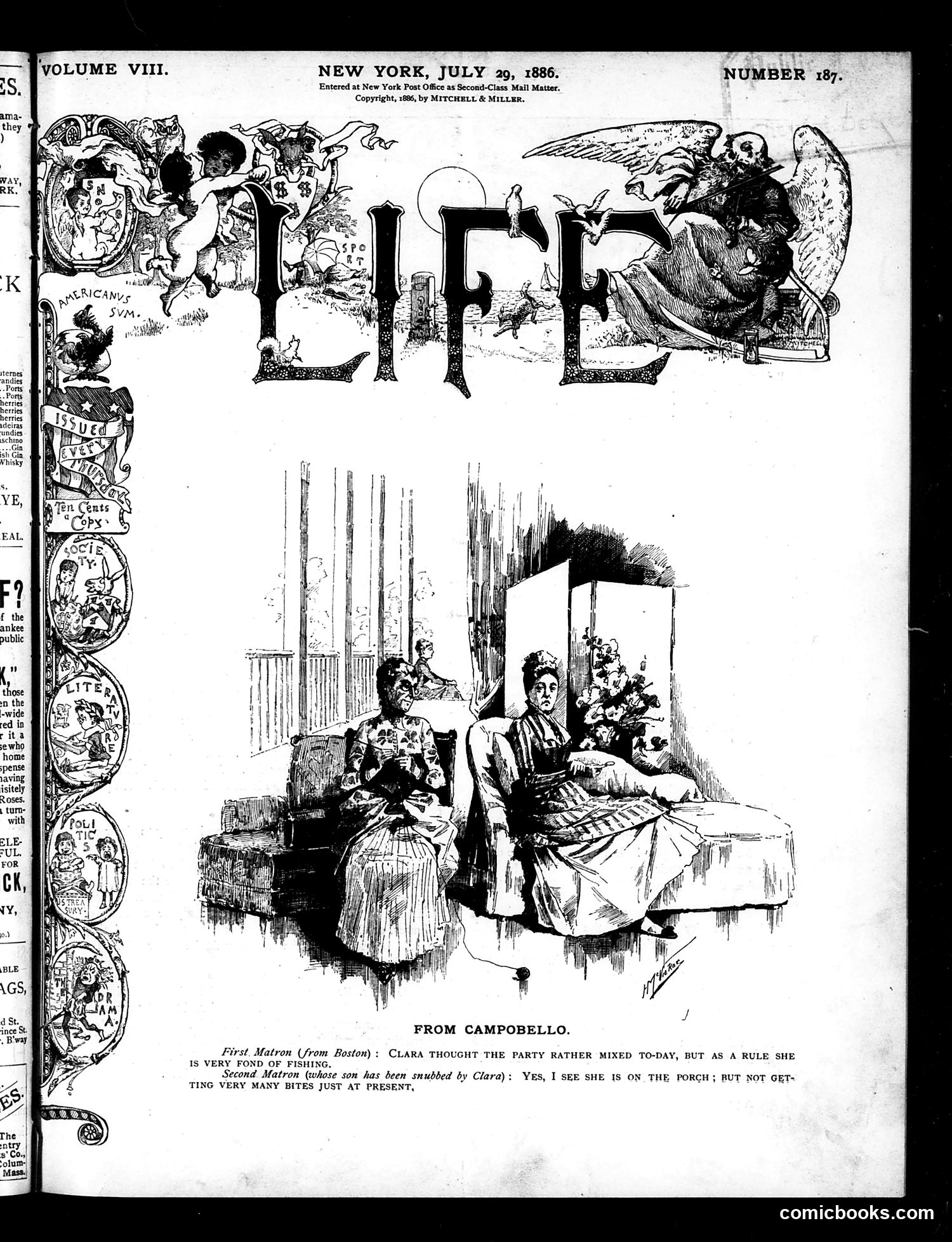
This page features "From Campobello," a domestic humor sketch. The cartoon depicts two matrons gossiping about a third woman named Clara. The first matron (from Boston) remarks that Clara "thought the party rather mixed to-day," while the second matron notes that Clara "is on the porch; but not getting very mary bites just at present." The humor appears to be social satire about class-conscious entertaining and party dynamics among upper-class women. Campobello refers to an actual location (likely Campobello Island in Canada, a fashionable resort area), suggesting this mocks the pretensions of wealthy summer visitors. The joke hinges on Clara's social awkwardness or exclusion despite attending the gathering—a pointed commentary on Victorian social hierarchies and the anxieties of maintaining proper social standing.
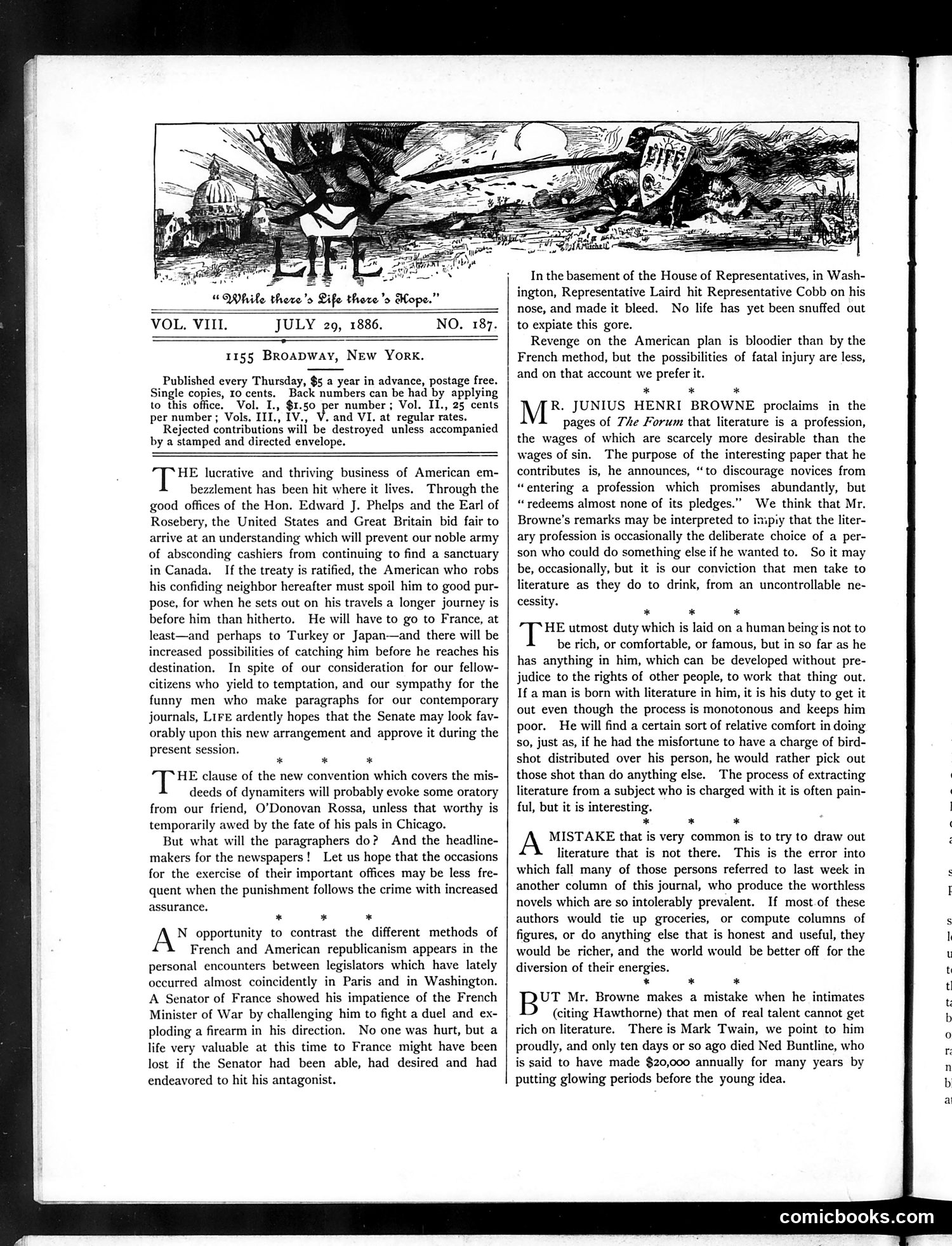
The top cartoon depicts a figure beneath a large tree labeled "While there's a Life there's a Slope" (a pun on the phrase "while there's life there's hope"). The image appears satirical in nature, though the specific political reference is unclear from the visual alone. The accompanying text discusses various political and social matters of 1886, including an incident where Representative Laird struck Representative Cobb in the House basement, references to dynamite-related violence (likely anarchist concerns of the era), and a debate about whether literature constitutes a legitimate profession. The exact satirical target of the cartoon remains uncertain without additional historical context about contemporary events or figures from July 1886.
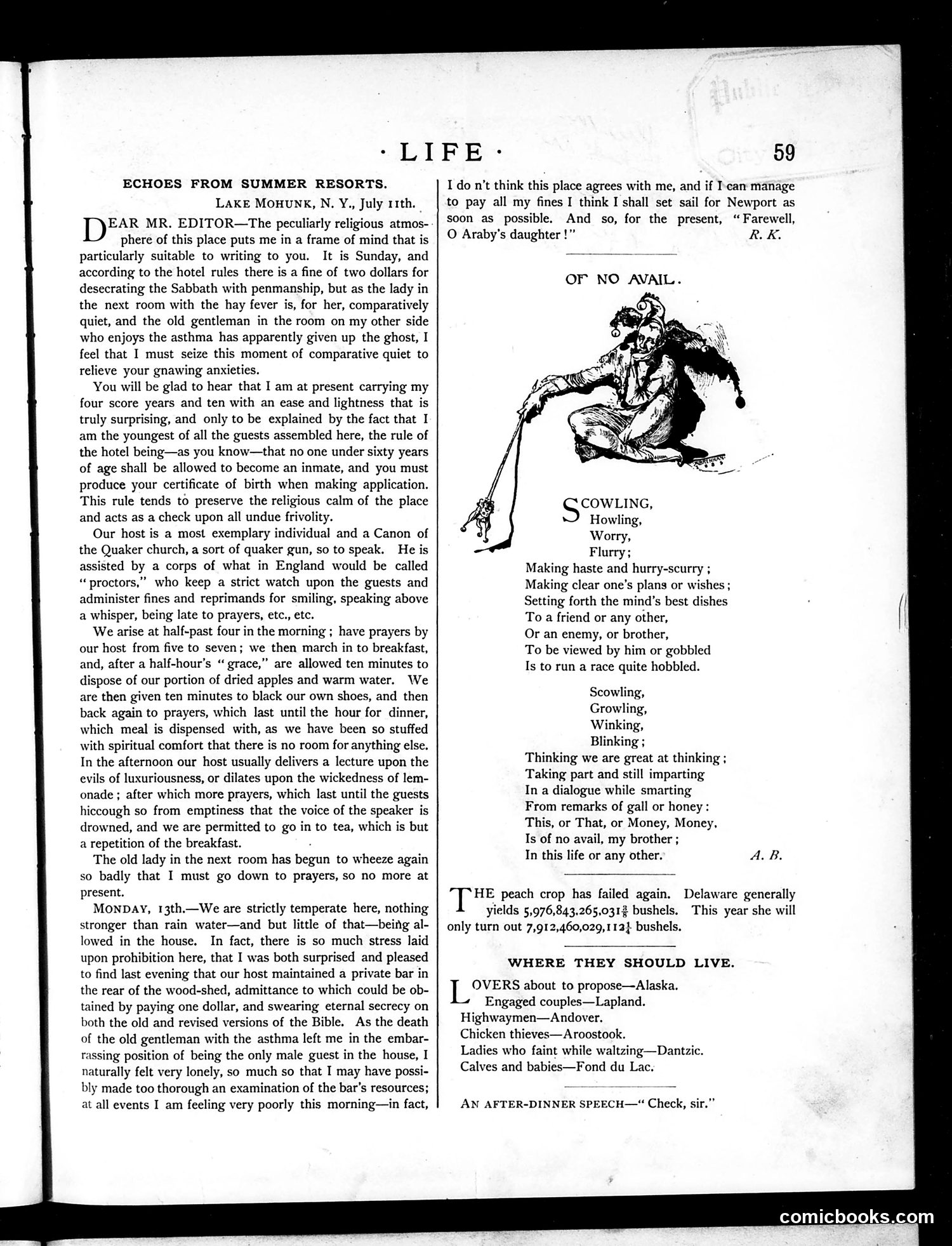
The page contains two distinct pieces of satirical content: **"Of No Avail"** (left cartoon): Depicts a skeletal, emaciated figure—likely representing Death or disease—in a dramatic pose. The accompanying poem lists various human afflictions (scowling, howling, worry, etc.) that ultimately prove powerless against death. This is memento mori satire, reminding readers that worldly anxieties and behaviors are futile in face of mortality. **"Where They Should Live"** (bottom): A humorous matching exercise pairing groups of people with inappropriate locations. For example, "Lovers about to propose—Alaska" and "Chicken thieves—Aroostook" use geographical absurdity for comedy, suggesting these places would be fitting (or punishing) destinations for various social types. The page also includes letter excerpts from summer resorts, mocking religious strictness at hotels.
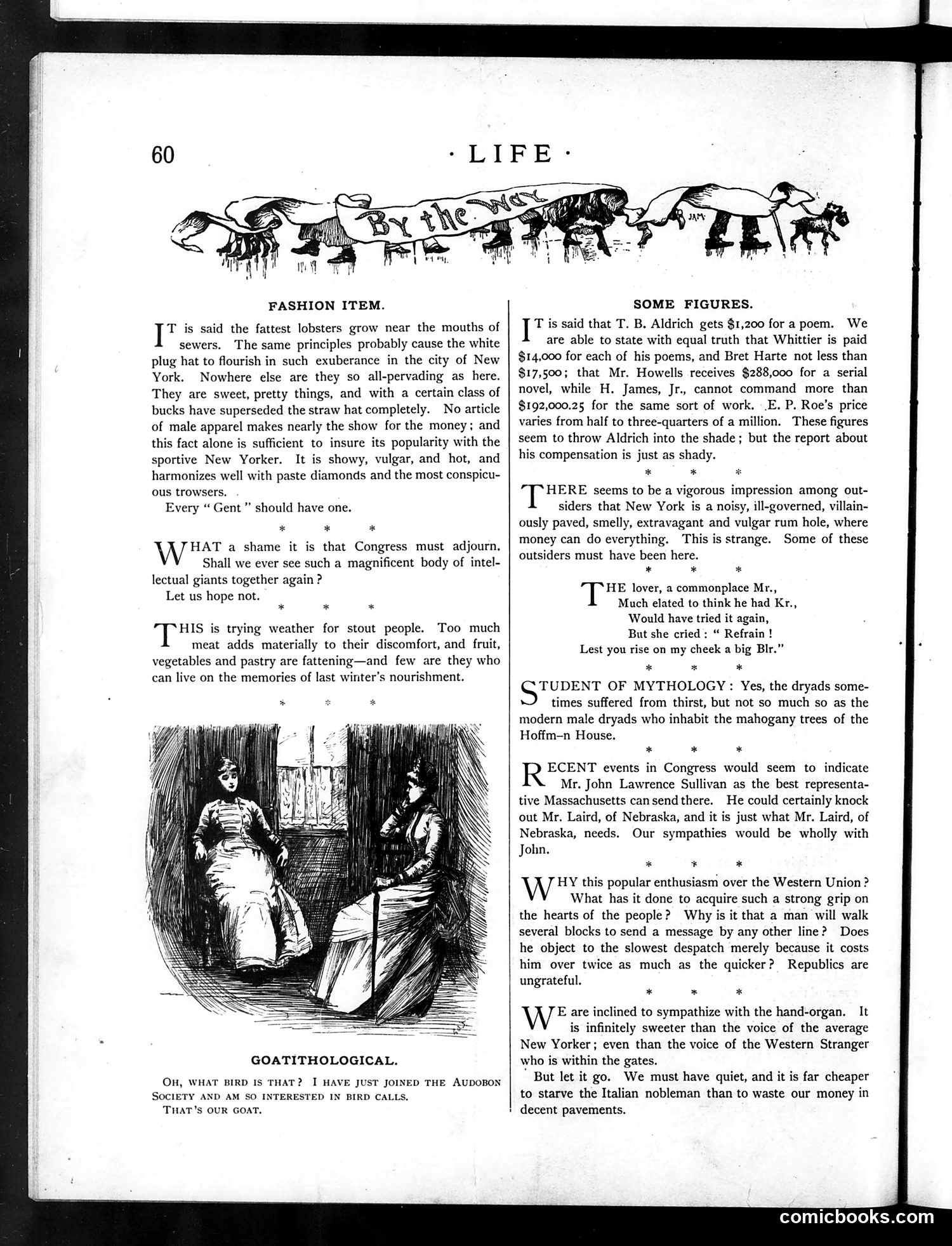
This page contains several brief satirical pieces on contemporary topics: **"Fashion Item"** mocks the prevalence of white plug hats in New York City near the sewers, suggesting they're fashionable but impractical and vulgar—a status symbol for the "conspicuous browsers." **"Some Figures"** critiques literary compensation disparities, noting T.B. Aldrich receives $1,200 per poem while other writers earn vastly different amounts, suggesting the pay structure is arbitrary and unfair. The sketch illustration depicts two women in conversation, likely illustrating social commentary about women's lives or relationships. **"Goathological"** is a humorous footnote about someone joining the Audubon Society for bird-watching interests. The remaining sections comment on Congressional adjournment, diet recommendations, the Western Union telegraph, and Italian street musicians—typical satirical observations on American urban life and politics of the era.
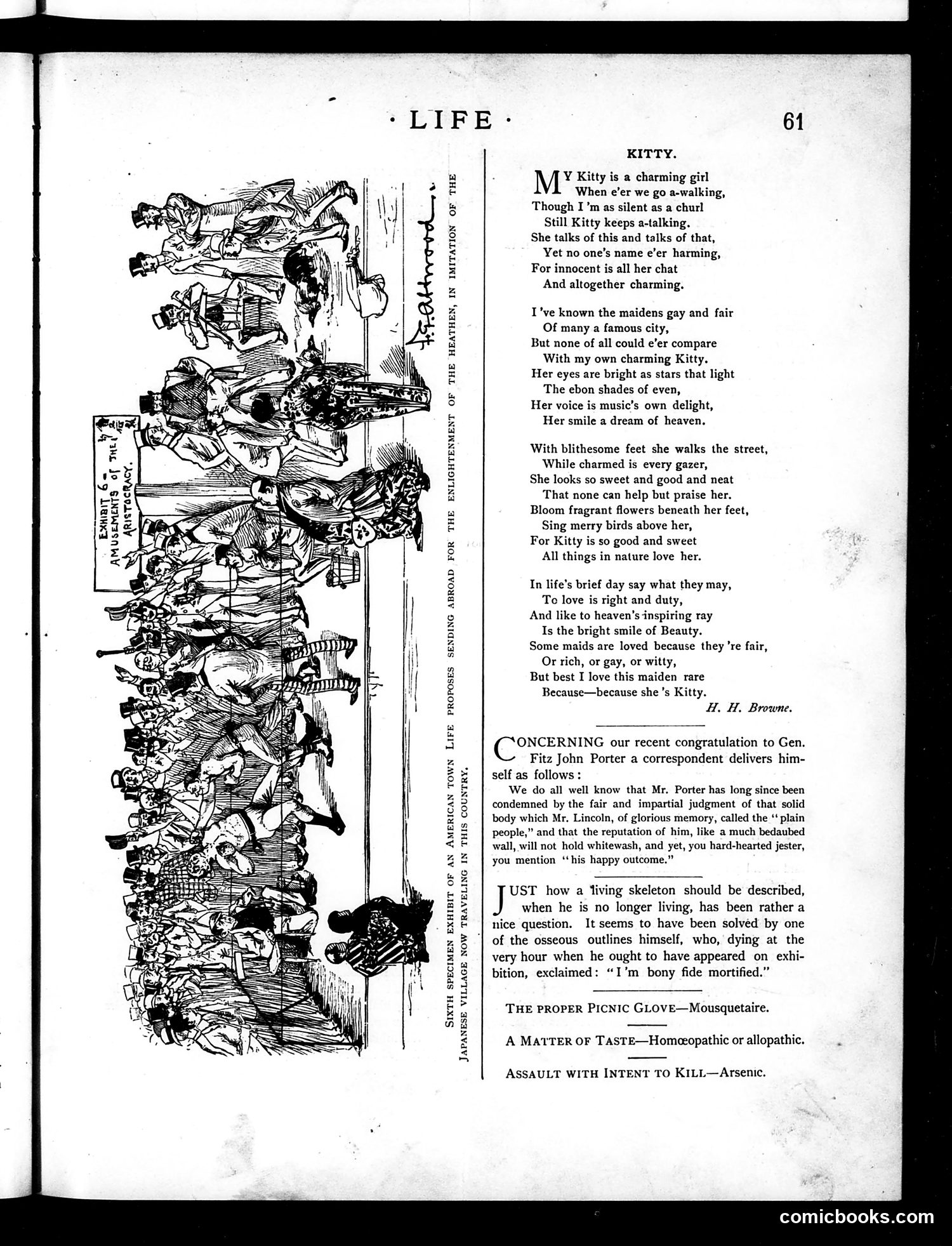
This page contains a poem titled "Kitty" by H.H. Browne celebrating an unnamed charming young woman. The accompanying illustration shows multiple figures in Victorian dress engaged in various social activities. Below the poem, a brief article addresses General Fitz John Porter, apparently responding to recent congratulations given to him. The passage defends Porter against criticism, referencing Abraham Lincoln's characterization of him as "plain people" and defending his reputation against what the writer calls unfair judgment. The page concludes with three brief satirical definitions—likely reflecting contemporary social commentary about picnic etiquette, medical philosophy, and legal matters (arsenic poisoning). The specific topical references remain unclear without additional historical context about Porter's situation and period debates.
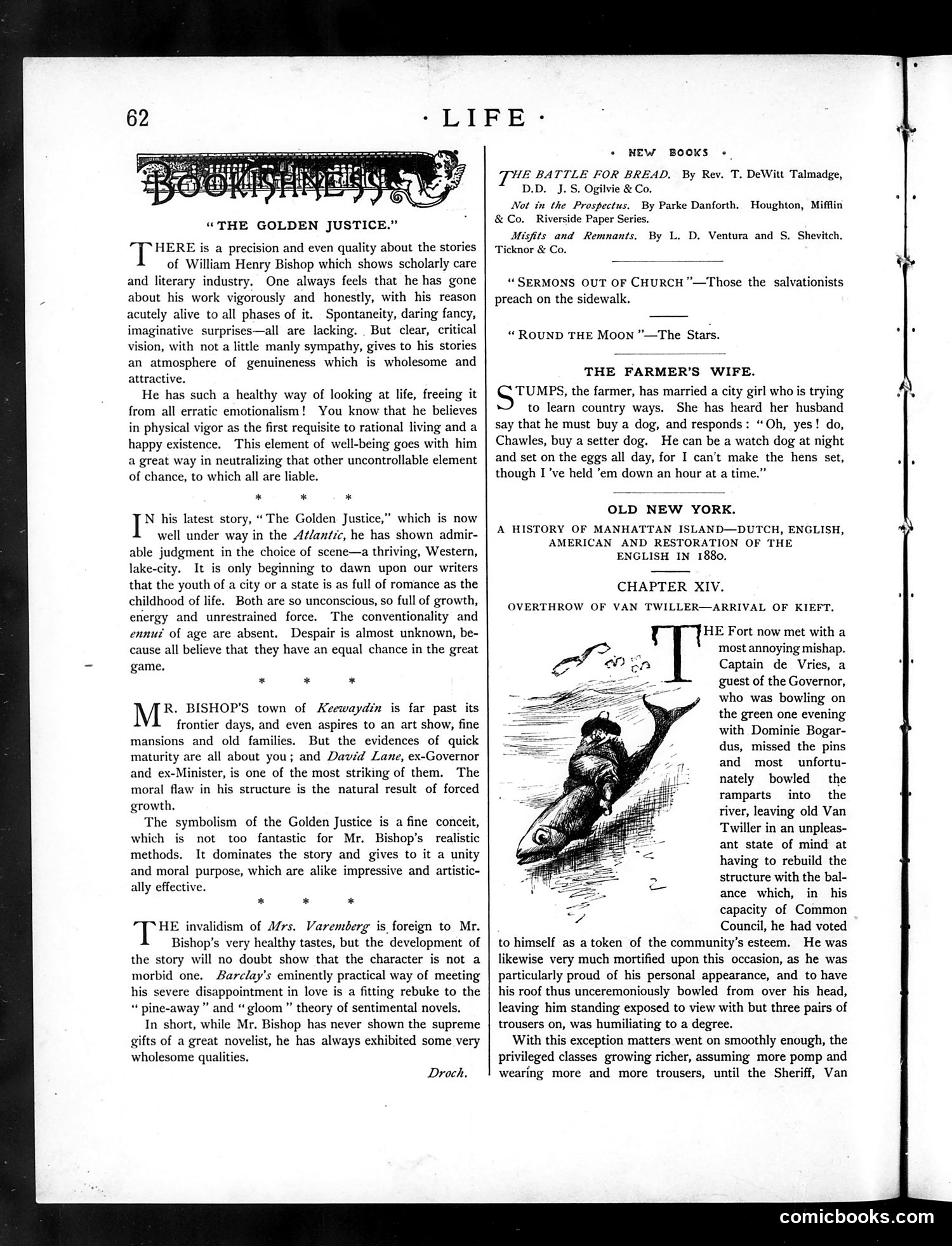
This page contains literary reviews rather than political cartoons. The main content discusses William Henry Bishop's story "The Golden Justice," praising his scholarly care and realistic portrayal of life. The review notes Bishop's balanced approach—combining spontaneity with critical vision while avoiding excessive sentimentality. A secondary story, "The Farmer's Wife," appears to satirize rural-urban cultural clash: a farmer's new city-bride wife resists his practical demands (buying a dog, setting eggs) with humor. The page also advertises new books and begins a serialized history of Dutch New York. The single illustration depicts someone falling into water—likely related to the "Old New York" historical narrative about colonial New Amsterdam.
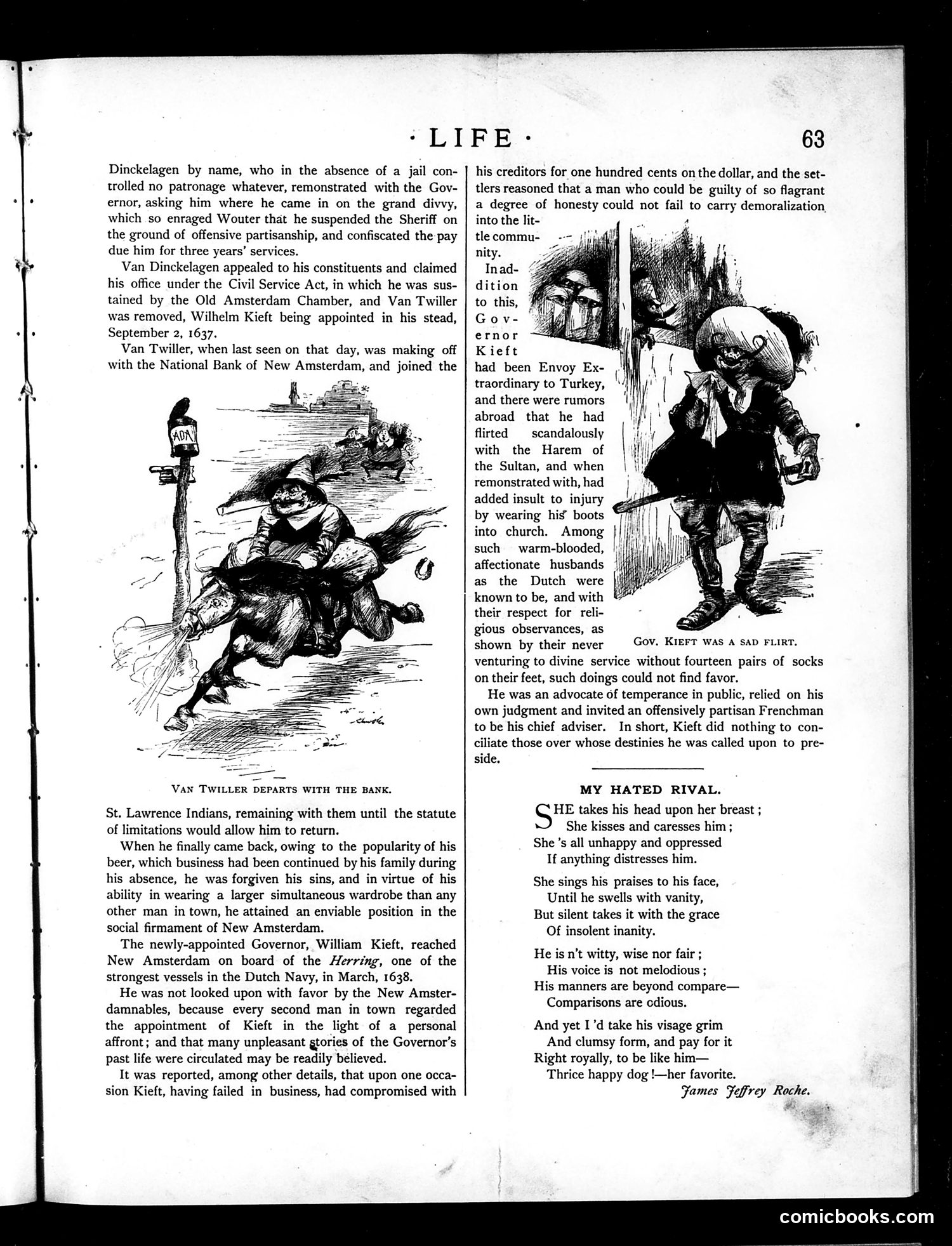
This page contains historical narrative about Dutch colonial New Amsterdam (early New York), not political satire. The text describes Governor Willem Kieft's unpopularity and subsequent removal in 1637, illustrated by two period sketches: one showing "Van Twiller departs with the bank" and another captioned "Gov. Kieft was a sad flirt." The page concludes with a poem titled "My Hated Rival" by James Jeffrey Roche—a romantic verse about a woman's jealousy toward her rival, entirely unrelated to the colonial history above it. This appears to be a miscellaneous content page mixing historical exposition with poetry, rather than political commentary or satire. The cartoons are historical illustrations rather than satirical commentary.
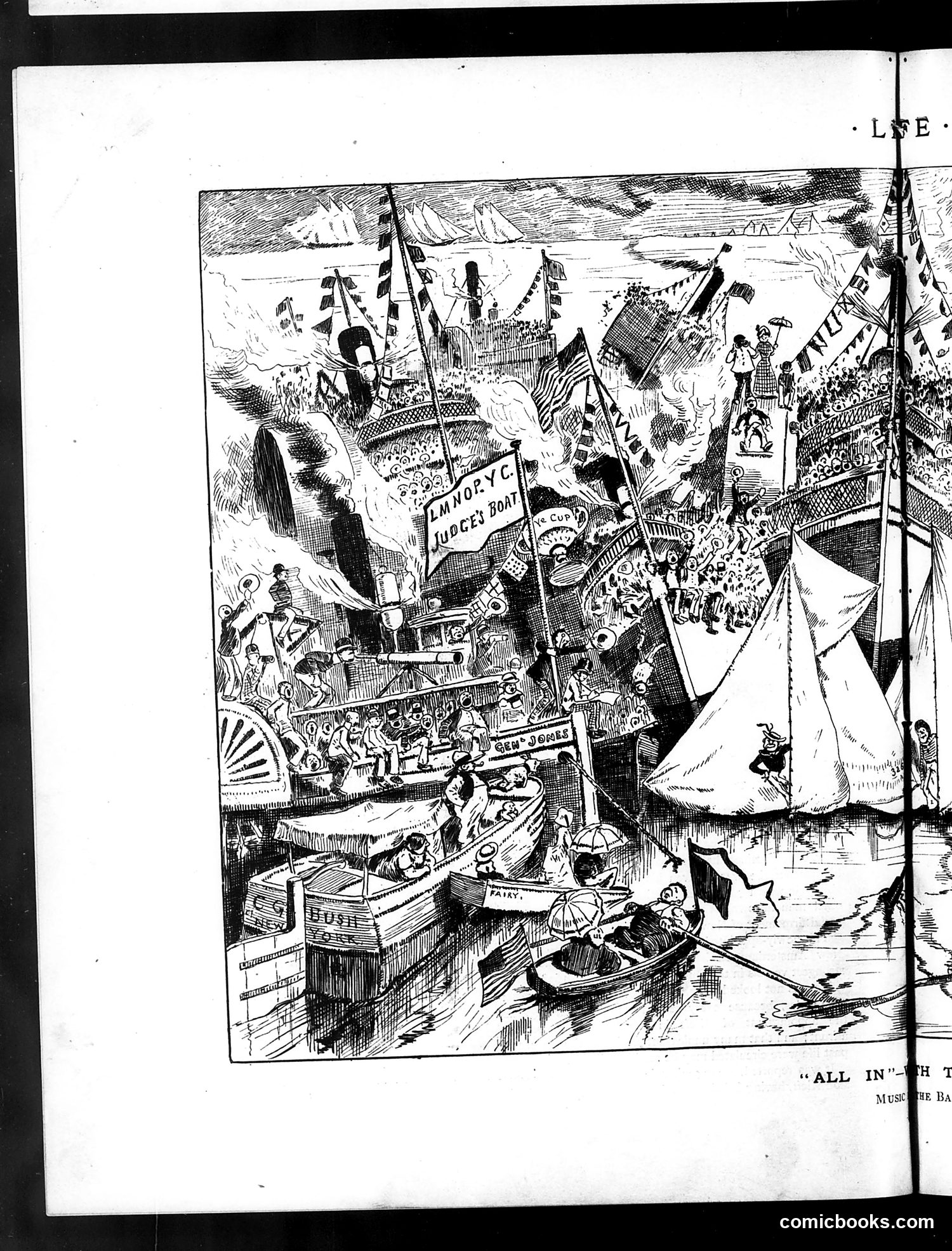
This is a detailed satirical engraving showing a crowded harbor scene labeled "Emporium Judges' Boat," depicting what appears to be a major public spectacle or regatta. The illustration teems with vessels, flags, and crowds of spectators in period dress, suggesting late 19th-century America. The text fragment at bottom ("ALL IN" and "MUST BE BA[CK]") is incomplete, making the specific satirical target unclear. However, the image's density and chaotic energy suggest commentary on: - Public spectacle and mass entertainment - Competitive excess or showmanship - Possibly political or judicial proceedings depicted as entertainment Without complete caption text, the precise reference remains uncertain. The style and composition indicate satire of contemporary American public life, but the specific target—whether judges, competing interests, or social commentary—cannot be definitively determined from visible information alone.
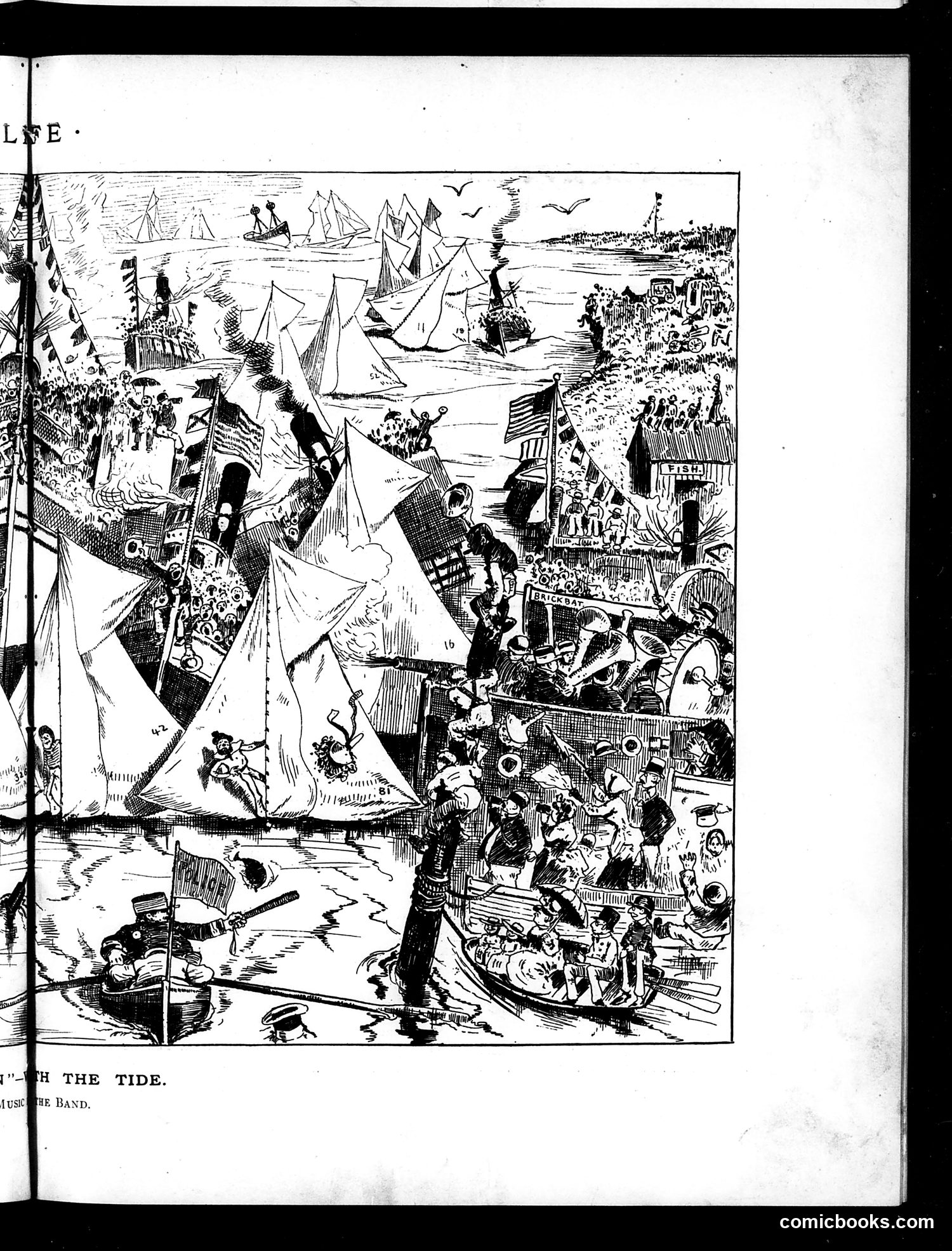
This satirical illustration depicts a crowded maritime scene titled "WITH THE TIDE" (partial text visible). The image shows a bustling harbor or seaside location with numerous boats, sailing vessels, and crowds of people on shore and in the water. The phrase "WITH THE TIDE" suggests commentary on following popular opinion or trends—a common satirical theme. The chaotic scene with many figures moving in apparent coordination likely mocks mob behavior, public opinion swaying, or social conformity. However, without clearer text or additional context identifying specific political figures or events, I cannot definitively determine which historical situation this addresses. The crowded composition and maritime setting suggest it comments on mass movement or public sentiment, but the exact targets or date remain unclear from this page alone.
This page contains satirical commentary on contemporary sports and social life, circa 1886 (based on letter dates). The "SUPPORT" section mocks aristocratic pretensions, particularly criticizing the "untitled aristocracy" in America who claim superior breeding. It references specific figures like George Work and John L. Sullivan (the famous boxer), questioning whether wealthy elites genuinely engage in sports for "personal daring" or merely adopt them as fashionable affectation. The yacht racing section discusses Norman L. Munro's challenge with his steam launch *Henrietta* against Jay Gould's *Atalanta*, satirizing wealthy sportsmen's competitive vanities. "THE RING" section briefly critiques Laird, a Nebraska boxer, suggesting his government position may be undeserved. The "EVOLUTION—DISSOLUTION" section reprints witty personal correspondence from Virgil O'Doud, demonstrating Life's satirical humor through social commentary on courtship and leisure activities among the upper classes.
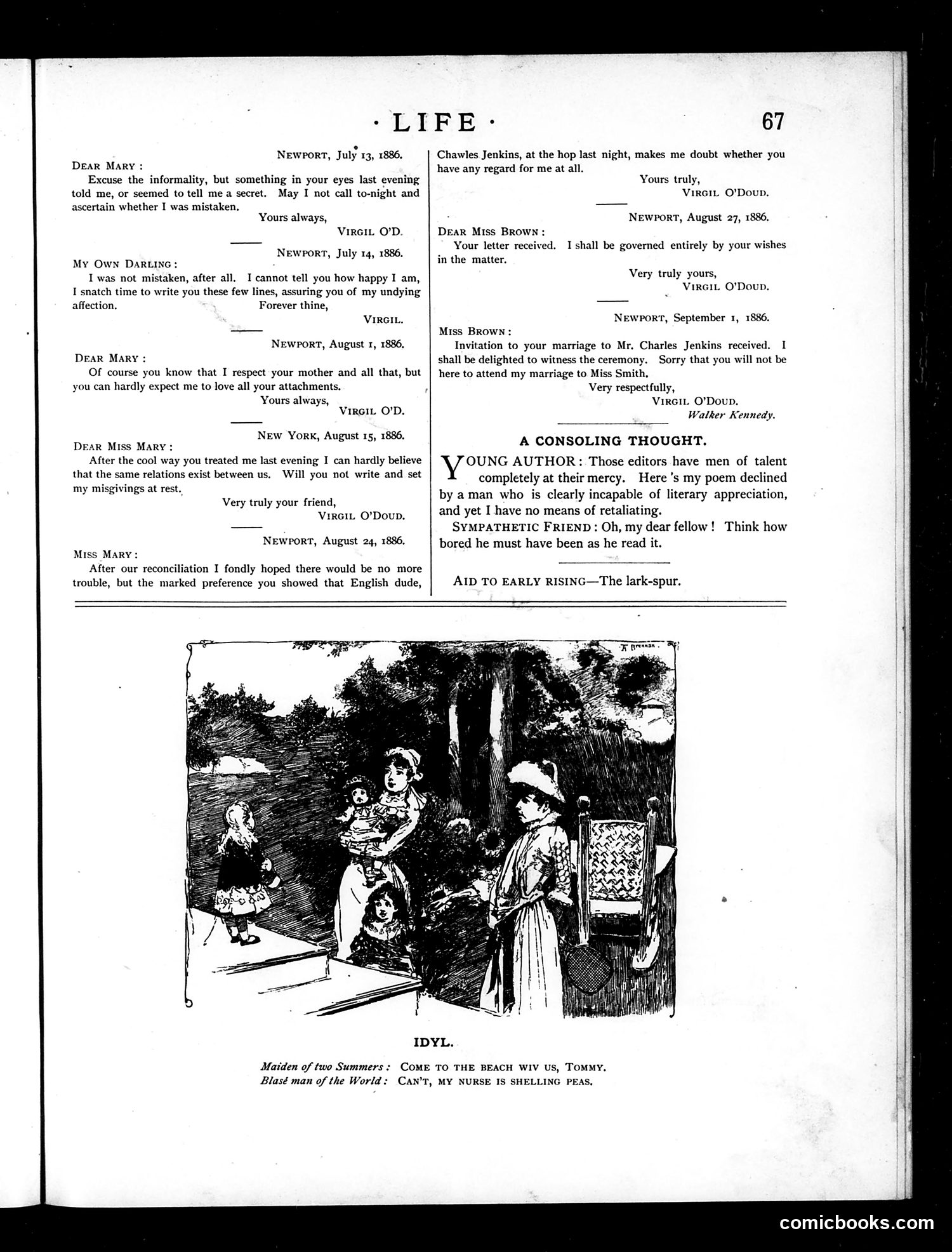
This page features satirical social commentary typical of *Life* magazine's humor. The main content is a humorous letter sequence mocking the fickleness of wealthy Newport society romance. "Virgil O'Doup" (a satirical name) writes increasingly formal letters to "Mary," progressing from passionate courtship to cold dismissal after she shows interest in "Chawles Jenkins" (an Anglicized spelling mocking pretentious society types). The punchline: by September, Virgil has already moved on, inviting Mary to *his* wedding to Miss Smith—revealing the shallow, mercenary nature of high-society matchmaking. Below, a brief joke mocks struggling authors' powerlessness against editors, followed by a small cartoon labeled "IDYL" depicting a nursemaid and children at the beach—likely satirizing Victorian parenting where nurses handle childcare while society folk pursue leisure. The satire targets wealthy Newport's romance, social climbing, and the absurd priorities of the leisure class.
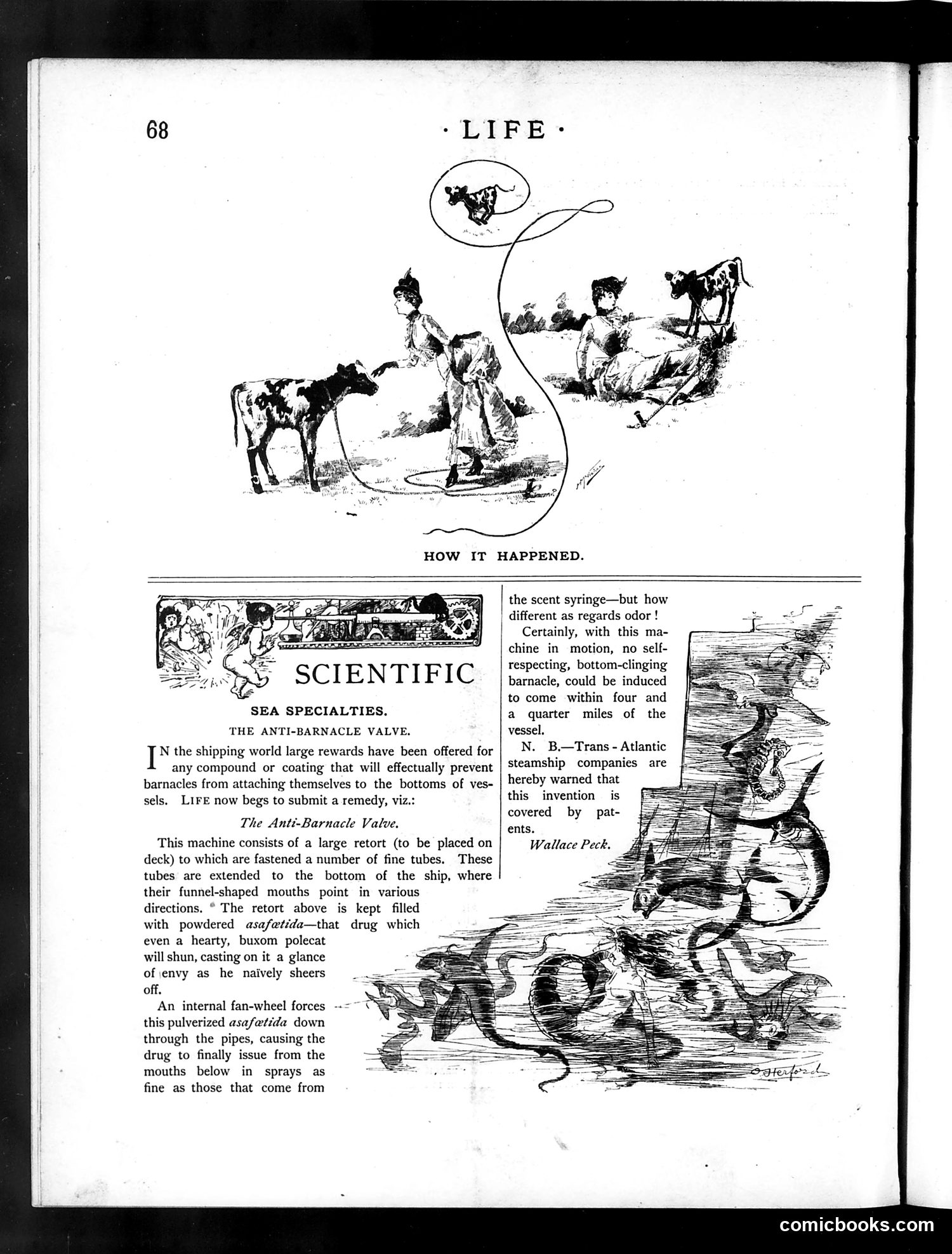
This is a humorous mock-scientific proposal addressing a genuine Victorian-era shipping problem: barnacles fouling ship hulls, which reduced speed and increased fuel costs. The shipping industry offered real rewards for effective prevention solutions. Life's satire invents an absurd "remedy": a deck-mounted retort filled with powdered asafetida (a notoriously foul-smelling plant resin used medicinally) that sprays the noxious powder through tubes to the ship's bottom. The joke relies on exaggeration—claiming the stench would repel barnacles from "four and a quarter miles" away. The cartoon above shows people (likely scientists or sailors) attempting this ridiculous contraption with lassoing implements, illustrating the impracticality. The satire mocks both pseudo-scientific solutions and the desperation of shipowners seeking any remedy, no matter how absurd, for this costly problem. The note attributing the invention to "Wallace Peck" suggests this is Life's own fabrication.
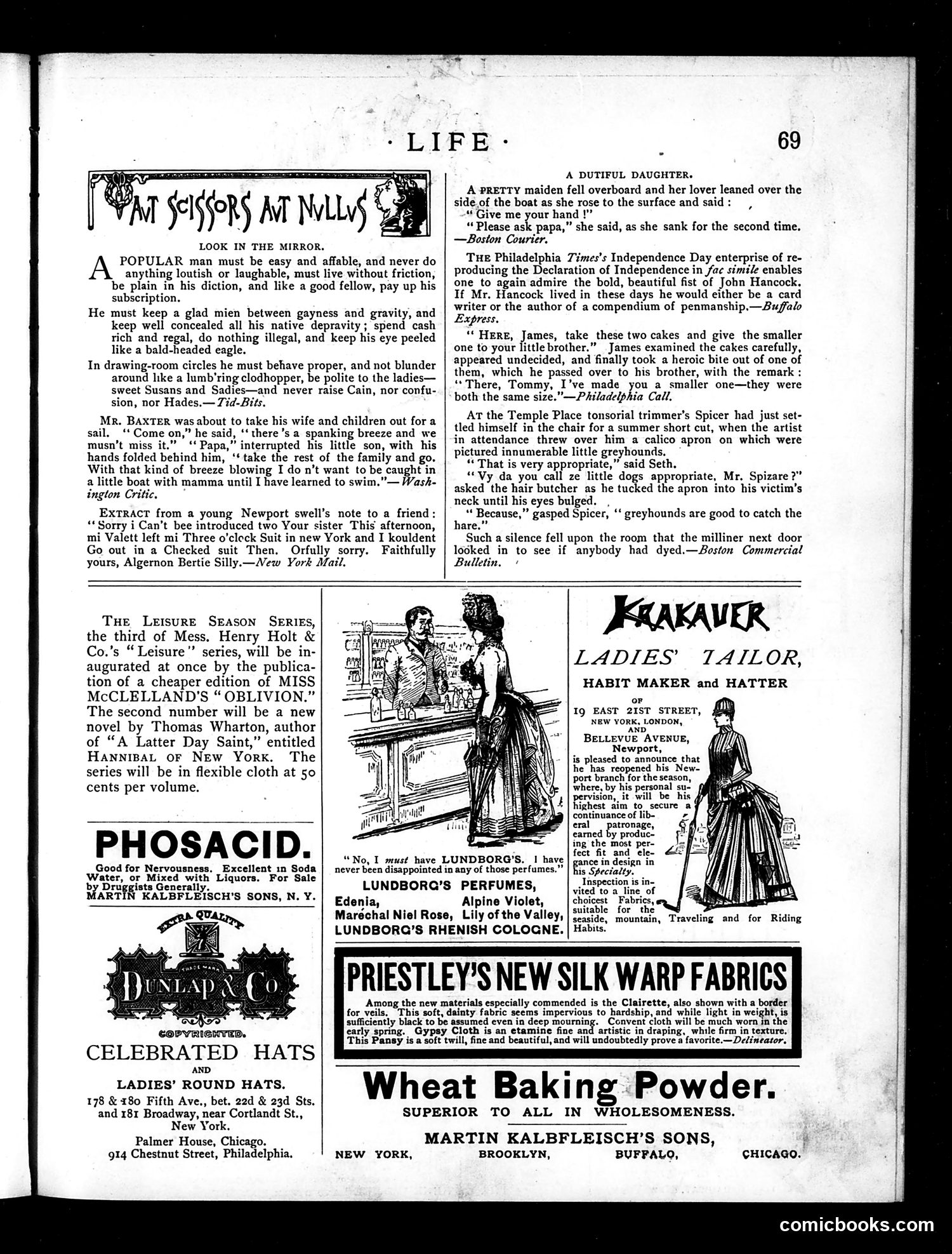
This page contains several short humorous anecdotes reflecting late 19th-century social commentary, plus advertisements. The main cartoon section titled "Look in the Mirror" offers satirical advice on how a "popular man" should behave: be affable, avoid scandal, spend money generously, maintain proper drawing-room etiquette, and never cause disturbance. The satire mocks rigid social conformity and the performative nature of respectability. The anecdotes below mock various social pretensions: a boy's fear of drowning with his mother; a wealthy Newport man's absurdly misspelled excuse (prioritizing his checked suit); a boy's selfish cake-division logic; and a barber's pun about greyhounds "catching the hare" that causes awkward silence. The remaining content is primarily **advertising**: for hats, perfumes, baking powder, tailoring services, and fabric—typical of period magazine filler. The humor relies on class anxieties, proper behavior, and wordplay that would have resonated with Life's middle-class readership in this era.
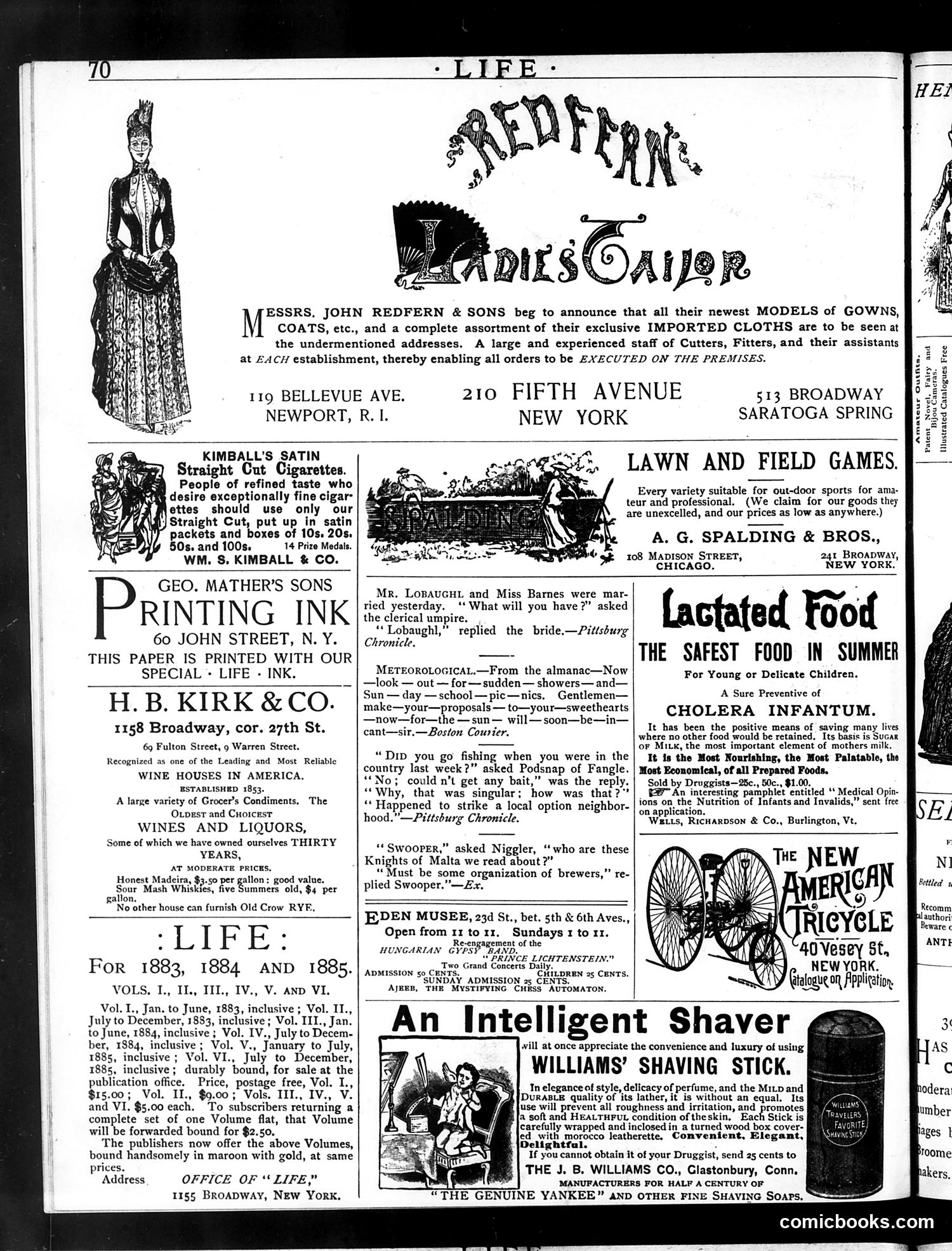
This is primarily an **advertising page** from Life magazine (1883-1885). The page contains minimal editorial content—mostly commercial advertisements for luxury goods and services of the Gilded Age. The few **jokes/satirical items** include: - A pun about a newlywed bride named Lobaugh choosing her husband's name when asked "what will you have?" - Weather humor about "sudden showers" ruining Sunday school picnics and courtship proposals - A joke equating "Knights of Malta" with brewers (likely referencing temperance debates of the era) - A fishing story joking about "local option" (prohibition laws) The **advertisements** showcase period interests: women's fashions (Redfern & Sons), fine wines and liquors, printing inks, sports equipment (Spalding), bicycles, and patent medicines. The prominent "Lactated Food" ad promoting a remedy for "cholera infantum" reflects 19th-century health anxieties and the marketing of proprietary medicines—many of dubious efficacy. This page exemplifies how Life subsidized satirical content through luxury advertising targeting wealthy readers.
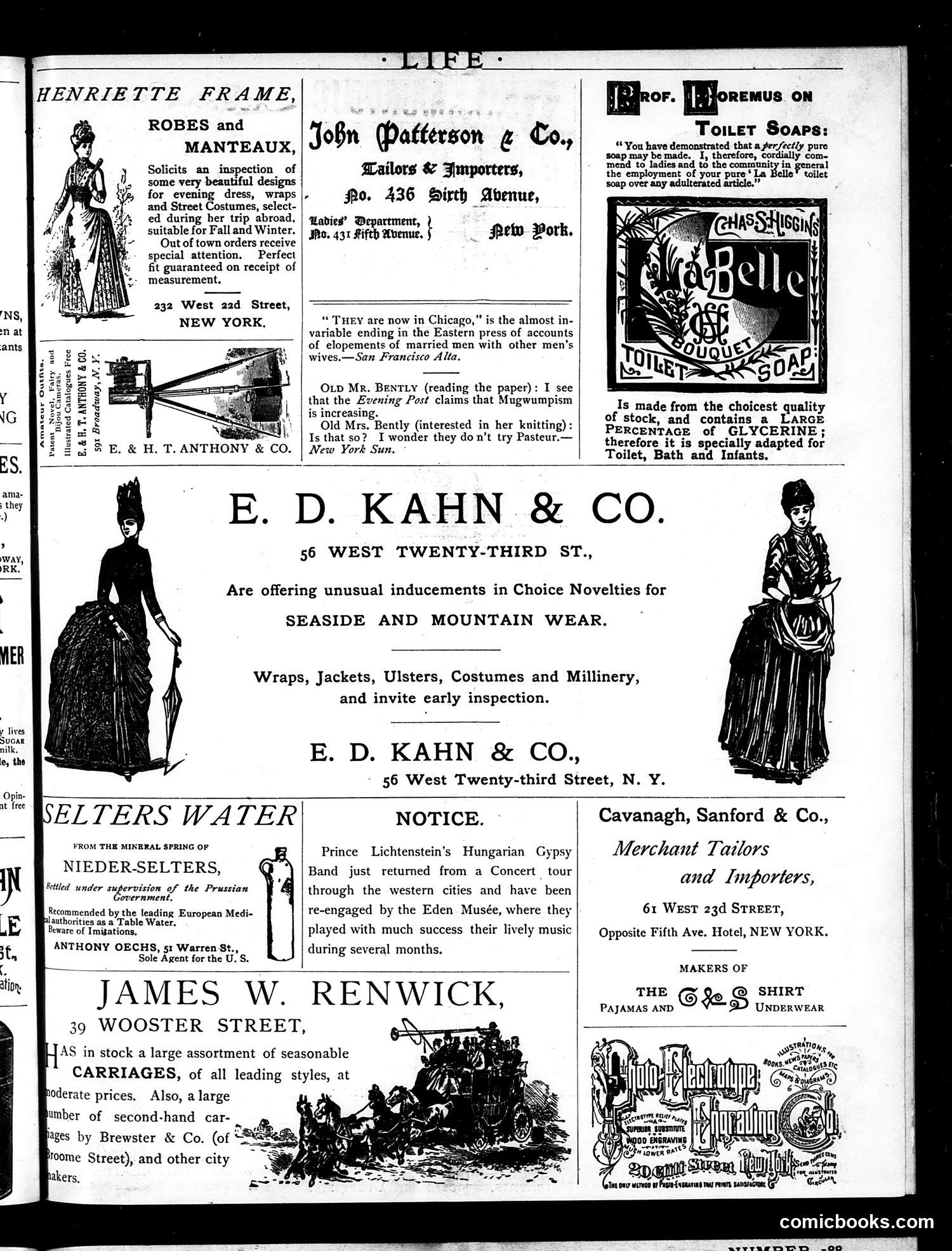
This is primarily an **advertising page** from the satirical magazine *Life*, with two brief jokes embedded among the commercial notices. ## The Jokes: **First joke** (attributed to *San Francisco Alta*): References the scandal of married men eloping with other men's wives—apparently so common that Chicago's involvement is "almost inevitable" in press accounts. The satire mocks both the prevalence of such affairs and the Eastern press's formulaic reporting. **Second joke** (from *New York Sun*): Mr. and Mrs. Bently discuss an article claiming "Mugwumpism" (political independents/reformers) is increasing. Mrs. Bently, knitting, suggests they "try Pasteur"—a joke treating Mugwumpism like a disease requiring medical treatment, referencing Louis Pasteur's germ theory. The humor lies in the absurd conflation of a political movement with an infectious disease. ## Advertisements: The rest of the page features typical Gilded Age ads for women's fashion, carriages, soaps, and imported goods—targeting wealthy New York consumers. The woodcut illustrations depict fashionable women in period dress.
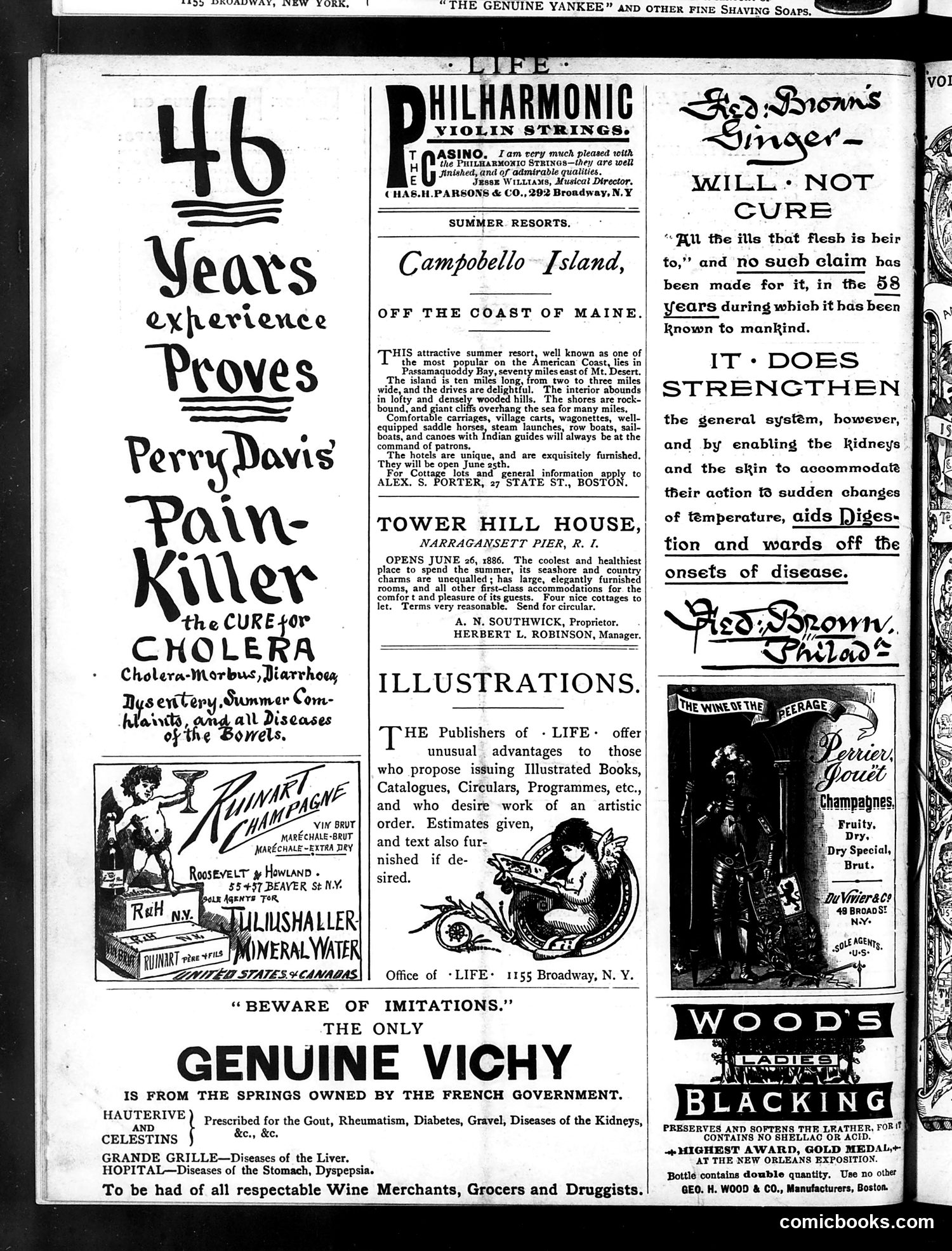
This page is primarily **advertising**, not satirical content. It contains multiple patent medicine and product advertisements typical of 1880s American publications. The largest ad promotes **Perry Davis Pain-Killer** as a cure for cholera and various bowel diseases—a common claim for patent medicines of this era, though now recognized as false and dangerous. Other notable ads include: - **Vichy water** (French mineral water), marketed for gout, rheumatism, and kidney disease - **Wood's Blacking** shoe polish - **Perrier champagne** - Summer resort advertisements for Campobello Island and Tower Hill House - Philharmonic violin strings A disclaimer from **Eno's Fruit Salt** explicitly states it "will not cure" illness, only "strengthen the general system"—a rare moment of honesty amid widespread medical fraud. The page reflects the pre-FDA era when unproven medicinal claims dominated advertising, preying on readers' health anxieties without regulation or scientific evidence.