
Life, 1886-07-29 · page 2 of 16
Life — July 29, 1886 — page 2: what you’re looking at
What you’re looking at
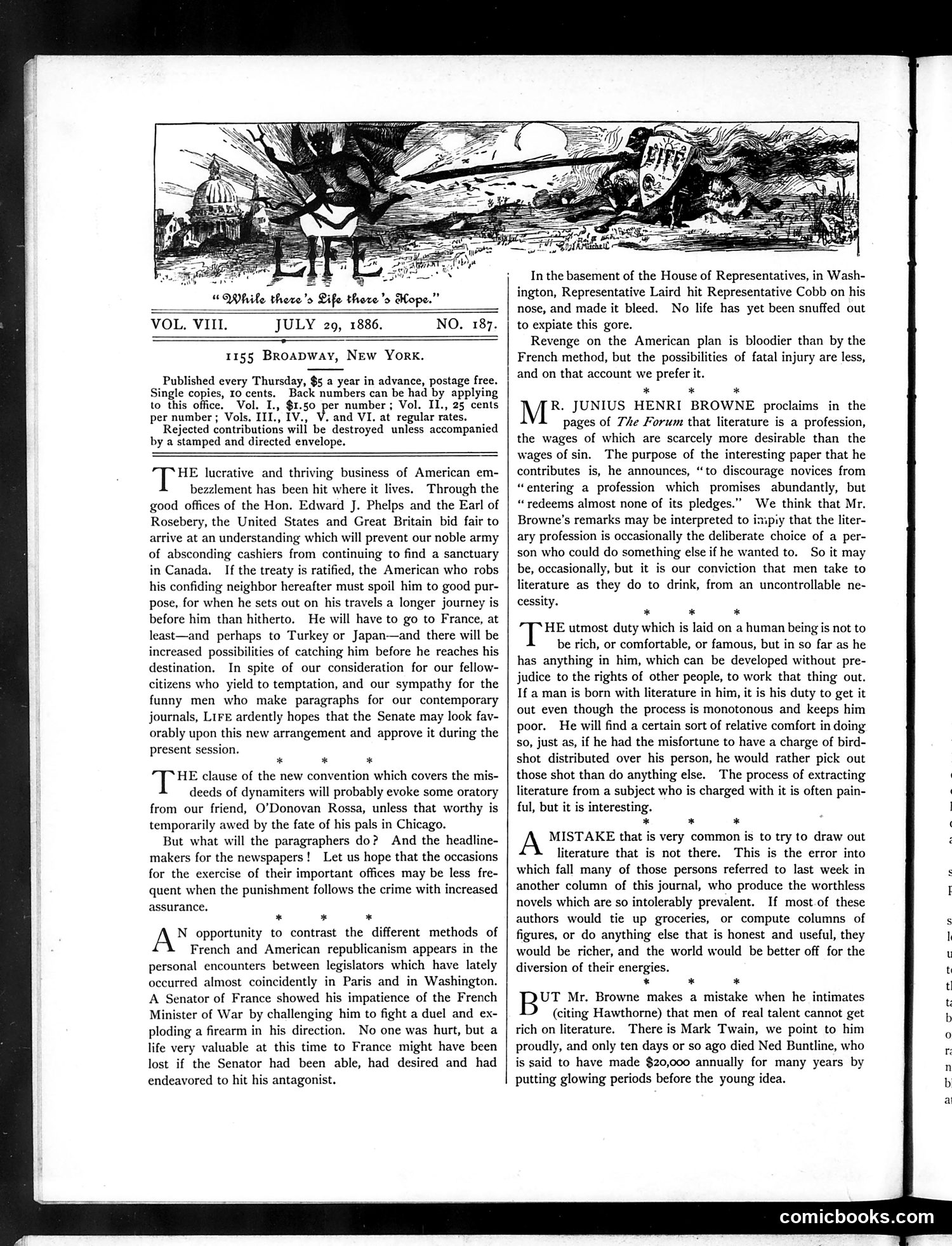
The top cartoon depicts a figure beneath a large tree labeled "While there's a Life there's a Slope" (a pun on the phrase "while there's life there's hope"). The image appears satirical in nature, though the specific political reference is unclear from the visual alone. The accompanying text discusses various political and social matters of 1886, including an incident where Representative Laird struck Representative Cobb in the House basement, references to dynamite-related violence (likely anarchist concerns of the era), and a debate about whether literature constitutes a legitimate profession. The exact satirical target of the cartoon remains uncertain without additional historical context about contemporary events or figures from July 1886.
📄 Transcribed text from this page (OCR, searchable)
Machine-transcribed from the original scan — historical spelling and the odd misread are preserved.
“OMhife there's Life there's Hope.” JULY 29, 1886. VOL. VIII. NO. 187. 1155 Broapway, New York. Published every Thursday, $5 a year in advance, postage free. Single copies, ro cents. Back numbers can be had by applying to this office. Vol. I., $1.50 per number; Vol. II., 25 cents per number ; Vols, III., IV., V. and VI. at regular rates. Rejected contributions will be destroyed unless accompanied by a stamped and directed envelope. HE lucrative and thriving business of American em- bezzlement has been hit where it lives. Through the good offices of the Hon. Edward J. Phelps and the Earl of Rosebery, the United States and Great Britain bid fair to arrive at an understanding which will prevent our noble army of absconding cashiers from continuing to find a sanctuary in Canada. If the treaty is ratified, the American who robs his confiding neighbor hereafter must spoil him to good pur- pose, for when he sets out on his travels a longer journey is before him than hitherto. He will have to go to France, at least—and perhaps to Turkey or Japan—and there will be increased possibilities of catching him before he reaches his destination. In spite of our consideration for our fellow- citizens who yield to temptation, and our sympathy for the funny men who make paragraphs for our contemporary journals, Lire ardently hopes that the Senate may look fav- orably upon this new arrangement and approve it during the present session. * * * HE clause of the new convention which covers the mis- deeds of dynamiters will probably evoke some oratory from our friend, O’Donovan Rossa, unless that worthy is temporarily awed by the fate of his pals in Chicago. But what will the paragraphers do? And the headline- makers for the newspapers! Let us hope that the occasions for the exercise of their important offices may be less fre- quent when the punishment follows the crime with increased assurance, * * * A’ opportunity to contrast the different methods of French and American republicanism appears in the personal encounters between legislators which have lately occurred almost coincidently in Paris and in Washington. A Senator of France showed his impatience of the French Minister of War by challenging him to fight a duel and ex- ploding a firearm in his direction. No one was hurt, but a life very valuable at this time to France might have been lost if the Senator had been able, had desired and had endeavored to hit his antagonist. In the basement of the House of Representatives, in Wash- ington, Representative Laird hit Representative Cobb on his nose, and made it bleed. No life has yet been snuffed out to expiate this gore. Revenge on the American plan is bloodier than by the French method, but the possibilities of fatal injury are less, and on that account we prefer it. * * * R. JUNIUS HENRI BROWNE pproclaims in the pages of 7he Forum that literature is a profession, the wages of which are scarcely more desirable than the wages of sin. The purpose of the interesting paper that he contributes is, he announces, ‘to discourage novices from “entering a profession which promises abundantly, but “ redeems almost none of its pledges.” We think that Mr. Browne’s remarks may be interpreted to impiy that the liter- ary profession is occasionally the deliberate choice of a per- son who could do something else if he wanted to. So it may be, occasionally, but it is our conviction that men take to literature as they do to drink, from an uncontrollable ne- cessity. * * * HE utmost duty which is laid on a human being is not to be rich, or comfortable, or famous, but in so far as he has anything in him, which can be developed without pre- judice to the rights of other people, to work that thing out. If a man is born with literature in him, it is his duty to get it out even though the process is monotonous and keeps him poor. He will find a certain sort of relative comfort in doing so, just as, if he had the misfortune to have a charge of bird- shot distributed over his person, he would rather pick out those shot than do anything else. The process of extracting literature from a subject who is charged with it is often pain- ful, but it is interesting. * * * MISTAKE that is very common is to try to draw out literature that is not there. This is the error into which fall many of those persons referred to last week in another column of this journal, who produce the worthless novels which are so intolerably prevalent. If most.of these authors would tie up groceries, or compute columns of figures, or do anything else that is honest and useful, they would be richer, and the world would be better off for the diversion of their energies. * * * UT Mr. Browne makes a mistake when he intimates (citing Hawthorne) that men of real talent cannot get rich on literature. There is Mark Twain, we point to him proudly, and only ten days or so ago died Ned Buntline, who is said to have made $20,000 annually for many years by putting glowing periods before the young idea. comicbooks.com