
Life, 1886-07-29 · page 6 of 16
Life — July 29, 1886 — page 6: what you’re looking at
What you’re looking at
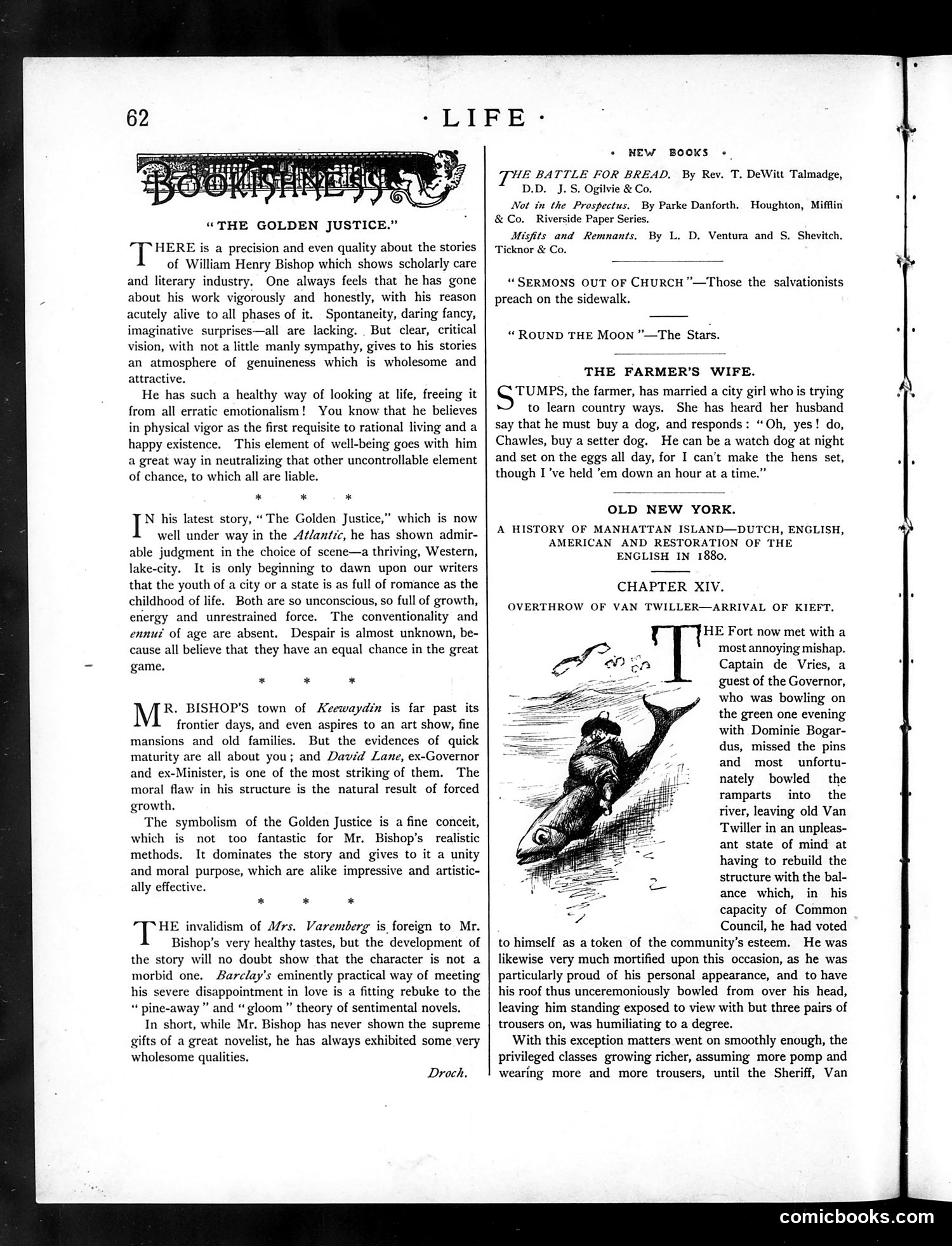
This page contains literary reviews rather than political cartoons. The main content discusses William Henry Bishop's story "The Golden Justice," praising his scholarly care and realistic portrayal of life. The review notes Bishop's balanced approach—combining spontaneity with critical vision while avoiding excessive sentimentality. A secondary story, "The Farmer's Wife," appears to satirize rural-urban cultural clash: a farmer's new city-bride wife resists his practical demands (buying a dog, setting eggs) with humor. The page also advertises new books and begins a serialized history of Dutch New York. The single illustration depicts someone falling into water—likely related to the "Old New York" historical narrative about colonial New Amsterdam.
📄 Transcribed text from this page (OCR, searchable)
Machine-transcribed from the original scan — historical spelling and the odd misread are preserved.
“THE GOLDEN JUSTICE.” HERE is a precision and even quality about the stories of William Henry Bishop which shows scholarly care and literary industry. One always feels that he has gone about his work vigorously and honestly, with his reason acutely alive to all phases of it. Spontaneity, daring fancy, imaginative surprises—all are lacking. . But clear, critical vision, with not a little manly sympathy, gives to his stories an atmosphere of genuineness which is wholesome and attractive. He has such a healthy way of looking at life, freeing it from all erratic emotionalism! You know that he believes in physical vigor as the first requisite to rational living and a happy existence. This element of well-being goes with him a great way in neutralizing that other uncontrollable element of chance, to which all are liable. * * * N his latest story, “The Golden Justice,” which is now well under way in the A¢/antic, he has shown admir- able judgment in the choice of scene—a thriving, Western, lake-city. It is only beginning to dawn upon our writers that the youth of a city or a state is as full of romance as the childhood of life. Both are so unconscious, so full of growth, energy and unrestrained force. The conventionality and ennué of age are absent. Despair is almost unknown, be- cause all believe that they have an equal chance in the great game. * * * R. BISHOP’S town of Keewaydin is far past its frontier days, and even aspires to an art show, fine mansions and old families. But the evidences of quick maturity are all about you; and David Lane, ex-Governor and ex-Minister, is one of the most striking of them. The moral flaw in his structure is the natural result of forced growth, The symbolism of the Golden Justice is a fine conceit, which is not too fantastic for Mr. Bishop’s realistic methods. It dominates the story and gives to it a unity and moral purpose, which are alike impressive and artistic- ally effective. * * * HE invalidism of Mrs. Varemberg is foreign to Mr. Bishop’s very healthy tastes, but the development of the story will no doubt show that the character is not a morbid one. Barclay’s eminently practical way of meeting his severe disappointment in love is a fitting rebuke to the “ pine-away ” and “gloom ” theory of sentimental novels. In short, while Mr. Bishop has never shown the supreme gifts of a great novelist, he has always exhibited some very wholesome qualities. Droch, « NEW BOOKS «+ TUE BATTLE FOR BREAD. By Rev. T. DeWitt Talmadge, D.D. J. S. Ogilvie & Co. Not in the Prospectus, By Parke Danforth. Houghton, Mifflin & Co. Riverside Paper Series. Misfits and Remnants. Ticknor & Co. By L. D, Ventura and S. Shevitch, “SERMONS OUT OF CHURCH "—Those the salvationists preach on the sidewalk. “ ROUND THE Moon "—The Stars. THE FARMER’S WIFE. TUMPS, the farmer, has married a city girl who is trying to learn country ways. She has heard her husband say that he must buy a dog, and responds: “Oh, yes! do, Chawles, buy a setter dog. He can be a watch dog at night and set on the eggs all day, for I can’t make the hens set, though I’ve held ’em down an hour at a time.” OLD NEW YORK. A HISTORY OF MANHATTAN ISLAND—DUTCH, ENGLISH, AMERICAN AND RESTORATION OF THE ENGLISH IN 1880. CHAPTER XIV. OVERTHROW OF VAN TWILLER—ARRIVAL OF KIEFT. HE Fort now met with a most annoying mishap. Captain de Vries, a guest of the Governor, who was bowling on the green one evening with Dominie Bogar- dus, missed the pins and most unfortu- nately bowled the ramparts into the river, leaving old Van Twiller in an unpleas- ant state of mind at having to rebuild the structure with the bal- ance which, in his capacity of Common Council, he had voted to himself as a token of the community’s esteem. He was likewise very much mortified upon this occasion, as he was particularly proud of his personal appearance, and to have his roof thus unceremoniously bowled from over his head, leaving him standing exposed to view with but three pairs of trousers on, was humiliating to a degree. With this exception matters went on smoothly enough, the privileged classes growing richer, assuming more pomp and wearing more and more trousers, until the Sheriff, Van comicbooks.com