
A complete issue · 21 pages · 1886
Life — June 24, 1886
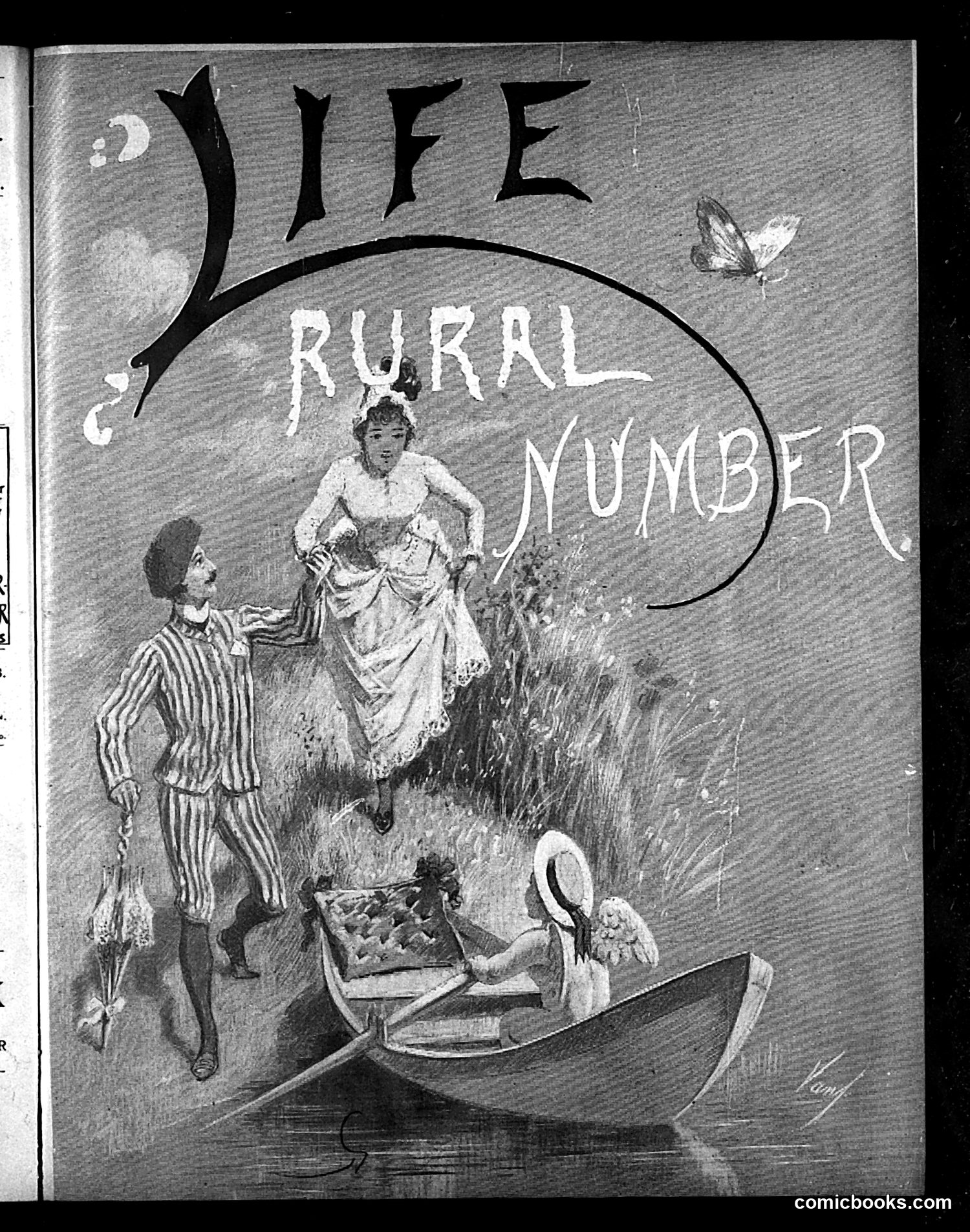
This appears to be a cover or title page for a special rural-themed issue of *Life* magazine. The illustration depicts a pastoral scene with three figures: a man in striped clothing (possibly representing an urban visitor or businessman), a woman in a dress standing prominently, and another figure in a boat below. The setting includes natural elements—a crescent moon, butterfly, water, and vegetation—emphasizing the rural theme. The satire likely mocks either urban attitudes toward rural life or contrasts rural simplicity with city sophistication. The formal dress and theatrical poses suggest ironic treatment of "rustic" subjects. Without additional context about the specific publication date, the exact satirical target remains unclear, though *Life* magazine regularly lampooned social and class differences.
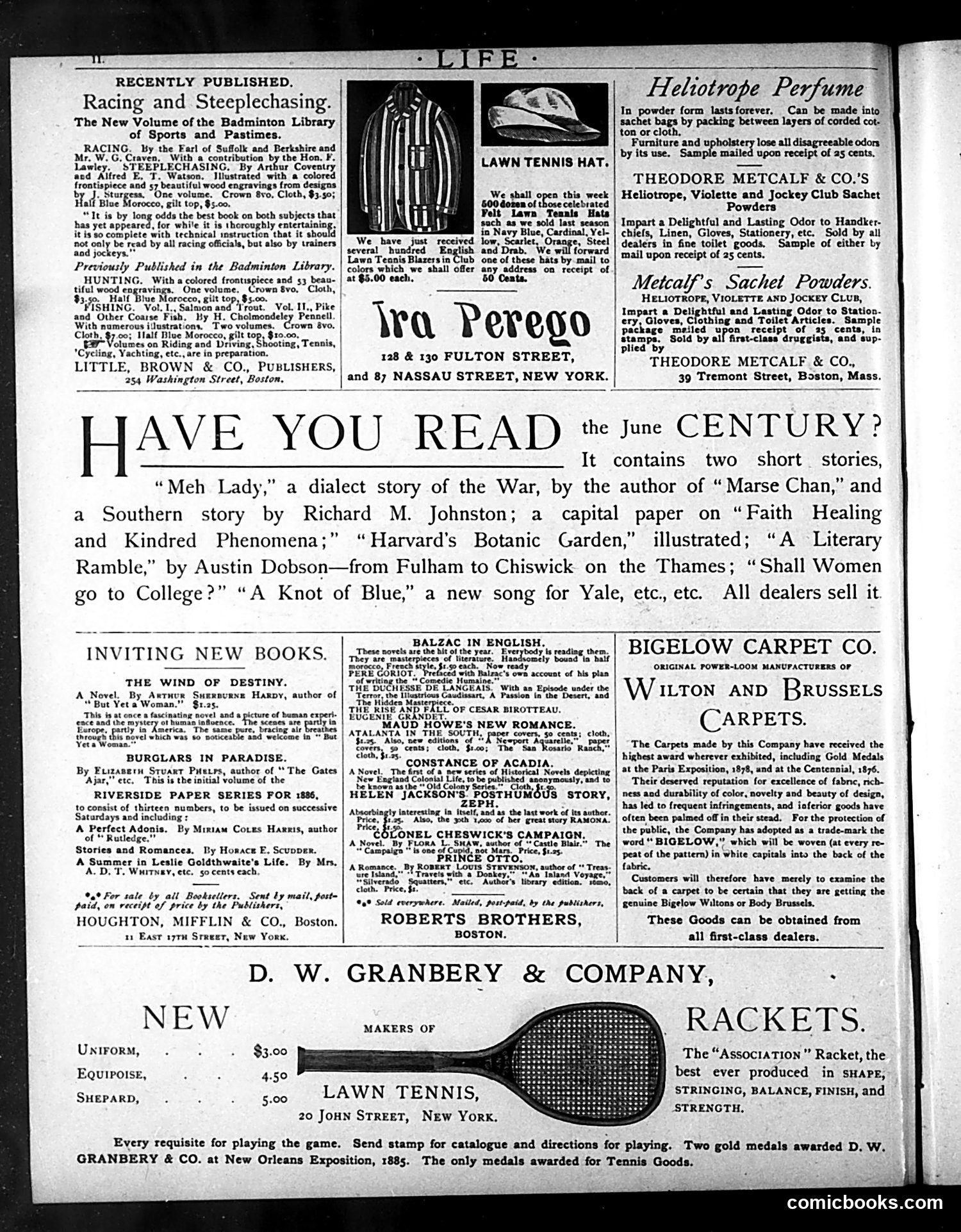
This page is **primarily advertising**, not satire or political commentary. It contains notices for recently published books and multiple product advertisements from the 1880s era. The advertisements include: - **Sporting goods**: lawn tennis hats and rackets (D.W. Granberry & Company), emphasizing "Association" rackets with gold medals - **Household products**: perfumes and sachet powders (Theodore Metcalf & Co.), carpet manufacturers (Bigelow), and paper - **Publishing**: promotion for *Century* magazine's June issue, listing literary contents The only editorial content is the *Century* magazine advertisement, which highlights fiction stories and articles on topics like "Faith Healing" and women's education. There is **no political cartoon visible**—this is a commercial page from Life magazine's advertising section.
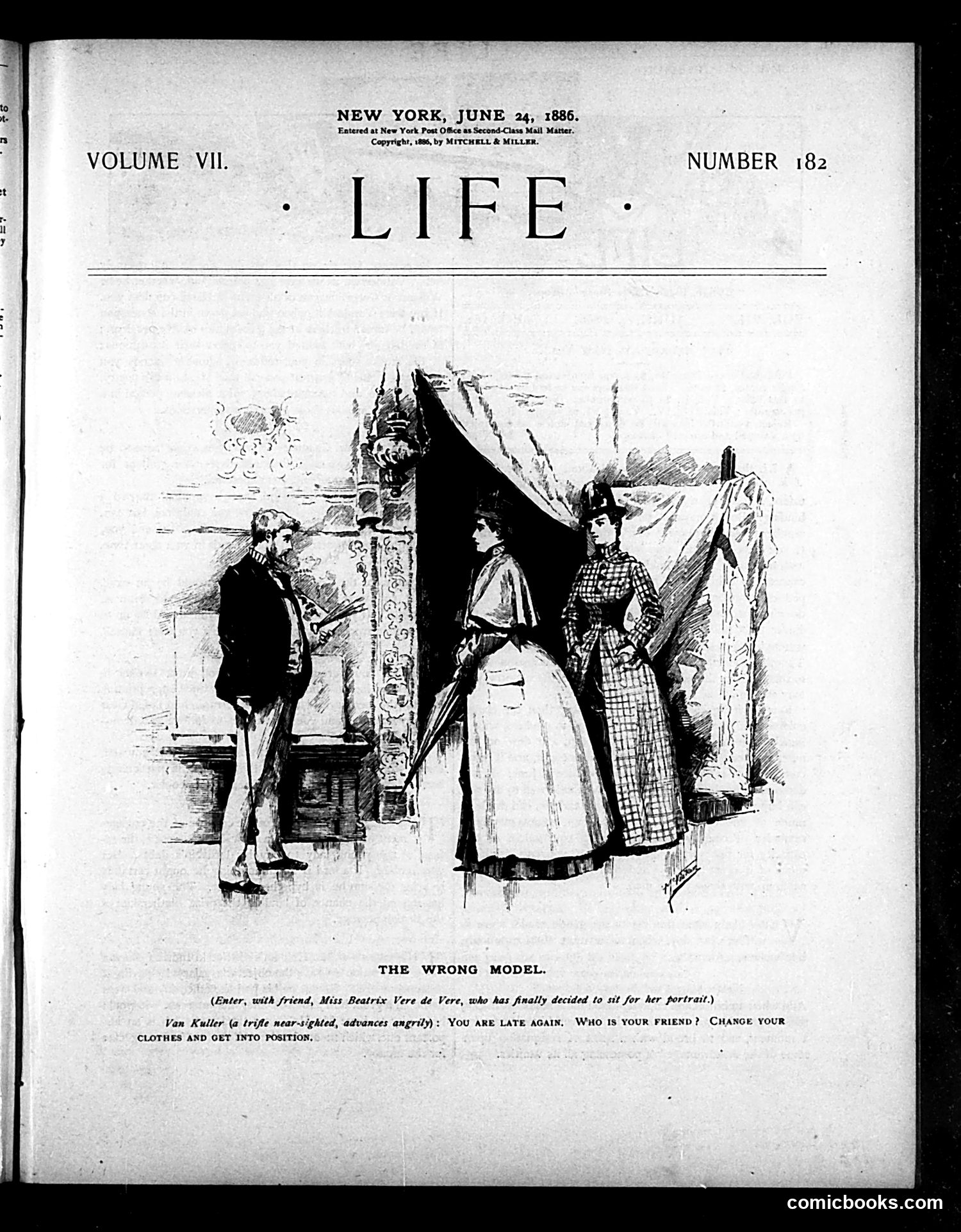
This satirical cartoon depicts a social embarrassment at what appears to be an artist's studio. A man identified as "Van Kuller" (a character, not a historical figure) has arrived late to a portrait sitting. He angrily confronts two women, demanding to know who the second woman is and insisting she change clothes and leave the studio. The joke hinges on mistaken identity: Van Kuller appears to have brought the wrong woman as his model for the portrait session. The caption reveals his companion is "Miss Beatrix Vere de Vere," who has decided against sitting for the portrait. The satire mocks upper-class social awkwardness and the confusion that ensues when proper decorum breaks down in artistic circles. The humor is situational rather than political.
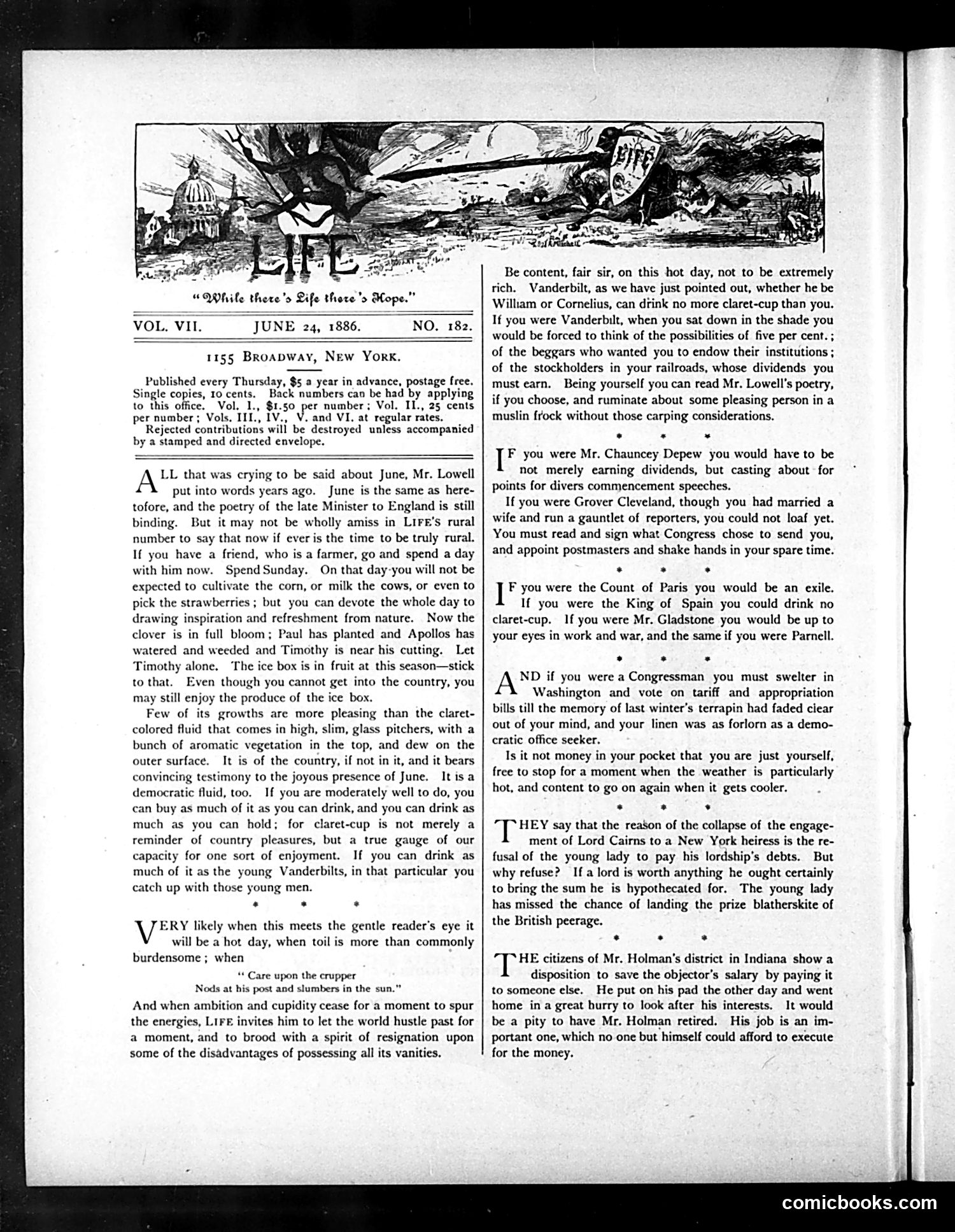
The masthead illustration titled "While there's Life there's Hope" depicts a skeletal Death figure looming over a pastoral landscape with a church—a memento mori image about mortality amid rural tranquility. The article's main text addresses Mr. Lowell's recent statements about rural life and June being the ideal season. The piece uses conditional satire: "If you were Vanderbilt," "If you were Mr. Chauncey Depew," "If you were Grover Cleveland"—mocking how wealthy industrialists and politicians cannot truly appreciate rural simplicity due to their obligations and wealth. The satire critiques the romantic idealization of country life while acknowledging that only the privileged can afford leisure to enjoy it. The piece ultimately argues that genuine contentment requires freedom from ambition and material concerns.
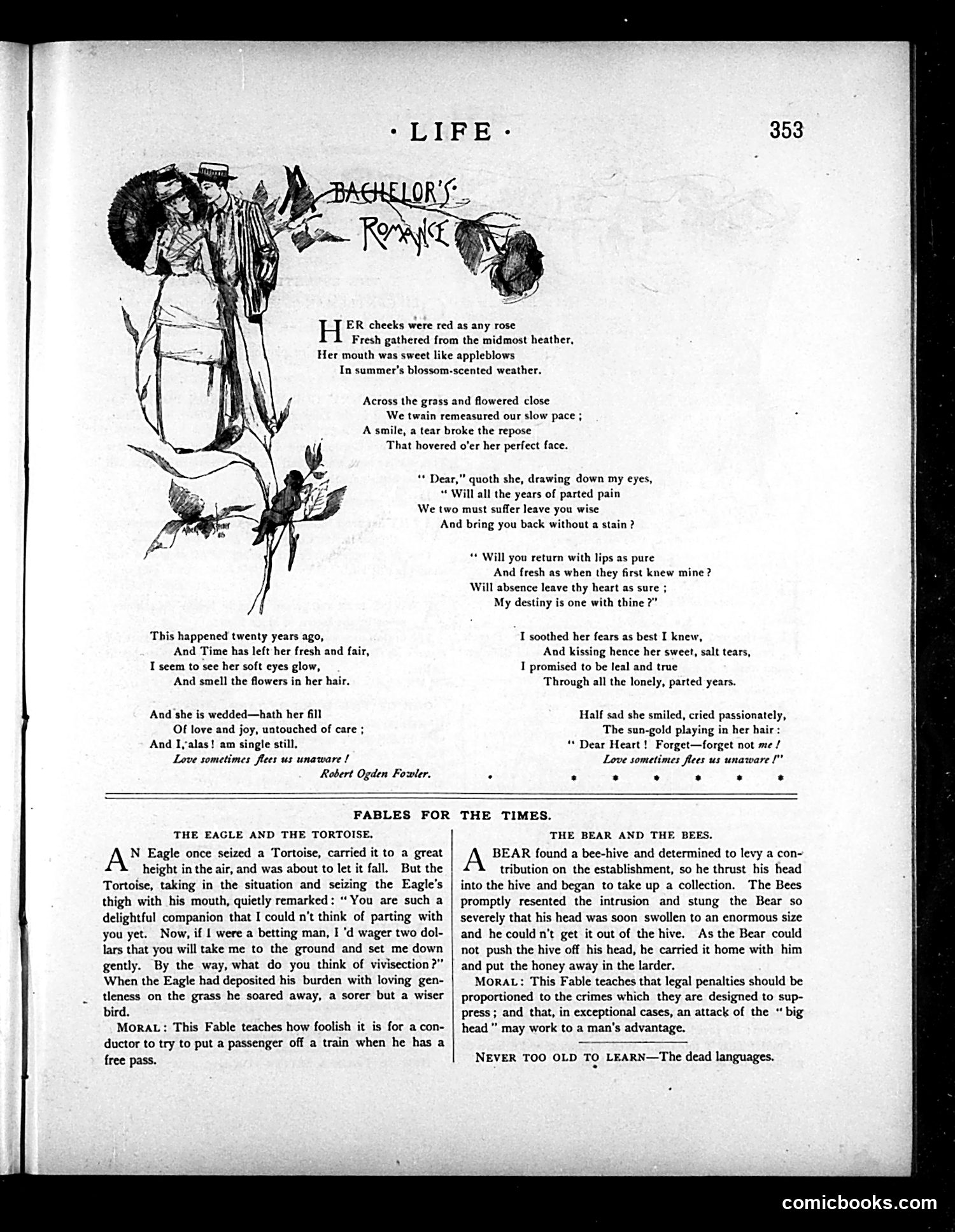
This page contains three distinct elements: 1. **"Bachelor's Romance"** — A romantic poem with decorative botanical illustrations, depicting a sentimental narrative about a man remembering a woman he loved twenty years ago who is now married to another. 2. **"Fables for the Times"** — Two short moral fables: - **The Eagle and the Tortoise**: Satirizes foolish conduct, with a moral about the absurdity of assisting someone off a train without a valid ticket. - **The Bear and the Bees**: Teaches that legal penalties should match crimes; attacking a beehive to steal honey results in disproportionate suffering. These fables appear designed as gentle social commentary on contemporary behavior and legal justice, using animal characters to deliver moralistic lessons to readers. The page blends sentimental poetry with satirical fables typical of Life's editorial content.
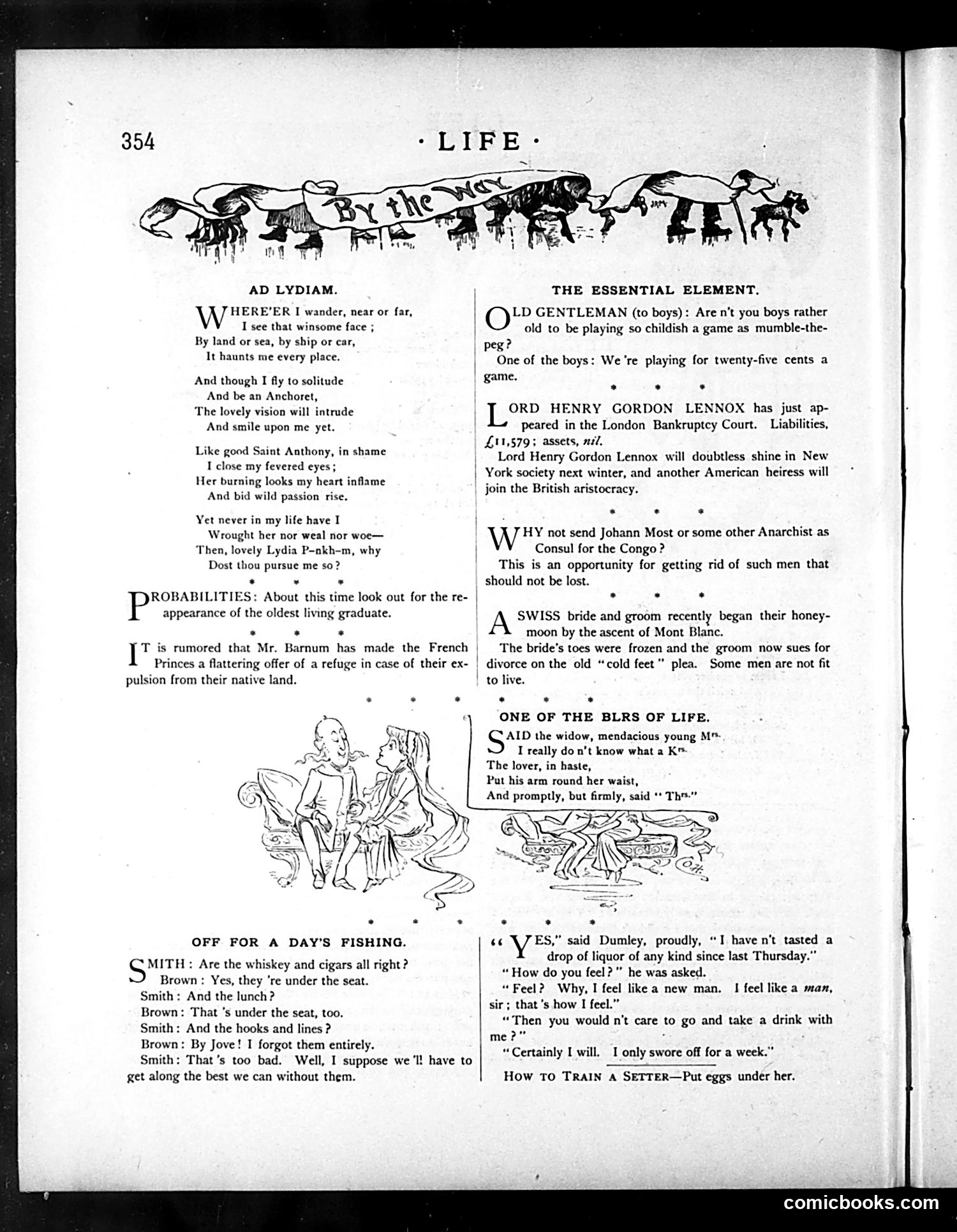
This page contains several brief satirical pieces rather than a single cartoon. The main items include: - **"Ad Lydiam"**: A poem about wandering, likely referencing classical themes - **"The Essential Element"**: A dialogue where boys playing marbles reject an old gentleman's characterization of their game as "childish," insisting they're playing seriously for money - **"Probabilities"**: A gossipy item about Lord Henry Gordon Lennox's bankruptcy proceedings and anticipated remarriage into American wealth - **"Off for a Day's Fishing"**: A humorous dialogue between Smith and Brown about forgetting essential supplies (whiskey, cigars, hooks, lines) The satire targets upper-class pretension, financial scandal, and male incompetence. The page reflects early-20th-century American satirical magazine style, mixing social commentary with light humor about contemporary society figures and everyday absurdities.
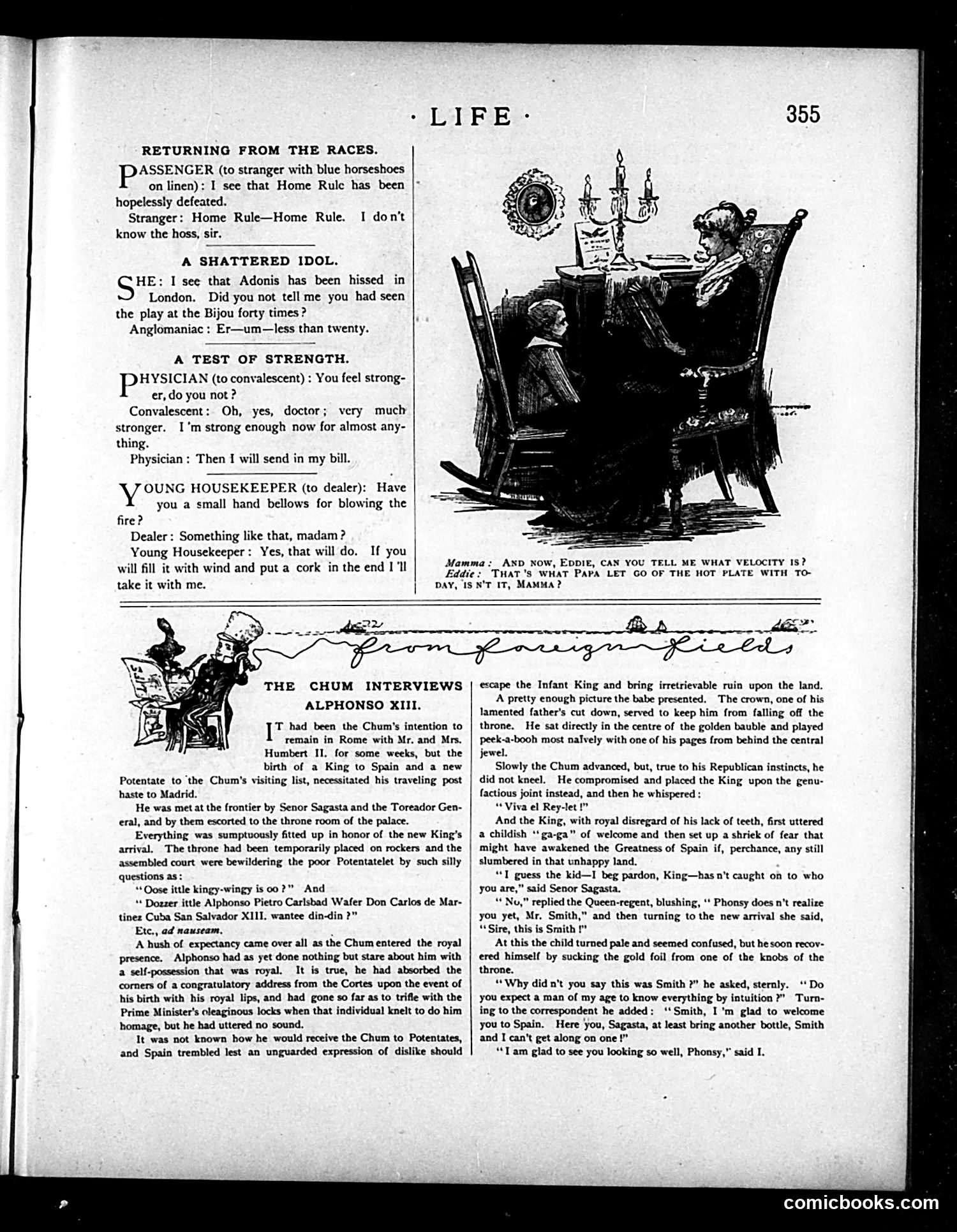
This page contains several brief satirical jokes and an illustrated article about "The Chum Interviews Alphonso XIII" (Spain's King Alfonso XIII). The upper jokes mock everyday situations: a stranger's ignorance about horses, Adonis's theatrical reputation, a physician's business practices, and a housekeeper's creative solution to acquiring bellows. The main illustrated feature depicts the king receiving visitors, with accompanying text describing diplomatic protocol when a Spanish infant prince was born. The satire targets the king's awkward social discomfort during the interview—he remains silent while courtiers nervously manage the conversation. The humor derives from portraying royal dignity as fragile, undermined by simple social anxiety and dental problems (referenced in dialogue about "lack of teeth"). The piece gently mocks Spanish court formality and the king's awkward interactions with his visitors.
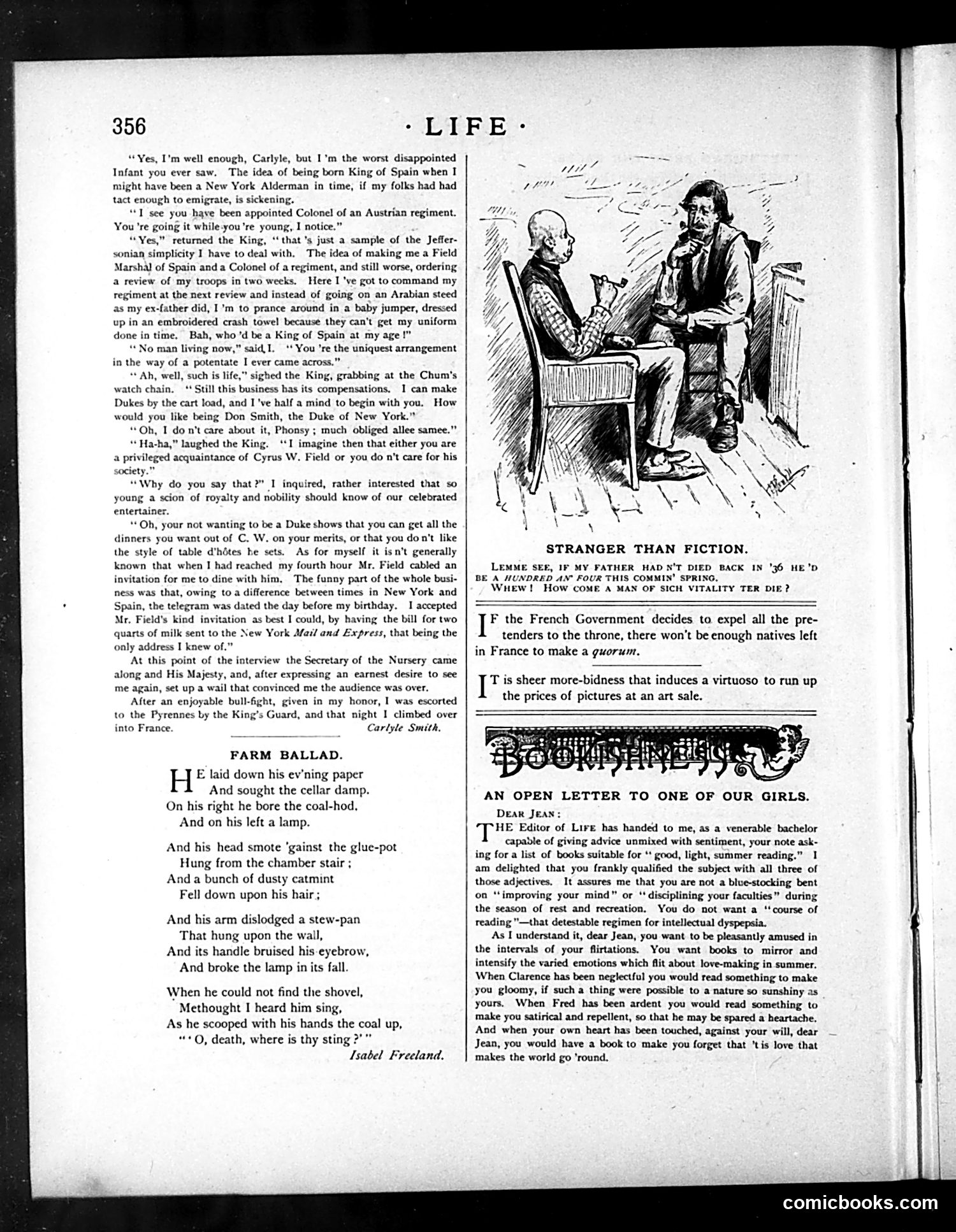
This page contains three distinct pieces: 1. **Top section**: A dialogue between characters named Carlyle and the King, discussing appointments and social obligations. The illustration shows two men in conversation—one appears to be a nobleman or official based on his formal dress. 2. **"Farm Ballad"** (by Isabel Freeland): A poem about a laborer finding a shovel, written in folk-verse style with rural imagery. 3. **"An Open Letter to One of Our Girls"**: Advice from *Life*'s editor to a female reader named Jean about improving her mind through reading and maintaining composure during emotional difficulties. The page reflects *Life* magazine's satirical approach—mixing social commentary on class/ambition with literary content and mock-serious advice to readers, typical of late 19th/early 20th-century American humor magazines.
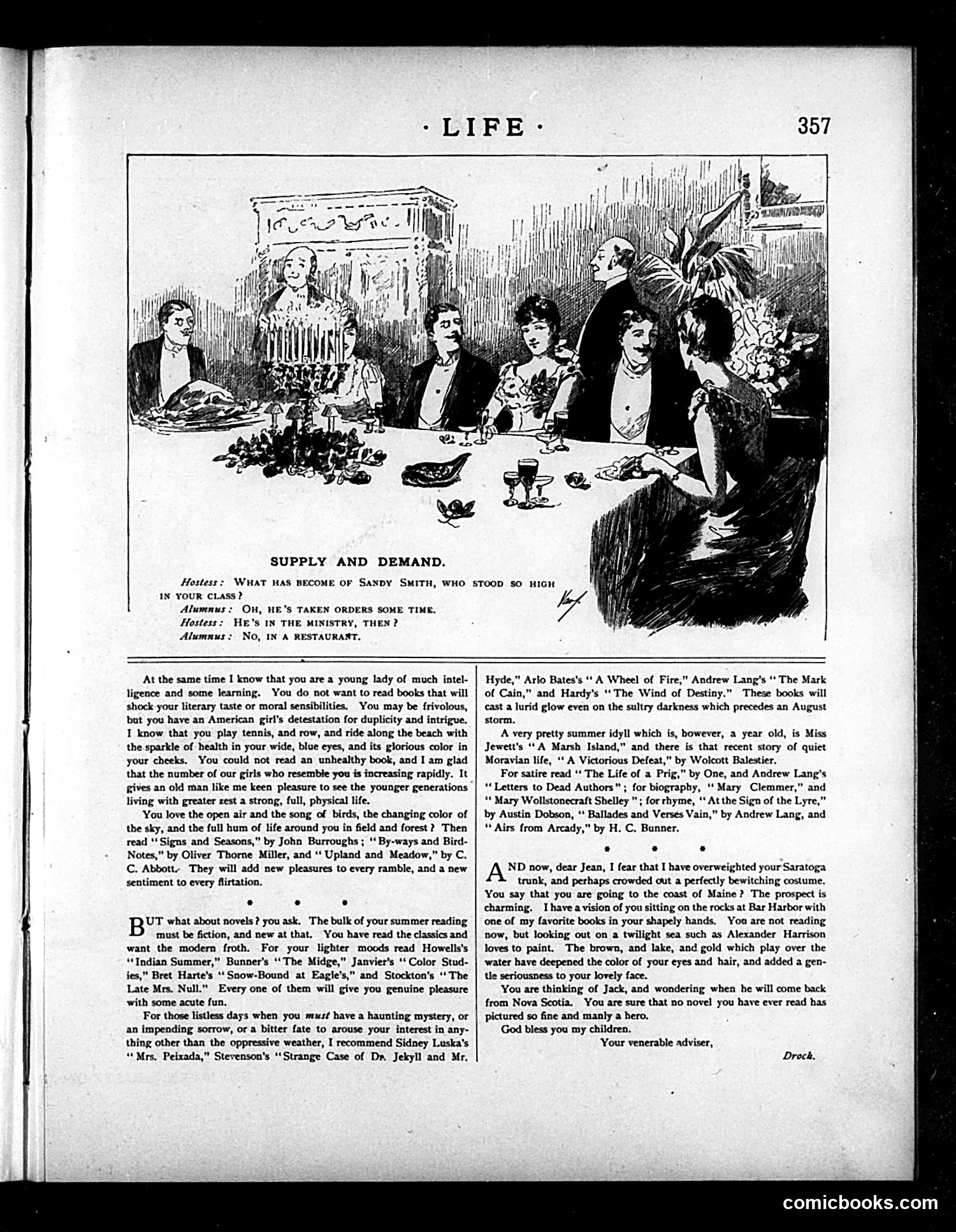
This cartoon satirizes **social climbing and class pretension**. The hostess asks about "Sandy Smith, who stood so high in your class"—implying he's risen socially. The punchline reveals he's now "in the ministry, then?" but the guest responds "No, in a restaurant," suggesting Smith has become a waiter or restaurateur rather than achieving respectable professional status. The joke mocks the gap between *perceived* social advancement and actual employment. Despite appearing to have "risen," Sandy Smith occupies a lower-status service position—a humbling comedown. The well-dressed dinner party setting emphasizes the irony: they're discussing someone serving others while they themselves dine. This reflects early-20th-century anxieties about social mobility and class markers.
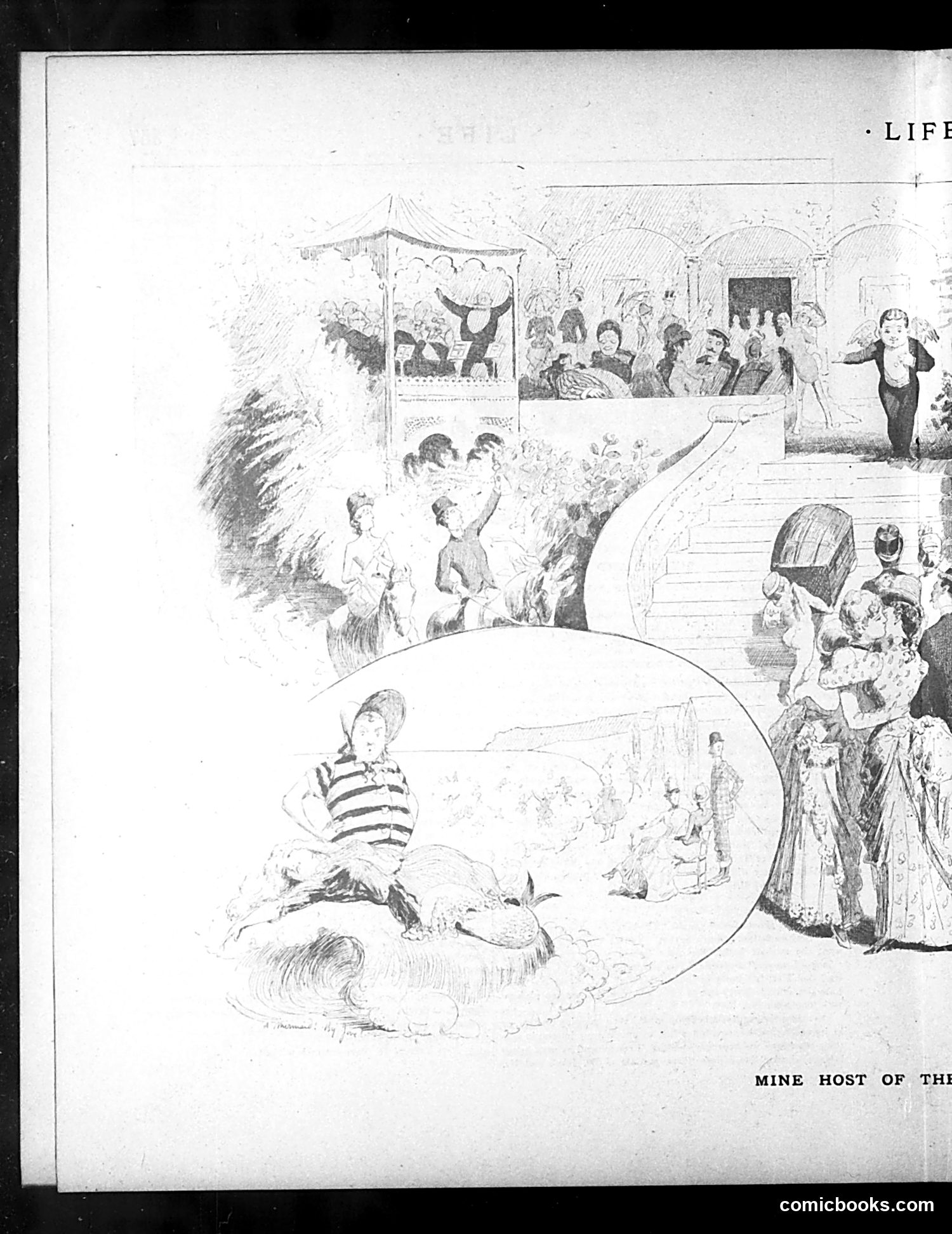
This page appears to be from *Life* magazine and depicts a social scene at what seems to be a seaside resort or beach establishment. The main illustration shows a child in a striped bathing suit playing in sand (lower left, in an oval frame), while above are various well-dressed society figures observing from a pavilion or boardwalk area. The title "Mine Host of The[...]" (text cut off) suggests the cartoon is satirizing hospitality or entertainment management at a fashionable venue. The contrast between the unselfconscious child at play and the formally-dressed, observant crowd above likely mocks Victorian-era social pretension and the artificial constraints of high society—particularly how adults at resort destinations performed respectability while watching others. The specific identities of figures remain unclear without the complete text.
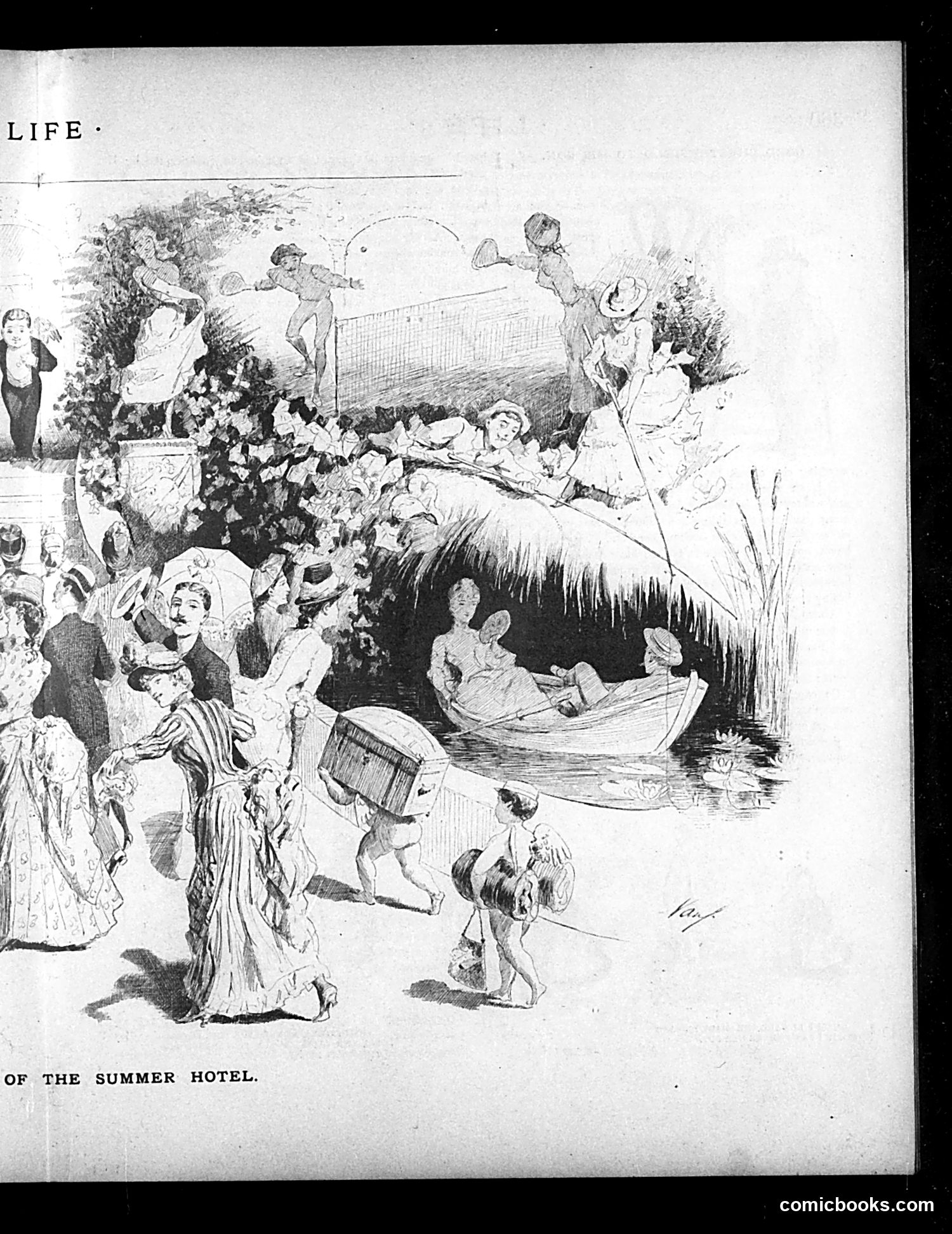
This satirical illustration depicts the social dynamics of a Victorian-era summer resort. The left side shows wealthy guests in formal dress socializing and dining, while the right side contrasts this with water-based leisure activities—guests swimming, boating, and fishing in a natural setting with water and vegetation. The satire appears to highlight the contrast between artificial social pretension (formal gatherings, elaborate clothing) and natural recreation. The composition suggests commentary on class distinctions and behavioral codes at resort hotels, where guests maintained formal propriety in social spaces while pursuing leisure activities in more natural settings. The style and subject matter are typical of Life magazine's social satire from the late 19th century, gently mocking resort culture and vacation behavior.
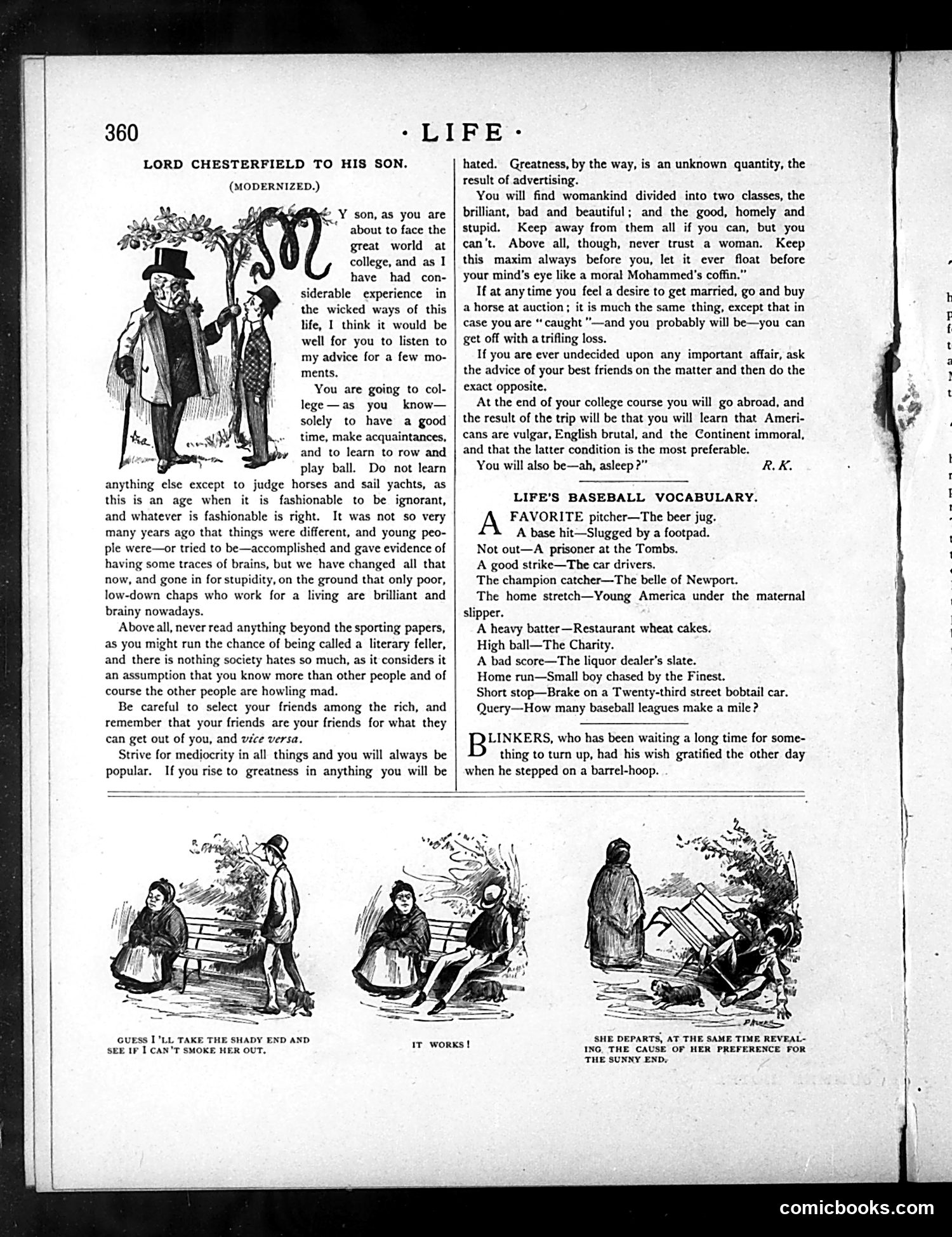
This page satirizes upper-class attitudes toward education and morality through a mock "Lord Chesterfield" letter advising a college-bound son. The satire inverts proper values: the father recommends avoiding learning, cultivating only rich friends for exploitation, pursuing mediocrity, and distrusting women—all presented as fashionable society norms. The humor targets Gilded Age excess: ignorance as status symbol, sports over intellect, and cynical social climbing. The "Baseball Vocabulary" section uses baseball terminology to mock contemporary life (the "champion catcher" is a wealthy Newport belle; "home run" is a boy evading police). Three small cartoons below depict a man courting a woman on park benches, using dubious tactics to "smoke her out"—she eventually leaves, revealing she preferred the sunny spot, not his company. The overall message criticizes how wealthy American society values superficiality, moral flexibility, and calculated self-interest over genuine accomplishment or virtue.
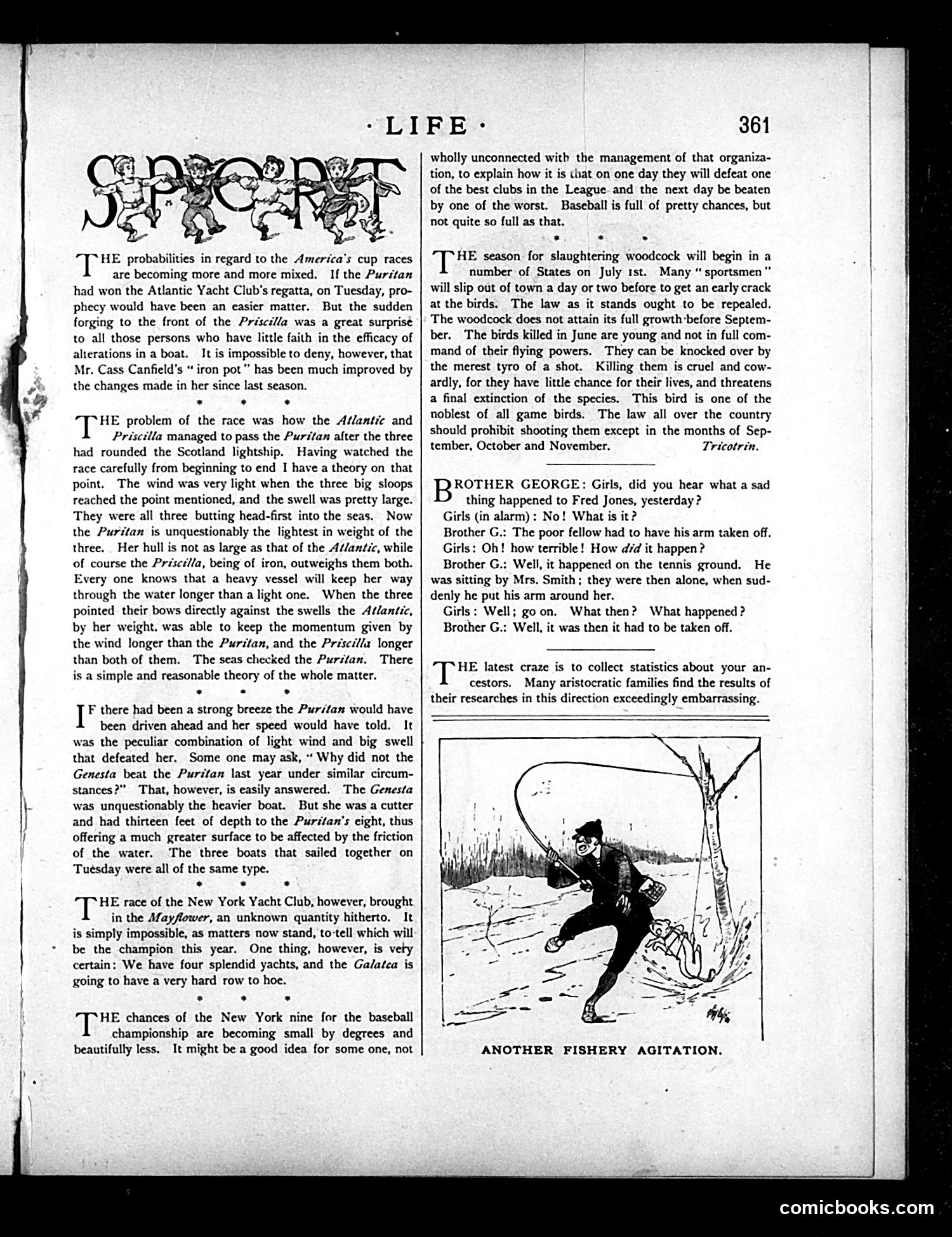
This page contains sports commentary and a single cartoon titled "Another Fishery Agitation." **The Cartoon**: The illustration depicts a man in period clothing (appears to be late 19th century) fishing near a birch tree by water. He's using a fishing rod and appears to be in an exaggerated, comedic posture. The caption "Another Fishery Agitation" suggests satirical commentary on fishing-related disputes or regulations. **The Text Content**: The page discusses yacht racing (America's Cup races, comparing boats like the *Puritan*, *Atlantic*, and *Priscilla*), baseball's New York nine, and woodcock hunting season regulations. The woodcock section is notably critical, arguing that July 1st hunting season should be repealed because birds killed in June are immature and defenseless, making the practice "cruel and cowardly" and threatening species extinction. The cartoon likely relates to contemporary fishing/hunting regulation debates, though the specific "agitation" referenced isn't entirely clear from this page alone.
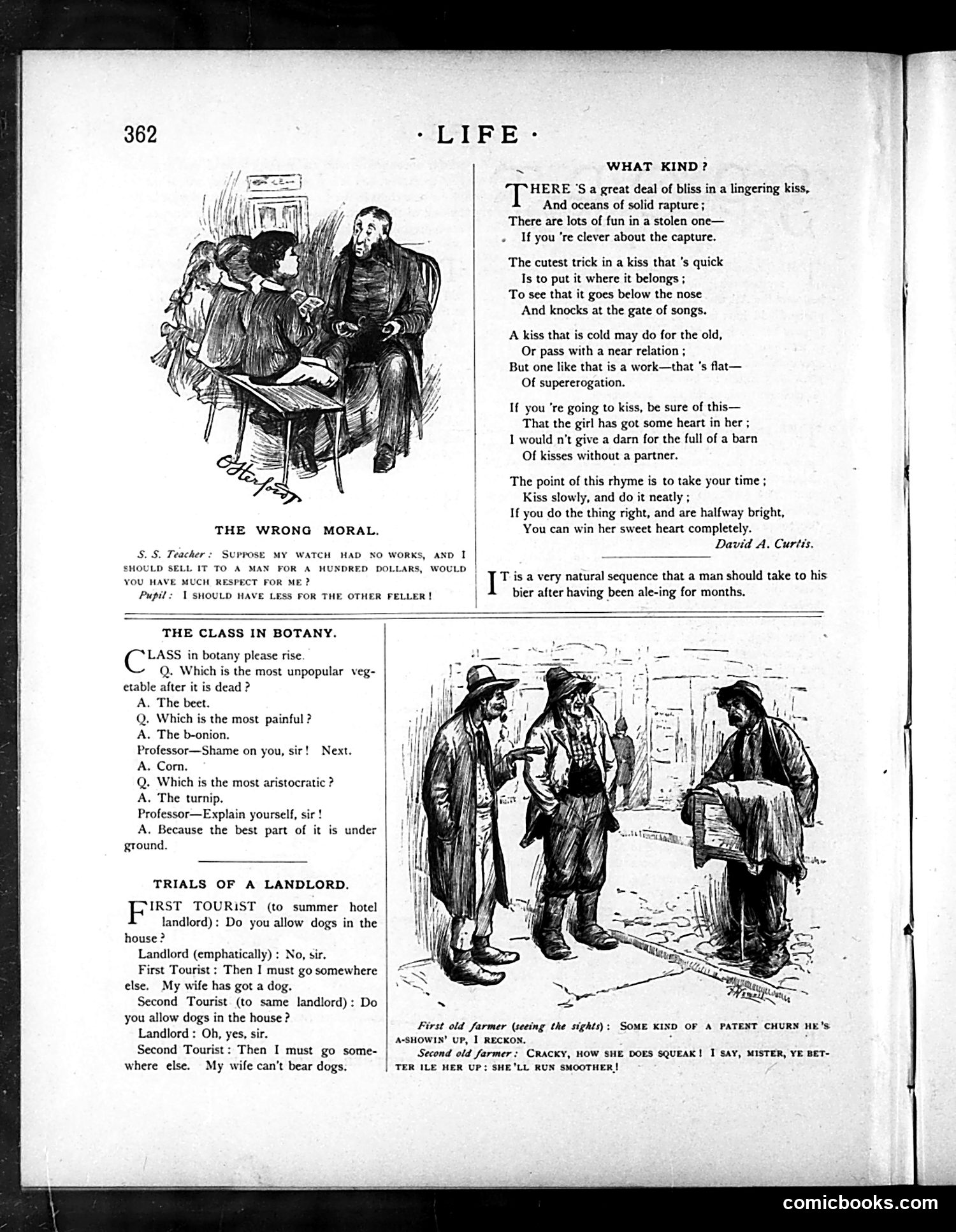
This page contains several unrelated humor pieces typical of Life magazine's format: **"What Kind?"** is a poem about kissing technique, offering comedic advice on proper form and timing—lighthearted romance humor. **"The Wrong Moral"** mocks a teacher-student exchange about logic: a teacher suggests selling a broken watch to gain respect; the pupil quips the seller should give *less* money to the buyer instead—satire on flawed reasoning. **"The Class in Botany"** features joke Q&A with students making puns (beet/beat, onion/union, turnip being "aristocratic" because its best part is underground). **"Trials of a Landlord"** shows a landlord's inconsistency: he refuses dogs to one tourist, then accepts them from another—both tourists must leave because their wives can't tolerate dogs. The joke reveals the landlord's arbitrary rules. **Bottom cartoon** depicts rural farmers mistaking modern machinery for a churn, humor based on country folk's unfamiliarity with industrial technology.
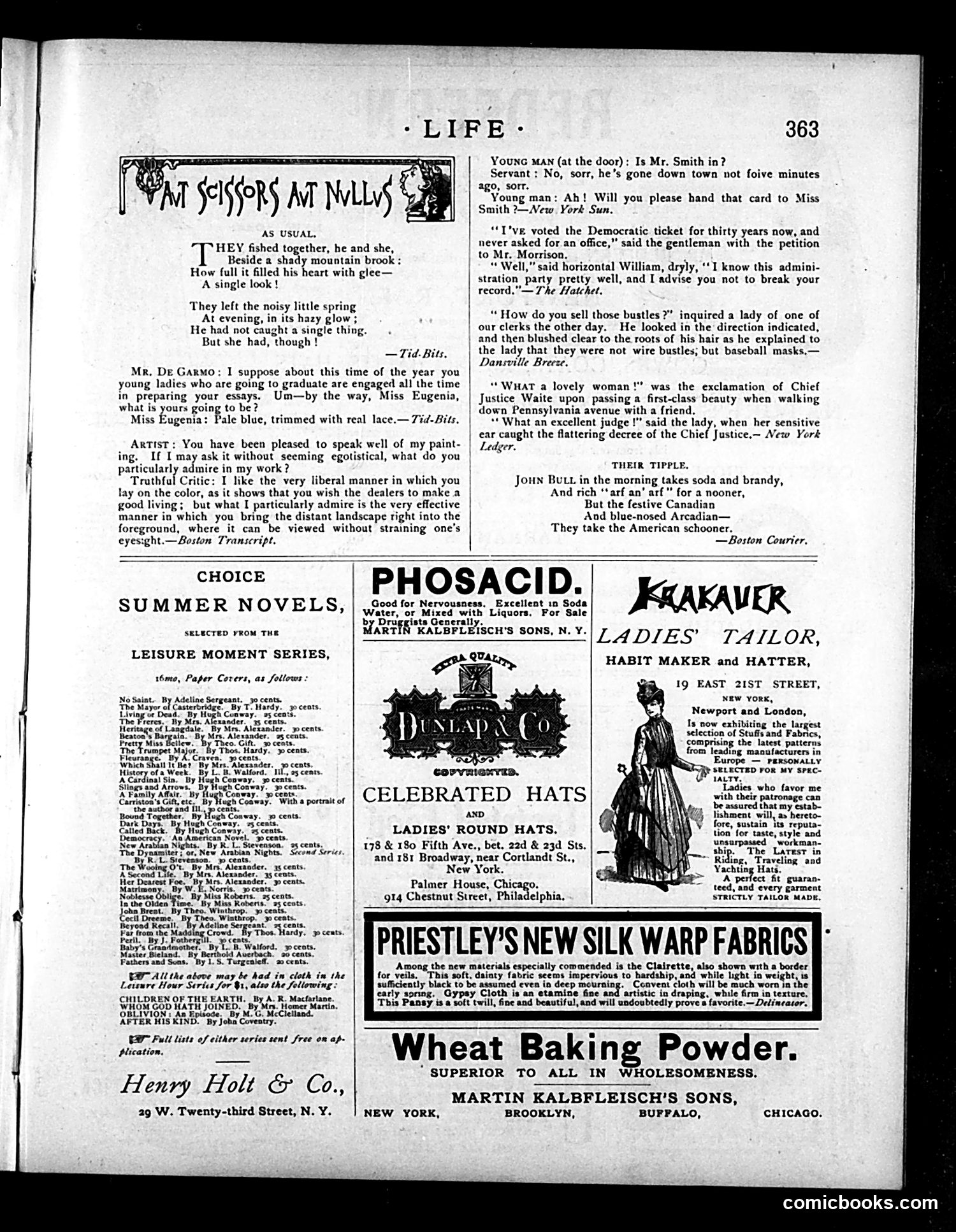
This page from *Life* magazine contains several brief satirical jokes rather than a single cartoon. The main illustrated piece, "Scissors at Nulls," depicts a fishing scene with ironic gender reversal: a man and woman fish together, but only she catches anything—inverting the typical expectation that men are successful providers. The page includes multiple short humorous anecdotes mocking various social situations: a graduate admissions mix-up, flattery of an artist's loose painting technique, a servant's Irish accent, political patronage, a clerk's embarrassment over mistaking baseball masks for bustles, and Chief Justice Waite's compliment to a woman. The humor relies on wordplay, unexpected punchlines, and gentle social observation. The remainder of the page comprises period advertisements for novels, clothing, hats, and baking powder—standard *Life* magazine fare from this era.
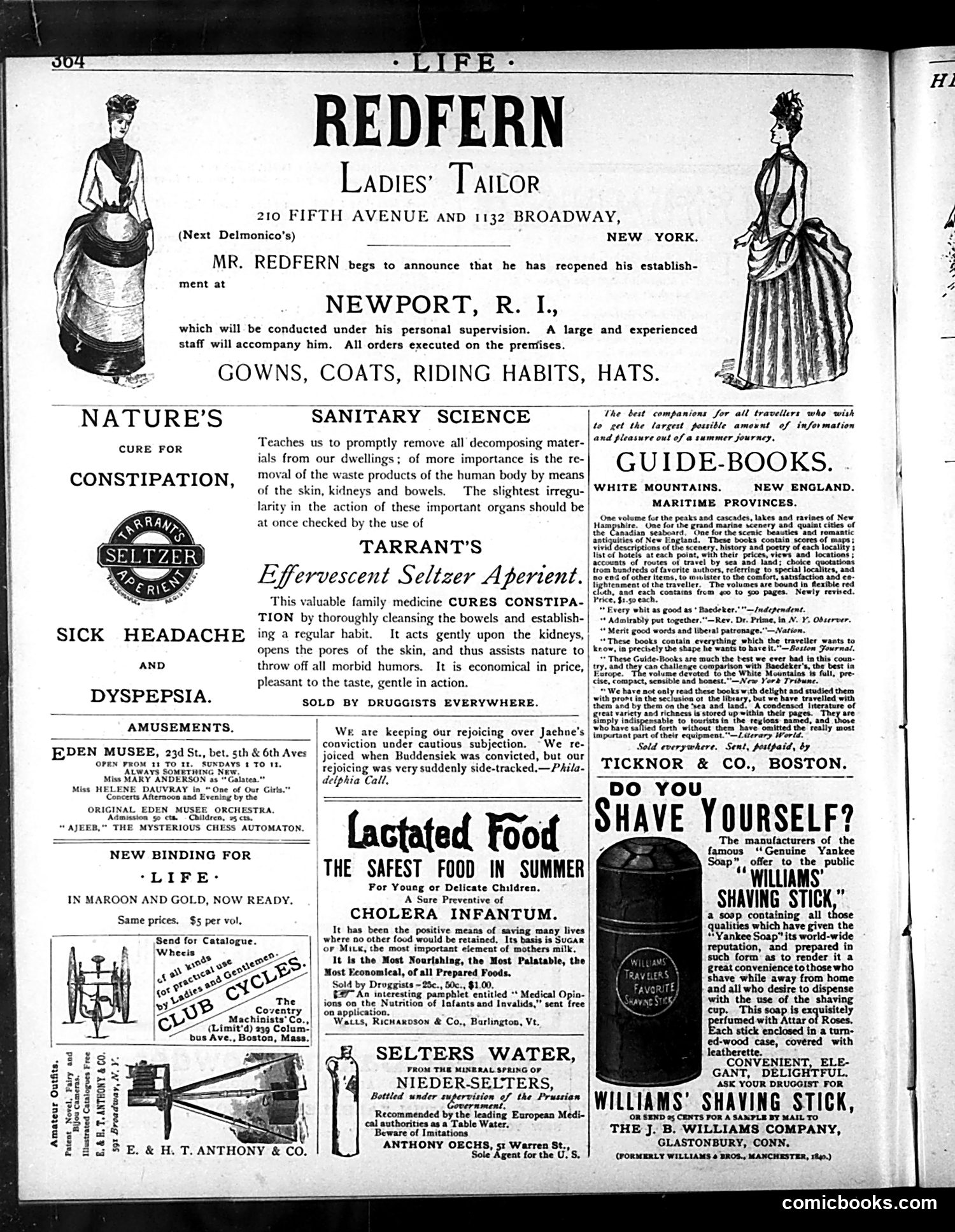
This page is **primarily advertising**, not satirical content. It contains various commercial advertisements typical of early 20th-century American magazines, including: - **Redfern Ladies' Tailor**: Fashion advertisement for women's clothing - **Tarrant's Effervescent Seltzer Aperient**: Patent medicine for constipation and digestive issues - **Lactated Food**: Infant formula advertised as safe for summer - **Williams' Shaving Stick**: Men's grooming product - **Selters Water**: Mineral spring water The page also advertises **Life's new maroon and gold binding** and entertainment venues like Eden Musee. There are **fashion illustrations** of women in period dress but no political cartoons or satirical commentary visible. The content reflects consumer culture and patent medicine marketing common to this era.
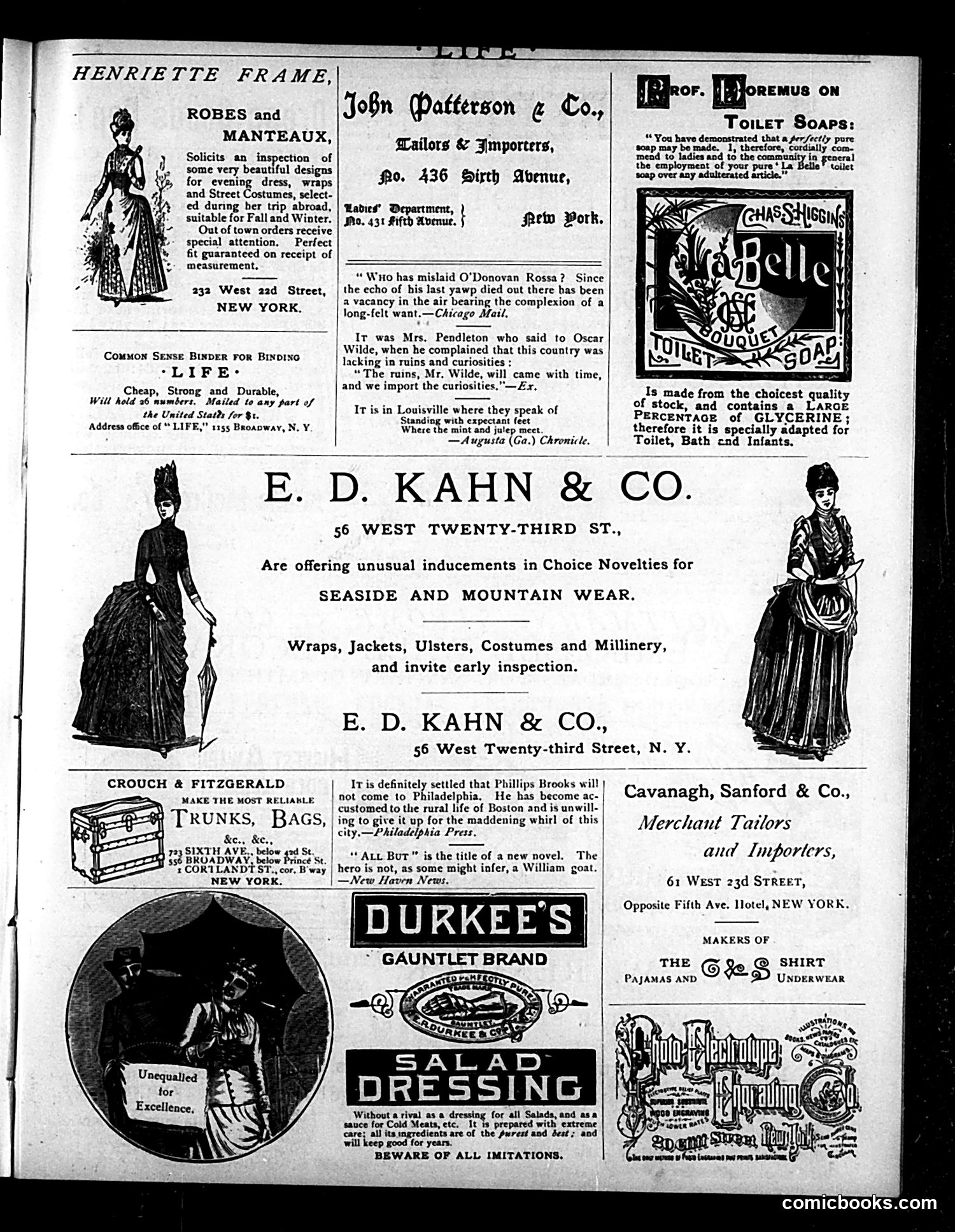
This is primarily **an advertising page** from Life magazine with minimal satirical content. The page features commercial advertisements for clothing, fashion accessories, and household products typical of late 19th-century New York retailers. The only substantive editorial content consists of **three brief humorous quips**: 1. A joke about O'Donovan Rossa (likely the Irish nationalist), suggesting his absence has left a void 2. A anecdote mocking Oscar Wilde's complaint about America's lack of "ruins," with the reply that ruins will come with time while Americans import curiosities 3. A reference to Louisville's mint juleps These items appear designed to entertain readers rather than deliver serious political satire. The Wilde reference is the most pointed—gently mocking both the writer's aesthetic pretensions and American cultural insecurity. Otherwise, this page serves primarily as a commercial publication vehicle for New York merchants advertising fashionable dress, tailoring, trunks, and condiments.
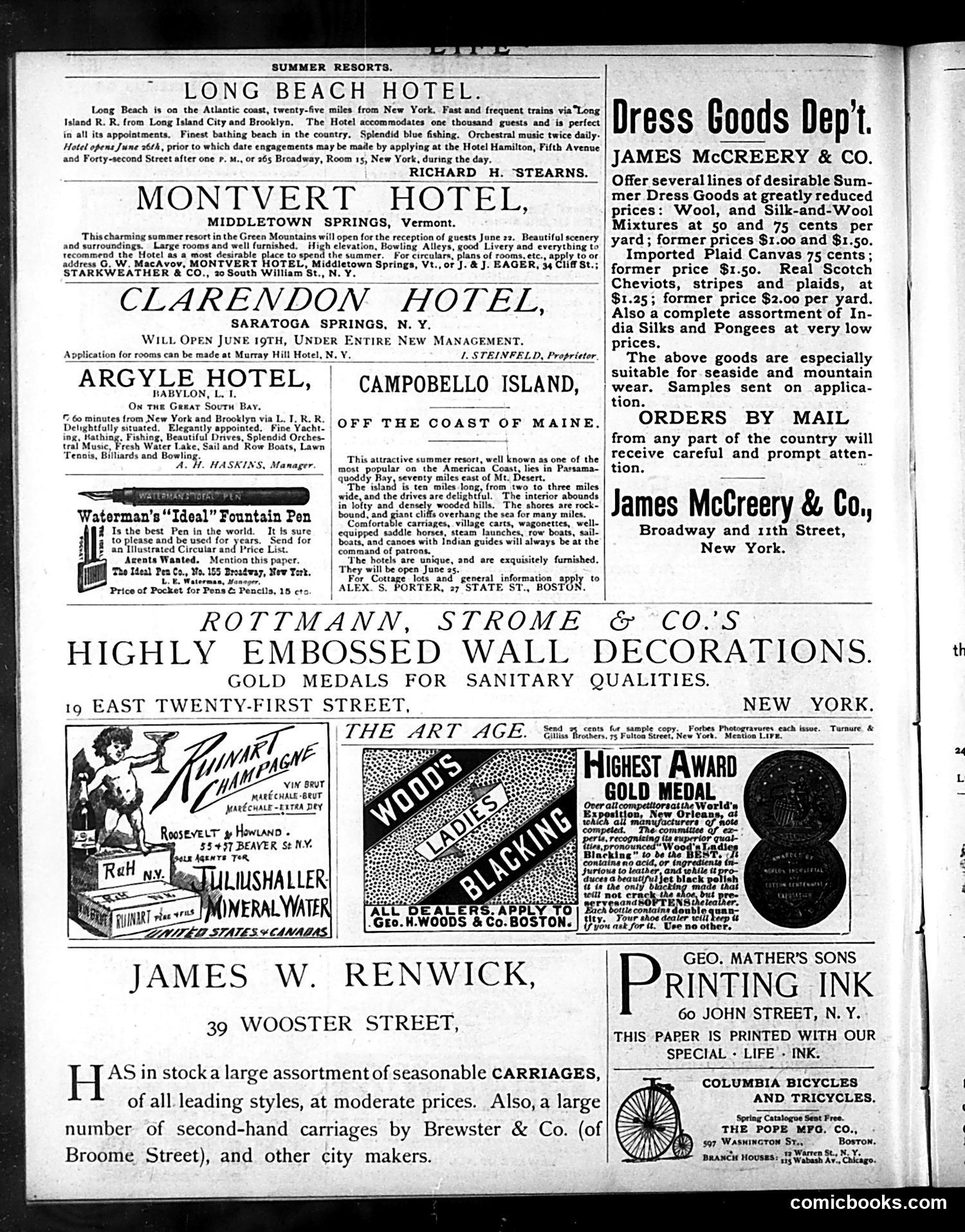
This page is primarily a **summer resort and merchandise advertisement section**, not political satire or comics. The visible advertisements promote: - Hotels (Long Beach, Montvert, Clarendon, Argyle, Campobello Island) - James McCreery & Co. dress goods - Waterman's fountain pens - Rottmann, Strome & Co. wall decorations - Plummet Champagne - Wood's Ladies' Blacking polish (with "Highest Award Gold Medal") - James W. Renwick carriages - Columbia Bicycles There is **no apparent political cartoon or satire on this page**—it functions as a commercial advertising section. The only illustrations are product logos and advertisements for consumer goods typical of 1890s Life magazine's advertising sections, which mixed editorial content with paid promotions.
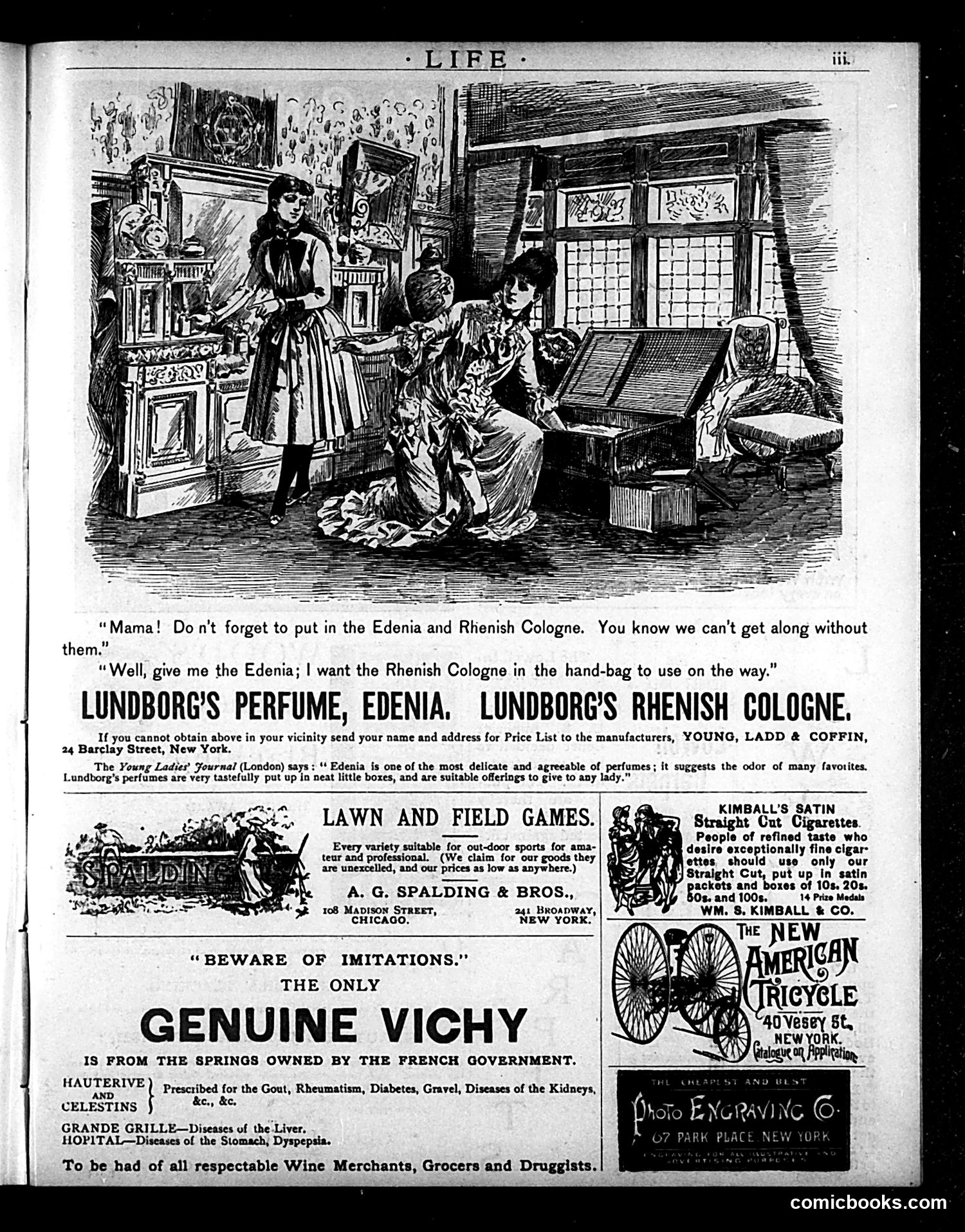
This page is primarily **advertising**, not satire or political commentary. The main cartoon illustrates a domestic scene where a mother prepares for travel with her daughter, who reminds her not to forget Lundborg's perfume products—Edenia and Rhenish Cologne. The dialogue humorously depicts these fragrances as absolute necessities ("we can't get along without them"), exaggerating their importance to fashionable ladies. The cartoon serves as an advertisement hook, using gentle humor about female vanity and travel preparations to promote luxury toiletries. The image and accompanying testimonial from a London journal position the products as refined, tastefully packaged gifts suitable for ladies. The page also contains unrelated period advertisements for sporting goods (A.G. Spalding), mineral water (Vichy), cigarettes (Kimball's), bicycles, and engraving services—typical of late 19th-century *Life* magazine content.
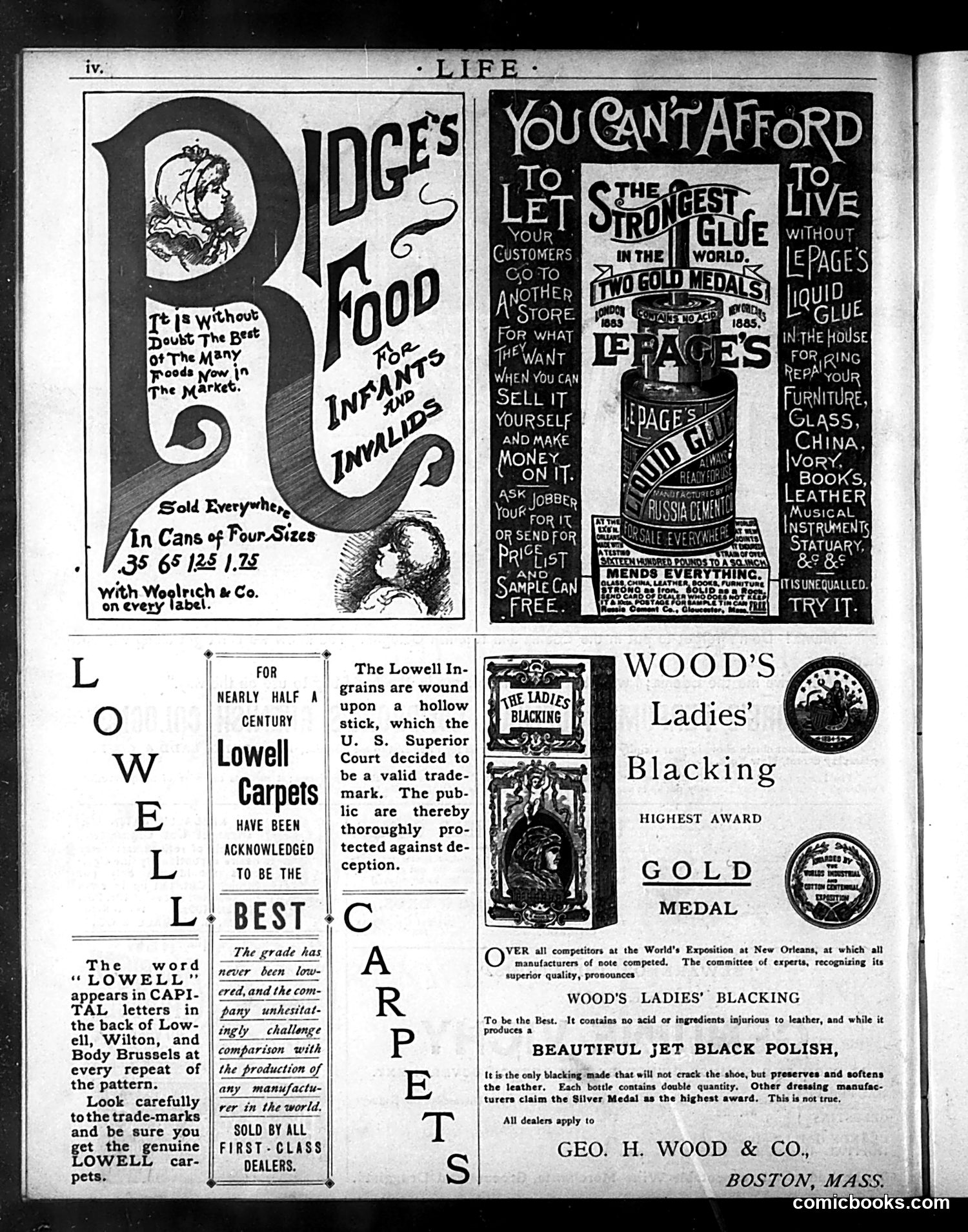
This page consists primarily of **product advertisements** rather than editorial cartoons or satire. The ads promote: 1. **Rindge's Food for Infants and Invalids** — a canned baby food/nutritional product sold in multiple sizes, claiming to be "the best of any foods now in the Market." 2. **Le Page's Liquid Glue** — emphasizing its strength and versatility for household repairs (furniture, glass, books, leather, etc.). 3. **Lowell Carpets** — highlighting a trademark/patent dispute settled by the U.S. Supreme Court, reassuring buyers they're getting genuine Lowell products by checking labels. 4. **Wood's Ladies' Blacking** — shoe polish claiming gold medal awards and superiority over competitors' claims. All advertisements use period-typical persuasive techniques: celebrity/authority endorsement, emphasis on quality/safety, and competitive claims. This reflects late 19th/early 20th-century consumer marketing before modern advertising regulation. There is no satirical content visible on this particular page.

I can see this is a blank or nearly blank page from a historical publication, with only "comicbooks.com" visible at the bottom. The page contains no discernible cartoon imagery, text content, or satirical material that would allow me to identify political figures, social references, or explain any jokes or commentary to a modern reader. This appears to be either a blank page from the original publication, a title page, or a page that did not scan clearly. Without visible content—whether cartoons, illustrations, or substantial text—I cannot provide historical context or explain satirical meaning.