
Life, 1886-06-24 · page 4 of 21
Life — June 24, 1886 — page 4: what you’re looking at
What you’re looking at
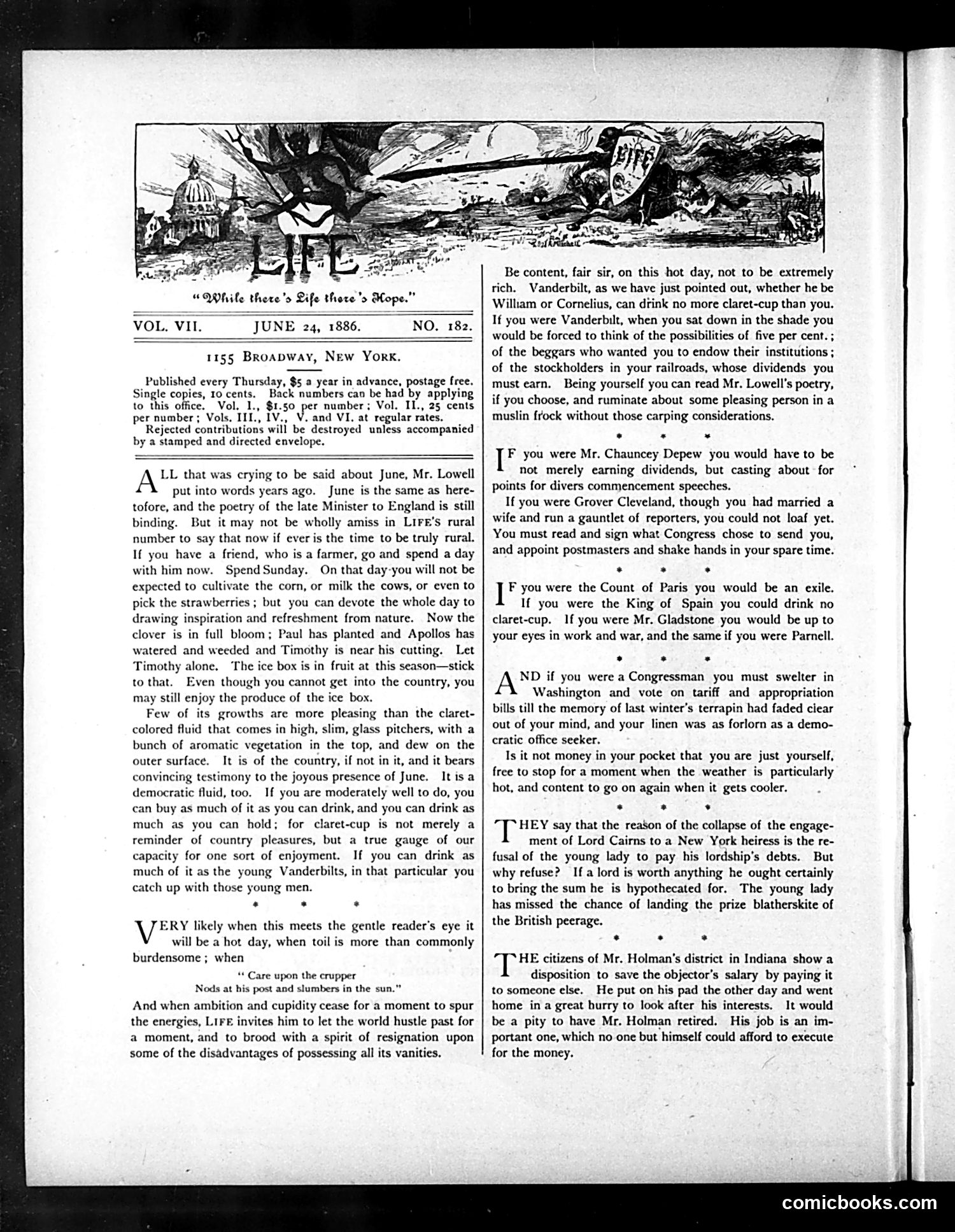
The masthead illustration titled "While there's Life there's Hope" depicts a skeletal Death figure looming over a pastoral landscape with a church—a memento mori image about mortality amid rural tranquility. The article's main text addresses Mr. Lowell's recent statements about rural life and June being the ideal season. The piece uses conditional satire: "If you were Vanderbilt," "If you were Mr. Chauncey Depew," "If you were Grover Cleveland"—mocking how wealthy industrialists and politicians cannot truly appreciate rural simplicity due to their obligations and wealth. The satire critiques the romantic idealization of country life while acknowledging that only the privileged can afford leisure to enjoy it. The piece ultimately argues that genuine contentment requires freedom from ambition and material concerns.
📄 Transcribed text from this page (OCR, searchable)
Machine-transcribed from the original scan — historical spelling and the odd misread are preserved.
“While there's Life there's Hope.” VOL. VII. JUNE 24, 1886. NO. 182. 1155 Broapway, New York. Published every Thursday, $5 a year in advance, postage free, Single copies, 10 cents. Back numbers can be had by applying to this office. Vol. I., $1.50 per number; Vol. II., 25 cents per number; Vols. III., IV., V. and VI. at regular rates. Rejected contributions will be destroyed unless accompanied by a stamped and directed envelope. LL that was crying to be said about June, Mr. Lowell put into words years ago. June is the same as here- tofore, and the poetry of the late Minister to England is still binding. But it may not be wholly amiss in Lire’s rural number to say that now if ever is the time to be truly rural. If you have a friend, who is a farmer, go and spend a day with him now. Spend Sunday. On that day-you will not be expected to cultivate the corn, or milk the cows, or even to pick the strawberries ; but you can devote the whole day to drawing inspiration and refreshment from nature. Now the clover is in full bloom; Paul has planted and Apollos has watered and weeded and Timothy is near his cutting. Let Timothy alone. The ice box is in fruit at this season—stick to that. Even though you cannot get into the country, you may still enjoy the produce of the ice box. Few of its growths are more pleasing than the claret- colored fluid that comes in high, slim, glass pitchers, with a bunch of aromatic vegetation in the top, and dew on the outer surface. It is of the country, if not in it, and it bears convincing testimony to the joyous presence of June, It is a democratic fluid, too. If you are moderately well to do, you can buy as much of it as you can drink, and you can drink as much as you can hold; for claret-cup is not merely a reminder of country pleasures, but a true gauge of our capacity for one sort of enjoyment. If you can drink as much of it as the young Vanderbilt, in that particular you catch up with those young men. . . . ERY likely when this meets the gentle reader's eye it will be a hot day, when toil is more than commonly burdensome ; when “Care upon the crupper Nods at his post and slumbers in the sun.” And when ambition and cupidity cease for a moment to spur the energies, LIFE invites him to let the world hustle past for a moment, and to brood with a spirit of resignation upon some of the disadvantages of possessing all its vanities. Be content, fair sir, on this hot day, not to be extremely rich. Vanderbilt, as we have just pointed out, whether he be William or Cornelius, can drink no more claret-cup than you. If you were Vanderbilt, when you sat down in the shade you would be forced to think of the possibilities of five per cent. ; of the beggars who wanted you to endow their institutions ; of the stockholders in your railroads, whose dividends you must earn. Being yourself you can read Mr. Lowell's poetry, if you choose, and ruminate about some pleasing person in a muslin frock without those carping considerations. . . . F you were Mr. Chauncey Depew you would have to be not merely earning dividends, but casting about for points for divers commencement speeches. If you were Grover Cleveland, though you had married a wife and run a gauntlet of reporters, you could not loaf yet. You must read and sign what Congress chose to send you, and appoint postmasters and shake hands in your spare time. . . . F you were the Count of Paris you would be an exile. If you were the King of Spain you could drink no claret-cup. If you were Mr. Gladstone you would be up to your eyes in work and war, and the same if you were Parnell. . . . ARS if you were a Congressman you must swelter in Washington and vote on tariff and appropriation bills till the memory of last winter’s terrapin had faded clear out of your mind, and your linen was as forlorn as a demo- cratic office seeker. Is it not money in your pocket that you are just yourself, free to stop for a moment when the weather is particularly hot, and content to go on again when it gets cooler. . * . Pe say that the reason of the collapse of the engage- ment of Lord Cairns to a New York heiress is the re- fusal of the young lady to pay his lordship’s debts. But why refuse? If a lord is worth anything he ought certainly to bring the sum he is hypothecated for. The young lady has missed the chance of landing the prize blatherskite of the British peerage. HE citizens of Mr. Holman’s district in Indiana show a disposition to save the objector’s salary by paying it to someone else. He put on his pad the other day and went home in a great burry to look after his interests. It would be a pity to have Mr. Holman retired. His job is an im- portant one, which no one but himself could afford to execute for the money, comicbooks.com