
Life, 1886-06-24 · page 5 of 21
Life — June 24, 1886 — page 5: what you’re looking at
What you’re looking at
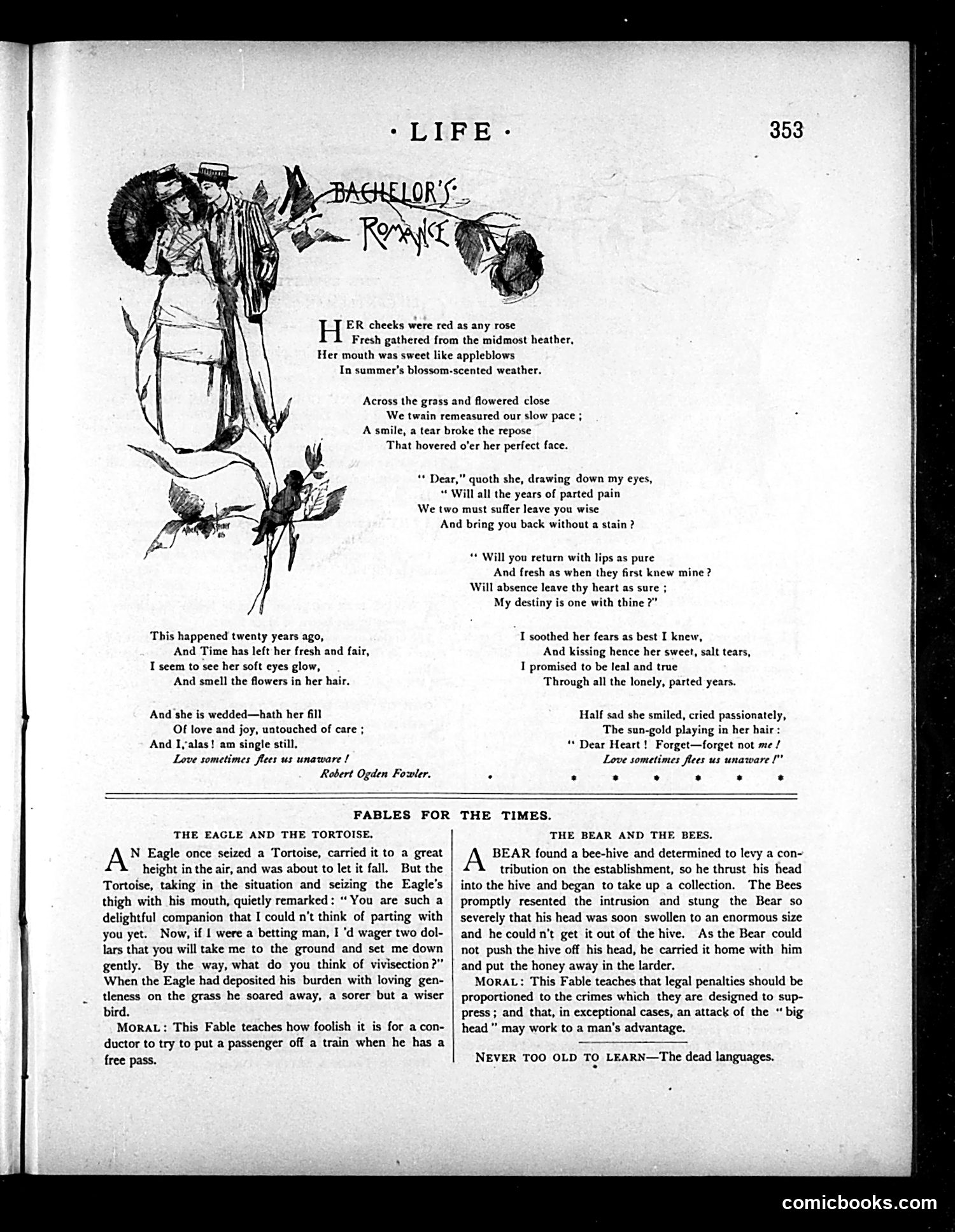
This page contains three distinct elements: 1. **"Bachelor's Romance"** — A romantic poem with decorative botanical illustrations, depicting a sentimental narrative about a man remembering a woman he loved twenty years ago who is now married to another. 2. **"Fables for the Times"** — Two short moral fables: - **The Eagle and the Tortoise**: Satirizes foolish conduct, with a moral about the absurdity of assisting someone off a train without a valid ticket. - **The Bear and the Bees**: Teaches that legal penalties should match crimes; attacking a beehive to steal honey results in disproportionate suffering. These fables appear designed as gentle social commentary on contemporary behavior and legal justice, using animal characters to deliver moralistic lessons to readers. The page blends sentimental poetry with satirical fables typical of Life's editorial content.
📄 Transcribed text from this page (OCR, searchable)
Machine-transcribed from the original scan — historical spelling and the odd misread are preserved.
ER cheeks were red as any rose Fresh gathered from the midmost heather, Her mouth was sweet like appleblows In summer's blossom-scented weather. Across the grass and flowered close We twain remeasured our slow pace ; A smile, a tear broke the repose That hovered o'er her perfect face. ** Dear,” quoth she, drawing down my eyes, “ Will all the years of parted pain We two must suffer leave you wise And bring you back without a stain ? This happened twenty years ago, And Time has left her fresh and fair, I seem to see her soft eyes glow, And smell the flowers in her hair. And’she is wedded—hath her fill Of love and joy, untouched of care ; And I,alas! am single still. Love sometimes flees us unaware Robert Ogden Fowler. “ Will you return with lips as pure And fresh as when they first knew mine? Will absence leave thy heart as sure ; My destiny is one with thine ?” I soothed her fears as best I knew, And kissing hence her sweet, salt tears, 1 promised to be leal and true Through all the lonely, parted years. Half sad she smiled, cried passionately, The sun-gold playing in her hair: “* Dear Heart! Forget—forget not me / Love sometimes flees us unaware!” * * * * * FABLES FOR THE EAGLE AND THE TORTOISE, A® Eagle once seized a Tortoise, carried it to a great height in the air, and was about to let it fall. But the Tortoise, taking in the situation and seizing the Eagle's thigh with his mouth, quietly remarked: “You are such a delightful companion that I could n’t think of parting with you yet. Now, if 1 were a betting man, I ‘d wager two dol- lars that you will take me to the ground and set me down gently. By the way, what do you think of vivisection?” When the Eagle had deposited his burden with loving gen- tleness on the grass he soared away, a sorer but a wiser bird. Morat: This Fable teaches how foolish it is for a con- ductor to try to put a passenger off a train when he has a free pass. THE TIMES. THE BEAR AND THE BEES. BEAR found a bee-hive and determined to levy a con~ tribution on the establishment, so he thrust his head into the hive and began to take up a collection. The Bees promptly resented the intrusion and stung the Bear so severely that his head was soon swollen to an enormous size and he could n’t get it out of the hive. As the Bear could not push the hive off his head, he carried it home with him and put the honey away in the larder. MorRAL: This Fable teaches that legal penalties should be proportioned to the crimes which they are designed to sup- press; and that, in exceptional cases, an attack of the “ big head” may work to a man’s advantage. NEVER TOO OLD TO LEARN—The dead languages. comicbooks.com