
A complete issue · 18 pages · 1886
Life — June 10, 1886
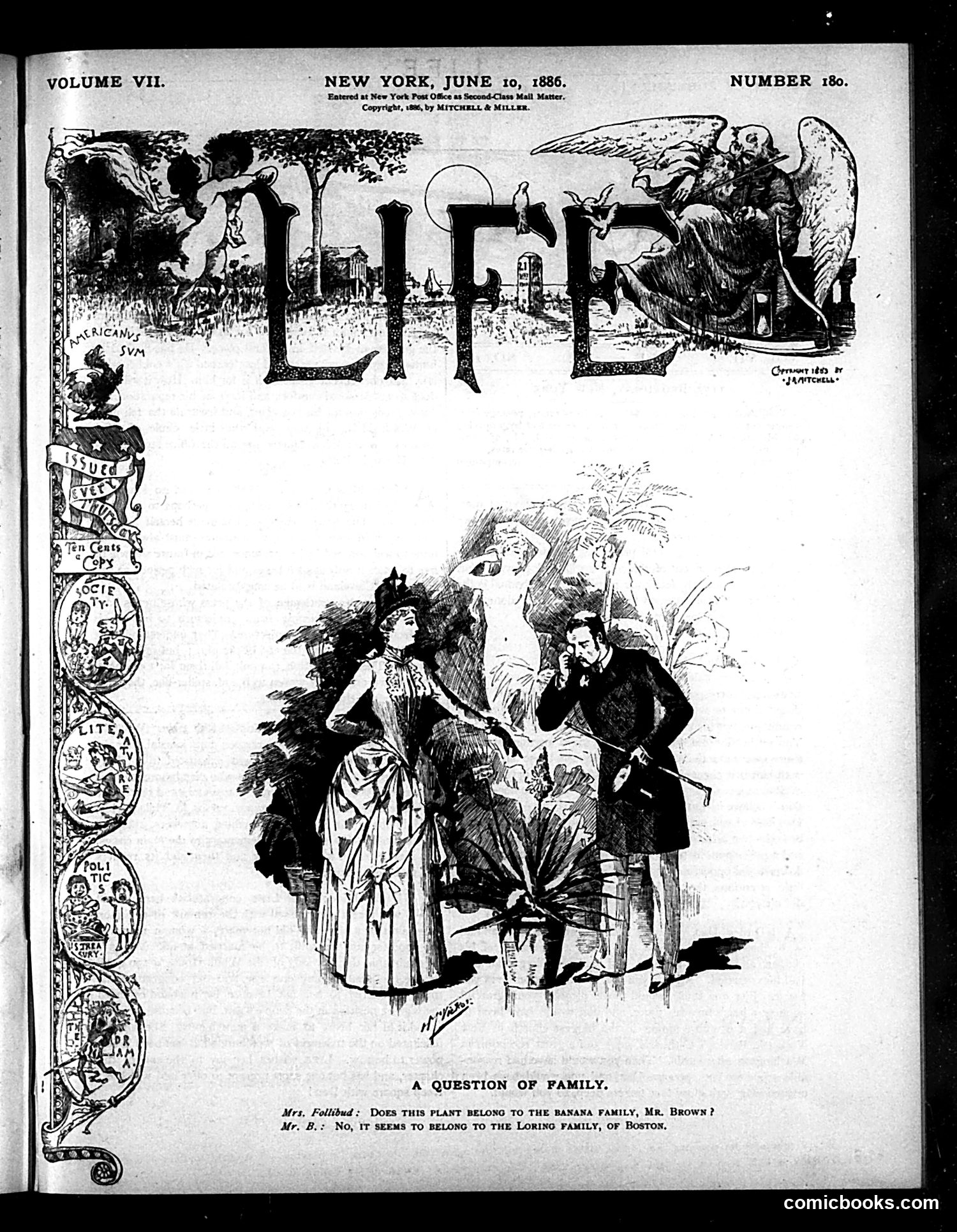
This cartoon satirizes social climbing and botanical snobbery among the wealthy. Mrs. Follihed asks whether a plant belongs to the "Banana family," while Mr. B. dismissively corrects her, stating it belongs to the "Loring family, of Boston." The joke targets the pretension of Boston's established elite families (the Lorings), who considered themselves socially superior. By having the characters debate a plant's "family" lineage, the cartoonist mocks how the upper classes obsessed over genealogy and family status—treating noble ancestry like botanical classification. Mrs. Follihed's mistake suggests nouveau riche ignorance, while Mr. B.'s correction emphasizes the rigid social hierarchies among Boston society where "proper" family names mattered enormously.
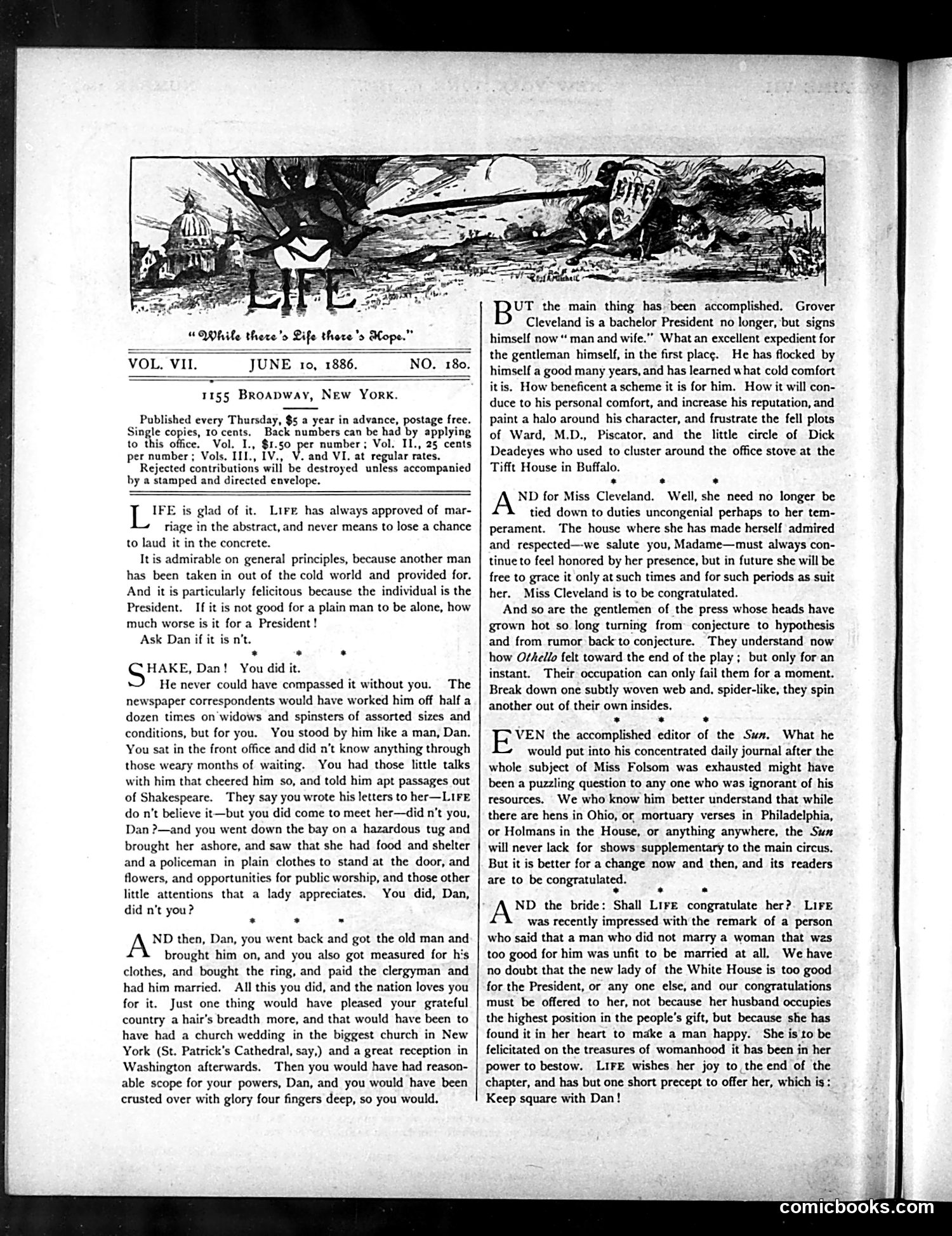
This page celebrates Grover Cleveland's recent marriage, congratulating him on becoming a "man and wife" and no longer a bachelor president. The editorial celebrates that Cleveland found "cold comfort" in bachelorhood and gained reputation through marriage. The text particularly praises Frances Folsom Cleveland, noting she need no longer be "tied down to duties uncongenial" and is "to be felicitated on the treasures of womanhood." The satire mocks both the press's obsession with the wedding (even the *Sun* newspaper exhausted coverage) and contemporary attitudes that a woman's fulfillment derives from marriage and supporting her husband's ambitions. The cartoon header's meaning is unclear from this page alone.
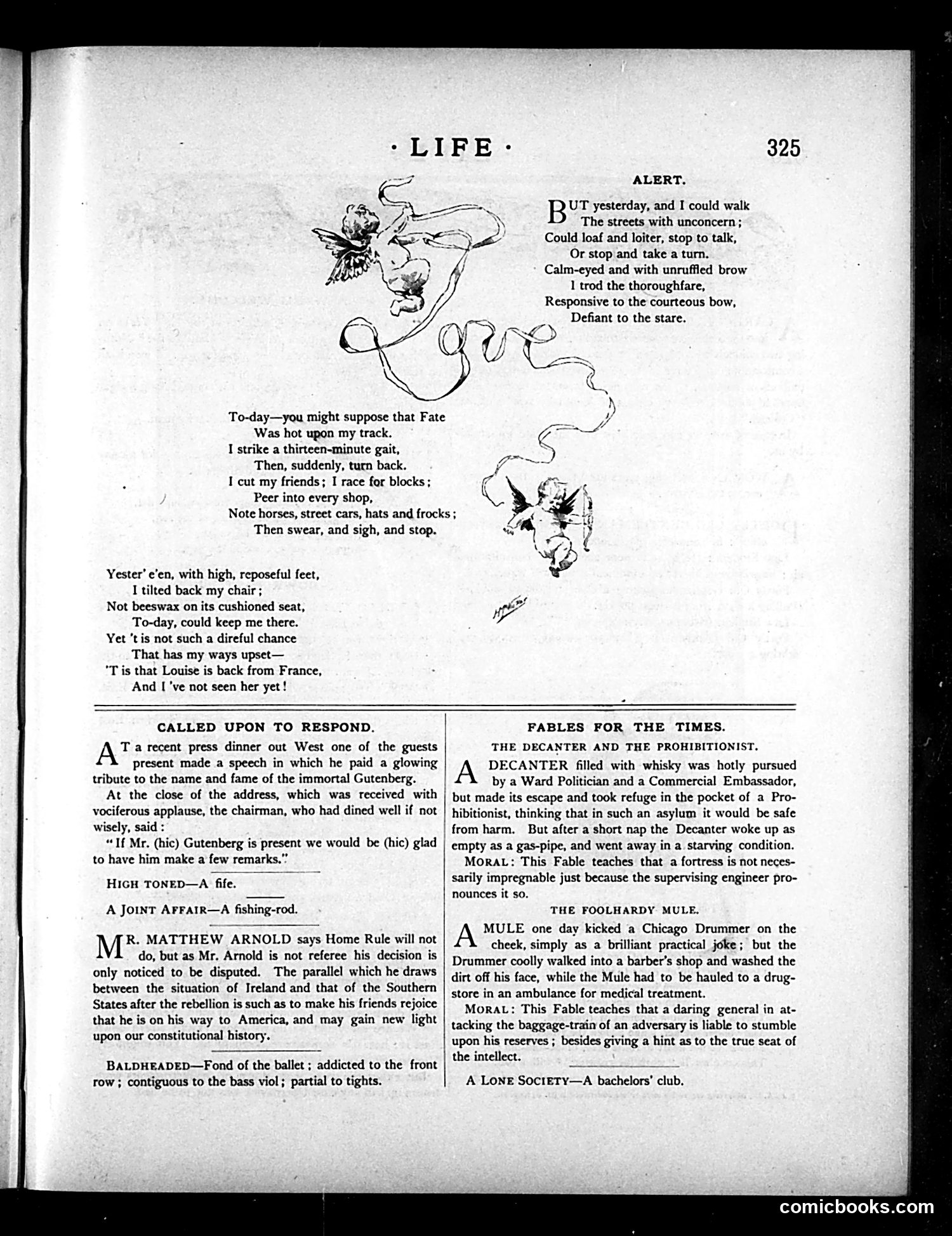
This page contains primarily literary content rather than political cartoons. The main piece is "Alert," a poem about urban restlessness and chance encounters, illustrated with small decorative drawings of figures in motion. Below are brief satirical definitions and fables: - "Called Upon to Respond" mocks a dinner speaker's empty praise of Gutenberg - "Fables for the Times" includes a decanter hiding in a Prohibition-era asylum and a mule kicking a Chicago drummer - Brief humorous definitions like "High Toned" (a wife) and "Baldheaded" (ballet enthusiast) The content reflects 1920s American life, with clear reference to Prohibition ("filled with whisky was hotly pursued"). The satirical tone targets pretension, politics, and social hypocrisy typical of Life magazine's editorial approach.
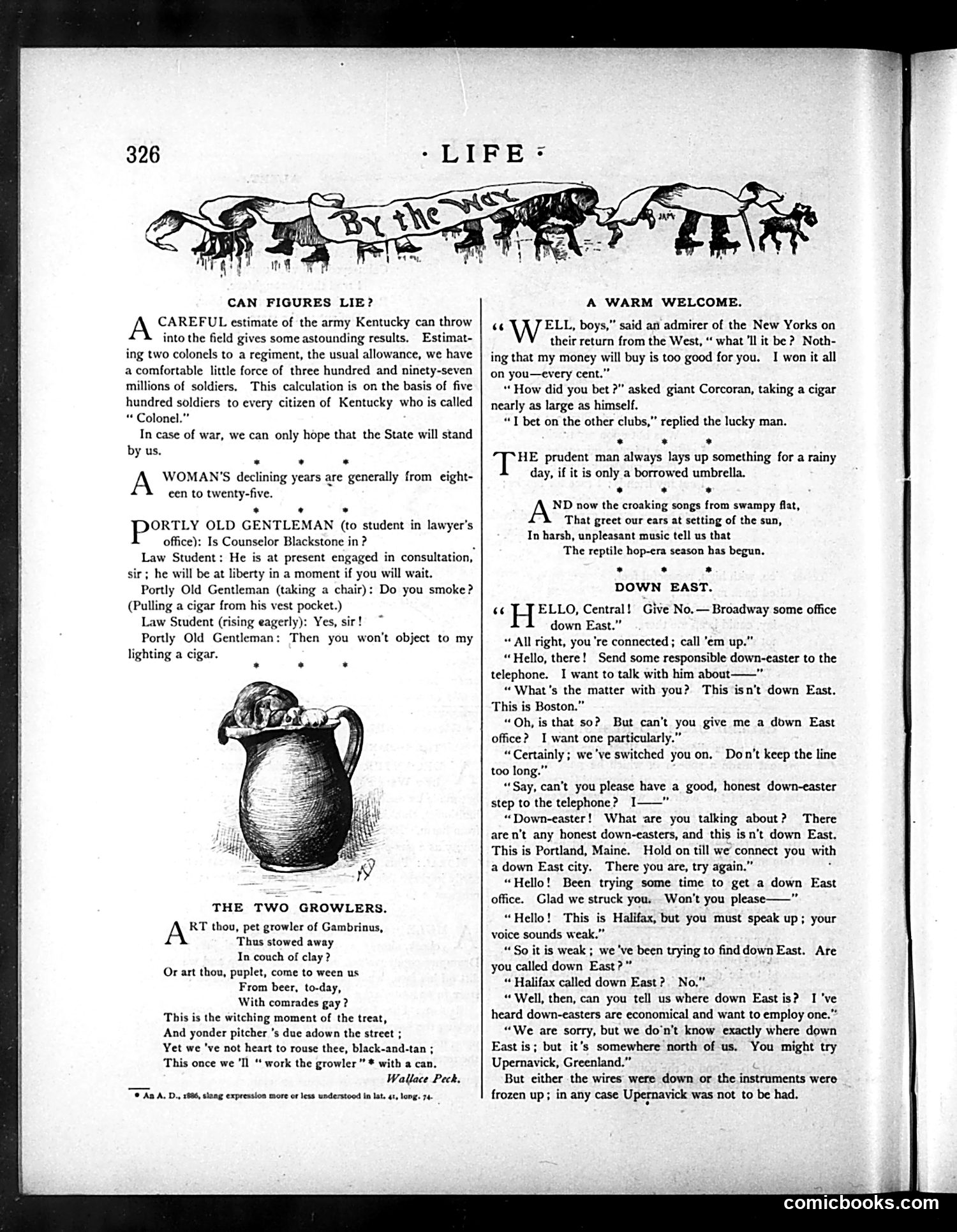
This page contains three distinct satirical pieces: 1. **"Can Figures Lie?"** - A political jab at Kentucky's military capacity, sarcastically calculating that the state could field roughly 397 million soldiers (one per citizen called a "Colonel"). The satire mocks inflated military claims. 2. **"The Two Growlers"** - A poem by Wallace Peck accompanying a pitcher illustration, likely satirizing complaint or grumbling behavior in society. 3. **"Down East"** - A humorous telephone conversation depicting the absurdity of trying to connect with a "down East" office, with callers repeatedly confused about locations (Portland Maine vs. Boston vs. Halifax). The satire ridicules regional confusion and poor telephone service. The overall tone is gentle social satire typical of Life magazine's humor.
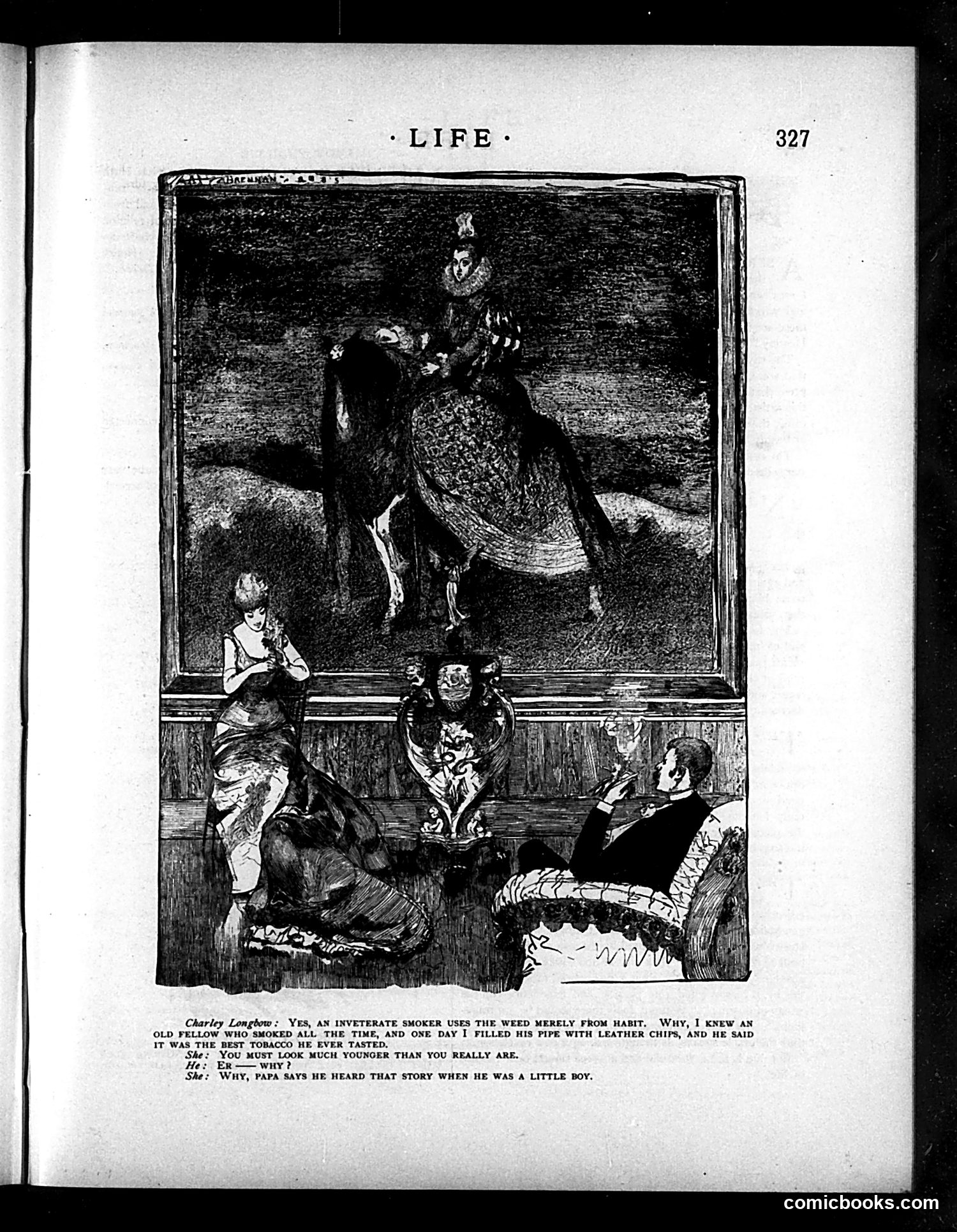
This page depicts a social scene where two people are viewing a portrait painting of an elegantly dressed woman on horseback. The dialogue attributes the quote to "Charley Langdon," who tells a story about an "inveterate smoker" who once filled his pipe with leather chips, claiming it was the best tobacco he ever tasted. The joke relies on the listener being gullible—the punchline reveals the smoker was deceived about what he was smoking. The caption suggests this is a story told to children ("Papa says he heard that story when he was a little boy"), implying it's an old, well-worn tale used to mock naive or credulous people. The cartoon appears to satirize gullibility and the circulation of tall tales in social settings, rather than addressing specific political figures or events.
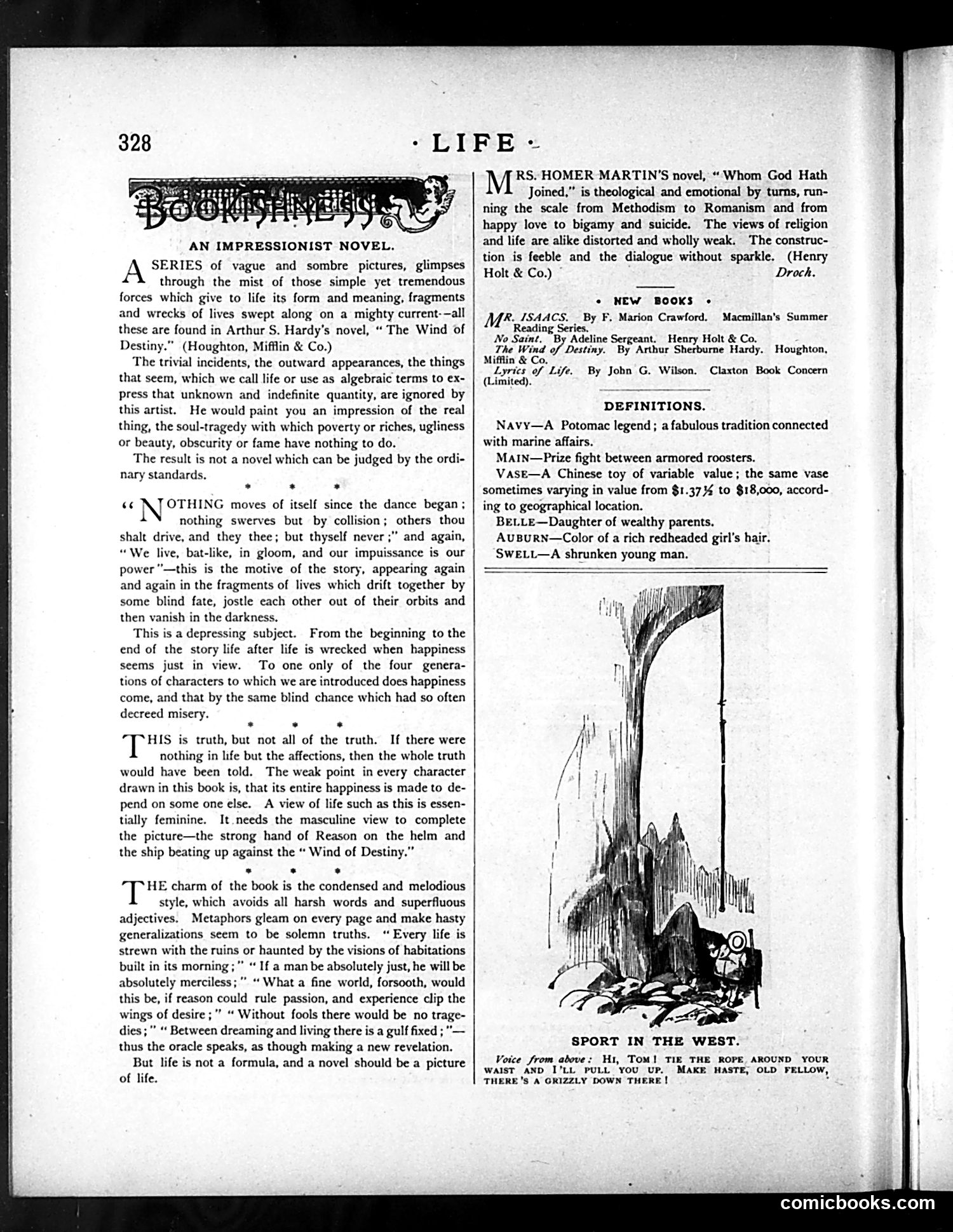
This illustration depicts a Western scene with a cowboy attempting to lasso a grizzly bear. The caption reads: "Voice from above: 'Hi, Tom! Tie the rope around your waist and I'll pull you up. Make haste, old fellow, there's a grizzly down there!'" The humor relies on the absurdity and danger of the situation—a man trying to rope a bear while suspended, creating a comedic scenario of frontier peril. This appears to be genteel satire about Western frontier life, playing on popular perceptions of cowboys and dangerous wildlife encounters that were common subjects in early 20th-century American humor. The joke's point seems to be mockery of casual bravado or foolish risk-taking in frontier scenarios, presented as entertainment.
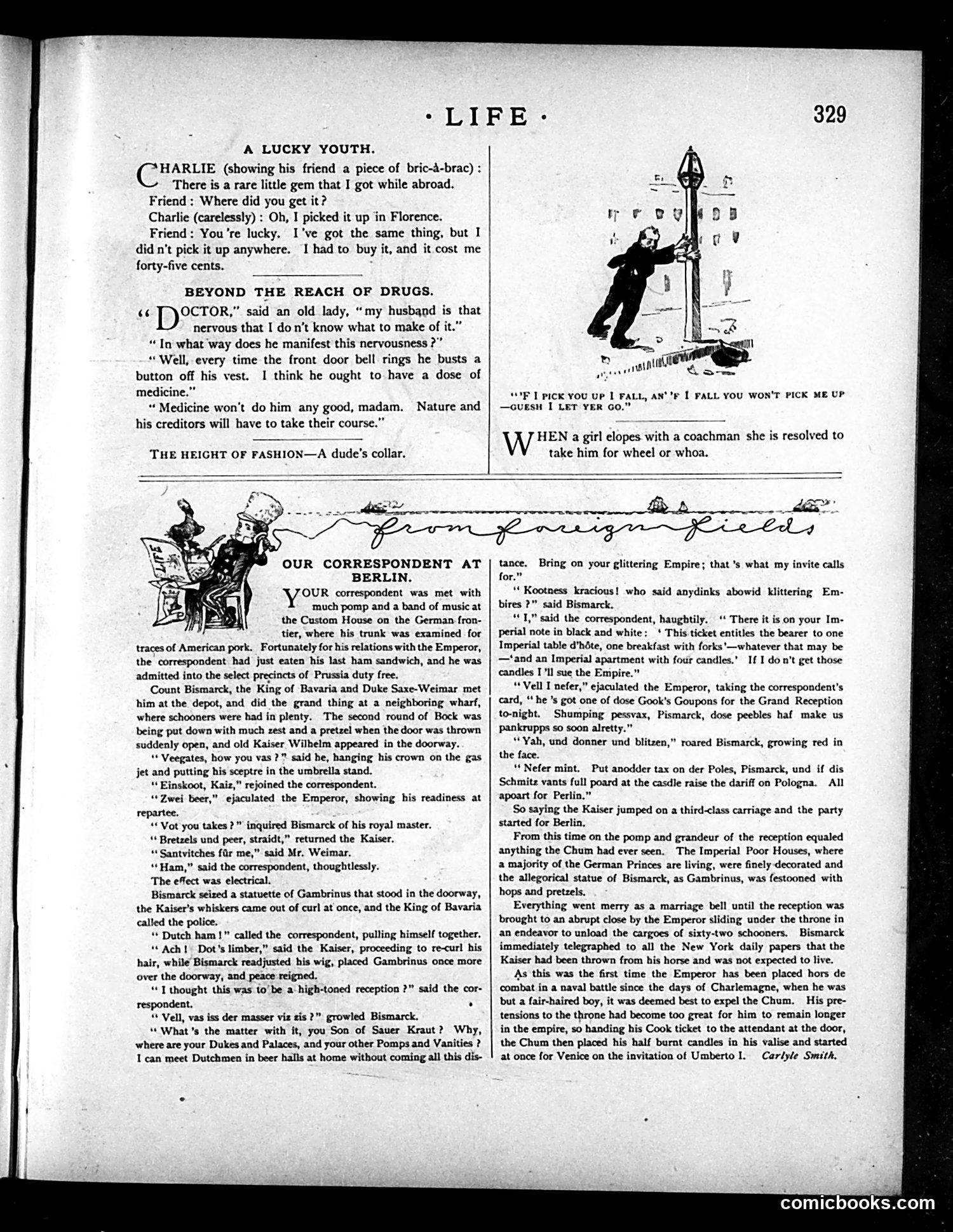
This page contains several brief humor pieces and anecdotes rather than political cartoons: **"A Lucky Youth"**: A simple joke about a tourist who purchased a bric-à-brac item in Florence, claiming he found it while abroad—one-upping his friend who actually bought an identical piece. **"Beyond the Reach of Drugs"**: A doctor dismisses an elderly woman's suggestion that her husband's nervous habit (compulsively ringing a bell and popping buttons) requires medication, arguing nature and creditors will handle the problem. **The cartoon** (right side) shows a man threatening to drop a woman if she doesn't promise reciprocal rescue if he falls. **"Our Correspondent at Berlin"**: A lengthy anecdote about a correspondent's meeting with German aristocracy (Bismarck, the Kaiser) at official functions, depicting early 1900s diplomatic social protocols and imperial German pomposity. No specific political figures are caricatured; the satire targets general human foibles and social pretension.
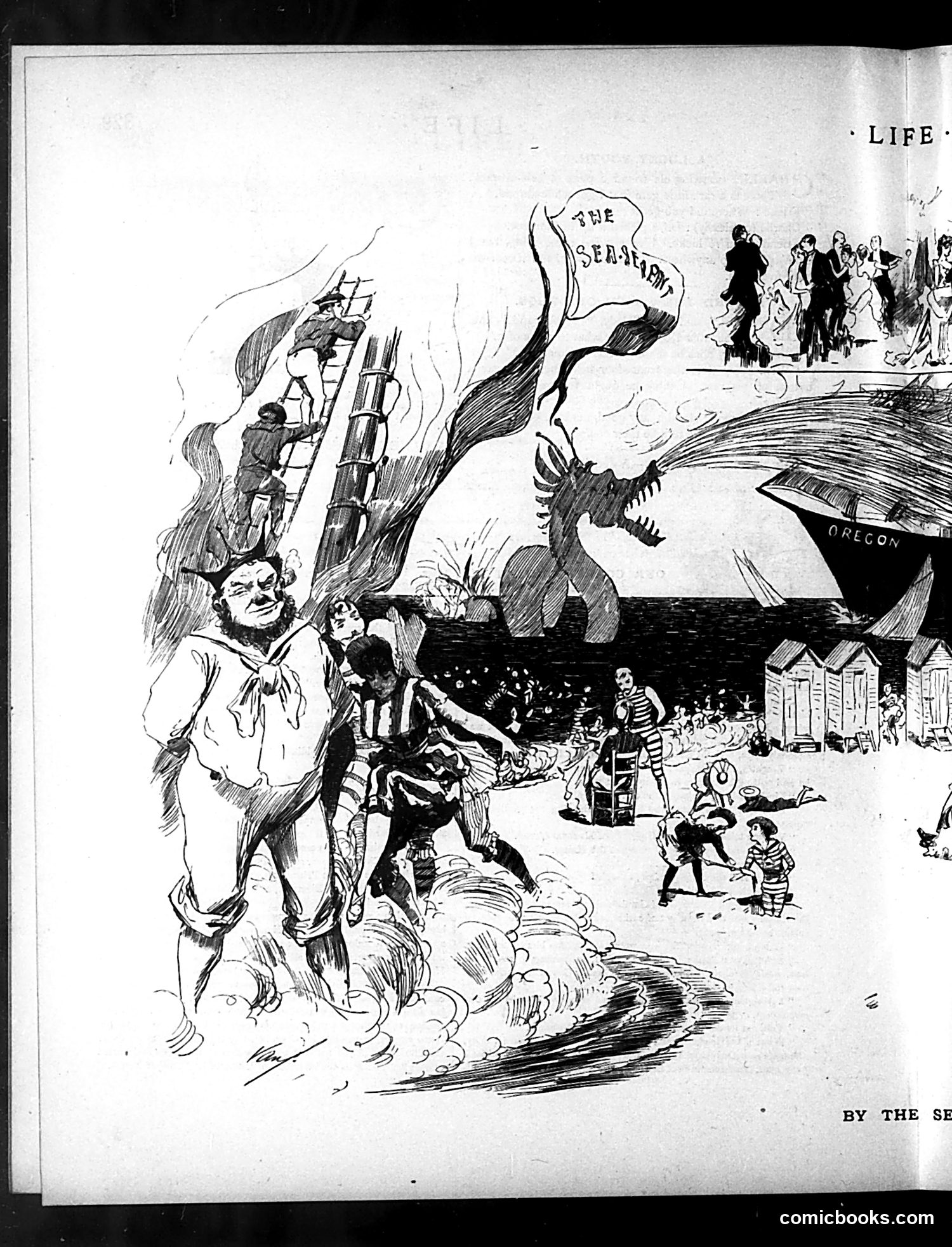
This appears to be a satirical illustration about maritime disaster and rescue. The composition shows a dramatic sea scene with a sinking or damaged ship labeled "OREGON" on the right. On the left, figures (appearing to include sailors or military personnel) are depicted in distress, with one climbing a ladder amid flames or smoke. A sea serpent or monster labeled "THE SEABIRD" looms menacingly in the center. The exact historical event referenced is unclear without additional context or dating, but the imagery suggests commentary on a specific maritime incident, possibly involving collision, rescue efforts, or naval mishap. The satirical style typical of Life magazine suggests this critiques either the incident itself or responses to it, though the specific political or social point remains uncertain from the visual alone.
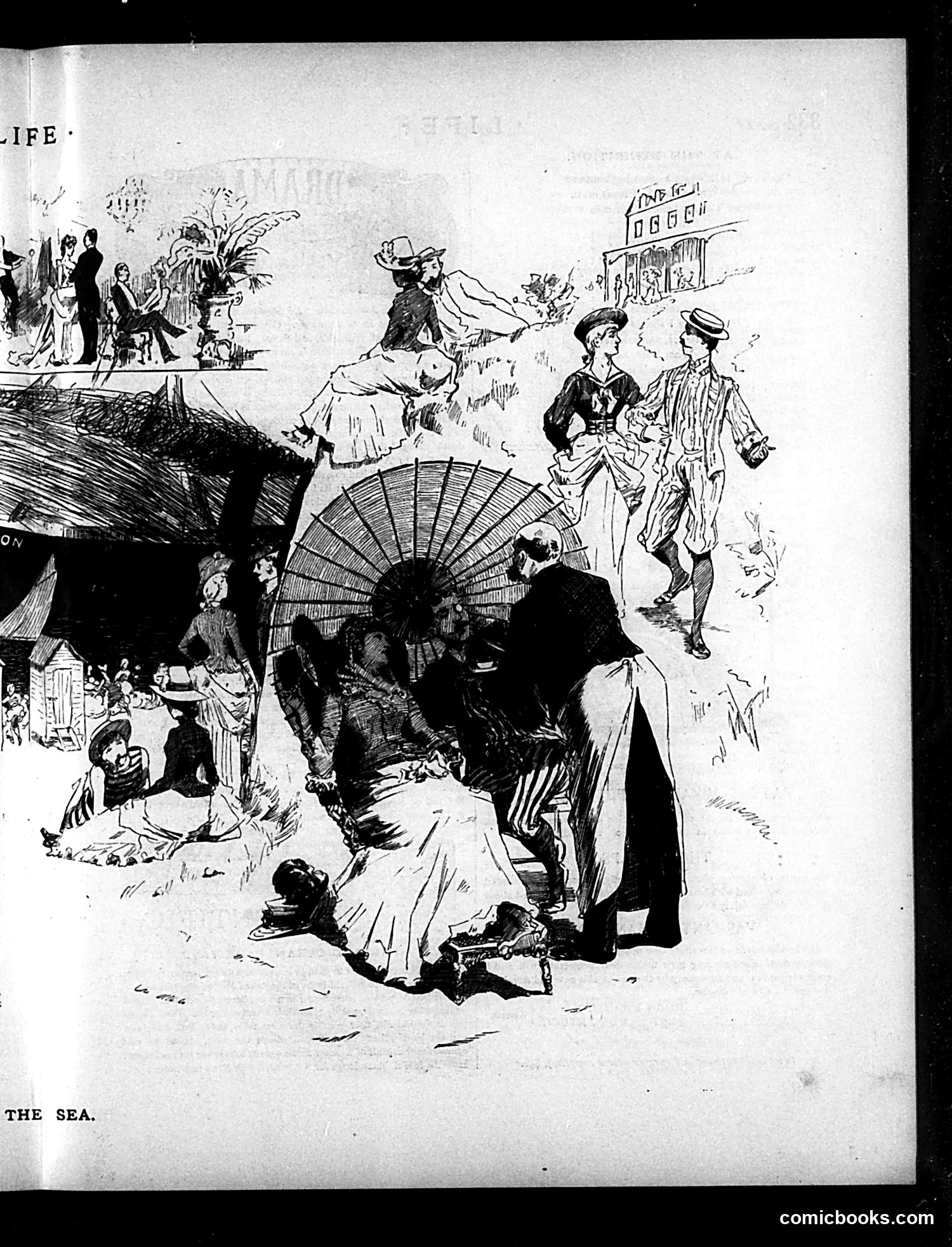
This beach scene satirizes **social class divisions** at seaside resorts in the late 19th or early 20th century. The composition contrasts two groups: **Upper left**: Well-dressed, leisured figures in formal attire enjoy elevated viewing areas and fashionable parasols—representing the wealthy elite. **Lower center/right**: Working-class or middle-class beachgoers in simpler clothing occupy the sandy beach itself, depicted as cramped and less desirable. The large parasol and segregated positioning emphasize how **public spaces reinforced social hierarchy**. Even at "public" beaches, wealth determined access to better vantage points and amenities. The cartoon mocks this artificial class stratification, suggesting that nature itself—the sea—remained indifferent to human social pretension.
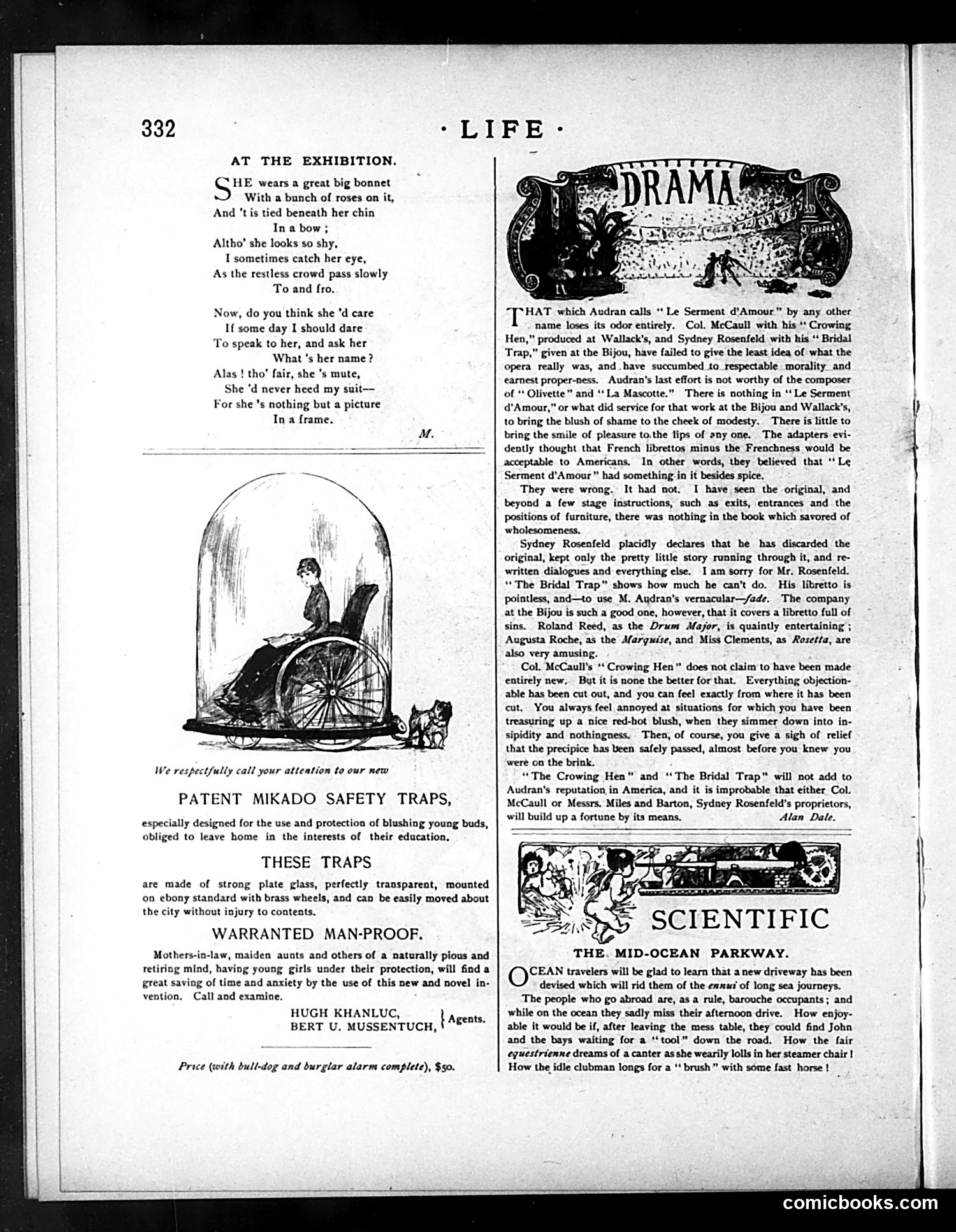
This page combines satirical commentary with advertisements typical of 1880s-90s Life magazine. **The Poetry & Illustration:** A sentimental poem about a man attracted to a woman at an exhibition—revealed in the punchline to be a portrait painting, not a real person. The joke mocks romantic naïveté and the artistic obsession of the era. **The "Patent Mikado Safety Traps" Advertisement:** This is elaborate satire disguised as a product ad. It advertises glass boxes to contain "blushing young buds" (unmarried women) to protect them from male attention while they pursue education. The phrase "man-proof" and references to "mothers-in-law" and "maiden aunts" as guardians mock Victorian anxieties about women's education and propriety. "Mikado" references the then-popular Gilbert & Sullivan operetta. **The Drama Section:** A theater critic reviews French operetta adaptations ("Le Serment d'Amour," "The Bridal Trap," "The Crowing Hen"), lamenting that American producers removed the French spice/sensuality to suit American "respectable morality," rendering the works pointless. The page satirizes Victorian sexual repression and cultural prudishness.
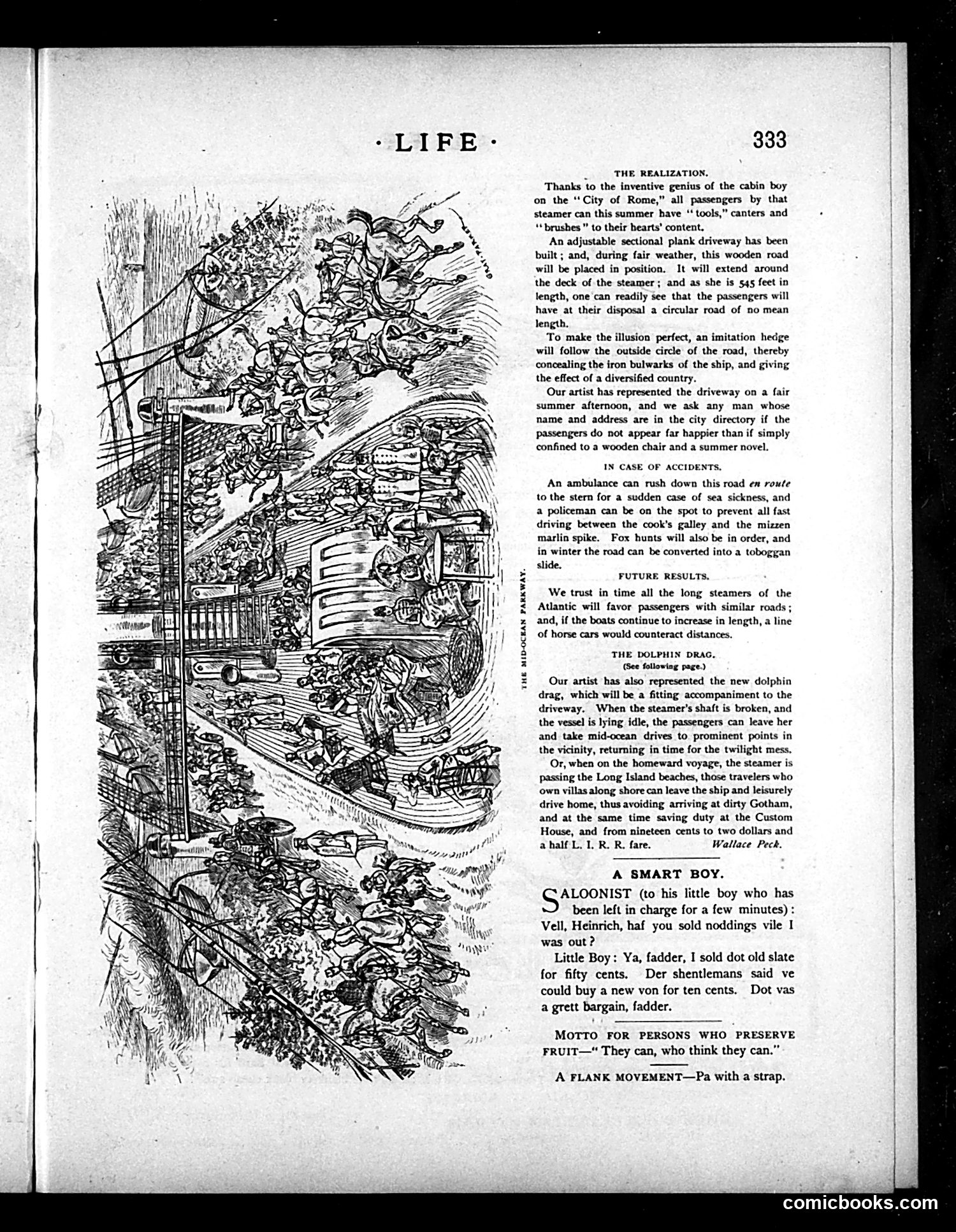
This page satirizes the absurd luxury amenities being added to steamships. The elaborate illustration depicts an impractical wooden driveway installed around the deck of the "City of Rome" steamer, complete with an imitation hedge to simulate a country drive. The satire works on multiple levels: the text mockingly describes increasingly ridiculous uses—"fox hunts," toboggan slides in winter, ambulances for seasickness, even horse cars for "long steamers." It ridicules the wealthy passengers' obsession with recreating land-based leisure activities at sea, suggesting their dissatisfaction with simple ocean travel. The accompanying vignettes ("A Smart Boy," "A Flank Movement") are unrelated humor pieces common to Life's format. The satire ultimately mocks Gilded Age excess and the notion that steamer travel requires elaborate artifice to entertain privileged passengers.
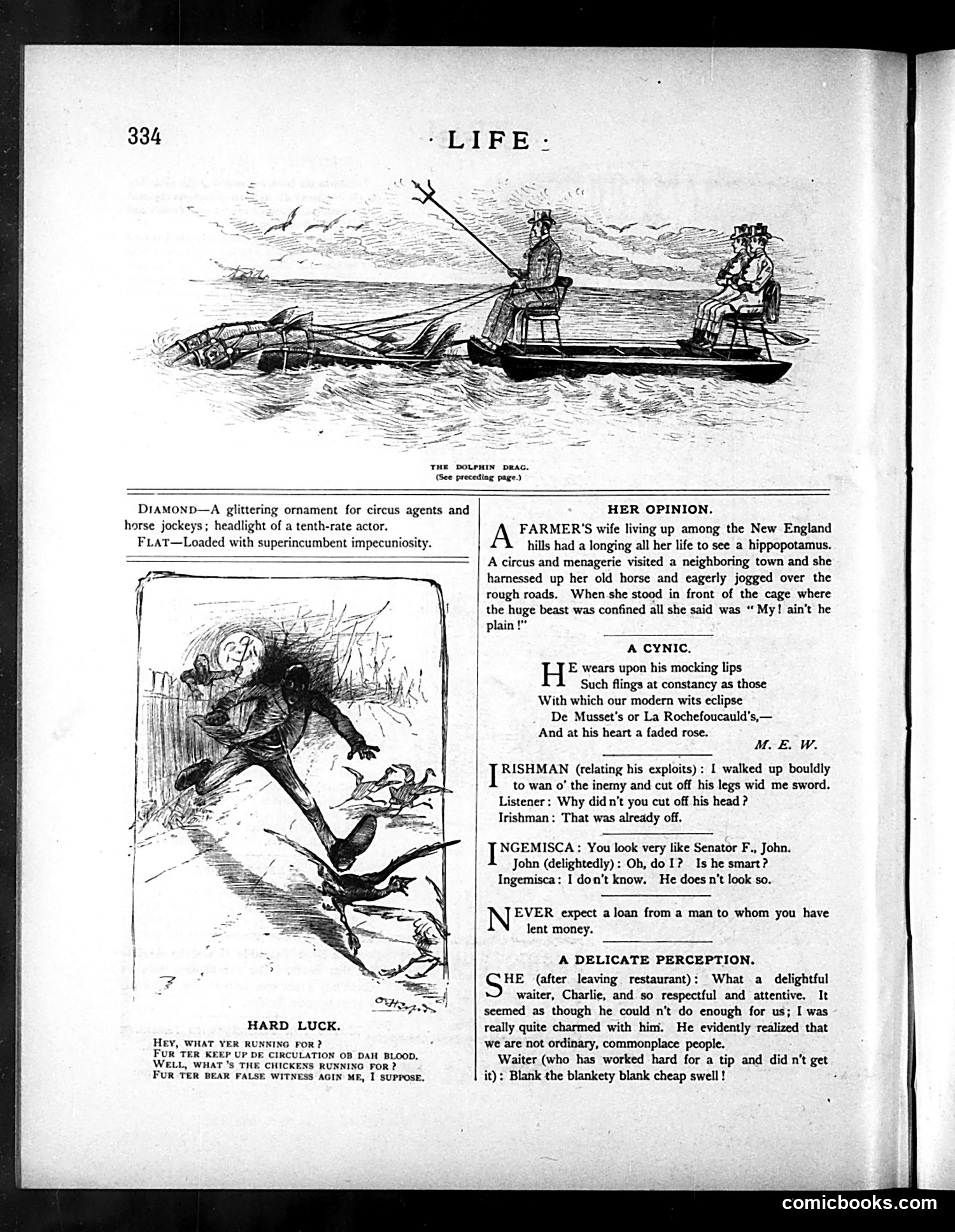
This page contains multiple brief satirical jokes and sketches typical of Life magazine's format. **"The Dolphin Drag"** (top) illustrates circus/theatrical slang definitions mocking show business pretension—"Diamond" being a flashy but hollow ornament, "Flat" someone broke. **"Her Opinion"** satirizes rural simplicity: a farmer's wife, finally seeing a hippopotamus after lifelong longing, finds it disappointingly plain—humor from deflated expectations. **"A Cynic"** is a literary jab at affected romanticism in modern wit. **The Irish anecdotes** mock Irish stereotypes through absurd illogical boasts. **"A Delicate Perception"** contrasts upper-class self-importance with working-class resentment: a wealthy diner mistakes a waiter's professional service for genuine respect, while the waiter (unshown, but implied) resents the poor tip from someone acting superior. The satire targets class pretension on both sides. **"Hard Luck"** (left) features rustic dialect humor about legal troubles.
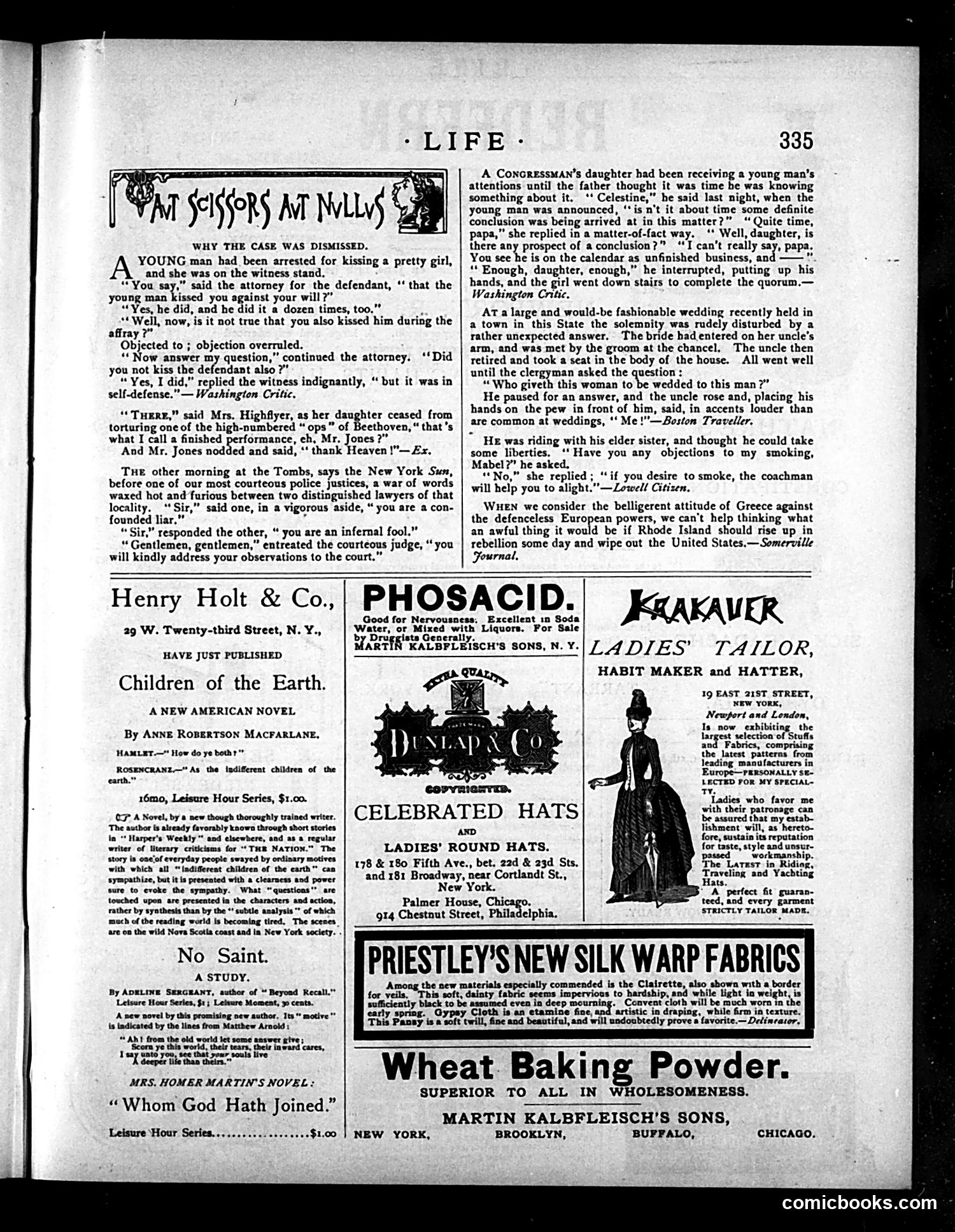
This page contains five brief humorous anecdotes mocking legal proceedings and social pretension in late 19th-century America. The title cartoon "Fat Smiles at Wills" likely refers to the top story: a young woman arrested for kissing claims her reciprocal kiss was "self-defense"—satirizing absurd legal logic and courtroom procedures. Other jokes target: lawyers' verbal abuse at the Tombs courthouse (the city jail); a congressman's daughter describing her suitor as "unfinished business" (bureaucratic language applied to romance); a wedding where an uncle loudly claims he's giving away the bride instead of the father; and a woman refusing her brother's smoking by telling him the coachman will help him "alight" (exit the carriage). The final joke sarcastically compares Rhode Island's hypothetical rebellion to Greece's "belligerent attitude" toward European powers—absurdist humor mocking both political anxiety and American overconfidence. The page is primarily advertising, featuring book publications and commercial products (baking powder, silk fabrics, hats).
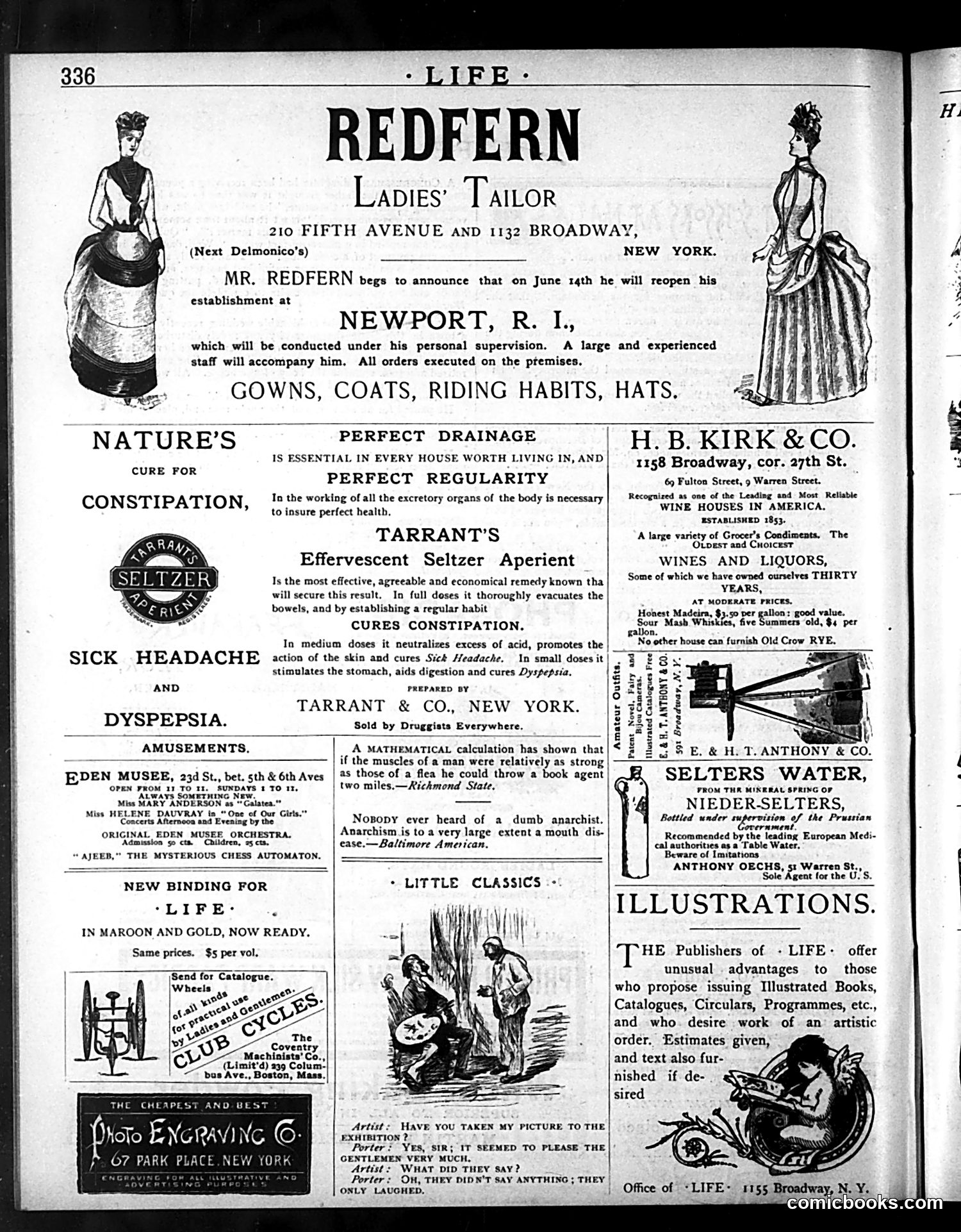
This is primarily an **advertising page** with one small cartoon joke at the bottom. The cartoon depicts an **Artist and Porter** exchange: The artist asks if the porter took his picture to an exhibition. The porter says yes and it pleased gentlemen greatly. When asked what they said, the porter replies they said nothing—"only laughed." **The joke's point:** The implication is that the gentlemen laughed *at* the artwork (finding it ridiculous or poorly executed), not with appreciation. The porter's innocent misreading of mockery as approval creates the humor. The rest of the page consists of period advertisements for luxury goods and services—Redfern ladies' tailoring, wine merchants, constipation remedies (Tarrant's Seltzer), mineral water, and photo engraving services. This reflects 1890s-era Life magazine's business model: satirical content mixed with upscale advertising targeting wealthy urban readers.
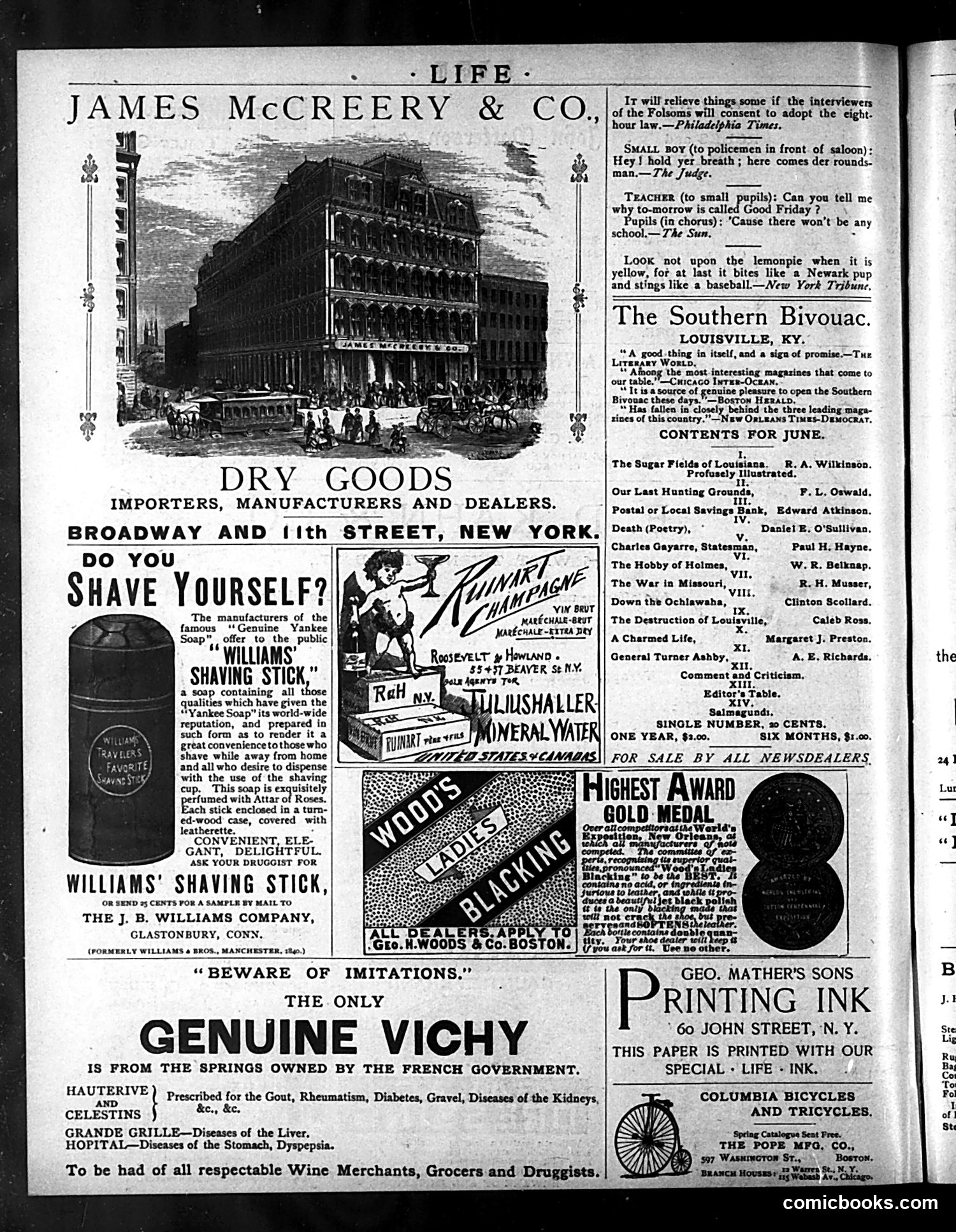
This is primarily an **advertising page** from Life magazine, with minimal satirical content. The page features commercial advertisements for various products (dry goods, shaving supplies, mineral water, printing ink, bicycles) interspersed with brief joke quotes. The only humor elements are **short, unrelated jokes** quoted from other publications: - A Philadelphia Times quip about police adopting an eight-hour workday - A Judge cartoon about a boy warning a policeman away from a saloon - A Sun joke about why children call it "Good Friday" (no school) - A New York Tribune line about lemon pie These appear to be **filler content**—brief humorous asides typical of Life's satirical format—rather than sustained political or social commentary. None target specific figures or events; they're general observational humor about everyday life (police, school, food). The page's primary purpose is **commercial**, showcasing period advertisements and promoting Life's June contents, which focus on American Southern history and literary pieces.
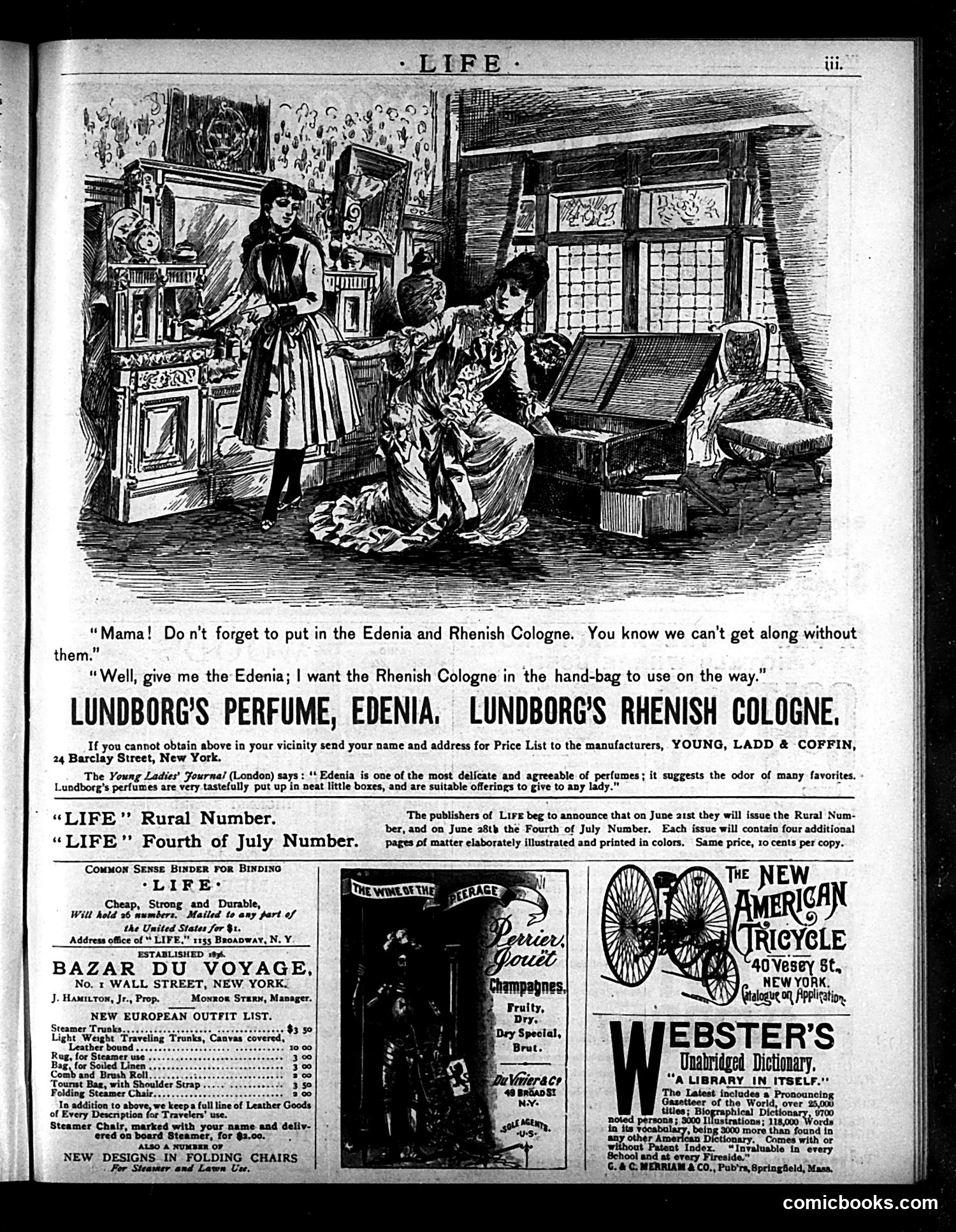
This page is primarily **advertising**, not political satire. The main cartoon depicts a domestic scene where a young woman asks her mother to pack Lundborg's Edenia perfume and Rhenish Cologne for travel, claiming "we can't get along without them." The humor is gentle social satire about **Victorian women's vanity and consumption habits**—the joke being that these cosmetic products are portrayed as absolute necessities rather than luxuries. The implication is that respectable ladies of the era considered personal fragrance essential, even for short trips. The cartoon supports the advertisement below it, which quotes the *Young Ladies' Journal* endorsing Lundborg's perfumes as refined gifts "suitable offerings to give to any lady." The page also advertises **travel goods** (Bazar du Voyage trunks and chairs), **Webster's Dictionary**, and announces special upcoming issues of *Life* magazine (Rural Number and Fourth of July Number).
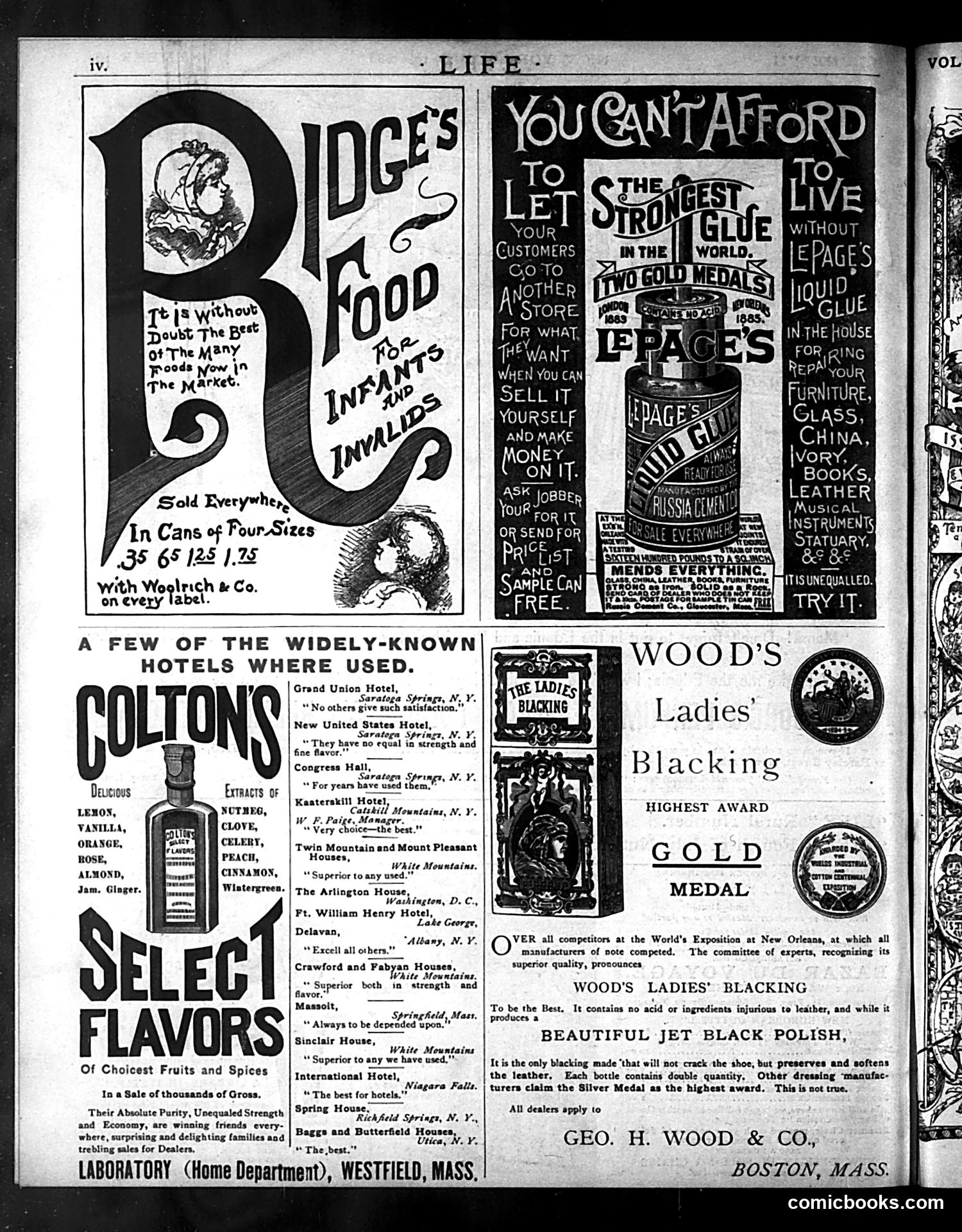
This page is **primarily advertising**, not satirical content. It contains four product advertisements typical of late 19th-century American magazines: 1. **Rindge's Food** (top left): Baby food marketed as "the best of the many goods now in the market," sold in various sizes. 2. **LePage's Liquid Glue** (top right): A household adhesive claiming superiority for repairing furniture, china, books, and other items—a humorous exaggeration of a product's universal utility. 3. **Colton's Select Flavors** (bottom left): Food extracts (lemon, vanilla, orange, etc.) endorsed by testimonials from prominent hotels like Saratoga Springs and the Arlington House. 4. **Wood's Ladies' Blacking** (bottom right): Shoe polish claiming a gold medal at the World's Exposition in New Orleans, emphasizing it won't crack leather. The page demonstrates how Life magazine—while known for satire—generated revenue through extensive advertising. No political commentary or satirical cartoons appear here.