
A complete issue · 18 pages · 1886
Life — June 3, 1886
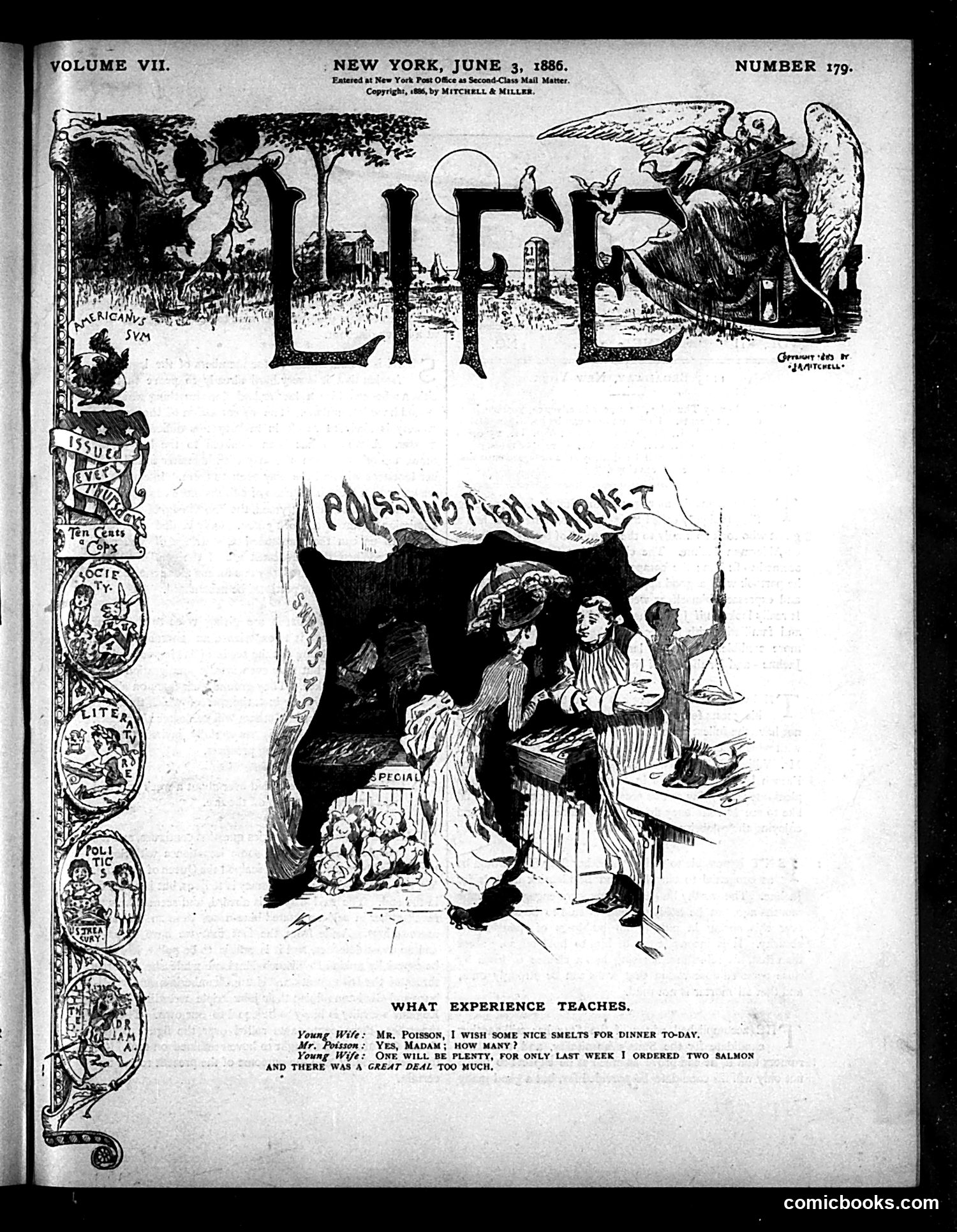
This cartoon satirizes dinner-table economics and household management. The scene shows a woman (likely a housewife) at a fish market or butcher stall, negotiating with a vendor over prices. The caption dialogue reveals the joke: a husband asks his wife about dinner plans, she mentions getting smells cheaply, he questions how many, she responds about ordering two salmon—then adds "AND THERE WAS A GREAT DEAL: TOO MUCH." The satire targets the contradiction between frugal shopping intentions and actual spending habits. The "experience teaches" title suggests this is a learned lesson about the gap between penny-pinching plans and reality. It reflects late-Victorian anxieties about household budgeting and women's role in managing domestic finances, presented as humorous domestic folly rather than serious financial concern.
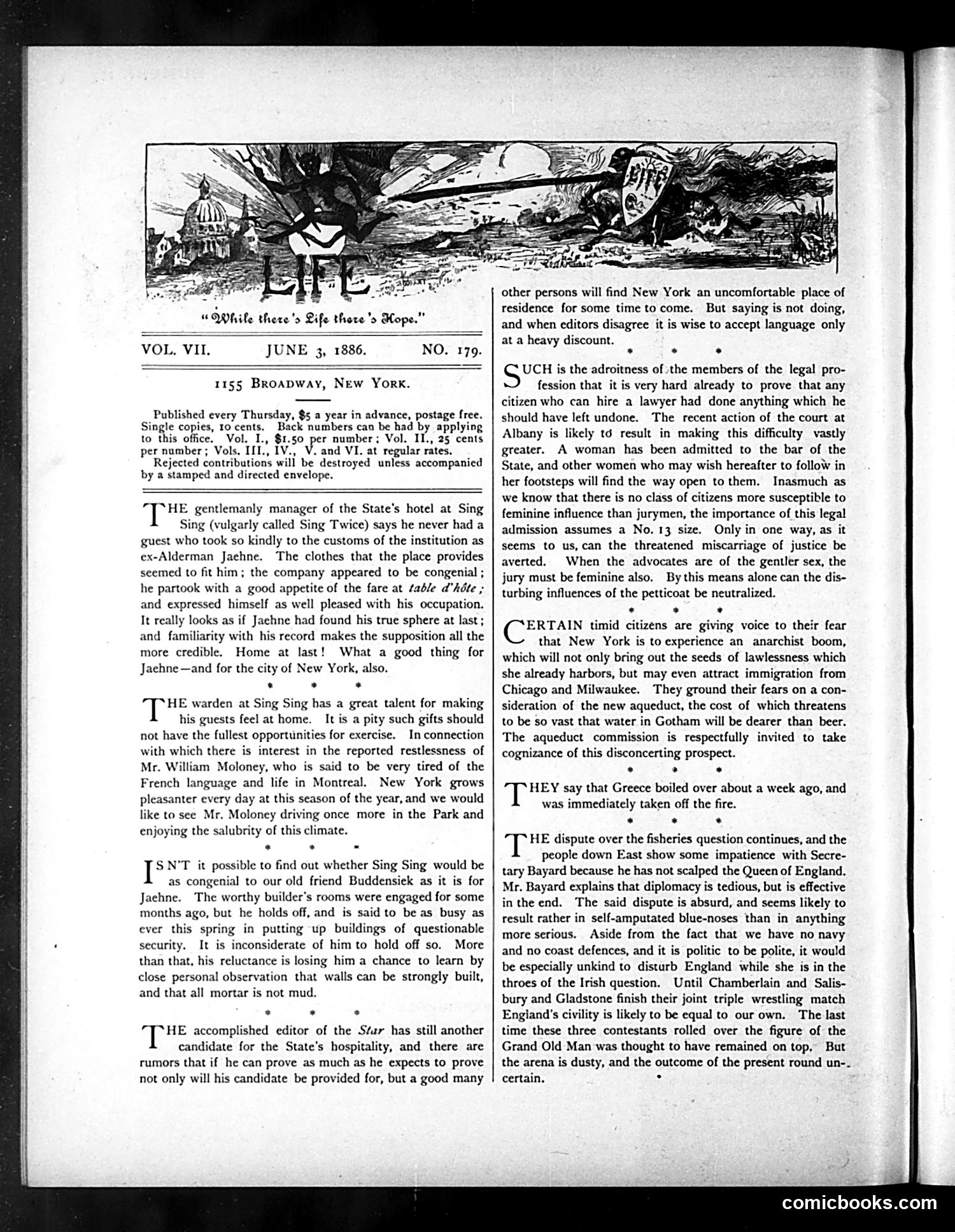
The masthead cartoon depicts "Life" as a figure observing various scenes—a cityscape, what appears to be a comet or celestial object labeled "BITS," and dramatic landscape elements. The caption reads "While there's Life there's Hope." The page contains satirical editorial commentary on contemporary New York issues, including: - **Women in law**: discussing a court ruling admitting women to the bar, with cautious optimism about female jurors neutralizing "petticoat" bias - **Hotel management**: criticism of the State hotel manager's competence - **Urban anxieties**: fears about anarchist movements potentially spreading from Chicago to New York - **Water infrastructure**: concerns about a proposed aqueduct's cost The tone is characteristic of Gilded Age satirical journalism—mixing social commentary with gentle mockery of civic leadership and emerging social changes.
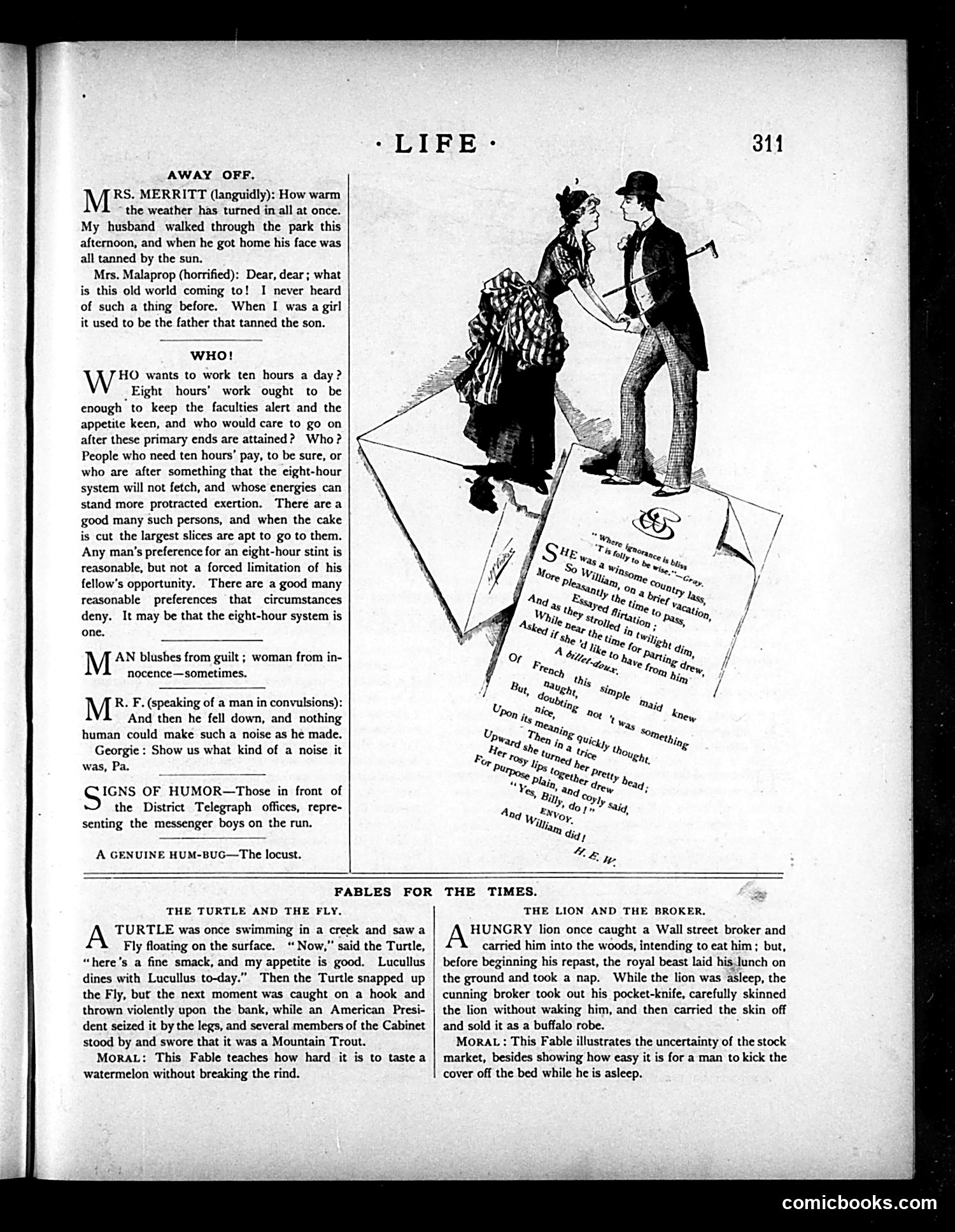
The main illustration depicts two men in formal dress examining what appears to be a stock certificate or financial document. One figure points at the paper while the other observes—likely satirizing Wall Street investors or financial speculation. The surrounding text consists of humorous anecdotes and aphorisms about social topics: work hours, gender differences ("Man blushes from guilt; woman from innocence"), and observations on human nature. Below are two brief fables ("The Turtle and the Fly" and "The Lion and the Broker") offering moral lessons—the broker fable particularly mocking financial deception and risk. The overall page satirizes Gilded Age financial culture, social pretension, and the follies of speculation, typical of Life's satirical commentary on American society during this period.
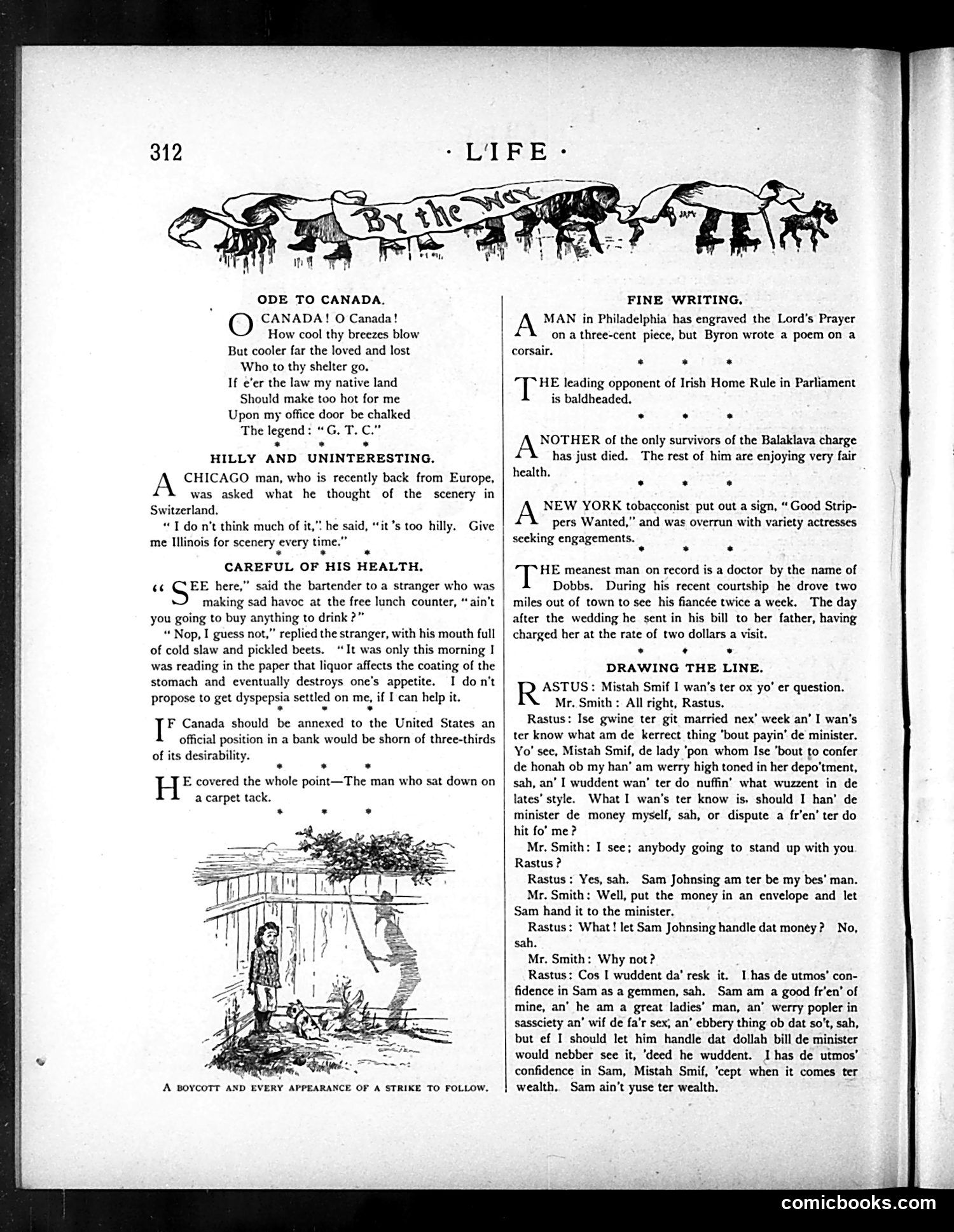
This page contains several short satirical pieces rather than a single cartoon. The main illustrated item at bottom shows "A boycott and every appearance of a strike to follow" — depicting what appears to be labor unrest, though specifics are unclear. The text pieces mock contemporary figures and situations: one criticizes a Chicago man's dismissive attitude toward Swiss scenery; another ridicules the "meanest man on record," a doctor who charged his fiancée for courtship visits; and a section titled "Drawing the Line" presents Irish dialect humor about political patronage and money handling. The "Ode to Canada" expresses patriotic sentiment. Overall, the page satirizes American social pretensions, romantic miserliness, and political corruption through brief anecdotes rather than cohesive narrative.
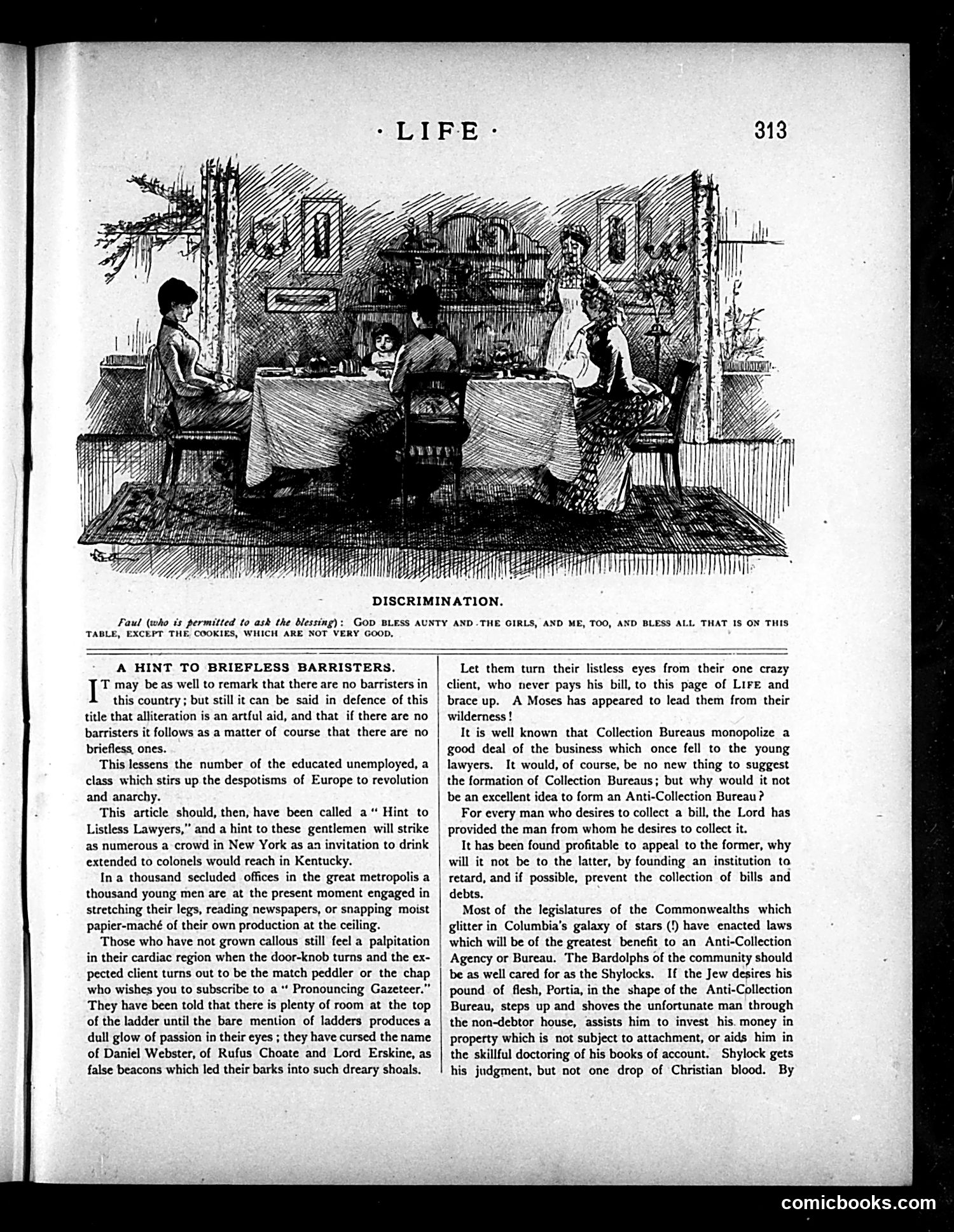
**The Cartoon:** Shows four well-dressed people dining together, illustrating the article's ironic title. **The Satire:** The piece mocks wealthy barristers (lawyers) who avoid paying their bills, labeling them hypocrites. The dinner blessing mentions blessing "all that is on this table, EXCEPT THE COOKIES, WHICH ARE NOT VERY GOOD"—sarcastically suggesting selective morality. **Main Argument:** The article proposes an "Anti-Collection Bureau" to protect debtors from bill collectors, arguing that Collection Bureaus exploit the poor. It critiques how wealthy lawyers and professionals use legal systems to avoid debt while ordinary people face harsh collection tactics. The satire suggests that "discrimination" (selective treatment) benefits the privileged class who can afford lawyers to shield themselves from financial consequences that ordinary citizens cannot escape.
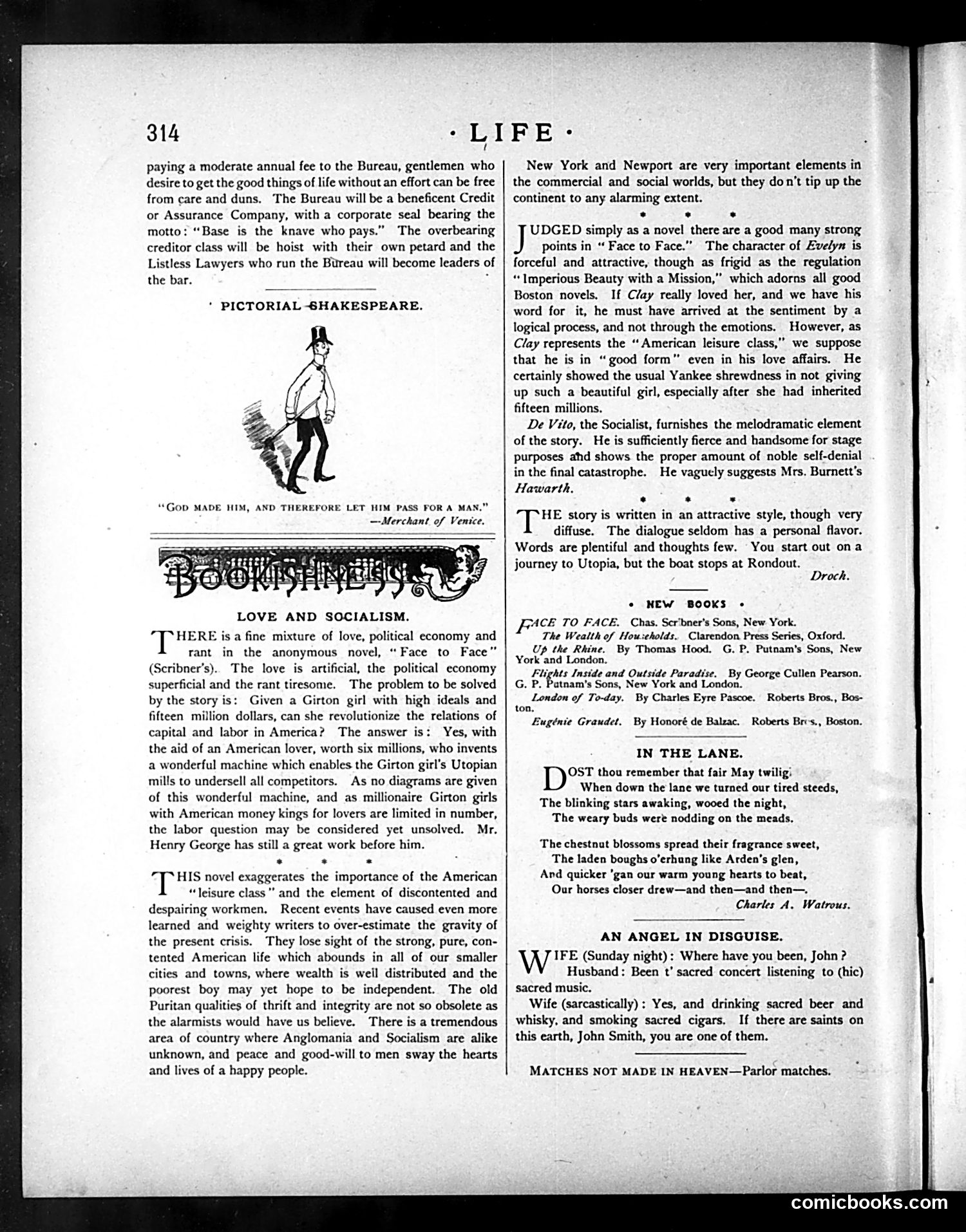
The page contains a section titled "Pictorial Shakespeare" featuring a small illustration of a man in formal dress with the caption "God made him, and therefore let him pass for a man" (from *Merchant of Venice*). The joke appears to be a visual pun or satirical commentary on a contemporary figure, though the specific identity is unclear from the image alone. Below this is a book review section discussing "Face to Face," a novel addressing American socialism and capitalism. The review critiques how the story portrays a Girton girl solving labor-capital relations through an invented machine—suggesting satire of idealistic but impractical socialist solutions. The page also includes poetry, new book listings, and a domestic humor piece titled "An Angel in Disguise" mocking marital relations.
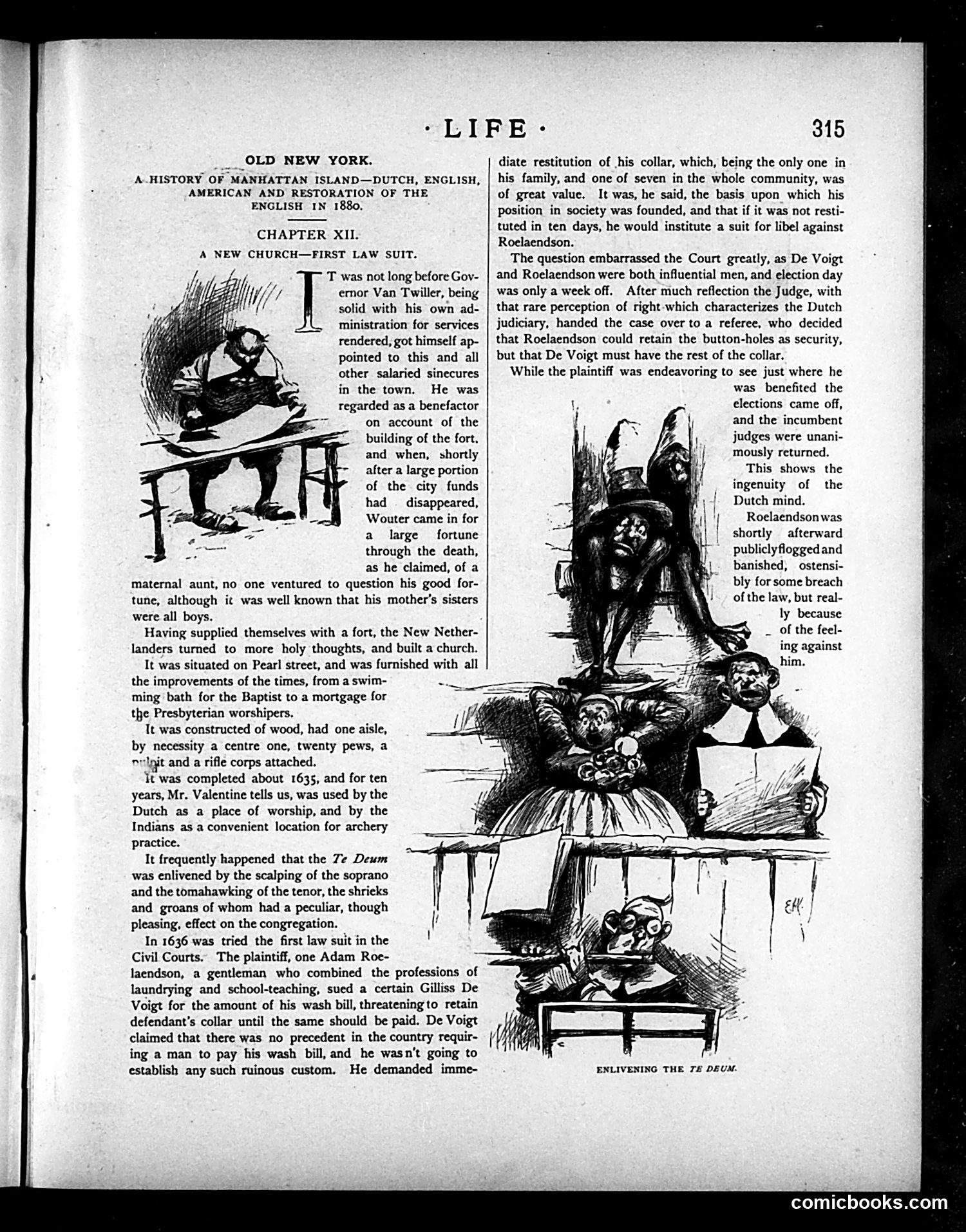
This satirical illustration comments on a 1656 lawsuit in New Amsterdam (early New York). The text describes how a soprano's "scalping of the tenor" and "unearthly shrieks and groans" disrupted church services during the *Te Deum* hymn. The cartoon depicts the chaotic musical performance: the soprano appears to be attacking or wildly gesturing above, while below, what seems to be a distressed congregation or choir members react in dismay. The "enlivening" in the caption is ironic—the performance was apparently so terrible it disturbed rather than enhanced worship. This satirizes both colonial Dutch culture and early American church life, poking fun at amateur musicians disrupting sacred services.
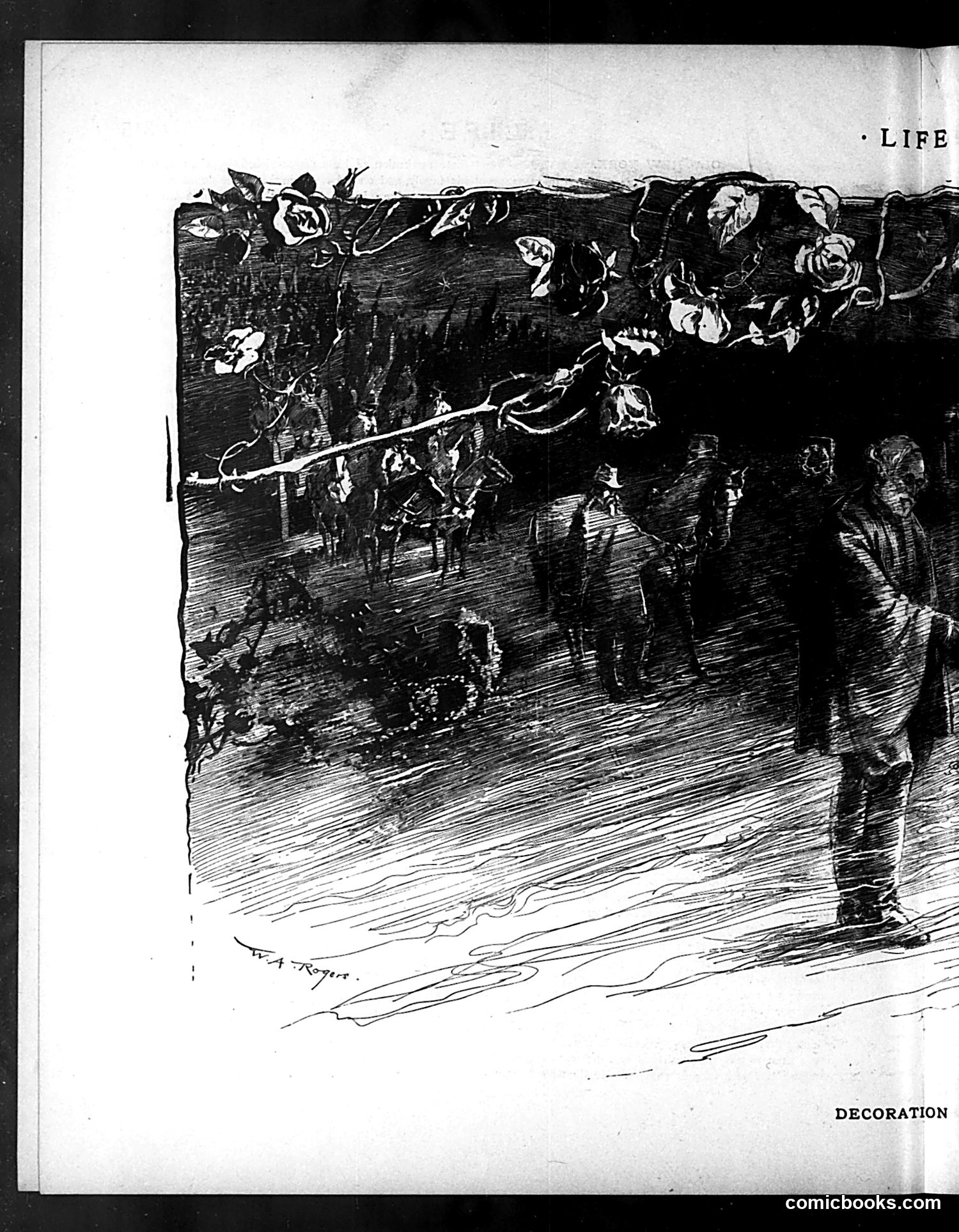
This page from *Life* magazine shows a satirical illustration titled "Decoration" at the bottom. The sketch depicts what appears to be a military or formal ceremony scene, with figures in uniform observing a decorated arch or bower laden with flowers at the top of the image. The style suggests early-to-mid 20th century commentary, likely satirizing either military pageantry, bureaucratic ceremony, or formal state occasions. The flowers adorning the arch contrast with the serious, regimented figures below, possibly mocking the elaborate ceremonial trappings surrounding official events. However, without additional context like the artist's name, publication date, or accompanying text, I cannot definitively identify which specific historical event or political figure this targets. The satire appears to critique excessive formality or decoration in official proceedings.
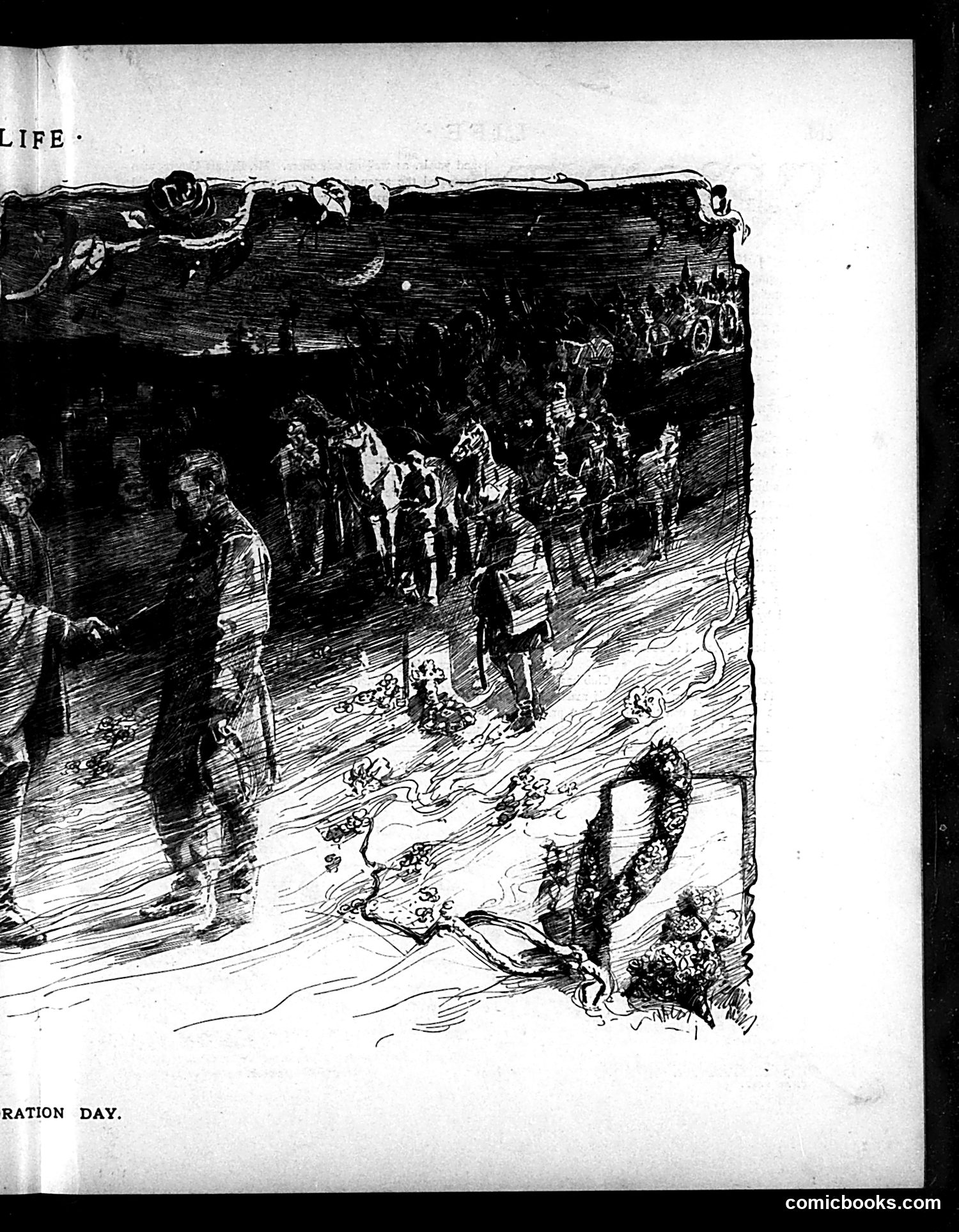
This appears to be a Life magazine illustration titled "RATION DAY" (visible at bottom). The sketch depicts what seems to be a military or civic scene with uniformed figures and civilians gathered in an indoor space. The artistic style—pen and ink with cross-hatching—is typical of early-to-mid 20th century magazine illustration. The "ration day" reference suggests this relates to wartime rationing, likely World War I or II era when food and supplies were distributed to the public under government control. The gathering of civilians and officials implies this illustrates an actual rationing distribution event. However, the specific satirical point and any caricatured figures remain unclear from the image quality and style. The exact commentary Life magazine intended requires additional context about the publication date and broader editorial context.
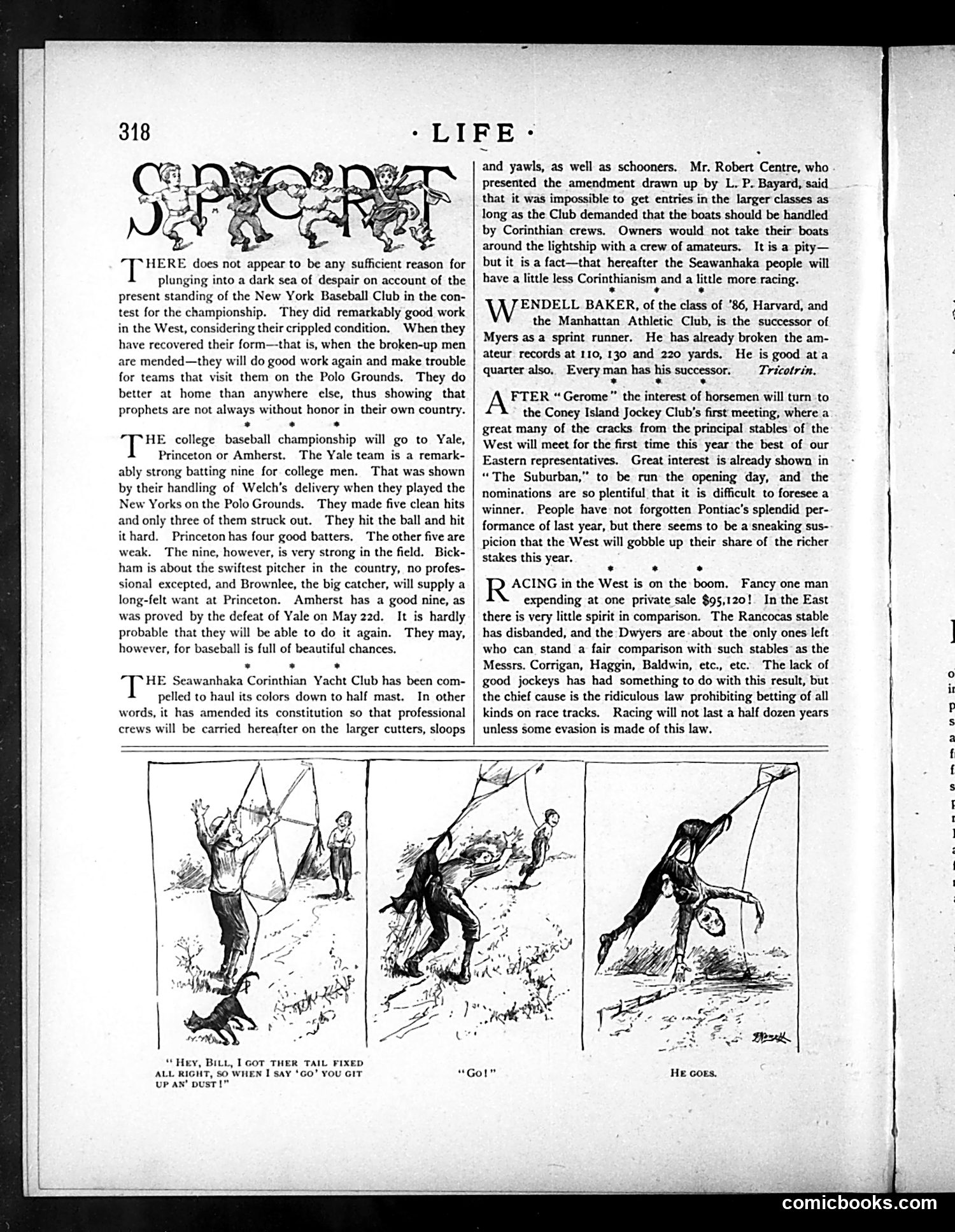
This page offers sports commentary on baseball, yacht racing, track and field, and horse racing. The **three cartoons below** depict kite-flying mishaps—a humorous visual break from the text. They show a man's kite troubles, captioned "Go!" and "He goes," playing on the comedy of amateur kite control. The substantive content discusses: the struggling New York Baseball Club (encouraged to improve); college baseball rivalry among Yale, Princeton, and Amherst; and a notable concession by the prestigious **Seawanhaka Corinthian Yacht Club**, which reluctantly agreed to permit professional crews after amateur-only crews proved unpopular. The text treats this as a regrettable compromise—favoring competitive racing over the amateur "Corinthianism" ideal. Other sections praise sprinter Wendell Baker and note the horse-racing boom in the West versus Eastern decline, lamenting that betting restrictions harm the sport.
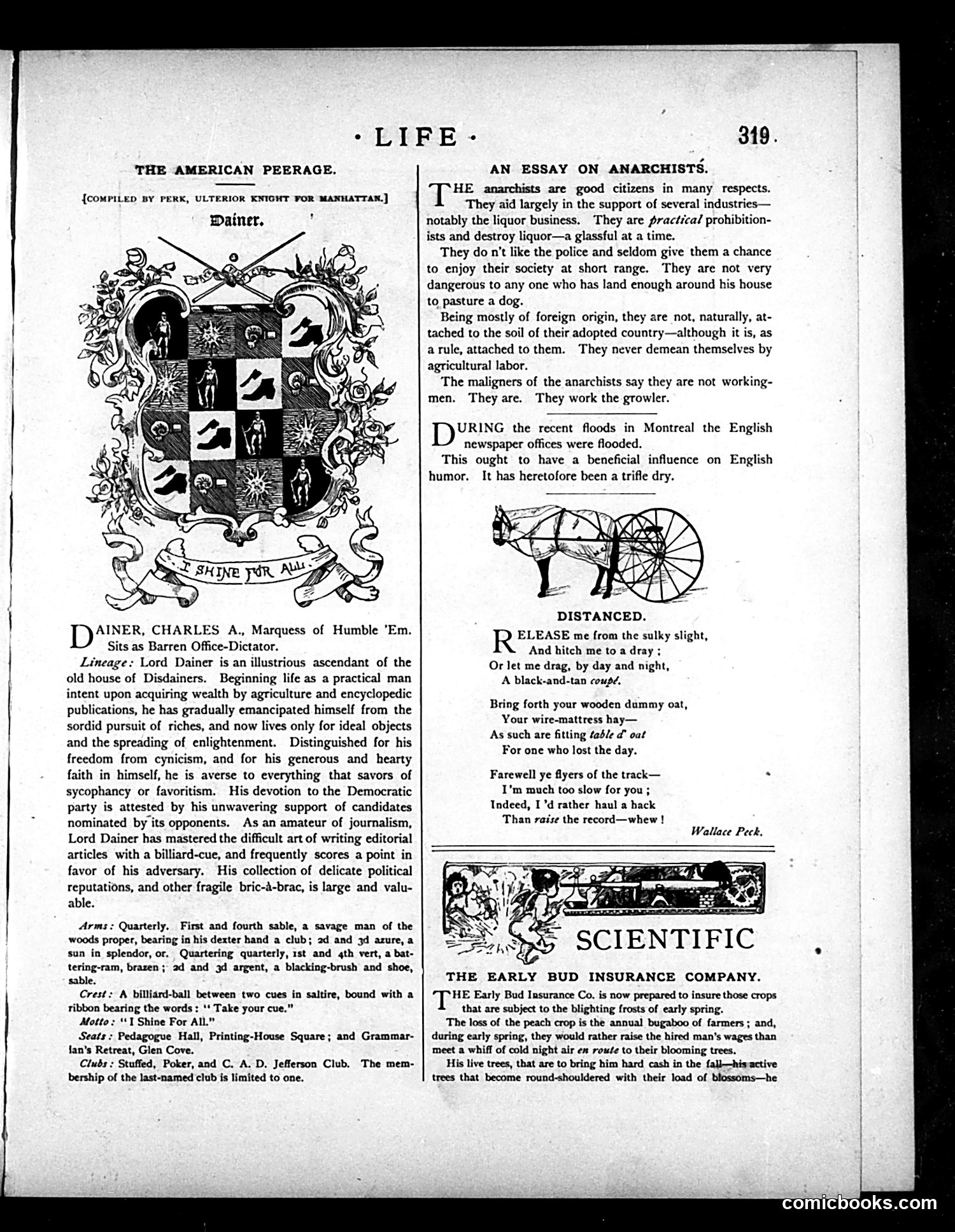
**"The American Peerage" (Left Column):** This is mock-heroic satire mocking Charles A. Dainer, styled as a nobleman ("Marquess of Humble 'Em"). The joke targets his self-contradiction: he claims devotion to ideals and the Democratic Party, yet his editorial writing supposedly "scores a point in favor of his adversary." His heraldic arms parody his pretentiousness—featuring billiard cues and a blacking-brush, suggesting he's not actually aristocratic. The satire mocks self-important editors who affect intellectual superiority while pursuing contradictory positions. **"An Essay on Anarchists" (Right Column):** Dark humor about anarchists as destructive radicals. The "essay" sardonically praises them as "good citizens" who support the liquor industry (by destroying bottles), avoid police, and "work the growler" (likely slang for causing trouble). The Montreal flooding joke suggests English journalists' humor is as waterlogged as their offices—dry and mediocre. **Minor Content:** A poem about a racehorses past its prime, and an advertisement for crop insurance against spring frosts.
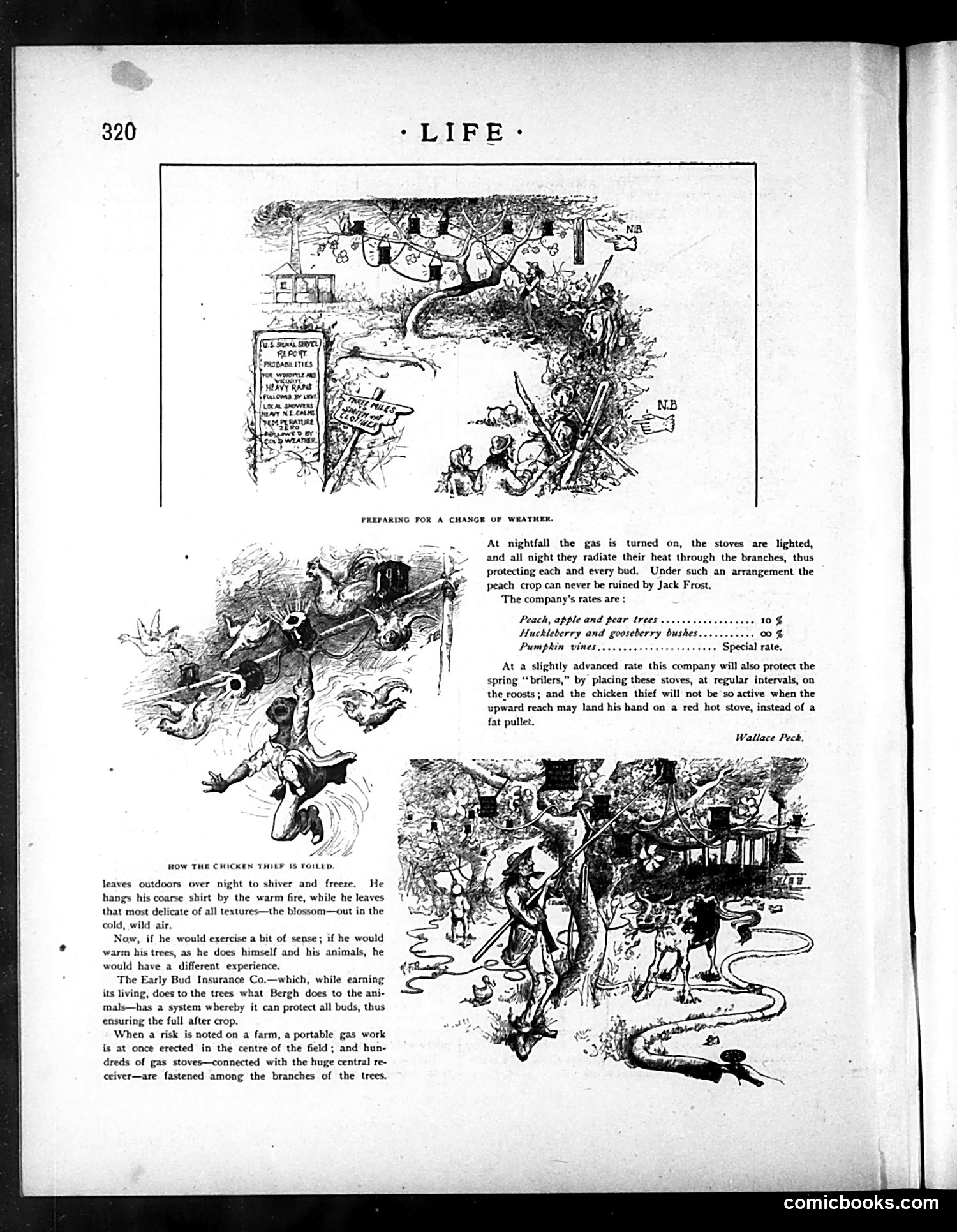
This page satirizes a fictional "Early Bud Insurance Co." that uses gas stoves to protect fruit crops from frost damage (personified as "Jack Frost"). The top cartoon shows an elaborate heating system installed in orchards—stoves hung from tree branches, connected by pipes to a central gas receiver. The satire's point: the company's rates are absurdly specific (10¢ for peach trees, 5¢ for berry bushes, "special rate" for pumpkins), treating agricultural protection like insurance premiums. A secondary joke targets chicken thieves: the company also places hot stoves on chicken roosts at night, so would-be thieves reach for poultry and burn their hands instead. The cartoonist (Wallace Peck) mocks both the inefficiency of farmers who won't invest in crop protection, and the entrepreneurial spirit of companies offering solutions to seasonal agricultural problems. The absurdity lies in the impracticality of heating entire fields with gas stoves—a satirical jab at overly-complicated "solutions" to natural problems.
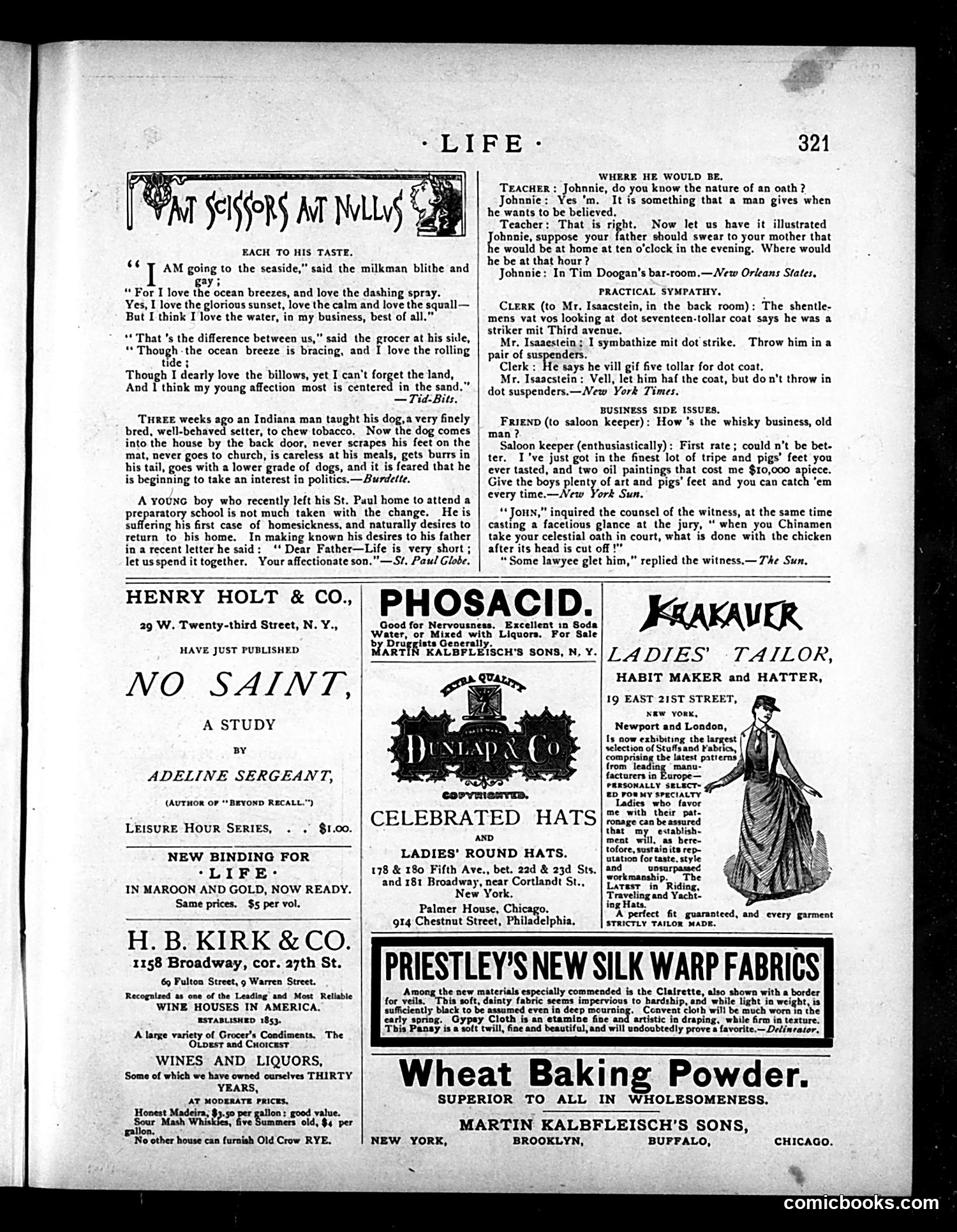
This page contains several short satirical pieces typical of Life's humor format: **"Each to His Taste"** presents a milkman and grocer discussing seaside vacations—a gentle joke about different preferences, with the milkman valuing water for his profession. **"The Dog Story"** satirizes the corrupting influence of bad habits. A well-bred setter taught to chew tobacco subsequently neglects church, associates with inferior dogs, and develops political interests—implying these are all signs of moral decay. **"Where He Would Be"** is a domestic humor joke where a schoolboy correctly deduces his father won't actually be home at the promised time, but rather at "Tim Doogan's bar-room"—poking fun at men's infidelity to domestic commitments. **"Practical Sympathy"** features an immigrant shopkeeper (Isaacstein) who expresses solidarity with striking workers but refuses to give them the same discount he offered them, exposing hypocrisy in labor sympathies. **"Business Side Issues"** mocks a saloon keeper's claim that expensive art and food (pigs' feet) drive business, suggesting lowbrow establishments succeed despite, not because of, pretense. The page is primarily advertising, with these jokes filling available space.
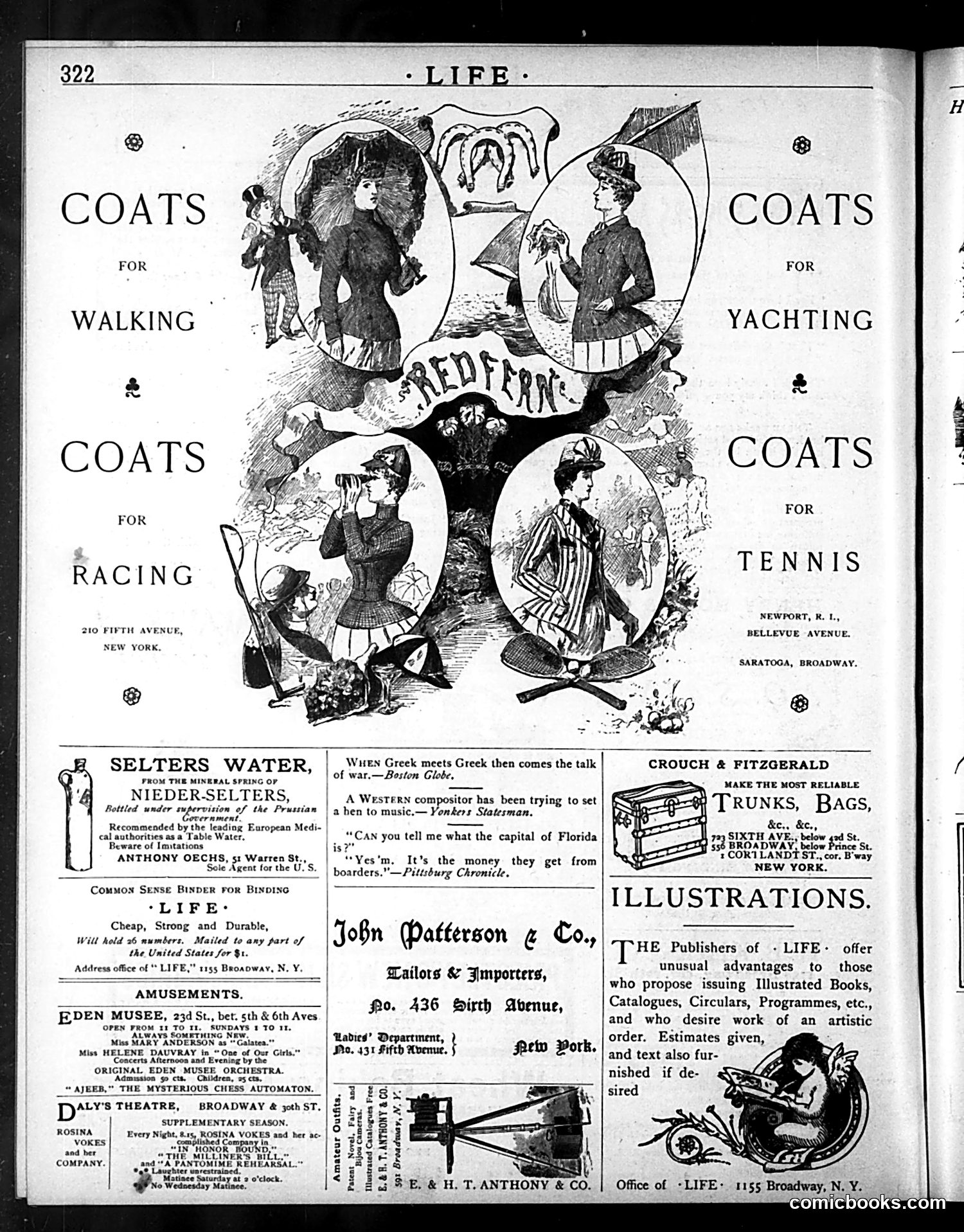
The main image is a **Redfearn advertisement** showcasing women's coats for different leisure activities—walking, yachting, racing, and tennis. Four illustrated female figures in Victorian-era dress are displayed in oval vignettes, each modeling appropriate attire for her respective sport. This reflects the late 19th-century convention of specialized, gender-specific sportswear. The page is predominantly **advertisements and filler content**: mineral water, theater listings, photography equipment, luggage makers, and a printing service. Three short humorous items appear—jokes about war, music composition, and Florida tourism—typical of Life's satirical filler material. **No significant political satire is present.** This is a standard commercial page typical of American magazines from this era, reflecting consumer culture and leisure activities among the affluent class Life's readership primarily represented.
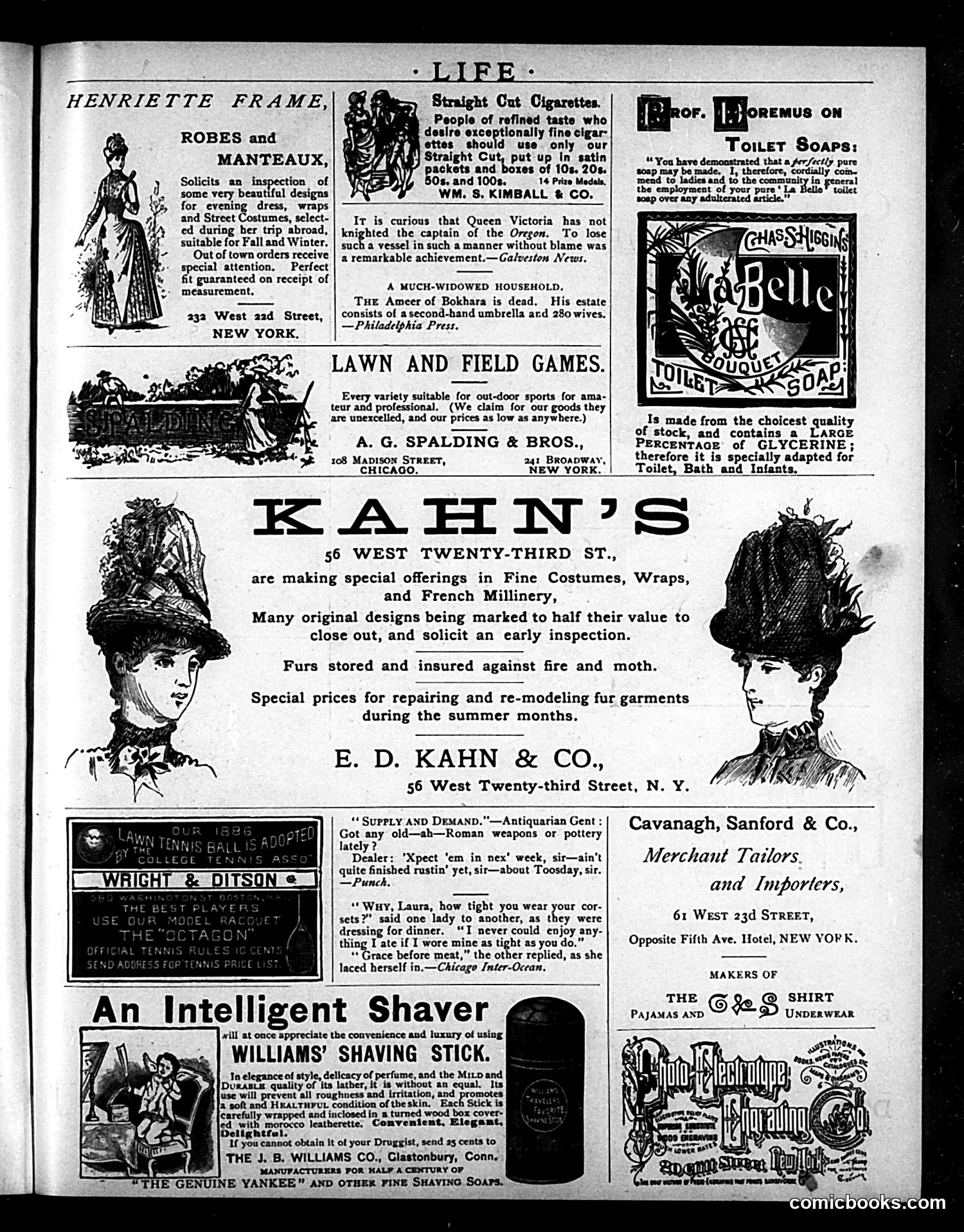
This is a Life magazine page devoted almost entirely to commercial advertisements for clothing, grooming products, and sporting goods—typical of late-19th-century publication layout. The few non-advertisement items are brief satirical snippets: - A jab at Queen Victoria for not knighting the captain of the USS *Oregon*, treating a naval mishap as oddly fortunate - A joke about the Ameer of Bokhara's estate consisting of "a second-hand umbrella and 280 wives"—satirizing both exotic polygamy and sudden impoverishment - Two brief comic dialogues mocking social pretension (an antiques dealer "finishing" Roman artifacts, and women discussing corset-tightness as religious devotion) These are typical *Life* magazine humor: society satire and wordplay. The page's primary function is selling fashionable clothing, furs, and toiletries to affluent urban readers.
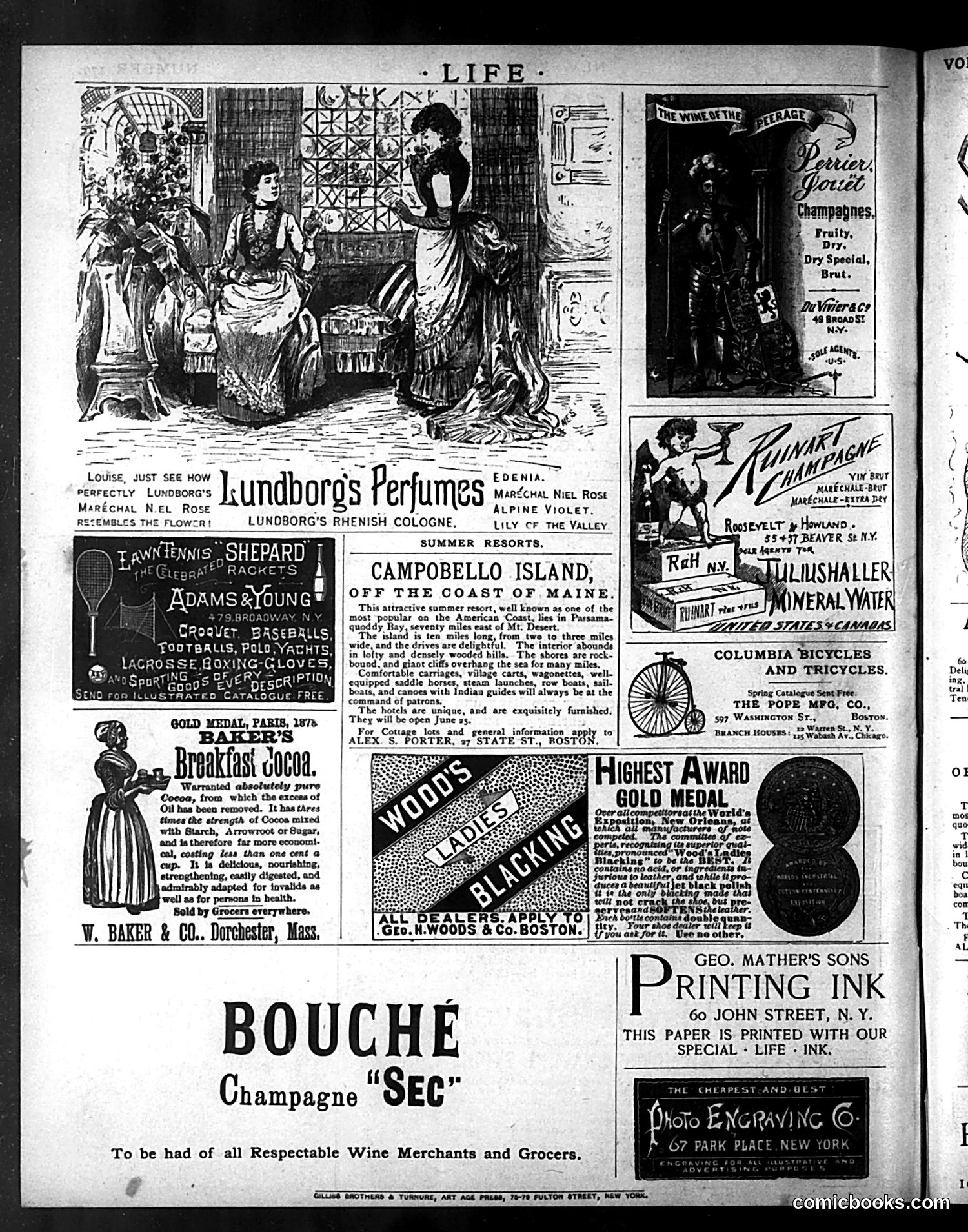
This is primarily an **advertising page** from a late 19th-century Life magazine, not a political cartoon. The dominant content is commercial advertisements for luxury goods and services aimed at wealthy Americans. **Key advertisements visible:** - **Lundborg's Perfumes** (top left): A illustrated scene of fashionable women; the ad claims the perfume "resembles the flower" it's named after - **Campobello Island** (center): A Maine summer resort advertisement - **Baker's Breakfast Cocoa** (left): Gold Medal winner, emphasizing purity and economy - **Bouché Champagne** (bottom): For "respectable wine merchants" - **Columbia Bicycles**, **Phinart Champagne**, **Printing Ink**, and **Photo Engraving** services **The satirical element** is minimal here—the page simply reflects Gilded Age consumer culture, showcasing products marketed to the wealthy leisure class. The illustration of women in elaborate dress reinforces the period's class aspirations and consumer identity.
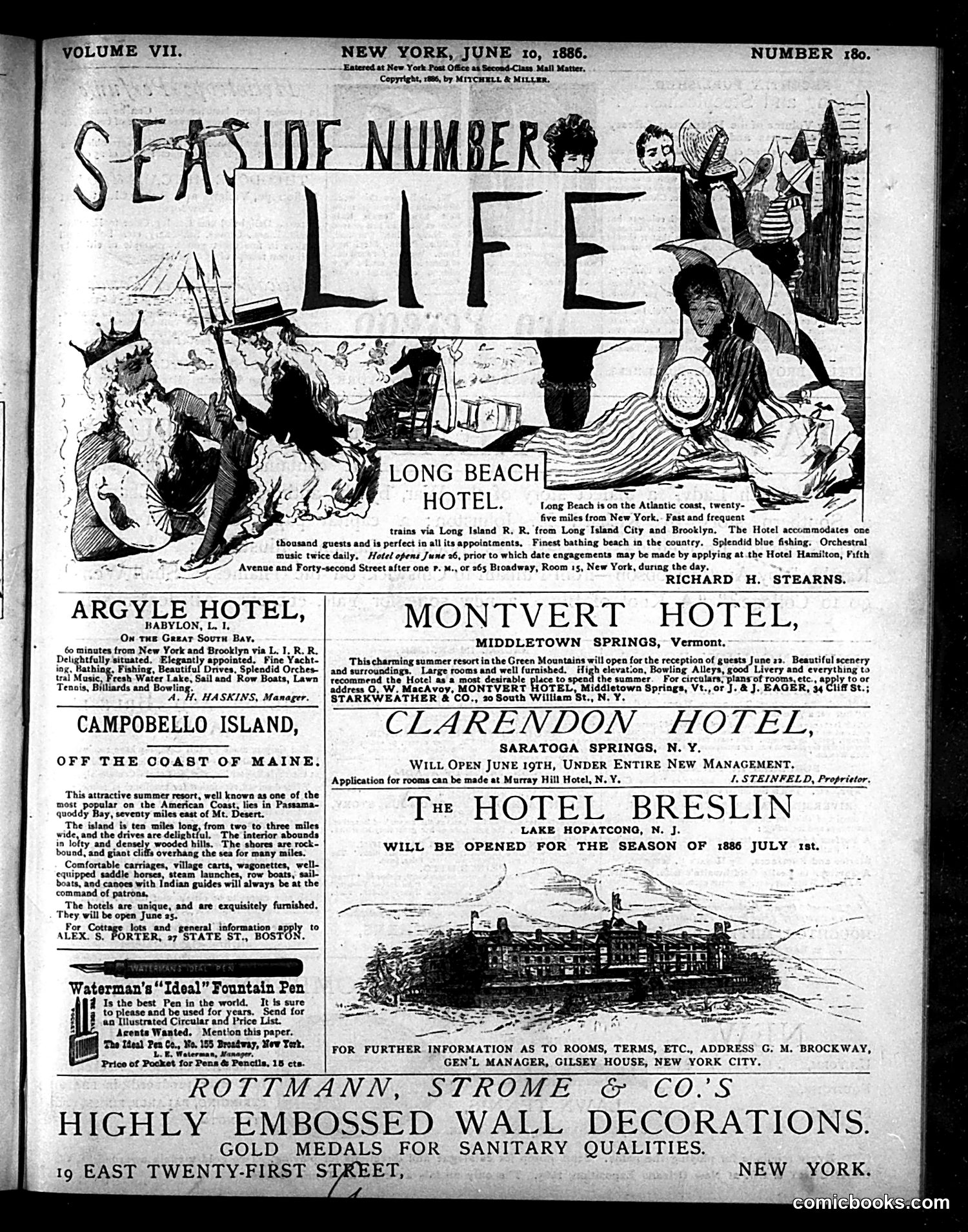
This is primarily an **advertising page** from the June 10, 1886 issue of *Life* magazine, with minimal satirical content visible. The main illustration at top—labeled "Sea Side Number Life"—depicts a generic summer leisure scene rather than political satire: figures in period dress enjoying a beach resort, with a woman in Victorian attire, a man in formal dress, and recreational activities. It serves as a decorative header for hotel advertisements. The page is dominated by **hotel advertisements** for luxury American summer resorts (Long Beach Hotel, Argyle Hotel, Montvert Hotel in Vermont, Clarendon Hotel, and Hotel Breslin). These promote upscale seasonal accommodations with amenities like orchestras, bathing beaches, and fine fishing—reflecting the Gilded Age leisure culture. There's also an advertisement for **Waterman's "Ideal" Fountain Pen**, a commercial product pitch. No specific political figures or events are identifiable. The page reflects 1880s consumer culture and vacation destinations for wealthy Americans rather than editorial satire or commentary.
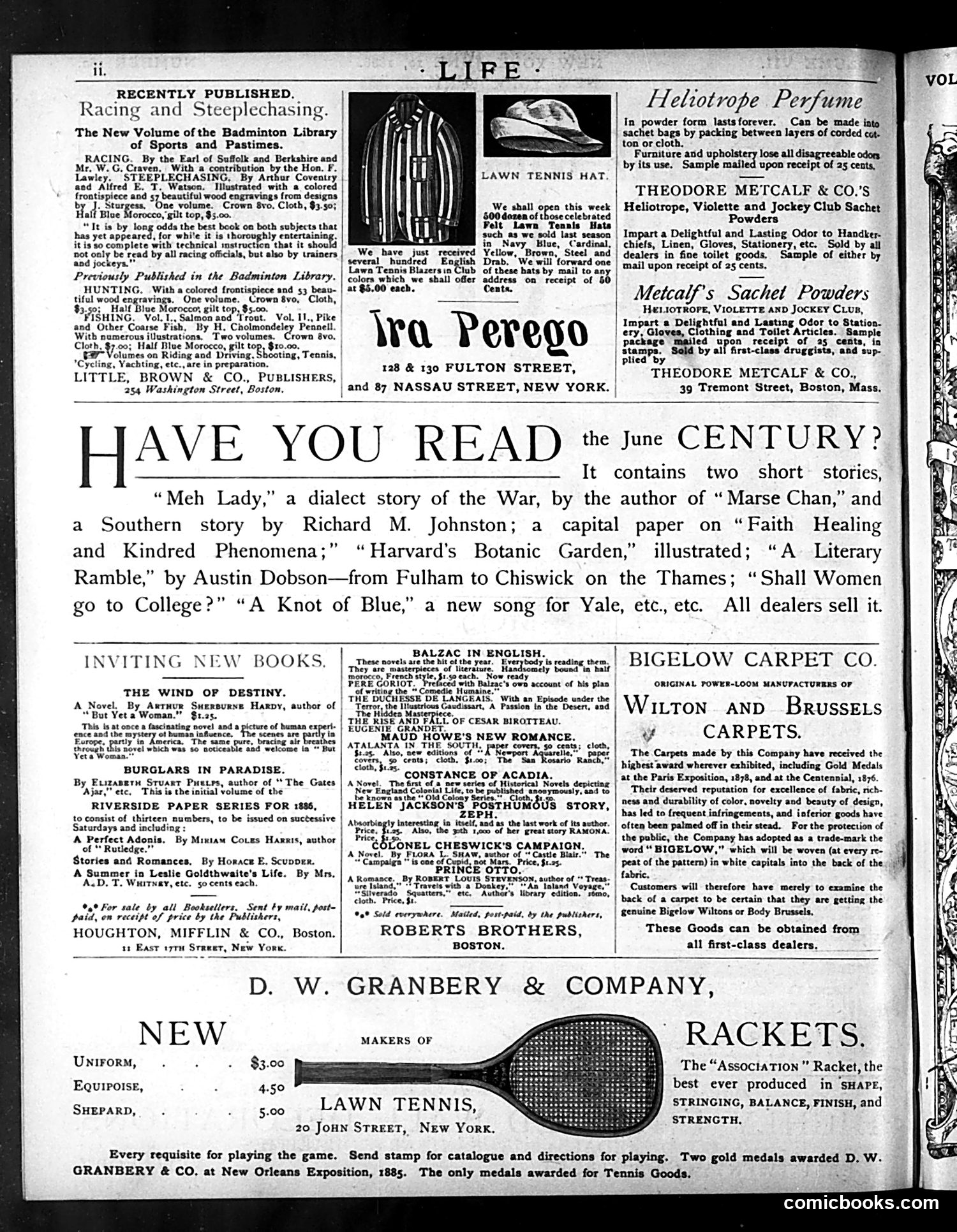
This page is primarily **advertising and literary promotion**, not political satire or editorial cartoons. The content includes: - **Book advertisements** for sporting guides (Racing, Steeplechasing, Hunting, Fishing) from the prestigious Badminton Library series - **Promotional material** for *Century Magazine's* June issue, highlighting literary content including a Civil War dialect story and essays on faith healing and women's education - **Consumer product ads** for lawn tennis equipment (hats, blazers, rackets), perfumes, and carpets - **Publisher announcements** for new novels and serial publications The only visual elements are product illustrations: a lawn tennis hat, a tennis racket, and what appears to be a tennis shoe. **For modern readers:** This represents the advertising-heavy format of 1880s magazines, targeting educated middle-to-upper-class readers interested in sports, literature, and refinement. There is no political cartoon or satirical commentary present on this particular page.