
Life, 1886-06-03 · page 7 of 18
Life — June 3, 1886 — page 7: what you’re looking at
What you’re looking at
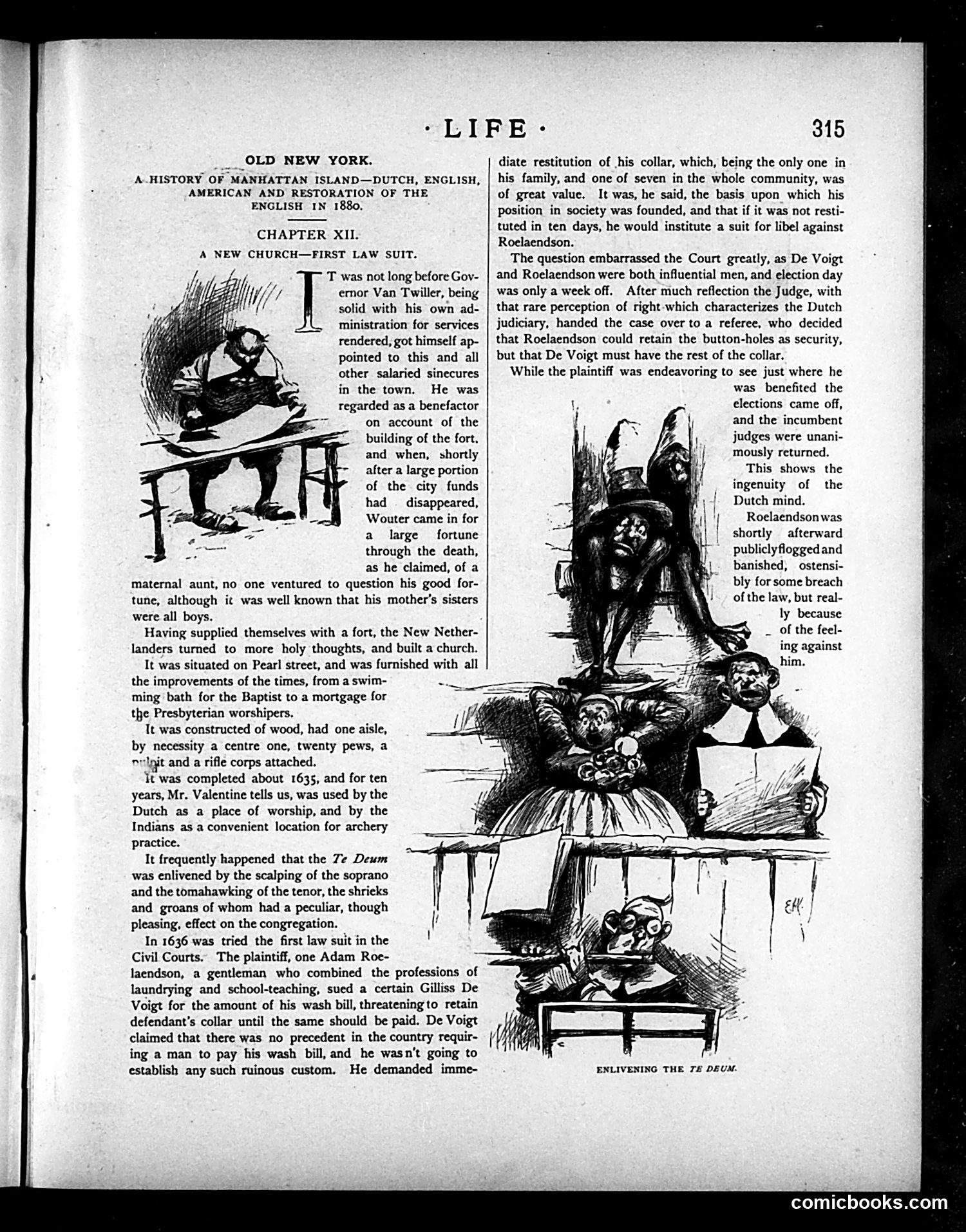
This satirical illustration comments on a 1656 lawsuit in New Amsterdam (early New York). The text describes how a soprano's "scalping of the tenor" and "unearthly shrieks and groans" disrupted church services during the *Te Deum* hymn. The cartoon depicts the chaotic musical performance: the soprano appears to be attacking or wildly gesturing above, while below, what seems to be a distressed congregation or choir members react in dismay. The "enlivening" in the caption is ironic—the performance was apparently so terrible it disturbed rather than enhanced worship. This satirizes both colonial Dutch culture and early American church life, poking fun at amateur musicians disrupting sacred services.
📄 Transcribed text from this page (OCR, searchable)
Machine-transcribed from the original scan — historical spelling and the odd misread are preserved.
- LIFE: ___OLD NEW YORK. A.HISTORY OF MANHATTAN ISLAND—DUTCH, ENGLISH, AMERICAN AND RESTORATION OF THE ENGLISH IN 1880. CHAPTER XII. A NEW CHURCH—FIRST LAW SUIT. T was not long before Gov- ernor Van Twiller, being solid with his own ad- ministration for services rendered, got himself ap- pointed to this and all other salaried sinecures in the town. He was regarded as a benefactor on account of the building of the fort. and when, shortly after a large portion of the city funds had — disappeared, Wouter came in for a large fortune through the death, as he claimed, of a maternal aunt, no one ventured to question his good for- tune, although it was well known that his mother’s sisters were all boys. Having supplied themselves with a fort, the New Nether- landers turned to more holy thoughts, and built a church. It was situated on Pearl street, and was furnished with all the improvements of the times, from a swim- ming bath for the Baptist to a mortgage for the Presbyterian worshipers. Tt was constructed of wood, had one aisle, by necessity a centre one, twenty pews, a nulgit and a rifle corps attached. Tt was completed about 1635, and for ten years, Mr. Valentine tells us, was used by the Dutch as a place of worship, and by the Indians as a convenient location for archery practice. It frequently happened that the Ze Deum was enlivened by the scalping of the soprano and the tomahawking of the tenor, the shrieks and groans of whom had a peculiar, though pleasing, effect on the congregation. In 1636 was tried the first law suit in the Civil Courts. The plaintiff, one Adam Roe- laendson, a gentleman who combined the professions of laundrying and school-teaching, sued a certain Gilliss De Voigt for the amount of his wash bill, threatening to retain defendant's collar until the same should be paid. De Voigt claimed that there was no precedent in the country requir- ing a man to pay his wash bill, and he wasn’t going to establish any such ruinous custom. He demanded imme- 315 diate restitution of his collar, which, being the only one in his family, and one of seven in the whole community, was of great value. It was, he said, the basis upon which his Position in society was founded, and that if it was not resti- tuted in ten days, he would institute a suit for libel against Roelaendson. The question embarrassed the Court greatly, as De Voigt and Roelaendson were both influential men, and election day was only a week off. After much reflection the Judge, with that rare perception of right-which characterizes the Dutch judiciary, handed the case over to a referee, who decided that Roelaendson could retain the button-holes as security, but that De Voigt must have the rest of the collar. While the plaintiff was endeavoring to see just where he was benefited the elections came off, and the incumbent judges were unani- mously returned. This shows the ingenuity of the Dutch mind. Roelaendsonwas shortly afterward publiclyfloggedand banished, ostensi- bly for some breach of the law, but real- ly because _ of the feel- ing against him. ENLIVENING THE 7# DEUM. comicbooks.com