
Life, 1886-06-03 · page 6 of 18
Life — June 3, 1886 — page 6: what you’re looking at
What you’re looking at
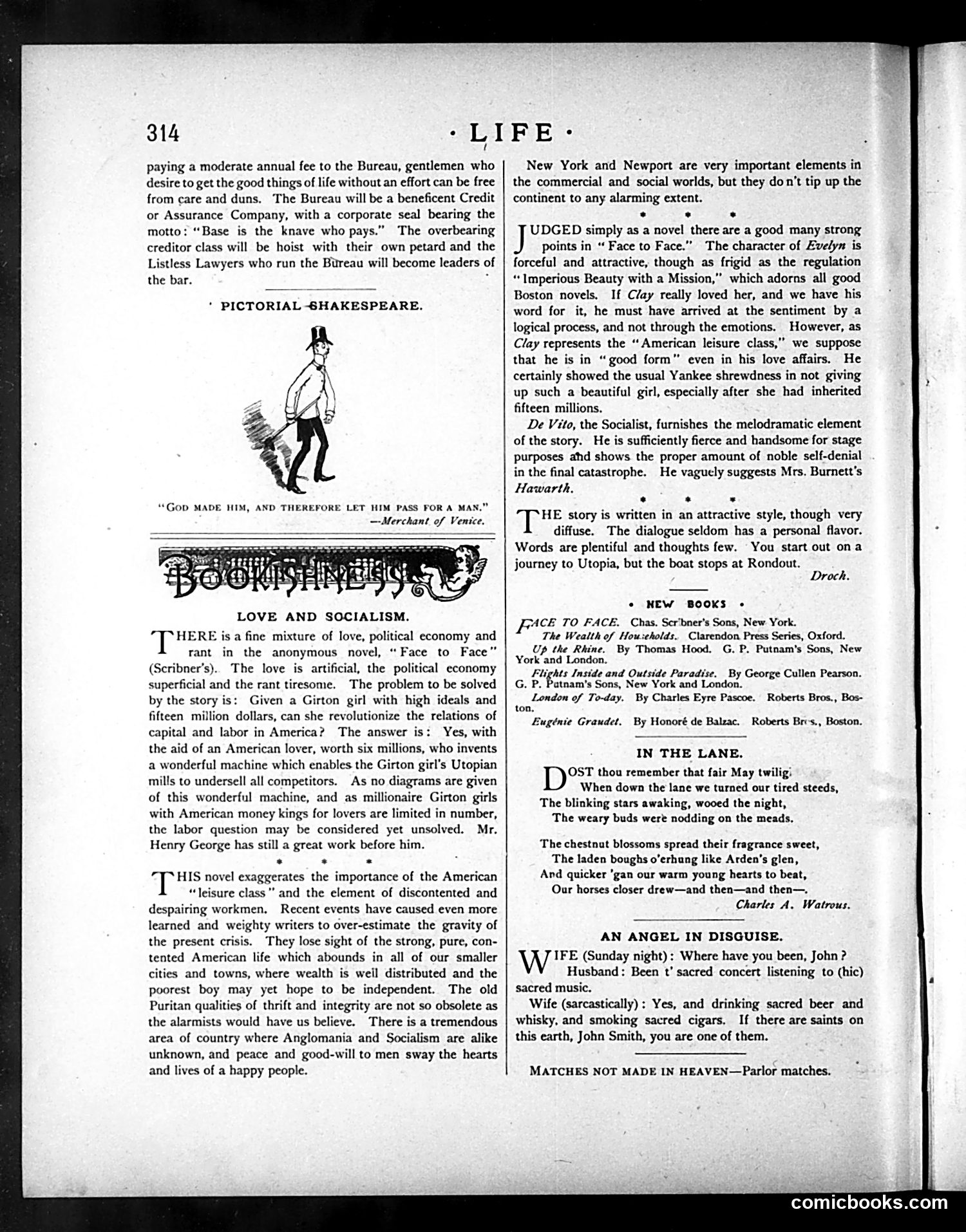
The page contains a section titled "Pictorial Shakespeare" featuring a small illustration of a man in formal dress with the caption "God made him, and therefore let him pass for a man" (from *Merchant of Venice*). The joke appears to be a visual pun or satirical commentary on a contemporary figure, though the specific identity is unclear from the image alone. Below this is a book review section discussing "Face to Face," a novel addressing American socialism and capitalism. The review critiques how the story portrays a Girton girl solving labor-capital relations through an invented machine—suggesting satire of idealistic but impractical socialist solutions. The page also includes poetry, new book listings, and a domestic humor piece titled "An Angel in Disguise" mocking marital relations.
📄 Transcribed text from this page (OCR, searchable)
Machine-transcribed from the original scan — historical spelling and the odd misread are preserved.
314 paying a moderate annual fee to the Bureau, gentlemen who desire to get the good things of life without an effort can be free from care and duns. The Bureau will be a beneficent Credit or Assurance Company, with a corporate seal bearing the motto: “Base is the knave who pays.” The overbearing creditor class will be hoist with their own petard and the Listless Lawyers who run the Bureau will become leaders of the bar. < * PICTORIAL SHAKESPEARE. e LET HIM PASS FOR A MAN,” —Merchant of Venice, LOVE AND SOCIALISM. HERE is a fine mixture of love, political economy and rant in the anonymous novel, “Face to Face” (Scribner’s). The love is artificial, the political economy superficial and the rant tiresome. The problem to be solved by the story is: Given a Girton girl with high ideals and fifteen million dollars, can she revolutionize the relations of capital and labor in America? The answer is: Yes, with the aid of an American lover, worth six millions, who invents a wonderful machine which enables the Girton girl’s Utopian mills to undersell all competitors. As no diagrams are given of this wonderful machine, and as millionaire Girton girls with American money kings for lovers are limited in number, the labor question may be considered yet unsolved. Mr. Henry George has still a great work before him. . . . HIS novel exaggerates the importance of the American “leisure class" and the element of discontented and despairing workmen. Recent events have caused even more learned and weighty writers to over-estimate the gravity of the present crisis. They lose sight of the strong, pure, con- tented American life which abounds in all of our smaller cities and towns, where wealth is weil distributed and the poorest boy may yet hope to be independent. The old Puritan qualities of thrift and integrity are not so obsolete as the alarmists would have us believe. There is a tremendous area of country where Anglomania and Socialism are alike unknown, and peace and good-will to men sway the hearts and lives of a happy people. -LIFE- New York and Newport are very important elements in the commercial and social worlds, but they don’t tip up the continent to any alarming extent. . . . UDGED simply as a novel there are a good many strong points in ‘ Face to Face.” The character of Evelyn is forceful and attractive, though as frigid as the regulation “Imperious Beauty with a Mission,” which adorns all good Boston novels, If C/ay really loved her, and we have his word for it, he must have arrived at the sentiment by a logical process, and not through the emotions. However, as Clay represents the “ American leisure class," we suppose that he is in “good form” even in his love affairs. He certainly showed the usual Yankee shrewdness in not giving up such a beautiful girl, especially after she had inherited fifteen millions. De Vito, the Socialist, furnishes the melodramatic element of the story. He is sufficiently fierce and handsome for stage purposes ahd shows the proper amount of noble self-denial in the final catastrophe. He vaguely suggests Mrs. Burnett's Hawarth. . . - HE story is written in an attractive style, though very diffuse. The dialogue seldom has a personal flavor. Words are plentiful and thoughts few. You start out ona journey to Utopia, but the boat stops at Rondout. Droch. * NEW BOOKS + Ace TO FACE, Chas. Scr'bner’s Sons, New York. The Wealth of Houeholds. Clarendon Press Series, Oxford. Up the Rhine. By Thomas Hood. G. P. Putnam's Sons, New York and London. Flights Inside and Outside Paradise. By George Cullen Pearson. G, P. Patnam's Sons, New York and London. London of To-day, By Charles Eyre Pascoe. Roberts Bros., Bos- ton, Eugénie Graudet, By Honoré de Balzac. Roberts Brvs., Boston. IN THE LANE. OST thou remember that fair May twiligi When down the lane we turned our tired steeds, The blinking stars awaking, wooed the night, The weary buds were nodding on the meads. The chestnut blossoms spread their fragrance sweet, The laden boughs o’erhung like Arden’s glen, And quicker 'gan our warm young hearts to beat, Our horses closer drew—and then—and then—. Charles A. Watrous. AN ANGEL IN DISGUISE. IFE (Sunday night): Where have you been, John ? Husband: Been t’ sacred concert listening to (hic) sacred music. Wife (sarcastically) : Yes, and drinking sacred beer and whisky, and smoking sacred cigars, If there are saints on this earth, John Smith, you are one of them. MATCHES NOT MADE IN HEAVEN—Parlor matches. comicbooks.com