
A complete issue · 16 pages · 1886
Life — May 13, 1886
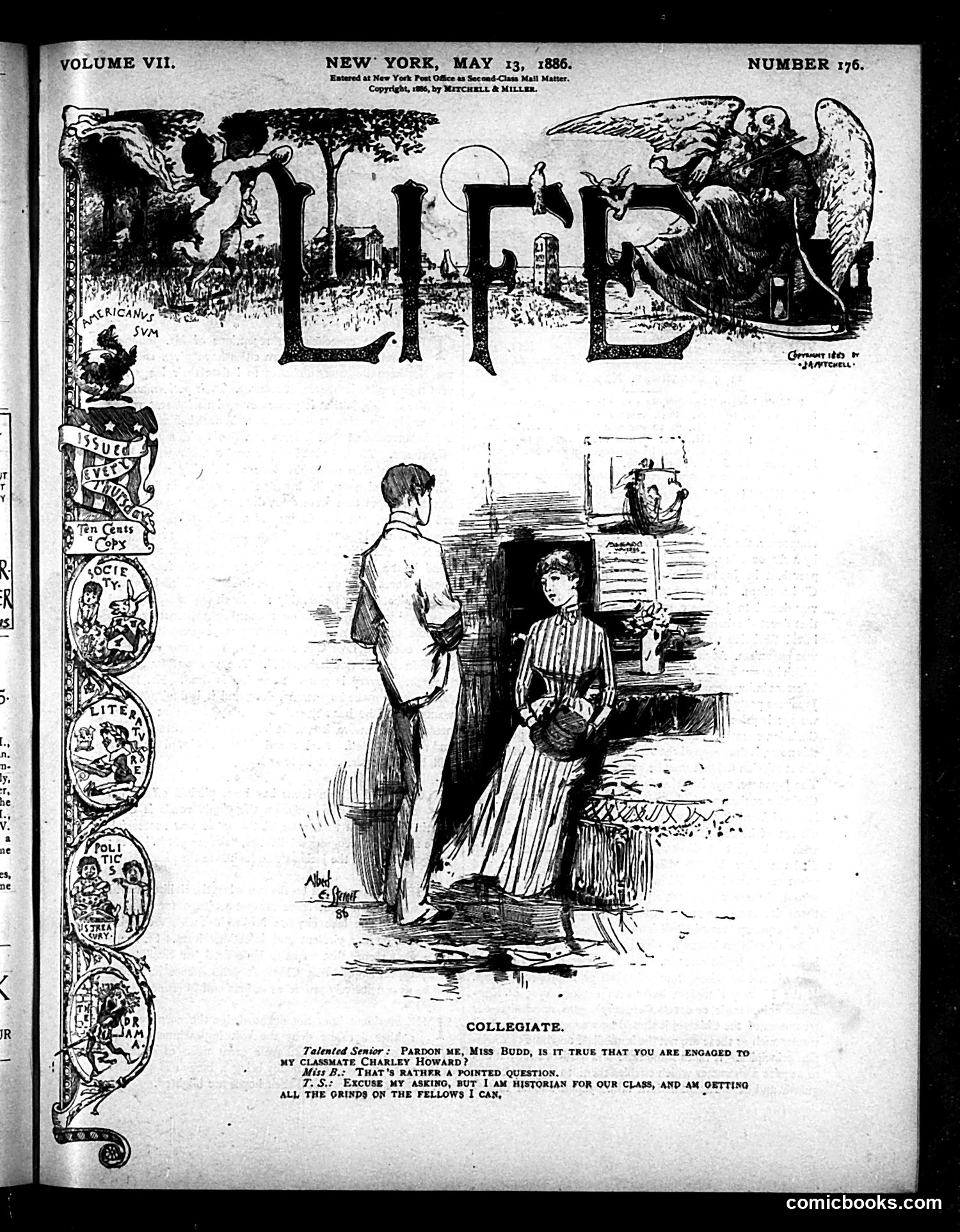
This cartoon satirizes college dating customs of the 1880s. The scene shows a young woman (Miss Budd) being confronted by a male student about her engagement to another classmate, Charlie Howard. The humor lies in the student's casual admission that he's asking not out of genuine concern, but to gather gossip about rivals and "get all the grinds on the fellows I can"—treating romantic entanglements as social fodder for campus gossip. The cartoon mocks the superficial social dynamics of collegiate life, where students treat engagement announcements as entertainment rather than sincere relationship matters. The pointed question reveals the self-interested, competitive nature of campus social hierarchies during this period.
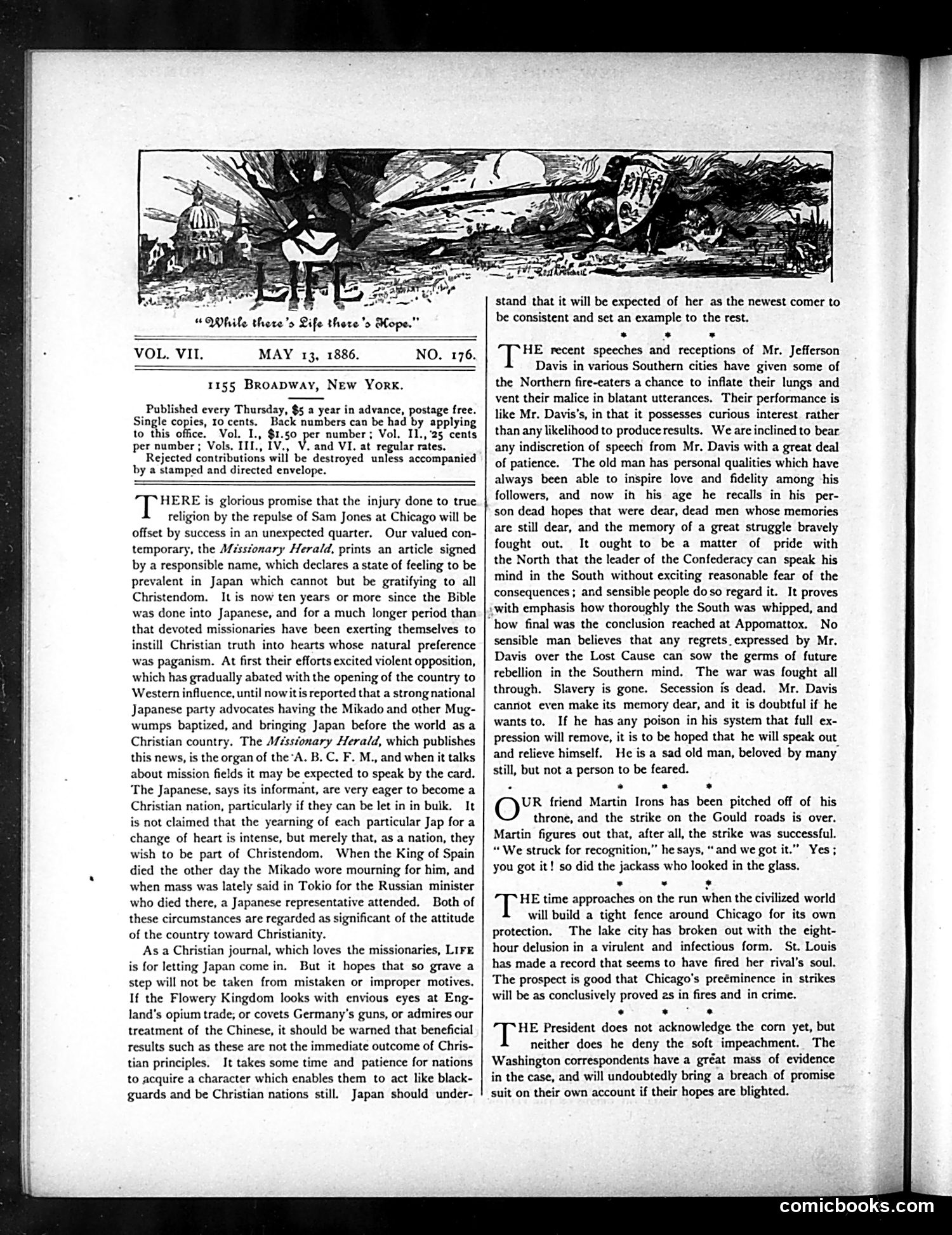
**The Cartoon:** The small engraving at top left depicts a classical scene with a dome structure (possibly St. Peter's Basilica) and the caption "While there's Life there's Hope." **The Editorial Content:** The main text discusses Japan's adoption of Christianity and the controversy around the Mikado's mourning practices. It references the "Missionary Herald" and debates whether Japan's Westernization represents genuine Christian conversion or merely superficial modernization. The piece also contains political commentary on Jefferson Davis's recent Southern speeches, criticizing his inflammatory rhetoric about the Civil War and the Lost Cause. The editor expresses hope Davis will "speak out and relieve himself" of his bitterness. Additional brief items mention Martin Irons (a labor figure in the Gould railroad strikes) and Chicago's crime problems. The overall tone is characteristic of Life's mix of religious commentary and partisan political critique.
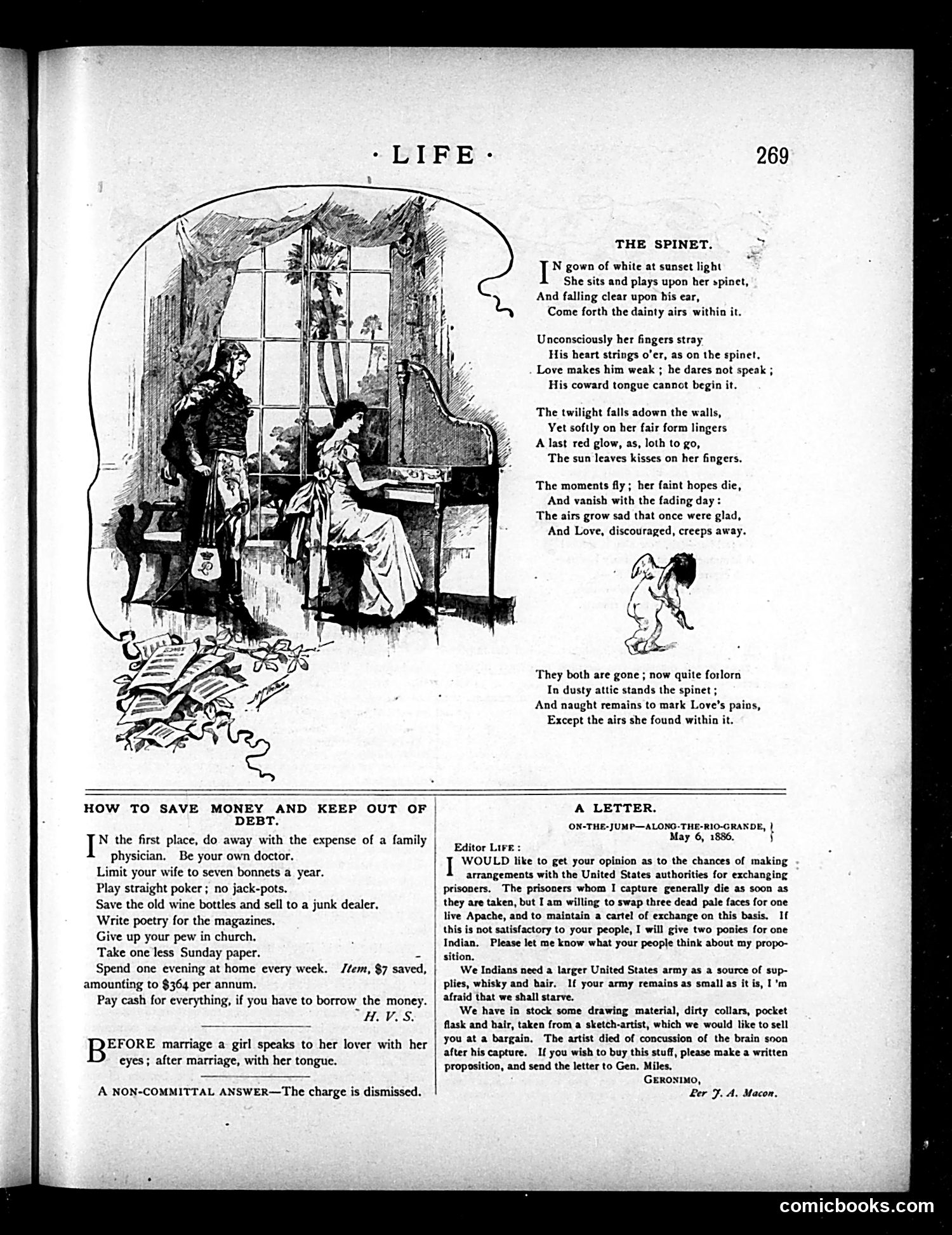
**The Main Poem: "The Spinet"** This romantic poem depicts a couple at sunset—a man and woman at a musical instrument (spinet/piano). The narrative describes their emotional distance: his heart "strings d'er" as on the spinet, he's too weak and cowardly to speak his feelings. Love ultimately "creeps away" as twilight falls. The poem is sentimental Victorian romance, exploring themes of unrequited affection and missed emotional connection. **Practical Advice Sections Below** The page includes humorous cost-saving tips ("How to Save Money and Keep Out of Debt") and a letter to the editor regarding prisoner exchanges with the United States and Native American concerns. These sections provide satire on domestic economy and contemporary policy debates, typical of Life's mixed editorial approach.
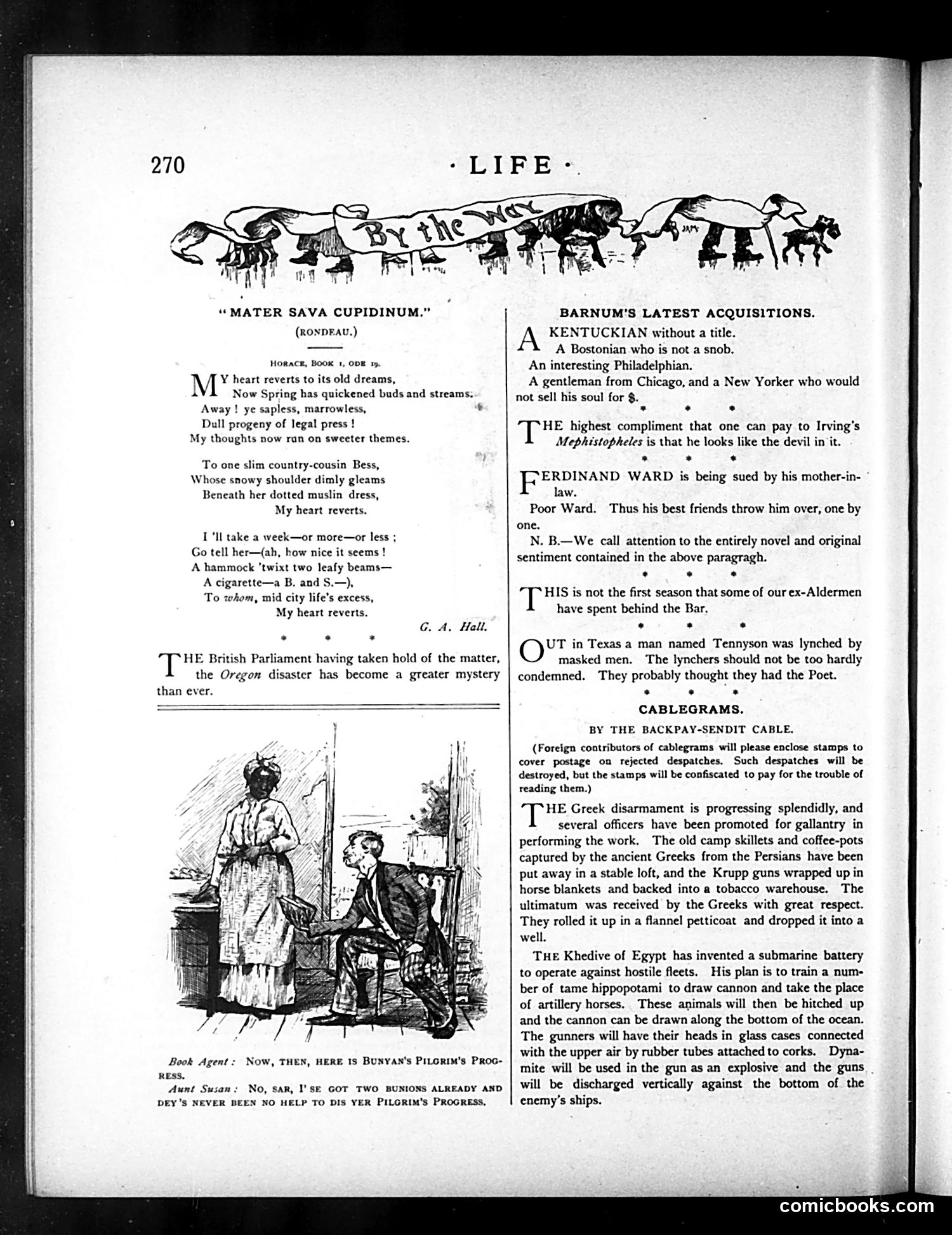
The page contains a poem titled "Mater Sava Cupidinum" by Horace, followed by satirical notes under "Barnum's Latest Acquisitions"—mockingly listing unusual people Barnum might display. The illustration shows a domestic scene with a woman standing and a seated man, captioned with dialogue about Bunyan's Pilgrim's Progress. The joke appears satirical about marriage or domestic life, suggesting wives impede their husbands' spiritual or personal progress—a common Victorian-era marital joke. The right column contains brief satirical items: criticism of Irving's *Mephistopheles*, Ferdinand Ward being sued by his mother-in-law, references to ex-aldermen frequenting bars, and a lynching in Texas. The "Cablegrams" section discusses Greek military innovations. Overall, the page mixes literary satire, domestic humor, and brief topical commentary typical of late 19th-century satirical magazines.
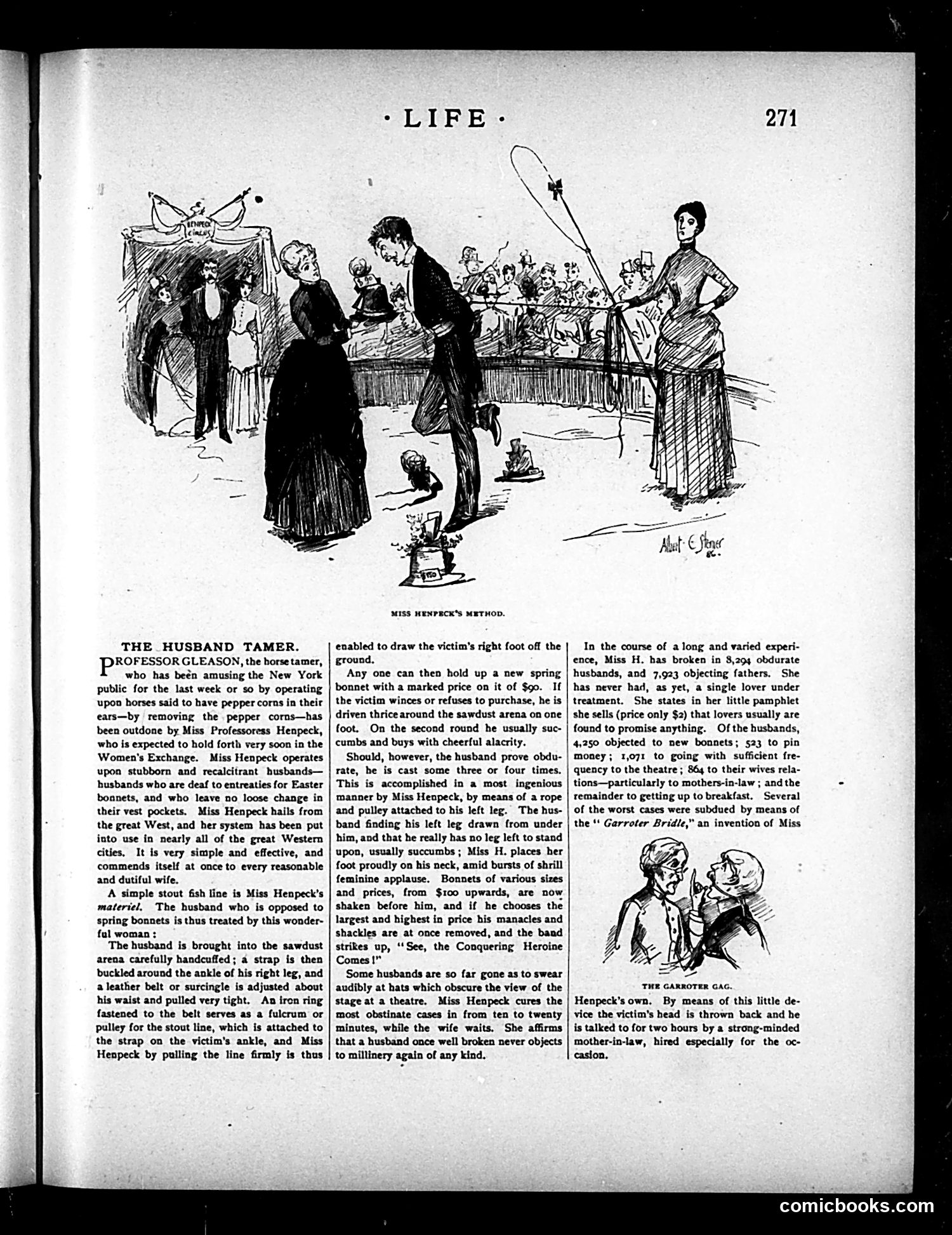
This page satirizes Miss Henpeck, a New York public performer who has apparently become famous for her act involving the mistreatment of horses. The article describes her "method" of breaking horses' spirits through humiliation and pain—forcing them into sawdust arenas, drawing their feet with marked prices, and using ropes and leather contraptions. The satire's point is clear: the text describes her horse-"taming" techniques with deliberately cruel detail, then notes that husbands subjected to similar methods supposedly become obedient. The two accompanying sketches ("The Carriages Gag") show this applied to human relationships, mocking both Miss Henpeck's brutish methods and, by extension, the broader notion of domineering wives controlling submissive husbands—a common satirical target in early 20th-century humor.
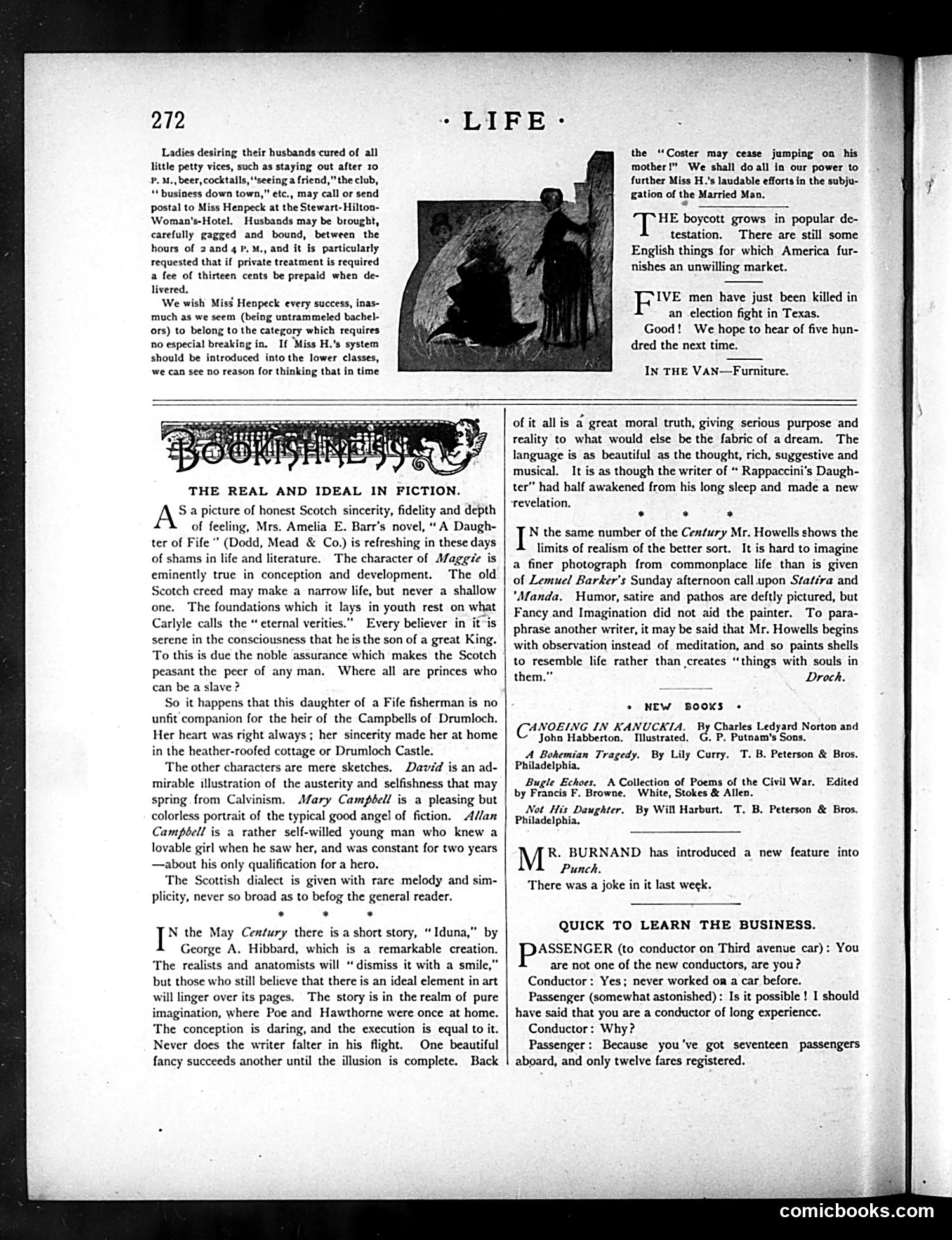
The page is primarily **literary criticism and book reviews** rather than political satire. The main content discusses fiction writing, particularly Scottish literature and character development in novels by authors like Amelia E. Barr. The only cartoon-like element is a **black and white illustration** accompanying the "Bookshelves" section, but it's unclear from the image quality what specific figures or scenes it depicts—it appears to show shadowed figures in an interior setting. The page includes brief **social commentary snippets** ("Five men killed in an election fight in Texas," "The boycott grows in popish destestation"), but these are standalone observations rather than developed satire, typical of Life's format mixing literary content with social notes.
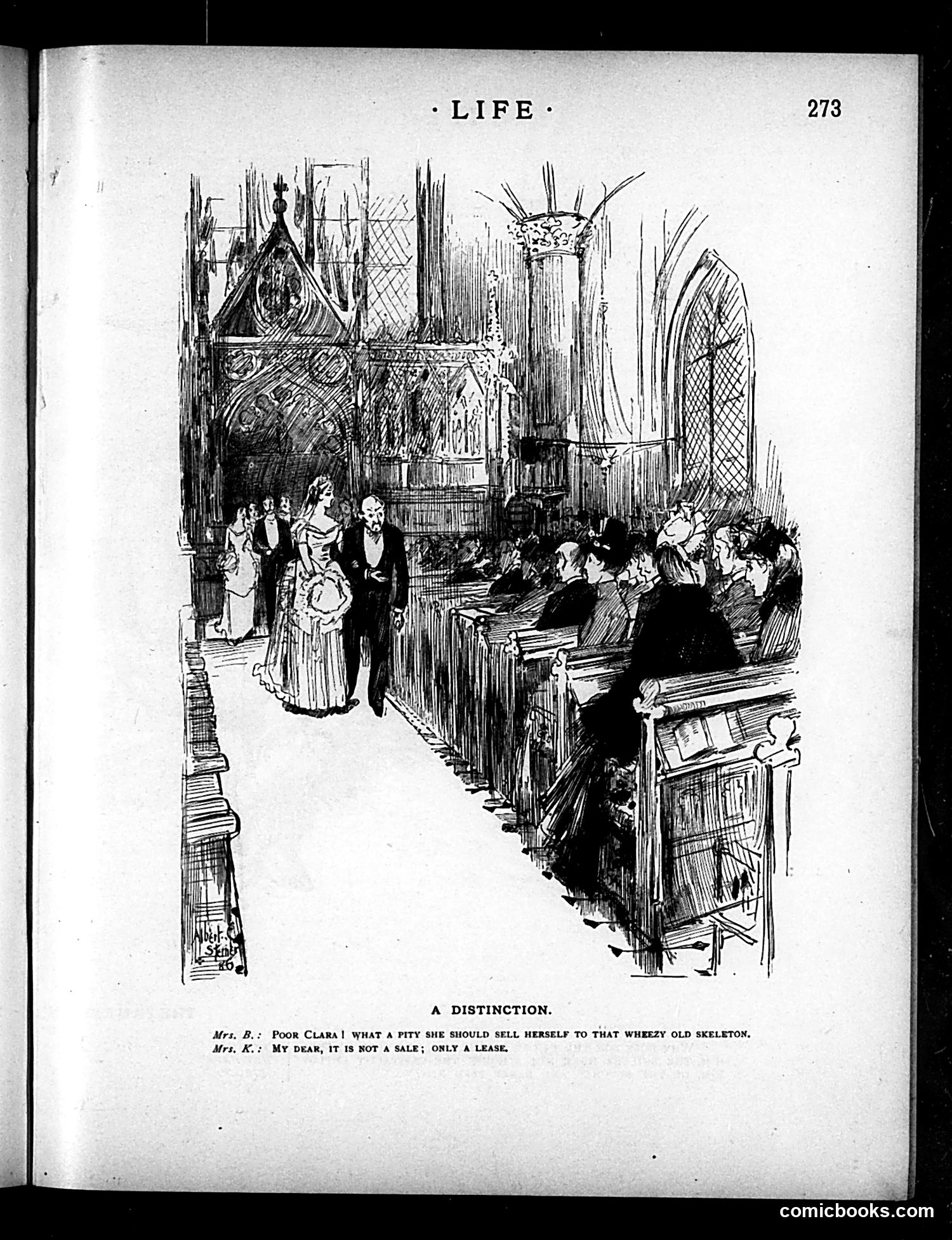
This cartoon depicts a church wedding scene where two women converse in the pews. The caption presents a joke about language and social propriety: **Mrs. B.** warns that poor Clara should not "sell herself to that wheezy old skeleton" (a disparaging reference to her prospective groom). **Mrs. A.** corrects her, insisting "it is not a sale; only a lease." The satire mocks the mercenary nature of marriage in high society, where women's unions were often financial transactions. The "lease" versus "sale" distinction is darkly humorous—both imply Clara has no genuine agency, only temporary or permanent ownership. The elderly groom's physical unattractiveness ("wheezy old skeleton") reinforces the critique that such marriages were purely economic arrangements rather than romantic partnerships, particularly disadvantaging women.
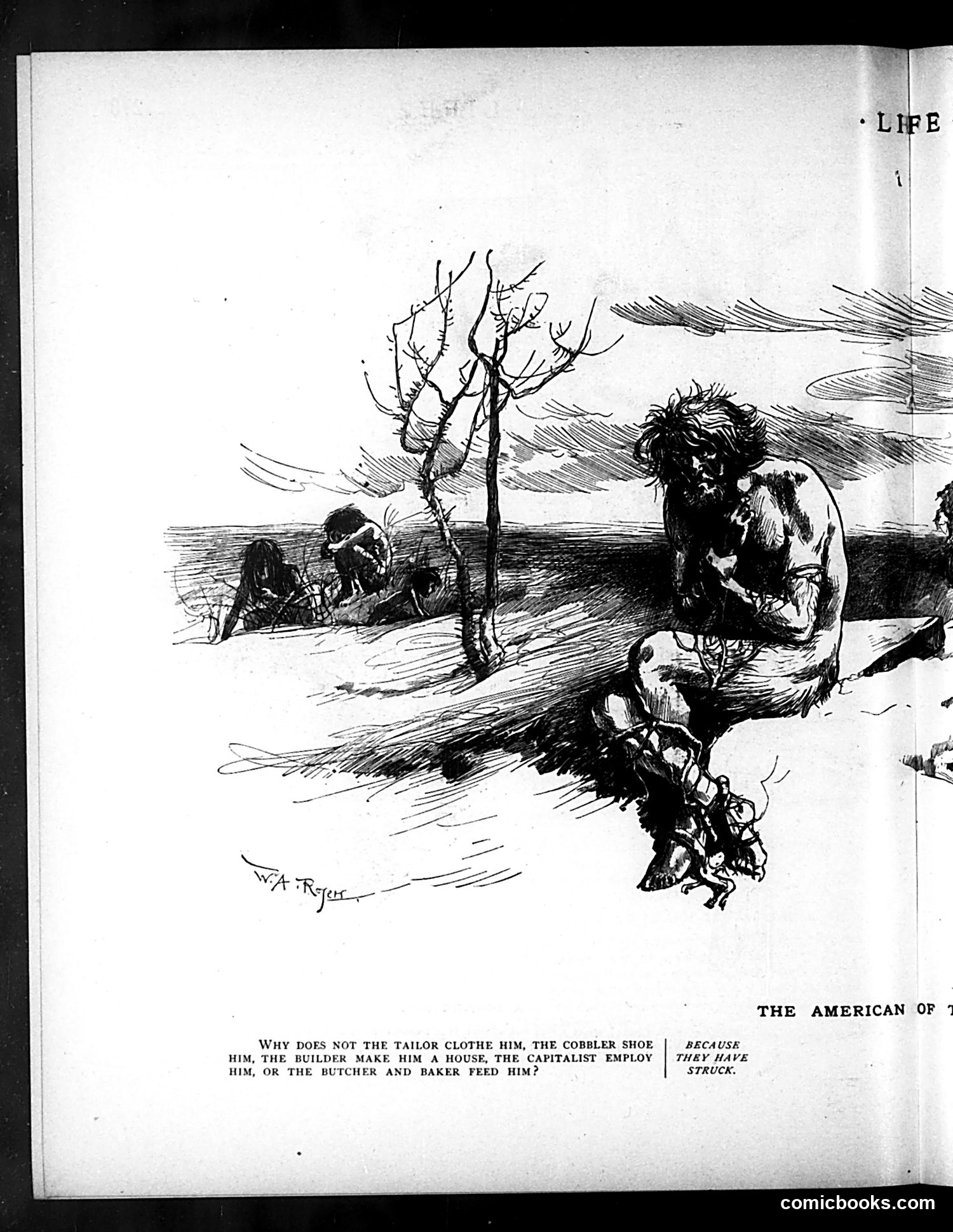
This is a political cartoon criticizing labor conditions and class inequality. The illustration depicts homeless or impoverished figures huddled around a bare, skeletal tree in a desolate landscape—a visual metaphor for poverty and deprivation. The text beneath poses a rhetorical question: "Why does not the tailor clothe him, the cobbler shoe him, the builder make him a house, the capitalist employ him, or the butcher and baker feed him?" The answer provided—"Because they have struck"—uses dark irony to suggest that these professions have collectively abandoned the poor person, or more likely, critiques the capitalist system for failing to provide basic necessities. The cartoon satirizes economic inequality and the inability (or unwillingness) of society's productive members to ensure the poor's survival.
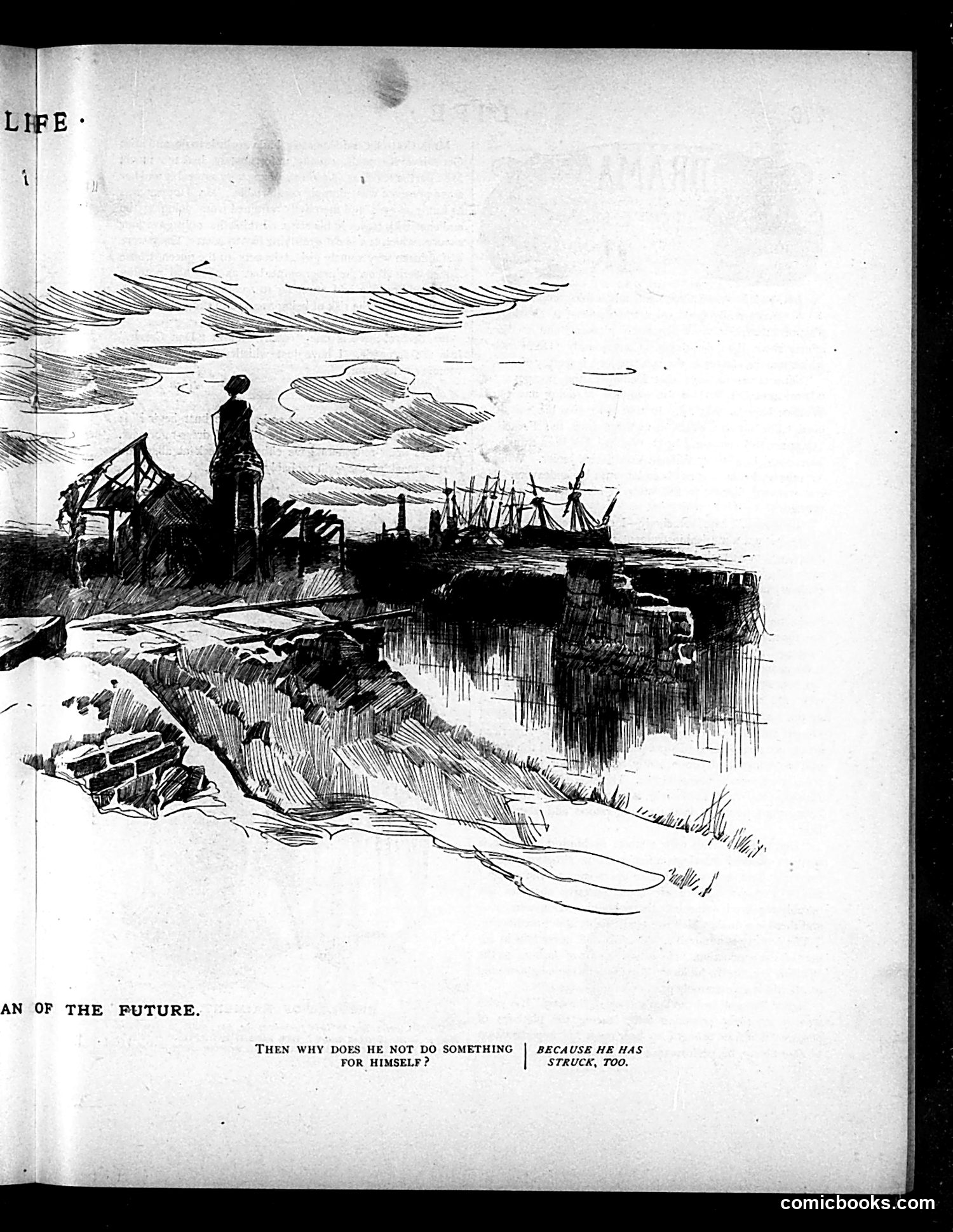
This page depicts a desolate industrial landscape with a solitary figure standing elevated, overlooking abandoned structures, boats, and barren ground. The caption reads: "THEN WHY DOES HE NOT DO SOMETHING FOR HIMSELF?" with the response "BECAUSE HE HAS STRUCK, TOO." This is social commentary on labor strikes and unemployment, likely from the early 20th century. The figure appears to represent an unemployed or striking worker, while the destroyed industrial setting suggests economic collapse or industrial shutdown caused by labor action. The satirical point critiques the paradox of striking workers harming their own prospects—by striking, they've made themselves unable to work "for themselves." The illustration condemns both labor unrest and worker idleness as mutually destructive forces.
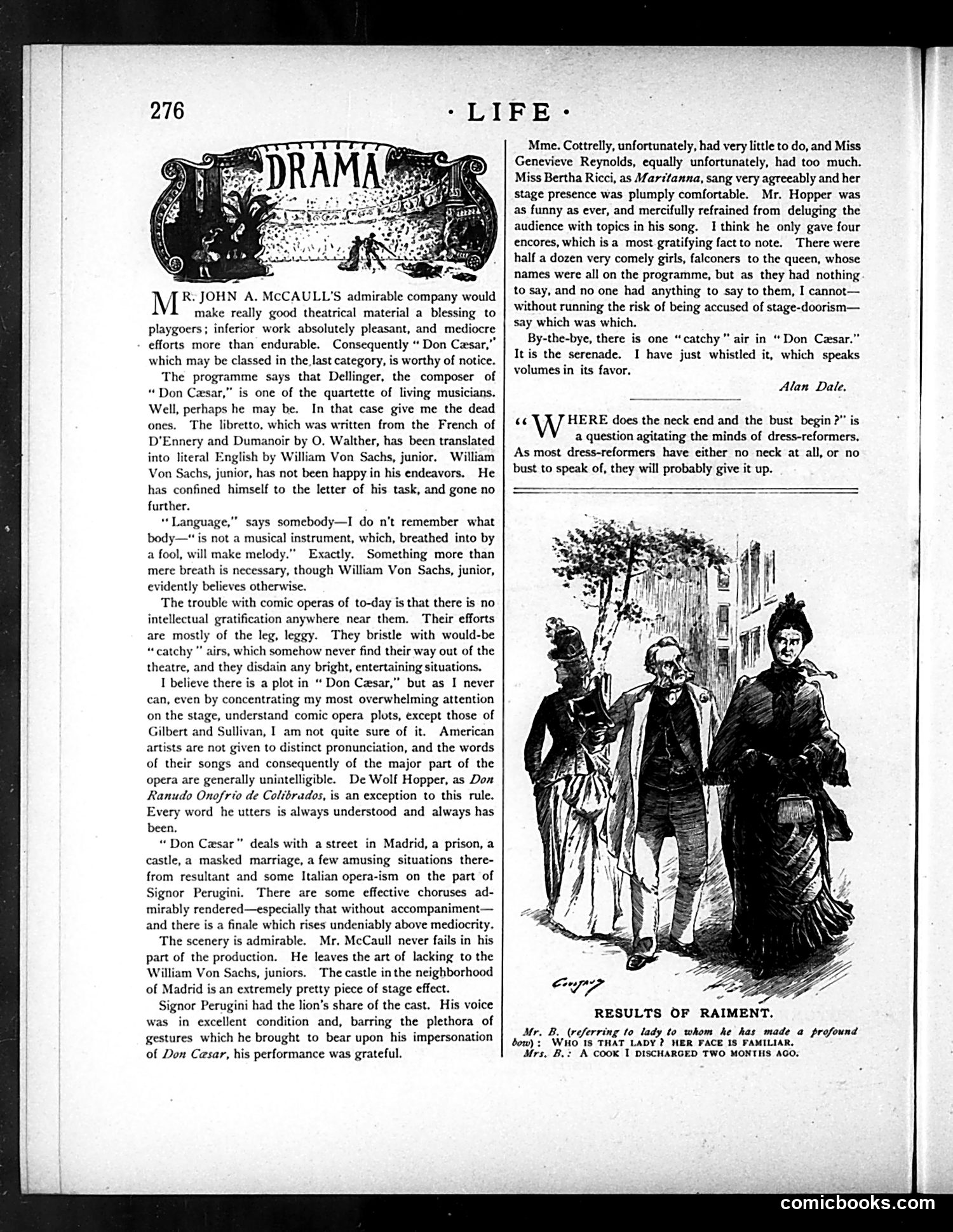
This is a theater review by critic Alan Dale critiquing John A. McCaull's production of the comic opera "Don Cesar." The accompanying illustration shows three figures in period dress on a Madrid street—the opera's setting. Dale's satire targets the mediocrity of contemporary American comic opera. He mocks composer Dellinger as barely worthy of mention, ridicules translator William Von Sachs Jr. for wooden literalism ("language is not a musical instrument...breathed into by a fool"), and criticizes comic operas generally for lacking intellectual content while relying on "catchy airs" and leggy chorus girls. De Wolf Hopper receives praise for clear enunciation—a backhanded compliment suggesting other American performers mumble unintelligibly. The review finds the plot incomprehensible, the scenery admirable, and most performances adequate but unmemorable, with only one genuinely catchy tune—the serenade—worth whistling about.
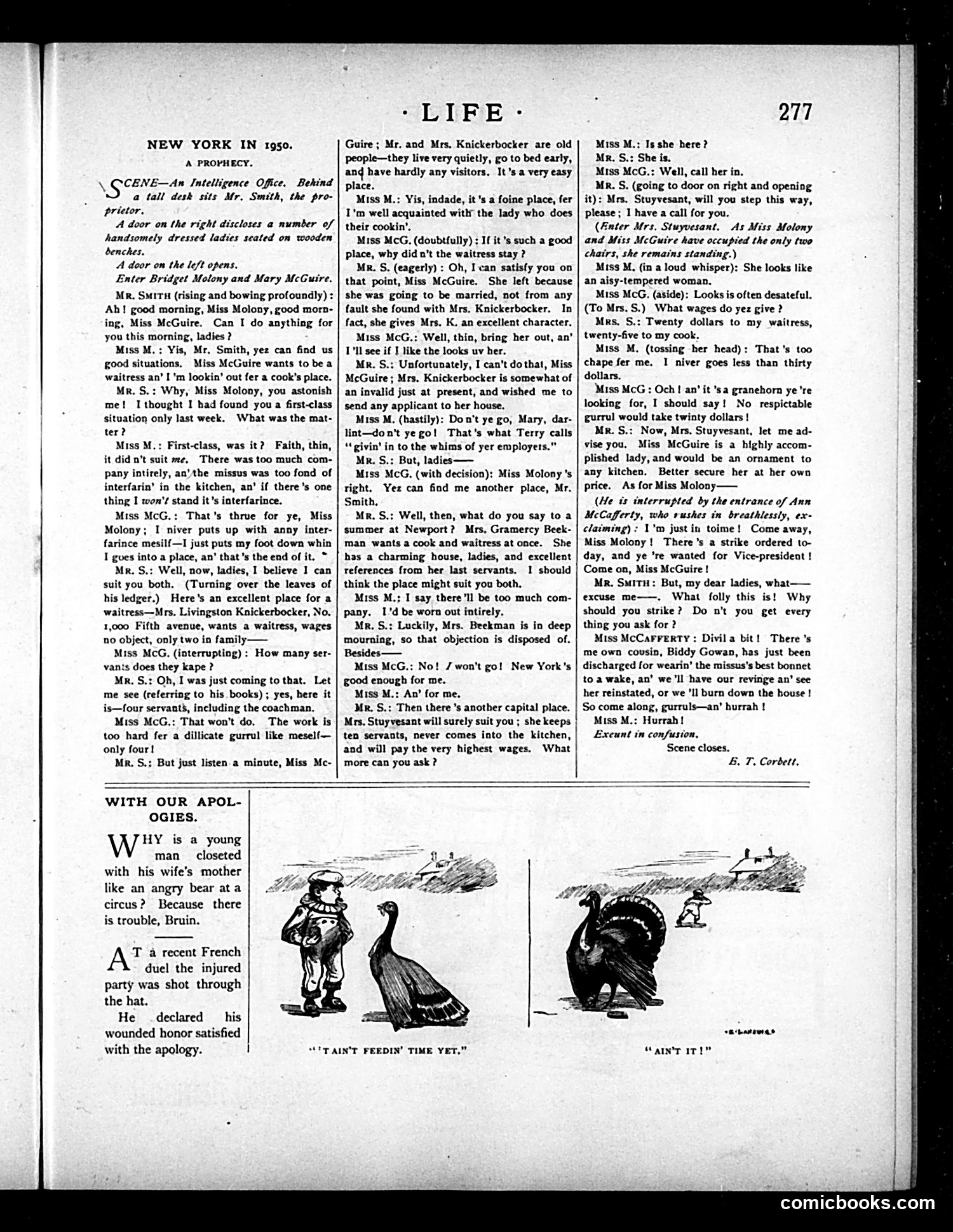
This satirical scene mocks Irish immigrant domestic servants' expectations and demands. Two Irish women—Bridget Molony and Mary McGuire—visit an employment agency seeking household positions, but reject every suitable offer. Their complaints reveal the satire's target: they object to "company" (too many household members), employers' "interference" in the kitchen, and working conditions they deem insufficiently luxurious. Each objection is absurd—they reject a position with wealthy Knickerbockers because the family is *too quiet*, and refuse Newport because Mrs. Beekman's mourning period means insufficient social activity. The joke critiques servants who've become unreasonably demanding, expecting employers to cater to them rather than vice versa. The title "A Prophecy" suggests the author sarcastically imagines a future where immigrant workers hold all the bargaining power—a anxiety-driven comic inversion of actual 1850 class hierarchies.
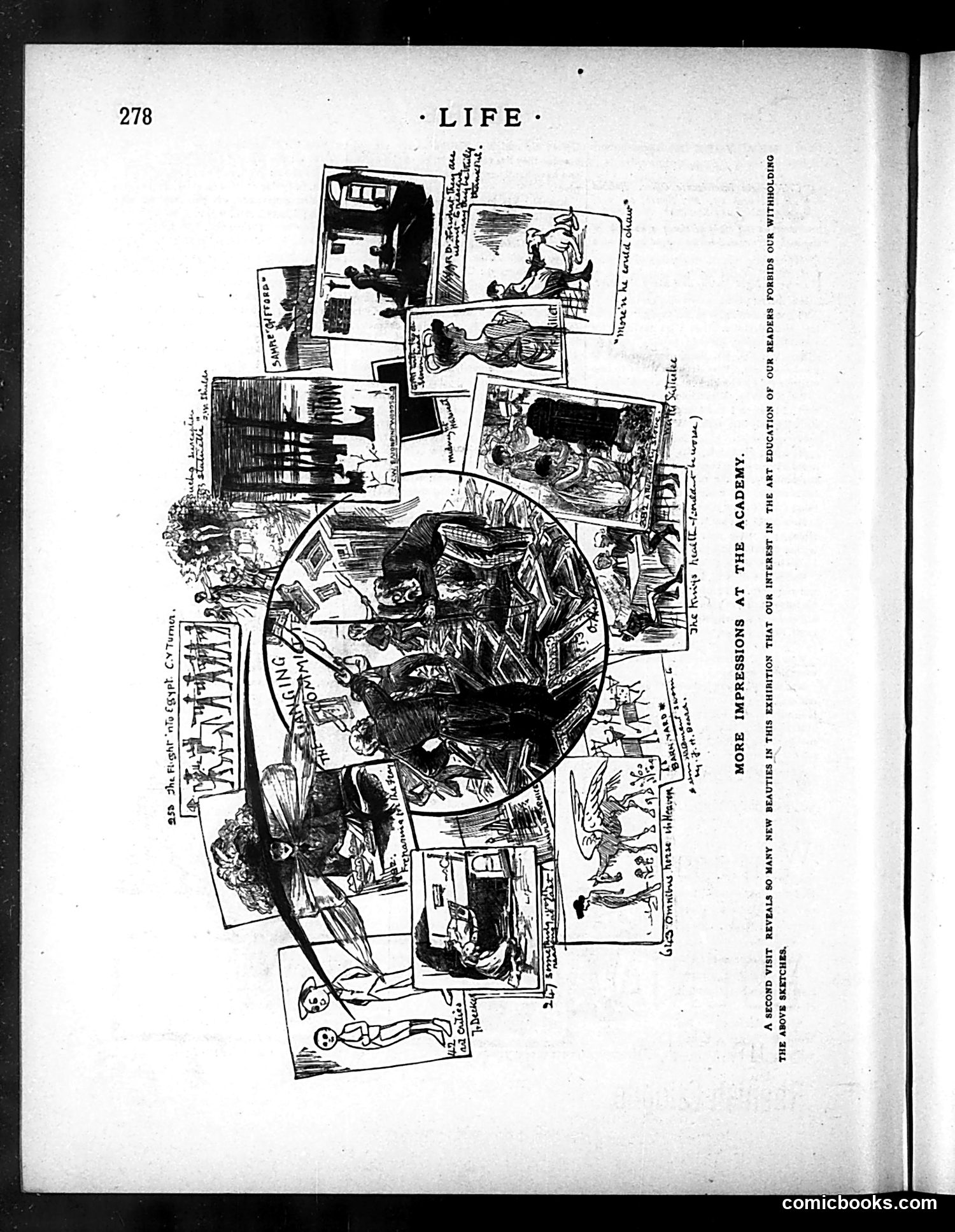
I cannot reliably read the OCR'd text (it appears garbled or reversed), and while the image shows a collage of multiple cartoon panels arranged around a central figure, the image quality and rotation make it difficult to identify specific individuals or political references with confidence. What I can see: This appears to be a composite political cartoon from Life magazine featuring numerous small scenes arranged around a central caricatured head. The style suggests early-to-mid 20th century American satire. The caption mentions "impressions at the Academy," suggesting this may relate to an art exhibition or cultural event. Without clearer text or image orientation, I cannot accurately identify the specific figures, the precise political/social commentary, or the satirical point being made. To properly explain this to a modern reader would require either clearer source material or additional historical context.
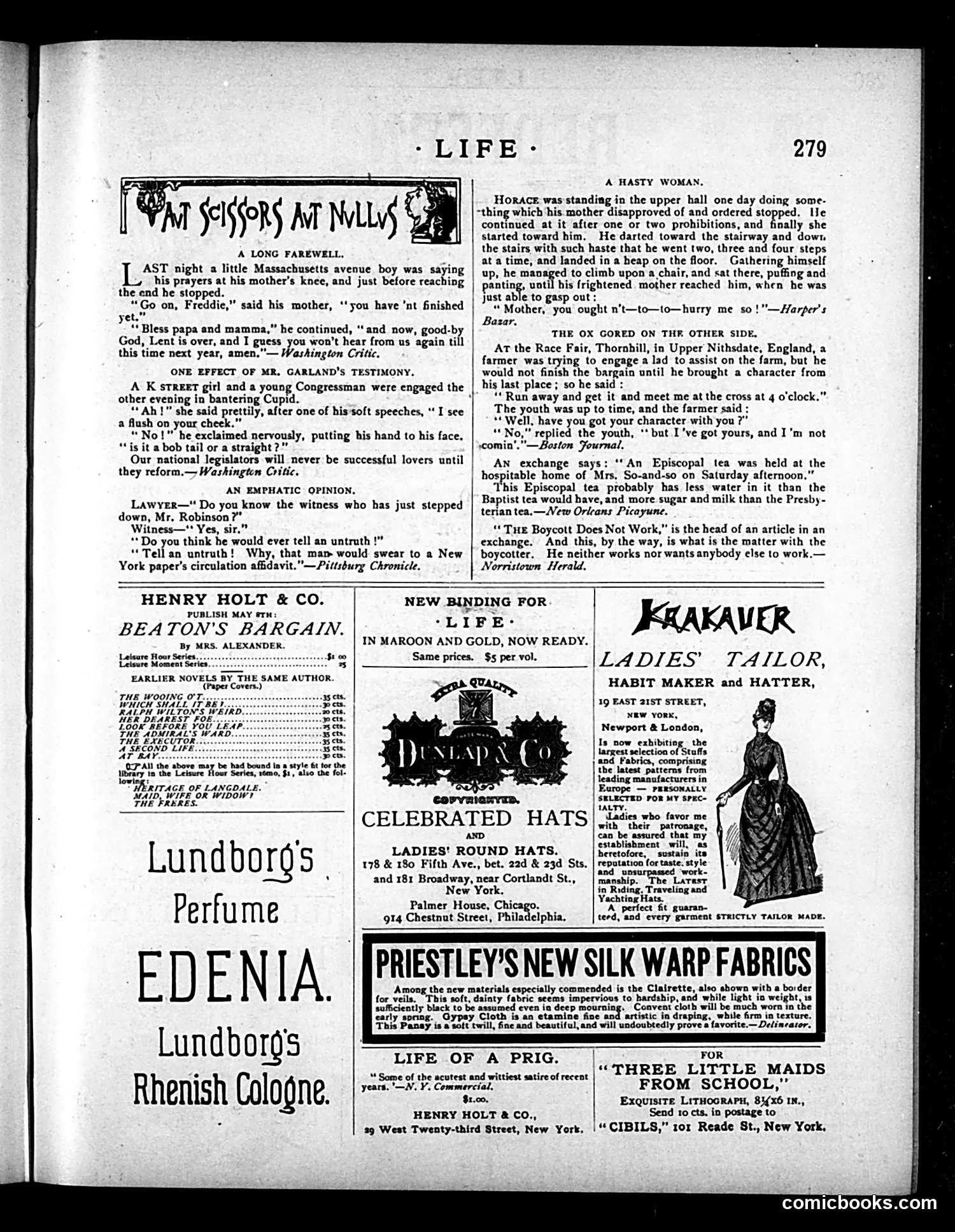
This page is primarily **advertising with embedded humor pieces** rather than political cartoons. The satirical content includes: **"A Long Farewell"**: A child's prayer joke mocking the Lenten season—the boy asks God not to expect prayers until next year when Lent returns, suggesting families neglect religious observance outside this period. **"One Effect of Mr. Garland's Testimony"**: References testimony (likely by politician James Garland, though unclear which incident) that apparently caused embarrassment or scandal, humorously suggesting congressmen are poor lovers because they're nervous about exposure. **"An Emphatic Opinion"**: A lawyer joke where a witness claims another man would sooner swear to a *New York newspaper's circulation figures* (notoriously inflated for advertising purposes) than tell an untruth—mocking both newspaper dishonesty and the absurdity of exaggerated claims. **"The Boycott Does Not Work"**: Social commentary on labor boycotts, claiming boycotters neither work themselves nor allow others to work. The remainder is **advertisements** for books, perfume, hats, and tailoring services typical of 1880s-90s Life magazine.
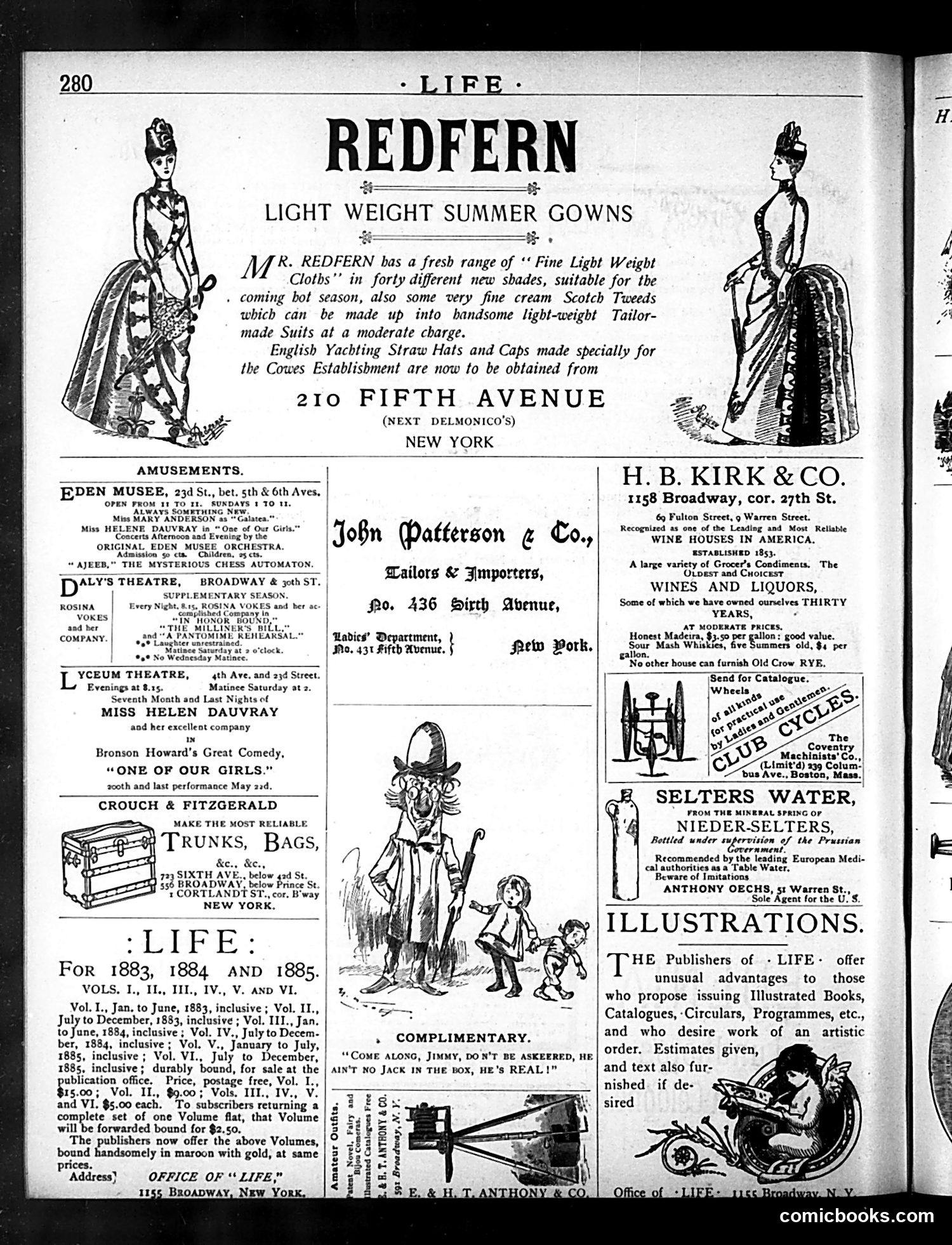
This page is primarily **advertising and business notices** rather than satirical content. The dominant feature is a Redfern fashion advertisement for lightweight summer gowns at their Fifth Avenue location in New York. The only cartoon appears mid-page: a sketch captioned "Come along, Jimmy, don't be askeered, he ain't no Jack in the box, he's real!" It depicts an adult figure with children, likely illustrating a colloquial reassurance—the phrase suggests convincing someone (Jimmy) not to be frightened because something is genuine, not a trick. The "Jack in the box" reference evokes the toy's surprise-spring mechanism, implying Jimmy fears a deception or sudden shock. The remainder consists of typical late-19th-century New York business listings: theaters (Eden Musee, Daly's, Lyceum), trunk manufacturers, tailors, wine merchants, and bicycle companies. It represents the magazine's mixed advertising-editorial format common to 1880s publications.
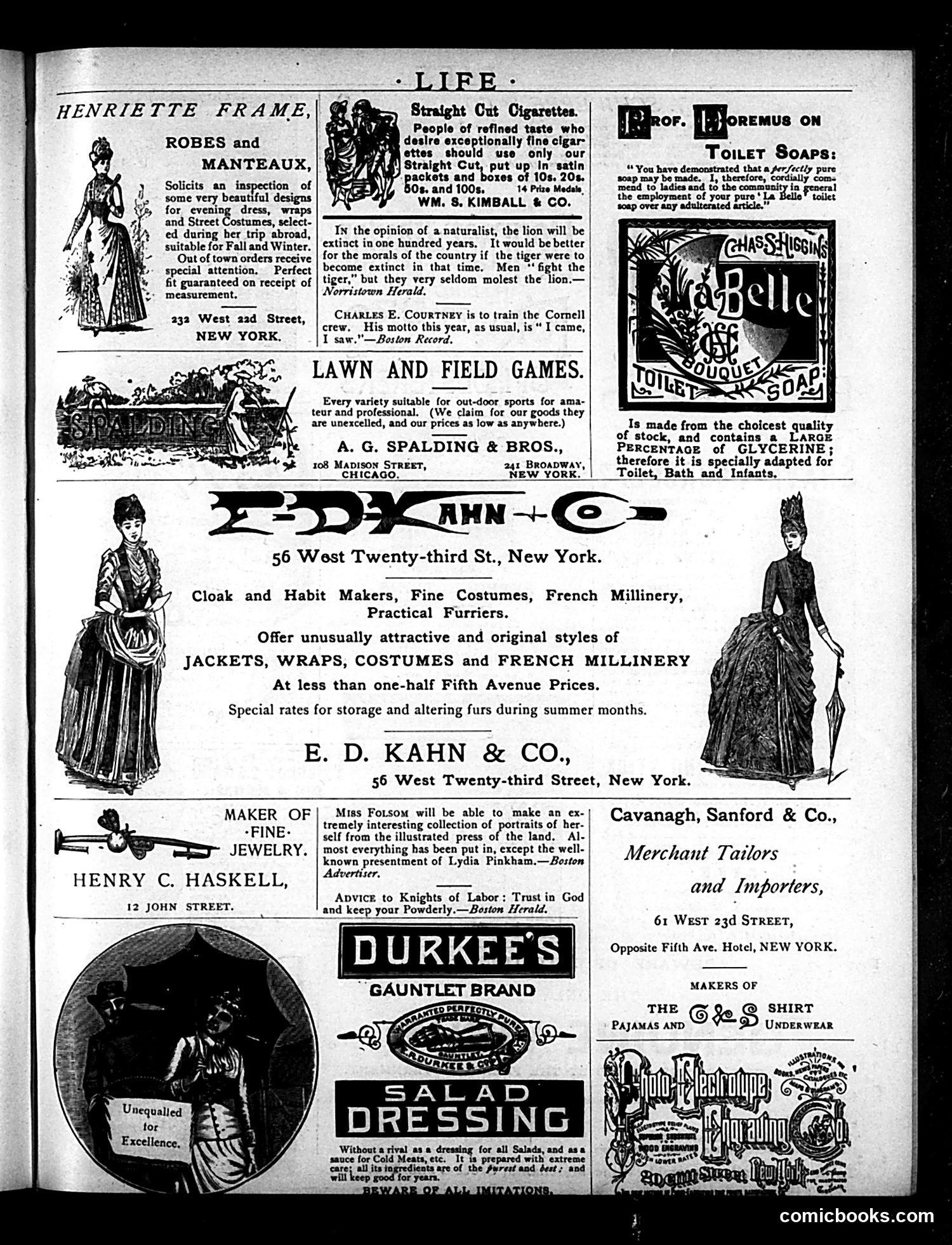
This is primarily an **advertising page** from the satirical magazine *Life*, with minimal editorial content. The page showcases late 19th-century New York businesses: women's clothing (Henriette Frame, E.D. Kahn & Co.), sporting goods (A.G. Spalding), tailoring (Cavanagh, Sanford & Co.), toiletries (La Belle soap), cigarettes, and jewelry. The only satirical content appears in brief quoted quips: - A naturalist's observation that lions will extinction in 100 years, but tigers should disappear "for the morals of the country"—likely mocking men who romanticize dangerous pursuits while ignoring moral decay - A joke about Miss Folsom's newspaper portraits, omitting Lydia Pinkham (a patent medicine advertiser), suggesting satire of over-commercialized media - A pun on "Powderly" (likely Terence Powderly, Knights of Labor leader): "keep your Powderly" = keep your powder dry The page reflects *Life's* role as both satirical publication and advertising medium for affluent urban consumers.
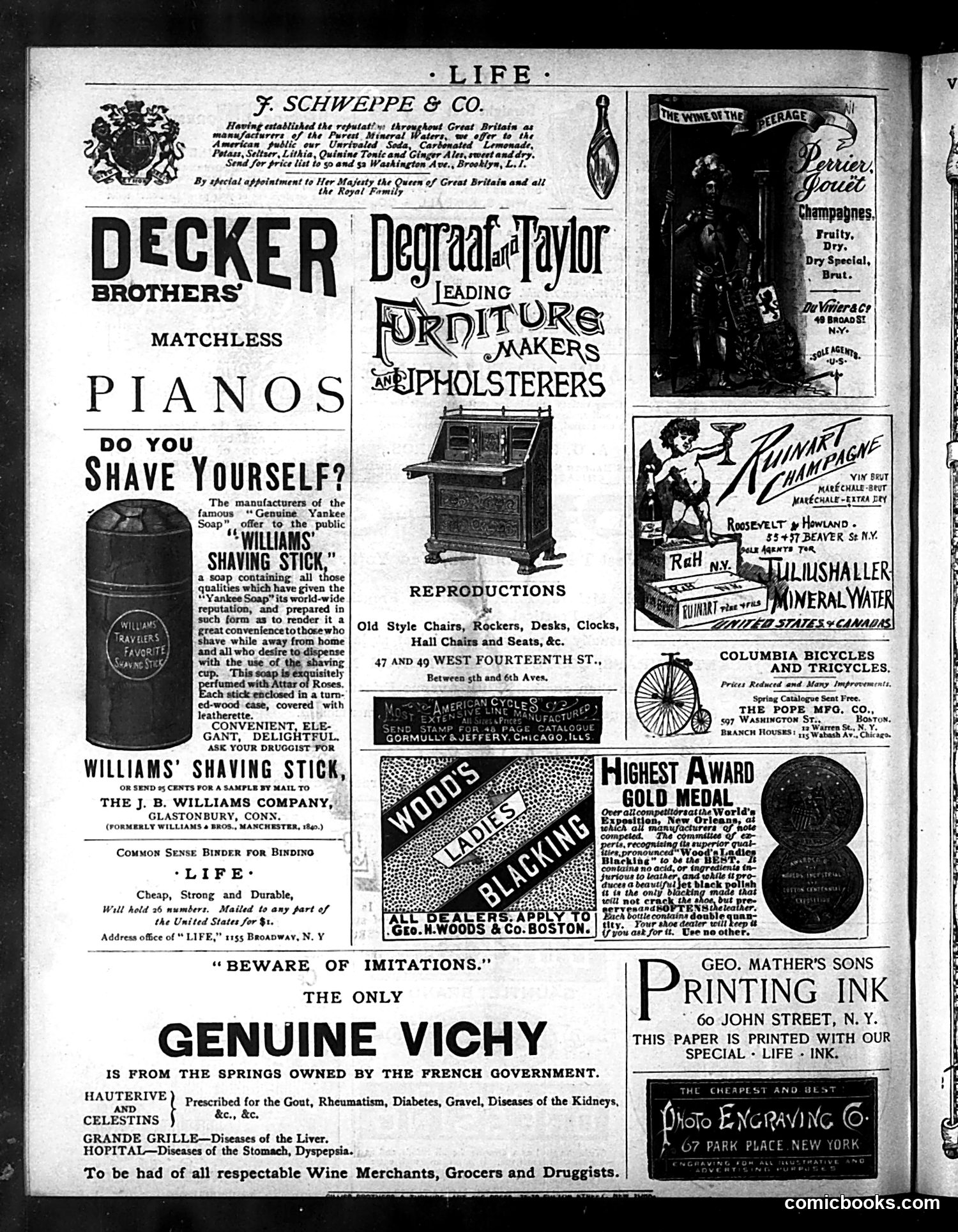
This is primarily an **advertising page** with no editorial cartoons or political satire. It showcases late-19th-century consumer products aimed at middle and upper-class American readers. Key advertisements include: - **Schweppe & Co.**: Mineral waters and carbonated beverages, emphasizing British prestige ("by special appointment to Her Majesty the Queen") - **Decker Brothers pianos**: Marketed as "matchless" - **Williams' Shaving Stick**: Portable soap for traveling gentlemen - **Vichy water**: French mineral water with medicinal claims for gout, rheumatism, and kidney disease - **Columbia Bicycles**: Newly popular transportation - **Various luxury goods**: Furniture reproductions, printing services The page reflects **Gilded Age consumer culture**—products stress European origins, medical benefits, and convenience for affluent Americans. The repeated "beware of imitations" warning (Vichy) reflects period concerns about product authenticity and counterfeiting. No satire or political commentary is present; this is straightforward period advertising.