
Life, 1886-05-13 · page 6 of 16
Life — May 13, 1886 — page 6: what you’re looking at
What you’re looking at
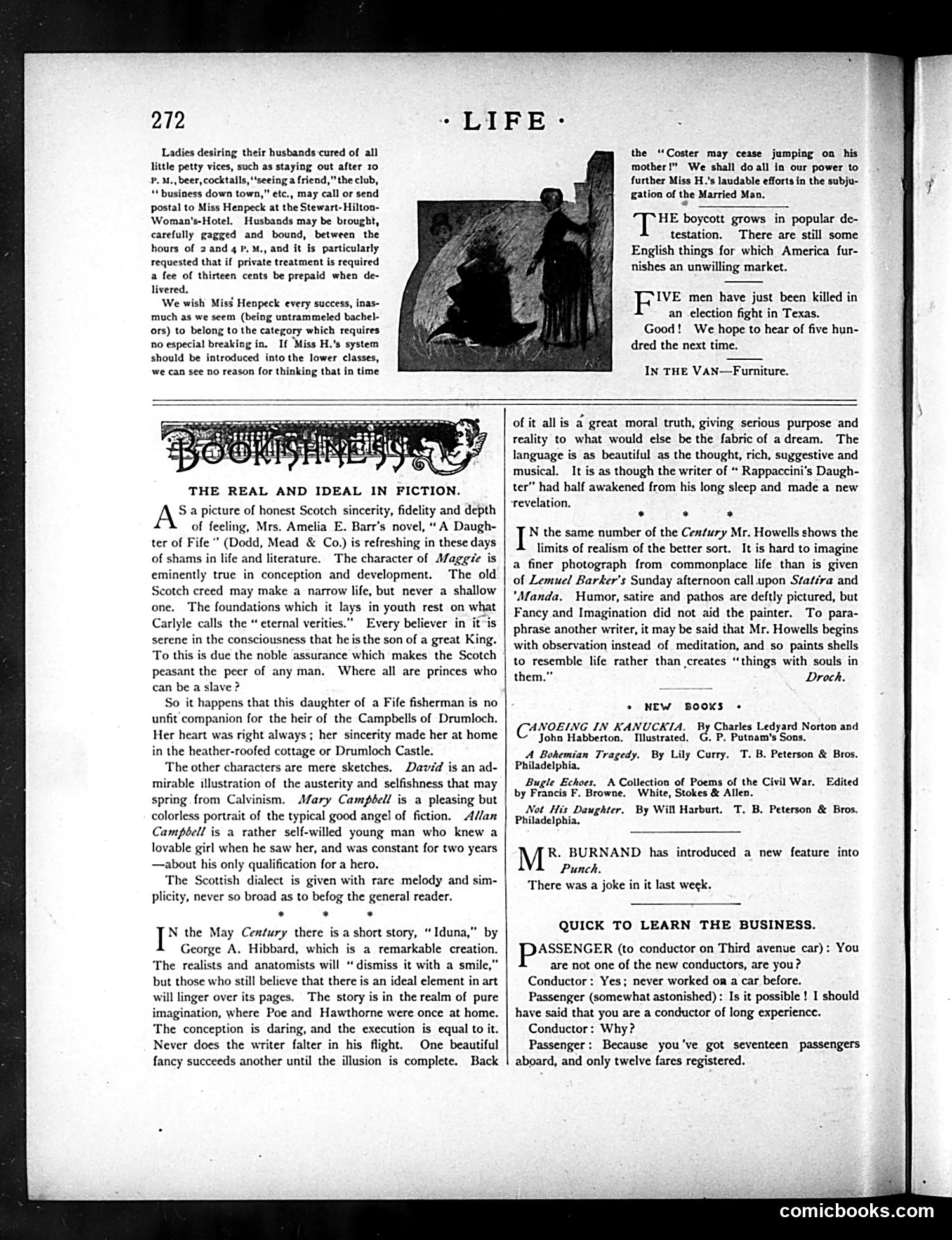
The page is primarily **literary criticism and book reviews** rather than political satire. The main content discusses fiction writing, particularly Scottish literature and character development in novels by authors like Amelia E. Barr. The only cartoon-like element is a **black and white illustration** accompanying the "Bookshelves" section, but it's unclear from the image quality what specific figures or scenes it depicts—it appears to show shadowed figures in an interior setting. The page includes brief **social commentary snippets** ("Five men killed in an election fight in Texas," "The boycott grows in popish destestation"), but these are standalone observations rather than developed satire, typical of Life's format mixing literary content with social notes.
📄 Transcribed text from this page (OCR, searchable)
Machine-transcribed from the original scan — historical spelling and the odd misread are preserved.
272 Ladies desiring their husbands-cured of all little petty vices, such as staying out after 10 P. M., beer, cocktails, ‘seeing a friend," the club, “business down town,” etc., may call or send postal to Miss Henpeck at the Stewart-Hilton- Woman’s-Hotel. Husbands may be brought, carefully gagged and bound, between the hours of 2 and 4 P.M., and ft is particularly requested that if private treatment is required a fee of thirteen cents be prepaid when de- livered. We wish Miss Henpeck every success, inas- much as we seem (being untrammeled bachel- ors) to belong to the category which requires no especial breaking in. If Miss H.'s system should be introduced into the lower classes, we can see no reason for thinking that in time the ‘Coster may cease jumping on his mother!” We shall do all in our power to further Miss H.'s laudable efforts in the subju- gation of the Married Man. HE boycott grows in popular de- testation. There are still some English things for which America fur- nishes an unwilling market. IVE men have just been killed in an election fight in Texas. Good! We hope to hear of five hun- dred the next time. In THE VAN—Furniture. THE REAL AND IDEAL IN FICTION. a picture of honest Scotch sincerity, fidelity and depth of feeling, Mrs. Amelia E. Bart's novel, “A Daugh- ter of Fife’ (Dodd, Mead & Co.) is refreshing in these days of shams in life and literature. The character of Maggie is eminently true in conception and development. The old Scotch creed may make a narrow life, but never a shallow one. The foundations which it lays in youth rest on what Carlyle calls the “ eternal verities.” Every believer in it is serene in the consciousness that he is the son of a great King. To this is due the noble assurance which makes the Scotch peasant the peer of any man, Where all are princes who can be a slave ? So it happens that this daughter of a Fife fisherman is no unfit companion for the heir of the Campbells of Drumloch. Her heart was right always ; her sincerity made her at home in the heather-roofed cottage or Drumloch Castle. The other characters are mere sketches, David is an ad- mirable illustration of the austerity and selfishness that may spring from Calvinism. Mary Campbell is a pleasing but colorless portrait of the typical good angel of fiction. A//an Campbell is a rather self-willed young man who knew a lovable girl when he saw her, and was constant for two years —about his only qualification for a hero. The Scottish dialect is given with rare melody and sim- plicity, never so broad as to befog the general reader. . . . N the May Century there is a short story, “Iduna,” by George A. Hibbard, which is a remarkable creatior The realists and anatomists will ‘dismiss it with a smile, but those who still believe that there is an ideal element in art will linger over its pages. The story is in the realm of pure imagination, where Poe and Hawthorne were once at home. The conception is daring, and the execution is equal to it. Never does the writer falter in his flight. One beautiful fancy succeeds another until the illusion is complete. Back of it all is a great moral truth, giving serious purpose and reality to what would else be the fabric of adream. The language is as beautiful as the thought, rich, suggestive and musical. It is as though the writer of “ Rappaccini’s Daugh- ter” had half awakened from his long sleep and made a new revelation. . . * N the same number of the Century Mr. Howells shows the limits of realism of the better sort. It is hard to imagine a finer photograph from commonplace life than is given of Lemuel Barker's Sunday afternoon call.upon Statira and ‘Manda. Humor, satire and pathos are deftly pictured, but Fancy and Imagination did not aid the painter. To para- phrase another writer, it may be said that Mr. Howells begins with observation instead of meditation, and so paints shells to resemble life rather than creates “things with souls in them.” Droch. * NEW BOOKS «+ CANOEING IN KANUCKIA. By Charles Ledyard Norton and John Habberton. Illustrated. . P, Putnam's Sons. A Bohemian Tragedy. By Lily Curry. T. B. Peterson & Bros. Philadelphia, Bugle Echoes. by Francis F. Browne. Not His Daughter. Philadelphia. A Collection of Poems of the Civil War. White, Stokes & Allen. By Will Harburt. T, B. Peterson & Bros. Edited R. BURNAND has introduced a new feature into Punch. There was a joke in it last we¢k. QUICK TO LEARN THE BUSINESS. ASSENGER (to conductor on Third avenue car): You are not one of the new conductors, are you? Conductor: Yes; never worked on a car before. Passenger (somewhat astonished) : Is it possible ! 1 should have said that you are a conductor of long experience. Conductor: Why? Passenger: Because you've got seventeen passengers aboard, and only twelve fares registered. a comicb ooks.com