
Life, 1886-05-13 · page 2 of 16
Life — May 13, 1886 — page 2: what you’re looking at
What you’re looking at
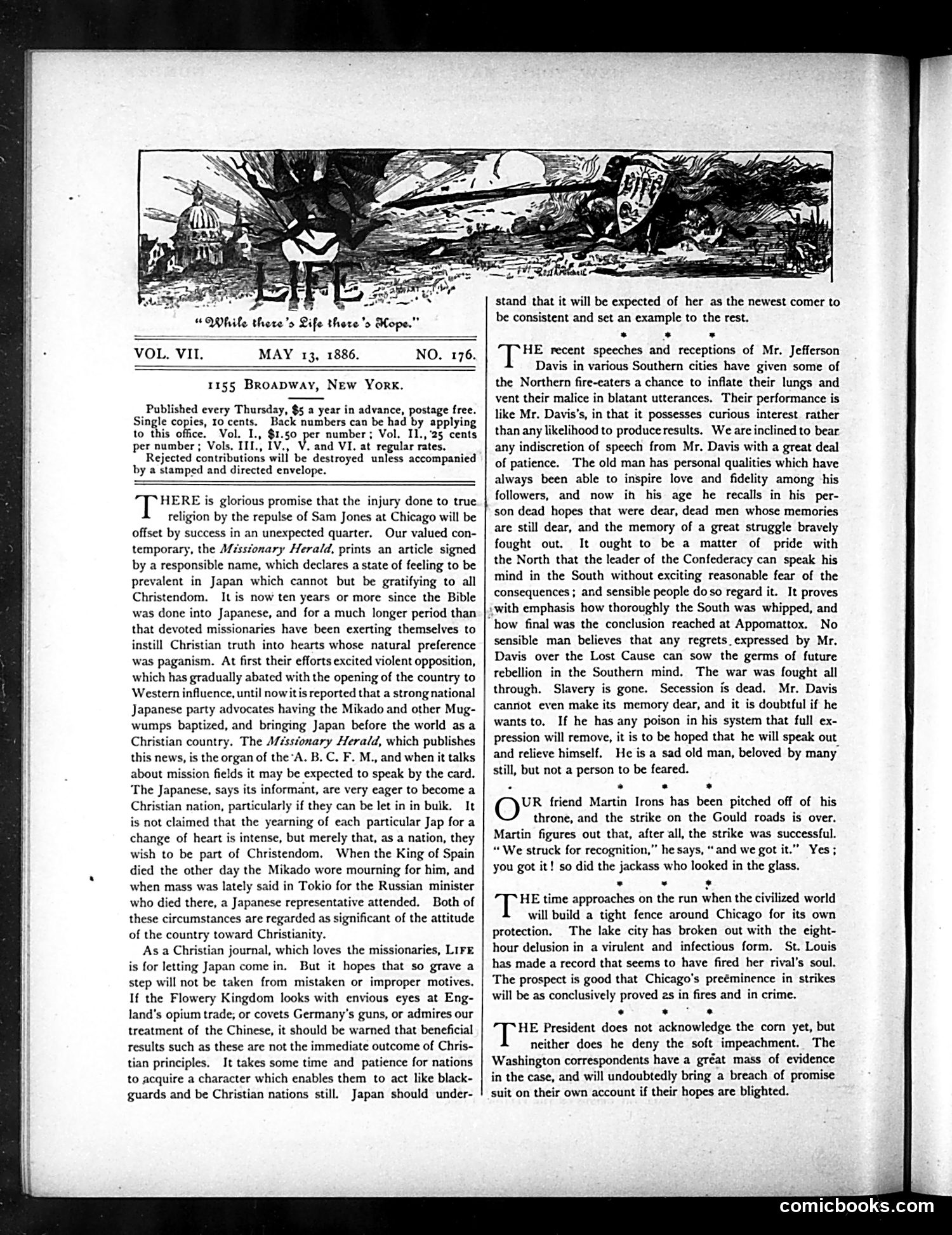
**The Cartoon:** The small engraving at top left depicts a classical scene with a dome structure (possibly St. Peter's Basilica) and the caption "While there's Life there's Hope." **The Editorial Content:** The main text discusses Japan's adoption of Christianity and the controversy around the Mikado's mourning practices. It references the "Missionary Herald" and debates whether Japan's Westernization represents genuine Christian conversion or merely superficial modernization. The piece also contains political commentary on Jefferson Davis's recent Southern speeches, criticizing his inflammatory rhetoric about the Civil War and the Lost Cause. The editor expresses hope Davis will "speak out and relieve himself" of his bitterness. Additional brief items mention Martin Irons (a labor figure in the Gould railroad strikes) and Chicago's crime problems. The overall tone is characteristic of Life's mix of religious commentary and partisan political critique.
📄 Transcribed text from this page (OCR, searchable)
Machine-transcribed from the original scan — historical spelling and the odd misread are preserved.
6 “While there's Life there's Hope.” VOL. VII. MAY 13, 1886. NO. 176. 1155 Broapway, NEw YORK. Published every Thursday, $5 a year in advance, postage free. Single copies, 10 cents. Back numbers can be had by applying to this office. Vol. I., $1.50 per number; Vol. IT.,‘25 cents per number ; Vols, III., IV., V. and VI. at regular rates. Rejected contributions will be destroyed unless accompanied by a stamped and directed envelope. HERE is glorious promise that the injury done to true religion by the repulse of Sam Jones at Chicago will be offset by success in an unexpected quarter. Our valued con- temporary, the M¢sstonary Herald, prints an article signed by a responsible name, which declares a state of feeling to be prevalent in Japan which cannot but be gratifying to all Christendom. It is now ten years or more since the Bible was done into Japanese, and for a much longer period than that devoted missionaries have been exerting themselves to instill Christian truth into hearts whose natural preference was paganism. At first their efforts excited violent opposition, which has gradually abated with the opening of the country to Western influence, until nowit is reported that a strong national Japanese party advocates having the Mikado and other Mug- wumps baptized, and bringing Japan before the world as a Christian country. The M/isstonary Herald, which publishes this news, is the organ of the A. B, C. F. M., and when it talks about mission fields it may be expected to speak by the card. The Japanese, says its informant, are very eager to become a Christian nation, particularly if they can be let in in buik. It is not claimed that the yearning of each particular Jap for a change of heart is intense, but merely that, as a nation, they wish to be part of Christendom. When the King of Spain died the other day the Mikado wore mourning for him, and when mass was lately said in Tokio for the Russian minister who died there, a Japanese representative attended. Both of these circumstances are regarded as significant of the attitude of the country toward Christianity. Asa Christian journal, which loves the missionaries, LIFE is for letting Japan come in. But it hopes that so grave a step will not be taken from mistaken or improper motives. If the Flowery Kingdom looks with envious eyes at Eng- land's opium trade; or covets Germany's guns, or admires our treatment of the Chinese, it should be warned that beneficial results such as these are not the immediate outcome of Chris- tian principles. It takes some time and patience for nations to acquire a character which enables them to act like black- guards and be Christian nations still. Japan should under- stand that it will be expected of her as the newest comer to be consistent and set an example to the rest. . * . HE recent speeches and receptions of Mr. Jefferson Davis in various Southern cities have given some of the Northern fire-eaters a chance to inflate their lungs and vent their malice in blatant utterances. Their performance is like Mr. Davis's, in that it possesses curious interest rather than any likelihood to produce results. We are inclined to bear any indiscretion of speech from Mr. Davis with a great deal of patience. The old man has personal qualities which have always been able to inspire love and fidelity among his followers, and now ih his age he recalls in his per- son dead hopes that were dear, dead men whose memories are still dear, and the memory of a great struggle bravely fought out. It ought to be a matter of pride with the North that the leader of the Confederacy can speak his mind in the South without exciting reasonable fear of the consequences ; and sensible people do so regard it. It proves swith emphasis how thoroughly the South was whipped, and “how final was the conclusion reached at Appomattox. No sensible man believes that any regrets.expressed by Mr. Davis over the Lost Cause can sow the germs of future rebellion in the Southern mind. The war was fought all through. Slavery is gone. Secession is dead. Mr. Davis cannot even make its memory dear, and it is doubtful if he wants to. If he has any poison in his system that full ex- pression will remove, it is to be hoped that he will speak out and relieve himself. He is a sad old man, beloved by many still, but not a person to be feared. : . . . UR friend Martin Irons has been pitched off of his throne, and the strike on the Gould roads is over. Martin figures out that, after all, the strike was successful. “We struck for recognition,” he says, “and we got it.” Yes ; you got it! so did the jackass who looked in the glass. . . . Sl ie time approaches on the run when the civilized world will build a tight fence around Chicago for its own protection. The lake city has broken out with the eight- hour delusion in a virulent and infectious form. St. Louis has made a record that seems to have fired her rival's soul. The prospect is good that Chicago's preéminence in strikes will be as conclusively proved 2s in fires and in crime. . . . HE President does not acknowledge the corn yet, but neither does he deny the soft impeachment. The Washington correspondents have a gréat mass of evidence in the case, and will undoubtedly bring a breach of promise suit on their own account if their hopes are blighted. comicbooks. com