
Life, 1886-05-13 · page 10 of 16
Life — May 13, 1886 — page 10: what you’re looking at
What you’re looking at
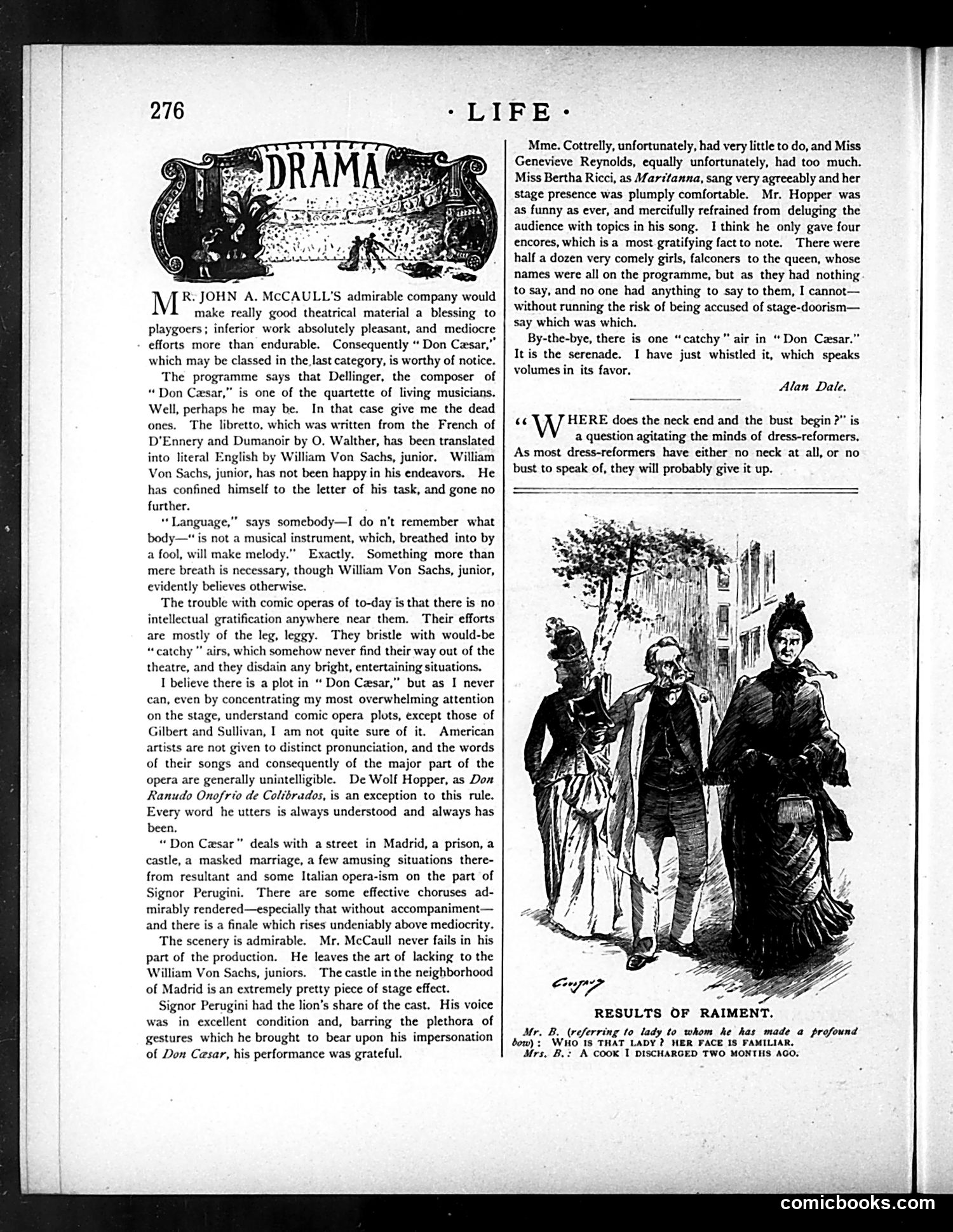
This is a theater review by critic Alan Dale critiquing John A. McCaull's production of the comic opera "Don Cesar." The accompanying illustration shows three figures in period dress on a Madrid street—the opera's setting. Dale's satire targets the mediocrity of contemporary American comic opera. He mocks composer Dellinger as barely worthy of mention, ridicules translator William Von Sachs Jr. for wooden literalism ("language is not a musical instrument...breathed into by a fool"), and criticizes comic operas generally for lacking intellectual content while relying on "catchy airs" and leggy chorus girls. De Wolf Hopper receives praise for clear enunciation—a backhanded compliment suggesting other American performers mumble unintelligibly. The review finds the plot incomprehensible, the scenery admirable, and most performances adequate but unmemorable, with only one genuinely catchy tune—the serenade—worth whistling about.
📄 Transcribed text from this page (OCR, searchable)
Machine-transcribed from the original scan — historical spelling and the odd misread are preserved.
-LIFE- WM R. JOHN A. MCCAULL'’S admirable company would make really good theatrical material a blessing to playgoers; inferior work absolutely pleasant, and mediocre efforts more than endurable. Consequently “ Don Czsar,” which may be classed in the last category, is worthy of notice. The programme says that Dellinger, the composer of “ Don Cesar,” is one of the quartette of living musicians. Well, perhaps he may be. In that case give me the dead ones. The libretto, which was written from the French of D'Ennery and Dumanoir by O. Walther, has been translated into literal English by William Von Sachs, junior. William Von Sachs, junior, has not been happy in his endeavors. He has confined himself to the letter of his task, and gone no further. “Language,” says somebody—I do n't remember what body—“ is not a musical instrument, which, breathed into by a fool, will make melody.” Exactly. Something more than mere breath is necessary, though William Von Sachs, junior, evidently believes otherwise. The trouble with comic operas of to-day is that there is no intellectual gratification anywhere near them. Their efforts are mostly of the leg, leggy. They bristle with would-be “catchy ” airs, which somehow never find their way out of the theatre, and they disdain any bright, entertaining situations. I believe there is a plot in “ Don Czsar,” but as I never can, even by concentrating my most overwhelming attention on the stage, understand comic opera plots, except those of Gilbert and Sullivan, 1 am not quite sure of it. American artists are not given to distinct pronunciation, and the words of their songs and consequently of the major part of the opera are generally unintelligible. De Wolf Hopper, as Don Ranudo Onofrio de Colibrados, is an exception to this rule. Every word he utters is always understood and always has been. “Don Caxsar" deals with a street in Madrid, a prison, a castle, a masked marriage, a few amusing situations there- from resultant and some Italian opera-ism on the part of Signor Perugini. There are some effective choruses ad- mirably rendered—especially that without accompaniment— and there is a finale which rises undeniably above mediocrity. The scenery is admirable. Mr. McCaull never fails in his part of the production. He leaves the art of lacking to the William Von Sachs, juniors. The castle in the neighborhood of Madrid is an extremely pretty piece of stage effect. Signor Perugini had the lion’s share of the cast. His voice was in excellent condition and, barring the plethora of gestures which he brought to bear upon his impersonation of Don Cesar, his performance was grateful. Mme. Cottrelly, unfortunately, had very little to do, and Miss Genevieve Reynolds, equally unfortunately, had too much. Miss Bertha Ricci, as Marttanna, sang very agreeably and her stage presence was plumply comfortable. Mr. Hopper was as funny as ever, and mercifully refrained from deluging the audience with topics in his song. I think he only gave four encores, which is a most gratifying factto note. There were half a dozen very comely girls, falconers to the queen, whose names were all on the programme, but as they had nothing to say, and no one had anything to say to them, I cannot— without running the risk of being accused of stage-doorism— say which was which. By-the-bye, there is one “catchy” air in “Don Cesar.” It is the serenade. I have just whistled it, which speaks volumes in its favor. Alan Dale, “cc HERE does the neck end and the bust begin ?” is a question agitating the minds of dress-reformers. As most dress-reformers have either no neck at all, or no bust to speak of, they will probably give it up. RESULTS OF RAIMENT. Mr. B. (referring to lady to whom he has made a profound bow): WHO 18 THAT LADY? HER FACE 1S FAMILIAR, Mfrs, B.: A COOK I DISCHARGED TWO MONTHS AGO, comicbooks.com