
A complete issue · 16 pages · 1886
Life — April 22, 1886
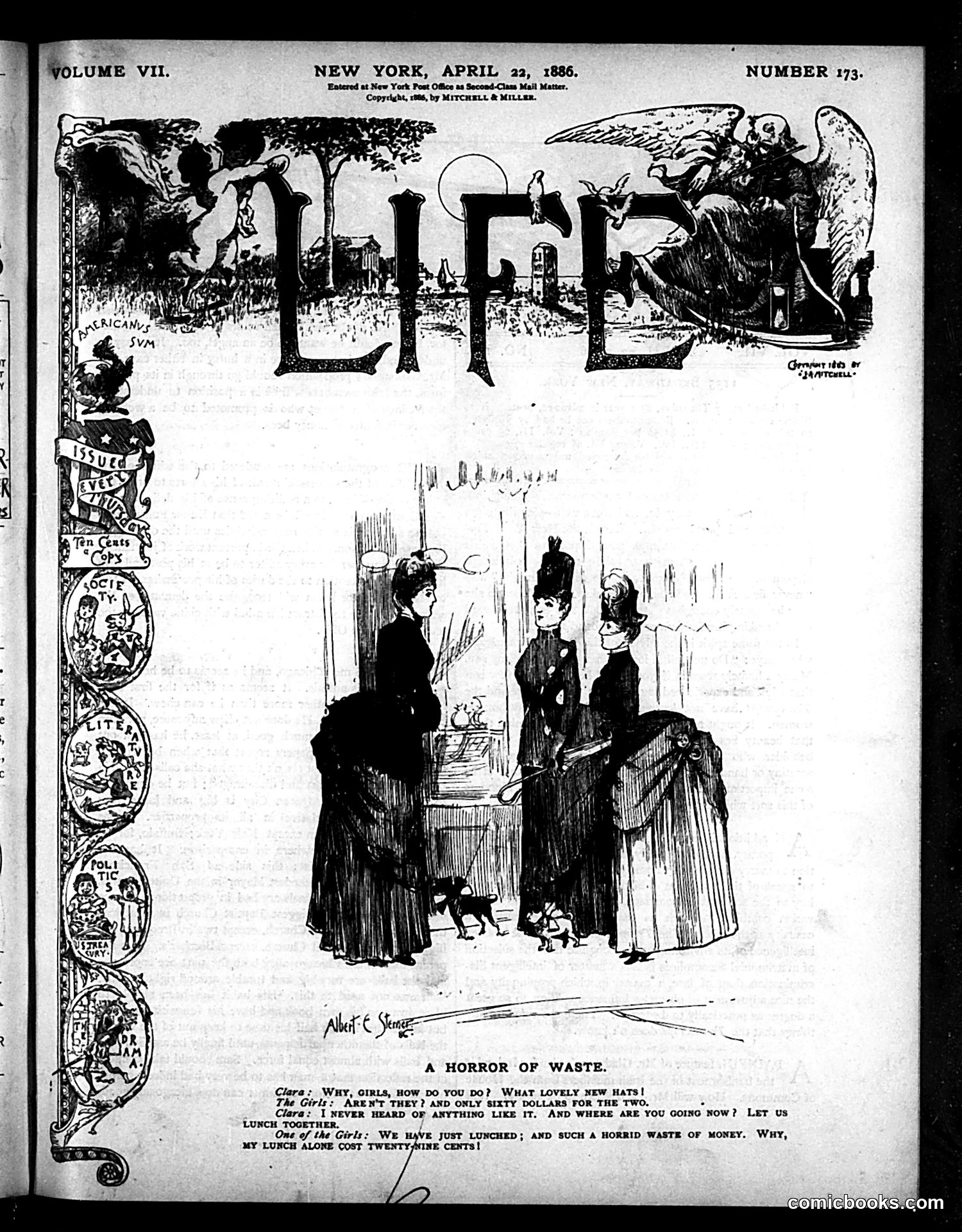
This cartoon by Albert Sterner satirizes wealthy women's wasteful spending habits. The scene depicts fashionable ladies (identifiable by their elaborate hats and coats) discussing lunch expenses. One woman complains that her lunch alone cost twenty-five cents—presented as an absurd extravagance. The satire targets the contradiction between upper-class women's casual spending and the economic reality of working-class laborers, for whom twenty-five cents represented significant earnings. The cartoon mocks both the women's obliviousness to money's value and the broader "waste" of resources among the wealthy during an era of significant economic inequality. The elaborate decorative border and masthead are typical of *Life* magazine's design from this period.
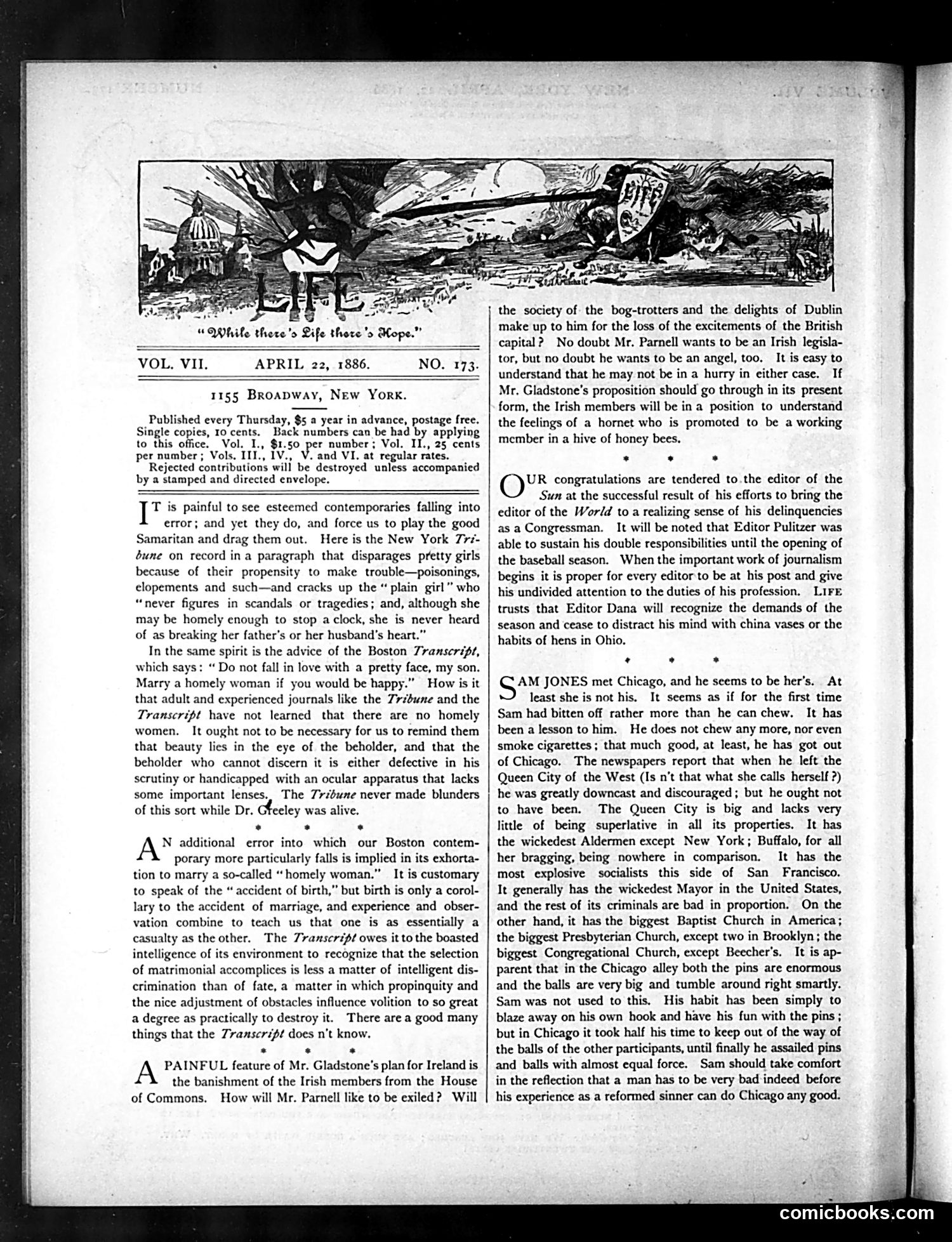
The cartoon's caption reads "While there's Life there's Hope," appearing to reference the magazine's own name as a pun on perseverance. The illustration depicts a chaotic, apocalyptic landscape with destruction, debris, and what appears to be industrial or architectural ruins. The style suggests social upheaval or collapse, though the specific political event remains unclear from the image alone. The surrounding text discusses journalistic ethics, critiques of Boston and Chicago newspapers, and commentary on Sam Jones (likely a public figure of the period). The magazine takes editorial positions on proper journalism conduct and comments on regional American city characteristics with characteristic 1880s satirical tone. Without clearer identification of the central figures or specific referenced events, the exact satirical target cannot be definitively stated.
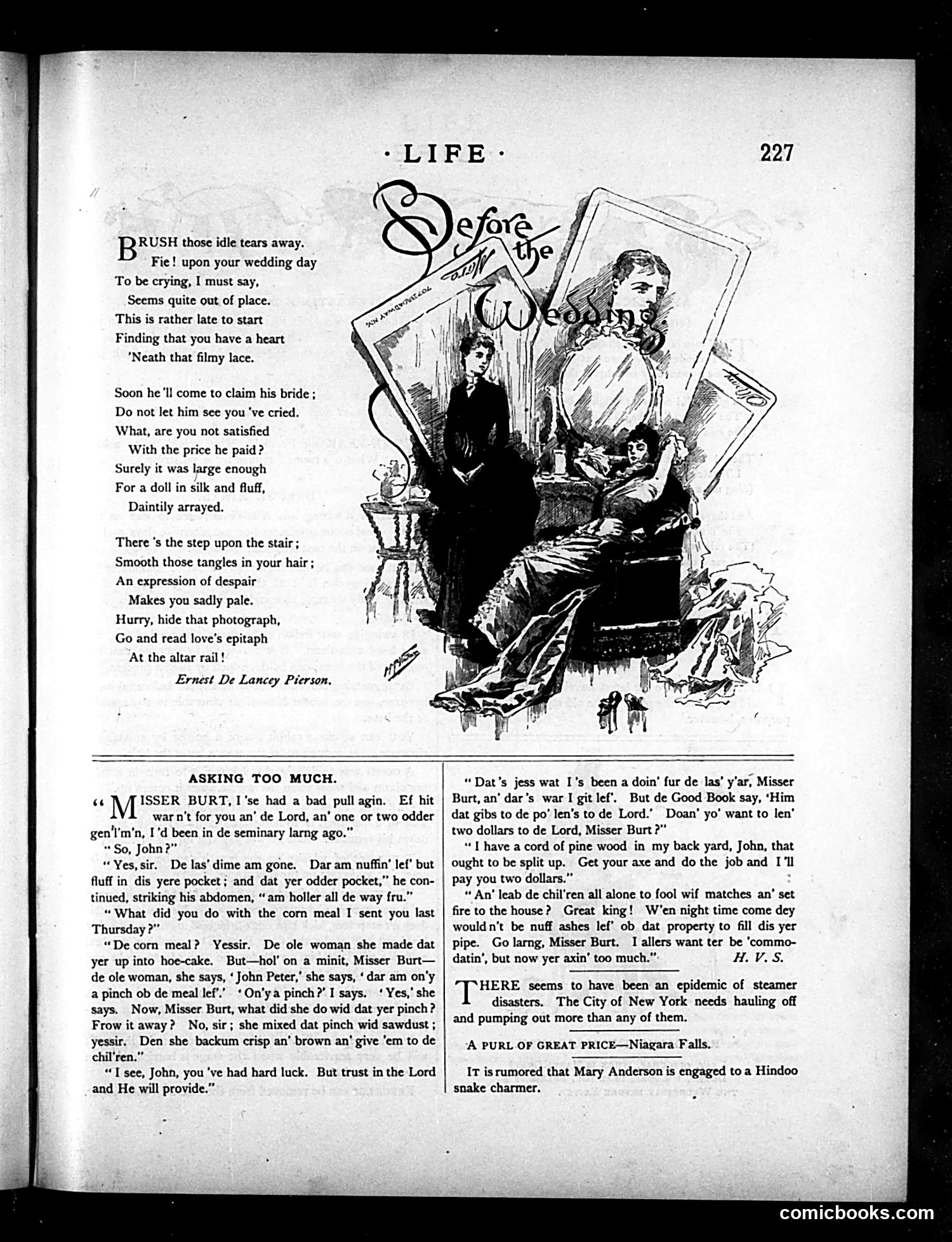
This page contains a poem titled "Before the Wedding" by Ernest De Lancy Pierson, accompanied by an illustration showing a bride-to-be preparing for her wedding day. The poem humorously advises the bride to hide evidence of her emotions—brushing away tears, smoothing her hair, hiding photographs—before her groom arrives to claim his bride. The satirical point mocks the expectation that brides should appear perfectly composed and "daintily arrayed," suppressing genuine feeling. Below the poem, a separate section titled "Asking Too Much" presents dialogue between working-class characters (Misser Burt and John) discussing hardship and financial struggle, with folksy dialect. The humor derives from their resigned acceptance of misfortune and mutual advice to "trust in the Lord." The page reflects early 20th-century attitudes about gender performance and working-class stoicism.
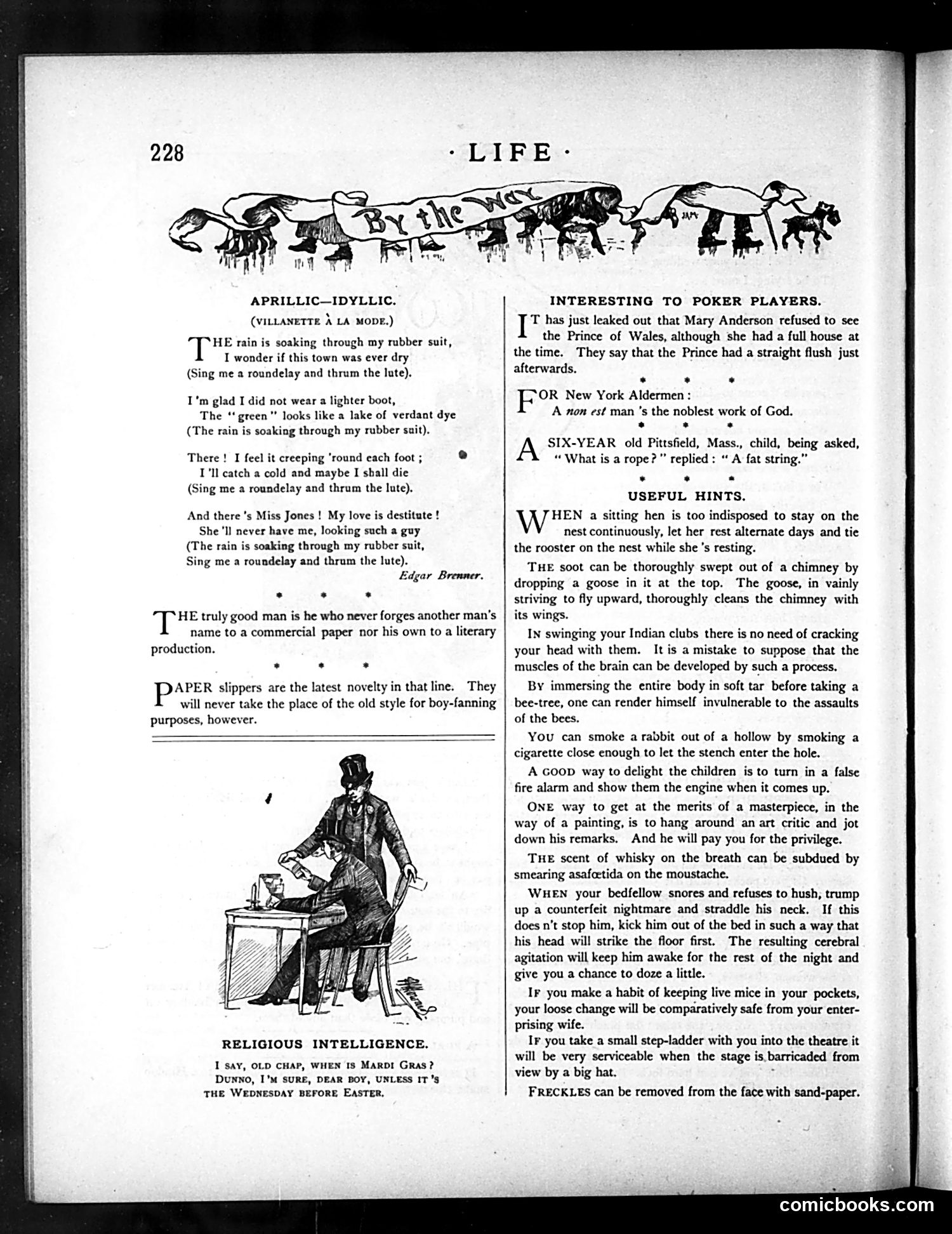
This page contains several satirical sections rather than a single cartoon: **"Aprillic-Idyllic"** is a humorous poem by Edgar Brommer about rain soaking through rubber clothing, playing on the contradiction between "April" and "idyllic." **"Interesting to Poker Players"** mocks high society—specifically a story about Mary Anderson refusing to meet the Prince of Wales despite having "a full house," using poker terminology as double meaning. **"Useful Hints"** offers absurd domestic advice (using geese to clean chimneys, smoking rabbits with cigarettes, etc.), satirizing the earnest "helpful tips" sections common in magazines. The illustration shows a woman ironing, likely supporting one of these domestic humor pieces. **"Religious Intelligence"** is a brief joke about Mardi Gras timing relative to Easter—gentle religious satire typical of the era. Overall, this is light social satire targeting middle-class life and customs.
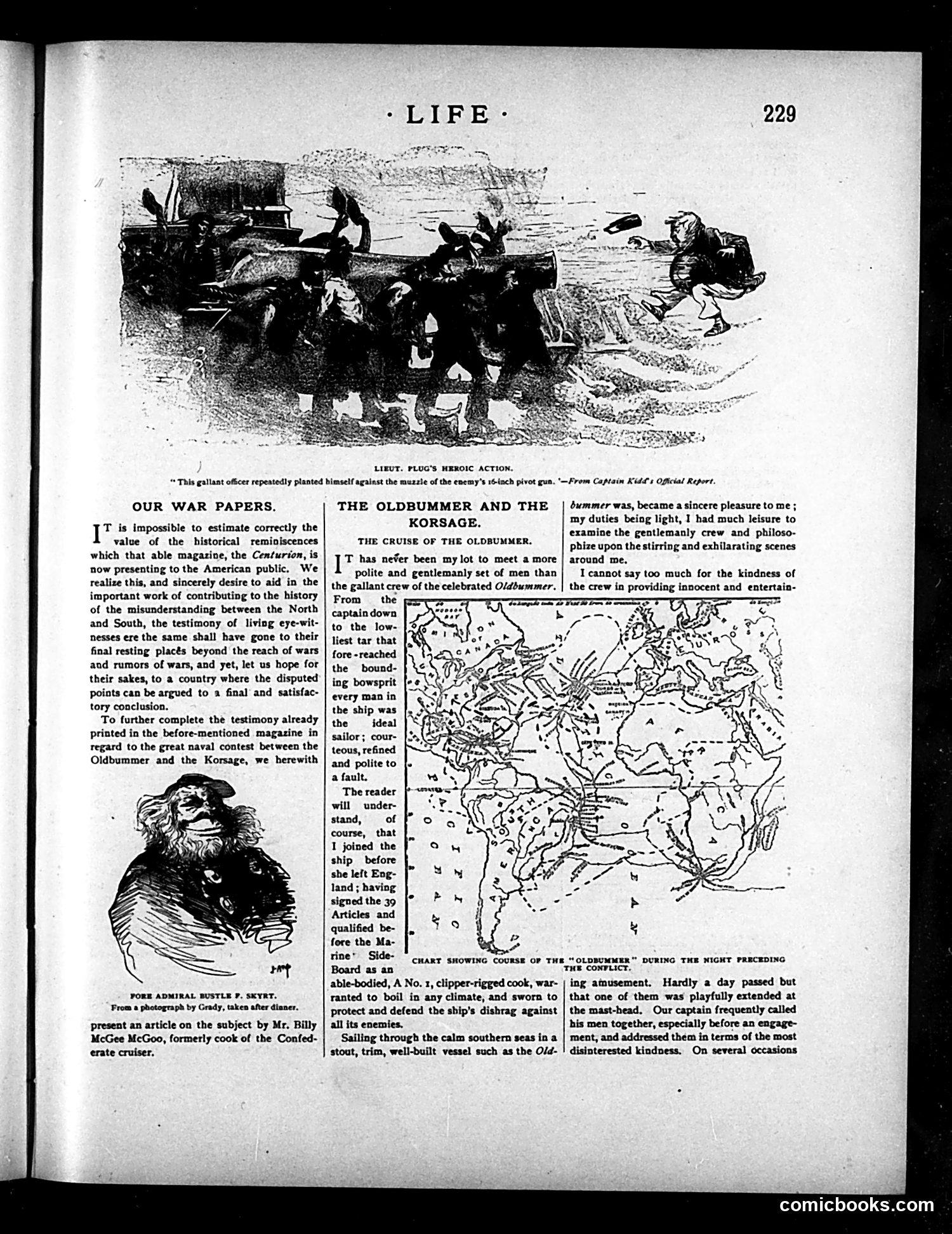
This page presents "Our War Papers," featuring accounts from the American Civil War, specifically about the USS Oldbummer and the CSS Korsage (likely the CSS Corsage). The top illustration shows "Lieut. Plog's Heroic Action," depicting an officer defending a ship's gun against enemy attack, quoted from Captain Kidd's Official Report. The portrait shows "Pore Admiral Bustle F. Skevt" from a photograph by Grady, taken after dinner, identified as a Confederate cruiser's cook named Billy McGee McCoo. The text describes the author's service aboard the Oldbummer, praising the captain and crew's conduct during naval conflict. The accompanying map charts the ship's course during an engagement. The satire appears to mock Civil War naval accounts and military pretension through absurdist character names and exaggerated reportage.
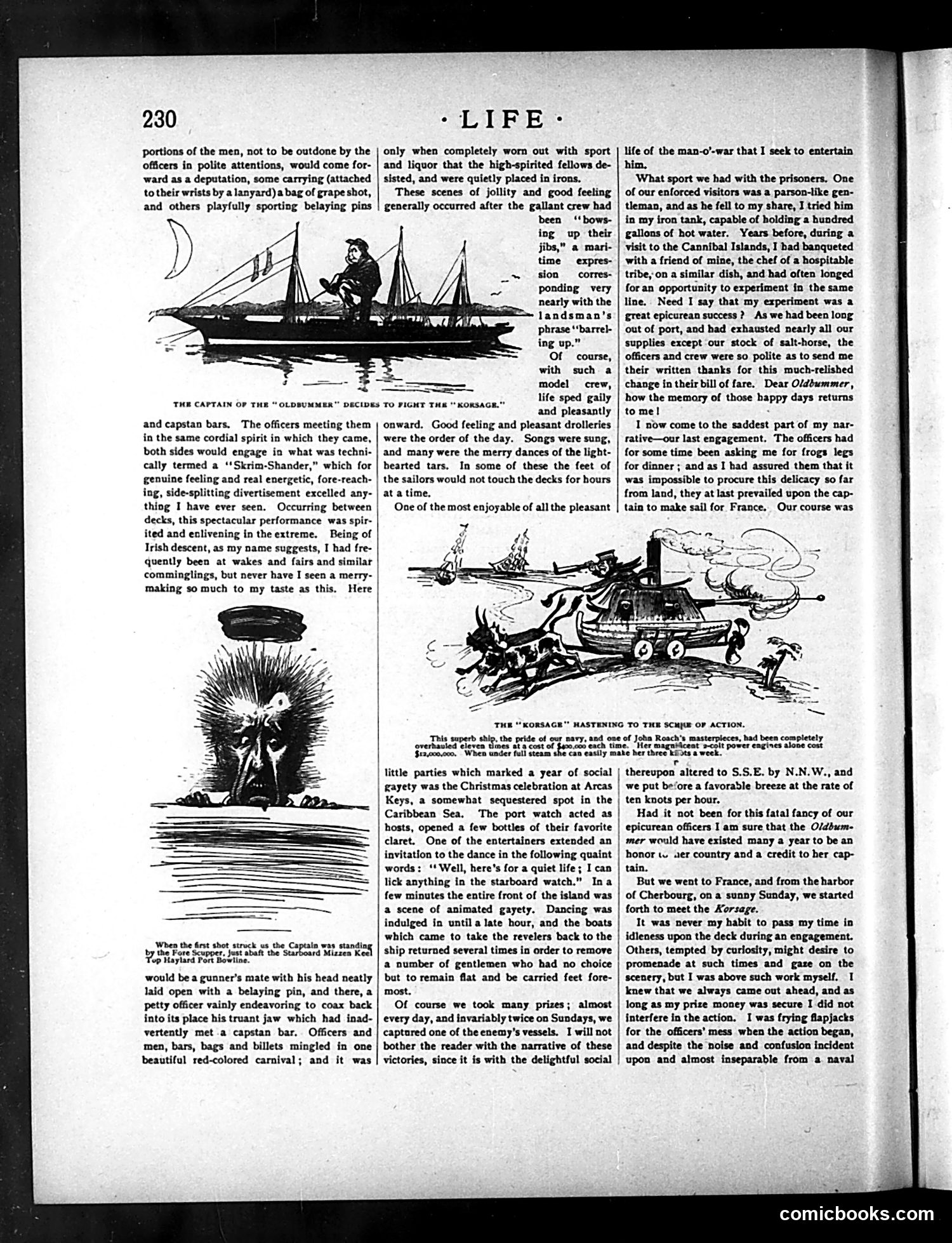
This page contains a narrative account of naval experiences during what appears to be a 19th-century voyage, accompanied by three illustrations. The illustrations depict: 1. **"The Captain of the Oldbrummer Decides to Fight the Korsage"** - showing a sailing vessel 2. **A dramatic water scene** - possibly depicting a naval incident or attack 3. **"The Korsage Mastering to the Scene of Action"** - showing a ship with horses and military equipment The text recounts social activities aboard ship, including Christmas celebrations and dancing at Arcas Keys in the Caribbean. It mentions capturing vessels and encounters with privateers, suggesting military/naval conflict during an era of oceanic commerce and potential piracy. The account emphasizes both the mundane social life and dramatic action of naval service, though without clear indication of which specific historical conflict or voyage is being documented.
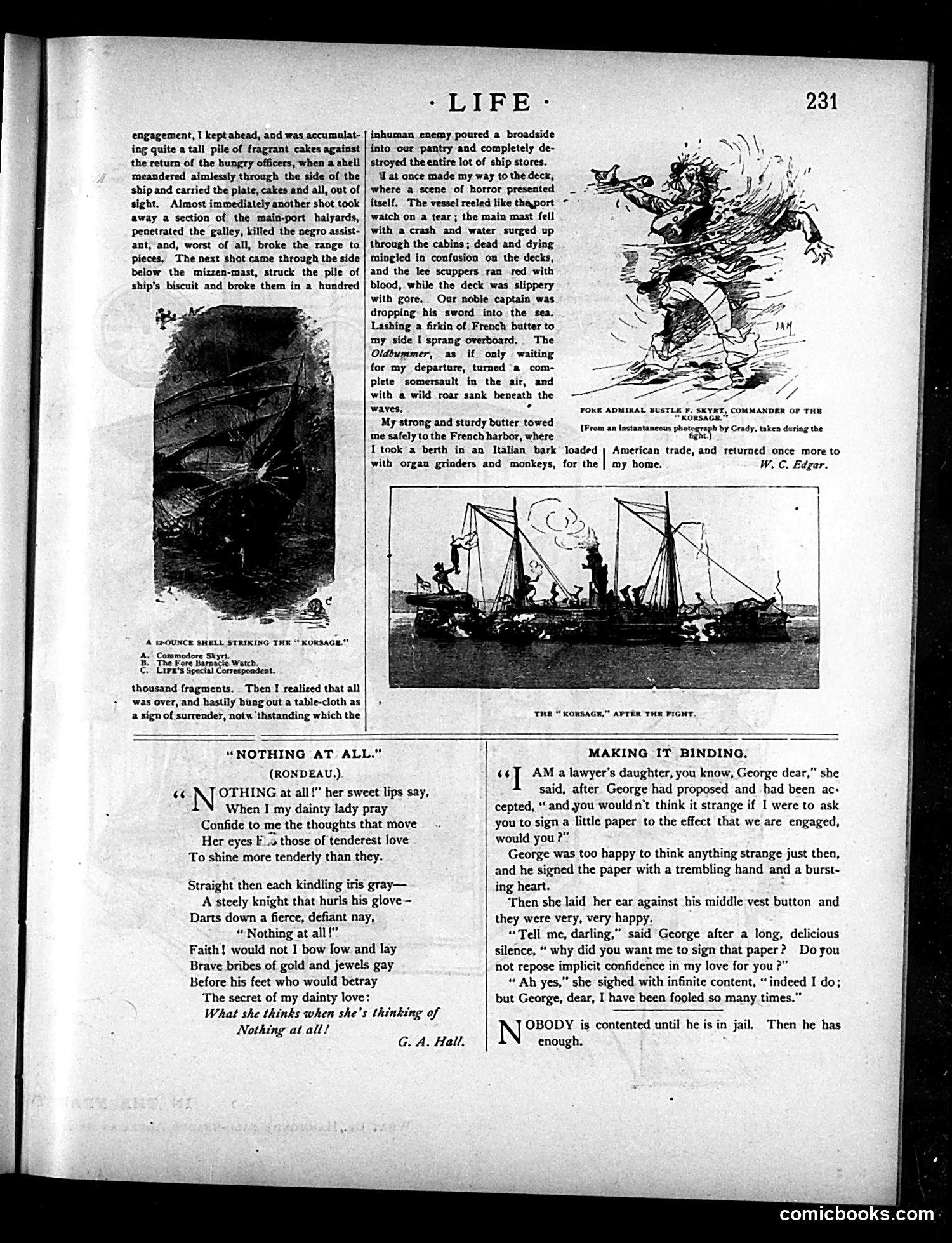
This page contains a naval combat narrative with illustrations rather than political satire. The text describes a battle between an American ship and what appears to be a French vessel, with vivid descriptions of cannon fire, casualties, and ship damage. The illustrations show: a ship striking another (labeled "A BRITISH SHIP STRIKING THE 'KORSAGE'"), and a photograph of "THE 'KORSAGE,' AFTER THE FIGHT." The lower portion shifts to literary content—a poem titled "NOTHING AT ALL" by G.A. Hall, and an unrelated romantic story beginning "MAKING IT BINDING" about a couple named George and his fiancée. This page appears to be historical adventure/war reportage mixed with fiction and poetry, typical of Life magazine's varied content, rather than political commentary.
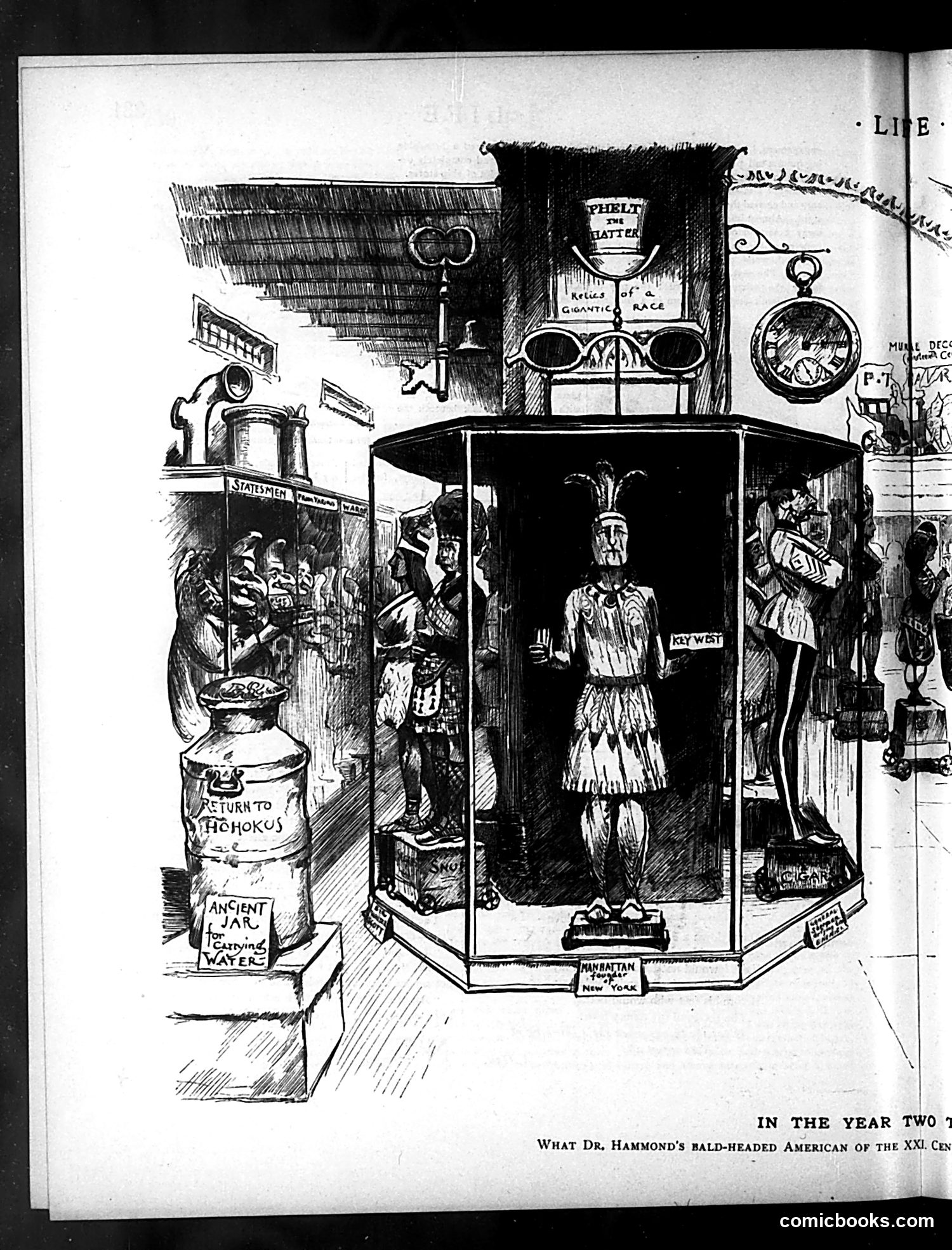
This appears to be a satirical illustration titled "In the Year Two Thousand" depicting Dr. Hammond's imagined vision of an American of the 21st century. The central figure is a bald-headed man displayed in what looks like a museum exhibit case in Manhattan, New York, suggesting he represents a curiosity or relic of the future. The surrounding display includes various period objects and signage—including references to "Hohokus" and "Ancient Jar of Spring Waters"—implying this exhibit showcases artifacts from the present day as historical curiosities. The satirical point appears to mock predictions about how dramatically American appearance or civilization might change, presenting contemporary humanity itself as an antiquated museum piece worthy of future study and display.
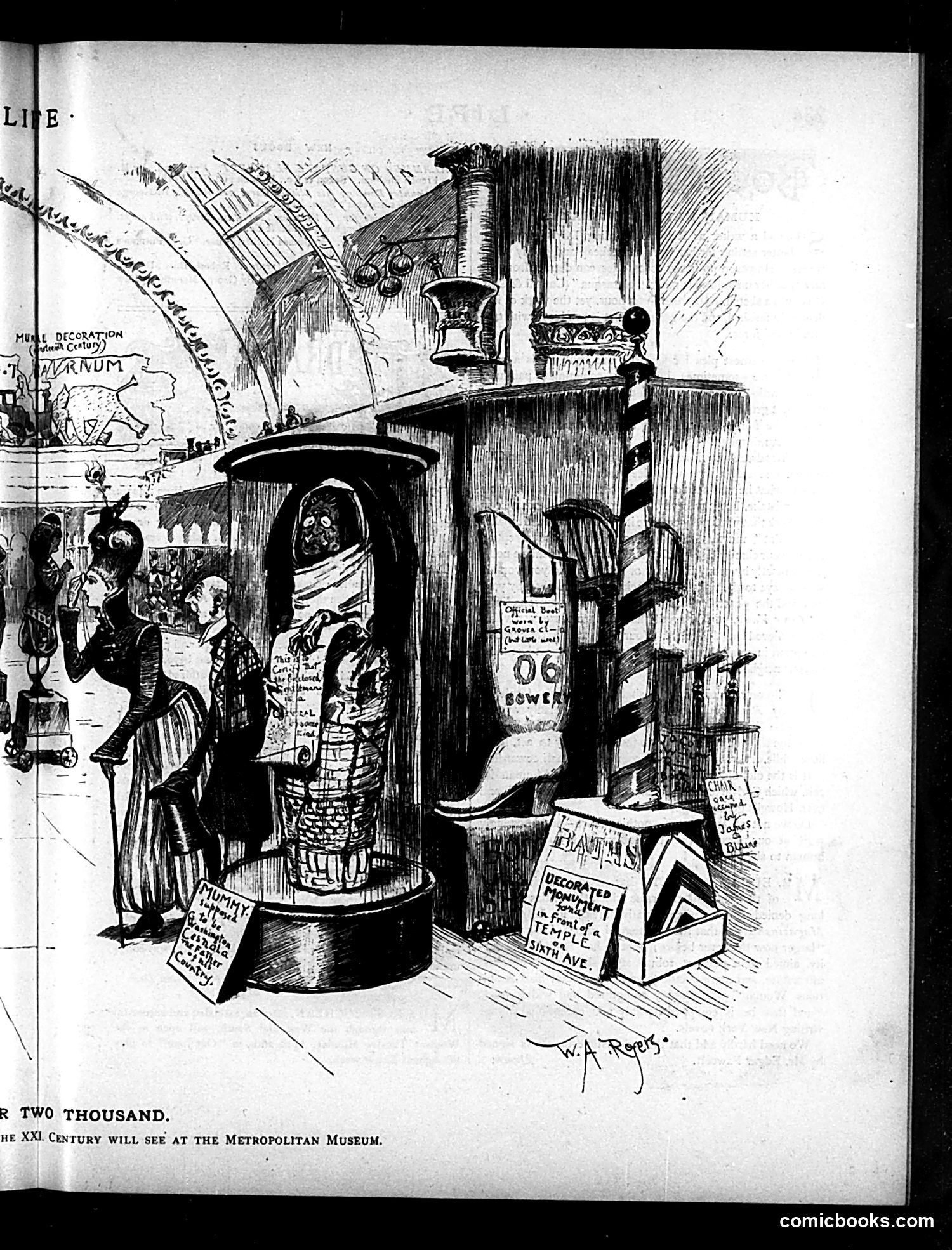
This satirical cartoon by W.A. Rogers depicts a futuristic "sewer" exhibit at the Metropolitan Museum of Art in the year 2000. The joke centers on early 20th-century urban sanitation infrastructure being preserved as high art—a commentary on society's tendency to romanticize and museum-ify even the most mundane or unglamorous aspects of modern life. Visitors in period dress examine the sewer installation as if it were precious antiquity. Signs advertising "baths" and commercial establishments suggest industrial-era commercialism. The satire mocks both the museum world's earnestness in collecting everything and contemporary obsession with progress and modernity. Rogers suggests that future generations will regard our current infrastructure with the same reverent bewilderment we reserve for ancient artifacts.
This page from *Life* magazine comprises literary criticism and theater reviews rather than political cartoons. The content satirizes social pretense and human nature through book reviews. The main critique targets **Rebecca Harding Davis's story "Natasqua,"** which explores how respectable people adopt false personas. The reviewer uses the character **Major Vaux**—a man of "puffery, brag and veneer" who maintains an elaborate sham for his family's sake—as an example of New York society's hypocrisy. The piece gently mocks this widespread "shabby gilding," noting that even readers wink knowingly at such deception rather than condemn it. A secondary satire appears in the Edgar Fawcett critique, where the reviewer notes that Fawcett himself wrote the glowing review of his own work in *Lippincott's Magazine*—a self-congratulatory deception that undercuts his alleged literary merit. The page essentially uses literary discussion to comment on 1880s urban social pretense and vanity.
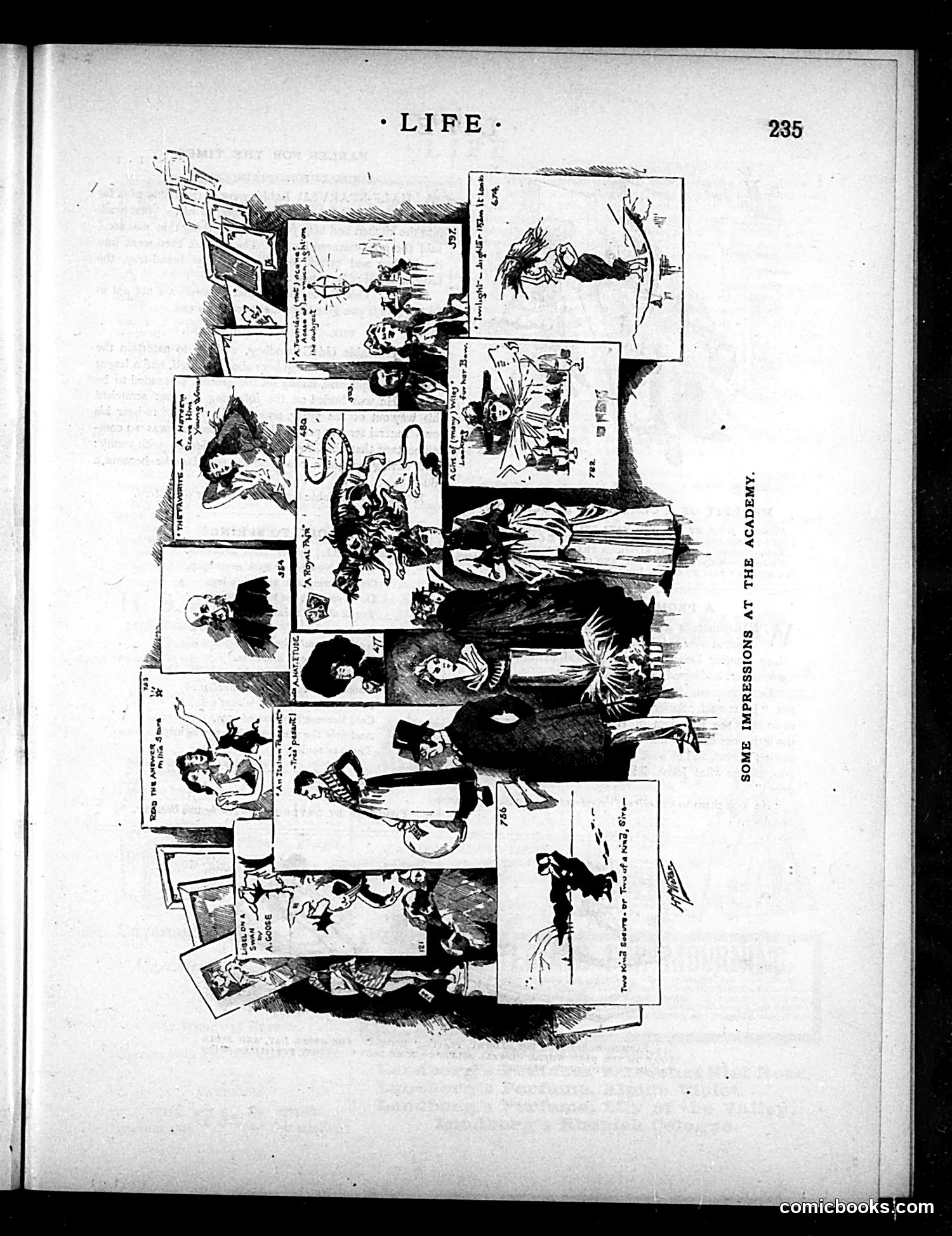
I cannot reliably interpret this page. The OCR text is severely corrupted and largely illegible—it appears to be reversed or scrambled. While the image shows a collage of multiple cartoon panels arranged on the page with the heading "SOME IMPRESSIONS AT THE ACADEMY" visible on the right side, the individual panels are too small and unclear for me to identify specific figures, caricatures, or satirical points with confidence. To provide accurate historical context as requested, I would need either clearer source material or legible caption text. I cannot responsibly guess at the identities or meanings without risking significant inaccuracy.
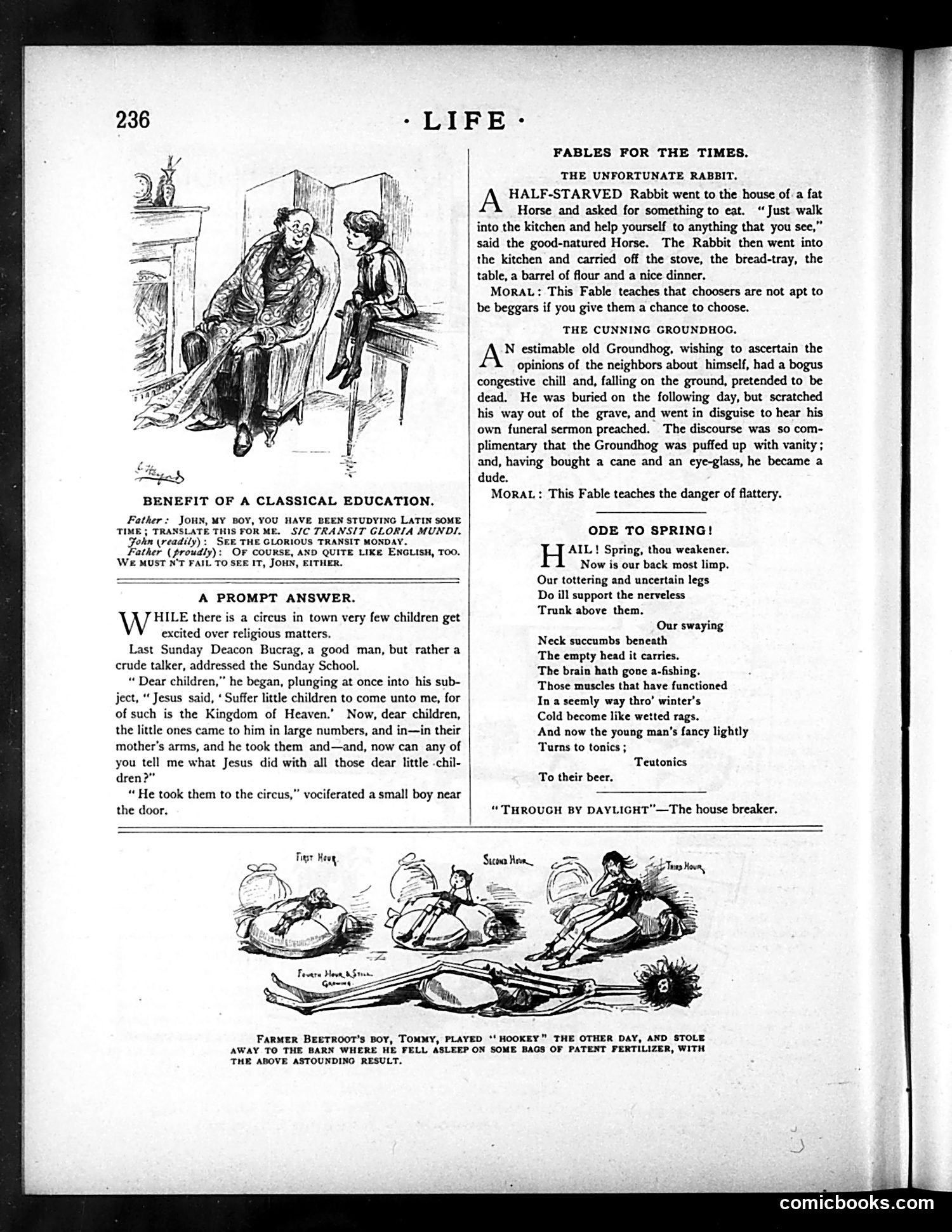
This page contains several unrelated satirical pieces targeting social pretension and foolishness: **"Benefit of a Classical Education"**: A father asks his son to translate the Latin phrase "Sic transit gloria mundi" (thus passes the glory of the world). The boy misinterprets it as "See the glorious Transit Monday"—confusing a profound statement about mortality with a reference to a streetcar line. The satire mocks both the boy's ignorance and the father's pride in such poor understanding. **"A Prompt Answer"**: A Sunday School teacher asks what Jesus did with children who came to him; a boy shouts "He took them to the circus!" The joke ridicules children's prioritization of entertainment over religion. **The "Fables"**: Absurdist moral tales—a rabbit exploits kindness by stealing everything; a groundhog fakes death to hear flattering funeral praise, then becomes a vain "dude." These mock human vanity and dishonesty. **Bottom cartoon**: Shows a boy sleeping on fertilizer bags with comedic physical consequences—simple slapstick humor about truancy's unfortunate results. Overall, the page satirizes human foolishness across classes and ages.
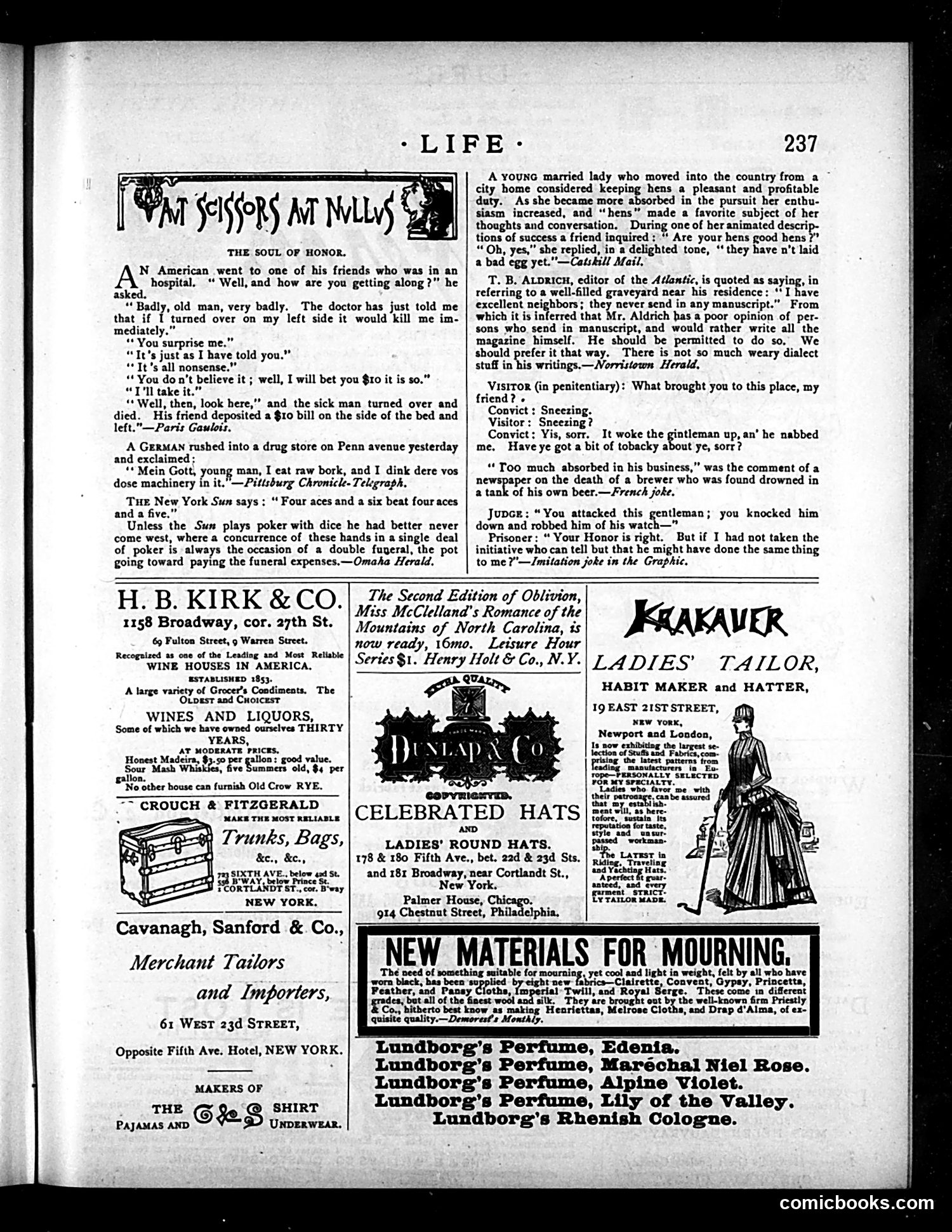
This page collects brief humorous anecdotes rather than traditional political cartoons. The cartoonist title "Wit, Scissors at Mills" refers to clipped jokes sourced from various newspapers—a common practice for *Life* magazine. The humor is primarily situational and wordplay-based: - **"The Soul of Honor"** jokes on literal-mindedness: a man dies after proving the doctor wrong by rolling over despite being told not to. - The German in the pharmacy plays on accent and assumed ignorance ("dink dere vos dose machinery"). - The poker joke mocks Western violence over gambling disputes. - The hen-keeper's malapropism ("haven't had a bad egg yet" misunderstands the question). - The editor joke satirizes literary culture—editors prefer dead neighbors who won't submit poor manuscripts. - The prisoner joke darkly plays on Irish dialect and fatalistic irony. The advertisements (wine, trunks, tailors, hats) dominate the page's lower half, typical of *Life's* revenue model. This issue appears mid-1890s based on fashion and typography.
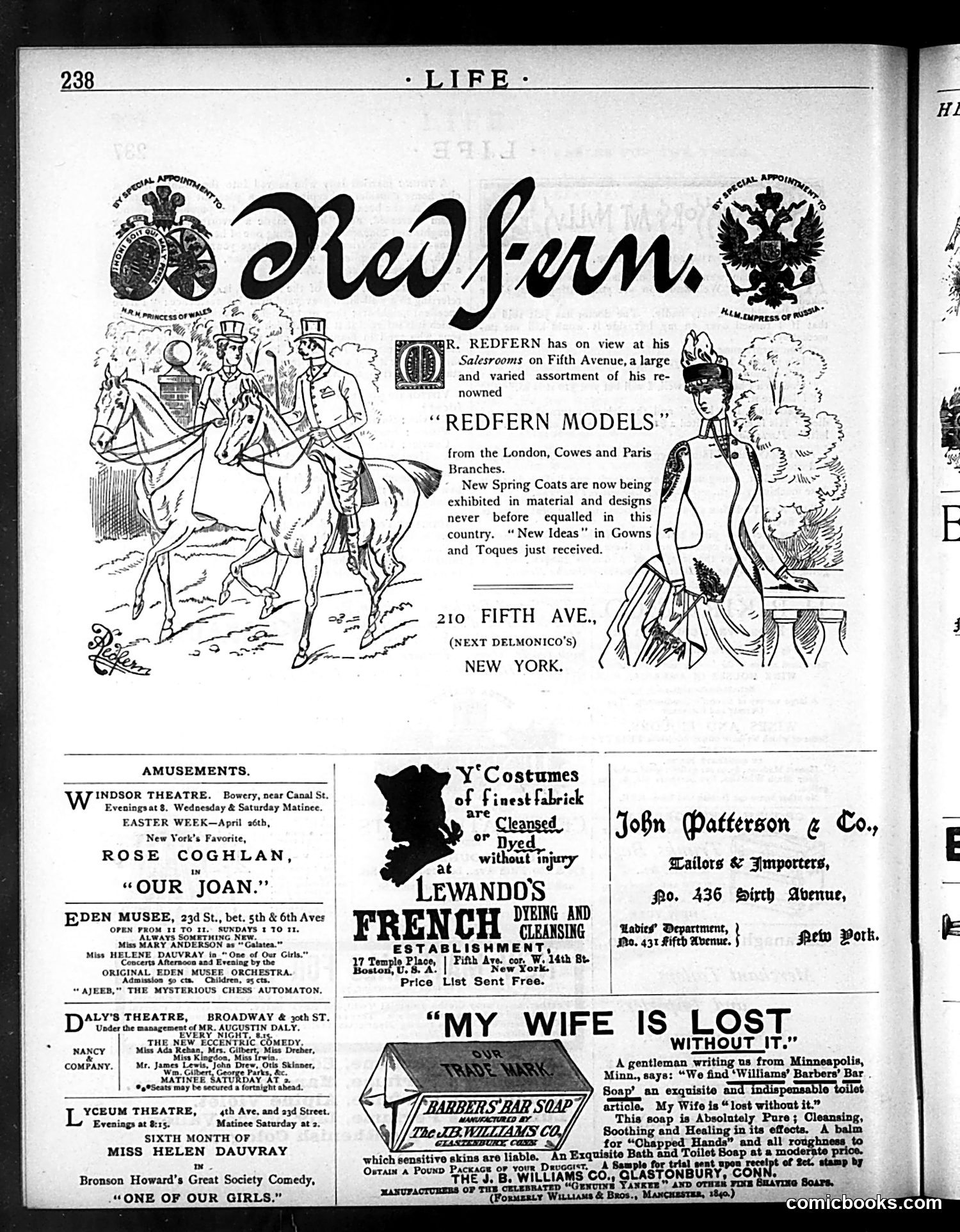
This page is primarily **advertising**, with the main content being commercial announcements for New York establishments and products (circa 1890s based on style). The top features **"Redfern"** — an advertisement for an upscale fashion house on Fifth Avenue displaying spring coats and gowns from London, Cowes, and Paris branches. The decorative header includes royal coats of arms (British and Russian), suggesting the brand's elite, international status. Below are theater listings for Broadway productions and the Eden Musée (a wax museum featuring "Ajeeb," a famous mechanical chess-playing automaton). The lower section advertises services: Lewando's French dyeing/cleaning establishment and John Patterson & Co. tailors. At bottom is a **product advertisement for "Williams' Barbers' Bar Soap,"** featuring a testimonial from a Minneapolis man claiming his wife is "lost without it" — typical Victorian advertising rhetoric emphasizing domestic necessity and purity. There is **no political satire** on this page; it represents standard commercial messaging of the era.
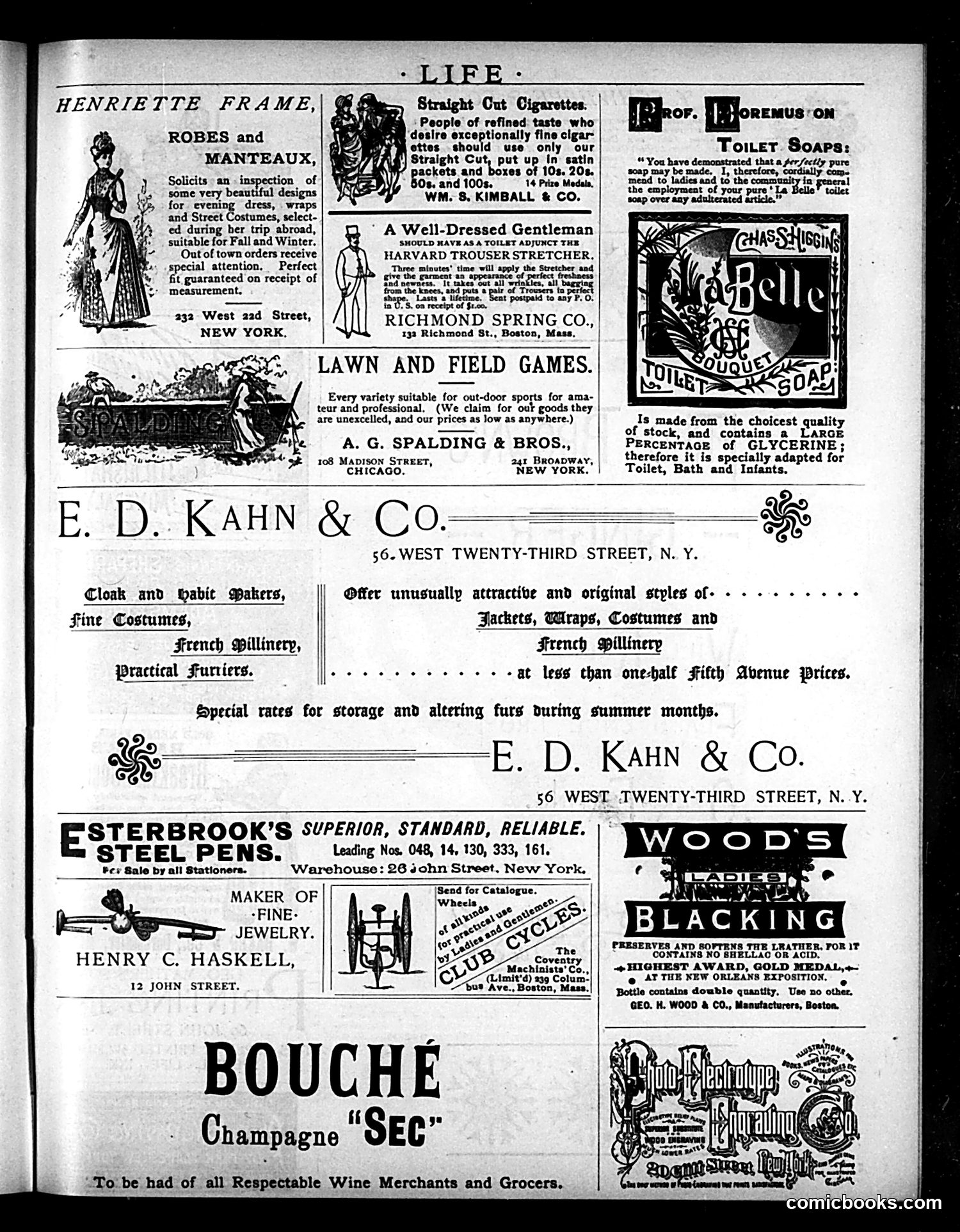
This page is **primarily advertisements** with no political cartoons or satirical content. It's a commercial compilation from an early American *Life* magazine (likely 1880s-1890s based on style). The ads reflect period consumer culture: women's fashion (robes, mantuas, French millinery), men's grooming (trouser stretchers, toilet soaps), sporting goods, jewelry, writing implements, and champagne. One notable element: the "Harvard Trouser Stretcher" ad presents an absurdly specific grooming device as a mark of being "well-dressed"—likely *light satire* of gentlemen's vanity and the era's elaborate standards of appearance. The product promises to eliminate wrinkles and restore shape, playing on anxiety about proper dress. Otherwise, this is straightforward commercial material showing what refined consumers of the Gilded Age considered essential purchases, from imported French goods to luxury champagne. The advertisements themselves constitute the "content" rather than serving as vehicles for satire.
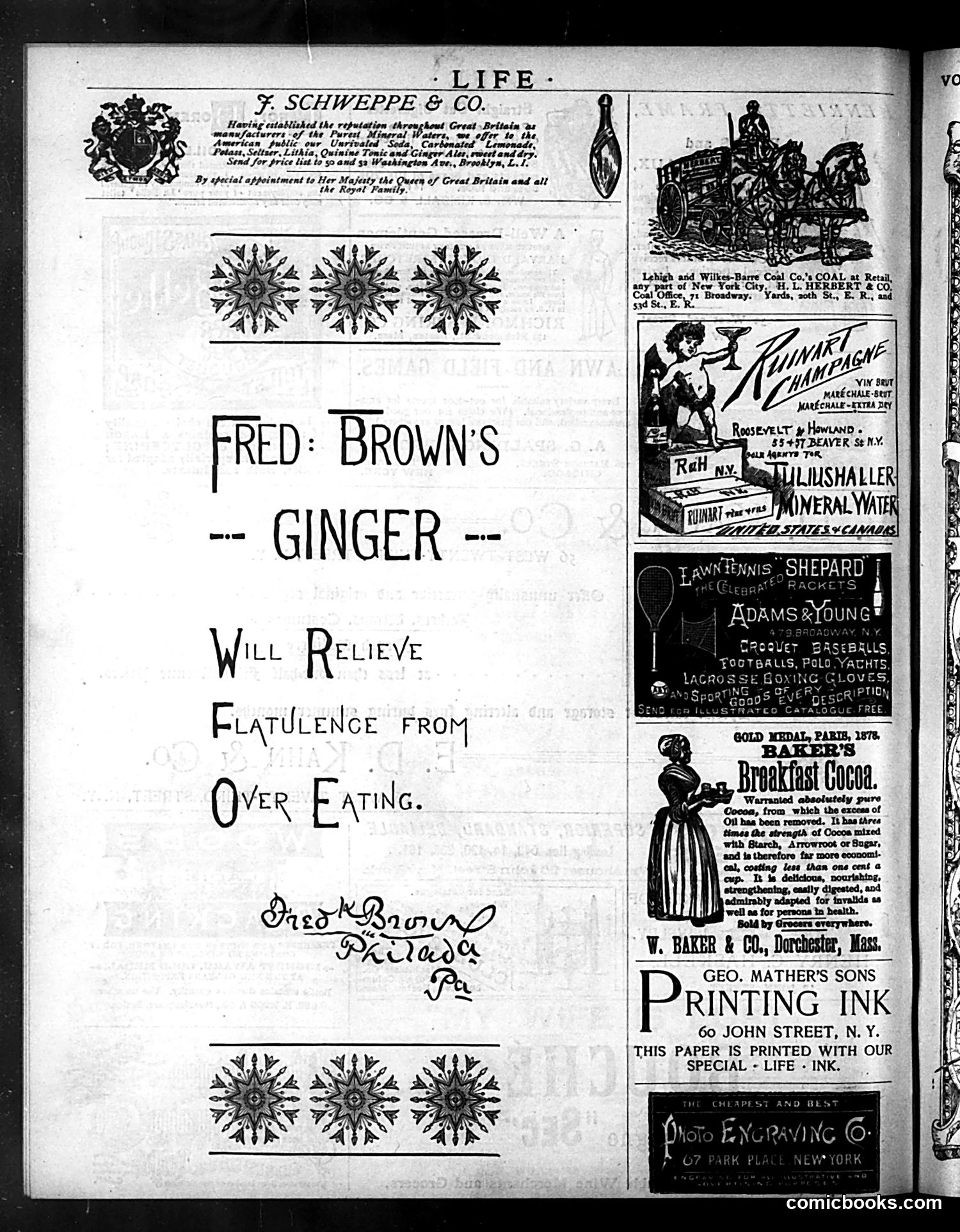
This is primarily an **advertising page** from Life magazine, not a cartoon or satirical content. It features several period product advertisements: The dominant advertisement is **Fred Brown's Ginger** (Philadelphia, PA), which claims to relieve flatulence from overeating. This reflects late 19th-century patent medicine marketing—products promising digestive relief were extremely common and often made exaggerated health claims. Surrounding this are ads for: - **Schweppe & Co.** mineral waters and sodas (with royal appointment) - **Baker's Breakfast Cocoa** (with Gold Medal, Paris 1878) - **Geo. Mather's Sons Printing Ink** (noting Life's use of their product) - Various sporting goods and other merchants The decorative floral dividers and formal typography are typical of the era. There is **no political satire or cartoon** visible here—this is straightforward commercial advertising representative of how Life magazine (like modern publications) monetized through ads.