
Life, 1886-04-22 · page 10 of 16
Life — April 22, 1886 — page 10: what you’re looking at
What you’re looking at
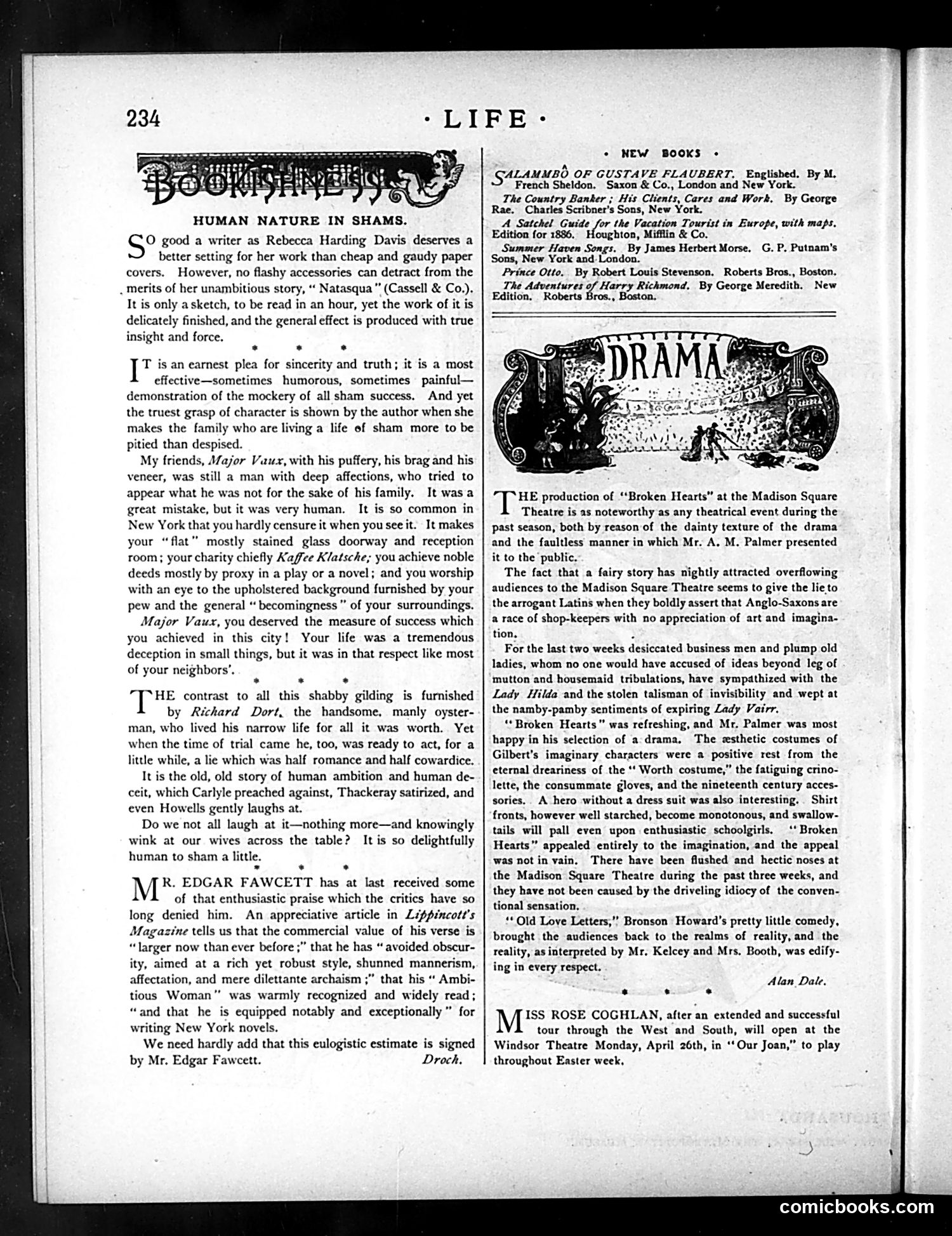
This page from *Life* magazine comprises literary criticism and theater reviews rather than political cartoons. The content satirizes social pretense and human nature through book reviews. The main critique targets **Rebecca Harding Davis's story "Natasqua,"** which explores how respectable people adopt false personas. The reviewer uses the character **Major Vaux**—a man of "puffery, brag and veneer" who maintains an elaborate sham for his family's sake—as an example of New York society's hypocrisy. The piece gently mocks this widespread "shabby gilding," noting that even readers wink knowingly at such deception rather than condemn it. A secondary satire appears in the Edgar Fawcett critique, where the reviewer notes that Fawcett himself wrote the glowing review of his own work in *Lippincott's Magazine*—a self-congratulatory deception that undercuts his alleged literary merit. The page essentially uses literary discussion to comment on 1880s urban social pretense and vanity.
📄 Transcribed text from this page (OCR, searchable)
Machine-transcribed from the original scan — historical spelling and the odd misread are preserved.
HUMAN NATURE IN SHAMS. O good a writer as Rebecca Harding Davis deserves a better setting for her work than cheap and gaudy paper covers. However, no flashy accessories can detract from the . merits of her unambitious story, ““ Natasqua” (Cassell & Co,). It is only a sketch, to be read in an hour, yet the work of it is delicately finished, and the general effect is produced with true insight and force. . . . T is an earnest plea for sincerity and truth; it is a most effective—sometimes humorous, sometimes painful— demonstration of the mockery of all sham success. And yet the truest grasp of character is shown by the author when she makes the family who are living a life of sham more to be pitied than despised. My friends, Major Vaux, with his puffery, his brag and his veneer, was still a man with deep affections, who tried to appear what he was not for the sake of his family. It was a great mistake, but it was very human. It is so common in New York that you hardly censure it when you see it. It makes your “flat” mostly stained glass doorway and reception ‘our charity chiefly Kaffee K/atsche, you achieve noble deeds mostly by proxy in a play or a novel; and you worship with an eye to the upholstered background furnished by your pew and the general “ becomingness ” of your surroundings. Major Vaux, you deserved the measure of success which you achieved in this city! Your life was a tremendous deception in small things, but it was in that respect like most of your neighbors’. . . HE contrast to all this shabby gilding is furnished by Richard Dort, the handsome, manly oyster- man, who lived his narrow life for all it was worth. Yet when the time of trial came he, too, was ready to act, for a little while, a lie which was half romance and half cowardice. It is the old, old story of human ambition and human de- ceit, which Carlyle preached against, Thackeray satirized, and even Howells gently laughs at. Do we not all laugh at it—nothing more—and knowingly wink at our wives across the table? It is so delightfully human to sham a little. - . . ] R. EDGAR FAWCETT has at last received some of that enthusiastic praise which the critics have so long denied him. An appreciative article in Lippincott's Magazine tells us that the commercial value of his verse is “larger now than ever before ;” that he has “ avoided obscur- ity, aimed at a rich yet robust style, shunned mannerism, affectation, and mere dilettante archaism ;” that his “ Ambi- tious Woman" was warmly recognized and widely read; “and that he is equipped notably and exceptionally” for writing New York novels. We need hardly add that this culogistic estimate is signed by Mr. Edgar Fawcett. Droch. * NEW BOOKS - Azad OF GUSTAVE FLAUBERT. Englished. By M. French Sheldon. Saxon & Co., London and New York. The Country Banker ; His Clients, Cares and Work, By George Rae. Charles Scribner's Sons, New York. A Satchel Guide for the Vacation Tourist in Europe, with maps, Edition for 1886, Houghton, Mifflin & Co. Summer Haven Songs. By James Herbert Morse. Sons, New York and.London. Prince Otto. By Robert Louis Stevenson. Roberts Bros., Boston. The Adventures of Harry Richmond, By George Meredith. New Edition, Roberts Bros., Boston. G. P. Putnam's HE production of ‘Broken Hearts” at the Madison Square Theatre is as noteworthy as any theatrical event during the past season, both by reason of the dainty texture of the drama and the faultless manner in which Mr. A, M. Palmer presented it to the public. The fact that a fairy story has nightly attracted overflowing audiences to the Madison Square Theatre seems to give the lieto the arrogant Latins when they boldly assert that Anglo-Saxons are a race of shop-keepers with no appreciation of art and imagina- tion, - For the last two weeks desiccated business men and plump old ladies, whom no one would have accused of ideas beyond leg of mutton and housemaid tribulations, have sympathized with the Lady Hilda and the stolen talisman of invisibility and wept at the namby-pamby sentiments of expiring Lady Vairr. “Broken Hearts” was refreshing, and Mr. Palmer was most happy in his selection of a drama, The wsthetic costumes of Gilbert's imaginary characters were a positive rest from the eternal dreariness of the ‘‘ Worth costume,” the fatiguing crino- lette, the consummate gloves, and the nineteenth century acces- sories.. A hero without a dress suit was also interesting. Shirt fronts, however well starched, become monotonous, and swallow- tails will pall even upon enthusiastic schoolgirls, ‘‘ Broken Hearts” appealed entirely to the imagination, and the appeal was not in vain, There have been flushed and hectic noses at the Madison Square Theatre during the past three weeks, and they have not been caused by the driveling idiocy of the conven- tional sensation, ‘* Old Love Letters,"? Bronson Howard’s pretty little comedy, brought the audiences back to the realms of reality, and the reality, as interpreted by Mr. Kelcey and Mrs. Booth, was edify- ing in every respect. Alan Date, * . . ISS ROSE COGHLAN, after an extended and successful tour through the West and South, will open at the Windsor Theatre Monday, April 26th, in ‘‘Our Joan,” to play throughout Easter week, comicbooks.com