
A complete issue · 16 pages · 1886
Life — April 8, 1886
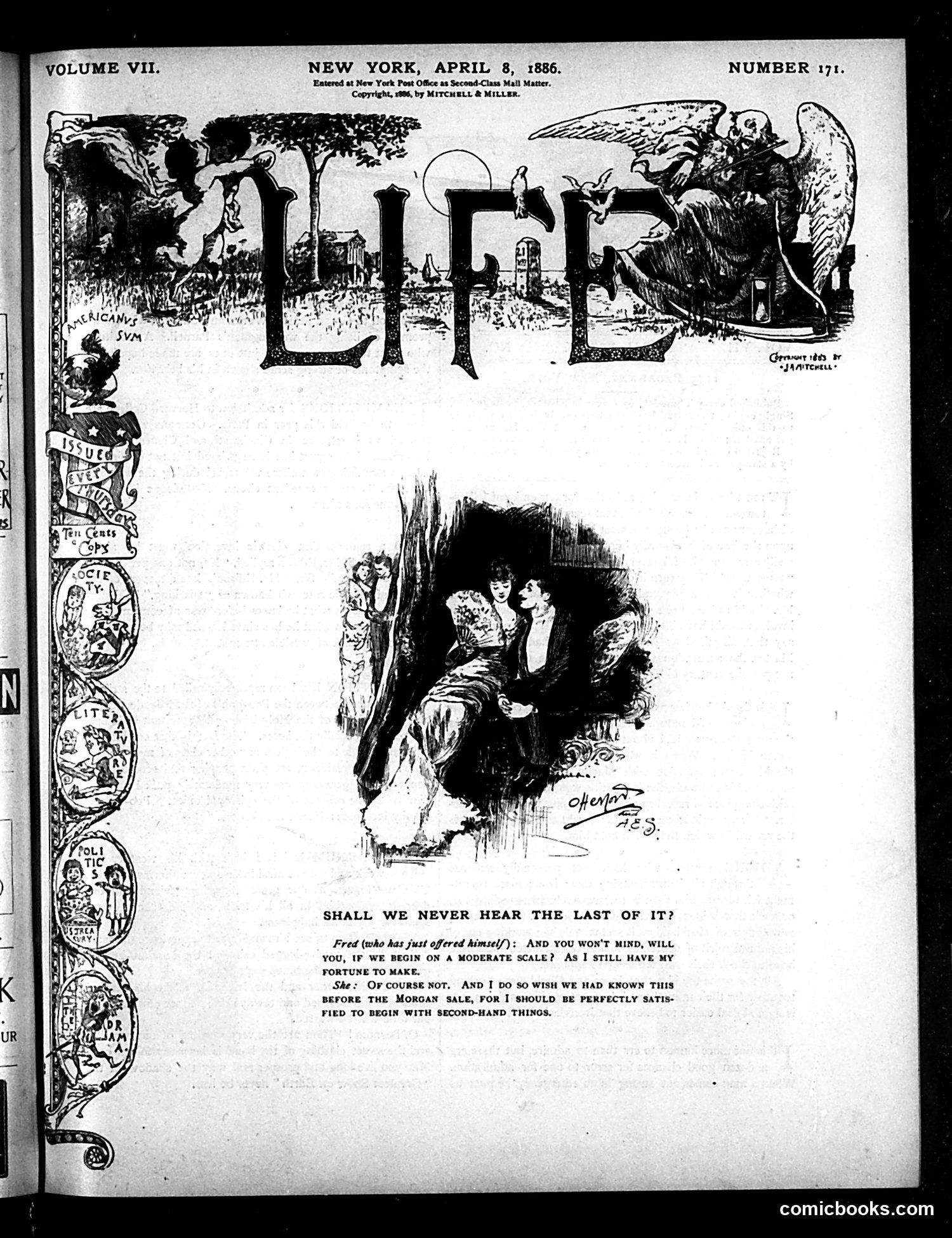
This page satirizes wealthy individuals reconsidering extravagant purchases. The illustration shows a well-dressed man (labeled "Fred") and woman discussing a financial misstep. Fred has apparently offered himself as collateral and suggests they "begin on a moderate scale," implying he's already spent considerable fortune. The woman responds that she wishes they'd known "before the Morgan sale" that they should have "started with second-hand things"—referencing what appears to be a major auction or financial transaction involving someone named Morgan (likely J.P. Morgan, the prominent banker/financier). The satire targets wealthy Americans' impulsive spending habits and the consequences when market conditions shift, mocking their assumption of unlimited resources.
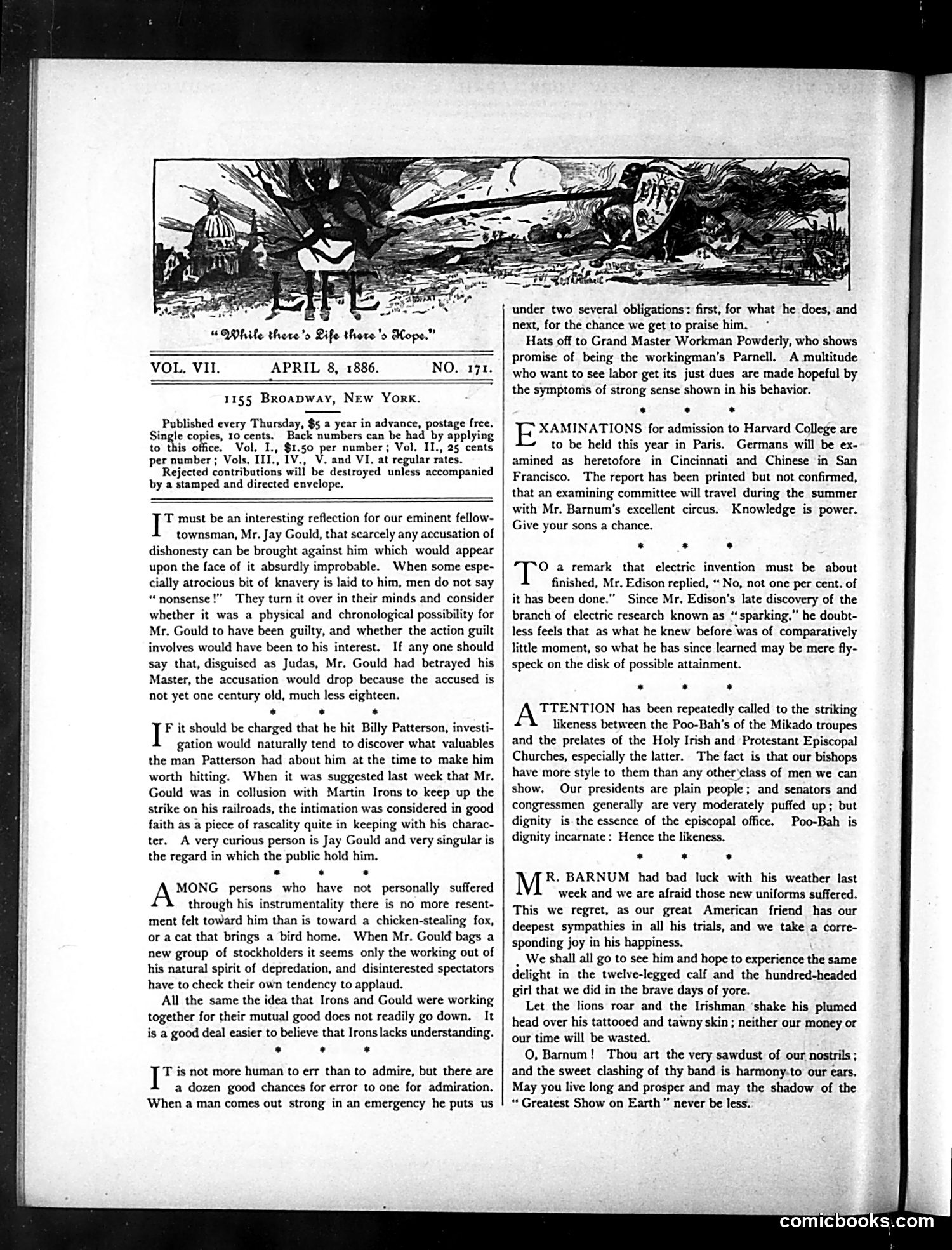
The page contains primarily **editorial commentary** rather than political cartoons. The masthead cartoon (top) appears illustrative but unclear in specific reference. The text defends **Jay Gould** against accusations of dishonesty and collusion, arguing his accusers lack chronological evidence. It addresses allegations he conspired with railroad interests (possibly regarding the **Irons strike**) and suggests critics should reconsider before judging him. Other brief items mention **Mr. Barnum** (circus proprietor), **Harvard College** admissions, and **Edison's electrical inventions**. The dominant piece is a **pro-Gould editorial**—unusual for a satirical magazine—suggesting Life had varying editorial positions or that defending wealthy industrialists represented legitimate contemporary debate.
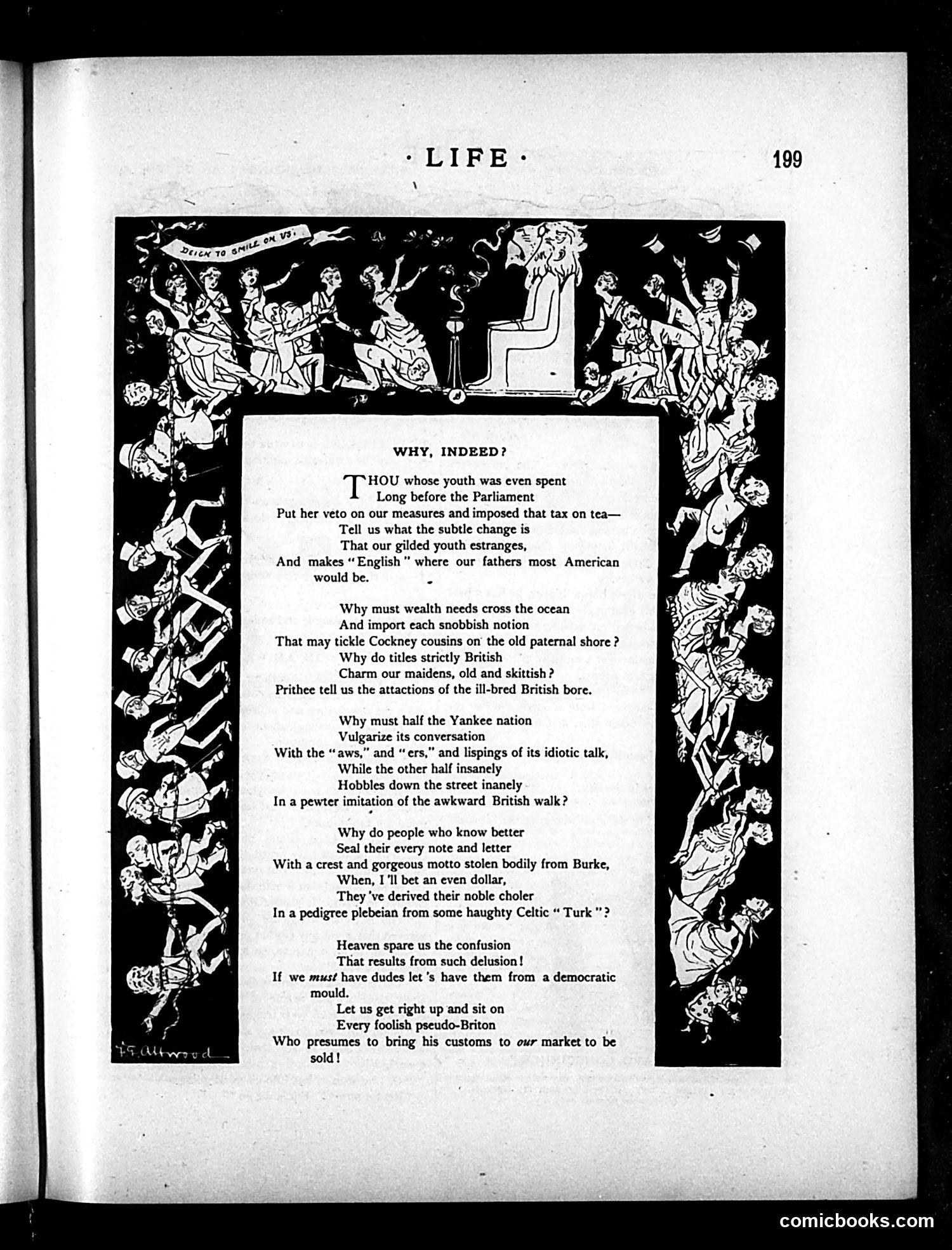
This satirical poem attacks Anglophilia among wealthy American elites. The verse criticizes Americans who adopt British mannerisms, speech patterns, and customs despite the nation's democratic founding. Key targets include: - Wealthy youth spending time in Parliament and adopting British habits - American heiresses marrying British nobility ("tickle Cockney cousins") - Americans imitating British accents and pronunciation ("awes" and "ers") - Pretentious genealogies falsely traced to British nobility The ornate decorative border framing the text appears to show classical or Baroque figures in satirical poses, emphasizing the mockery of affected "high culture." The poem's core argument: Americans should reject British affectation and embrace democratic values instead of importing foreign snobbery. This reflects recurring American anxiety about class pretension and foreign influence.
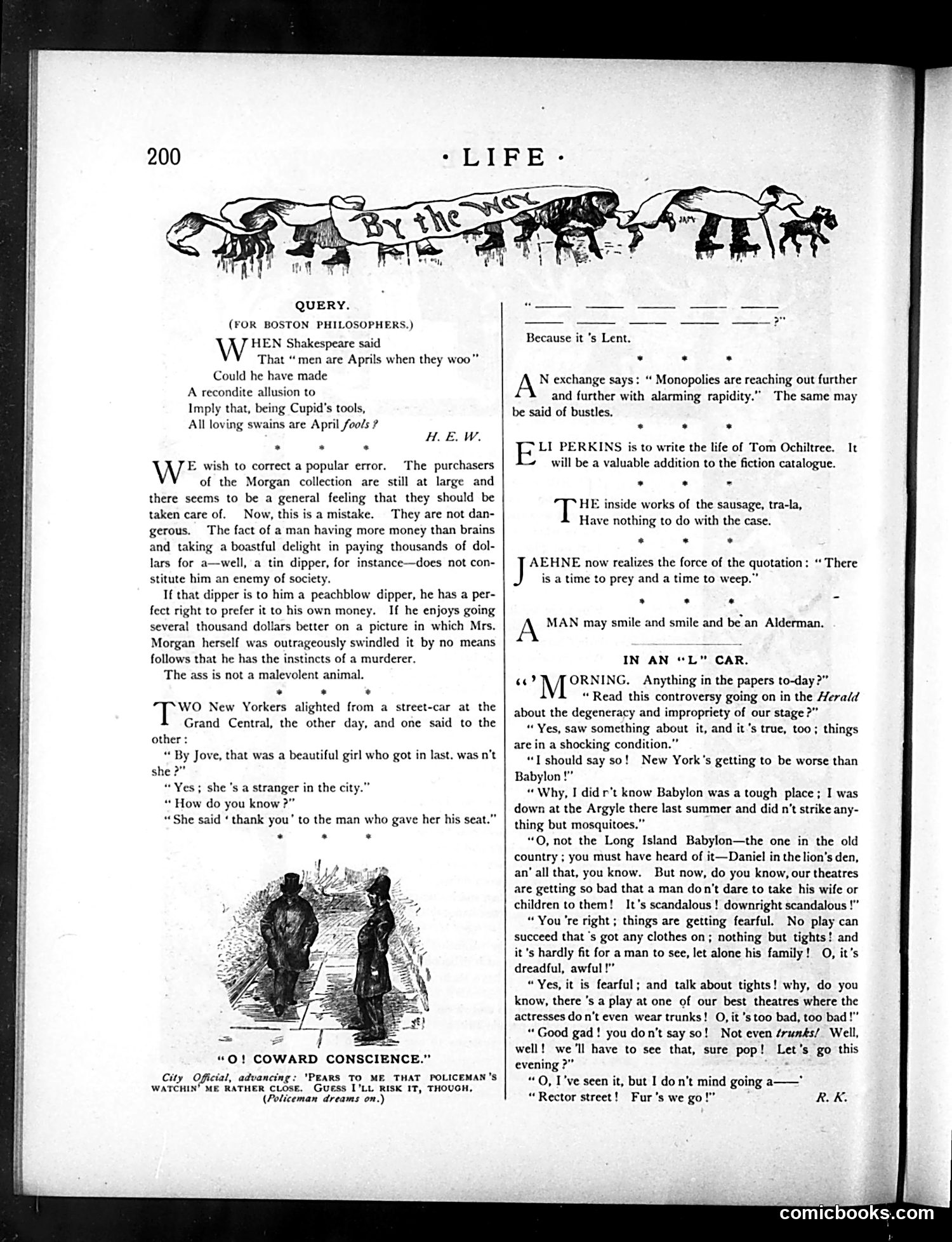
This page contains literary commentary and social satire rather than political cartoons. The "Query" section discusses Shakespeare and the Morgan art collection, correcting misconceptions about wealthy collectors—suggesting that owning expensive art doesn't confer cultural sophistication or social standing. The "In an 'L' Car" dialogue satirizes New York theater audiences complaining about declining stage quality and indecent costumes. The speakers worry theaters have become "scandalous" with actresses wearing insufficient clothing and risqué plays unsuitable for families—reflecting early 20th-century anxieties about theatrical morality. The small illustration labeled "O! Coward Conscience" depicts two figures on a street, likely illustrating a moment of moral discomfort or hypocrisy, though the specific reference remains unclear without additional context.
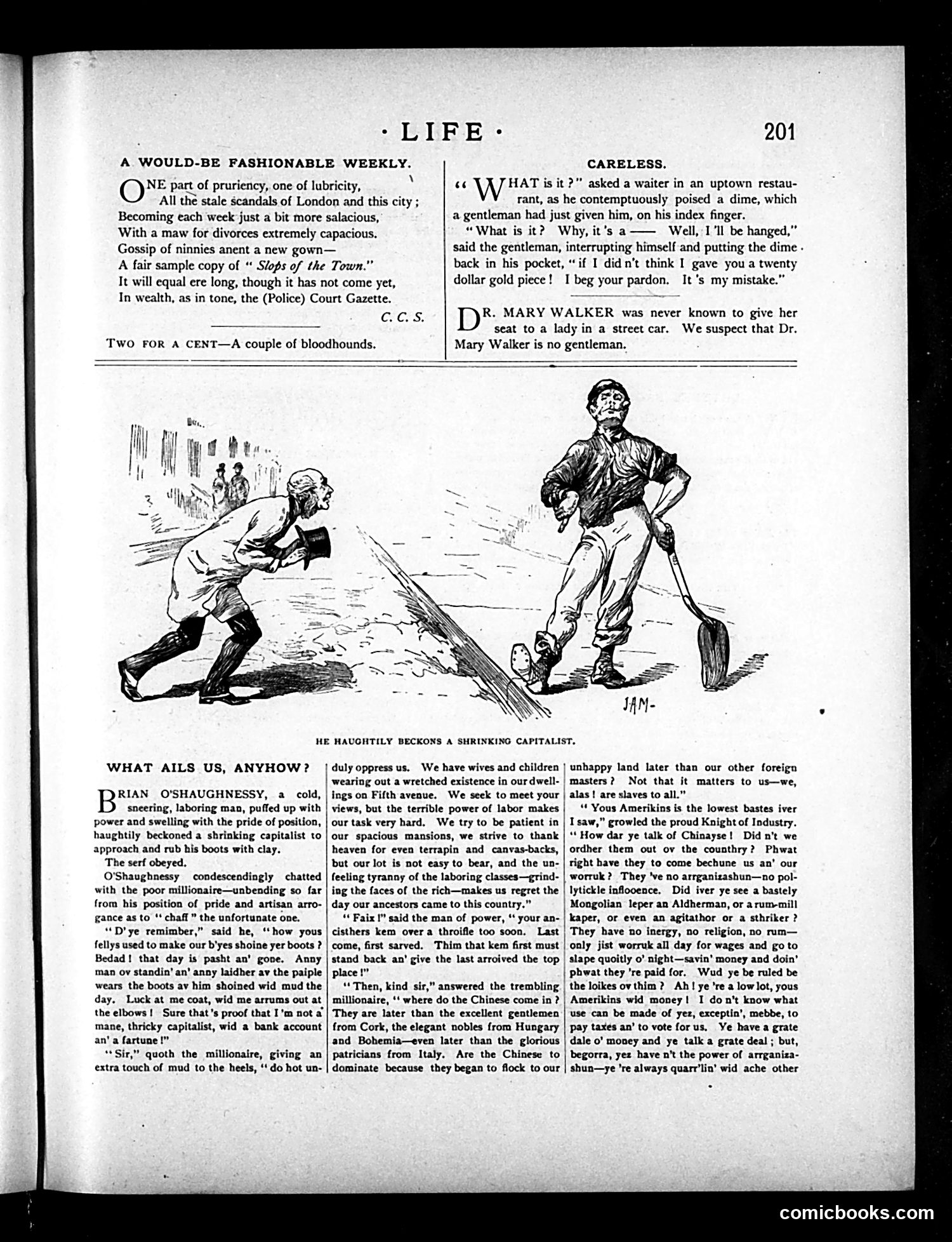
**The Main Cartoon:** The illustration titled "He Haughtily Beckons a Shrinking Capitalist" depicts two figures in a confrontational stance, apparently representing labor and capital in conflict. One figure appears menacing while the other recoils—satirizing the tension between working-class demands and wealthy industrialists' resistance. **The Article "What Ails Us, Anyhow?":** Brian O'Shaughnessy, described as a cold, energetic laboring man, complains to a capitalist about poor wages, working conditions, and harsh treatment. He invokes immigrant labor competition and questions why foreign workers—Chinese, Italian, Hungarian—are allowed to undercut wages. **The Satire's Point:** The piece critiques both labor grievances and working-class xenophobia, presenting O'Shaughnessy as simultaneously sympathetic (exploited worker) yet prejudiced (blaming foreign immigrants rather than systemic exploitation).
This page contains several sections: a dialogue joke titled "APPEARANCES VERY DECEIVING" about a young man meeting a girl at "the toboggran slide" who weighs ninety pounds, and "THE MINISTER'S CHARGE" (a brief joke about marriage fees). The main content is a literary review titled "A ROMANCE OF BEEKMAN PLACE," discussing Sidney Luska's new story "Mrs. Peixada." The reviewer praises the work's character development and romantic intrigue set in New York's Jewish quarter around Beekman Place, comparing it favorably to Hugh Conway's "Dark Days." The page also includes a "Letters from the People" section with reader correspondence on various topics. There are no political cartoons visible on this particular page—it's primarily satirical prose humor and literary criticism.
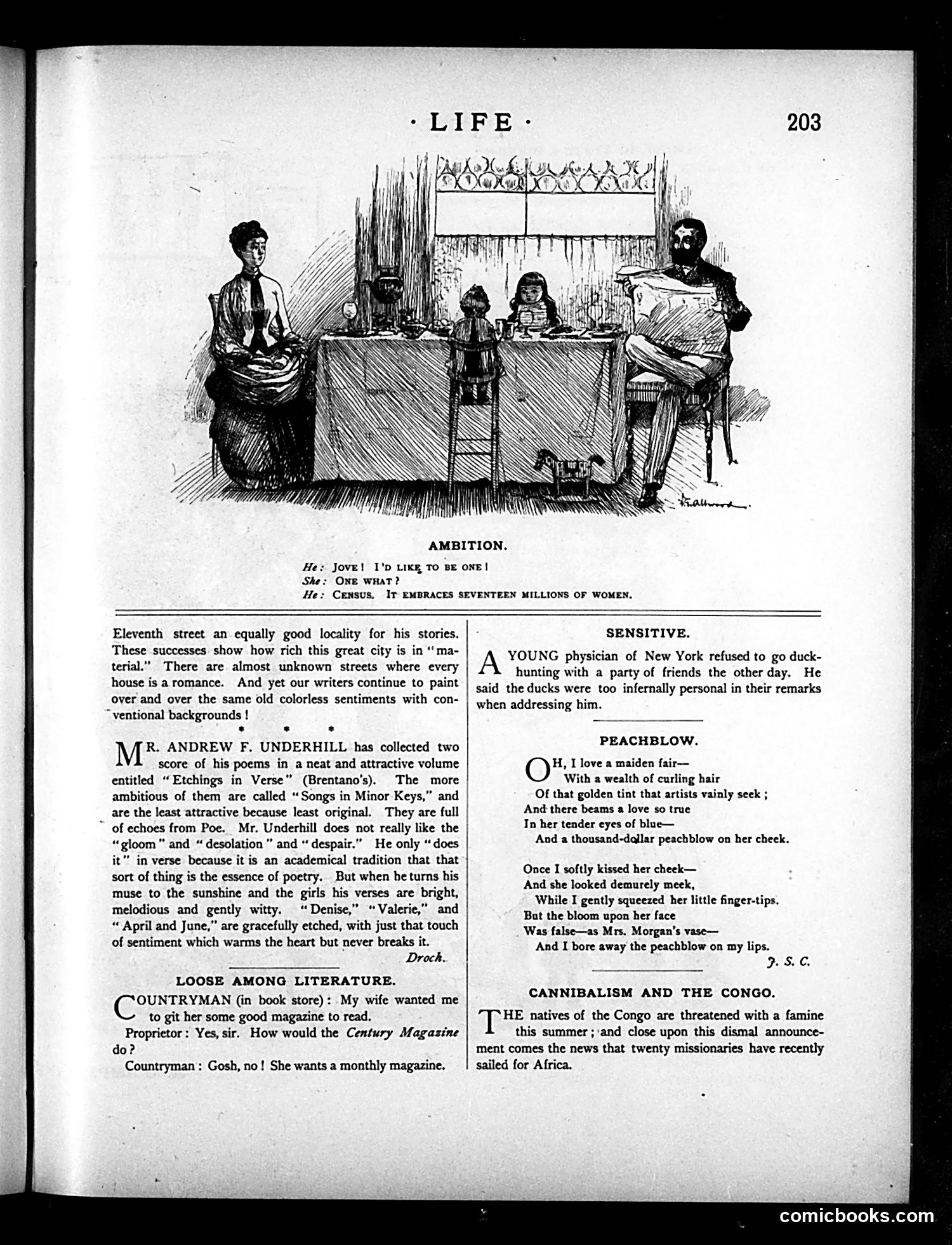
**The "Ambition" Cartoon:** This sketch depicts a census official at a desk interviewing a woman. The joke hinges on the woman's stated ambition: "I'd like to be one!" When asked "One what?" she replies, "Census. It embraces seventeen millions of women." The satire mocks women's limited career aspirations and employment opportunities in this era—the census being presented as an absurdly modest professional goal. It also satirizes the vast number of women (17 million) apparently unaccounted for or invisible in society. **Text Content:** The page includes literary criticism and humorous anecdotes alongside the cartoon. One piece critiques Andrew Underhill's poetry collection, another mocks a New York physician's sensitivity about duck-hunting, and a final item presents dialogue about magazine preferences.
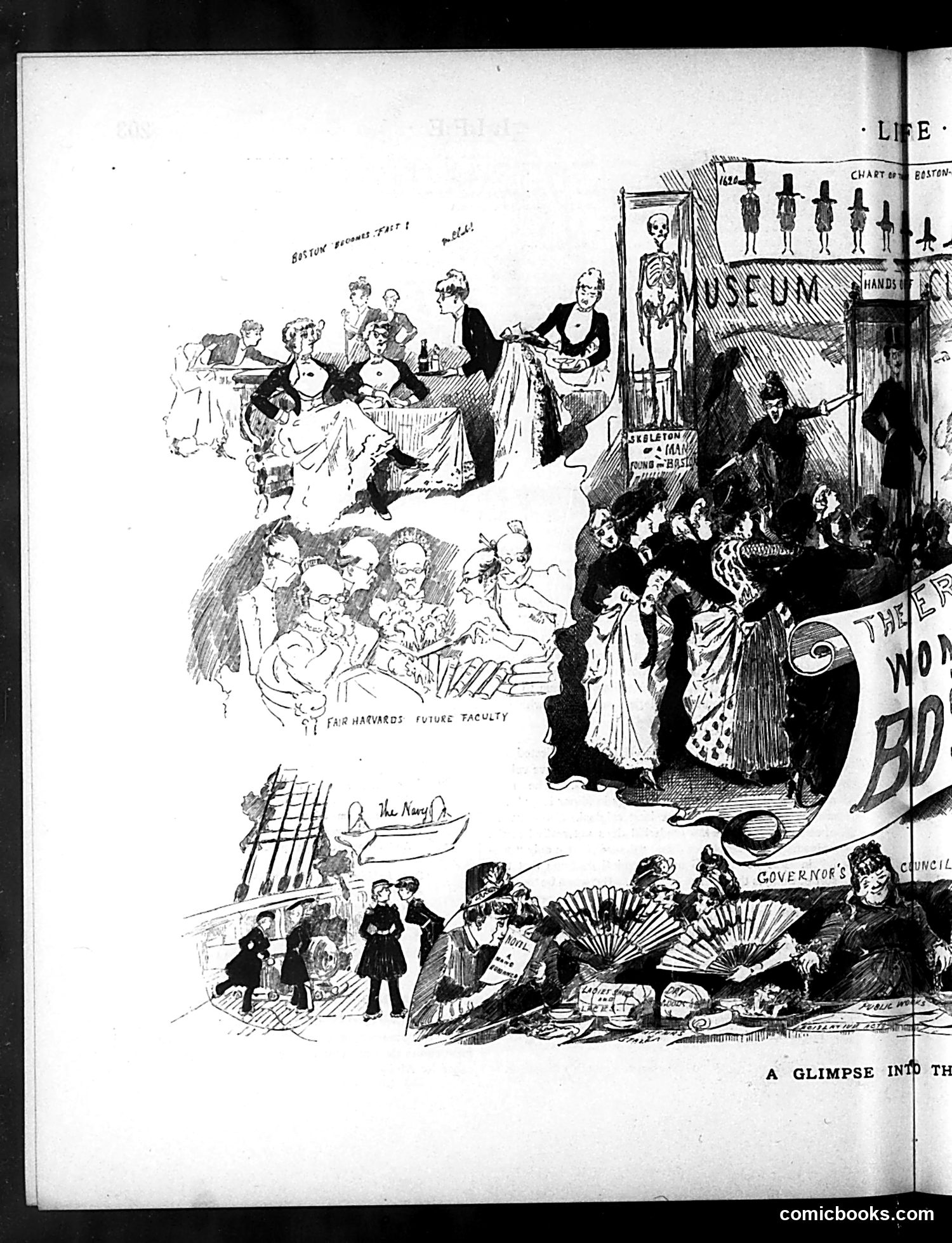
This page shows "A Glimpse Into" (title cut off) featuring satirical sketches of Boston society. The visible scenes include: **Top section**: "Boston's Finest Part" - appears to depict Boston's elite social scene with well-dressed figures at what looks like a formal gathering or dinner. **Middle section**: Labeled "Harvard's Future Faculty" - caricatures of what appear to be Harvard scholars or academics. **Bottom section**: "The Navy" scene - shows naval personnel and what appears to be a governor's council, with figures in formal dress and military attire. The cartoons satirize Boston's institutional and social hierarchies—Harvard's academic establishment, naval affairs, and political governance. The exaggerated physical caricatures and social positioning mock Boston's prominent institutions and their leaders, typical of Life magazine's satirical approach to American society and power structures.
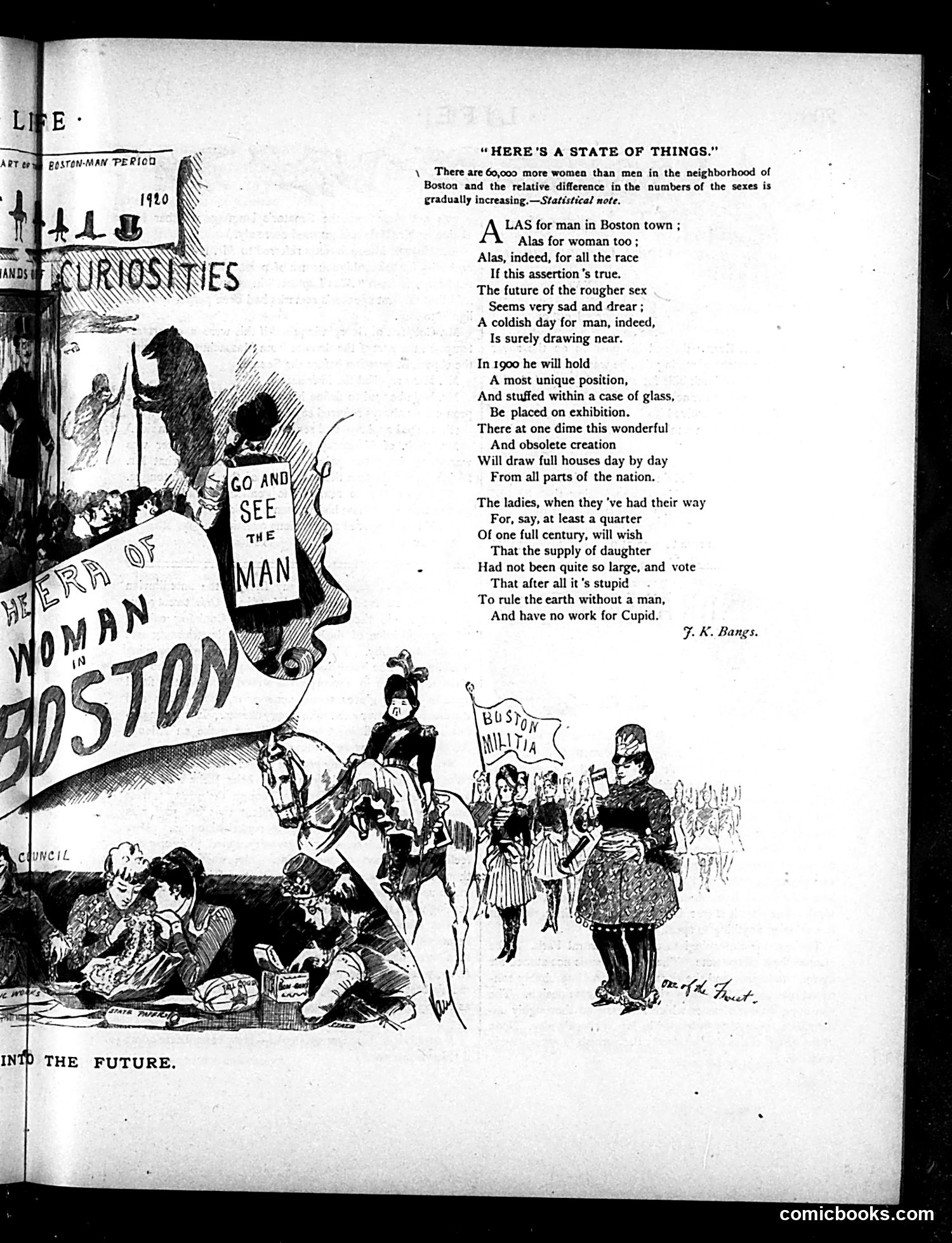
This 1880 Life magazine page satirizes anxieties about Boston's gender imbalance. A statistical note states there are 60,000 more women than men in the area, and the poem by J.K. Bangs humorously explores this problem's consequences. The cartoon depicts the feared future: by 1900, the last man will be displayed in a museum case as an extinct curiosity, drawing crowds. Meanwhile, women govern independently—shown marching with a "Boston Militia" banner and performing civic duties without male participation. The satire mocks contemporary fears about women's increasing independence and suffrage movements. The poem suggests women will eventually regret the gender imbalance and wish they hadn't advocated for "rule[ing] the earth without a man." It's comedic commentary on both demographic anxiety and anti-feminist sentiment of the era.
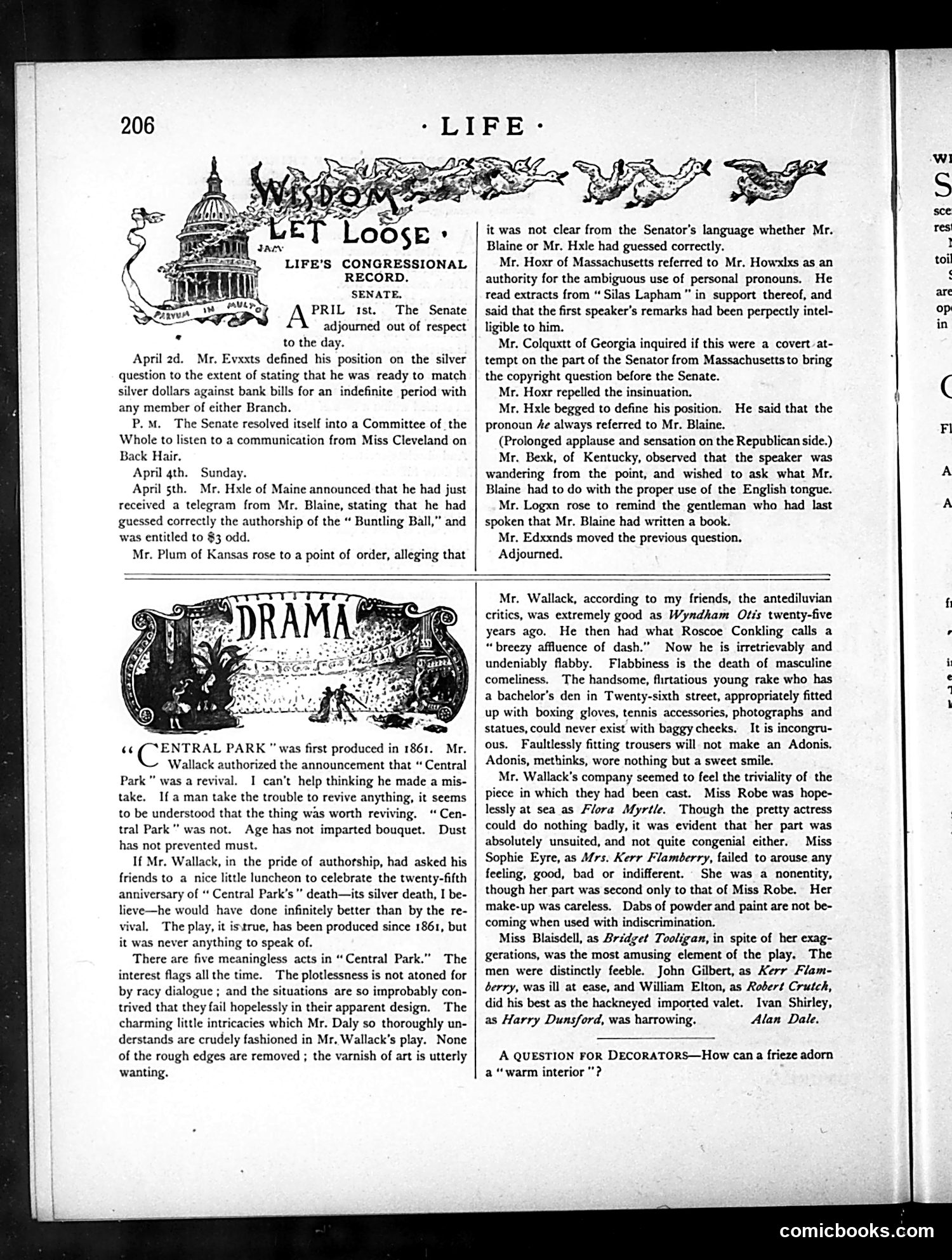
This page satirizes both Congress and theater through mock-serious commentary. **"Let Loose" (Congressional Record):** Life ridicules Senate ineffectuality by reporting absurd proceedings: senators debating whether Blaine or Hale guessed the authorship of "The Bungling Ball," a trivial dispute that somehow invokes literary criticism (Howells' *Silas Lapham*) and copyright law. The joke exposes how senators waste time on meaningless minutiae while avoiding substantive work. References to real figures like Evarts (silver question), Blaine, and Logan suggest actual Senate dysfunction dressed in ridiculous language. **Drama Section:** The critic savagely reviews Lester Wallack's revival of *Central Park* (originally 1861). The satire attacks both the play's quality—"plotless," "meaningless acts," "improbably contrived"—and Wallack's aging appearance. The comparison of young Wallack's "breezy affluence of dash" to his now-"flabby" present mocks theatrical vanity and physical decline, suggesting revival theater itself is pointless nostalgia. Both sections ridicule institutional irrelevance and wasted effort.
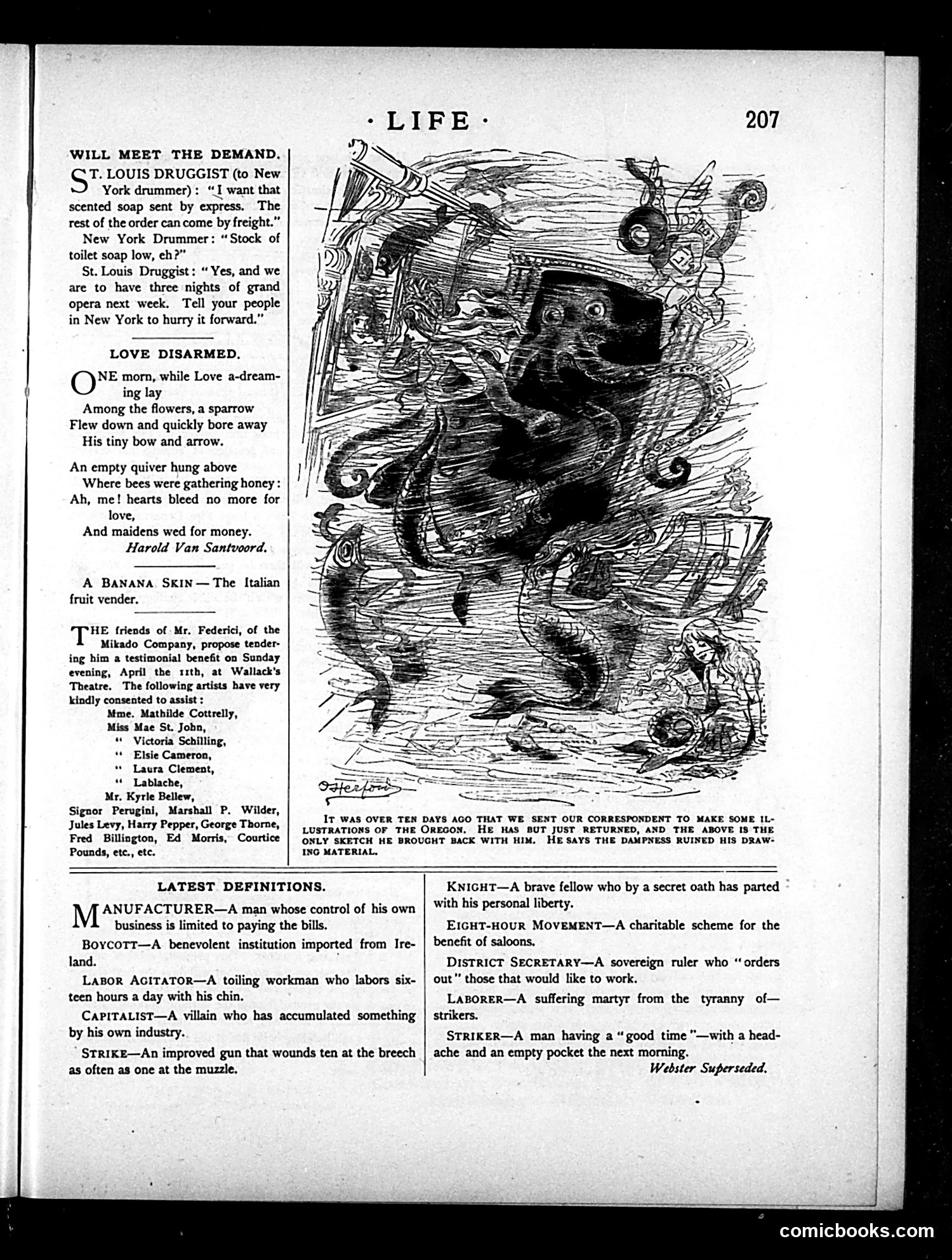
This page contains several satirical pieces. The main cartoon shows a chaotic domestic scene, likely depicting marital discord or household upheaval. The opening anecdote mocks social climbing: a St. Louis druggist urgently needs scented soap for an upcoming opera season, implying he's rushing to appear cultured and refined before wealthy guests. "Love Disarmed" is sentimental verse: Cupid loses his bow to a sparrow, symbolizing that modern women marry for money rather than love. The "Latest Definitions" section offers biting political satire on labor disputes and class conflict—then a contentious issue. It presents cynical redefinitions: manufacturers are enslaved by bills, capitalists are villains, strikers are unemployed troublemakers with hangovers, and an "eight-hour movement" supposedly benefits only saloons (bars). The satire targets labor agitators while mocking business owners, reflecting the era's intense class tensions and skepticism toward workers' organizing.
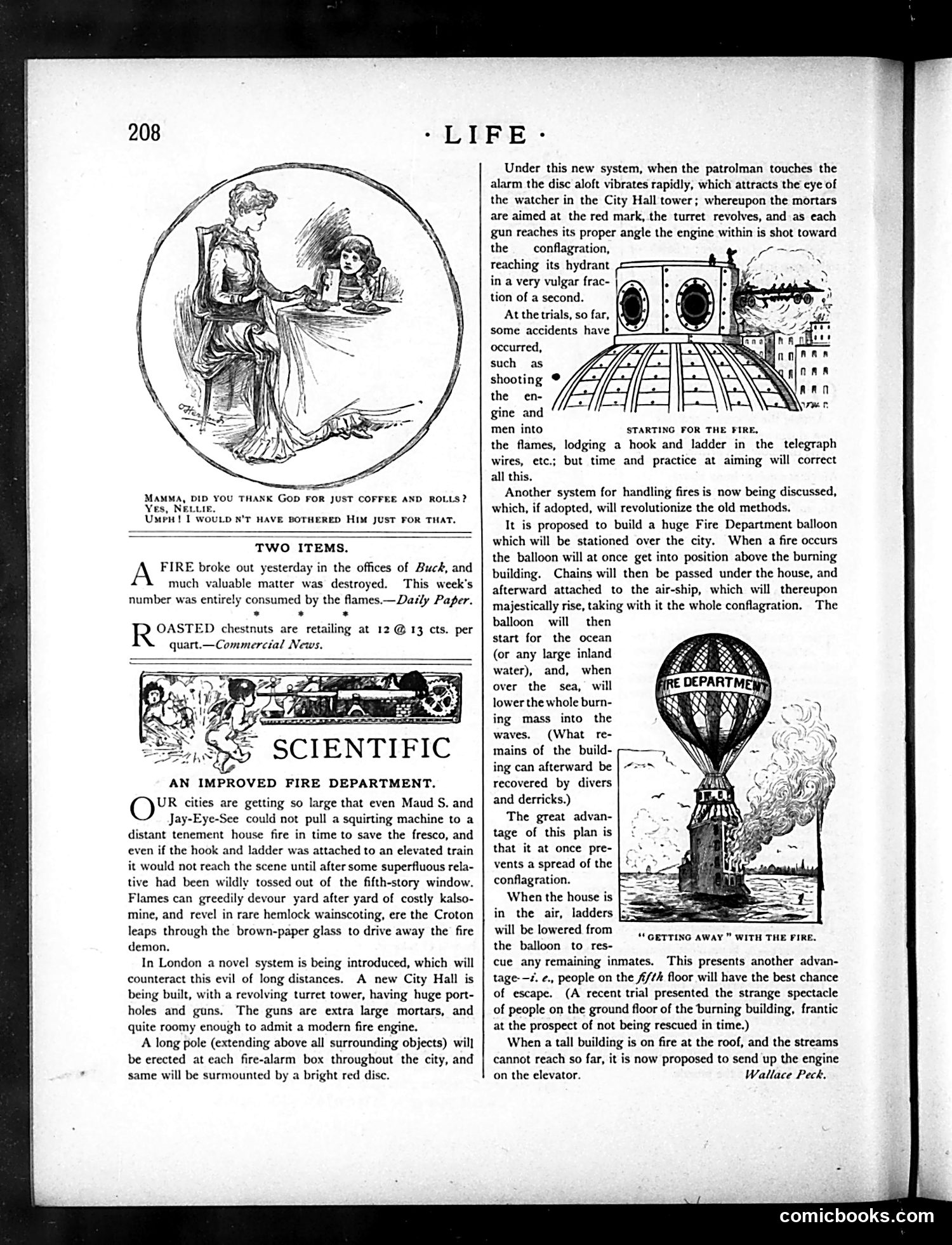
This page satirizes proposed "improvements" to London and American fire departments that are absurdly impractical. The humor lies in presenting ridiculous solutions to real urban problems—as cities grew larger, traditional fire brigades couldn't respond quickly enough. The first proposal mocks a rotating turret tower in a new City Hall that shoots fire engines via mortars at burning buildings. The satire notes accidents already occurred: engines and men were shot into flames and tangled in telegraph wires. The second scheme is more fantastical: a massive balloon stationed over the city would grab burning buildings with chains and carry them out to sea, dumping the conflagration into waves. The joke highlights the absurd logic—people on higher floors would have "better" escape chances than those below. Both proposals exaggerate real attempts to solve genuine problems (distance, response time) through increasingly baroque technological solutions, suggesting that Victorian-era faith in mechanical innovation had become laughably disconnected from practical reality.
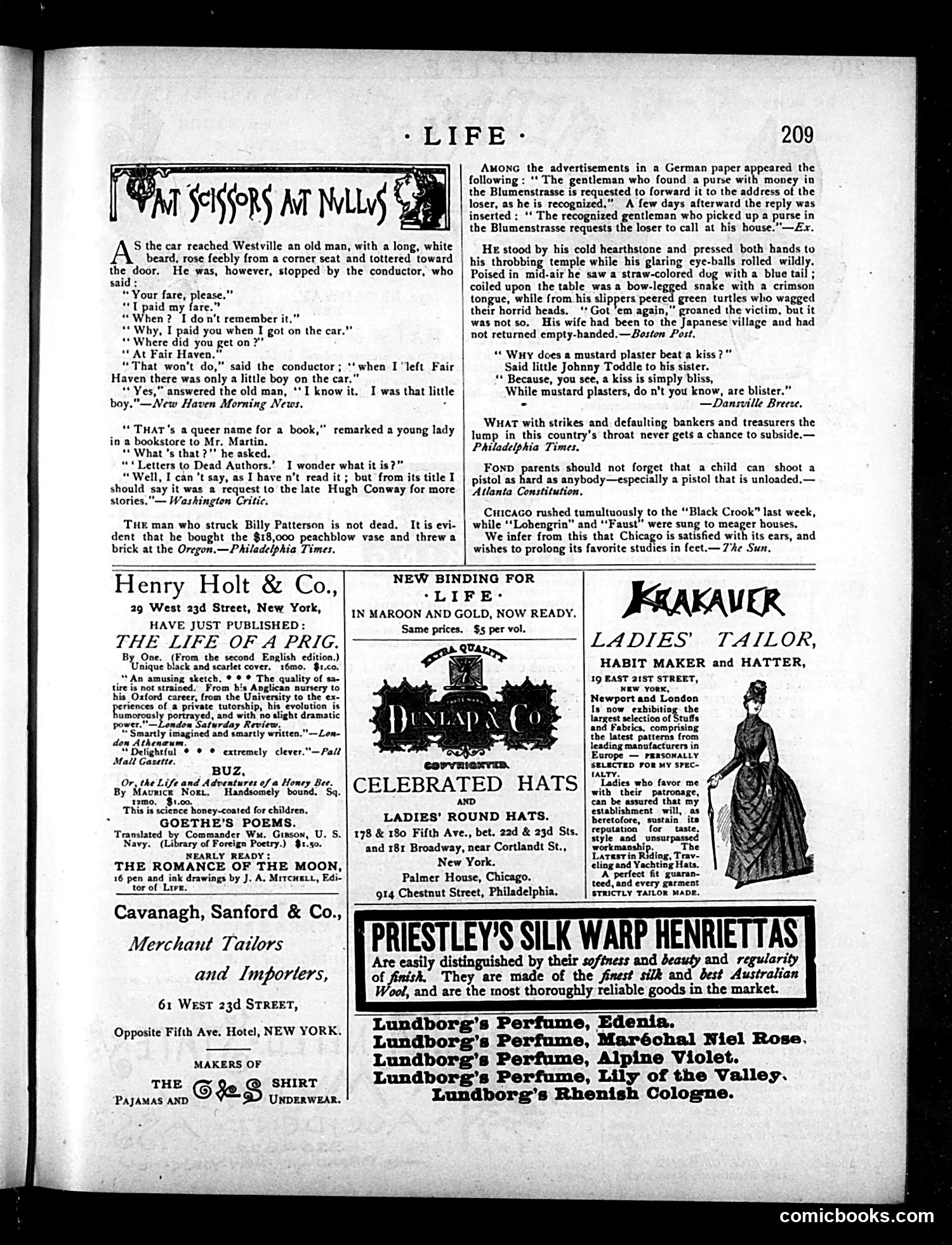
This page is primarily **advertisements and humor anecdotes** from Life magazine. The top half contains several short, satirical jokes typical of the era's humor magazines: 1. **The conductor and old man joke**: A conductor doesn't recognize an elderly passenger who claims he boarded at Fair Haven, leading to the punchline that the passenger was once a little boy there. 2. **The "Letters to Dead Authors" joke**: A bookstore conversation making fun of author Hugh Conway. 3. **A German newspaper ad absurdity**: A lost purse announcement where the finder asks the loser to collect it from him—suggesting the "honest" finder wants a reward. 4. **Hallucination joke**: A man sees imaginary animals (colored dog, snake, turtles) at home after his wife visits "the Japanese village." The remaining content consists entirely of **period advertisements** for clothing, hats, perfumes, and books. The page contains no political cartoons—it's a standard advertising and humor section characteristic of 19th-century satirical magazines.
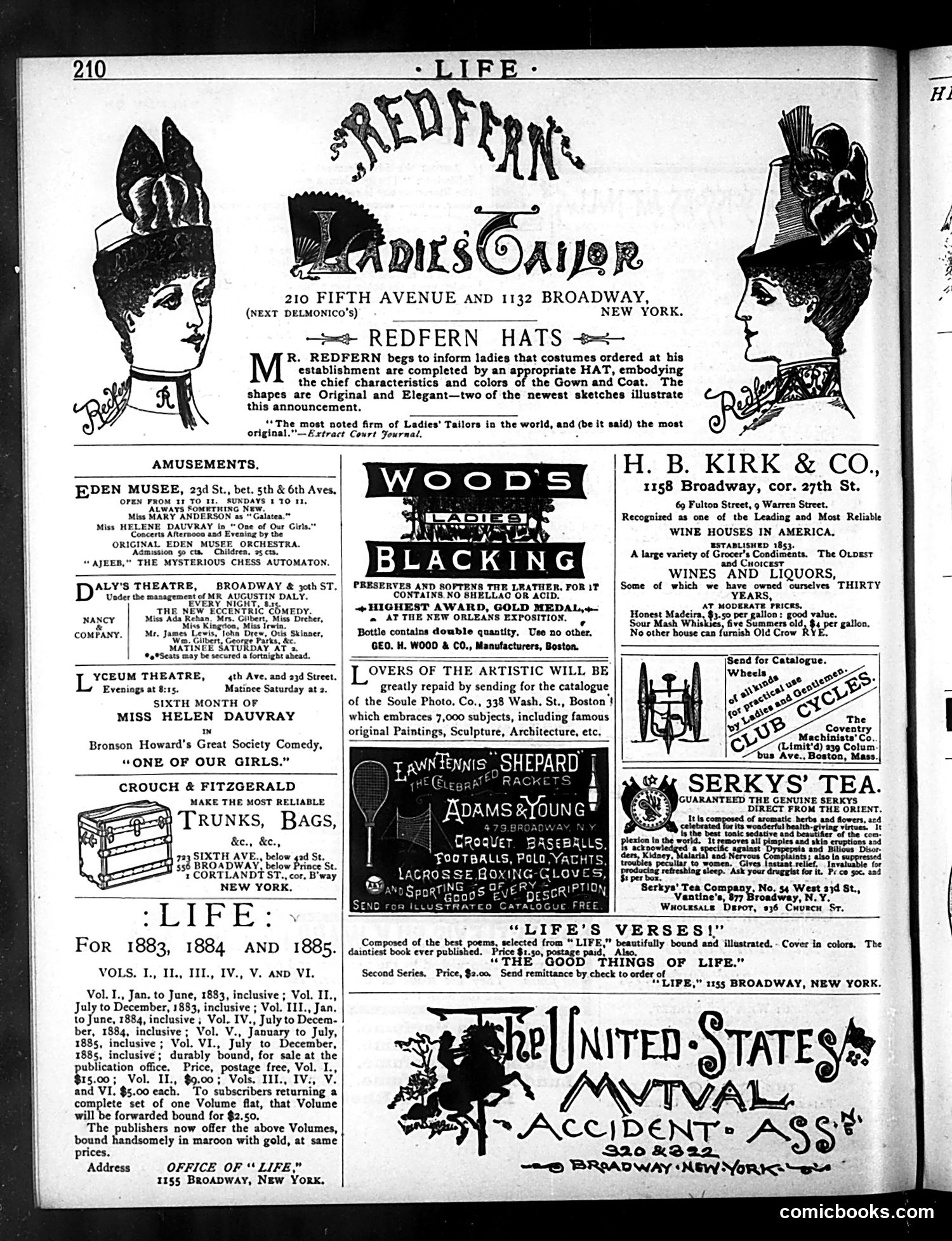
This page is primarily **advertising and announcements**, typical of 1880s Life magazine. There are no political cartoons or satirical illustrations with identifiable figures. The content includes: - **Redfern Hats advertisement**: A ladies' fashion house announcing that ordered costumes come with coordinated hats embodying the dress and coat's characteristics. Two sketched hat designs illustrate the announcement. - **Theater listings**: Multiple Broadway venues advertising productions, including Helen Dauvray in "One of Our Girls." - **Product ads**: Shoe blacking, wine merchants (H.B. Kirk & Co.), luggage makers, and various other commercial goods typical of the era. - **Life magazine back-volume sales**: Advertising bound collections of Life from 1883-1885. The page reflects **1880s urban consumer culture**—fashion, theater, and luxury goods marketed to Life's affluent New York readership. No satire or political commentary is evident; this appears to be a standard revenue-generating advertisement section.
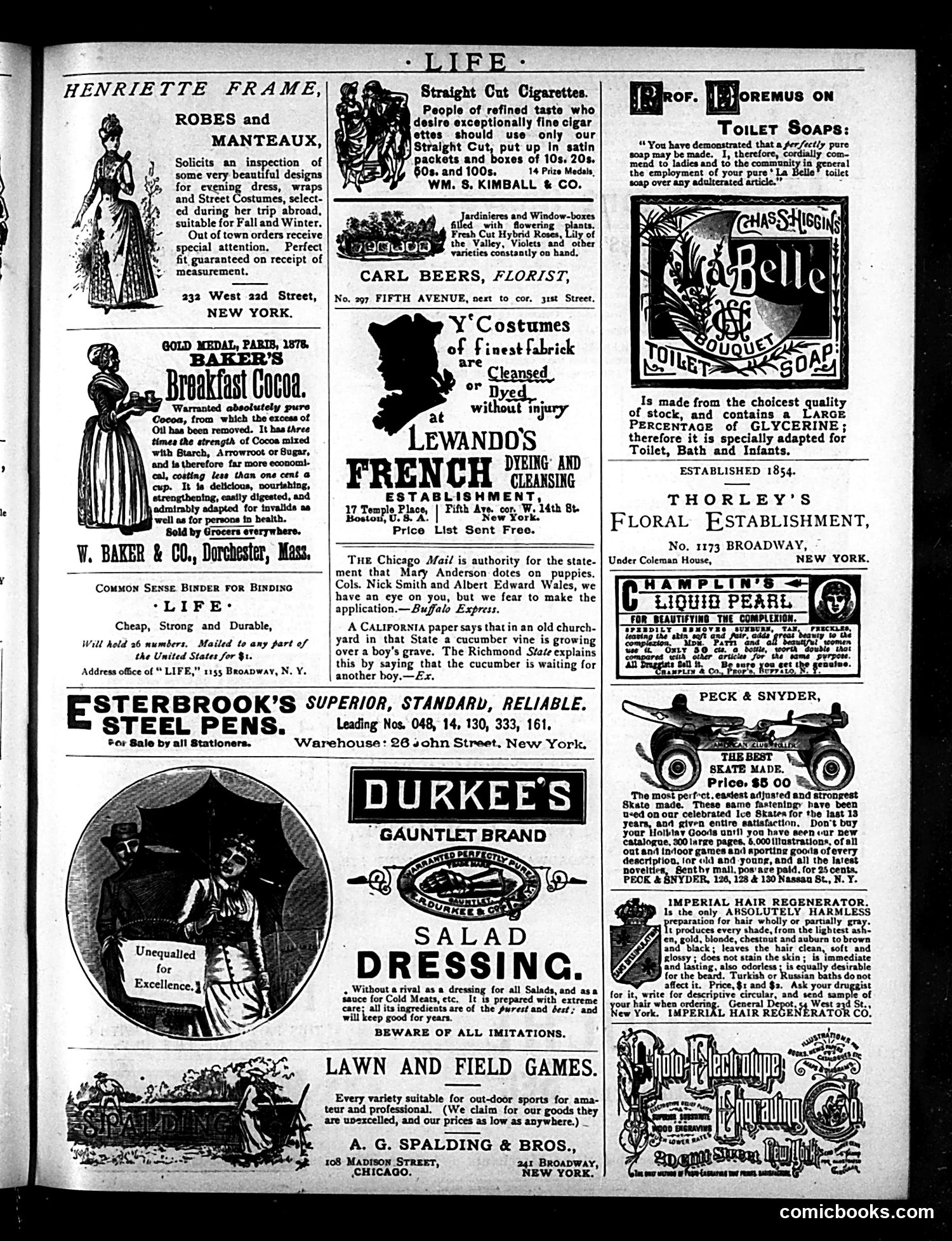
This is primarily an **advertising page** with minimal editorial content. The advertisements reflect late-19th-century consumer culture and include: **Notable ads:** - Women's fashion (Henriette Frame's robes and mantels) - Toiletries (La Belle soap, Imperial Hair Regenerator) - Food products (Breakfast Cocoa, Durkee's Salad Dressing) - Office supplies (Esterbrook steel pens) - Sports equipment (Spalding lawn games, Peck & Snyder ice skates) **The only satirical content** appears to be brief newspaper gossip items in the middle: references to actress Mary Anderson and puppies, and a joke about a cucumber vine growing over a boy's grave in California. These are light, society-page humor typical of Life's style. The page documents consumer aspirations of the period—refined tastes, imported goods, and leisure activities—rather than political satire.
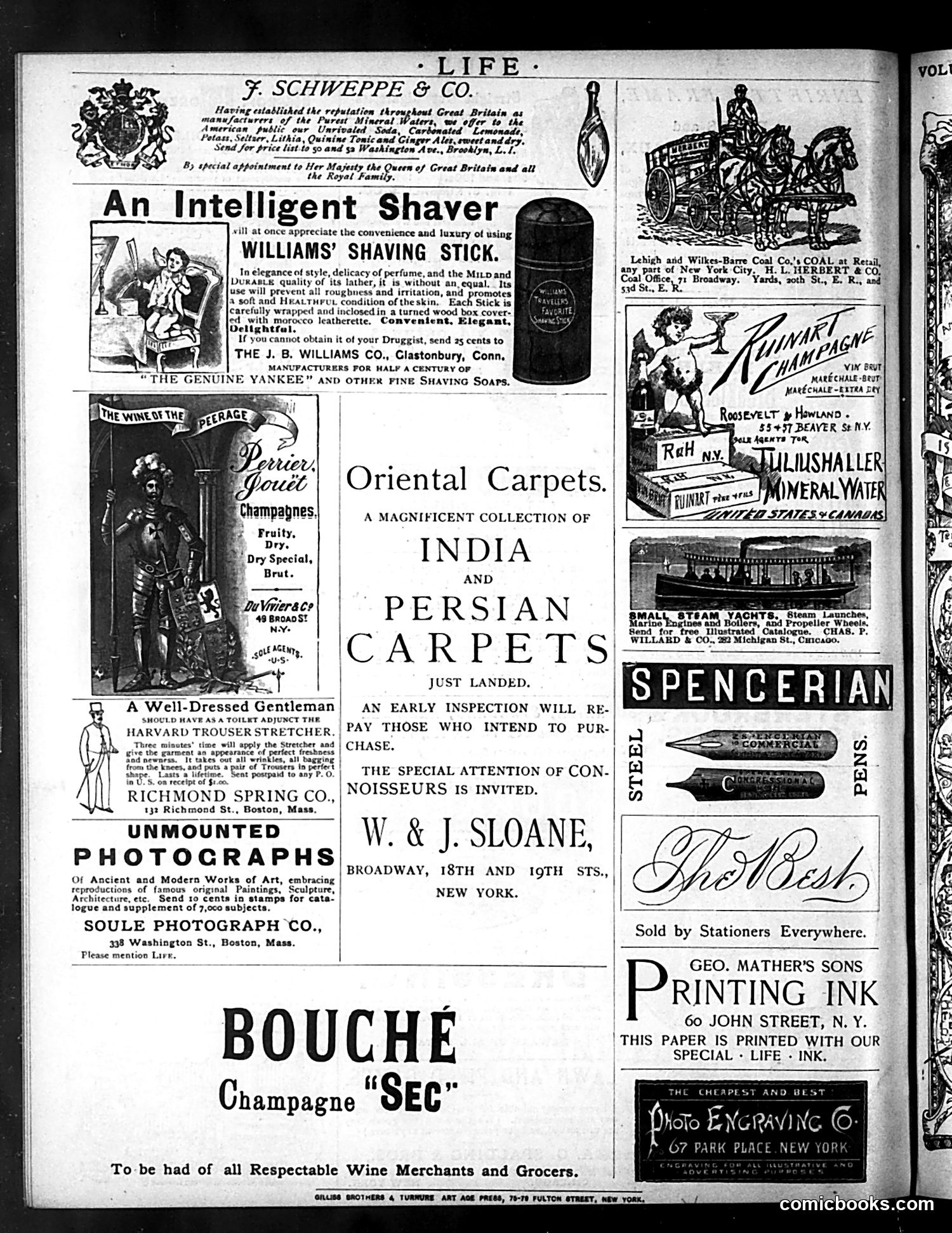
This page is primarily **advertising**, not political satire or commentary. It contains commercial notices for consumer goods typical of the late 19th/early 20th century. Notable ads include: - **Williams' Shaving Stick**: A grooming product marketed as elegant and convenient - **Oriental Carpets**: W. & J. Sloane advertising newly arrived Indian and Persian carpets for wealthy clientele - **Harvard Trouser Stretcher**: A device promising to keep gentlemen's trousers wrinkle-free and fresh - **Bouché Champagne**: Wine merchant advertisement - Various other luxury goods (printing inks, mineral waters, photography services) The decorative header shows Schweppes & Co., a British mineral water manufacturer with a royal warrant. There is **no discernible political cartoon or satirical content** on this page—it functions as a straightforward advertising section aimed at affluent readers of *Life* magazine.