
Life, 1886-04-08 · page 12 of 16
Life — April 8, 1886 — page 12: what you’re looking at
What you’re looking at
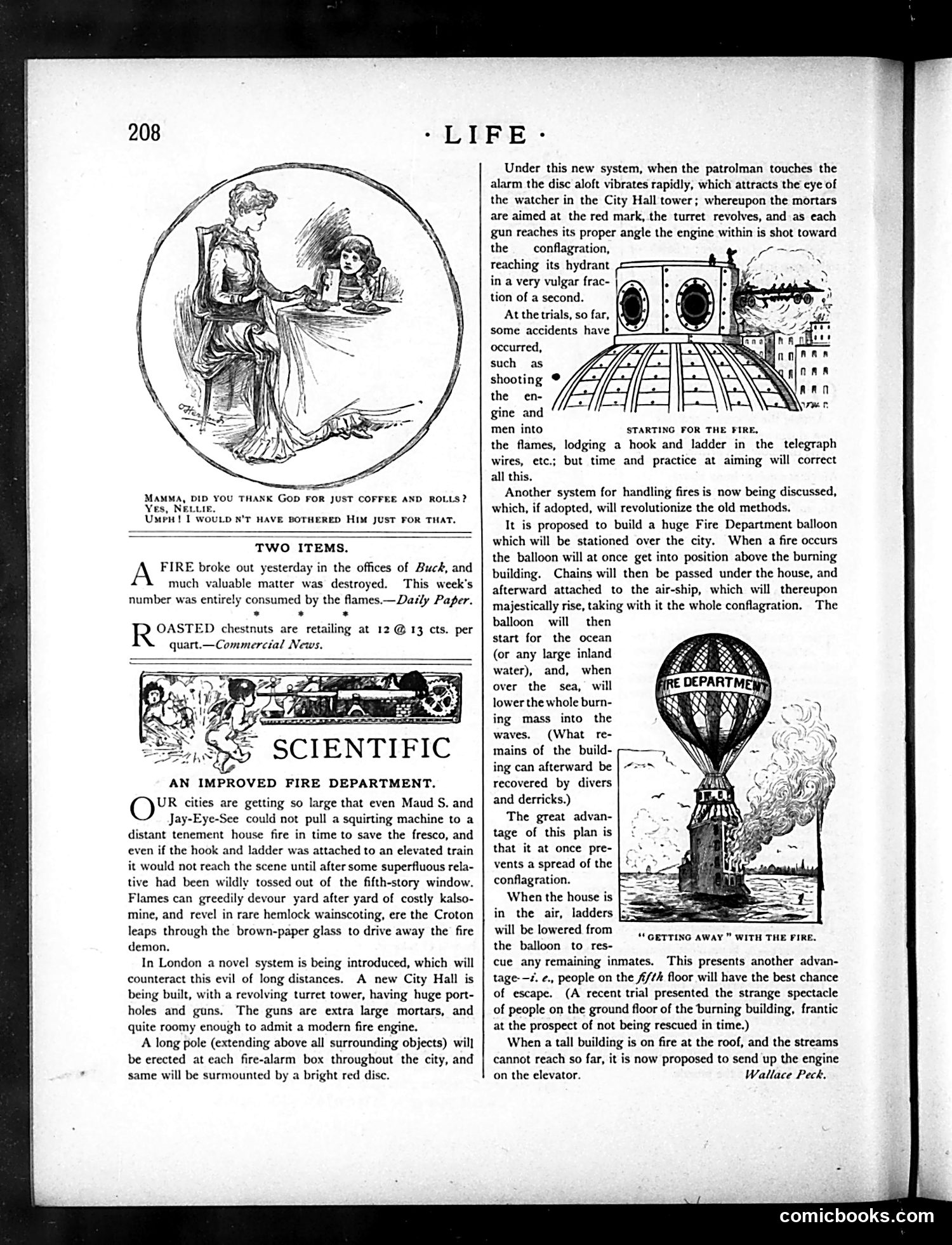
This page satirizes proposed "improvements" to London and American fire departments that are absurdly impractical. The humor lies in presenting ridiculous solutions to real urban problems—as cities grew larger, traditional fire brigades couldn't respond quickly enough. The first proposal mocks a rotating turret tower in a new City Hall that shoots fire engines via mortars at burning buildings. The satire notes accidents already occurred: engines and men were shot into flames and tangled in telegraph wires. The second scheme is more fantastical: a massive balloon stationed over the city would grab burning buildings with chains and carry them out to sea, dumping the conflagration into waves. The joke highlights the absurd logic—people on higher floors would have "better" escape chances than those below. Both proposals exaggerate real attempts to solve genuine problems (distance, response time) through increasingly baroque technological solutions, suggesting that Victorian-era faith in mechanical innovation had become laughably disconnected from practical reality.
📄 Transcribed text from this page (OCR, searchable)
Machine-transcribed from the original scan — historical spelling and the odd misread are preserved.
- LIFE: UNG as MAMMA, DID YOU THANK GOD FOR JUST COFFEE AND ROLLS? Yes, NELLIE. Umeu! T WOULD N'T HAVE BOTHERED Him just FOR THAT. TWO ITEMS. A FIRE broke out yesterday in the offices of Buck, and much valuable matter was destroyed. This week's number was entirely consumed by the flames.—Dasly Paper. . . * OASTED chestnuts are retailing at 12 @ 13 cts. per quart.—Commercial News. AN IMPROVED FIRE DEPARTMENT. UR cities are getting so large that even Maud S, and Jay-Eye-See could not pull a squirting machine to a distant tenement house fire in time to save the fresco, and even if the hook and ladder was attached to an elevated train it would not reach the scene until after some superfluous rela- tive had been wildly tossed out of the fifth-story window. Flames can greedily devour yard after yard of costly kalso- mine, and revel in rare hemlock wainscoting, ere the Croton leaps through the brown-paper glass to drive away the fire demon. In London a novel system is being introduced, which will counteract this evil of long distances. A new City Hall is being built, with a revolving turret tower, having huge port- holes and guns. The guns are extra large mortars, and quite roomy enough to admit a modern fire engine. A long pole (extending above all surrounding objects) will be erected at each fire-alarm box throughout the city, and same will be surmounted by a bright red disc. Under this new system, when the patrolman touches the alarm the disc aloft vibrates rapidly, which attracts the eye of the watcher in the City Hall tower; whereupon the mortars are aimed at the red mark, the turret revolves, and as each gun reaches its proper angle the engine within is shot toward the conflagration, reaching its hydrant in a very vulgar frac- | tion of a second. At the trials, so far, some accidents have occurred, such as shooting the en- gine and men into STARTING FOR THE FIRE, the flames, lodging a hook and ladder in the telegraph wires, etc.; but time and practice at aiming will correct all this. Another system for handling fires is now being discussed, which, if adopted, will revolutionize the old methods. It is proposed to build a huge Fire Department balloon which will be stationed over the city. When a fire occurs the balloon will at once get into position above the burning building. Chains will then be passed under the house, and afterward attached to the air-ship, which will thereupon majestically rise, taking with it the whole conflagration. The balloon will then start for the ocean (or any large inland water), and, when over the sea, will lower the whole burn- ing mass into the waves, (What re- mains of the build- ing can afterward be recovered by divers and derricks.) The great advan- tage of this plan is that it at once pre- vents a spread of the conflagration. When the house is | - in the air, ladders |; will be lowered from the balloon to res- cue any remaining inmates. This presents another advan- tage-—z. ¢., people on the f/¢h floor will have the best chance of escape. (A recent trial presented the strange spectacle of people on the ground floor of the burning building, frantic at the prospect of not being rescued in time.) When a tall building is on fire at the roof, and the streams cannot reach so far, it is now proposed to send up the engine on the elevator. Wallace Peck. “GETTING AWAY ” WITH THE FIRE. comicbooks.com