
Life, 1886-04-08 · page 10 of 16
Life — April 8, 1886 — page 10: what you’re looking at
What you’re looking at
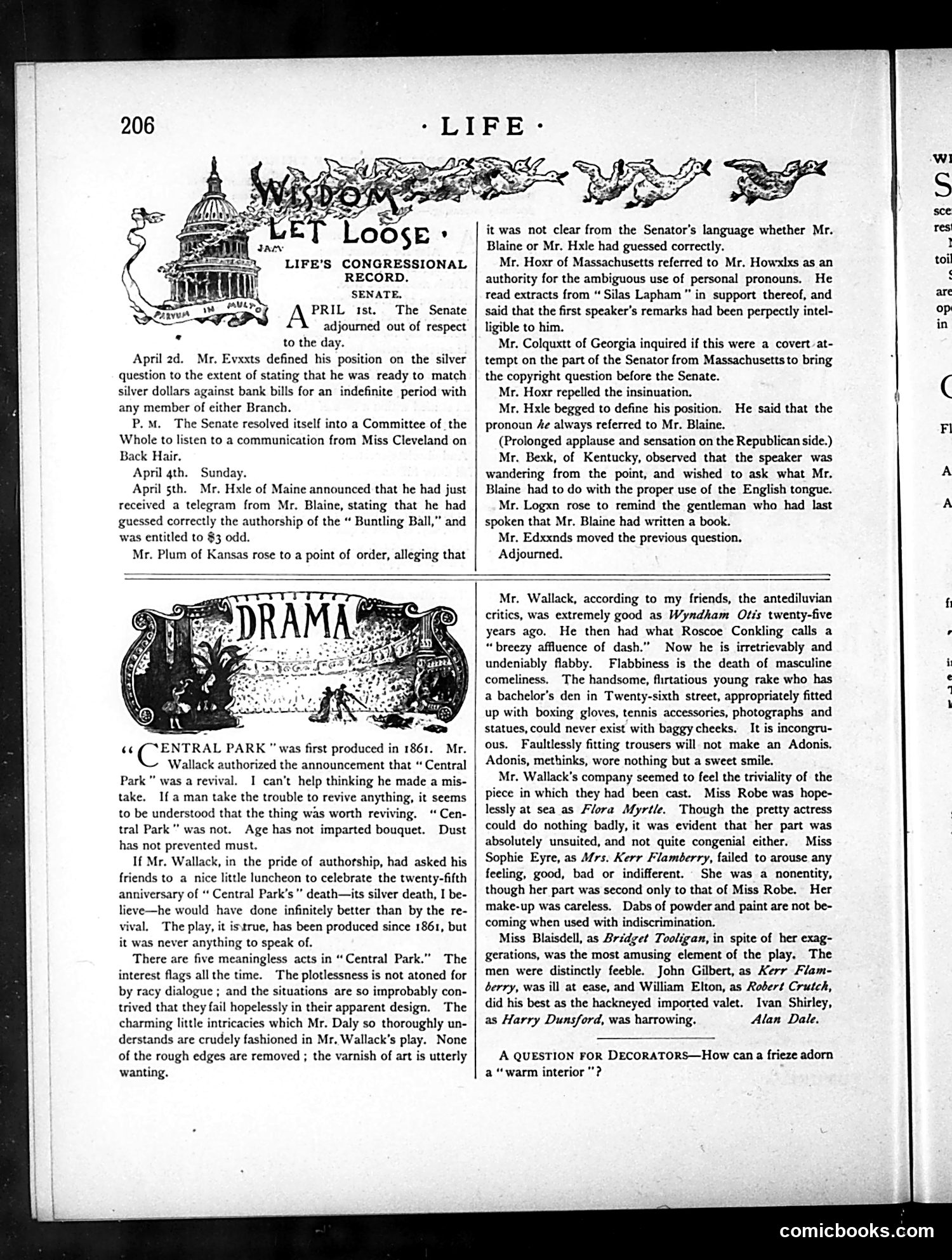
This page satirizes both Congress and theater through mock-serious commentary. **"Let Loose" (Congressional Record):** Life ridicules Senate ineffectuality by reporting absurd proceedings: senators debating whether Blaine or Hale guessed the authorship of "The Bungling Ball," a trivial dispute that somehow invokes literary criticism (Howells' *Silas Lapham*) and copyright law. The joke exposes how senators waste time on meaningless minutiae while avoiding substantive work. References to real figures like Evarts (silver question), Blaine, and Logan suggest actual Senate dysfunction dressed in ridiculous language. **Drama Section:** The critic savagely reviews Lester Wallack's revival of *Central Park* (originally 1861). The satire attacks both the play's quality—"plotless," "meaningless acts," "improbably contrived"—and Wallack's aging appearance. The comparison of young Wallack's "breezy affluence of dash" to his now-"flabby" present mocks theatrical vanity and physical decline, suggesting revival theater itself is pointless nostalgia. Both sections ridicule institutional irrelevance and wasted effort.
📄 Transcribed text from this page (OCR, searchable)
Machine-transcribed from the original scan — historical spelling and the odd misread are preserved.
LIFE’S CONGRESSIONAL RECORD. SENATE, PRIL 1st. The Senate adjourned out of respect to the day. April 2d. Mr. Evxxts defined his position on the silver question to the extent of stating that he was ready to match silver dollars against bank bills for an indefinite period with any member of either Branch. P.M. The Senate resolved itself into a Committee of the Whole to listen to a communication from Miss Cleveland on Back Hair. April 4th. Sunday. April 5th. Mr. Hxle of Maine announced that he had just received a telegram from Mr. Blaine, stating that he had guessed correctly the authorship of the “ Buntling Ball,” and was entitled to $3 odd. Mr. Plum of Kansas rose to a point of order, alleging that FO. GPX it was not clear from the Senator’s language whether Mr. Blaine or Mr. Hxle had guessed correctly. Mr. Hoxr of Massachusetts referred to Mr. Howxlxs as an authority for the ambiguous use of personal pronouns. He read extracts from “ Silas Lapham” in support thereof, and said that the first speaker’s remarks had been perpectly intel- ligible to him. Mr. Colquxtt of Georgia inquired if this were a covert at- tempt on the part of the Senator from Massachusetts to bring the copyright question before the Senate. Mr. Hoxr repelled the insinuation. Mr. Hxle begged to define his position. pronoun 4e always referred to Mr. Blaine. (Prolonged applause and sensation on the Republican side.) Mr. Bexk, of Kentucky, observed that the speaker was wandering from the point, and wished to ask what Mr. Blaine had to do with the proper use of the English tongue. Mr. Logxn rose to remind the gentleman who had last spoken that Mr. Blaine had written a book. Mr. Edxxnds moved the previous question. Adjourned. He said that the ““ ENTRAL PARK " was first produced in 1861. Mr. Wallack authorized the announcement that “ Central Park " was a revival. I can’t help thinking he made a mis- take. If a man take the trouble to revive anything, it seems to be understood that the thing was worth reviving. ‘ Cen- tral Park’ was not. Age has not imparted bouquet. Dust has not prevented must. If Mr. Wallack, in the pride of authotship, had asked his friends to a nice little luncheon to celebrate the twenty-fifth anniversary of “ Central Park's” death—its silver death, I be- lieve—he would have done infinitely better than by the re- vival. The play, it istrue, has been produced since 1861, but it was never anything to speak of. There are five meaningless acts in “Central Park.” The interest flags all the time. The plotlessness is not atoned for by racy dialogue ; and the situations are so improbably con- trived that they fail hopelessly in their apparent design. The charming little intricacies which Mr. Daly so thoroughly un- derstands are crudely fashioned in Mr. Wallack’s play. None of the rough edges are removed ; the varnish of art is utterly wanting. Mr. Wallack, according to my friends, the antediluvian critics, was extremely good as Wyndham Otis twenty-five years ago. He then had what Roscoe Conkling calls a “breezy affluence of dash.” Now he is irretrievably and undeniably flabby. Flabbiness is the death of masculine comeliness. The handsome, flirtatious young rake who has a bachelor’s den in Twenty-sixth street, appropriately fitted up with boxing gloves, tennis accessories, photographs and statues, could never exist with baggy cheeks. It is incongru- ous. Faultlessly fitting trousers will not make an Adonis, | Adonis, methinks, wore nothing but a sweet smile. Mr. Wallack’s company seemed to feel the triviality of the piece in which they had been cast. Miss Robe was hope- lessly at sea as Flora Myrtle. Though the pretty actress could do nothing badly, it was evident that her part was absolutely unsuited, and not quite congenial either. Miss Sophie Eyre, as Mrs. Kerr Flamberry, failed to arouse any feeling, good, bad or indifferent. She was a nonentity, though her part was second only to that of Miss Robe. Her make-up was careless. Dabs of powder and paint are not be- coming when used with indiscrimination. Miss Blaisdell, as Bridget Tooligan, in spite of her exag- gerations, was the most amusing element of the play. The men were distinctly feeble. John Gilbert, as Kerr Flam- berry, was ill at ease, and William Elton, as Robert Crutch, did his best as the hackneyed imported valet. Ivan Shirley, as Harry Dunsford, was harrowing. Alan Dale. A QUESTION FOR DECORATORS—How can a frieze adorn a “warm interior "? comicbooks.com