
Life, 1886-04-08 · page 6 of 16
Life — April 8, 1886 — page 6: what you’re looking at
What you’re looking at
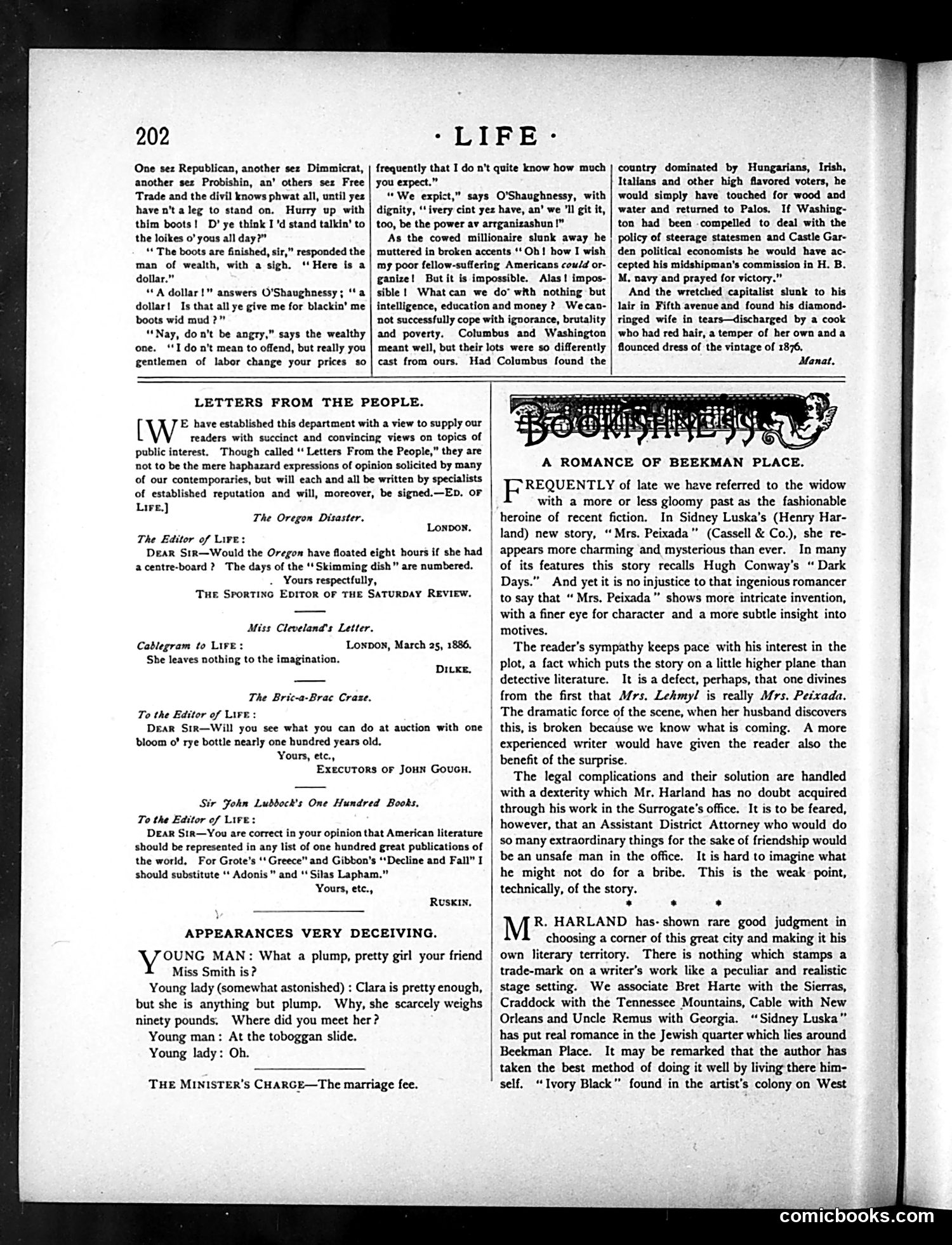
This page contains several sections: a dialogue joke titled "APPEARANCES VERY DECEIVING" about a young man meeting a girl at "the toboggran slide" who weighs ninety pounds, and "THE MINISTER'S CHARGE" (a brief joke about marriage fees). The main content is a literary review titled "A ROMANCE OF BEEKMAN PLACE," discussing Sidney Luska's new story "Mrs. Peixada." The reviewer praises the work's character development and romantic intrigue set in New York's Jewish quarter around Beekman Place, comparing it favorably to Hugh Conway's "Dark Days." The page also includes a "Letters from the People" section with reader correspondence on various topics. There are no political cartoons visible on this particular page—it's primarily satirical prose humor and literary criticism.
📄 Transcribed text from this page (OCR, searchable)
Machine-transcribed from the original scan — historical spelling and the odd misread are preserved.
202 One sez Republican, another sez Dimmicrat, another sez Probishin, an’ others sez Free Trade and the divil knows phwat all, until yez have n't aleg to stand on. Hurry up with thim boots! D’ ye think I ‘d stand talkin’ to the loikes o’ yous all day?” “« The boots are finished, sir,” responded the man of wealth, with a sigh. “Here is a dollar.” “A dollar!” answers O'Shaughnessy; ‘a dollar! Is that all ye give me for blackin’ me boots wid mud ?” - LIFE: frequently that I do n't quite know how much you expect.” “We expict,” says O'Shaughnessy, with dignity, ‘ivery cint yez have, an’ we 'll git it, too, be the power av arrganizashun !" ‘As the cowed millionaire slunk away he muttered in broken accents ‘‘Oh! how I wish my poor fellow-suffering Americans couéd or- ganize! But it is impossible. Alas! impos- sible! Whatcan we do’ with nothing but intelligence, education and money? Wecan- not successfully cope with ignorance, brutality country dominated by Hungarians, Irish, Italians and other high flavored voters, he would simply have touched for wood and water and returned to Palos. If Washing- ton had been compelled to deal with the policy of steerage statesmen and Castle Gar- den political economists he would have ac- cepted his midshipman’s commission in H. B. M. navy and prayed for victory.” And the wretched capitalist slunk to his lair in Fifth avenue and found his diamond- ringed wife in tears—discharged by a cook “Nay, don't be angry,” says the wealthy one. ‘I do n't mean to offend, but really you gentlemen of labor change your prices so and poverty. cast from ours. Columbus and Washington meant well, but their lots were so differently Had Columbus found the who had red hair, a temper of her own anda flounced dress of the vintage of 1876, LETTERS FROM THE PEOPLE. [ E have established this department with a view to supply our readers with succinct and convincing views on topics of public interest. Though called ‘* Letters From the People,” they are not to be the mere haphazard expressions of opinion solicited by many of our contemporaries, but will each and all be written by specialists of established reputation and will, moreover, be signed.—Ep. oF Lire.) The Oregon Disaster. Lonpow. The Editor of Live: Dear Str—Would the Oregon have floated eight hours if she had acentre-board ? The days of the ‘Skimming dish” are numbered. Yours respectfully, Tue Sportinc Epitor oF THE SATURDAY REVIEW. Miss Cleveland's Letter. Cablegram to LIFE: Lonpon, March 25, 1886, She leaves nothing to the imagination. Ditxe. The Bric-a-Brac Craze. To the Editor of Lire: DEAR StR—Will you see what you can do at auction with one bloom o° rye bottle nearly one hundred years old. Yours, ete., Executors oF Joun GoucH. Sir Fohn Lubbock’s One Hundred Books, To the Editor of Lire: DEAR S1n—You are correct in your opinion that American literature should be represented in any list of one hundred great publications of the world, For Grote’s ‘ Greece” and Gibbon's ‘Decline and Fall” I should substitute ‘* Adonis” and ‘Silas Lapham.” Yours, etc., Ruskin, APPEARANCES VERY DECEIVING. OUNG MAN: What a plump, pretty girl your friend Miss Smith is? Young lady (somewhat astonished) : Clara is pretty enough, but she is anything but plump. Why, she scarcely weighs ninety pounds, Where did you meet her? Young man: At the toboggan slide. Young lady: Oh. THE MINISTER'S CHARGE—The marriage fee. | detective literature. A ROMANCE OF BEEKMAN PLACE. REQUENTLY of late we have referred to the widow with a more or less gloomy past as the fashionable heroine of recent fiction. In Sidney Luska’s (Henry Har- land) new story, “Mrs. Peixada” (Cassell & Co.), she re- appears more charming and mysterious than ever. In many of its features this story recalls Hugh Conway's “ Dark Days.” And yet it is no injustice to that ingenious romancer to say that “ Mrs, Peixada” shows more intricate invention, with a finer eye for character and a more subtle insight into motives. The reader’s sympathy keeps pace with his interest in the plot, a fact which puts the story on a little higher plane than It is a defect, perhaps, that one divines from the first that Mfrs. Lehmyl is really Mrs. Petxada. | The dramatic force of the scene, when her husband discovers this, is broken because we know what is coming. A more experienced writer would have given the reader also the benefit of the surprise. The legal complications and their solution are handled with a dexterity which Mr. Harland has no doubt acquired through his work in the Surrogate’s office. It is to be feared, however, that an Assistant District Attorney who would do so many extraordinary things for the sake of friendship would be an unsafe man in the office. It is hard to imagine what he might not do for a bribe. This is the weak point, technically, of the story. . . * R. HARLAND has- shown rare good judgment in choosing a corner of this great city and making it his | own literary territory. There is nothing which stamps a | trade-mark on a writer’s work like a peculiar and realistic | stage setting. We associate Bret Harte with the Sierras, Craddock with the Tennessee Mountains, Cable with New Orleans and Uncle Remus with Georgia. “Sidney Luska” has put real romance in the Jewish quarter which lies around Beekman Place. It may be remarked that the author has taken the best method of doing it well by living there him- self. “Ivory Black” found in the artist’s colony on West comicbooks.com