
A complete issue · 16 pages · 1886
Life — January 28, 1886
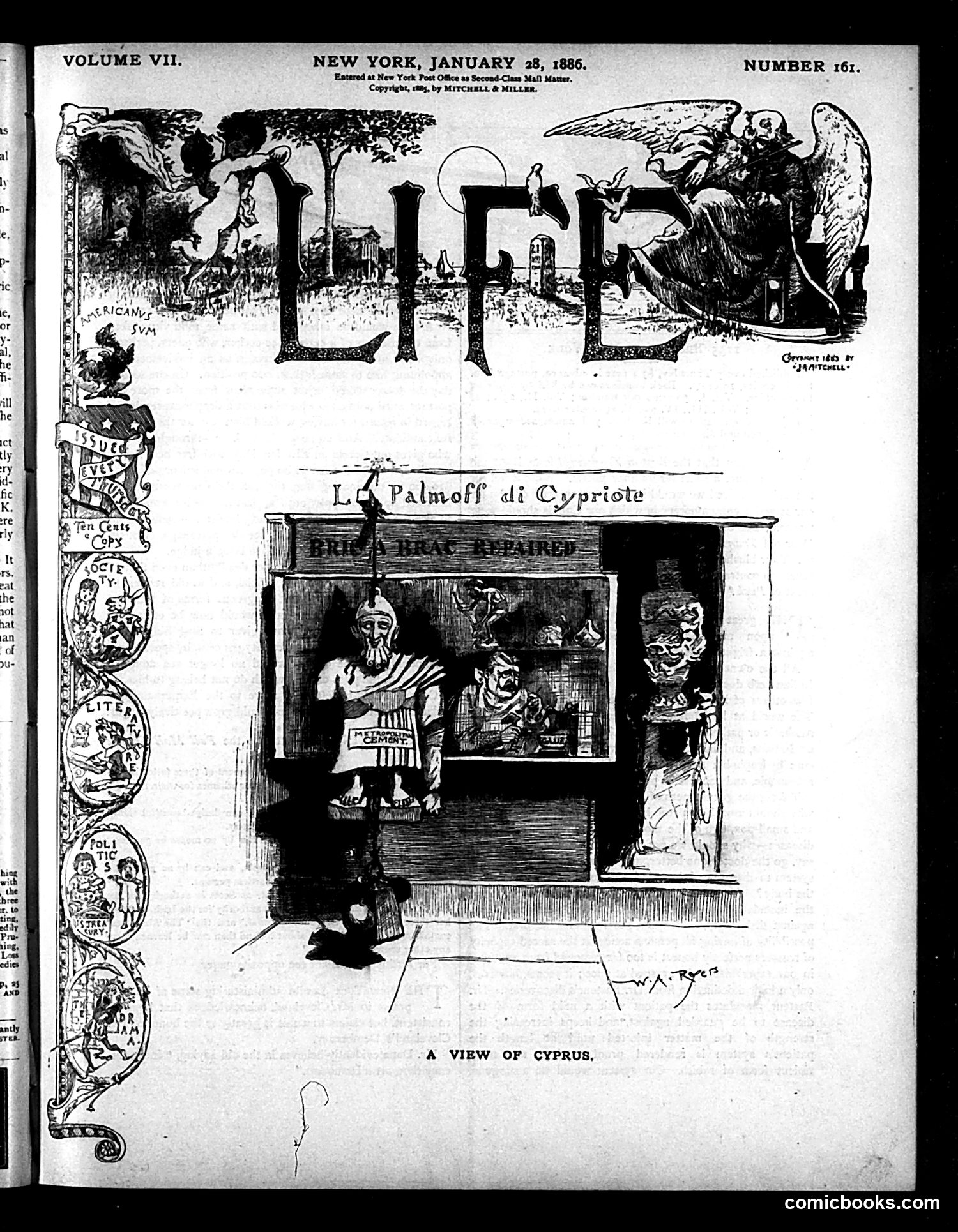
This page features two distinct illustrations. The top section shows "LIFE" magazine's masthead with decorative allegorical figures—art and angels surrounding a cityscape—typical Victorian ornamental design for the publication's title. Below appears "La Palmoff di Cypriote" ("The Palmoff of Cyprus"), depicting what seems to be a theatrical or political puppet show scene. A figure in classical dress (possibly representing Cyprus or a political authority) operates or displays smaller figures within a booth-like structure, while an observer stands outside watching. The subtitle reads "A View of Cyprus," suggesting this satirizes contemporary events related to Cyprus—likely Britain's 1878 occupation and administration of the island. The puppet-show imagery implies the political situation involves manipulation or theatrical governance rather than authentic sovereignty.
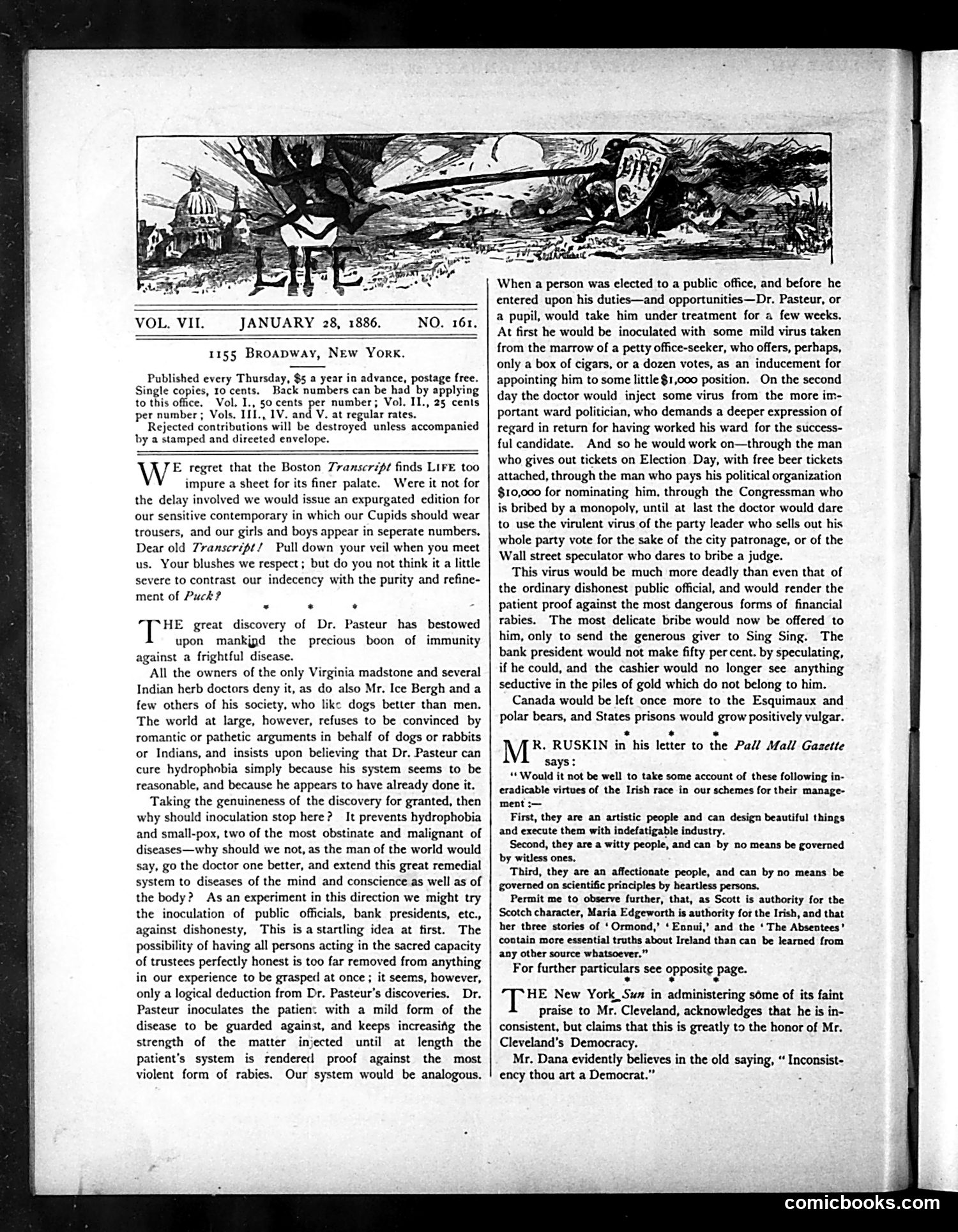
The header cartoon depicts a chaotic scene with a skeletal figure (likely representing disease or death) looming over a cityscape, while a classical building (possibly representing government or institutions) sits to the left. The accompanying editorial discusses Dr. Pasteur's recent discovery of inoculation against rabies. The writer satirizes the idea of using similar medical principles to "inoculate" public officials against corruption—injecting them with a mild form of political dishonesty so they develop immunity to bribes and patronage. The satire critiques widespread graft: politicians accepting bribes from office-seekers, Wall Street speculators, and monopolies in exchange for favors. The piece mockingly suggests this corruption is so endemic that officials should simply be vaccinated against it rather than reformed.
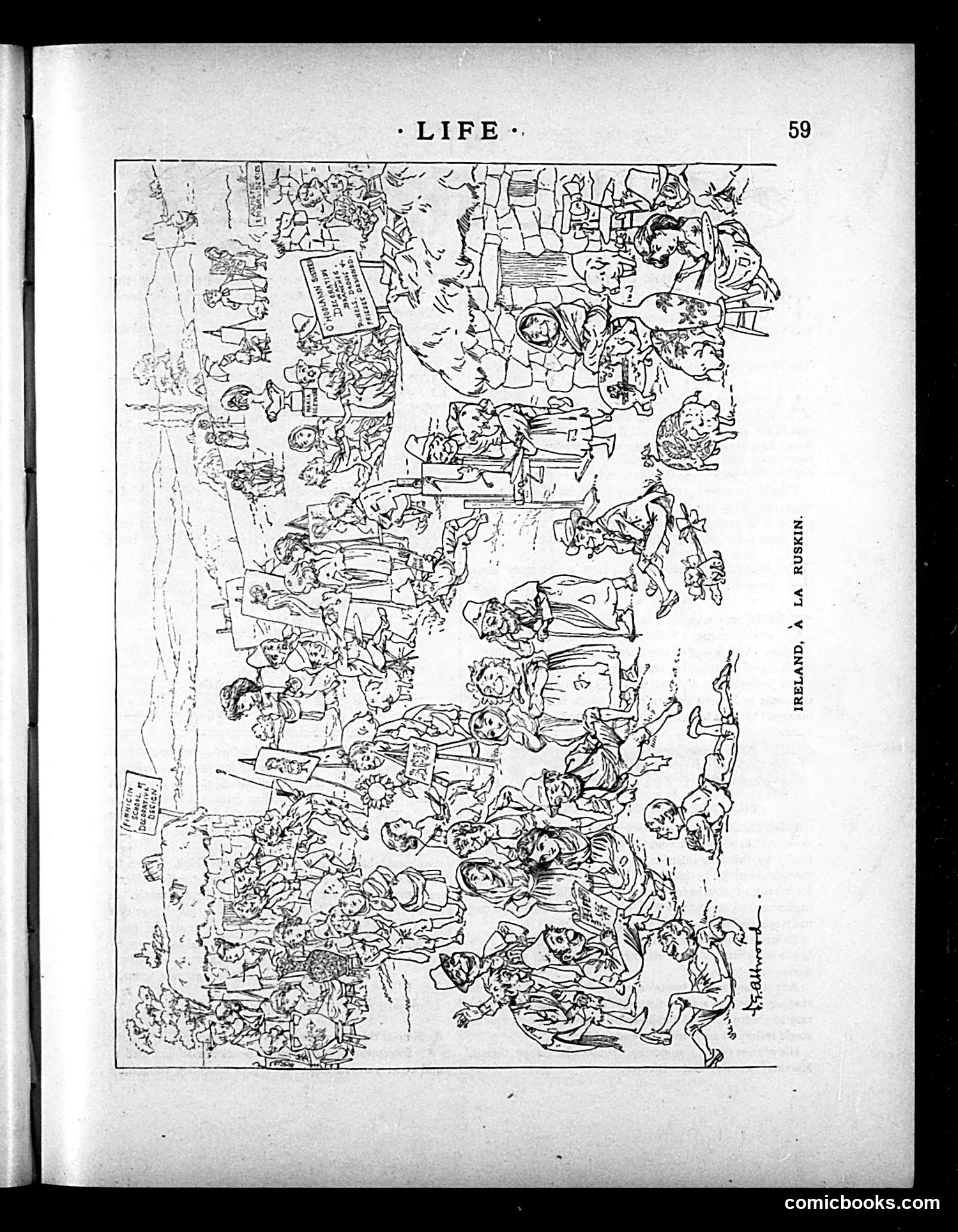
This political cartoon satirizes Irish society or politics, though the specific historical moment is unclear from the image alone. The title "Ireland à la Rubbish" suggests the cartoon depicts Ireland in a chaotic or degraded state. The densely packed illustration shows numerous figures in what appears to be a crowded, disorganized scene—possibly representing Irish political factions, social classes, or institutions in disarray. Without clearer identification of specific caricatured figures or dated references, I cannot definitively identify which political conflict or crisis this addresses. Given *Life* magazine's satirical nature, it likely critiques contemporary Irish governance or social conditions, but the exact subject requires additional context to interpret accurately.
The page contains satirical commentary on contemporary issues rather than a traditional political cartoon. **"By the Way" section:** Satirizes Senator Fassett's appointment as Port Warden, leaked through political channels. The satire mocks Republican colleagues' indignation at the news leak while noting they benefit from such arrangements—highlighting hypocrisy about political patronage. **"Bob Ingersoll" reference:** Suggests the Republican Party needs "a new conscience," using Ingersoll (a prominent freethinker) ironically to critique worn-out political morality. **"The Terrors of Matrimony":** The main satirical piece mocks a advice book ("How to be Happy, though Married"). It ridicules marriage advice reducing "conjugal felicity" to a mathematical formula (Gush + Mush), sarcastically suggesting unhappy bachelors would prefer divorce over such prescribed matrimonial misery. The satire targets both political corruption and Victorian marriage literature.
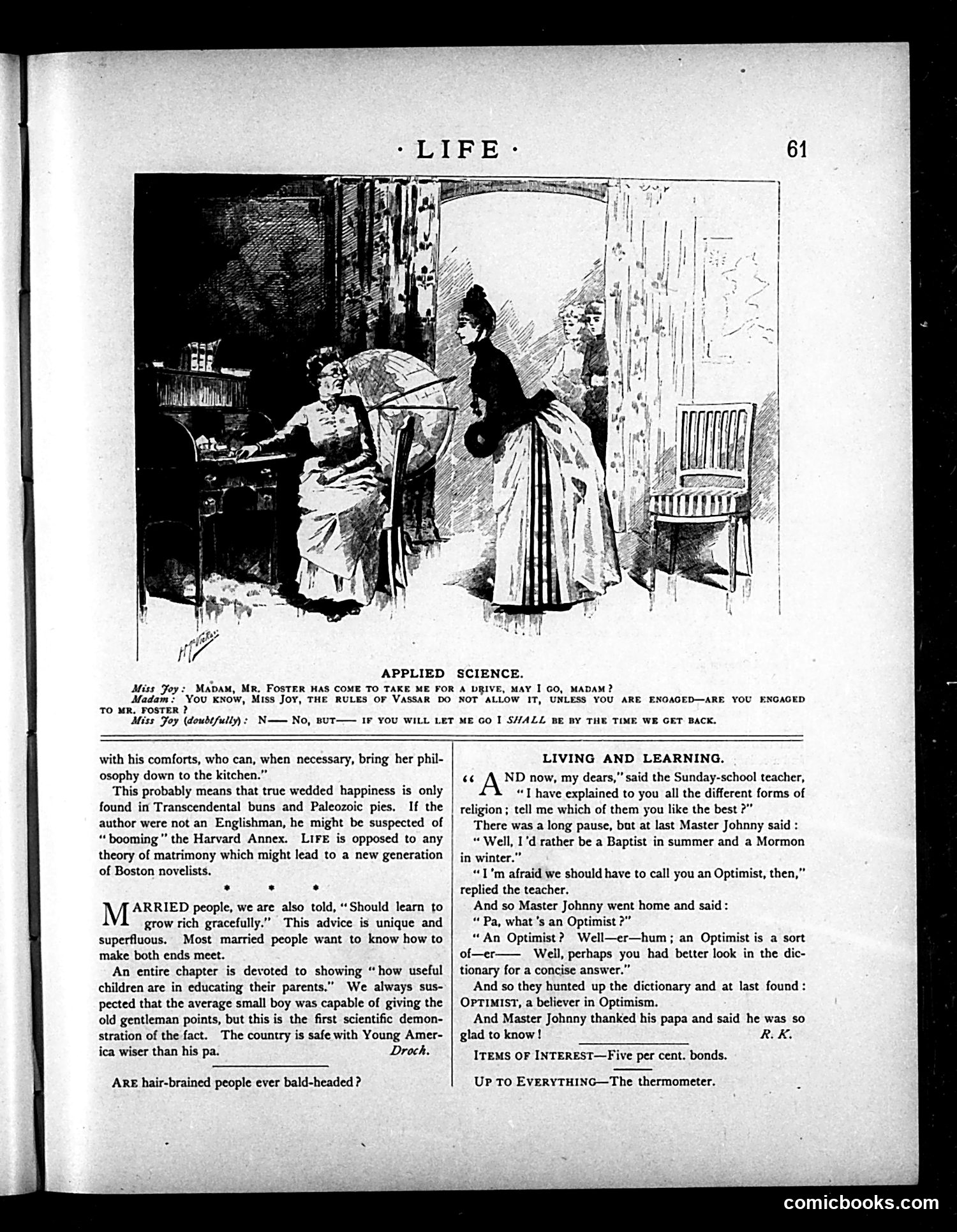
This cartoon satirizes Victorian-era dating rules and social conventions. It depicts a young woman ("Miss Joy") refusing a carriage ride from "Mr. Foster" unless they are engaged to be married. Her chaperone emphasizes that "the rules of Vassar do not allow it, unless you are engaged." The satire targets the rigid, nonsensical nature of upper-class courtship protocols—where a woman cannot spend time alone with a man without formal engagement, yet engagement itself requires prior courtship. The title "Applied Science" mockingly suggests these arbitrary social rules operate with scientific logic. The cartoon critiques how restrictive Victorian society made it nearly impossible for unmarried couples to genuinely know each other before commitment, illustrating the absurdity of rules enforced at prestigious women's institutions like Vassar College.
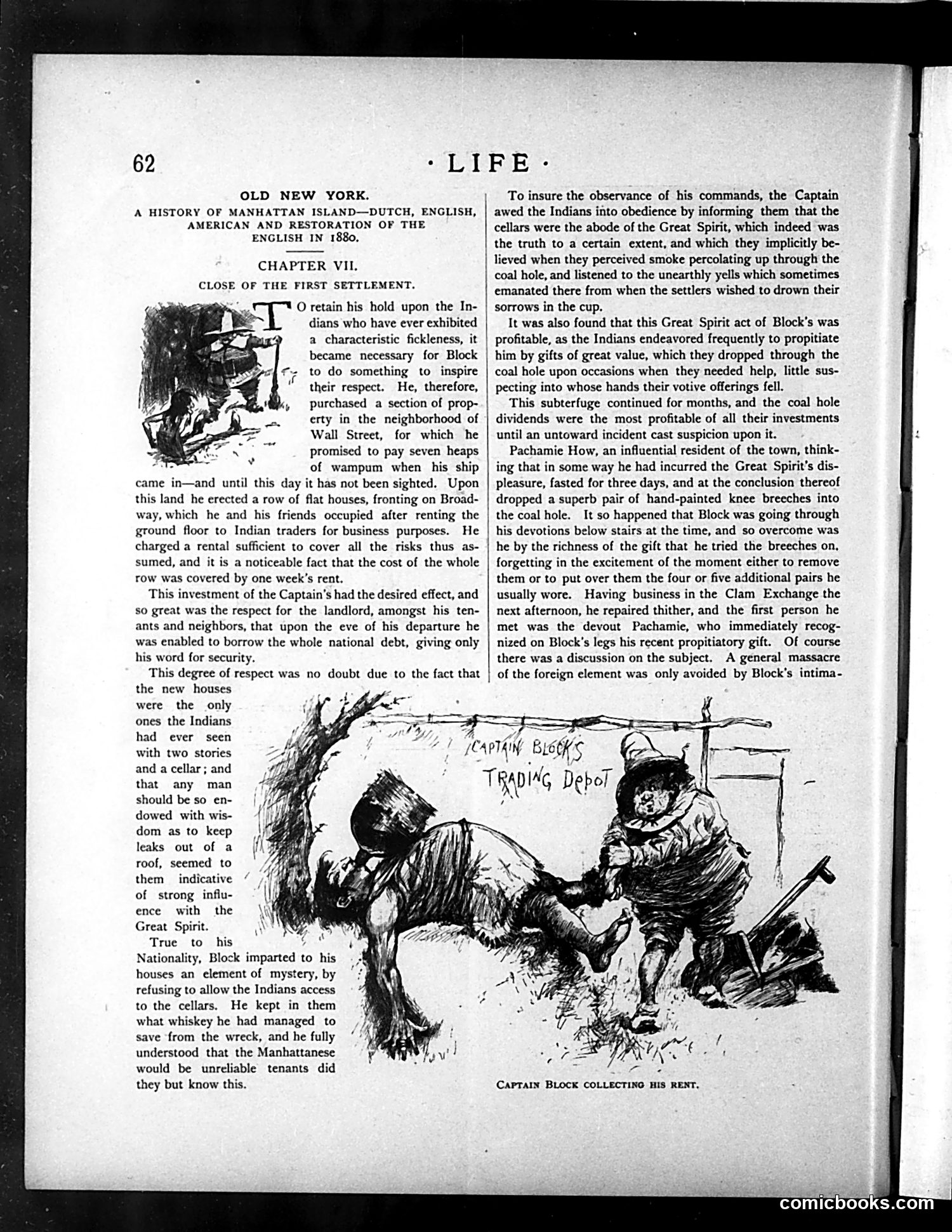
This illustration depicts **Captain Block collecting rent** from Native Americans at his trading post in early New Amsterdam (New York). The cartoon satirizes the colonial exploitation of indigenous peoples through commerce and deception. The text reveals Block's strategy: he kept Indians out of his cellar, stored liquor there, and promoted a "coal hole" as a spiritual site. Native Americans made "profitable" gifts to Block, believing they were communicating with the "Great Spirit." Block exploited this religious deception for financial gain. The satire critiques how early colonists used cultural misunderstandings and spiritual manipulation to extract wealth from Native Americans while establishing commercial dominance in the new settlement.
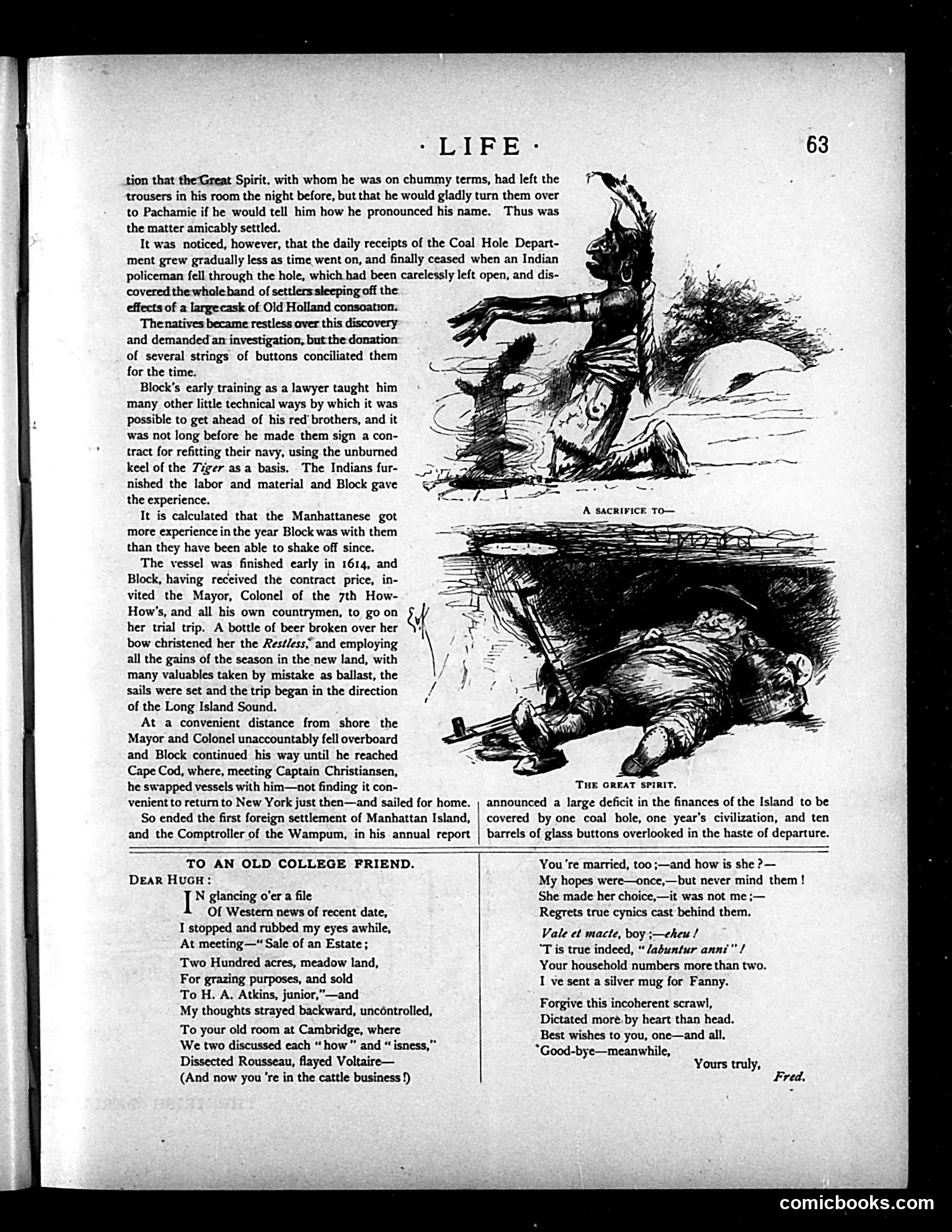
The page contains two distinct sections: historical narrative text about early Manhattan settlement and ship-building, accompanied by two ink illustrations labeled "A SACRIFICE TO—" and "THE GREAT SPIRIT." The illustrations appear to depict Native Americans in dramatic poses—one figure leaping or falling, another prostrate on the ground. These sketches likely satirize the violent displacement of Indigenous peoples during Manhattan's colonial development, which the text discusses. Below is a poem titled "TO AN OLD COLLEGE FRIEND" and a response letter signed "Fred," discussing marriage, property ("Two Hundred acres"), and rural life—typical genteel social commentary of the era. The cartoons' dark humor critiques the human cost of colonial expansion, contrasting the text's matter-of-fact historical account with visceral imagery of Indigenous suffering.
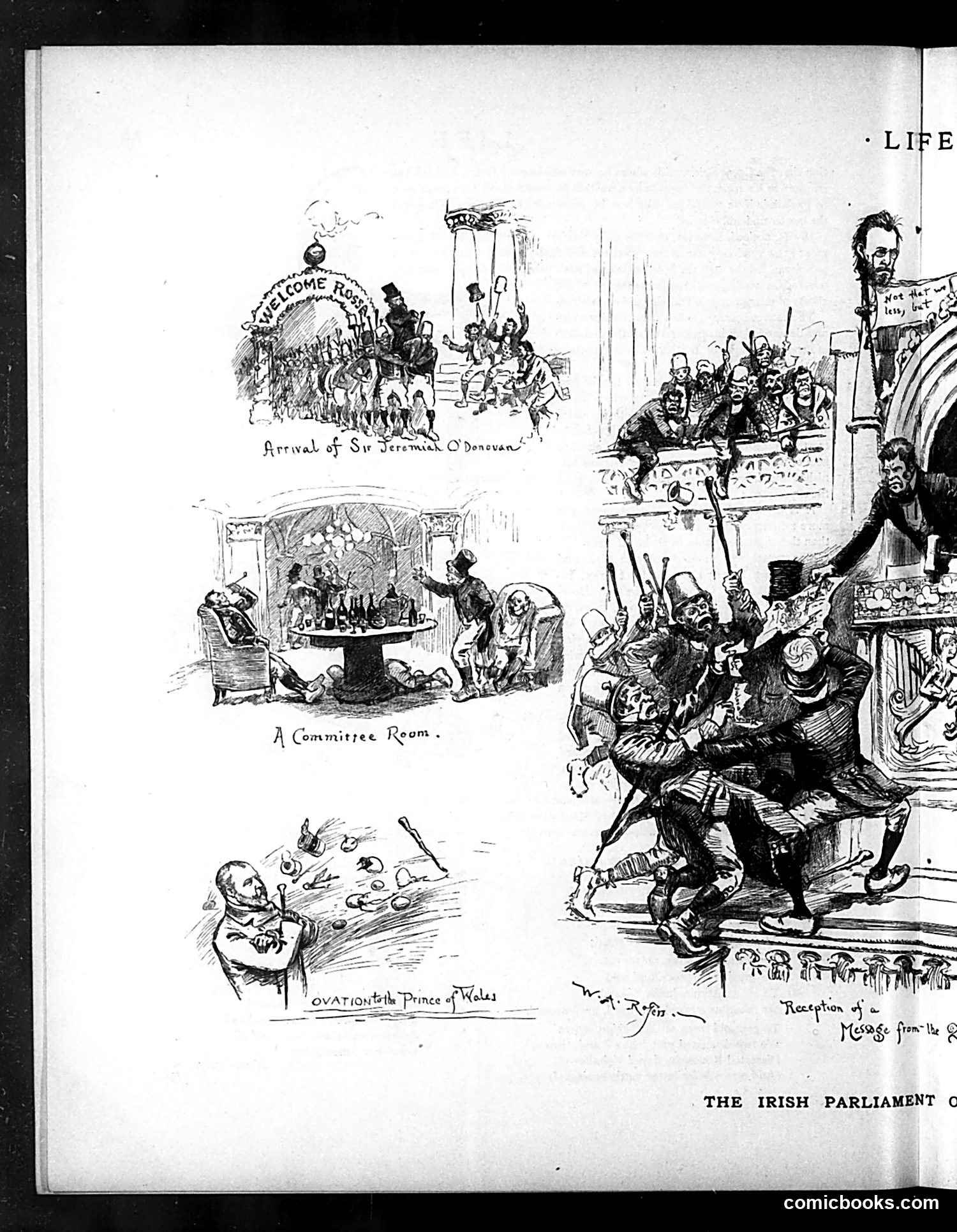
This page satirizes **Irish parliamentary politics**, likely from the late 19th or early 20th century. The four sketches mock various aspects of Irish political life: 1. **"Arrival of Sir Jeremiah O'Donovan"** - appears to satirize a notable Irish political figure's ceremonial reception 2. **"A Committee Room"** - shows politicians playing chess, likely mocking the strategic maneuvering of Irish parliamentary delegates 3. **"Ovation to the Prince of Wales"** - unclear reference, possibly satirizing obsequious reception of royalty 4. **"Reception of a Message from the Q[ueen]"** - depicts chaotic reaction to official communication, mocking Irish parliamentary disorder or dramatic responses to authority The cartoons employ caricature to present Irish politics as theatrical, disorganized, and overly dramatic. The page heading references "THE IRISH PARLIAMENT," confirming the satirical focus on Irish political institutions and personalities.
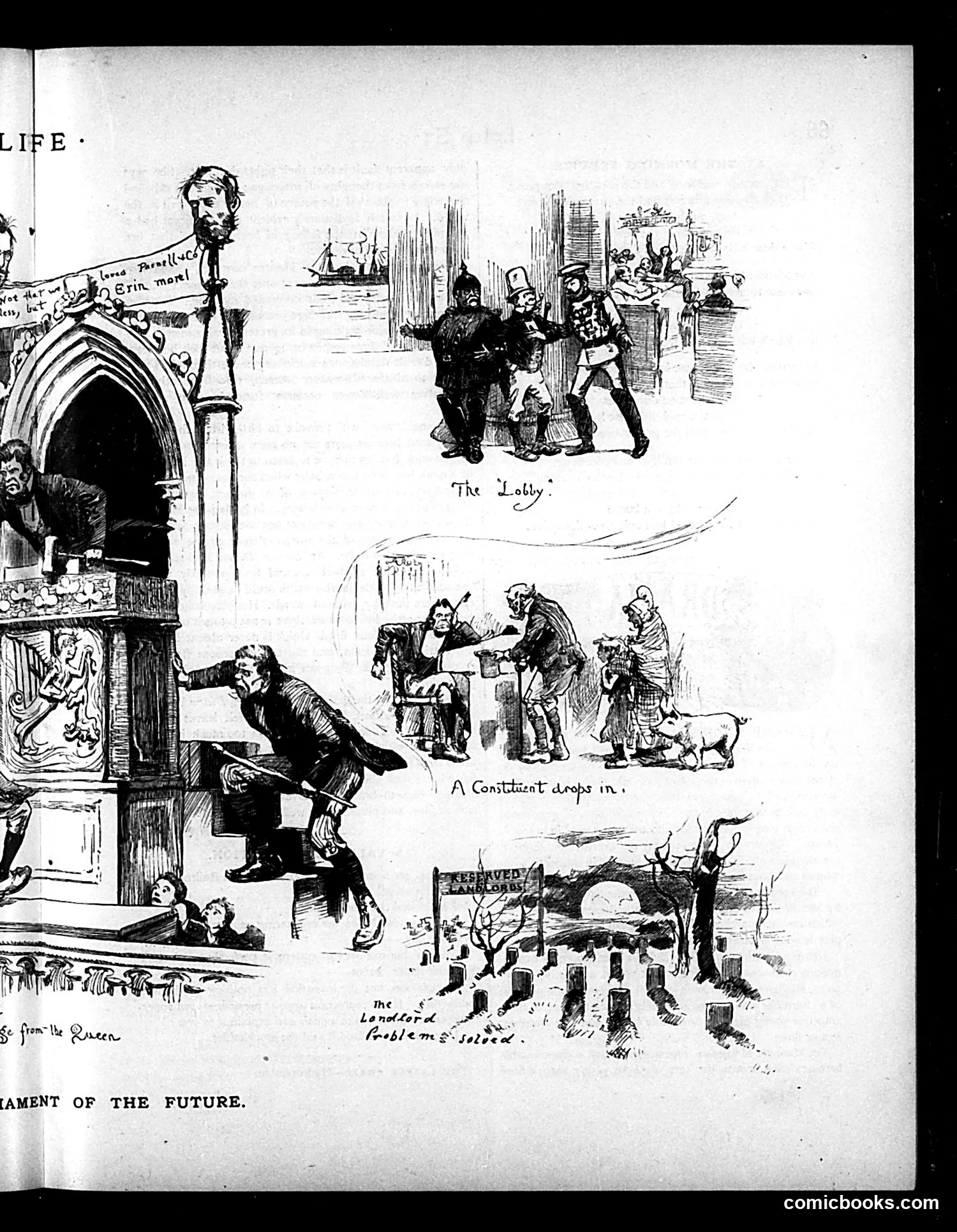
This page from *Life* magazine presents three satirical sketches titled "The Lobby," "A Constituent drops in," and "The landlord's problem solved." The cartoons appear to mock 19th-century political corruption and urban social problems. "The Lobby" depicts politicians in what looks like a government building entrance, likely satirizing backroom deals or lobbyists' influence. "A Constituent drops in" shows ordinary citizens attempting to access politicians, suggesting the difficulty regular people faced getting attention. The final panel, set in a cemetery marked "Reserved," appears to use dark humor about solving housing problems—possibly commenting on poverty, homelessness, or mortality among the poor. The overall message critiques political indifference to constituents' needs and urban social inequities.
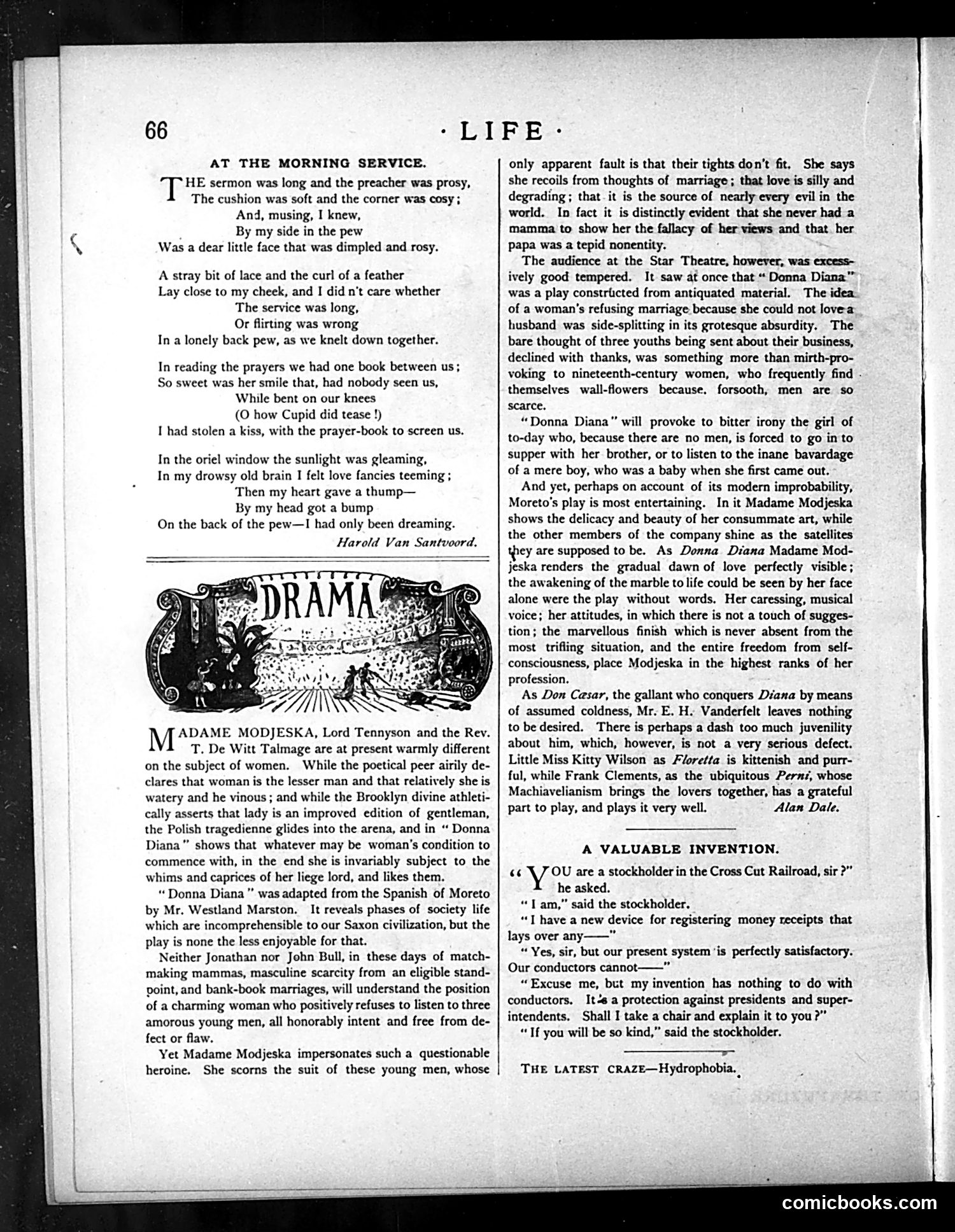
This page contains two distinct pieces of social satire: **"At the Morning Service"** is a humorous poem by Harold Van Santvoord about a man distracted during church by flirtation with an attractive young woman in the pew. The joke culminates when he dreams of stealing a kiss behind a prayer-book—only to bump his head on the pew, revealing it was all fantasy. The satire gently mocks romantic daydreaming and the tension between proper religious conduct and human desire. **The Drama section** reviews actress Madame Modjeska in "Donna Diana," a Spanish play where a woman refuses three suitors because she won't marry without love. The critic sarcastically notes this premise seems absurd to 1890s audiences: modern women would *welcome* marriage proposals since eligible men are scarce, yet here's a character rejecting multiple options. The satire targets both the outdated Spanish play and contemporary marriage-market desperation among women with limited romantic prospects. Both pieces mock human nature—male distraction and female romantic idealism—from a Victorian perspective.
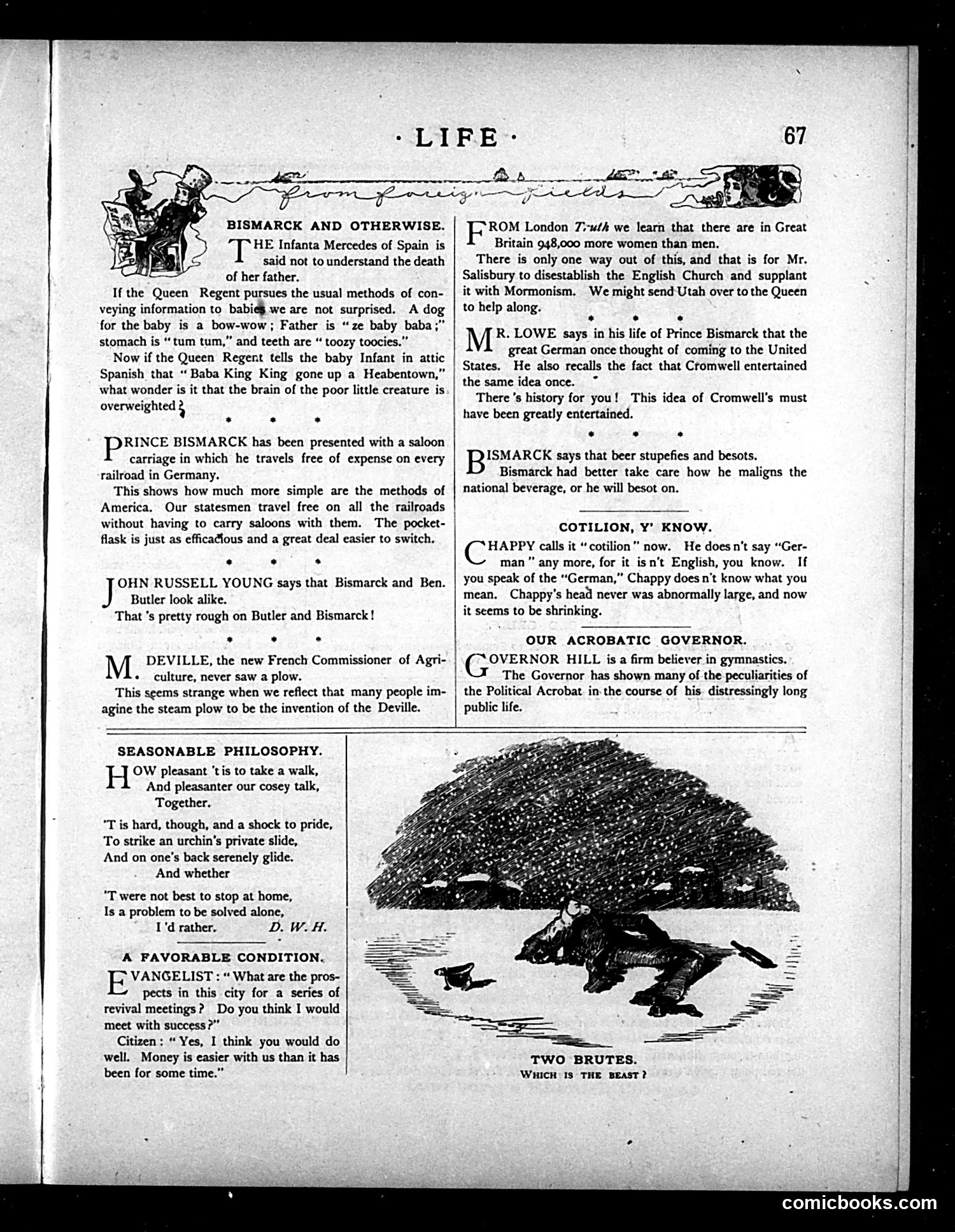
This page from *Life* magazine contains several brief satirical pieces mocking contemporary political figures and social trends: **"Bismarck and Otherwise"** opens with mockery of Spain's Infanta Mercedes, suggesting the Queen Regent speaks to her in infantilized language. The piece then jokes about Prince Bismarck receiving a luxury railroad carriage in Germany, contrasting it with American statesmen who simply carry pocket-flasks—a dig at American political corruption and drinking culture. Other quips target: John Russell Young's comparison of Bismarck to General Ben Butler (unflattering to both); French Agriculture Commissioner Deville (who allegedly never saw a plow); and proposals to send Mormon Utah to help Britain's surplus female population. **"Two Brutes"** is a political cartoon juxtaposing an elephant (likely representing the Republican Party or a political figure) with a turtle, asking "Which is the Beast?"—likely commentary on animal behavior versus political conduct. The remaining pieces satirize changing speech patterns ("cotilion" instead of "German"), Governor Hill's gymnastics obsession, and revival meetings tied to economic conditions. The humor targets politicians, social pretension, and hypocrisy.
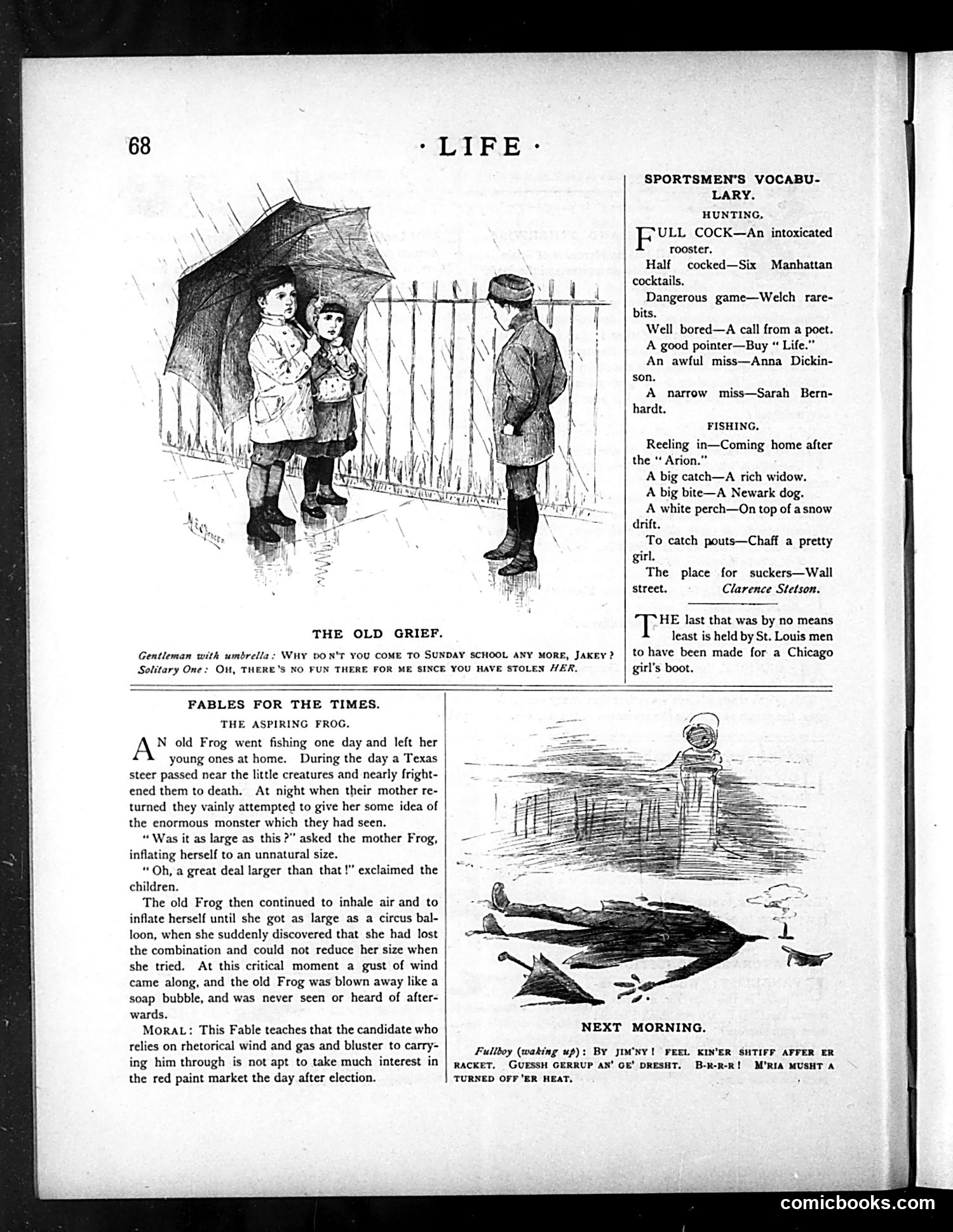
**"The Old Grief"** depicts a gentleman confronting a boy named Jakey outside a church. The boy admits he's stopped attending Sunday school because "there's no fun there for me since you have stolen her"—suggesting the gentleman has either married or courted away Jakey's romantic interest, leaving the boy heartbroken and unable to enjoy wholesome activities. The page also includes **"The Aspiring Frog,"** a political fable mocking candidates who rely on bombastic rhetoric ("wind and gas and bluster") to win elections, then lose interest in actual governance once elected. The moral satirizes politicians' empty campaign promises. The **"Sportsmen's Vocabulary"** is wordplay humor—mock definitions where hunting and fishing terms have social commentary (e.g., "An awful miss—Anna Dickinson"; "The place for suckers—Wall street"). All three pieces target human vanity, broken promises, and romantic disappointment with gentle satirical humor typical of Life magazine's approach.
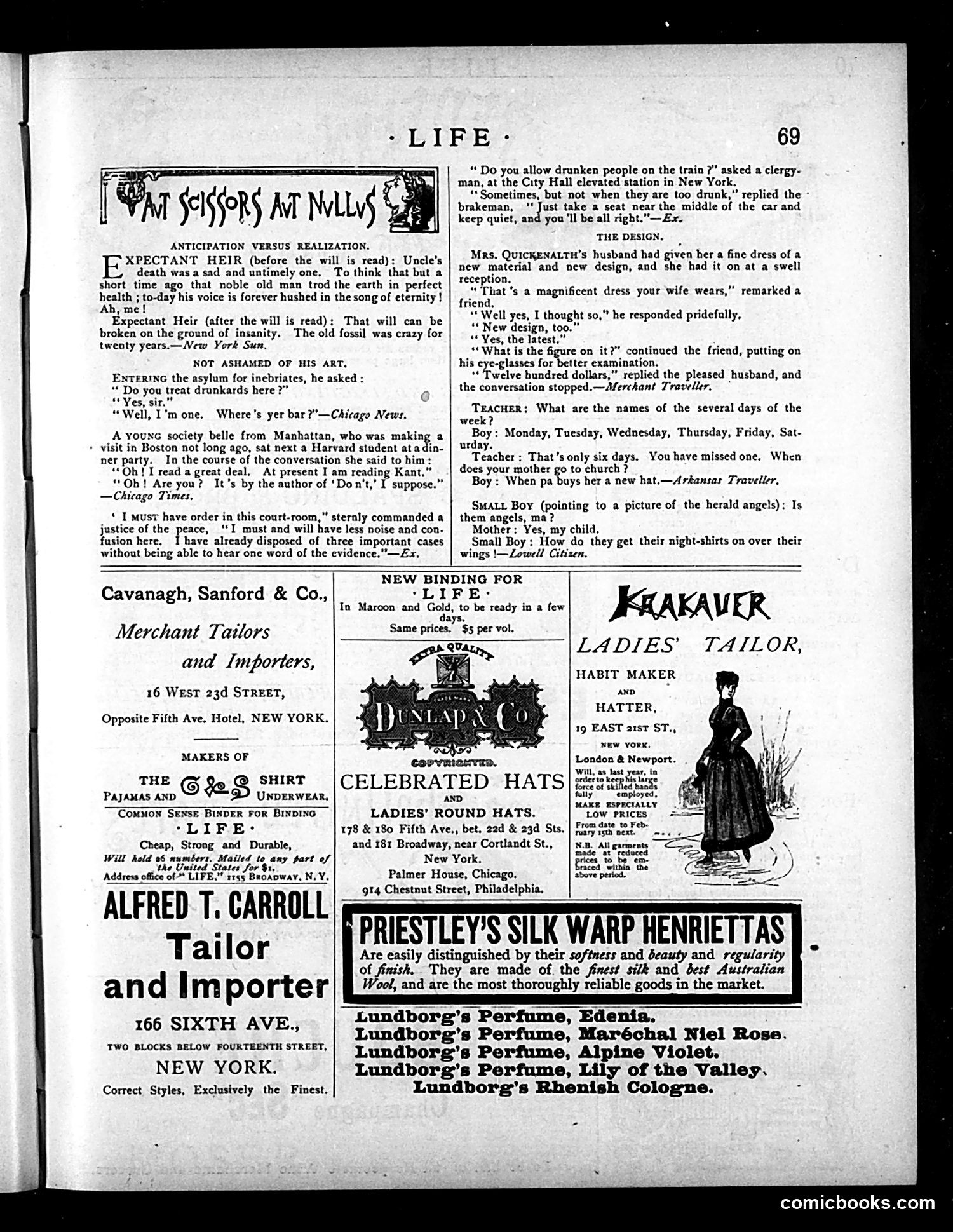
This page contains six brief satirical jokes typical of *Life* magazine's humor style, plus period advertisements. The cartoons mock human hypocrisy and absurdity: an heir's false grief transforms to greed upon reading a will; a drunk entering a treatment facility immediately asks for a bar; a Harvard student mistakes "Kant" (the philosopher) for a book title; a judge can't hear testimony due to courtroom noise; a clergyman is advised to sit near a drunk on a train; and a husband reveals his wife's dress costs $1,200—an astronomical sum for the era. Child humor includes a boy claiming his mother goes to church when buying new hats, and another asking how angels don don nightshirts over wings. The remainder is advertising for tailors, hat makers, perfumes, and magazine bindings—typical commerce of the period. No political satire is present; the humor targets universal human follies and class-based absurdities accessible to *Life's* educated audience.
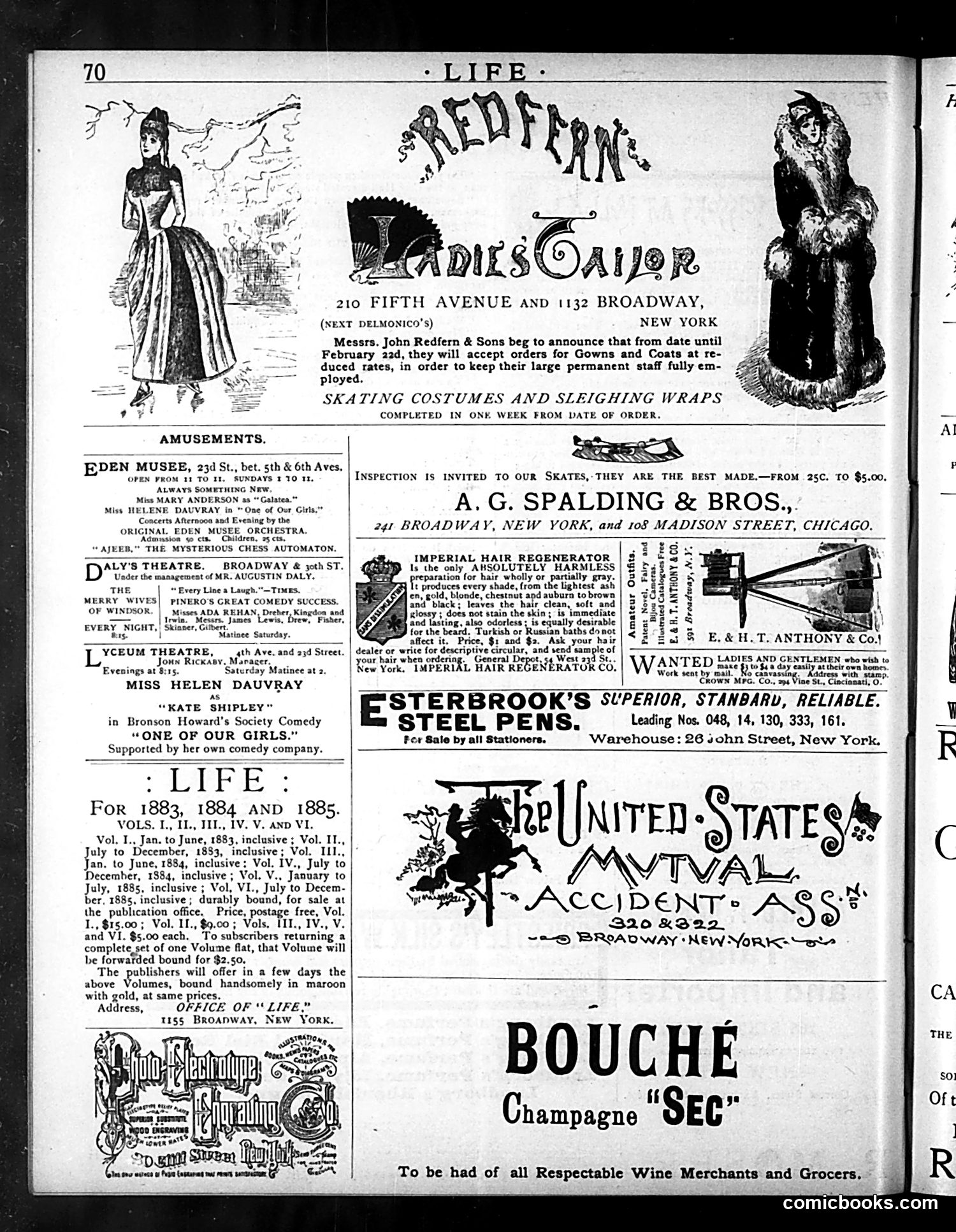
This page is primarily **advertising**, not satirical editorial content. It's from Life magazine's advertising section (page 70). The main advertisements feature: 1. **Redfern Ladies' Tailor** (top)—a high-end dressmaker offering reduced rates on gowns, coats, skating costumes, and sleighing wraps, employing the seasonal sales pitch of keeping staff busy until February 22nd. 2. **Theater listings** for popular Broadway productions and museums (Eden Musee, Daly's Theatre, Lyceum Theatre). 3. **Sporting goods** (A.G. Spalding ice skates) and **patent medicines** (Imperial Hair Regenerator for gray hair). 4. **Back issues of Life magazine** itself, sold bound in volumes. 5. **Luxury goods**: Bouché Champagne, Sterbrook steel pens, and E. & H. Anthony cameras. The "Red Fern Ladies' Tailor" illustration shows fashionable women's clothing typical of the 1880s. There is no political satire visible here—this is a straightforward commercial page reflecting upper-class consumer culture of the era.
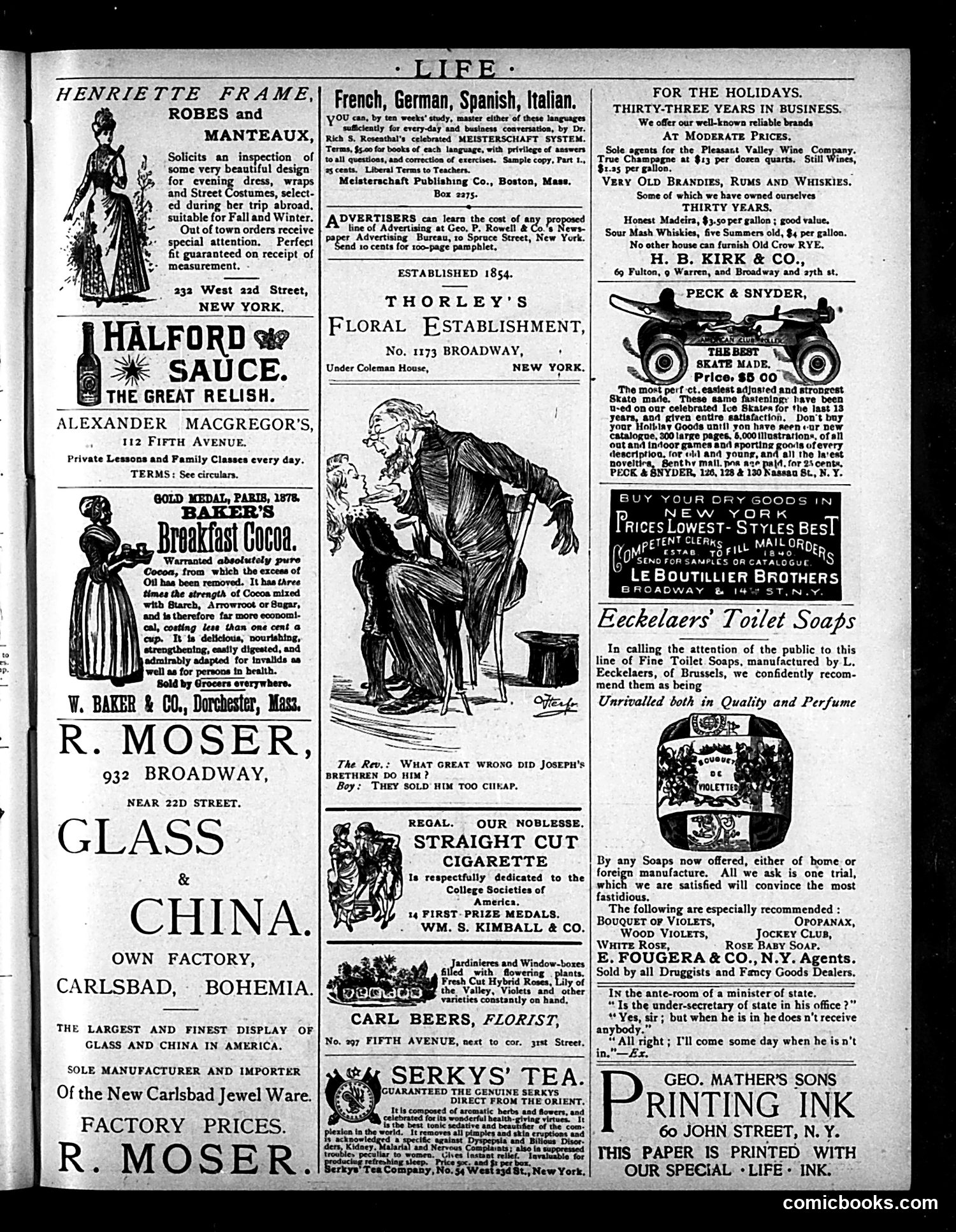
This page is **primarily advertisements** with one small cartoon joke, typical of 1870s-80s Life magazine format. **The Cartoon:** The only significant illustration is a small sketch showing a Rev (reverend/clergyman) asking a young boy: "What great wrong did Joseph's brethren do him?" The boy replies: "They sold him too cheap." **The Satire:** This is a sardonic religious joke. It references the Biblical story of Joseph, sold into slavery by his brothers. Rather than condemning the *act* of betrayal, the joke crudely suggests the only "wrong" was the poor *price*—implying the brothers were bad businessmen, not bad brothers. It's cynical humor suggesting that in the commercial age, profit matters more than morality. **The Advertisements:** The page features typical 1880s luxury goods: imported wines, cocoa, German language instruction, glass and china from Bohemia, florists, and roller skates. This reflects the magazine's audience: affluent urban Americans interested in European refinement and holiday shopping.
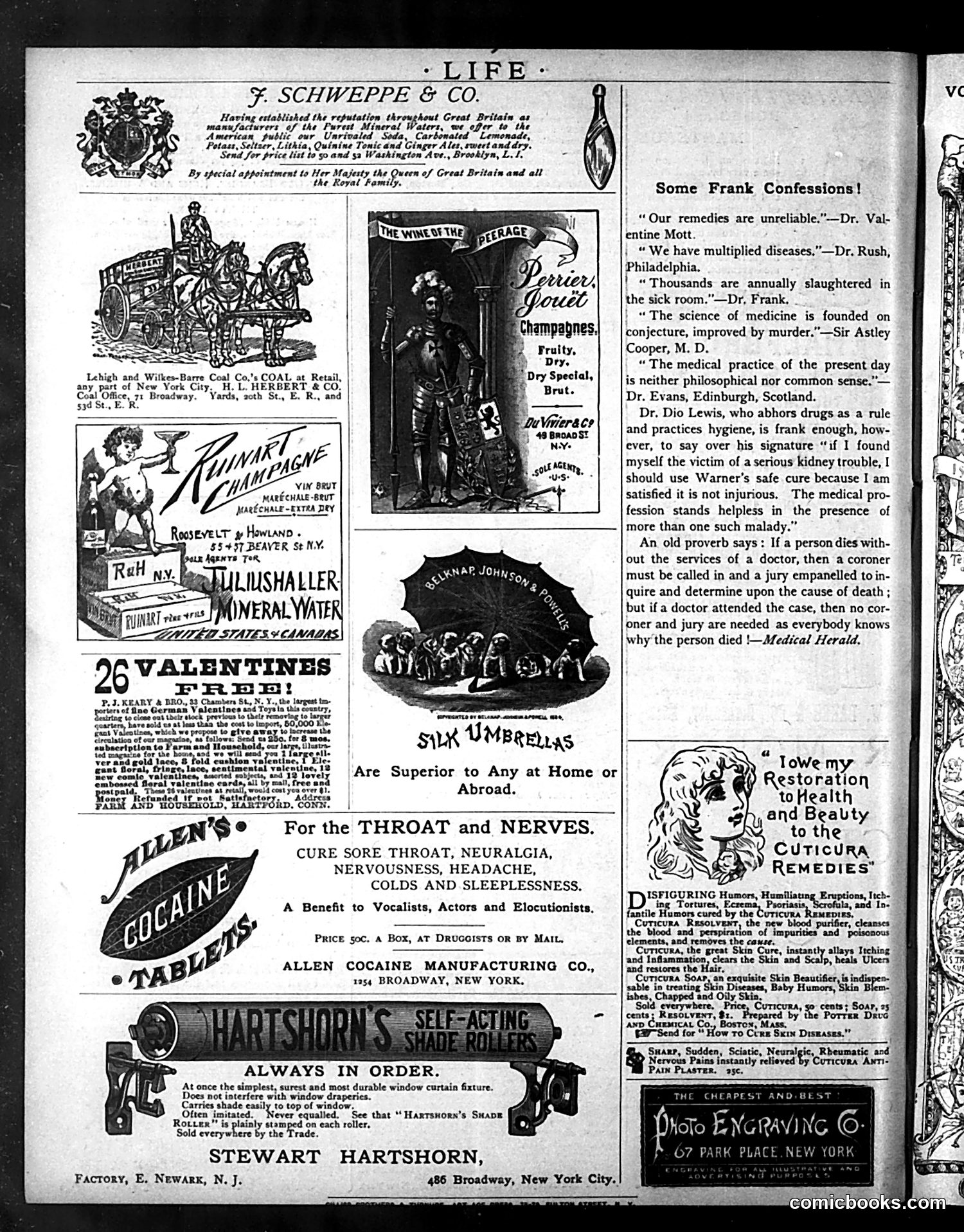
This page is primarily **advertisements**, but includes one notable satirical section: "Some Frank Confessions!" ## The Satire The "Confessions" column mocks the medical establishment by presenting critical quotes allegedly from prominent 19th-century doctors (Valentine Mott, Dr. Rush, Sir Astley Cooper, etc.). These physicians supposedly admit that medical remedies are unreliable, doctors create diseases, and patients die whether doctors treat them or not. The final proverb sardonically suggests doctors somehow prevent autopsies from occurring—implying they escape accountability for poor outcomes. **The joke's target**: The medical profession's ineffectiveness and hubris. Life magazine uses fake "admissions" to undermine doctor credibility. **The irony**: The page is surrounded by patent medicine ads (cocaine tablets, mineral waters, "safe cure" tonics) also claiming to heal various ailments—suggesting these unproven remedies are just as dubious as mainstream medicine's claims. This reflects genuine 19th-century skepticism about both conventional medicine and the booming patent medicine industry, both largely ineffective by modern standards.